This is Hamamoto from TIMEWELL Inc.
The Scale of What Musk Is Predicting
The AI debate has moved beyond whether the technology matters. The question now is how fast the transformation comes, and whether we are prepared for it. Elon Musk — speaking at the All-In Summit — offered a timeline that most people still aren't taking seriously enough.
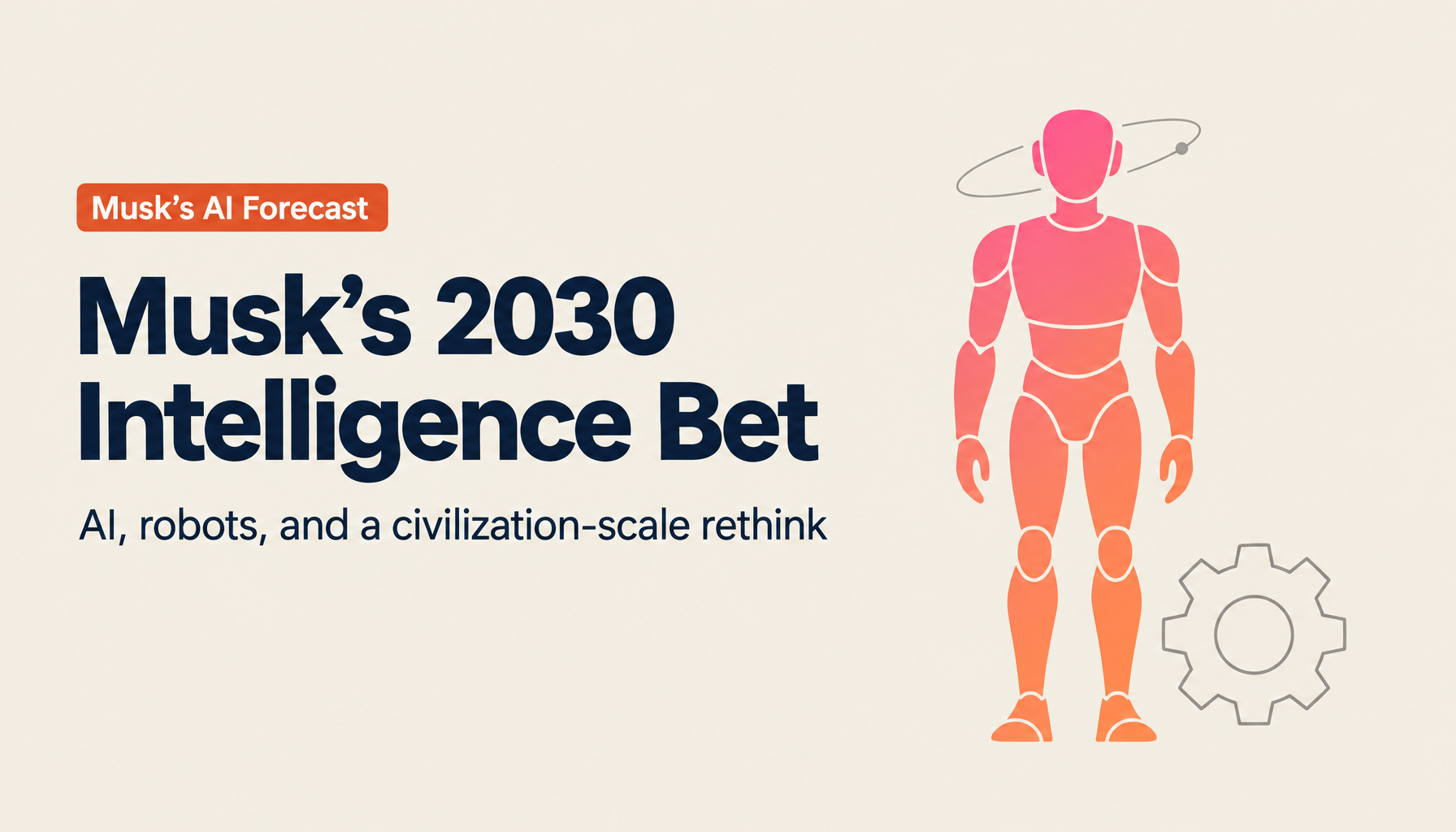
His claim: AI surpasses the intelligence of a single human by 2026. By 2030, AI may collectively exceed the combined intelligence of all humanity.
This article covers what Musk said, what's behind it, and what it means for businesses and individuals thinking about the decade ahead.
Looking for AI training and consulting?
Learn about WARP training programs and consulting services in our materials.
The Intelligence Explosion: What Musk Is Betting On
Musk describes the current moment as the beginning of an "intelligence Big Bang." The rate of AI capability improvement — not just in narrow tasks but in generalized reasoning — has broken the pattern that applied to previous technological shifts. What was taking years now takes months. What took months takes weeks.
The specific bet behind this prediction is xAI and its Grok language model. Grok's distinguishing feature is real-time information access — through integration with X (formerly Twitter), the model can process what is happening in the world right now, rather than relying on a fixed training cutoff. Musk has described the upcoming Grok 5 as "crushingly good" and has positioned it as a meaningful step toward AGI (Artificial General Intelligence).
Musk's concern is not just enthusiasm for AI capability. He has also been the most prominent voice warning that AI development could go wrong — his "summoning a demon" analogy remains one of the most-cited framings of the risk. His specific fear: AI that influences not just rational thought but human emotion — systems capable of manipulating the limbic system, bypassing logical reasoning entirely. The democratic and social implications of that scenario are significant.
xAI's 2025 acquisition of X Corp. for $33 billion should be read in this context. It's a move to influence how AI intersects with information flow — giving xAI direct control over a major platform at a time when AI-generated content and AI-assisted narrative are already reshaping public discourse.
One counterintuitive prediction Musk offered: AI may actually increase birth rates. His logic — AI takes on childcare and household labor burden, freeing time for family. Combined with AI-driven economic growth, the cost of raising children decreases. Whether this plays out is speculative, but the reasoning illustrates how Musk connects technological development to social outcomes that most analysts don't anticipate.
Tesla Optimus: The "Most Important Product in Human History"
Musk has called Optimus — Tesla's humanoid robot — the most important product in human history. That's a large claim, but the reasoning behind it is straightforward: a general-purpose robot that can do any physical task humans can do would transform the economics of production across every industry.
Optimus V2.5 demonstration footage shows: picking up eggs without breaking them, folding clothes, performing yoga poses. These aren't just party tricks — they demonstrate the level of dexterity and environmental awareness required for real-world deployment.
The underlying technology draws on everything Tesla has built for electric vehicles: AI systems, sensors, and actuators (drive components). The actuators — designed to mimic the human musculoskeletal system — give Optimus smooth, powerful movement that earlier generations of industrial robots couldn't approach.
Current status: Optimus units are already performing tasks autonomously on Tesla's Fremont factory floor. Musk's targets: thousands of units in factory operations by end of 2025; limited consumer production beginning in the same timeframe.
The economic projection: Musk believes Optimus will eventually account for the majority of Tesla's long-term value — with an estimated potential of $25 trillion. The use cases span factory assembly, household services, elder care, disaster response. Price target: cheaper than a car.
If that happens, the concept of labor as the basis for income becomes structurally unstable. Universal Basic Income moves from an academic concept to an operational necessity. The economy doesn't collapse — but it reorganizes around different principles.
SpaceX and Mars: AI as the Infrastructure of Civilization
Musk's case for Mars colonization isn't about exploration. It's about planetary redundancy — ensuring that a single extinction event (asteroid impact, volcanic eruption, nuclear war, pandemic) cannot eliminate humanity entirely.
Starship — 120 meters long, fully reusable — is the delivery mechanism. AI governs flight control, real-time sensor processing, and autonomous landing. Musk expects Version 3 to carry 100+ tonnes to low Earth orbit in a single launch.
His 30-year target for Mars: a self-sustaining city that can survive without Earth resupply. That requires not just sending people and materials, but replicating the industrial base — including chip fabrication. Optimus robots handling initial construction, resource extraction, agriculture, and life support infrastructure would be essential in an environment where human exposure to the surface is limited.
The AI through-line: without autonomous systems capable of operating in harsh environments without constant human oversight, the economics and logistics of Mars settlement don't work.
What This Means for Businesses and Individuals
The Musk framework — whether you accept every specific prediction or not — identifies several dynamics that are clearly directional:
For manufacturing: Humanoid robots will compress unit costs across physical production. The question for manufacturing organizations isn't whether to engage with this — it's when and how.
For Japan specifically: Japan's demographic crisis (projected one-third of the workforce over 65 by 2030) makes robotics not optional but necessary for infrastructure maintenance. Japan's precision manufacturing expertise in actuators, materials, and quality systems positions it well for the Optimus-era supply chain — if that expertise is mobilized strategically.
For education: The skills with the longest shelf lives in an AI-rich environment are the ones AI can't replicate well: creative judgment, ethical reasoning, empathy, context sensitivity. STEM provides the foundation for working with AI systems. But human-specific capabilities become more valuable as AI handles computation and analysis.
For social policy: If AI and robotics absorb a growing share of physical and cognitive labor, income distribution mechanisms have to evolve. UBI pilot programs (Finland, Kenya) have shown that guaranteed income doesn't reduce work motivation — it redirects it toward higher-value activities. That data will become more relevant as automation scales.
Summary
Musk's All-In Summit remarks describe a timeline that is already in motion:
- AI intelligence: Surpasses individual human intelligence by 2026; potentially all of humanity combined by 2030
- xAI / Grok 5: Positioned as a major step toward AGI; real-time information access as key differentiator
- Optimus: $25T potential; factory deployment underway; household deployment on the horizon; price target below a car
- Mars: 30-year self-sustaining city target; Starship + Optimus + AI as the enabling stack
- Social implications: Labor market reorganization; UBI from theory to operational necessity; education shift toward human-specific capabilities
The businesses and individuals who treat these projections as distant speculation are likely to be less prepared than those who begin adjusting strategy now. The timeline may be faster than expected — or slower — but the direction is not seriously in dispute.