Hello, this is Ryuta Hamamoto from TIMEWELL.
This is for export control teams at companies with subsidiaries or plants in the EU, and for procurement teams that buy semiconductor equipment, materials or components from EU suppliers.
In short, the EU's list of items that need an export licence was replaced with a new version on November 20. New entries include semiconductor manufacturing tools, a wider net for advanced computing chips, and high-temperature ceramic materials.
Why now? The Commission adopted the update on September 14, and after the scrutiny period for the Council and the European Parliament it was published in the Official Journal on November 1912. We missed the publication in the previous week's check and caught it on November 30. Since it is already in force, it is worth checking classifications at EU sites soon.
Background reading. For how EU export controls work, see our guide to the EU Dual-Use Regulation. The previous update is covered in our article on the EU 500 series.
Key points
- Annex I of Regulation (EU) 2021/821, the EU control list, was replaced in full by Delegated Regulation (EU) 2026/2288 and has applied since November 20, 2026
- The update reflects 2025 decisions in the international regimes (the Wassenaar Arrangement, the Australia Group and the Nuclear Suppliers Group) and additional controls that member states accepted as Wassenaar participants
- New entries include semiconductor manufacturing equipment (3B501), a wider scope for advanced computing ICs (3A501.a.16), inductive encoders (3A501.f), ceramic matrix composites (1C507) and CVD equipment for silicon carbide fibres (1B501)
- The 500 series grew from 16 to 21 entries. Classifications at EU sites and suppliers should be rechecked against the new Annex I
A few terms used below:
| Term | Plain meaning |
|---|---|
| Annex I | The list attached to the EU Dual-Use Regulation of items that need an export licence. All member states use the same list |
| Delegated regulation | A Commission regulation used to amend technical annexes. Annex I is updated this way every year |
| 500 series | Entries whose third digit is 5, such as 3B501. The previous update (2025/2003) had 16 of them; five more were added this time |
| TPP (Total Processing Performance) | A measure of an IC's computing power, based on the number of operations and the bit length of the data handled |
 Figure 1. The update at a glance: in force November 20, 21 entries in the 500 series, five of them new. Source: TIMEWELL, based on Commission Delegated Regulation (EU) 2026/2288 (Official Journal, November 19, 2026)
What the regulation does
EU export controls rest on the Dual-Use Regulation, Regulation (EU) 2021/821. Annex I lists the items that need a licence, and every member state uses the same list. The list is amended at least once a year by delegated act, based on decisions in the international regimes2.
Delegated Regulation (EU) 2026/2288 was adopted by the Commission on September 14, 2026 and published in the Official Journal on November 19. It has two articles. Article 1 replaces Annex I with the text annexed to the regulation, and Article 2 says it enters into force on the day after publication1. The new Annex I has therefore applied since November 20. The recitals explain that the quick entry into force is meant to ensure full compliance with international security obligations as soon as possible.
The recitals give two reasons for the changes. First, the control lists of the international non-proliferation regimes and export control arrangements in which member states take part, such as the Wassenaar Arrangement, changed during 2025. Second, member states informed the Commission on April 15, 2026 that they had all accepted, also as members of the Wassenaar Arrangement, further commitments to control additional items1. The Commission's announcement makes the same two points2.
By number, the 500 series grew from 16 entries in the previous update (2025/2003) to 21. The new ones are 1B501, 1B504, 1C507, 5E501 and 9E503. Checking the earlier text, none of these five numbers appears in the Annex I of 2025/20033. Not every new item has a new number, though. New sub-items were also added inside existing entries such as 3B501 and 3A501.
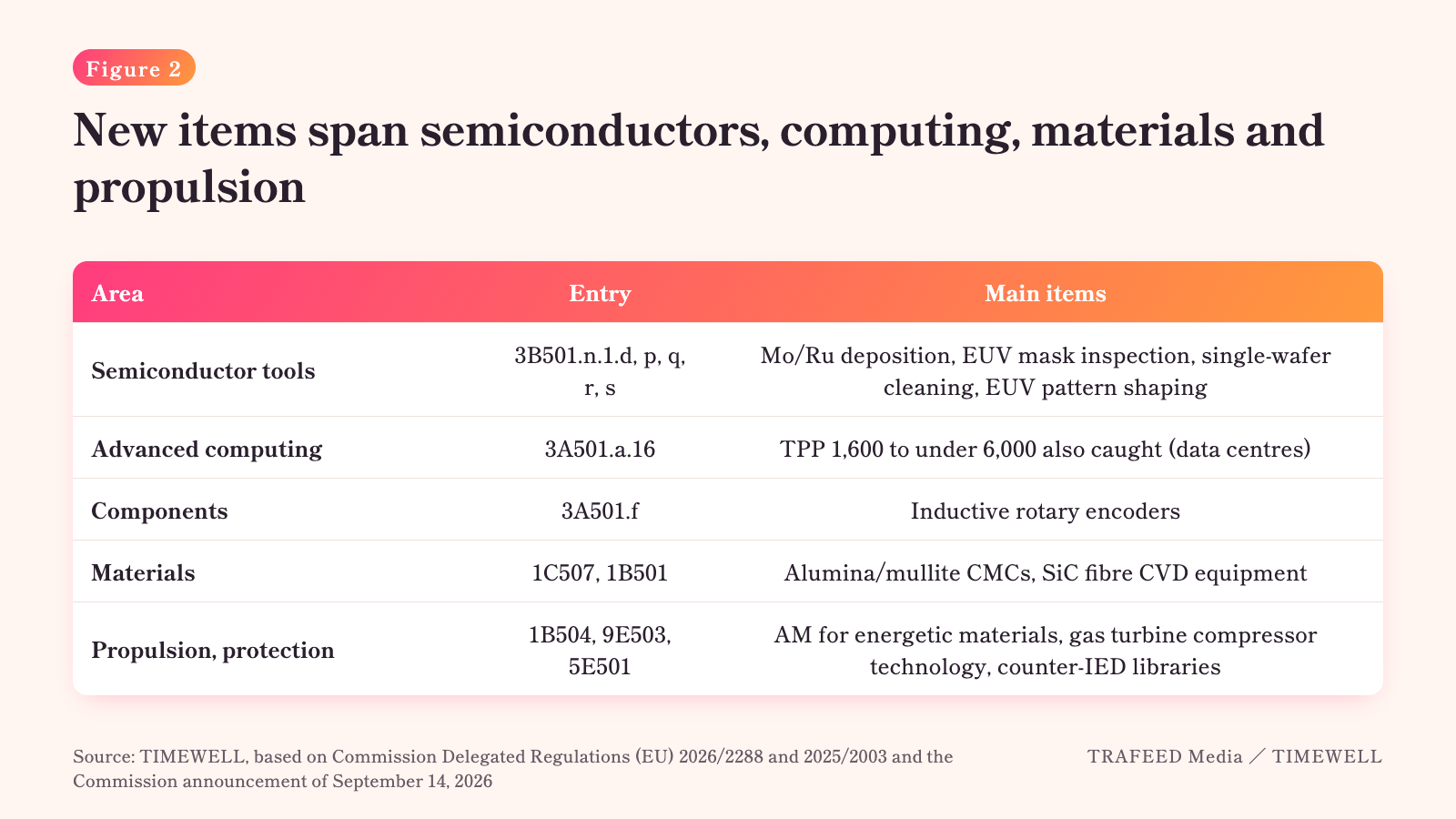 Figure 2. Main items added by 2026/2288 and their Annex I numbers. We confirmed that the earlier version (2025/2003) does not contain the same text for any of them. Source: TIMEWELL, based on Commission Delegated Regulations (EU) 2026/2288 and 2025/2003 and the Commission announcement of September 14, 2026
Semiconductor tools and advanced computing: additions to 3B501 and 3A501
Most of the new items sit in 3B501, the entry for semiconductor manufacturing equipment. The new sub-items we confirmed in the text are1:
| Entry | Item (summary) |
|---|---|
| 3B501.n.1.d | Equipment for depositing molybdenum, ruthenium or combinations of them, with a metal precursor source operating above 75 °C and a process chamber using a hydrogen-containing reducing agent at 4 kPa or more |
| 3B501.p | Inspection equipment for detecting defects in, or particles on, EUV mask blanks or patterned EUV masks |
| 3B501.q | Single-wafer wet cleaning equipment with surface-modification (silylation) drying |
| 3B501.r | Single-wafer cleaning equipment using supercritical CO2 or sublimation drying |
| 3B501.s | Equipment for EUV "pattern shaping", a deposition or removal process used to adjust patterns |
An EU maker of metal deposition tools used for leading-edge interconnects, or of EUV mask inspection tools, will now need to check whether its exports require a licence from its member state. In other words, interconnect, cleaning and EUV-related tools in front-end manufacturing are at the heart of this update.
For advanced computing ICs, 3A501.a.16 is not a new number but a wider one. The earlier version covered ICs with one or more digital processing units and a TPP of 6,000 or more. Under 2026/2288 it covers those, plus ICs with a TPP of at least 1,600 but below 6,000 and a performance density of 5.92 or more. The second test does not apply to items that are not designed for use in data centres (note to 3A501.a.16)13. Computers and electronic assemblies containing such ICs remain under 4A507.
3A501 also gains 3A501.f, inductive rotary absolute encoders (parts that read rotation angle) with digital output, an outer diameter of 40 mm or less, and a resolution of 16 bits or more1. It catches compact, high-resolution inductive encoders that fall outside 3A001.f, which covers encoders with an accuracy of one second of arc or better.
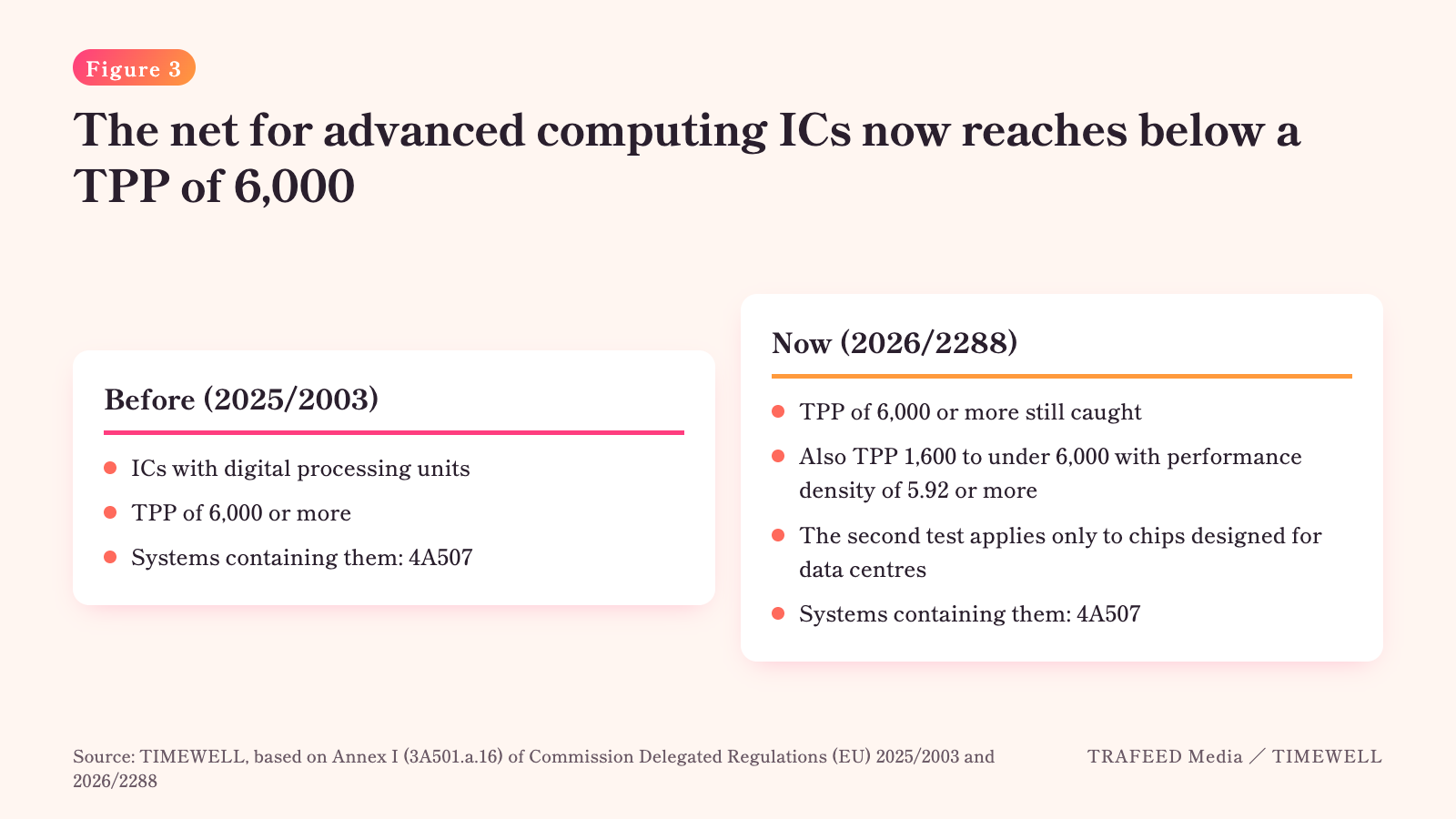 Figure 3. 3A501.a.16 before and after. The second test in the right column does not apply to ICs not designed for data centres. Source: TIMEWELL, based on Annex I (3A501.a.16) of Commission Delegated Regulations (EU) 2025/2003 and 2026/2288
Replace siloed classification work with AI.
METI's FY2024 data shows 52% of foreign exchange law violations stem from classification errors. Download the TRAFEED product catalog covering features and rollout.
Materials, propulsion and the other new 500-series entries
The five new 500-series entries are closer to materials, aerospace and defence than to semiconductors. In summary1:
1B501.d.2 covers equipment, not caught by 1B001.d.2, that produces multiple parallel silicon carbide (SiC) fibres by laser-driven chemical vapour deposition. 1B504 covers additive manufacturing equipment designed or modified to produce explosive, pyrotechnic or propellant devices or shapes from energetic materials, with one or more ultrasonic extruders or nozzles.
1C507.c.1.a covers ceramic-ceramic composites with a glass or oxide matrix, reinforced with continuous fibres made of alumina (Al2O3) or mullite. The fibres must have a tensile strength of at least 700 MPa at 1,000 °C and creep of no more than 1% after 100 hours at 100 MPa and 1,000 °C. The Commission describes this as mullite-reinforced ceramic matrix composites for high-temperature applications2.
9E503.l covers technology required for developing gas turbine axial compressors that combine certain design features, such as multiple-stream fan systems or feedback control of blade tip clearance, with calculated thresholds for stage loading, efficiency and stability margin. A note says 9E503 includes technology for aero, aero-derivative, marine and industrial gas turbines. 5E501.f covers "libraries" specially designed or modified so that equipment can perform the functions of counter-IED (improvised explosive device) equipment in 5A001.h.
Put simply, the new 500-series entries cover high-temperature materials, fibres, propulsion and protective equipment, handled by a limited number of companies. Still, if you send parts or test equipment for such items to an EU site, re-exports from that site may now be classified differently, so it is worth checking once before concluding the update does not affect you.
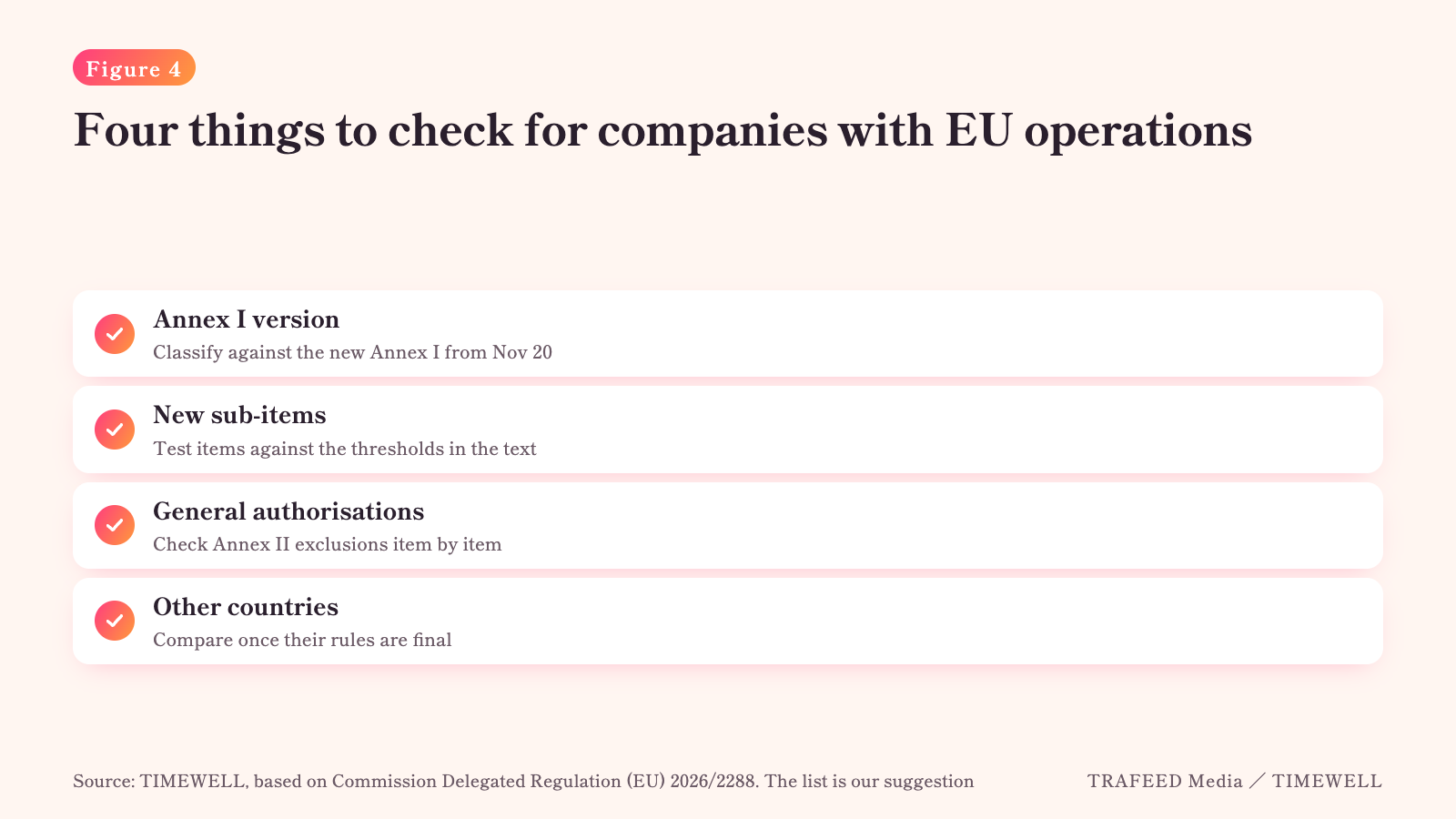 Figure 4. A checking order for companies with EU sites or suppliers. Working from the top gives you what you need for the next item. Source: TIMEWELL, based on Commission Delegated Regulation (EU) 2026/2288. The list is our suggestion, not a requirement of the regulation
What companies with EU operations should check
First, check which version EU subsidiaries and sites are classifying against. Annex I has been replaced in full, so exports after November 20 must be classified against the new Annex I. Recording the Annex I version on classification records and item master data makes the next review faster.
Second, identify items that may fall under the new sub-items. If you handle anything close to semiconductor tools, data-center ICs, encoders, ceramic composites, SiC fibre equipment, additive manufacturing for energetic materials or gas turbine technology, test it against the thresholds in the text. For advanced computing ICs, note that chips below a TPP of 6,000 can now be caught depending on performance density and whether they are designed for data centres.
Third, check which authorisation applies to shipments to your destination. The EU has Union general export authorisations, such as EU001 for certain destinations including Japan and the United States, but some items are excluded, as set out in Annex II of the regulation. This article does not check those exclusions, so confirm item by item whether a general authorisation can be used for the new entries.
Fourth, watch how other countries implement the same 2025 regime decisions. In Japan, for example, public comment on draft amendments to the Export Trade Control Order closed on November 18, and they had not been promulgated as of November 30 (our article on the amendments). Which items match the EU update can only be compared once each country's rules are final, so it is safer not to assume identical coverage yet.
Summary
Annex I of the EU Dual-Use Regulation was replaced in full by Delegated Regulation (EU) 2026/2288, and the new version has applied since November 20.
- The update reflects 2025 decisions in the international regimes and additional controls member states accepted as Wassenaar participants
- New items include semiconductor tools (3B501.n.1.d, p, q, r and s), a wider scope for advanced computing ICs (3A501.a.16) and inductive encoders (3A501.f)
- The 500 series grew from 16 to 21 entries, adding 1B501 (SiC fibre CVD equipment), 1B504 (additive manufacturing for energetic materials), 1C507 (alumina- or mullite-reinforced CMCs), 5E501 (libraries for counter-IED equipment) and 9E503 (gas turbine axial compressor technology)
- Recheck classifications at EU sites and suppliers against the new Annex I, and confirm item by item in Annex II whether a general export authorisation can be used
TRAFEED Media tracks EU and Japanese list changes in its regulatory updates. Once Japan's amendments are promulgated, we plan to add a comparison with this EU update.
Related articles
- Guide to the EU Dual-Use Regulation
- The EU 500 series: quantum, semiconductor equipment and advanced computing
- EU export rules in 2026: dual-use, CRA, CBAM and CE marking
- Japan's export control amendments
References
Footnotes
-
Commission Delegated Regulation (EU) 2026/2288 of 14 September 2026 amending Regulation (EU) 2021/821 as regards the list of dual-use items (Official Journal, November 19, 2026; in force November 20). https://eur-lex.europa.eu/legal-content/EN/TXT/?uri=OJ:L_202602288 (retrieved November 30, 2026; recitals 3 and 4, Articles 1 and 2, and entries 1B501, 1B504, 1C507, 3A501, 3B501, 5E501 and 9E503 of Annex I) ↩ ↩2 ↩3 ↩4 ↩5 ↩6 ↩7
-
European Commission, "2026 Update of the EU Control List of Dual-Use Items" (September 14, 2026). https://policy.trade.ec.europa.eu/news/2026-update-eu-control-list-dual-use-items-2026-09-14_en (retrieved November 30, 2026) ↩ ↩2 ↩3 ↩4
-
Commission Delegated Regulation (EU) 2025/2003 (the previous Annex I). https://eur-lex.europa.eu/legal-content/EN/TXT/?uri=OJ:L_202502003 (retrieved November 30, 2026; used to confirm the new items were absent and that 3A501.a.16 covered a TPP of 6,000 or more) ↩ ↩2