Hello, this is Ryuta Hamamoto from TIMEWELL.
"We don't ship to that country directly. Our buyer is a trading company in a third country, and it isn't on any list." I hear some version of this in almost every export control consultation. Yet when you open the guidance published by Japan, the United States, the EU and the G7 one after another, the same warning keeps coming back: even if your direct counterparty is clean, you are expected to look at where the goods go next.
Here is the short answer to the question this article tackles. Passing through a third country is ordinary trade. It becomes a problem when someone hides the final destination or use, or makes the paperwork differ from reality, in order to avoid controls or sanctions. What authorities ask of companies is not detective work. They ask for a routine: confirm the final destination, end use and end user through contracts, questions and public information, and stop the deal if something does not add up.
In what follows I explain what diversion is, how Japan, the United States, the EU and the G7 each prepare for it, and what you can do in your own company starting today. I rely only on facts I could confirm in official sources, and I do not say that any particular country or company took part in diversion. Where a case is cited, it comes from a government publication.
Words to know first: how "transit" differs from "diversion"
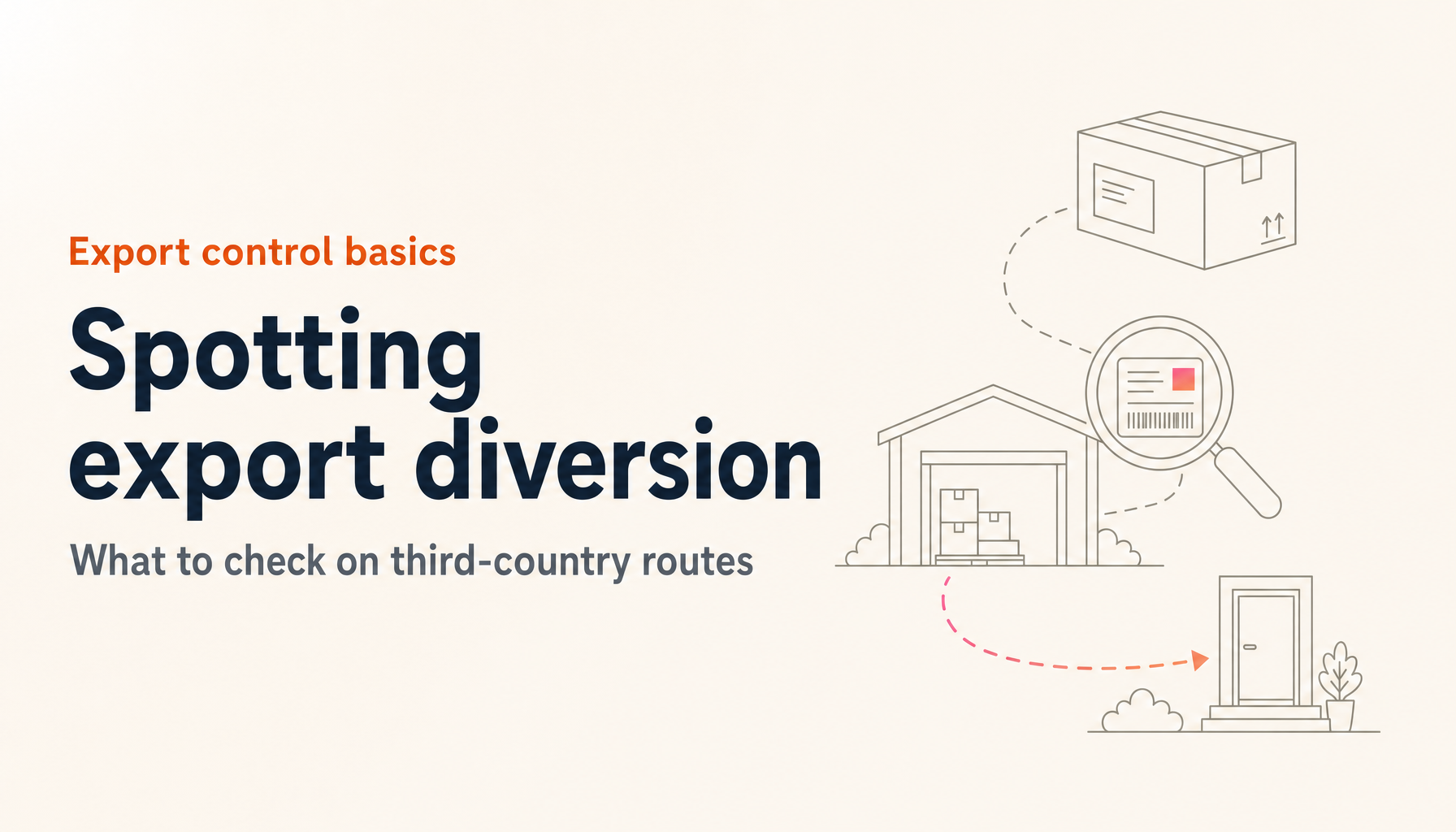
Think of a parcel. You send it to an acquaintance, who forwards it to someone else. Forwarding is normal. Now imagine that someone who does not want the true recipient to receive the parcel rewrites the label to the acquaintance's address, puts a different name on the recipient line, and swaps the original address back in further down the line. The parcel passed through another house in both stories, but the second one was routed to hide the destination. In export control, that second story is what we call diversion.
Before going further, here are the terms used in this article. If you are new to the field, read this table first.
| Term | Meaning |
|---|---|
| Diversion or circumvention | Sending goods through a third country or a different company to avoid a controlled party or region |
| Transshipment | Moving cargo from one ship or aircraft to another at an intermediate port. By itself, this is ordinary logistics |
| Re-export | Exporting goods that were previously imported on to yet another country |
| Final destination | The country or region where the goods finally arrive. It is different from a transit point |
| End user | The person or organisation that finally uses the goods or technology. A carrier or a trading intermediary normally does not count |
| End use | What the goods will be used for |
| Catch-all controls | Japan's mechanism that requires a licence for non-listed goods if end use or end user raises a concern. The formal name is supplementary export controls |
| Inform requirement | A licence becomes necessary once the Minister of Economy, Trade and Industry notifies you that you must apply |
| Common High Priority List (CHPL) | A list of 50 items, identified by six-digit HS codes, that Japan, the EU, the UK and the US jointly flagged as targets of diversion to Russia |
| Red flag | A warning sign that something in a transaction is abnormal |
| Sanctions evasion | Any act that slips through sanctions. Diversion is one typical method |
One more clarification. The "transshipment scam" that drew attention in August 2026, when the White House published a report, was mainly about disguising origin to avoid tariffs. I walked through that report from the primary source in a separate piece (the White House transshipment report and what it means for Japan). This article is about export control and sanctions, not tariffs. The tariff question is "how much do I pay," and the export control question is "may I send this at all." The same cargo can face both questions at once.
Three shapes of diversion, and what has actually happened
I find it useful to sort diversion into three shapes. The first is physical: the goods themselves travel through a third country. The second is a change of name: the real end user orders under another company's name. The third is concealment by paperwork: the destination, the product or the price is declared differently from reality. Real cases usually combine all three.
To see how this plays out, take a case published by the Japanese government. A September 2025 METI document describes an administrative sanction. A trading company in Osaka and its representative exported 523 items, such as motorbikes and personal watercraft, whose export to Russia is restricted, in 18 shipments between August 2022 and June 2023. The actual final destination was Russia, but the shipments were declared as going to another country, and no approval from the Minister was obtained. The sanction was a one-year export ban for both the company and the representative, running from 16 May 2025 to 15 May 2026. Criminal penalties were also imposed: according to the same document, a fine of 5 million yen on the company and a three-year prison sentence, suspended for four years, on the representative1.
The core of this case is that the destination written on the paperwork differed from the real one. Note also what it does not show. It describes the conduct of a specific company, not any involvement of the country that was named as the declared destination. A country entered on a form can be nothing more than a label.
The same METI document includes an illustrative diagram. A Japanese manufacturer, "Company A," instructs its overseas subsidiary to buy machine parts from a third-country company, "Company B," and Company B ships the parts to the subsidiary in Russia. The document notes that communication between the sales floor and the legal department was insufficient1. What I take from it is that diversion does not always begin with bad intent. When internal coordination is thin, a well-meant transaction can end up looking like circumvention.
Let me add a hypothetical example. It is not a real case. Suppose a component maker has sold a few dozen electronic parts a month to a domestic trading company. From one month on, orders jump. Asked about end use, the buyer says only "for domestic equipment." The delivery address is a warehouse, and payment arrives not from the trading company but from a firm in a country that appears nowhere else in the deal. Each point may have an innocent explanation, but taken together you can no longer see where the goods are going. This accumulation of small mismatches is what authorities call red flags.
Replace siloed classification work with AI.
METI's FY2024 data shows 52% of foreign exchange law violations stem from classification errors. Download the TRAFEED product catalog covering features and rollout.
Japan's framework: catch-all controls and the inform requirement
Japan's export control has two broad nets. One is list control, which restricts items in Appended Table 1 of the Export Trade Control Order by performance and specification. The other is catch-all control. Even if goods are not on the lists, a licence is required when they may be used to develop weapons of mass destruction or conventional weapons. This is where diversion enters the picture. List control looks at what you export. Diversion works by blurring to whom, to where and for what. Catch-all control makes the exporter check precisely that blurred part.
There are two entrances to a licence requirement. The first is the objective requirement: the exporter learns, from contracts or documents it has obtained, that the goods may be used for weapons development. It splits into an end-use test and an end-user test. The second is the inform requirement: the Minister of Economy, Trade and Industry notifies the exporter that it must apply for a licence2. I take the provisions apart in my article on the three requirements of catch-all controls, and the "clearly not for weapons" test for end users is explained in the guideline explainer.
For diversion, the most important point is the revision that took effect on 9 October 2025. METI explains that, following the interim report of an advisory council in April 2024, the relevant cabinet orders and ordinances were promulgated on 9 April 2025 and entered into force on 9 October 20253. In the text of the Export Trade Control Order, Article 1, paragraph 3 requires a licence under Article 48, paragraph 2 of the Foreign Exchange and Foreign Trade Act when goods under item 16 of Appended Table 1 (almost everything outside the lists) are exported to the destinations in Appended Table 3, that is, Group A. Article 4, paragraph 2, item 3 disapplies that requirement unless the exporter has received an inform notice4. In plain terms, a path now exists by which an export to a Group A country needs a licence if the government sends a notice, even though such exports used to sit outside catch-all control.
Why was it designed this way? I read it as a safeguard against diversion through friendly countries. That is my own reading of the text, not an official explanation I have confirmed. What is clear is that two nets overlap. One is the exporter's own awareness (the objective requirement). The other is a mechanism that uses information only the government holds (the inform requirement). Governments sometimes see an overall pattern that no single company can.
Japan's Russia sanctions also take diversion into account. According to METI, among goods destined for Russia, those going to designated entities and those in Appended Table 2-3 of the Order require export approval under Article 48, paragraph 3 of the Act, and approval is in principle not given. As entities subject to an export ban, Japan has designated 561 in Russia, 27 in Belarus and 56 located in third countries (as of September 2025)1. To be clear, such designations are regulatory classifications and do not find that the listed entities did anything wrong. In the same document, METI also urges exporters to confirm the end user carefully when shipping Russia-restricted items, including the CHPL items, to countries other than Russia1.
METI also gives eleven "examples that call for attention." I reorganise them into a practical checklist later in this article.
The U.S. framework: responsibility for re-exports and the ban on looking away
The U.S. Export Administration Regulations (EAR) reach not only goods leaving the United States but also re-exports of U.S.-origin items and technology between other countries. For Japanese companies, they can matter when a product that contains U.S.-origin parts is shipped from Japan to a third country. I leave the scope questions to other articles and introduce two ideas that matter for diversion.
The first is the "Know Your Customer" guidance in Supplement No. 3 to Part 732 of the EAR, issued by the Bureau of Industry and Security (BIS). Its skeleton is this: without red flags, there is generally no affirmative duty to verify what a customer tells you; with red flags, you have a duty to check out the suspicious circumstances. It also says "do not self-blind." Cutting off the information that comes to your firm in the normal course of business, or adopting a policy of avoiding bad news, does not shield you from liability. If employees do not know how to handle red flags, that too may be regarded as a form of self-blinding5. If you cannot resolve the doubt, you refrain from the transaction or consult BIS. Japanese companies can adopt the same flow in their own procedures.
The second is the meaning of "knowledge." Under the EAR, knowledge covers not only positive certainty but also awareness of a high probability, and it can be inferred from willful avoidance of facts. BIS quotes this definition in a footnote of its July 2024 guidance6. The EAR also prohibits taking any action with intent to evade the regulations as a separate violation (15 CFR 764.2(h))7. So proven intent to circumvent can itself be the problem.
BIS also warns companies about parties that are not on any published list. The guidance dated 10 July 2024 describes four tools. The first is the "supplier list" letter, in which BIS tells a company about foreign parties that, according to commercially available data, have been diverting CHPL items to Russia. The second is a Project Guardian request, which asks a company to watch for a specific party or inquiry and, if one appears, to stop processing the order and contact the local BIS field office. The third is the "red flag" letter, which tells a company that a customer has likely re-exported the same type of item in violation of the EAR. The fourth is the "is informed" letter, through which BIS notifies a company of an additional licence requirement for specific items or parties6. The fourth resembles Japan's inform requirement closely. Both countries use information held by the government to cast an extra net.
The guidance also spells out what a company that receives a red flag must do: obtain information that resolves the concern, record the verification steps and the reasoning in detail, and, if it cannot resolve the flag, refrain or apply for a licence. Proceeding without a licence while knowing a red flag exists is treated as an aggravating factor in later administrative enforcement. Voluntary cooperation with BIS is treated as a mitigating factor6.
The United States also has the BIS 50 percent rule (Affiliates Rule), which extends restrictions to companies owned 50 percent or more, directly or indirectly, by listed parties and thus closes one route for diversion. The start of its application has moved more than once, so please check my explainer on the rule and the Federal Register for the latest. I could not confirm the current status as of 6 November 2026, so I make no claim about it here.
The EU and the G7: tying the buyer by contract
The EU took a contractual approach. Council Regulation (EU) 2023/2878, adopted on 18 December 2023, added Article 12g to Regulation 833/2014, the so-called "no re-export to Russia" clause8.
The text provides that, when selling, supplying, transferring or exporting goods listed in Annexes XI, XX and XXXV, the common high priority items in Annex XL, or certain firearms and ammunition to a third country, exporters must, as of 20 March 2024, contractually prohibit re-exportation to Russia and re-exportation for use in Russia. Partner countries listed in Annex VIII are excluded. The contract must contain adequate remedies for breach, and an exporter that learns of a breach by the counterpart must inform the competent authority of the Member State where it is established. Contracts concluded before 19 December 2023 were given until 20 December 2024 or their expiry, whichever was earlier8.
The European Commission's FAQ (version of 18 December 2024) gives examples of remedies such as termination and a contractual penalty, and recommends treating the clause as an essential element of the contract. Its model wording obliges the buyer not to sell or re-export to Russia directly or indirectly, to use best efforts so that resellers further down the chain do not frustrate the purpose, to maintain a monitoring mechanism, to report problems immediately, and to provide information within two weeks of a request9. The same FAQ states that, as of 24 June 2024, Annex VIII includes Japan among the partner countries9. I have not verified whether the text has changed since.
This is not an obligation for Japanese companies. But when you buy from EU suppliers, or partner with EU companies for sales in third countries, you may well be asked for similar wording. If you can explain why, the conversation moves faster. The legal mechanism behind it is the EU's decision to deter diversion by contract. My article on end-user certificates and pledges covers how such wording is drafted.
Article 12 of the same regulation also prohibits knowingly and intentionally taking part in activities whose object or effect is to circumvent the sanctions. The Commission's FAQ says that if you suspect circumvention, you should report it to your national competent authority or use the EU whistleblower tool9.
The G7 is trying to align all this internationally. It set up an Enforcement Coordination Mechanism in February 2023 and, in September 2023, a Sub-Working Group on Export Control Enforcement under it. On 24 September 2024 the group published updated guidance for industry1011. METI has also released a Japanese translation (provisional), so you can read the whole text in Japanese. The guidance has four parts: a list of items at heightened risk of diversion, red flag indicators, best practices for companies, and screening resources.
The item list is the Common High Priority List (CHPL), developed jointly by the EU, Japan, the UK and the US and identified by 50 six-digit HS codes. The guidance sorts the items into Tier 1 through Tier 4. Tier 1 is integrated circuits, where domestic production is limited and global manufacturers are few. Tier 2 is additional electronics such as wireless communications equipment. Tier 3 covers other electronic components and mechanical parts. Tier 4 covers manufacturing and testing equipment for electronic components and circuit boards, and CNC machine tools10. METI's September 2025 document lists the same 50 items as 4 integrated circuits, 5 communication items, 16 items such as diodes and transistors, 9 mechanical and optical items, 11 items for semiconductor manufacturing and 5 items for numerically controlled machine tools1. The composition of the list can be updated, so always check the current list on the authorities' own pages.
For the case where red flags appear, the guidance gives concrete best practices. Screen the transaction parties against public sanctions lists, running names and addresses separately; if only an address matches, further due diligence is advisable because it may point to shell companies or company-formation agents. Beyond that, ask more about end use and end user, research public business registries and trade data, obtain written certification that items will not be transferred to Russia, Belarus or sanctioned parties in third countries, and update distributor agreements. If concern remains, refrain from the transaction and disclose information to the appropriate authority10. A walk-through that applies this to Japanese cases is in the article on diverted Japanese components and red flags.
What you can do today: questions, contracts and warning signs
Now to practice. Reading the official documents does not by itself tell you where to begin, so I reduce them to three tools: questions for your counterparty, clauses for your contracts, and a guide to spotting abnormal patterns.
Start with questions. For a new customer, or an existing one whose orders have changed, send these in writing so that you can later show how you proceeded.
- What is your business, and in which countries and industries are your main customers?
- What is the end use of these goods? Into which product or facility will they be built?
- Who is the end user? Please give the company name, address and line of business.
- Through which countries or regions will the goods travel to reach the end user?
- Do you plan to resell to a third party? If so, to whom and in which country?
- From which company and from which country will payment be made?
- Can you certify in writing that you will not transfer these goods to Russia, Belarus or other restricted parties?
The seventh item, a written certification, is one of the measures the G7 guidance recommends10. An unexplained refusal to give it is itself counted as a red flag there.
Next, contracts. The EU model clause is a useful reference when you review your own agreements. Points worth including are an explicit ban on direct and indirect re-export, a duty to pass the same obligation on to resellers, monitoring and information duties, remedies such as termination and a penalty for breach, and a duty to notify you when the buyer becomes aware of a problem9. The EU wording is written for EU rules, though. When you adapt it to a Japanese contract, check governing law, jurisdiction and consistency with your obligations under Japan's Foreign Exchange and Foreign Trade Act with a lawyer. And do not treat a clause as a safe harbour. It clarifies the counterparty's responsibility; it does not replace the exporter's own duty to check.
Finally, the guide to abnormal patterns. I combined the eleven examples METI gives for exports of CHPL items with the red flags in the G7 guidance and arranged them by the situation in which you notice them110.
| Situation | Warning signs |
|---|---|
| The customer | The goods do not fit the customer's business. No clear answer about end use. The address is a residence. The website is thin or missing |
| The order | First inquiry only after February 2022. Order volume jumped, or is large for the customer's scale. Terms are unusually favourable, such as a price above market or full prepayment. Delivery time is extremely short |
| The destination | A carrier is named as the final destination. No end user has been decided. The route is unclear or roundabout. Delivery instructions changed at the last minute |
| Paperwork and money | Documents are incomplete or inconsistent. Payment comes from a third-country company that is not otherwise in the deal. The invoice is split into small amounts. A written certification is refused |
| The counterparty's background | A branch, subsidiary or shareholder in Russia or similar. Same address as a designated entity. Connections to parties that appear on public lists |
The key is not to jump to a conclusion when one item applies. The G7 guidance itself says that no single red flag is indicative of illicit activity, and that all surrounding facts and circumstances should be considered10. As matching items accumulate, move to more questions and research. If you still cannot explain the picture, stop. This order should be a company procedure, not a hunch of the person at the desk. I describe the practical steps of end-user checks in the basics of end-user screening.
If you do find a transaction that bothers you, a safe sequence is as follows.
- Suspend the shipment or performance of the contract.
- Send the questions above in writing, and keep the dates and the answers.
- Check names and addresses against public sanctions lists, company registers and trade data.
- Judge whether the picture can be explained and whether the counterparty and the transaction are legitimate, and record why.
- If concerns remain, decline the deal or consult the competent authority. In Japan, the Trade Control Division of METI is the contact point1.
When in doubt, lean toward stopping. A shipment delayed by a few days can be caught up. Trust lost after suspicion has been raised takes much longer to rebuild.
Common misconceptions
Let me go through the points above again in the form in which they come up on the shop floor.
The first misconception: "If the buyer is not on a list, we are fine." A list is only a record of parties authorities have already identified. BIS writing to companies about parties outside the published lists, and the G7 recommending that you check addresses as well as names, both assume that risk exists beyond the lists610.
The second: "The goods go to a third country, so Japan's controls do not apply." Catch-all controls require a licence when you learn of a concern about end use or end user, whatever the destination. Even for Group A, an inform notice makes a licence necessary4.
The third: "A distributor handles it, so we do not know." The U.S. guidance says that employees not knowing how to handle red flags may itself count as self-blinding5. METI likewise encourages exporters to recommend sanctions checks to overseas subsidiaries and agents1.
The fourth: "We put a clause in the contract, so we are covered." A clause helps deterrence and clarifies responsibility, but it does not erase responsibility for missing visible signs. Keep both the clause and the checks.
The fifth: "Diversion is something companies from certain countries do." The METI case I cited involved a Japanese company that misdeclared the destination. Diversion is spotted in the structure of a deal and in mismatched paperwork, not in nationality. I believe putting the same questions to every counterparty in the same way, whatever country it is in, is both fairer and more effective than being wary of particular countries or peoples.
One word for readers who handle Taiwan routes. Article 13, paragraph 1 of Taiwan's Trade Act requires that the use and end user of strategic high-tech commodities be declared truthfully and not changed without permission. Paragraph 2 requires permission when specified strategic high-tech commodities bound for controlled areas pass through Taiwan's ports, are transshipped there, or enter bonded warehouses and similar facilities12. As in Japan, where the goods travel is part of what is regulated.
Next step: start by asking who the end user is
You may feel there are too many systems. I do not suggest fixing everything at once. The smallest thing you can start with is this: when you get a new customer or see an order change, ask in writing for the end use and the end user. Just asking is informative, and so is a refusal to answer.
After that, turn the warning signs that apply to your business into a checklist, and let sales, legal and logistics look at the same sheet. As the METI case showed, a gap between the sales floor and the legal department can be the entrance for diversion.
If you get stuck on the details, you can consult the Trade Control Division of METI. If you want outside help, TIMEWELL's export control AI agent TRAFEED supports counterparty screening and the record-keeping around it. The final determination of classification and whether to proceed always rests with your own export control officer. If you would like to talk through your situation, please reach out through a consultation.
One last thought. What struck me most in these documents is that authorities do not ask companies to "suspect." They ask them to "check and record." Suspicion is a feeling; checking is a procedure. Once it is a procedure, the same questions keep getting asked when the person in charge changes and when new country rules appear.
References
Note: Inclusion in a regulatory list or designation is a regulatory classification and not a judgment about the listed company or organisation. This article is a general explanation based on public official sources and does not decide whether any particular transaction may proceed. The final decision rests with your own export control officer.
Footnotes
-
Ministry of Economy, Trade and Industry (METI), Trade Control Division, "The risks of Russia sanctions and the need to respond" (Japanese), September 2025. https://www.meti.go.jp/policy/external_economy/trade_control/01_seido/04_seisai/downloadCrimea/20250912_risk.pdf (accessed 2026-11-06. The administrative sanction cited was announced 9 May 2025. Names are omitted here.) ↩ ↩2 ↩3 ↩4 ↩5 ↩6 ↩7 ↩8
-
Export Trade Control Order (Cabinet Order No. 378 of 1949), Article 4, paragraph 1, items 3 and 4. e-Gov Law Search https://laws.e-gov.go.jp/law/324CO0000000378 (accessed via the law API on 2026-11-06) ↩
-
METI, "Revision of supplementary export controls (in force 9 October 2025)" (Japanese). https://www.meti.go.jp/policy/anpo/apply-01/20251009_catchminaoshi/20251009catchall.html (last updated 2026-04-15, accessed 2026-11-06) ↩
-
Export Trade Control Order, Article 1, paragraph 3 and Article 4. e-Gov Law Search https://laws.e-gov.go.jp/law/324CO0000000378 (accessed via the law API on 2026-11-06) ↩ ↩2
-
15 CFR Part 732, Supplement No. 3, "BIS's 'Know Your Customer' Guidance and Red Flags." eCFR https://www.ecfr.gov/current/title-15/part-732 (accessed 2026-11-06) ↩ ↩2
-
U.S. Department of Commerce, Bureau of Industry and Security, "Guidance to Industry on BIS Actions Identifying Transaction Parties of Diversion Risk," 10 July 2024. https://www.bis.gov/media/documents/guidance-complying-bis-letters-identifying-transaction-parties-diversion-risk-v8.pdf (accessed 2026-11-06) ↩ ↩2 ↩3 ↩4
-
15 CFR 764.2(h) (Evasion). eCFR https://www.ecfr.gov/current/title-15/section-764.2 (accessed 2026-11-06) ↩
-
Council Regulation (EU) 2023/2878 of 18 December 2023 (Official Journal L, 18.12.2023), Article 1(28) inserting Article 12g into Regulation 833/2014, and Annex XL. https://eur-lex.europa.eu/eli/reg/2023/2878/oj (EUR-Lex PDF, accessed 2026-11-06) ↩ ↩2
-
European Commission, "'No re-export to Russia' clause: Frequently Asked Questions" (as of 18 December 2024). https://finance.ec.europa.eu/system/files/2024-02/faqs-sanctions-russia-no-re-export_en.pdf (accessed 2026-11-06) ↩ ↩2 ↩3 ↩4
-
G7 Sub-Working Group on Export Control Enforcement, "Preventing Russian Export Control and Sanctions Evasion: Updated Guidance for Industry," 24 September 2024. BIS-hosted copy: https://www.bis.gov/media/documents/g7-updated-guidance-industry-preventing-russian-export-control-sanctions.pdf (accessed 2026-11-06) ↩ ↩2 ↩3 ↩4 ↩5 ↩6 ↩7
-
European Commission, "Sanctions vis-à-vis Russia: Commission publishes G7 industry guidance on preventing sanctions evasion," 24 September 2024. https://finance.ec.europa.eu/news/sanctions-vis-vis-russia-commission-publishes-g7-industry-guidance-preventing-sanctions-evasion-2024-09-24_en (accessed 2026-11-06) ↩
-
Trade Act of the Republic of China (Taiwan), Article 13. Laws & Regulations Database of the Republic of China https://law.moj.gov.tw/LawClass/LawSingle.aspx?pcode=J0090004&flno=13 (accessed 2026-11-06) ↩