Hello, this is Ryuta Hamamoto from TIMEWELL.
"So what exactly is the American ITAR?" Someone asked me that the other day. Even people who have been in export control for a few months tend to know the terms ECCN and EAR99 first, while ITAR still feels far away.
Here is the short answer. ITAR is the US rulebook for military items. The State Department runs it, and it covers not just finished goods such as tanks and fighter aircraft but also the drawings and technical documents behind them, and even the act of teaching a foreign party how to assemble or repair them. The EAR (Export Administration Regulations), run by the Commerce Department, handles commercial and dual-use goods. Think of ITAR as the entrance reserved for military items. Japanese companies tend to run into it first when a US counterpart sends over defense-related parts or drawings.
This article is for readers meeting ITAR for the first time. I will walk through the terms to learn first, where ITAR and the EAR part ways, what happens when ITAR is overlooked, and what a Japanese company should check first, in the order you would actually do it. I leave the EAR itself to our existing articles and stay on the border between the two. Every citation number below was checked against the original text in the Code of Federal Regulations (eCFR) or the other primary sources listed in the footnotes.
The short version: ITAR is the entrance for military items
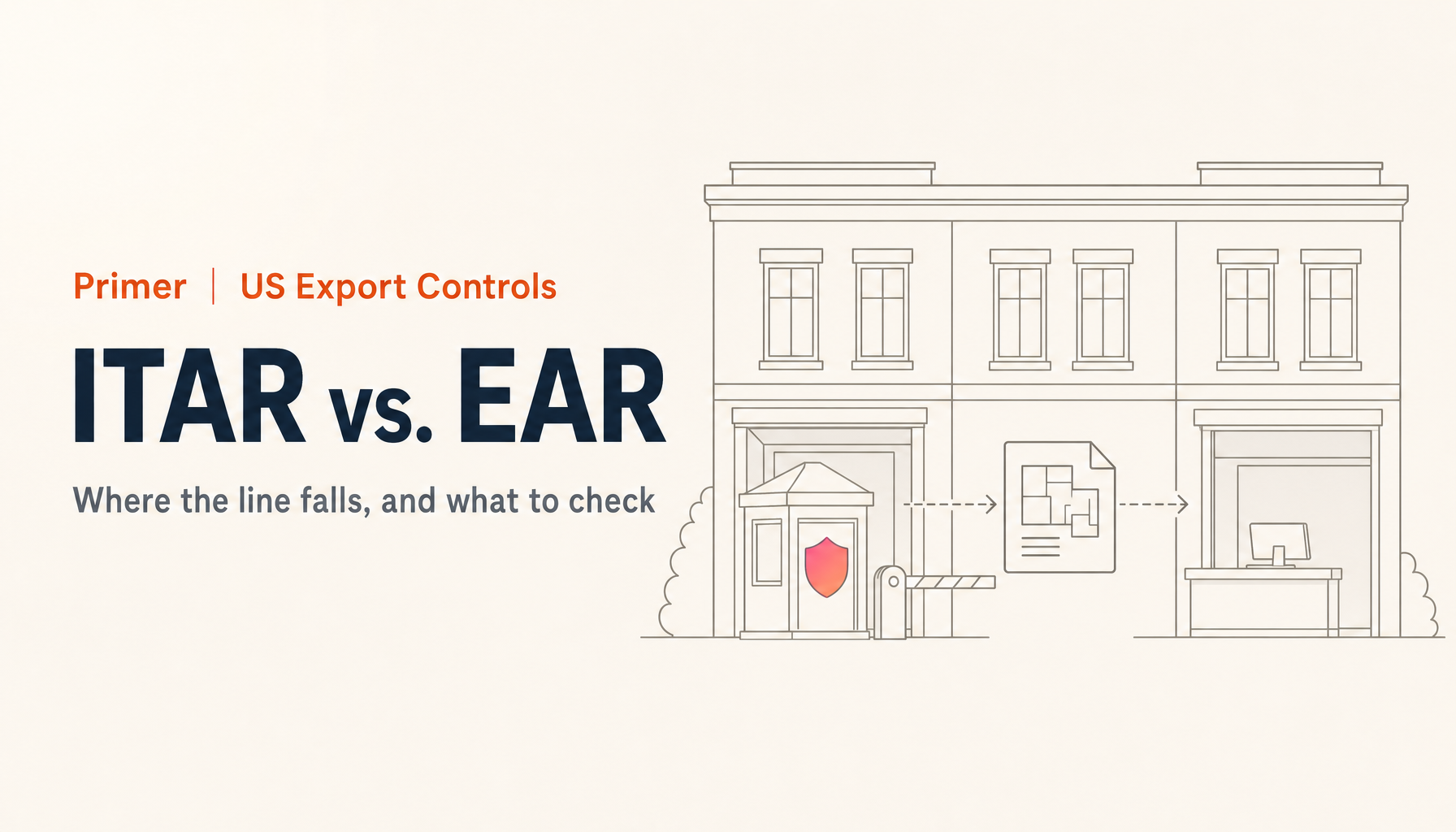
Picture US export control as one large building with two entrances. One is reserved for military items and watched by a guard booth at the State Department. The other is for commercial and dual-use goods and is handled at a Commerce Department counter. Every item is first checked against the military entrance. Only items that do not belong there go to the general one. That order matters.
The rulebook for the military entrance is ITAR, formally the International Traffic in Arms Regulations. Its basis is section 38 of the Arms Export Control Act (AECA). The President's authority was delegated to the Secretary of State, and the Directorate of Defense Trade Controls (DDTC), under the Bureau of Political-Military Affairs, administers the rules12. The regulations sit in Title 22 of the CFR, parts 120 through 130.
How does this reach a Japanese company? Usually through one of three doors. You receive ITAR-controlled parts or drawings from a US customer. You build such parts into your own product. Or you show the drawings to foreign-national engineers or overseas partners. All of this can look like a purely domestic matter, yet the US approval conditions stay attached.
Here are the terms to learn first. If you get lost later, come back to this table.
| Term | Meaning | Everyday analogy |
|---|---|---|
| ITAR | US rules for military items and their technology (22 CFR parts 120 to 130) | The rulebook for the military entrance |
| AECA | The Arms Export Control Act, the parent statute (22 U.S.C. 2778) | The law that gave the authority to write the rulebook |
| DDTC | The State Department office that runs ITAR and issues approvals | The guard booth at that entrance |
| USML | The US Munitions List, the list of ITAR-controlled items (22 CFR 121.1) | The guest list at that entrance |
| Defense article | An item on the USML, plus its technical data | The dish itself |
| Defense service | Helping or training foreign persons in design, manufacture, repair and so on | A cooking class |
| Technical data | Information needed to design or make a defense article: drawings, specifications, software | The recipe |
| EAR | Commerce Department rules for commercial and dual-use items | The rulebook for the general entrance |
| CCL | The Commerce Control List, the EAR's list of controlled items | The guest list at the general entrance |
| Retransfer | A change in the approved end user or end use after the first export | Passing the dish on to another restaurant |
| Commodity jurisdiction (CJ) | A DDTC ruling on whether an item falls under ITAR or the EAR | Asking in advance which entrance you should use |
What ITAR actually controls
ITAR does not control only goods. The text separates three things: defense articles, defense services and technical data. If you miss this, it is easy to conclude, "We never ship finished weapons, so this does not concern us."
A defense article is an item designated on the USML, together with technical data directly relating to it. It includes forgings, castings and other unfinished products once they have reached a stage where their mechanical properties, material composition, geometry or function clearly identify them as defense articles3. Basic marketing information on function or purpose and general system descriptions are not included.
A defense service is assistance or training given to foreign persons in the design, development, engineering, manufacture, production, assembly, testing, repair, maintenance, modification, operation or use of defense articles. Furnishing ITAR-controlled technical data to a foreign person also counts as a defense service3. In kitchen terms, serving the dish is the export of a defense article, handing over the recipe is a transfer of technical data, and stepping into the kitchen to teach the method is a defense service.
Technical data is information required for the design, development, production, manufacture, assembly, operation, repair, testing, maintenance or modification of defense articles. It comes as blueprints, drawings, photographs, plans, instructions or documentation, and software directly related to defense articles is included. General scientific, mathematical or engineering principles commonly taught in schools and universities, and information in the public domain, are not3.
The USML has 21 categories4. They run from firearms in Category I and guns and armament in II, through ammunition and ordnance, launch vehicles and missiles, explosives and propellants, surface vessels of war, ground vehicles, aircraft, training equipment and personal protective equipment, to military electronics in XI. Then come fire control, laser, imaging and guidance equipment in XII, materials in XIII, toxicological agents in XIV, spacecraft in XV, nuclear weapons related articles in XVI, classified articles in XVII, directed energy weapons in XVIII, gas turbine engines in XIX, submersible vessels in XX, and articles not otherwise enumerated in XXI. What surprises many manufacturers is that ordinary-looking industrial goods such as electronics, materials and engine parts show up in these lists.
One more phrase to know. Many USML categories end with a paragraph that sweeps in parts, components, accessories and attachments "specially designed" for a listed item. This is a catch-all inside the list. It is a different mechanism from Japan's catch-all control, which looks at end use and end user. "Specially designed" is defined in detail, and basic items such as fasteners are carved out. Most of the hard calls in practice come from how that definition is read.
Whether something is ITAR or the EAR is decided in a fixed order. You begin with the USML. If the item is described there, ITAR applies. If not, you classify it on the Commerce Control List5. Neither "it looks military" nor "it looks commercial" settles the question. What matters is whether the wording of the list fits.
Replace siloed classification work with AI.
METI's FY2024 data shows 52% of foreign exchange law violations stem from classification errors. Download the TRAFEED product catalog covering features and rollout.
Where ITAR and the EAR part ways
Here is the comparison table. For the EAR side, including how to read an ECCN and what EAR99 means, see our other articles. If you want to start from how an ECCN is assigned, read our ECCN primer, and for where EAR99 sits, What is EAR99. Below I give only what the comparison needs.
| Point | ITAR | EAR |
|---|---|---|
| Agency | State Department, DDTC | Commerce Department, BIS |
| Statutory basis | Arms Export Control Act (22 U.S.C. 2778) | Authority including the Export Control Reform Act of 2018 (50 U.S.C. 4801 to 4852) |
| Scope | Military items, technical data, defense services (USML) | Commercial items, dual-use items and some military items (CCL) |
| List | USML (21 categories) | CCL (ECCNs) and EAR99 |
| Basic approach | Exports of listed items generally need prior approval, unless an exemption applies | Depends on item and destination; many shipments need no license |
| Registration | Anyone manufacturing or exporting in the United States must register with DDTC first | No registration system |
| US content | Controlled items stay controlled after incorporation; no percentage test found in the text | De minimis rule: US content of 10% or less, or 25% or less depending on destination, can fall outside the EAR |
| Retransfer | Written DDTC approval needed to change end user, end use or destination | Reexport controls depend on destination and end use |
| Foreign persons | Releasing technical data to a foreign person counts as an export (deemed export) | A similar concept exists |
| Penalties | Civil: greater of $1,271,078 or twice the transaction value per violation. Criminal: up to $1 million fine or 20 years in prison | A separate regime (not covered here) |
Three of these points cause most of the confusion.
The first is the nature of the license. Under the EAR, the destination decides much of the outcome, so a general-purpose item going to a friendly country often needs no license. Under ITAR, being on the list is itself the starting point, and a license is normally needed at the time of export, for example the DSP-5 application for a permanent export of unclassified items6. For defense services to foreign persons, DDTC must also approve an agreement such as a Technical Assistance Agreement (TAA)7.
The second is de minimis. Under the EAR, a foreign-made item that contains US-origin controlled content worth 10% or less of its value, or 25% or less for most destinations, can be outside the EAR8. The ITAR text goes the other way. Defense articles described on the USML remain subject to ITAR after being incorporated into an item that is not on the USML, unless the regulations say otherwise (22 CFR 120.11(c))5. The commercial invoice statement that accompanies an authorized export says the items may not be resold or transferred "either in their original form or after being incorporated into other items" without US government approval9. People in the field call this the "see-through" effect, which is a nickname rather than a term in the regulations, so check the text before relying on it. Think of a bouillon dissolved in a soup: the flavor is still there in the finished dish.
The third is that the EAR also has a home for military items. Items moved from the USML to the Commerce list sit in the "600 series." The EAR sets out cases where de minimis does not work for them8. Leaving ITAR does not automatically mean lighter control.
People sometimes ask me, "Our item is EAR99, so ITAR is not our problem, right?" EAR99 is the label for items subject to the EAR but not listed on the CCL. An item that is controlled by ITAR is not subject to the EAR at all, so it cannot be EAR99. And when a supplier says EAR99, whether that classification is correct is a separate question. I treat a supplier's classification as a lead and ask for the documents behind it.
What happens when ITAR is overlooked
Let me use a hypothetical. This is an invented case, not a real company or deal.
A Japanese parts manufacturer wins an order from a US customer to machine prototype components. The drawing files carry no ITAR notice. The manufacturer stores them on its internal design server and shares them with an overseas partner to move the work along. Later, the customer finds that the drawings are technical data on the USML. Three problems follow. Nobody checked the conditions attached to the drawings at receipt. Nobody had worked out who inside the company could open them. And nobody knows whether the transfer to a partner in a third country had DDTC approval.
Each of these makes sense in light of the regulations. ITAR treats releasing technical data to a foreign person as an export, and that export is deemed to go to every country in which the person holds or has held citizenship or holds permanent residency10. Changing the approved end user, end use or destination requires written DDTC approval, with the original authorization number and details of the new end user9. A foreign company that receives an authorized export must have effective procedures to prevent diversion, and the rules provide a conditional exemption for transfers to employees within an organization, which depends on screening of employees and non-disclosure agreements11.
Let me be clear that none of this is about regarding any nationality with suspicion. What the regulation asks is that a company know who gets the technical data and keep a record. It is about gaps in the system and the checks on the receiving side, not about any group of people. Japan's Foreign Exchange and Foreign Trade Act has a comparable idea, and our article on deemed export in practice covers the Japanese side.
On penalties, civil penalties for a violation of AECA section 38 are capped per violation at the greater of $1,271,078 or twice the value of the transaction. That figure is from 22 CFR 127.10 and is adjusted for inflation regularly, so check the current text when you use it12. For willful violations, 22 U.S.C. 2778(c) provides a fine of up to $1,000,000 per violation, imprisonment of up to 20 years, or both2. The State Department can also debar a person from activities subject to ITAR. Debarment generally lasts three years, and reinstatement is not automatic12.
Enforcement examples are available in the consent agreements and orders that DDTC publishes on its Penalties and Oversight Agreements page13. As far as I could confirm, orders from 2021 include one with a civil penalty of $13 million (part of it devoted to remedial compliance measures and suspended) and another of $6.6 million, and the list also shows 2026 settlements with large manufacturers. However, the original documents are scanned PDFs, and I could not machine-read the full text this time. The allegations and the breakdown of amounts are unverified, so I do not name companies or give details. A listing is a record of a settlement the agency published, not a judgment about a company. What I would have you read is not the size of the amount but the condition that appears in every one of them: a review of the company's compliance structure with remedial measures.
The regulations also contain a voluntary disclosure provision. If a person who believes a violation may have occurred discloses it to DDTC before the government learns of substantially the same information from another source, DDTC may treat it as a mitigating factor. It is not a guarantee of leniency, and the text does not rule out referral for criminal prosecution14. Decide ahead of time who you will call, rather than carrying the question alone.
What a Japanese company should check first, in order
Now for the practical part. Work from the top and you will miss less.
One, check whether the transaction or purchase includes US-origin defense-related items or technical data. If the customer's contract includes a clause on US export control compliance or mentions ITAR, start there. Look at the drawings and specifications you received for markings such as ITAR, USML or Export Controlled. A missing marking is not a reason to relax, so ask your suppliers and customers in writing whether the item is under ITAR, and if so which USML category, and if not what its ECCN or whether it is EAR99. If the answer is vague, that is the place to stop and ask.
Two, read the conditions at receipt. An ITAR approval names the recipient, the use and the destination. Assurances may be attached that bind the receiving party, such as not to retransfer and to use the items only as authorized15. If the people handling the item do not know the conditions, a violation can happen by accident later. Keep the authorization number and a copy of the conditions for each transaction.
Three, sort out who inside the company can access the data. Check whether foreign-national employees, temporary staff, overseas partners or cloud administrators are among them. ITAR does treat sending or storing unclassified technical data as not an export when conditions are met, such as strong end-to-end encryption and no storage in or transmission to the countries named in the regulation16. Because there are conditions, have your IT team read the text with you.
Four, check for retransfer to a third country. When you send received items, technical data, or products that incorporate them from Japan to another country, written DDTC approval may be required9. This is a separate process from permission from Japan's Minister of Economy, Trade and Industry under the Foreign Exchange and Foreign Trade Act, and holding one does not replace the other. That is my own reading, so confirm with a specialist for a real case.
Five, check incorporation into your own products. As noted, using an ITAR item as a component extends US control to the whole product. Check the customers, destination countries and end users at the design stage. For borderline items, the commodity jurisdiction (CJ) procedure exists. When it is unclear whether an item is under ITAR, you file Form DS-4076 and DDTC decides in consultation with the Departments of Defense and Commerce17. How a CJ request should be filed, by whom and with what attachments, depends on the case, so talk to your counterpart and a specialist first.
Six, check Japan's own rules in parallel. Item 1 of Appended Table 1 of Japan's Export Trade Control Order lists guns, explosives, military vehicles, military vessels, military aircraft, military satellites and similar goods, and exports to all regions need METI permission18. Transfers of defense equipment are governed separately by the Three Principles on Transfer of Defense Equipment and Technology and their implementation guidelines. Our existing article explains that a revision was decided on April 21, 2026; see the article on the Three Principles and the 2026 revision. The primary texts from the Ministry of Defense and METI could not be fetched automatically this time, so I have not verified that point against the originals (unverified).
Seven, decide on records and who to consult. Keep what you investigated, supplier replies, copies of approvals and the scope of internal access for each transaction. If you have no specialist in-house, consult an export control lawyer or a professional body early in the deal.
Here are the seven steps as a decision flow.
| Step | What to check | If the answer is yes or unknown |
|---|---|---|
| 1 | Does the deal include US-origin defense-related items or technical data? | Ask the supplier and customer in writing |
| 2 | Were you told it is under ITAR? | Obtain the USML category, authorization number and a copy of the conditions |
| 3 | Were you told it is not under ITAR? | Get the ECCN or EAR99 basis in writing, and consider CJ if in doubt |
| 4 | Can foreign-national staff, contractors or cloud administrators see it? | Restrict access and align operations with the approval conditions |
| 5 | Will you send it to a third country? | Check with a specialist whether retransfer approval is needed |
| 6 | Will it be built into your product? | Confirm customers and end uses at the design stage |
| 7 | Does Japan's FEFTA or the Three Principles apply? | Run that process in parallel |
For the general EAR process once an item is outside ITAR, see how to handle EAR compliance. An item you confirm is not under ITAR goes back into that flow.
ITAR-free design, and the USML review under way in 2026
You may hear "ITAR-free" in design and procurement. The idea is to build a product without ITAR-controlled items, to cut the management burden and the limits on who you can sell to. I could not find an official certification or definition of the term in the regulations. Treat it as industry shorthand.
The actual work is unglamorous. Can the ITAR part be replaced with an alternative that is not on the USML? Does that alternative really fall outside the USML description? Will the supplier state in writing that the item is not ITAR-controlled? Settling this early saves trouble when your sales territory grows. What you want to avoid is designing on the assumption that a part is "surely ITAR-free" and learning later that it falls under a USML catch-all.
The USML itself is moving. Under Executive Order 14268 of April 9, 2025, the State Department has said it wants ITAR controls to focus on the most sensitive technologies19. These are the main 2026 rulemakings.
| Federal Register date | Content | Status |
|---|---|---|
| July 23, 2026 | Interim final rule removing silencers and similar items for non-automatic and semi-automatic firearms from Category I | Effective November 20, 2026 |
| August 28, 2026 | Interim final rule removing civil aircraft modified to incorporate aircraft survivability equipment (ASE) from the USML (corrected September 16) | Effective October 13, 2026 |
| September 18, 2026 | Rule removing certain uncrewed underwater vehicles from Category XX(a) | Effective October 19, 2026 |
| October 1, 2026 | Proposed rule reviewing the USML, definitions and license exemptions (removal of some items, clarified definitions, a new exemption) | Comments due November 30, 2026 |
The October 1 proposal would move some items from the USML to the EAR, for example most radar altimeters in Category VIII and smooth-bore fixed-barrel canister launchers in Category II20. It would also split and narrow the broad catch-all in Category XX and add an exemption for the temporary export of a foreign defense article to its manufacturer for repair. These are proposals, not final rules.
For Japanese companies this means two things. An item that moves from ITAR to the EAR may be easier to handle. But it may also still be controlled, for example under the 600 series, so a move is not a release. For any specific item, check the Federal Register effective date and the guidance DDTC publishes.
Japan also holds a particular position here. Section 126.14 says DDTC may provide comprehensive authorizations, such as major project authorizations, for NATO members, Australia, Japan and Sweden21. That framework is applied for by the registered US exporter, so a Japanese company does not use it directly. In a joint development, treat it as a tool your US partner may consider.
Common misunderstandings, and a short Q&A
Here are the misconceptions I hear most.
"ITAR is only for US companies." Not so. The regulations set conditions on exports, retransfers and releases of technical data to foreign persons, including Japanese companies. The duty to register falls on persons who manufacture or export in the United States (22 CFR 122.1(a)), so a Japanese company would normally be a registrant only if it has a US entity or engages in certain brokering activities22. Registration does not confer export rights; it is a precondition for applying for approvals. The registration fee starts at $3,000 per year for new registrants.
"If we do not ship finished products, we are fine." Technical data such as drawings and specifications, and defense services such as design and repair support, are covered. Emailing a drawing or sharing a screen can be a problem if the conditions are not met.
"ITAR is about weapons of war." The USML includes military electronics, sensors, materials and engine parts that sit close to civil industry. Decide by comparing the item with the wording of the list, not by its name.
"ITAR-free means we are safe." You can only say that once you have confirmed in writing that the replacement is outside the USML. Proceeding on assumption is the riskiest approach.
"Is the ITAR country list a list of parties we must not trade with?" That is a different thing. Section 126.1 sets a policy of generally denying approvals for exports to certain countries, which is a policy classification at country level and not a judgment on any individual company23. Counterparty checks are done separately against sanctions lists and the Entity List, compared in our comparison of three restricted-party lists.
Three short questions.
Q. Does a small company need to check ITAR? A. Yes. ITAR turns on the nature of the item and the technical data, not on company size. A small team actually benefits from making written supplier confirmation a routine step.
Q. My supplier said "it's fine" verbally. A. Get it in writing. A spoken assurance cannot serve as evidence later.
Q. If I get it wrong, am I punished immediately? A. The penalties in the text are criminal penalties for willful violations and civil penalties. If you notice a mistake, voluntary disclosure is a mitigating factor. Do not leave it alone; consult a specialist early.
The next step
You may be thinking, "I still cannot tell whether ITAR touches our deals." That is a normal place to be. The first step you can take today is small. Pick one recent transaction with a US counterpart and look at whether the drawings or specifications you received carry any export control marking. Then write a one-line email to the supplier asking, "Is this item subject to ITAR?" The reply is your way in.
What I like is to see export control as work that gets things through, not work that stops them. Once you pick the right entrance, the rules become the route for the deal. ITAR looks heavy, but when you check it in order, a workable path shows up for Japanese companies too.
TRAFEED is an AI agent for export control that supports Japanese classification and counterparty screening in one flow. It does not make final determinations under US rules, but it can help organize the Japanese-side determination and keep a record of counterparty checks. The final classification decision is made by your company's export control officer. You can see the service at the TRAFEED page, or contact us through the consultation form.
Footnotes
-
International Traffic in Arms Regulations, 22 CFR Part 120 (sections 120.1, 120.2, 120.11, 120.50, 120.56 and others) — Electronic Code of Federal Regulations (eCFR) — version current as of November 4, 2026, checked November 6, 2026 — https://www.ecfr.gov/current/title-22/chapter-I/subchapter-M/part-120 ↩
-
22 U.S.C. 2778 Control of arms exports and imports (criminal penalties in subsection (c)) — United States Code — checked November 6, 2026. The text was read through the Legal Information Institute reproduction because uscode.house.gov could not be fetched automatically — https://www.law.cornell.edu/uscode/text/22/2778 ↩ ↩2
-
22 CFR 120.31 (defense article), 120.32 (defense service), 120.33 (technical data) — eCFR — checked November 6, 2026 — https://www.ecfr.gov/current/title-22/chapter-I/subchapter-M/part-120 ↩ ↩2 ↩3
-
22 CFR 121.1 The United States Munitions List (21 categories) — eCFR — checked November 6, 2026 — https://www.ecfr.gov/current/title-22/chapter-I/subchapter-M/part-121 ↩
-
22 CFR 120.11 Order of review (paragraph (a) control, (c) integration of controlled items, (d) other controls) — eCFR — checked November 6, 2026 — https://www.ecfr.gov/current/title-22/chapter-I/subchapter-M/part-120 ↩ ↩2
-
22 CFR 123.1 Requirement for export or temporary import licenses (Forms DSP-5, DSP-73, DSP-61, DSP-85) — eCFR — checked November 6, 2026 — https://www.ecfr.gov/current/title-22/chapter-I/subchapter-M/part-123 ↩
-
22 CFR 124.1 Manufacturing license agreements and technical assistance agreements — eCFR — checked November 6, 2026 — https://www.ecfr.gov/current/title-22/chapter-I/subchapter-M/part-124 ↩
-
15 CFR 734.4 De minimis U.S. content (10%, 25%, exceptions for 600 series), 734.3 Items subject to the EAR — eCFR — checked November 6, 2026 — https://www.ecfr.gov/current/title-15/subtitle-B/chapter-VII/subchapter-C/part-734 ↩ ↩2
-
22 CFR 123.9 Country of ultimate destination and approval of reexports or retransfers — eCFR — checked November 6, 2026 — https://www.ecfr.gov/current/title-22/chapter-I/subchapter-M/part-123 ↩ ↩2 ↩3
-
22 CFR 120.50 Export (paragraphs (a)(2) and (b)), 120.56 Release, 120.63 Foreign person — eCFR — checked November 6, 2026 — https://www.ecfr.gov/current/title-22/chapter-I/subchapter-M/part-120 ↩
-
22 CFR 126.18 Exemptions regarding intra-company, intra-organization, and intra-governmental transfers to employees who are dual nationals or third-country nationals — eCFR — checked November 6, 2026 — https://www.ecfr.gov/current/title-22/chapter-I/subchapter-M/part-126 ↩
-
22 CFR 127.10 Civil penalty, 127.7 Debarment — eCFR — version current as of November 4, 2026, checked November 6, 2026 (the civil penalty amount was last amended at 90 FR 1868, January 10, 2025) — https://www.ecfr.gov/current/title-22/chapter-I/subchapter-M/part-127 ↩ ↩2
-
Penalties & Oversight Agreements — US State Department, Directorate of Defense Trade Controls (DDTC) — checked November 6, 2026. The 2021 order amounts are from order text shown in search results; the originals are scanned PDFs and the full text is unverified — https://www.pmddtc.state.gov/ddtc_public?id=ddtc_kb_article_page&sys_id=384b968adb3cd30044f9ff621f961941 ↩
-
22 CFR 127.12 Voluntary disclosures — eCFR — checked November 6, 2026 — https://www.ecfr.gov/current/title-22/chapter-I/subchapter-M/part-127 ↩
-
22 CFR 123.10 Nontransfer and use assurances — eCFR — checked November 6, 2026 (only the section heading was confirmed; details are unverified) — https://www.ecfr.gov/current/title-22/chapter-I/subchapter-M/part-123 ↩
-
22 CFR 120.54 Activities that are not exports, reexports, retransfers, or temporary imports — eCFR — checked November 6, 2026 — https://www.ecfr.gov/current/title-22/chapter-I/subchapter-M/part-120 ↩
-
22 CFR 120.4 Commodity jurisdiction, 120.12 Commodity jurisdiction determination requests — eCFR — checked November 6, 2026 — https://www.ecfr.gov/current/title-22/chapter-I/subchapter-M/part-120 ↩
-
Export Trade Control Order, Appended Table 1, item 1 — e-Gov Laws and Regulations Search (Japanese) — checked November 6, 2026 — https://laws.e-gov.go.jp/law/324CO0000000378 ↩
-
International Traffic in Arms Regulations (ITAR): Review of the U.S. Munitions List and Related Definitions and License Exemptions (91 FR 62361; the preamble refers to Executive Order 14268) — Federal Register — October 1, 2026 — checked November 6, 2026 — https://www.federalregister.gov/documents/2026/10/01/2026-20079/international-traffic-in-arms-regulations-itar-review-of-the-us-munitions-list-and-related ↩
-
Same document (proposed changes and comment deadline, as described in the Federal Register). Other 2026 rules: USML Category XX(a) (91 FR 59063, September 18, 2026, effective October 19, 2026); aircraft survivability equipment (91 FR 55457, August 28, 2026, effective October 13, 2026, corrected at 91 FR 58610); Category I silencers (91 FR 46279, July 23, 2026, effective November 20, 2026). For the last two only the summaries were checked and the full text is unverified — https://www.federalregister.gov/documents/2026/09/18/2026-19211/international-traffic-in-arms-regulations-modification-of-us-munitions-list-category-xxa ↩
-
22 CFR 126.14 Special comprehensive export authorizations for NATO, Australia, Japan, and Sweden — eCFR — checked November 6, 2026 — https://www.ecfr.gov/current/title-22/chapter-I/subchapter-M/part-126 ↩
-
22 CFR 122.1 Registration, 122.3 Registration fees, 120.13 Registration — eCFR — checked November 6, 2026 — https://www.ecfr.gov/current/title-22/chapter-I/subchapter-M/part-122 ↩
-
22 CFR 126.1 Prohibited exports, imports, and sales to or from certain countries — eCFR — checked November 6, 2026 — https://www.ecfr.gov/current/title-22/chapter-I/subchapter-M/part-126 ↩