Hello, this is Ryuta Hamamoto from TIMEWELL.
I recently wrote about the Japan Coast Guard's hazardous material detection unmanned vessel traced through its procurement record. That was one boat. Following it left me with a question: how much does the Coast Guard actually spend on unmanned systems, and who wins the work?
Unmanned capability is a standing theme in Japanese policy. Marine unmanned vehicles are one of the 62 priority technologies in the Growth Strategy. But policy documents carry projected investment, not the contracts actually signed and with whom.
So I counted all of them. It comes to a little over ¥410 million. Whether that is large or small depends entirely on the breakdown.
How I counted
The Coast Guard publishes bid and award status by fiscal year. I machine-extracted every item containing "unmanned", "drone", "autonomous navigation" or "remotely operated" from those pages, then downloaded each contract's bid result PDF. Those documents carry the contract value and ceiling price, and also the list of companies that submitted bids.
Coverage is FY2023 through FY2026, four years of open tenders, yielding eight items. I added one more from the FY2025 annual disclosure — development and manufacture of the unmanned control system — for a total of nine. That contract has no individual result PDF on the site, following the FY2025 migration to the central procurement portal.
What I could not get, stated plainly: Ministry of Defense and ATLA contract data could not be retrieved by machine. Access controls block automated collection. So this article is about the Coast Guard, and I cannot call it "Japanese government unmanned procurement". Sole-source contracts are also out of scope, since I only read the open tender pages. The MQ-9B SeaGuardian aircraft were bought through a trading house and do not appear in these listings.
Replace siloed classification work with AI.
METI's FY2024 data shows 52% of foreign exchange law violations stem from classification errors. Download the TRAFEED product catalog covering features and rollout.
Nine contracts, ¥410.8 million
| FY | Contract | Winner | Value (JPY) | Award ratio | Bidders |
|---|---|---|---|---|---|
| 2023 | General-purpose UAV, 7 units + 2 items | Sener and Barnes | 12,206,700 | 91.0% | 2 |
| 2023 | UAV batteries, 100 units + 2 items | Plus Lab | 1,625,533 | 90.5% | 3 |
| 2023 | Hazmat detection USV design + 2 items | Yanmar Power Technology | 110,000,000 | 92.4% | 1 |
| 2024 | Small unmanned aircraft, 9 items | Sener and Barnes | 6,978,180 | 84.6% | 2 |
| 2024 | UAV batteries, 74 units + 4 items | Sener and Barnes | 2,958,780 | 91.6% | 2 |
| 2024 | Large UAV volcano survey support | Yamaha Motor | 12,859,000 | 97.0% | 2 |
| 2025 | Unmanned control system, development & manufacture | Yanmar Power Technology | 200,420,000 | 99.9% | n/a |
| 2025 | ROV seabed object survey | Kaiyo Engineering | 31,240,000 | 87.8% | 3 |
| 2026 | Large UAV ocean survey support | Yamaha Motor | 32,560,000 | 99.0% | 1 |
Total ¥410,848,193. A single patrol vessel costs over ¥10 billion to build, so this sits two orders of magnitude below that.
The first thing that caught me was the spread.
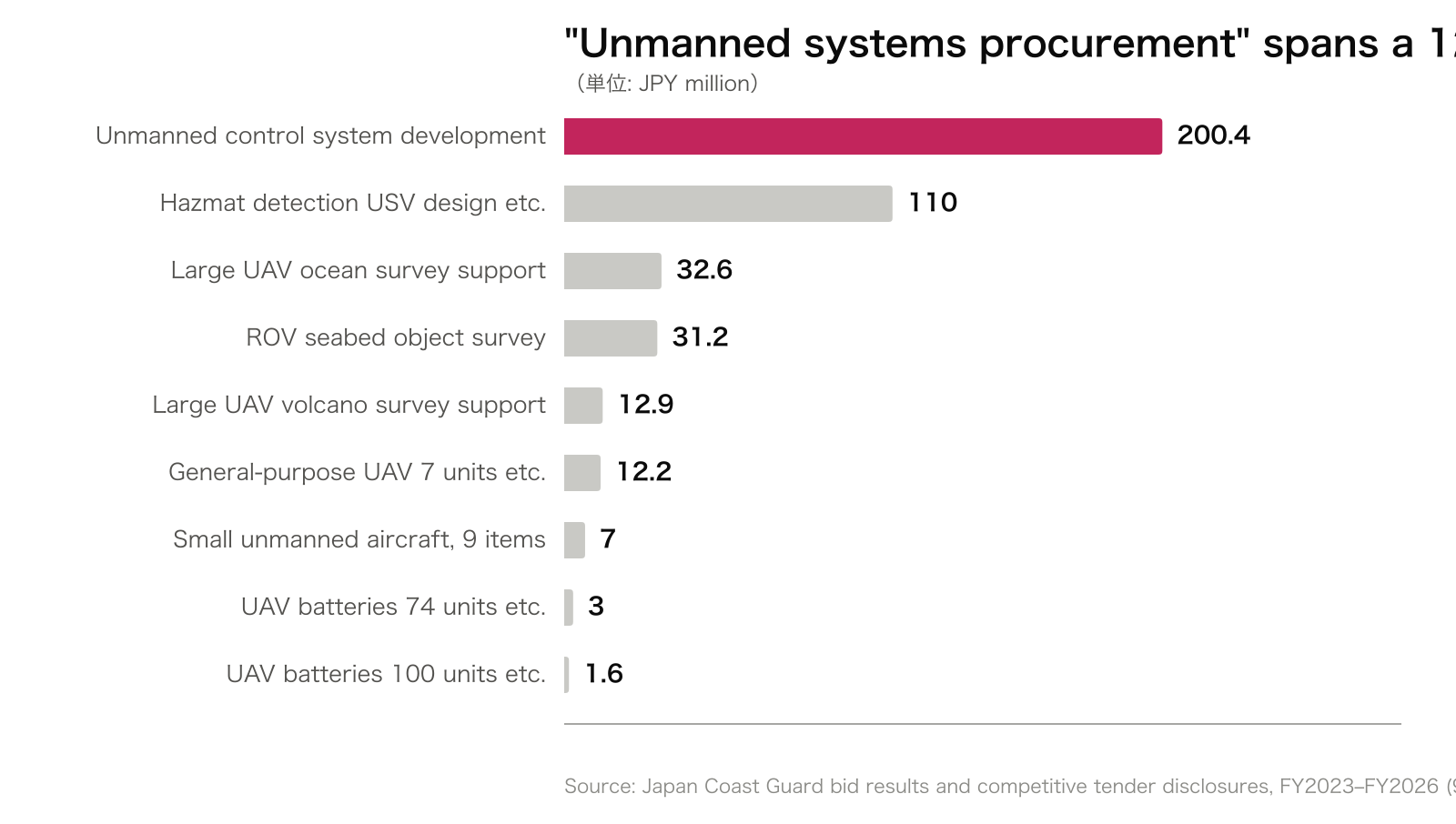
Smallest ¥1.63 million of batteries; largest ¥200.42 million to develop a system. A 126-fold range. The same phrase — procuring unmanned systems — covers restocking consumables and designing a new vessel from scratch.
Both of the top two relate to the hazmat detection vessel, and both went to Yanmar Power Technology: ¥110 million for design, ¥200.42 million for development and manufacture. Those two alone are 75.6% of the total. The remaining seven come to roughly ¥100 million between them. Most of this "unmanned procurement" was buying off-the-shelf equipment and consumables.
One bidder, and the ratio pins to the ceiling
Now the award ratios: contract value divided by ceiling price.
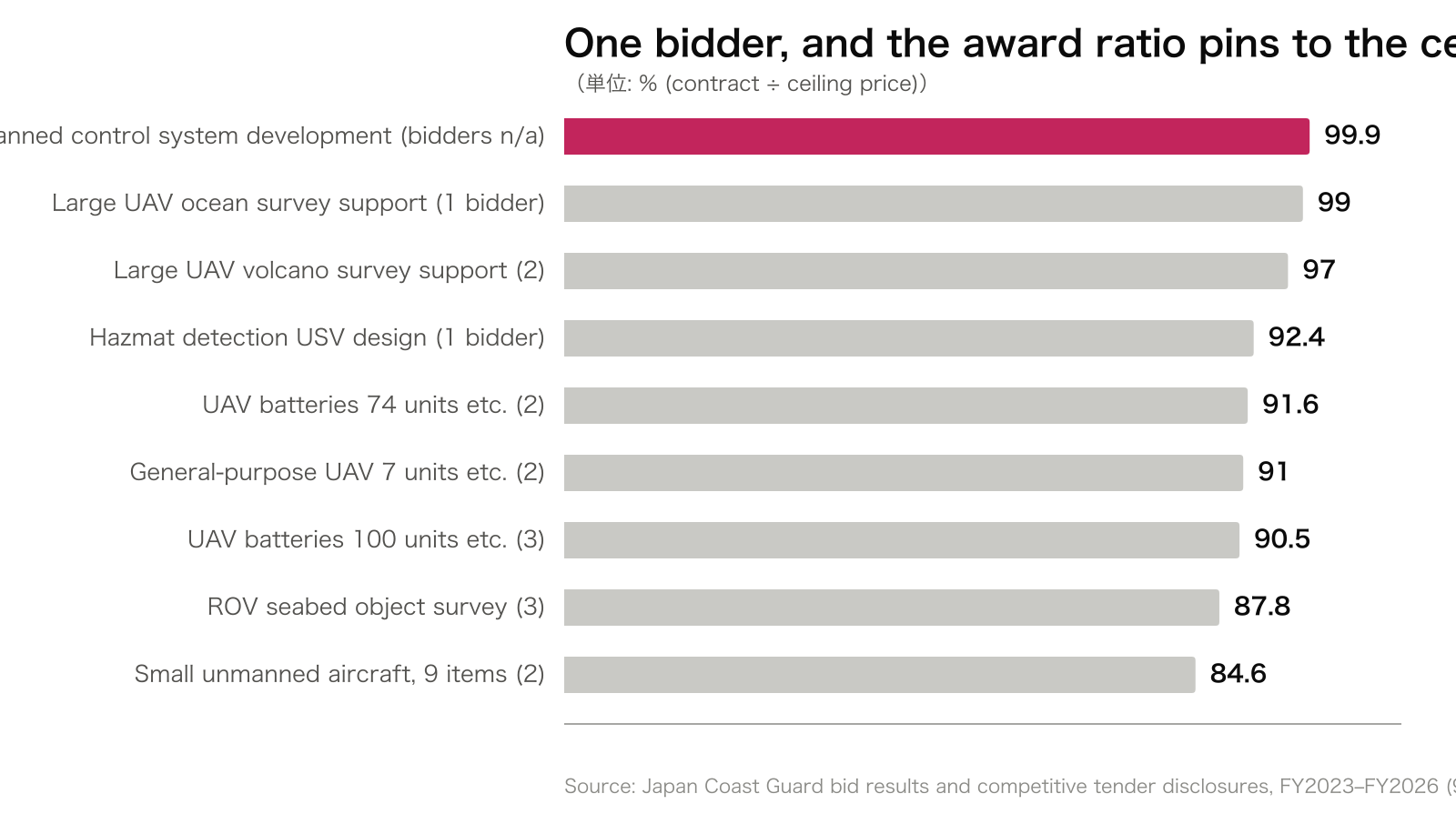
It separates cleanly. Six contracts with multiple bidders average 90.4%; the two with a single bidder average 95.7%. A 5.3-point gap.
The top two stand out. The unmanned control system came in at 99.9% (¥200.42m against a ¥200.6m ceiling), and large UAV ocean survey support at 99.0% (¥32.56m against ¥32,879,999). The bid result for the latter records a single bidder.
Numbers like these make some readers suspicious, so let me state my reading: I do not think this should be read as evidence of anything improper.
The reason is that very few firms can meet the specification. For an unmanned vessel, the set of Japanese companies that build their own marine engines, mould their own hulls and hold automatic docking control in-house can be counted on one hand. For large UAV flight services, few operators hold both the aircraft and the operating organisation. When one company can bid, price sits near the ceiling. Competition did not fail; the pool that could compete is simply tiny.
Consumables show the opposite. Batteries drew three bidders at 90.5%; nine items of small unmanned aircraft drew two at 84.6%. The moment something becomes a commodity, competition appears — an entirely unsurprising result, now with numbers attached.
Buying flight hours, not aircraft
Something else only became visible through counting: what is being bought is changing.
The FY2024 "large UAV volcano survey support" and FY2026 "large UAV ocean survey support" both went to Yamaha Motor, and neither is an aircraft purchase. As the titles say, these are survey support services — the flying is contracted out.
The values were ¥12,859,000 in FY2024 and ¥32,560,000 in FY2026. A 2.5x increase in two years.
There is sound logic here. Owning large UAVs in-house means absorbing maintenance, pilot training, regulatory approvals and hangar space. For a handful of volcano and ocean surveys a year, paying someone to fly is cheaper. The FY2026 figure of ¥32.56 million does not come close to buying an airframe.
But this shape also means capability accumulates on the contractor's side. Operating know-how and data collection practice build up at the winning company. In terms of keeping technology inside Japan that aligns with the Growth Strategy's intent; whether operational knowledge accumulates at the Coast Guard is a separate question. I would flag this as structure to be aware of, not as good or bad.
The Growth Strategy's commitment to "market formation through anchor tenancy" for marine unmanned vehicles is covered in a separate article. Government as first customer, building a market. These nine contracts are that policy in practice. ¥410 million is small for market-making, but from the suppliers' side — Yamaha, Yanmar, Sener and Barnes — it proves the exit for development investment exists.
Count by contracts or by value and the picture changes
Aggregating by supplier shifts the view again.
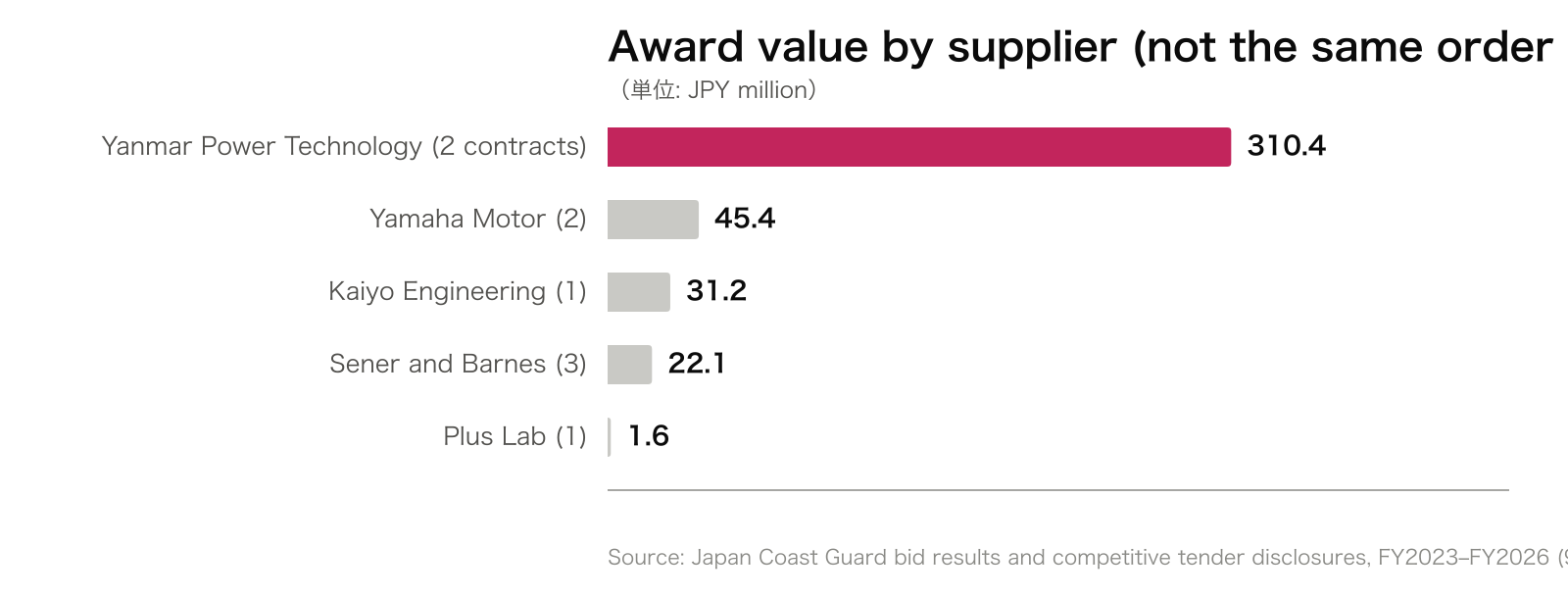
By count, Sener and Barnes leads with three. By value, its ¥22.1 million ranks fourth. Yanmar Power Technology has only two contracts but ¥310.4 million, 75.6% of the total.
The gap reflects different roles. Sener and Barnes supplies off-the-shelf equipment: seven UAVs, batteries, nine items of small unmanned aircraft. Small unit values, higher frequency. Yanmar won the design of the hazmat detection vessel and the development and manufacture of its control system — one-off development work.
Yamaha's two are neither. Not supplying airframes, not developing them: flying them. ¥45.4 million total, second by value on two contracts.
So inside these nine "unmanned procurements" sit three distinct kinds of transaction: buying commodities, funding one-off development, and contracting operations. Counting alone does not surface that. I only noticed it after putting value and count side by side.
What this has to do with export control
Marine unmanned vehicles are named in the Growth Strategy as dual-use technology — usable for civilian and military purposes alike. And looking at these nine contracts, the winners are not defence primes. Yamaha Motor, Yanmar, and small specialist suppliers. Companies that have always made civilian products are carrying Japan's public-sector unmanned capability.
That is where the practical line falls. A component or airframe designed as a civilian product can change classification the moment it is built into an unmanned platform. Sensors, motors, communications equipment, controllers. Not controlled on their own, potentially controlled depending on end use and integration.
If your products might enter this kind of supply chain, our three-minute export compliance check is a quick way to see where you stand. TRAFEED supports classification against METI criteria and counterparty screening, with final classification always resting with your own export control officer.
In summary
- Nine open-tender contracts, ¥410,848,193 across FY2023–FY2026
- Values span 126x, from ¥1.63m to ¥200.42m. The top two (vessel design and development) are 75.6% of the total
- Six multi-bidder contracts average 90.4%; two single-bidder contracts average 95.7%. Highest 99.9%
- Consumables drew two and three bidders with ratios around 90%
- Service procurement is displacing hardware purchase. Large UAV survey support rose from ¥12.86m to ¥32.56m in two years, 2.5x
- By count Sener and Barnes leads with three; by value Yanmar holds 75.6%. Three distinct transaction types sit inside the nine
- Winners are civilian manufacturers, not defence primes
- Ministry of Defense data could not be retrieved by machine; this is a Coast Guard-only count
Counting sharpened my sense of what "unmanned" means in practice. Government unmanned capability calls to mind large platforms; the contracts actually moving were mostly small off-the-shelf aircraft, their batteries, and paying someone to fly. Unglamorous. But field survey work is demonstrably being displaced, and these nine contracts show it.
If your technology may touch public-sector unmanned work and you want to start with export control, talk to us directly.
Sources: Japan Coast Guard, "Bid and award status (open tenders)" for FY2023–FY2026, and the individual bid result PDFs for each contract. The FY2025 "development and manufacture of an unmanned control system for hazardous material detection" is from the annual disclosure of competitive tender information for goods and services. All retrieved 27 August 2026.