This is Hamamoto from TIMEWELL.
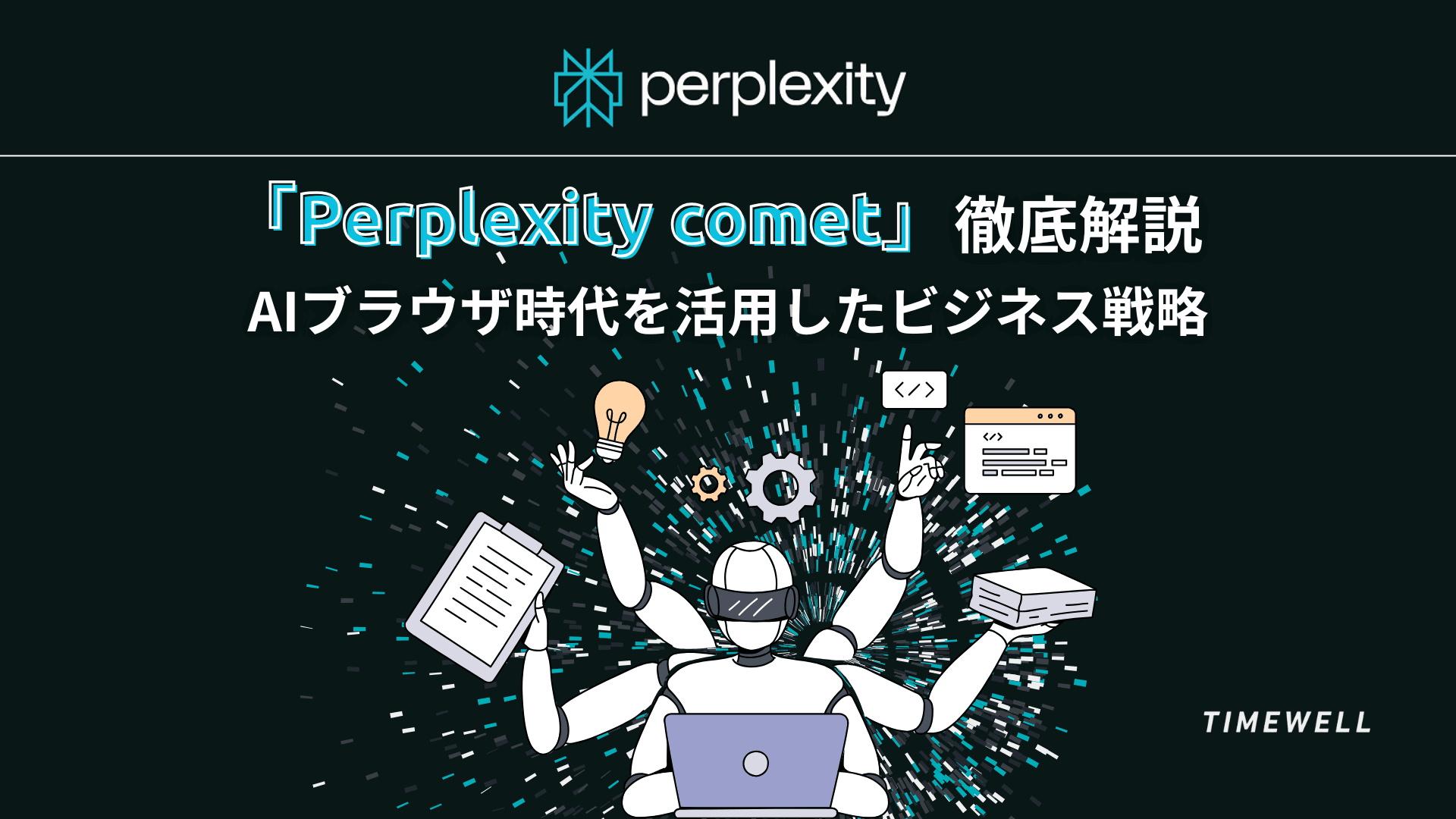
The constant switching between applications is one of the most underestimated sources of friction in modern knowledge work. A professional who needs to review a YouTube tutorial, summarize its contents, compare related products on Amazon, check social engagement on X, and schedule a follow-up meeting in Google Calendar might touch five or six separate applications to complete that sequence. Perplexity's AI browser Comet is designed to eliminate that switching entirely.
Comet integrates YouTube, Amazon, social platforms, Gmail, and Google Calendar into a single AI-native interface. Users log in once and can move between these services within a unified environment, with AI assistance available at any step. This article covers what Comet actually does, how it works in practice, and what it means for business strategy.
Why an AI-Native Browser Makes Sense Now
The premise behind Comet is straightforward: the current browser model was designed for document retrieval and navigation between sites. It was not designed for the kind of multi-source, multi-step information work that defines most contemporary knowledge work. Adding AI tools on top of a Chrome or Firefox interface helps at the margins, but does not eliminate the fundamental friction of context-switching.
Comet's approach is different. Rather than adding AI as an overlay on top of existing browser behavior, it rebuilds the interface around the assumption that AI is always present and always useful. Every service you access within Comet is available for AI interrogation — you can ask questions about a YouTube video while watching it, request a comparison of Amazon products without leaving the page, or schedule a calendar event in natural language without opening a separate application.
The competitive positioning is explicit: Google's Chrome and Gemini integration create a powerful combination, but they lock users into Google's ecosystem. Comet offers a platform-independent alternative that gives users full functionality across multiple services without becoming dependent on any single provider's roadmap.
The initial rollout is behind a waitlist, with premium plans available at around $200 per month — a price point that signals enterprise focus.
Looking for AI training and consulting?
Learn about WARP training programs and consulting services in our materials.
What Comet Does: Practical Use Cases
Video consumption and information extraction. Within Comet, a user watching a Canva tutorial on YouTube can activate an assist button to receive a real-time summary of the video's key points, alongside suggested search queries and related content. This eliminates the separate workflow of watching, pausing, copying, and pasting into a summarization tool. The AI output appears alongside the video, not in a separate tab.
Product research on Amazon. When evaluating a purchase decision, Comet can display a side-by-side comparison of up to ten products in response to a natural language query — price, recommendation rationale, use case, and Amazon link all structured in a table. This collapses a research process that would typically involve multiple tabs, manual note-taking, and significant time into a single interaction.
Social media analytics. Connected to X (formerly Twitter) or Instagram, Comet can generate structured analytics for any account — posting date, topic, engagement metrics, retweet counts, and content summaries formatted as a table — in response to a query. For marketing teams monitoring competitor activity or tracking campaign performance, this reduces a workflow that normally requires third-party analytics tools to a browser-native action.
Calendar and email management. Users can schedule a Google Calendar event or draft a Gmail message in natural language within Comet — "Schedule an online meeting at 2:00 PM today" triggers automatic calendar entry without requiring the user to navigate to a separate application. The demonstration of this capability in Comet's public previews shows a smooth handoff between instruction and execution.
Seamless authentication carryover. One friction point in switching to a new browser is re-authenticating with every service. Comet handles this by inheriting login state from existing services where possible, reducing the setup overhead that typically makes browser transitions feel prohibitive.
The Business Intelligence Play
For organizations thinking beyond individual productivity, Comet's potential is more significant. A browser that processes all of a user's web activity within a unified AI environment generates a comprehensive dataset about that user's information needs, research patterns, and decision-making processes.
This creates a feedback loop that conventional browsers cannot match. Comet can identify which content types drive engagement, which research paths lead to purchase decisions, and which queries represent unmet information needs — in real time, not in retrospect. For enterprise deployments, this means marketing strategy, product feedback collection, and internal knowledge management can all draw on behavioral data that was previously invisible.
The comparison to Google's ecosystem is instructive. Google achieves similar intelligence by routing activity through its own services — Search, YouTube, Gmail, Chrome — and using the behavioral data to improve targeting and products. Comet's pitch is that organizations can achieve comparable intelligence without becoming dependent on Google's infrastructure or contributing their data to Google's AI training pipeline.
For an enterprise deploying Comet as a standard internal browser, the implications include more accurate measurement of how employees actually use information, stronger security through centralized activity logging, and the ability to surface institutional knowledge at the moment it is needed.
Future Direction: The AI Agent Era
The trajectory Comet is on leads somewhere more consequential than productivity improvements. As AI browsers mature, the natural extension is full automation of multi-step information workflows — what the industry is calling the "AI agent" paradigm.
Rather than a professional querying each service manually, an AI agent operating through a browser like Comet could monitor a market development, extract relevant information from multiple sources, synthesize it into a structured briefing, and deliver it to the appropriate stakeholder — all without human initiation of each step. The speed differential between human-directed research and AI-agent research is already significant; as agent capabilities improve, it will become decisive.
Training and knowledge management are parallel application areas. A browser that can surface the most relevant internal documentation, competitive intelligence, or training material at the moment a user's query indicates they need it — without requiring the user to know where to look — addresses one of the most persistent knowledge management failures in large organizations.
Summary
Perplexity's Comet is the most ambitious attempt yet to rebuild the browser around AI-native interaction rather than adding AI as a feature to an existing model. The practical capabilities — YouTube summarization, Amazon product comparison, social media analytics, Gmail and Google Calendar management — are real and demonstrated. The integration is genuinely seamless in a way that productivity-tool overlays are not.
For business professionals, the immediate value is reduced friction across the multi-application workflows that define daily information work. For organizations, the longer-term value is the behavioral intelligence that a unified AI browser generates — and the independence from platform lock-in that Comet's approach enables.
The competitive landscape will intensify quickly; Google's advantages in content ownership and search integration are not easily replicated. But for organizations that want AI-native productivity without full dependence on a single platform's ecosystem, Comet represents a genuinely different approach worth evaluating.
Reference: https://www.youtube.com/watch?v=82oX-LDS3F8
Related Articles
- The Reality of a Part-Time Employee Who Worked Full-Time, Took Two Maternity Leaves, and Changed Her View of Work | TIMEWELL
- Before Paternity Leave — What You Absolutely Must Do to Take Leave Even During a Busy Period
- Pursuing a Hands-On Architecture Firm: Finding My Own Way as the 5th Generation of a Construction Company | Fujita Construction