Hello, this is Ryuta Hamamoto from TIMEWELL.
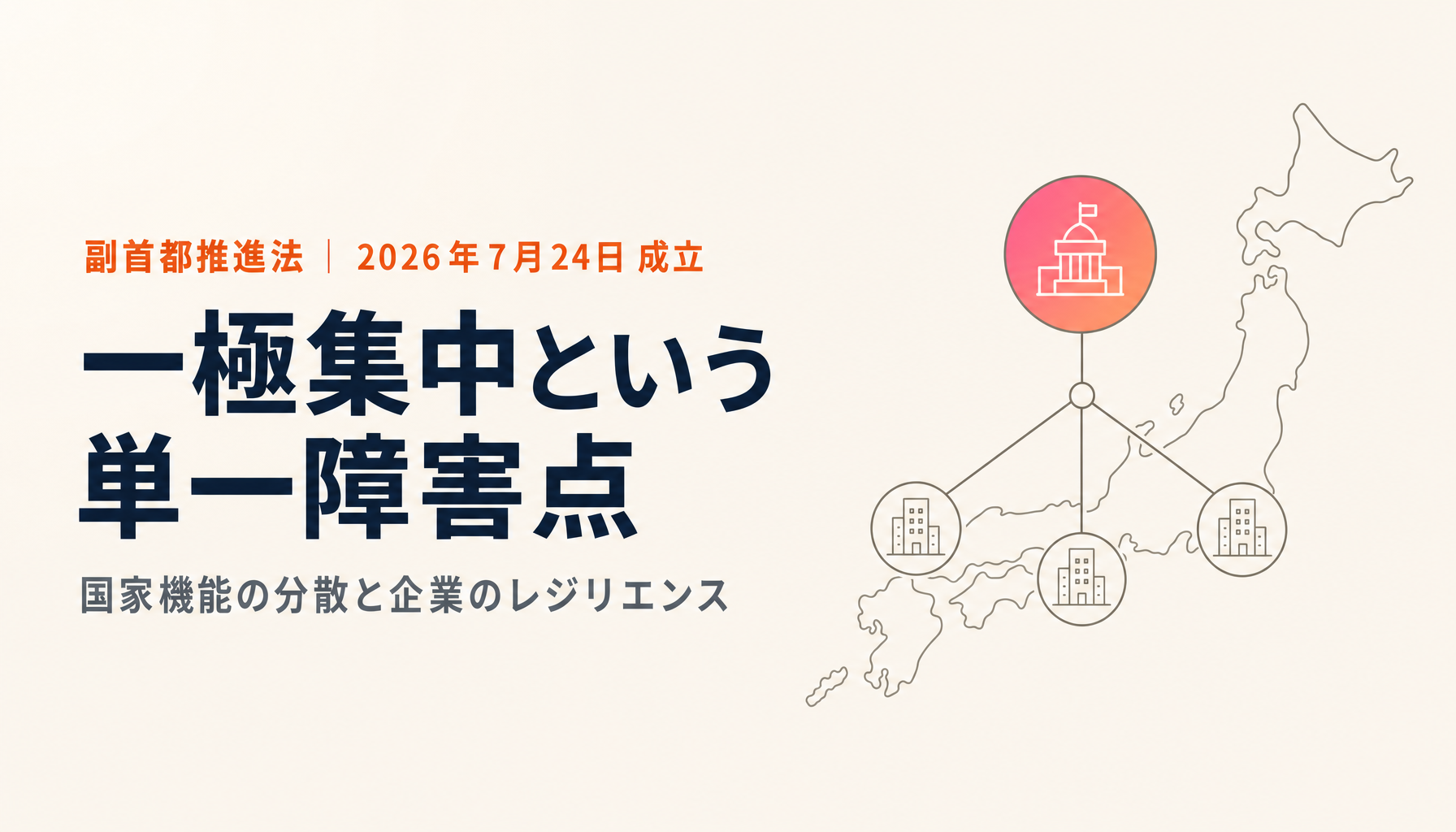
On July 24, 2026, Japan enacted a law about a "secondary capital." From the headline alone, it can look like a relocation-or-rivalry story ("will Osaka become the secondary capital?"). But read the name of the enacted law together with the government's own damage estimates, and it feels more like a story about security and resilience.
Working on economic security and export control day to day at TRAFEED, I see "don't concentrate critical functions in one place" as both a national question and a very practical corporate one — business continuity and site dispersal. So I'll read this through the enacted framework law and the government's figures, from a company's point of view.
Summary first
- On July 24, 2026, the "Act on Promotion of Measures to Ensure the Continuity of National and Social Functions and to Develop a Secondary Capital" was enacted. A member-sponsored bill jointly submitted by the LDP and the Japan Innovation Party, it is a framework law for "continuity of functions" and "developing a secondary capital" — not a law that designates a specific city.
- Behind it is the over-concentration of core functions — politics, administration, the economy — in Tokyo. The government itself states that losing those functions in a Tokyo-inland earthquake would have "a major impact on the whole country's daily life and economy, and overseas."
- The countermeasures it names are "strengthening the redundancy of core capital functions" and "temporary relocation." Over-concentration is, in effect, a single point of failure, and the idea is to disperse and reduce it.
- This sits on the same ground as corporate practice — BCP, site dispersal, data-center redundancy, supply-chain diversification. It is the same resilience story as economic security and national resilience.
What was actually enacted (from the source)
First, the facts, from the Diet's primary record.
- Formal name: "Act on Promotion of Measures to Ensure the Continuity of National and Social Functions and to Develop a Secondary Capital."
- Submission: a member-sponsored bill jointly submitted by the Liberal Democratic Party and the Japan Innovation Party (221st Diet session, House of Representatives bill No. 27).
- Progress: passed the House of Representatives with amendments on July 15, 2026, then passed and enacted in the House of Councillors on July 24, 20261.
The name says a lot. Before "developing a secondary capital" comes "ensuring the continuity of national and social functions." The core of this law is not "which city becomes the secondary capital" but "keeping the nation's social functions running even in a crisis" — continuity. It is a framework law promoting the measures for that, not a law designating a specific city — a point worth holding onto.
So this article does not wade into the city-versus-city debate ("Osaka, Nagoya, or Fukuoka?"). Several local governments are reported to be keen, but the question of place is for future procedures. Here I stick to the institutional and security point: how to reduce the single point of failure in national functions.
Replace siloed classification work with AI.
METI's FY2024 data shows 52% of foreign exchange law violations stem from classification errors. Download the TRAFEED product catalog covering features and rollout.
Why "security"? Read the government's figure
You might ask how this differs from ordinary earthquake preparedness. The fastest way to see it is the government's own figure — the summary of the report the Cabinet Office's Tokyo-inland earthquake working group compiled in December 2025.
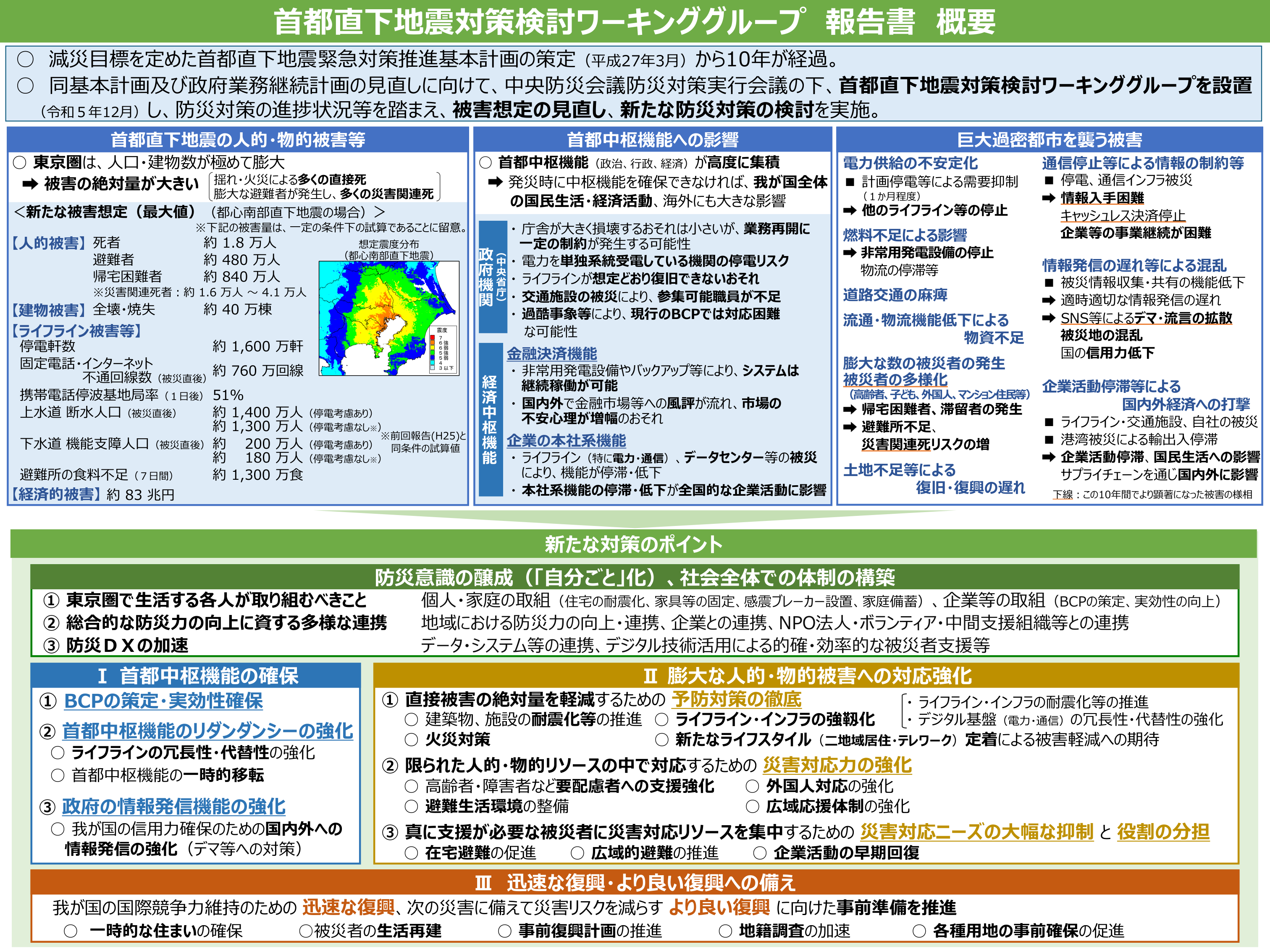
Source: Cabinet Office, Central Disaster Management Council, "Summary of the report of the Tokyo-inland earthquake countermeasures working group" (December 2025)2
The left of the figure is the scale of damage; the center is "impact on core capital functions." Here is the heart of the dispersal argument, in the government's own words.
- "Core capital functions (politics, administration, the economy) are highly concentrated."
- "If core functions cannot be secured at the time of the disaster, there is a major impact on the whole country's daily life and economy, and overseas."
- For government bodies, "under severe events, the current BCP may be unable to cope."
- For companies' headquarters functions, "damage to lifelines (especially power and communications) and data centers would stall or degrade functions," and "the stall or decline of headquarters functions affects corporate activity nationwide."
And lower in the figure, under "key measures," it says plainly: "strengthen the redundancy of core capital functions," "strengthen the redundancy and substitutability of lifelines," and "temporary relocation of core capital functions"2.
Redundancy is originally a systems-design term: build in double or triple capacity so that one failure doesn't stop the whole. The government is using that word about capital functions. That, to me, is the essence of this secondary-capital debate. Piling everything onto a single node called Tokyo is building a single point of failure — that's the concern.
Reading the numbers without alarmism
Here are the concrete numbers, too — not to frighten. The government's estimates are "under set conditions," and in some respects damage is smaller than before thanks to seismic reinforcement. I'll read them calmly, with that in mind.
Tokyo-inland earthquake (southern-Tokyo case, maximum values)2
| Item | Estimate |
|---|---|
| Deaths | about 18,000 (plus about 16,000–41,000 disaster-related deaths) |
| Fully collapsed / burned | about 400,000 buildings |
| Evacuees | about 4.8 million |
| Unable to return home | about 8.4 million |
| Without water supply (right after) | about 14 million people |
| Economic damage | about 83 trillion yen |
Nankai Trough megaquake (maximum values)3
| Item | Estimate |
|---|---|
| Deaths | up to about 298,000 |
| Fully collapsed / burned | up to about 2.35 million buildings |
| Economic damage (assets, etc.) | about 224.9 trillion yen |
| Impact on economic activity | about 45.4 trillion yen |
The Nankai Trough spans a wide area centered on western Japan; the Tokyo-inland quake strikes the national core that is the Tokyo area. Both are on a scale that dwarfs the fiscal and economic capacity to absorb them. That is exactly why the question becomes: assuming it happens, how do you protect the functions?
This "back up the capital's functions" thinking is not new, either. Right after the 2011 Great East Japan Earthquake, the government set up a "study group on securing core capital functions in a Tokyo-inland earthquake" (2011–2012) and, with core political, administrative, and economic bodies and lifeline operators, already discussed continuity and backup4. This year's promotion act sits on that line — a decade-in-the-making institutionalization, I'd say.
Function dispersal is a common design worldwide
"Politics, the economy, and information all gathered in one city" is, compared with other major countries, actually an exception. Plenty of countries separate the administrative capital from the economic center.
- United States: the political and administrative capital is Washington, D.C.; the economic and financial center is New York. Tech clusters in Silicon Valley, and recent years have seen corporate moves to places like Texas. A clear case of a geographically split core.
- Germany: after reunification, it moved capital functions from Bonn to Berlin. But under the "Berlin/Bonn Act," some ministries remain in Bonn to this day — a choice not to pile everything into one place at once.
- Australia: unable to settle on Sydney or Melbourne, it built the administrative capital, Canberra, on purpose, in between.
- South Korea: to ease Seoul's overcrowding and balance national development, it launched Sejong Special Autonomous City in 2012 and relocated many central ministries there (largely completed around 2017). Meanwhile, debate continues over keeping the National Assembly and the presidential office in Seoul (a full relocation of ministries was once halted by a 2004 Constitutional Court ruling, leaving only a partial move)5.
Each has its own history, of course. But the common thread is that "separating the administrative and economic capitals, or dispersing core functions geographically," is hardly a wild idea. That Japan is only now starting this debate is, internationally, a bit "at last."
How it connects to corporate resilience
Now the real point. National function dispersal is not someone else's problem for companies. The government report itself lists, as a countermeasure, "strengthening corporate BCP (business continuity plans)"2. National-level "redundancy" translates, at the company level, like this:
- Site dispersal: don't concentrate headquarters functions, core systems, and key people only in the Tokyo area. Place alternate sites in regions with a different damage profile.
- Data redundancy: split data centers and cloud geographically into a redundant configuration. The government figure explicitly names "damage to data centers would stall or degrade functions."
- Supply-chain diversification: don't run procurement and logistics on a single line. This is exactly the "supply-chain resilience" we always talk about in export control and economic security.
Economic security can look like an "outward" story — export controls, sanctions, securing critical goods. But at its root is a resilience idea: "don't make critical functions depend on a single point." The secondary-capital plan reads well as an attempt to implement that idea at the scale of national territory.
Honestly, nothing is settled yet — where the secondary capital will be, or when anything moves. But it is not a small thing that "reduce the single point of failure in national functions" has been institutionalized as a top-level government debate. For companies, this is a good moment to check your own BCP, sites, and data for "redundancy." That's the realistic place to begin.
Wrap-up
- What passed on July 24, 2026 is a framework law to promote "ensuring the continuity of national and social functions" and "developing a secondary capital." It designates no specific city; place is for future procedures.
- Behind it is the over-concentration of core functions in Tokyo. The government itself states that losing them in a Tokyo-inland earthquake would hit the whole country and overseas, and that the current BCP may not cope.
- The keywords are "strengthening redundancy" and "temporary relocation" — dispersing and reducing the single point of failure that is over-concentration.
- This sits on the same ground as corporate BCP, site dispersal, data redundancy, and supply-chain diversification — the same resilience story as economic security and national resilience.
- Rather than wading into "where," check whether your own critical functions have a single point of failure. That is where the value is, for a company.
The language of policy is grand, but what a company does is surprisingly simple: don't put everything in one basket. The secondary-capital plan, as I read it, is an attempt to do that at the scale of a nation.
Sources (primary)
Footnotes
-
House of Representatives, "Bill progress information: Act on Promotion of Measures to Ensure the Continuity of National and Social Functions and to Develop a Secondary Capital" (221st Diet session, HR bill No. 27). Passed the House of Representatives (amended) on July 15, 2026; passed and enacted in the House of Councillors on July 24, 2026. https://www.shugiin.go.jp/internet/itdb_gian.nsf/html/gian/keika/1DE2ACE.htm ↩
-
Cabinet Office, Central Disaster Management Council, "Summary of the report of the Tokyo-inland earthquake countermeasures working group" (December 2025). The figure here reproduces that summary, with the source cited. https://www.bousai.go.jp/jishin/syuto/taisaku_wg_02/pdf/r7houkoku1.pdf ↩ ↩2 ↩3 ↩4
-
Cabinet Office, Central Disaster Management Council, "Summary of the report of the Nankai Trough megaquake countermeasures working group" (March 2025). https://www.bousai.go.jp/jishin/nankai/taisaku_wg_02/pdf/nankai_gaiyo.pdf ↩
-
Cabinet Office, "Study group on securing core capital functions in a Tokyo-inland earthquake" (2011–2012). https://www.bousai.go.jp/kaigirep/kentokai/kinoukakuho/syuto_chusu_top.html ↩
-
Based on the history of Sejong Special Autonomous City, Republic of Korea (launched 2012), the relocation of central ministries, and the debate over keeping the National Assembly and presidential office in Seoul. The overseas examples (United States, Germany, Australia, South Korea) are an overview based on generally established facts about each country's capital-function arrangement; treat each country's official information as authoritative for specific years and the scope of relocation. ↩