Hello, this is Ryuta Hamamoto from TIMEWELL.
This one is for companies that buy semiconductors, multilayer ceramic capacitors, magnets, storage batteries or machine-tool parts and build them into their own products in Japan. I wrote it with two readers in mind: the person who handles procurement, corporate planning and export control at the same time, and the manager above them. If you are an overseas company with a site in Japan, or a supplier selling these parts to Japanese manufacturers, this is the question your Japanese counterparts are being asked right now.
In one sentence: a report says the Japanese government is thinking about a system under which companies that use critical parts would have to draw up a plan for buying them reliably. It is still at the consideration stage, and government publications do not yet confirm it.
Why now? On November 25, 2026, the Nikkei ran a story whose headline says, in our translation, that companies would be required to plan for stable procurement of semiconductors and advanced components1. The same week brought reports of a planned special account for economic security and of an outline of the economic security measures to be written into Japan's three security documents23. When someone inside your company asks whether you will have to file something, you should be able to answer by separating what has been decided from what has not. That is the purpose here.
Background that helps before reading. I cover the whole of the Economic Security Promotion Act in the guide to its four pillars and corporate practice, and the designated items in the guide to specified critical materials. This article narrows the topic to companies on the using side.
The conclusion first
- No obligation has been decided. The source is a Nikkei report, and as of November 29, 2026, we could not confirm it in Cabinet Office materials or in the summaries of the responsible minister's press conferences
- Plans under the current law are filed voluntarily by the making and supplying side. There were 171 certified plans as of November 26, 2026
- Companies on the using side are already inside a provision, in force since September 18, 2026, that asks the parties to endeavor to cooperate with one another
- Even before the details are set, you can inventory four things: sources, substitutes, stock and contracts. All four overlap with wording in the current law
A few terms first.
| Term | In plain words |
|---|---|
| Economic Security Promotion Act (経済安全保障推進法; "the Act" below) | Japan's law for protecting the supply of critical materials and core infrastructure. Its first parts took effect in August 2022 |
| Specified critical materials (特定重要物資) | Materials designated by Cabinet Order whose supply disruption would cause real harm. There are 16 today |
| Stable supply initiative policy (安定供給確保取組方針; "initiative policy" below) | A policy set by the competent minister for each material, stating what is to be done and by when |
| Supply assurance plan (供給確保計画) | A plan that manufacturers and others may prepare voluntarily and have certified by the minister. Certification opens the door to support |
| Best-effort obligation (努力義務) | A provision worded as a duty to endeavor. There is no penalty for not meeting it |
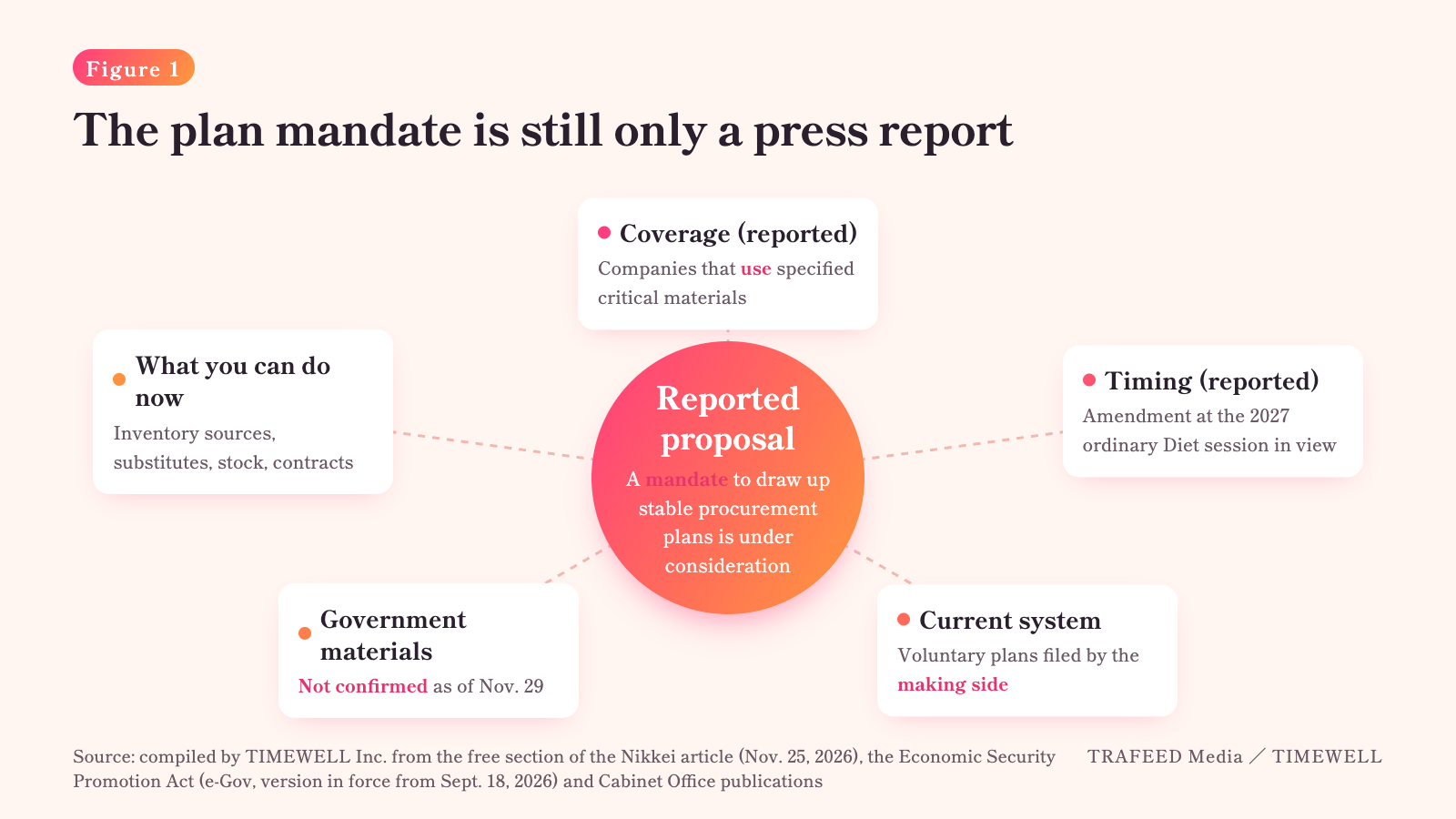 Figure 1. Where the reported proposal stands. The reported proposal is in the center, and the five items around it are what is known and what is not. Source: compiled by TIMEWELL Inc. from the Nikkei (November 25, 2026), the Economic Security Promotion Act (e-Gov) and Cabinet Office publications
What the report says, and what government documents do not confirm
The report makes four points, and none of them can yet be backed up from government publications. Let me first separate what is known and how far.
What I could read of the Nikkei article is the opening section that is free to read. It says the following. The government will consider a system that would require companies using critical materials such as semiconductors and advanced components, including makers of finished products, to draw up stable procurement plans. The aim is to diversify procurement routes and lower dependence on particular countries or suppliers. An amendment to the Act at the 2027 ordinary Diet session is also in view. The state would set a policy on the initiatives and indicate the actions and targets that companies using specified critical materials should work toward1. I have not read the paid section, so this article treats three things as unknown: where the line for covered companies would be drawn, what a plan would have to contain, and whether there would be penalties.
Next I went through the government's own materials. The Cabinet Office's economic security pages carry an overview of the system (November 2026 edition) and an overview of the amendment (September 2026 edition). Neither says anything about requiring companies that use the materials to file plans45. Summaries of press conferences by Kimi Onoda, the minister in charge of economic security, are published up to November 24. I found no mention of this system in the summaries for November 17, 20 and 246. Summaries for conferences after November 25, the day of the report, are not yet posted.
I also checked the materials of the Cabinet Secretariat's Expert Panel on Economic Security Legislation (経済安全保障法制に関する有識者会議). The latest meeting shown in the published list is the 18th (October 16, 2026), and its agenda was data security and related topics. The materials of the supply chain resilience working meeting reported at the 17th meeting (July 24) explain the best-effort obligation and the cooperation requests (Article 8-2) introduced by the 2026 amendment. They contain no proposal to require plans from companies that use the materials7. Meetings held after November 25 have not been published. We have not yet checked the summary of proceedings of that working meeting or the materials of the 16th meeting.
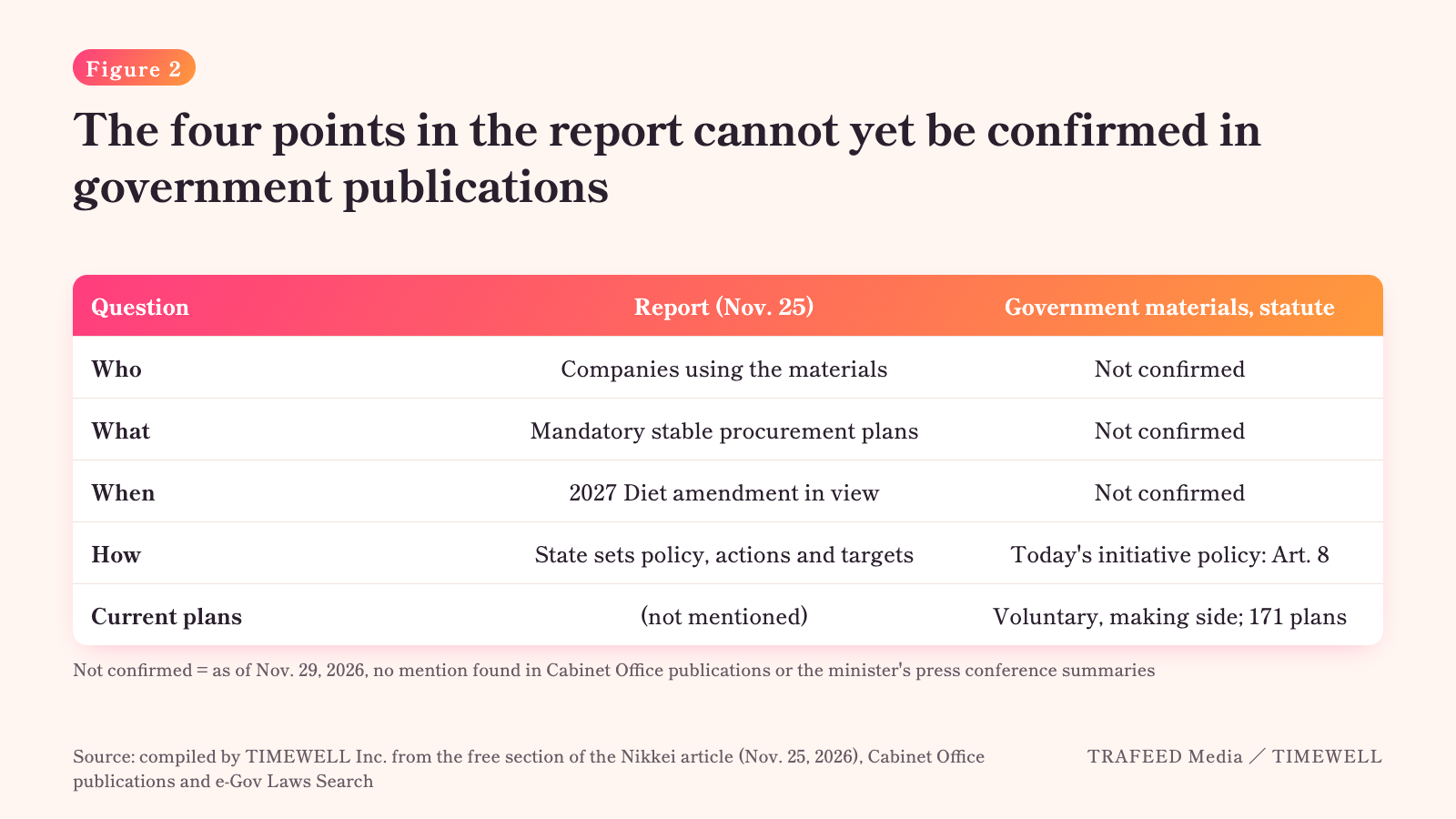 Figure 2. The content of the report and how much of it primary sources confirm. The left column is the question, the middle is the report, and the right is what we found in government materials and the statute. Source: compiled by TIMEWELL Inc. from the free section of the Nikkei article (November 25, 2026), Cabinet Office publications and e-Gov Laws Search (as of November 29, 2026)
Two other reports from the same week get the same treatment. On November 23, Kyodo News reported that the government will set up a special account for investment in key economic security fields and aims to amend the law at the ordinary Diet session early next year. The funding is reported to count on gains from selling exchange-traded funds (ETFs) held by the Bank of Japan2. For this one, a primary source exists for the direction only. The Basic Policy on Economic and Fiscal Management and Reform 2026, approved by the Cabinet on July 21, 2026, says that fields of particular importance for economic security will be managed in a separate framework under a special account, with funding secured over multiple fiscal years8. The content of the bill, its size and the breakdown of funding are not things I have confirmed in government materials.
On the three security documents (the National Security Strategy and two others), the Liberal Democratic Party has announced that its National Defense Division and Research Commission on Security held a joint meeting on November 25 and heard from the government about the direction of economic security in the revision3. The outline the government presented has not been published, and terms such as AI sovereignty (our translation) are known only from news headlines9. I read the direction the government showed at the August expert panel from primary materials in the article on the expert panel for the three security documents.
Picture a board meeting where someone asks, "Do we have to file a plan starting next year?" What you can say today stops here: it has been reported as under consideration; the report puts a legal amendment at the 2027 ordinary Diet session at the earliest; coverage and content have not been published. So there is no need at this stage to rewrite internal rules or to design a filing form in advance. What is worth doing is the inventory of facts I describe further down.
Replace siloed classification work with AI.
METI's FY2024 data shows 52% of foreign exchange law violations stem from classification errors. Download the TRAFEED product catalog covering features and rollout.
The system today: the making side files voluntarily, and the state supports it
The current Act does have plans, but they are filed by the side that makes or supplies the materials, and filing is the company's choice. Once you see that, it becomes clearer what the reported proposal would change.
Chapter 2 of the Act is built in this order. The state designates, by Cabinet Order, materials whose supply disruption would cause harm (Article 7). The minister with jurisdiction over a material sets an initiative policy for it (Article 8). The policy is to state the content of the initiatives and the period or deadline for carrying them out. Then a business that intends to work on stable supply may prepare a supply assurance plan, submit it to the minister and obtain certification (Article 9)10. The statute says a business may do this, not that it must, so it is voluntary. A certified business can receive support such as subsidies, interest subsidies to financial institutions and lending through the Japan Finance Corporation4.
Here is the track record in numbers. According to Cabinet Office materials, there are 16 specified critical materials, a total budget of 2.5643 trillion yen and 171 certified supply assurance plans as of November 26, 202611. The count differs widely by material.
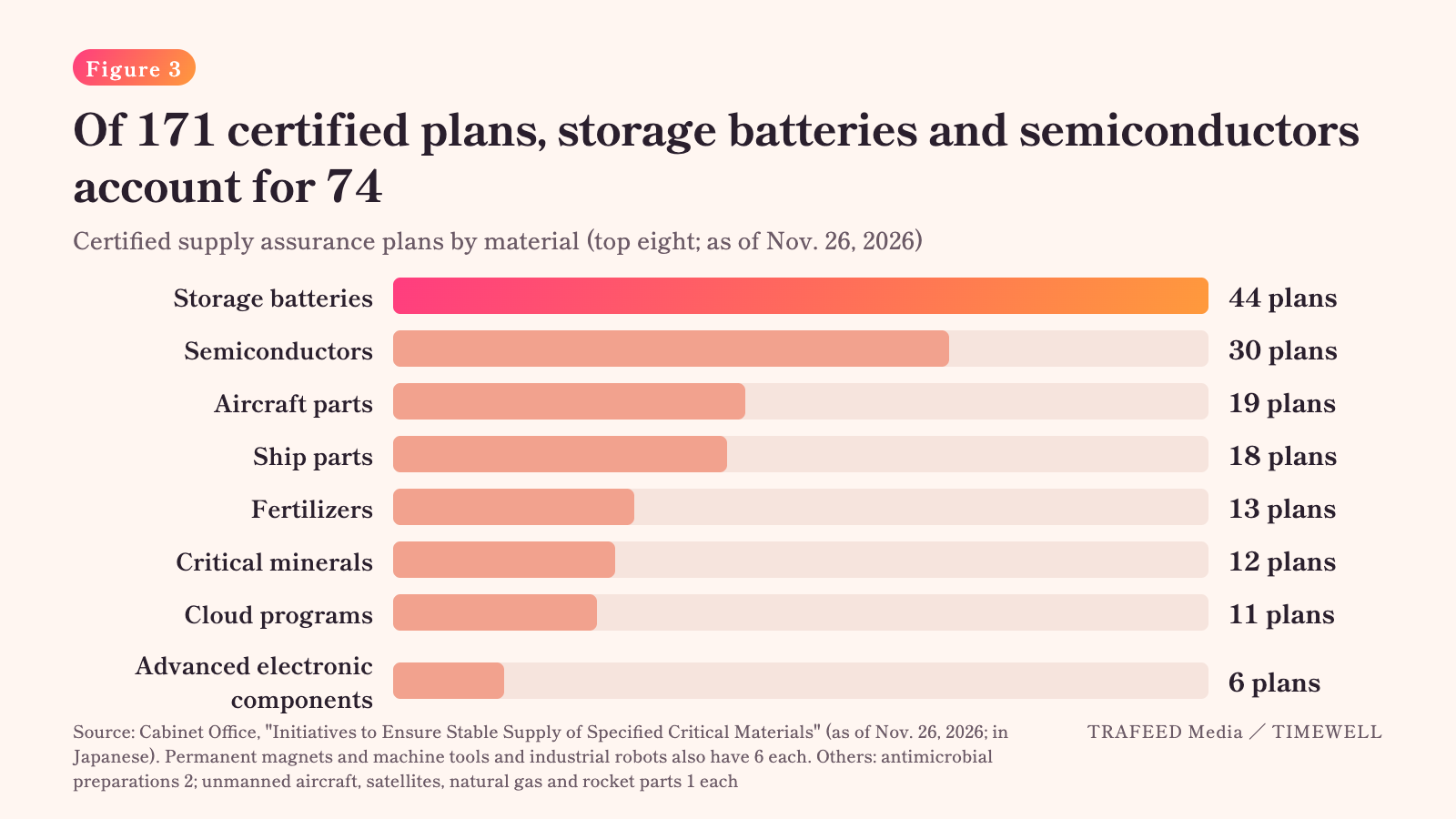 Figure 3. Certified supply assurance plans by material (top eight). A longer bar means more certified plans. Source: Cabinet Office, "Initiatives to Ensure Stable Supply of Specified Critical Materials" (as of November 26, 2026; in Japanese)
Storage batteries have 44 plans and semiconductors 30, which together exceed 40 percent of the total. Advanced electronic components (multilayer ceramic capacitors, filters, magnetic sensors and so on), the category closest to the "advanced components" in the headline, have 6. Permanent magnets also have 611. The materials dated November 4 showed a total of 169, so the count rose by 2 in about three weeks4.
The point to hold on to is who files those 171 plans: companies that make the materials, and companies that supply their raw materials or production equipment. The certification requirements also list investment that maintains or strengthens supply capacity10. Take an industrial machinery maker that buys capacitors and magnets from a trading company and builds them into control panels. Under the current system, that company is not in a position to file a plan. The entrance to support basically faces the making side.
Certified businesses carry duties too. They must report to the minister every fiscal year on how the plan is being carried out (Article 12). A business that is asked by the minister for a report or materials and fails to respond, or reports falsely, faces a fine of up to 300,000 yen (Article 48, paragraph 4; Article 96)10. That said, this is a duty borne by companies that raised their own hands and took the support.
So the current system works like this: suppliers that want support file a plan, and only those that file take on a reporting duty. Companies that merely use the materials have so far stood outside the plans.
The amended Act already touches users: two things the reported proposal would change
Companies on the using side have appeared in the text of the law since September 18, 2026. I read the reported proposal as an extension of that line which would change two things: who is addressed, and how binding it is.
The amending act promulgated on June 17, 2026 (Act No. 38 of 2026) took effect on September 18105. It added three articles to Chapter 2. I covered the amendment as a whole in the article on the amendment to the Act and the article on cooperation with like-minded countries, so here I read only the parts that concern users.
The first is Article 8-2. It provides that the state, businesses that produce, import or sell specified critical materials, and other parties concerned, including individuals and corporations that receive supplies of those materials, are to endeavor to cooperate while coordinating with one another for stable supply10. The Cabinet Office materials also describe this group as businesses that receive supplies of specified critical materials5. This amendment is where companies that buy and use parts were first written into the statute as parties expected to endeavor to cooperate. It is a best-effort obligation, though, with no penalty.
The second is Article 9-2. Where a business producing or selling a material is discontinued, transferred or relocated, the minister may ask the parties concerned for materials and information. If the minister then finds that leaving things as they are could impair stable supply, the minister may encourage the preparation and submission of a supply assurance plan10. Those who can be encouraged are on the side that carries out production, import, sales and similar business.
The third is Article 11-2. When a certified business looks unlikely to proceed as planned, for example because a raw-material supplier is closing, it can have the minister ask the parties concerned for cooperation10. Separately, Article 48, which predates the amendment, lets the minister ask businesses that produce, import or sell the materials to report on their procurement and storage. The wording for those asked is that they must endeavor to respond10.
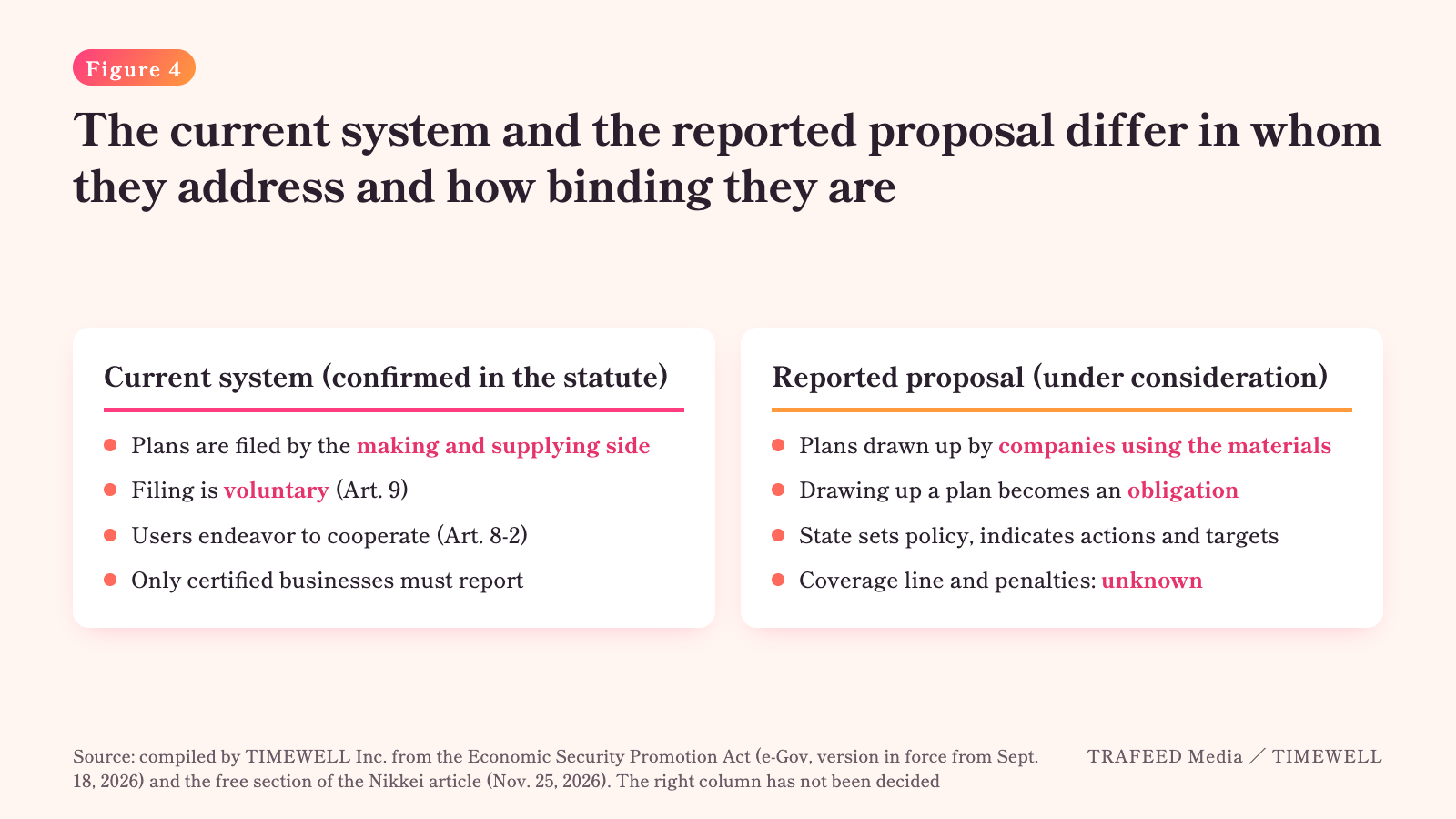 Figure 4. Comparing the current system with the reported proposal. The left side is the current system as confirmed in the statute, and the right side is the proposal as reported. The right column is under consideration and has not been decided. Source: compiled by TIMEWELL Inc. from the Economic Security Promotion Act (e-Gov, version in force from September 18, 2026) and the free section of the Nikkei article (November 25, 2026)
Set side by side, the reported proposal would change two things. The party that files a plan would widen from the making side to the using side. And the voluntary verbs of the current law, such as may, encourage and endeavor, would become an obligation. The report's description, in which the state sets a policy and indicates the actions and targets companies should work toward, looks to me like applying today's initiative policy mechanism (Article 8) to users as well. That is my own reading from comparing the statute with the report. The government has not explained it that way.
The government's concern can also be read from published documents. The Basic Policy 2026 says supply chains and the manufacturing base will be strengthened from upstream to downstream, and that for areas where stable supply is hard to secure if left to economic rationality, further forms of state support will be considered8. I mapped the spread of export restrictions in various countries that sits behind this in the overview map of rare earth export controls.
For companies on the using side, then, the foundation of endeavoring to cooperate is already in force. The reported proposal is about whether a concrete task, drawing up a plan and showing it, would be placed on top of that foundation.
What form could a "plan obligation" take? Three models in existing Japanese law
The word obligation makes people brace, but plan obligations in Japanese law come in several models of different weight. Which one the reported proposal would follow is not known. What follows is my own sorting of existing laws. It is not an account of any government proposal.
The first model is regular filing. The Energy Conservation Act (formally the Act on Rationalizing Energy Use and Shifting to Non-fossil Energy; 省エネ法) designates companies whose energy use is at or above a level set by Cabinet Order as specified business operators, and requires them to prepare a medium- to long-term plan and submit it to the minister. Failure to submit carries a fine of up to 500,000 yen12. The line is drawn by size, and covered companies file every time.
The second model applies only in an emergency. The Food Supply Difficulty Situation Countermeasures Act (食料供給困難事態対策法) lets the minister instruct businesses to prepare and file a plan only in a situation where food supply falls seriously short and requests to adjust shipments or sales have not been enough. Failing to file against such an instruction carries a fine of up to 200,000 yen, and a business that does not act according to its plan may be named publicly13. Nothing is filed in normal times. The plan is called for once the situation arises.
The third model is prior review. Under the Act's core infrastructure system, a designated operator files a plan before installing important equipment and undergoes government review. Failing to file, or filing falsely, carries imprisonment of up to two years or a fine of up to 1 million yen10. I wrote about how this works in practice in the article on prior screening for core infrastructure.
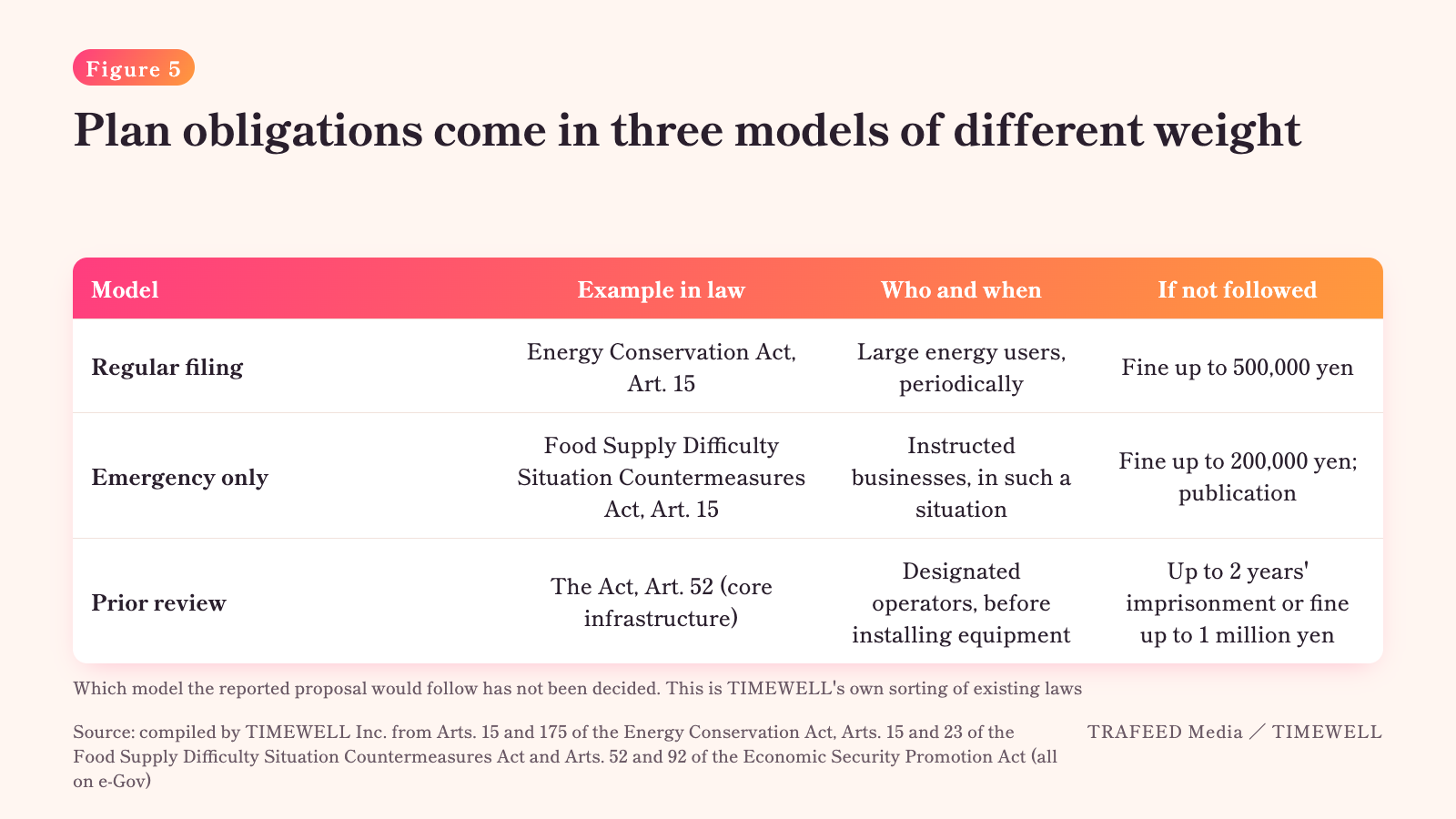 Figure 5. Three models of plan obligation in existing law. The higher rows are filed as a matter of routine, and the lowest involves review before a transaction. Which model the reported proposal would follow has not been decided. Source: compiled by TIMEWELL Inc. from the Energy Conservation Act, the Food Supply Difficulty Situation Countermeasures Act and the Economic Security Promotion Act (all on e-Gov)
Whichever model is chosen, there is a provision that acts as a brake. Article 5 of the Act says regulatory measures under it must be taken, with their effect on economic activity in mind, only to the extent reasonably necessary to ensure security10. The basic policy as revised on September 11, 2026 also says the government will endeavor to keep regulatory measures to the minimum necessary, and that it will endeavor to share information so as to encourage voluntary action by businesses14. A design that demanded the same plan from every company using even a single part is hard for me to square with that provision. I would expect the debate to narrow coverage by the volume used or by how much damage a stoppage would do.
It is worth checking the timeline as well.
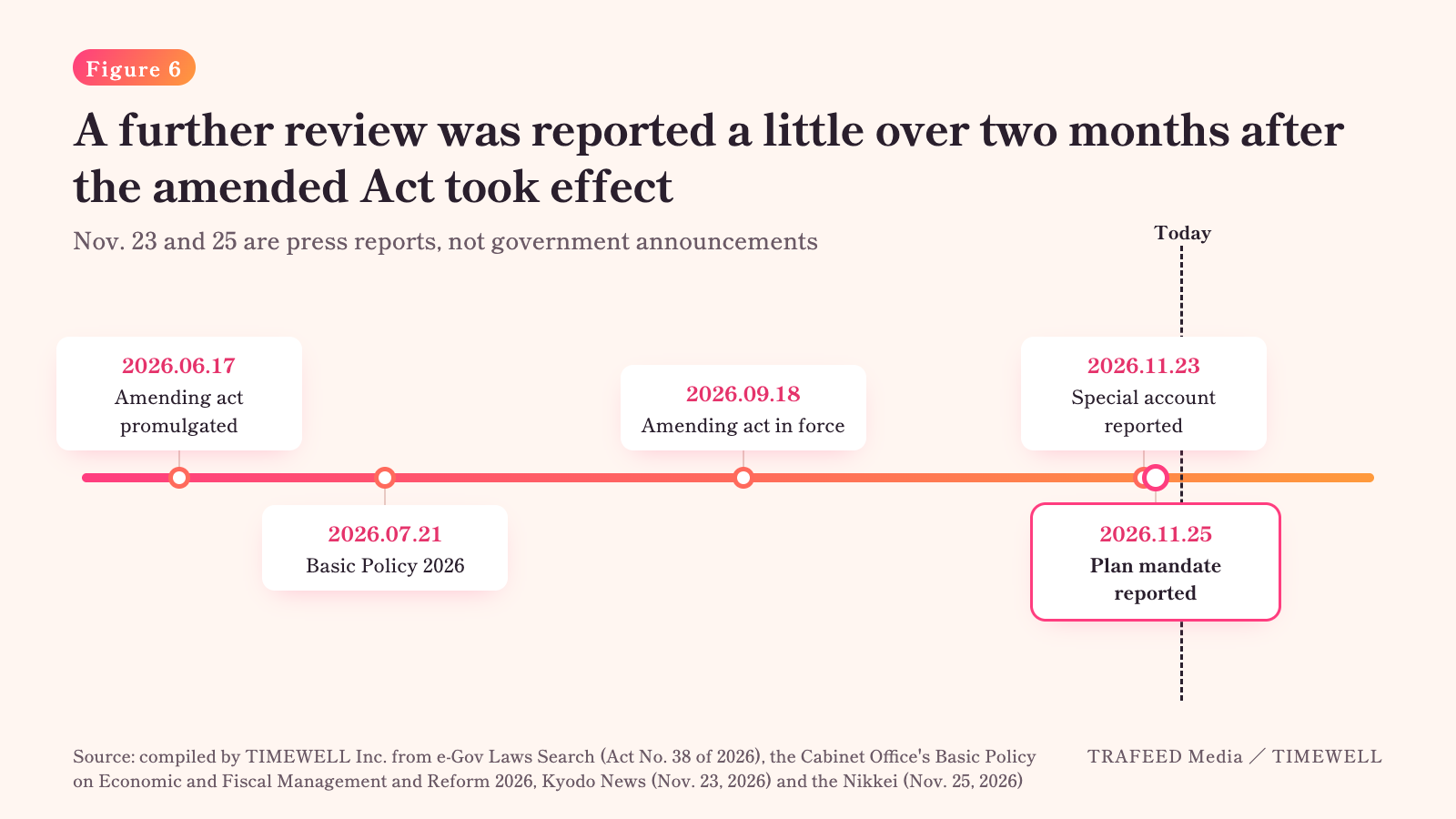 Figure 6. Events from June to November 2026. The darker dot is the day the plan mandate was reported as under consideration. The two points on November 23 and 25 are press reports, not government announcements. Source: compiled by TIMEWELL Inc. from e-Gov Laws Search, the Cabinet Office's Basic Policy on Economic and Fiscal Management and Reform 2026, Kyodo News (November 23, 2026) and the Nikkei (November 25)
Even if an amendment bill does go to the 2027 ordinary Diet session as reported, passage would be followed by Cabinet Orders, ministerial ordinances and revisions to the initiative policy for each material. For the 2026 amendment, about three months passed between promulgation in June and the entry into force of the supply-related parts105. So even if this became an obligation, there would be time before the coverage line and the plan format came into view. My view is that the time is better spent on the inventory in the next section than on waiting for a form.
Four things to inventory now: sources, substitutes, stock and contracts
Some preparation will not be wasted whatever the system turns out to be. It comes down to four things, sources, substitutes, stock and contracts, and each matches wording in the current statute.
The starting point is to confirm which of your purchased items fall under specified critical materials. The Cabinet Office list names items such as legacy semiconductors, multilayer ceramic capacitors, neodymium magnets, storage batteries, CNC units (numerical controllers for machine tools), ball screws, reduction gears and carbon fiber11. Match your bill of materials against that list and mark the items that fall under it. Then check the four in order.
The first is sources. A certified plan has a field for the current state of procurement and use of the material (Article 9, paragraph 3, item 8)10. If users were ever asked for a plan, this is probably the first thing they would be asked. If you buy through a trading company, write down the manufacturer behind it and the country of manufacture. Say you buy the same capacitor part number from two trading companies. If one plant makes it, you have one source.
The second is substitutes. Article 7 lists rationalizing use and developing substitute materials among the ways of lowering dependence10. For each item, put down in one line whether a substitute exists, how many months of design change and evaluation testing a switch would take, and whether your customer has to approve it.
The third is stock. Article 7 also includes stockpiling10. Add what is in your own warehouse to what your supplier holds for you, and count how many days of normal production it covers. Holding the figure in days and not in money makes it usable for decisions when supply stops.
The fourth is contracts. The certification requirements include measures to be taken when supply and demand tighten (Article 9, paragraph 4, item 4)10. When supply thins, who does your supplier ship to first? Will you be told in advance? How many months ahead is end of production notified? Reread your master agreement and specifications and pick out the points on which nothing is agreed.
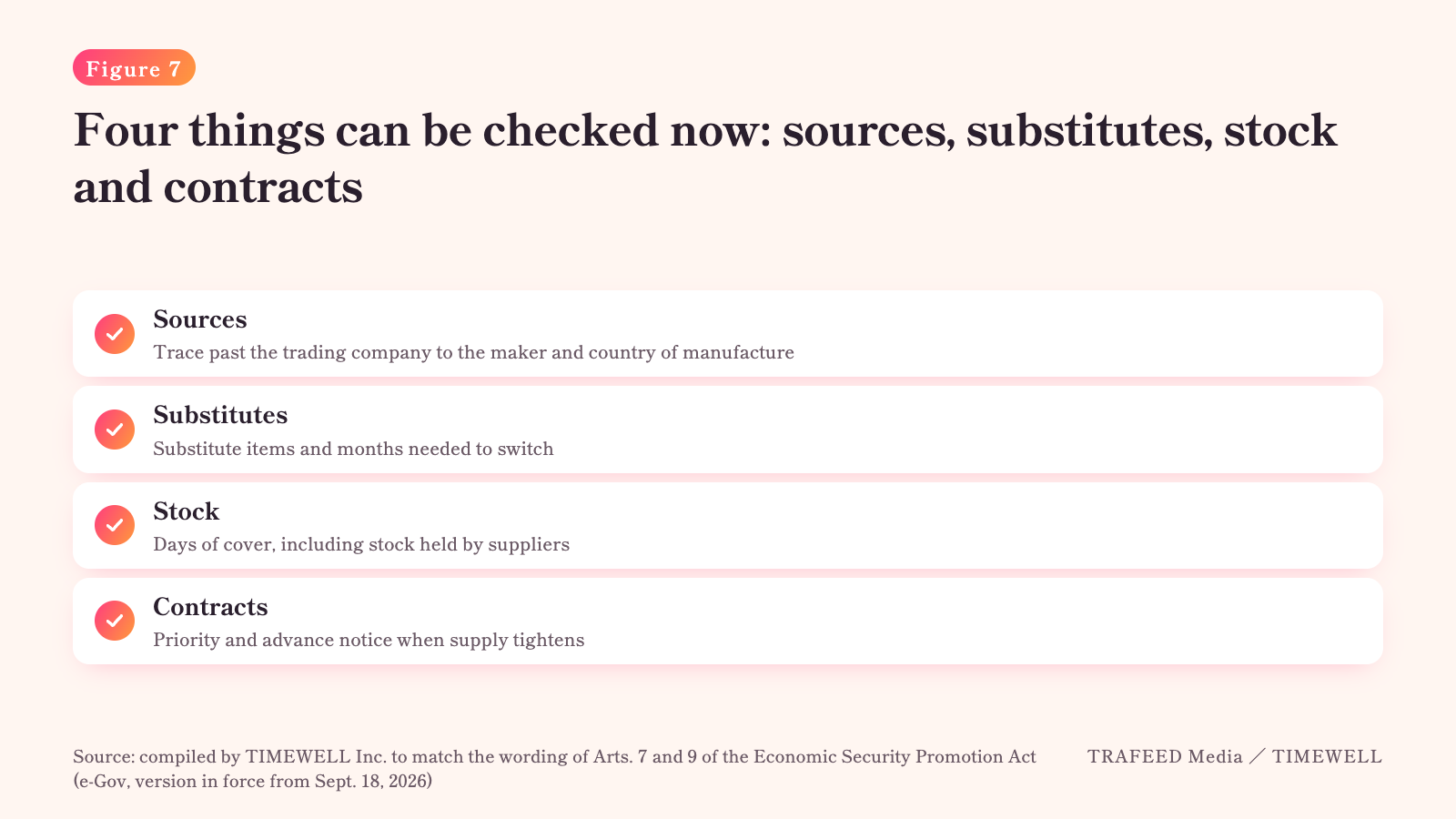 Figure 7. Four points to check before the system's details are settled. Working from the top gives you the material for the next item. Source: compiled by TIMEWELL Inc. from Articles 7 and 9 of the Economic Security Promotion Act (e-Gov)
These four also connect to export control work. Tracing a source back to the manufacturer can use the same ledger as counterparty screening, where you confirm who the other party really is. Widen your sources to a new country and you add the work of screening those parties. The more hats you wear, the more it pays to keep a single ledger. As starting points, we offer the Supply-Chain Due Diligence Self-Check Sheet, which lists the items to confirm with suppliers, and the 44-item self-check sheet for the Economic Security Management Guidelines (in Japanese), which reviews your setup against the guidelines of the Ministry of Economy, Trade and Industry (METI). How to read the guidelines themselves is in the explainer on the Economic Security Management Guidelines.
Honestly, doing all four for every item is heavy work. I suggest picking three items, among those that fall under specified critical materials, whose stoppage would stop your shipments, and starting there. The idea is to gather the facts that would go into a form before the form exists.
Summary
As of November 29, 2026, the stable procurement plan mandate is something the press has reported as under consideration. What government publications confirmed was the mechanism of the current Act and the direction written in the Basic Policy 2026, and no more. Coverage, plan content, penalties and timing cannot be stated as fact until they are published.
Reading the statute did tell me something, though. Companies on the using side were already inside the provision on endeavoring to cooperate when the amendment took effect on September 18. The reported proposal reads more naturally as the next step along that line than as something that appeared out of nowhere. What I think will matter more in practice than whether it becomes an obligation is whether the initiative policy for each material ends up saying what users are to do and by when.
There is one thing you can do this week. Match your bill of materials against the list of specified critical materials and mark the items that fall under it. From there, work through sources, substitutes, stock and contracts in that order, and whichever form the system takes, you will have the facts to hand. I will update this article when government materials or a bill are published. We also cover developments each week in the weekly regulatory update.
TRAFEED, which uses AI to support counterparty checks and the tracking of regulatory changes across countries, helps with screening new parties as you widen your sources. The final classification (determining whether an item falls under the control list) should be made by the person responsible for export control at your company.
Footnotes
-
Nikkei, "Semiconductors and advanced components: companies to be required to plan for stable procurement; government considering under economic security" (title translated by TIMEWELL; published November 25, 2026, 18:10, updated 18:41; in Japanese). We read the opening section that is free to read and have not read the paid section. Retrieved November 29, 2026. https://www.nikkei.com/article/DGXZQOUA255W30V21C26A1000000/ ↩ ↩2
-
Kyodo News, "Special account to be set up for economic security, aiming to secure multi-year budgets" (title translated by TIMEWELL; distributed November 23, 2026; in Japanese). This is information from a press report and we have not confirmed it in a government announcement. Retrieved November 29, 2026. https://news.yahoo.co.jp/articles/d894947eb8f1de3b7c4cf423bc99135d9398c859 ↩ ↩2
-
Liberal Democratic Party, notice on the security-related joint meeting that discussed economic security ahead of the revision of the three documents (posted November 26, 2026; joint meeting of the National Defense Division and the Research Commission on Security on November 25; in Japanese). Retrieved November 29, 2026. https://www.jimin.jp/news/information/214704.html ↩ ↩2
-
Cabinet Office, Counsellor (Specified Critical Materials) under the Director-General for Economic Security, "On the overall system for ensuring stable supply of critical materials (supply chain resilience) under the Economic Security Promotion Act and on preventing technology outflow" (November 2026, 13 pages; page 3 gives 169 certified plans as of November 4, 2026; pages 4 and 5 give the system overview and effective dates; in Japanese). Retrieved November 29, 2026. https://www.cao.go.jp/keizai_anzen_hosho/suishinhou/supply_chain/doc/sc_gaiyou.pdf ↩ ↩2 ↩3
-
Cabinet Office, "Overview of the amendments to the Economic Security Promotion Act and related laws (supply chain resilience)" (September 2026; page 2 gives the effective date of the amending act as September 18, 2026; page 3 explains the best-effort obligation, cooperation requests and related points; in Japanese). Retrieved November 29, 2026. https://www.cao.go.jp/keizai_anzen_hosho/suishinhou/supply_chain/doc/sc_kaiseigaiyo.pdf ↩ ↩2 ↩3 ↩4
-
Cabinet Office, summaries of press conferences by Minister of State for Special Missions Onoda (summaries for November 17, 20 and 24, 2026; in Japanese). As of November 29, 2026, the November 24 summary is the latest. https://www.cao.go.jp/minister/2609_k_onoda/index.html ↩
-
Cabinet Secretariat, meeting record of the Expert Panel on Economic Security Legislation (from fiscal 2022), and Document 1-1 of the 17th meeting (July 24, 2026), "Key points of proceedings and meeting materials of the 5th working meeting on supply chain resilience" (in Japanese). Retrieved November 29, 2026. We have not checked the summary of proceedings of that working meeting (Document 1-2). https://www.cas.go.jp/jp/seisaku/keizai_anzen_hosyohousei/4index.html ↩
-
"Basic Policy on Economic and Fiscal Management and Reform 2026" (Cabinet decision of July 21, 2026), page 19 (strengthening economic security), page 26 and footnote 117 (separate management under a special account). Page numbers are those printed on the pages. In Japanese. Retrieved November 29, 2026. https://www5.cao.go.jp/keizai-shimon/kaigi/cabinet/honebuto/2026/2026_basicpolicies_ja.pdf ↩ ↩2
-
Reports by several outlets from November 23 to 25, 2026 on the outline of the economic security measures to be included in the three security documents (Yomiuri Shimbun, Jiji Press, TV Asahi, the Nikkei and others; in Japanese). We checked these at headline level and have not seen the original outline presented by the government. ↩
-
Act on the Promotion of Ensuring National Security through Integrated Implementation of Economic Measures (Act No. 43 of 2022; as amended by Act No. 38 of 2026, version in force from September 18, 2026), Articles 5, 7, 8, 8-2, 9, 9-2, 11-2, 12, 48, 52, 92 and 96. e-Gov Laws Search (in Japanese). Retrieved November 29, 2026. https://laws.e-gov.go.jp/law/504AC0000000043 ↩ ↩2 ↩3 ↩4 ↩5 ↩6 ↩7 ↩8 ↩9 ↩10 ↩11 ↩12 ↩13 ↩14 ↩15
-
Cabinet Office, "Initiatives to Ensure Stable Supply of Specified Critical Materials" (as of November 26, 2026; 16 specified critical materials, total budget of 2.5643 trillion yen, 171 certified plans in total, with counts and items by material; in Japanese). Retrieved November 29, 2026. https://www.cao.go.jp/keizai_anzen_hosho/suishinhou/supply_chain/doc/jisseki.pdf ↩ ↩2 ↩3
-
Act on Rationalizing Energy Use and Shifting to Non-fossil Energy (Act No. 49 of 1979), Articles 7, 15 and 175. e-Gov Laws Search (in Japanese). Retrieved November 29, 2026. https://laws.e-gov.go.jp/law/354AC0000000049 ↩
-
Food Supply Difficulty Situation Countermeasures Act (Act No. 61 of 2024), Articles 15 and 23. e-Gov Laws Search (in Japanese). Retrieved November 29, 2026. https://laws.e-gov.go.jp/law/506AC0000000061 ↩
-
"Basic Policy on the Promotion of Ensuring National Security through Integrated Implementation of Economic Measures" (Cabinet decision of September 30, 2022; partially revised September 11, 2026), pages 6 and 7 (Chapter 1, Section 2 (3), coordination with businesses; Chapter 2, Section 2, points to note in implementing regulatory measures; in Japanese). Retrieved November 29, 2026. https://www.cao.go.jp/keizai_anzen_hosho/suishinhou/doc/kihonhoushin.pdf ↩