Hello, this is Ryuta Hamamoto from TIMEWELL.
"Our company somehow ended up on the government's critical materials list — does that mean we have to do something about it?" A procurement manager at a mid-sized maker of semiconductor materials once brought me exactly that question. The words "economic security" flood the news almost every day, yet the moment your own company becomes a party to it, it turns out to be surprisingly unclear what to check and where. A great many people stumble right at the entrance to this framework.
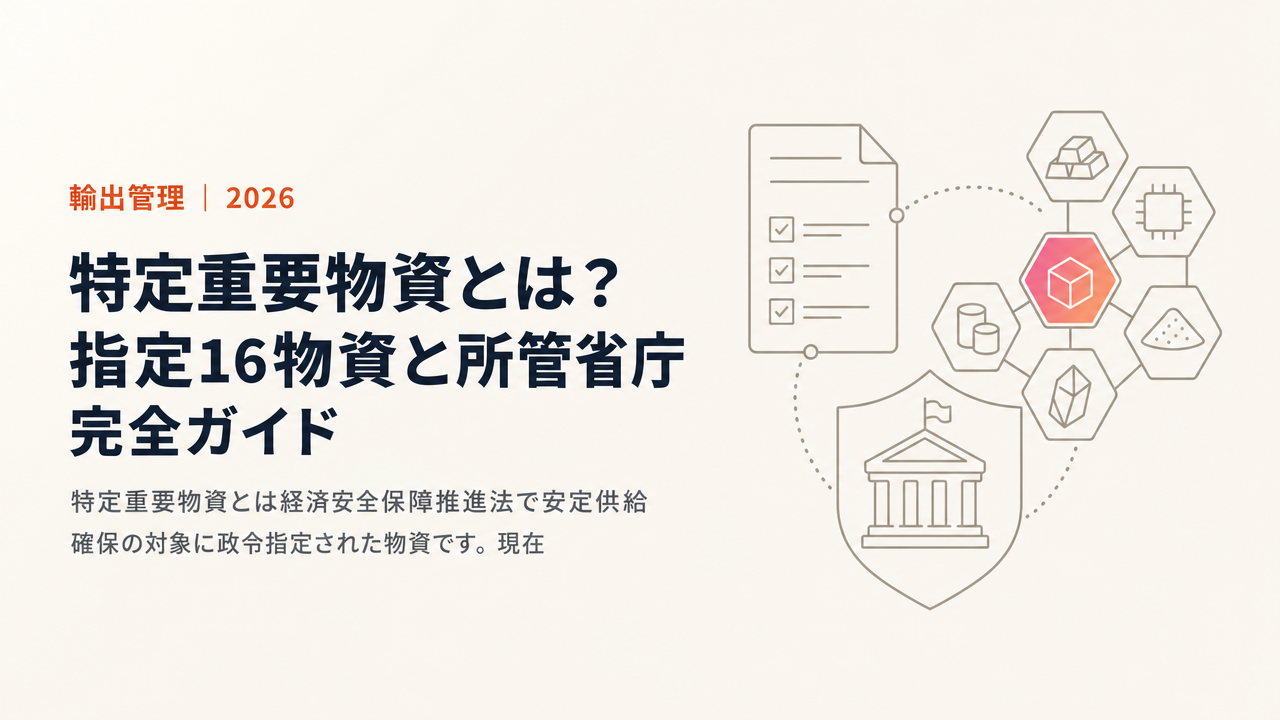
That entrance is the concept of "specified critical materials." These are goods that the government, under the Economic Security Promotion Act, has judged to be things whose stable supply must be assured — or else people's lives and the economy would grind to a halt — and has designated by cabinet order. Once designated, a material becomes eligible for generous support toward increased production, domestic manufacturing, stockpiling, and the development of alternatives; at the same time, companies take on a responsibility to protect the supply network. Semiconductors, storage batteries, permanent magnets, critical minerals, aircraft components, and — added at the end of 2025 — even ventilators and artificial satellites: this lineup is the very backbone of manufacturing.
In this article, I will organize the full picture of specified critical materials, which had expanded to 16 items as of July 2026, drawing on primary sources from the Cabinet Office and METI. What has happened to the frequently searched figure of "12 materials"? Who supervises each item, how much budget is attached, and how do you apply? If you want to determine whether your company falls within the framework, I recommend using our free export control and economic security self-check, which is built for economic-security compliance, alongside this guide — it lets you gauge where you stand from both the supply-assurance and export-control angles.
What Are Specified Critical Materials — One of the Four Pillars of the Economic Security Promotion Act
The quickest way to understand specified critical materials is to first grasp the overall shape of the law that underpins them. The governing statute is the "Act on the Promotion of Ensuring Security by Taking Economic Measures in an Integrated Manner" (経済施策を一体的に講ずることによる安全保障の確保の推進に関する法律), commonly known as the Economic Security Promotion Act. It was promulgated on May 18, 2022 as Act No. 43 of 2022 (令和4年法律第43号)1. To respond to an era in which the economy and security can no longer be separated, this law establishes the following four systems as its pillars.
The first is "assuring the stable supply of critical materials." The second is "ensuring the stable provision of critical infrastructure services." The third is "supporting the development of advanced critical technologies." The fourth is "non-disclosure of patent applications." Specified critical materials sit at the heart of the first pillar — the framework for strengthening supply chains. I cover the remaining three pillars in the complete guide to the Economic Security Promotion Act, which takes a bird's-eye view of the whole framework, so reading both together will give you a three-dimensional understanding.
If you sort the four pillars by character, specified critical materials and critical infrastructure are the two "defensive" systems. When something like semiconductors or electric power would stop society if it were cut off, you secure it domestically or diversify its supply sources. Advanced-technology development support and patent non-disclosure, by contrast, are systems for nurturing the seeds of Japan's technology and keeping them from leaking abroad — in character, they sit somewhere between offense and defense. Reading this alongside the pre-review system for critical infrastructure and the patent application non-disclosure system brings into focus what each system is trying to protect.
The important point is that specified critical materials are not merely a "list of important things." They are the starting point from which the government pours funding and institutional support into rebuilding supply networks. For a designated material, the government sets a policy, businesses draw up plans in line with it, and once certified, they can receive subsidies and low-interest financing. In other words, designation is closer in character to "support" than to "regulation." This is where it differs sharply from regulatory economic-security systems such as export control.
[Reference Table] The 16 Specified Critical Materials, Their Supervising Ministries, Support Agencies, and Certification Counts
Let's start by capturing the whole picture in one table. For the 16 materials designated as of July 2026, I have compiled the common name, supervising ministry, the stable-supply-assurance support agency responsible for subsidies and the like, and the number of certified supply assurance plans. The certification counts are the figures as of April 9, 2026, from the Cabinet Office document "Support Measures for Assuring the Stable Supply of Specified Critical Materials"2.
| Specified critical material (common name) | Supervising ministry | Support agency | Certifications |
|---|---|---|---|
| Antibacterial preparations | Ministry of Health, Labour and Welfare | National Institutes of Biomedical Innovation, Health and Nutrition | 2 |
| Fertilizer | Ministry of Agriculture, Forestry and Fisheries | Fertilizer Economy Research Institute | 12 |
| Permanent magnets | METI | NEDO | 6 |
| Machine tools and industrial robots | METI | NEDO | 6 |
| Aircraft components | METI | NEDO | 18 |
| Semiconductors | METI | NEDO | 26 |
| Storage batteries | METI | NEDO | 42 |
| Cloud programs | METI | NEDO | 11 |
| Combustible natural gas | Agency for Natural Resources and Energy | JOGMEC | 1 |
| Critical minerals | METI | JOGMEC | 7 |
| Ship components | Ministry of Land, Infrastructure, Transport and Tourism | Japan Ship Technology Research Association | 10 |
| Advanced electronic components | METI | NEDO | 4 |
| Ventilators | Ministry of Health, Labour and Welfare / METI (jointly supervised) | Japan Association for the Advancement of Medical Equipment | 0 |
| Unmanned aircraft | METI | NEDO | 0 |
| Artificial satellites | METI | NEDO | 0 |
| Rocket components | METI | NEDO | 0 |
Looking over this table, several features emerge. First, METI supervises 12 of the 16 materials. Combustible natural gas is handled by the Agency for Natural Resources and Energy, an external bureau of METI, so METI is effectively the core agency for this framework. Its Manufacturing Industries Bureau handles permanent magnets, machine tools, aircraft components, critical minerals, and space-related items, while its Commerce and Information Policy Bureau handles semiconductors, storage batteries, cloud programs, and advanced electronic components. Beyond that, fertilizer falls under the Ministry of Agriculture, Forestry and Fisheries; ship components under the Ministry of Land, Infrastructure, Transport and Tourism; and the medically related antibacterial preparations and ventilators under the Ministry of Health, Labour and Welfare. The framework as a whole is coordinated by the Cabinet Office's Director-General for Policy Planning (Economic Security).
Another point worth noting is that the support agency that handles the practical work of subsidies differs by material. For the ten materials supervised by METI, NEDO (the New Energy and Industrial Technology Development Organization) builds the fund and disburses subsidies; for natural gas and critical minerals, JOGMEC (the Japan Organization for Metals and Energy Security) does so. The medical field uses the National Institutes of Biomedical Innovation, Health and Nutrition and the Japan Association for the Advancement of Medical Equipment; fertilizer uses the Fertilizer Economy Research Institute; ships use the Japan Ship Technology Research Association. The design deliberately puts an agency well versed in each field at the front desk. When you need to know whom to consult for your material, this table doubles as a map of contact points.
One caveat: for readability I have used common names in the table, but the statutory wording in Article 1 of the Order for Enforcement differs considerably from those common names. Semiconductors are "semiconductor elements and integrated circuits" (半導体素子及び集積回路); cloud programs are "programs for the internet and other advanced information and telecommunications networks" (インターネットその他の高度情報通信ネットワーク用プログラム); critical minerals are "metal mineral products" (金属鉱産物), designating 22 kinds including manganese, nickel, and chromium. When you need the formal name for application documents, always confirm the original text in the e-Gov law database3.
Replace siloed classification work with AI.
METI's FY2024 data shows 52% of foreign exchange law violations stem from classification errors. Download the TRAFEED product catalog covering features and rollout.
Why They Are Called "12 Materials" — How the Designations Expanded
"Specified critical materials 12" is a figure you often see in searches. It is not a mistake; it simply refers to a slightly earlier state. Specified critical materials were not all decided at once — they have grown in stages. Following them chronologically makes clear why "12" and "16" coexist.
The starting point was December 23, 2022. On that day the Order for Enforcement (Cabinet Order No. 394 of 2022 / 令和4年政令第394号) was promulgated and took effect, designating an initial 11 materials3. The lineup was: antibacterial preparations, fertilizer, permanent magnets, machine tools and industrial robots, aircraft components, semiconductors, storage batteries, cloud programs, combustible natural gas, critical minerals, and ship components — 11 in all. Because these were designated right after Japan experienced pandemic-era shortages of masks and pharmaceuticals and a global scramble for semiconductors, it reflects the times that medical goods and critical components sat side by side from the outset.
The next milestone was February 2024. That amendment newly added "advanced electronic components" — specifically capacitors and filters — bringing the count from 11 to 12. At the same time, uranium was added to critical minerals. Because the count became 12 at this point, articles and news written from this period through the end of 2025 describe specified critical materials as "12 items," and that figure still shows up frequently in searches. In other words, "12 materials" is not wrong — it is a snapshot from 2024 to around December 2025.
The most recent major move was the December 2025 amendment. Here, four materials — ventilators, unmanned aircraft, artificial satellites, and rocket components — were added at once, bringing the total to 16. Existing materials also had their scope broadened: hulls were added to ship components, and magnetic sensors to advanced electronic components. Fields that are gaining weight in both security and daily life — drones, space, and medical devices — newly entered the list. The reason the framework is described as being on an "expansionary track" is the plain fact that, over these three years, it grew steadily from 11 to 16.
Designations do not only ever increase in a one-way street. The law also envisions a mechanism to review a designation once excessive external dependence is resolved. That said, given today's persistently high geopolitical risk, my honest read is that further additions are more likely than removals for the time being. Even if the items your company handles are outside the scope now, they may be inside it a few years from now. With that in mind, I recommend tracking the movement of designations regularly.
What the Major Materials Actually Cover — To Judge Whether Your Company Falls Within Scope
"I get that semiconductors are among the 16 materials. But what we make isn't the semiconductor itself — it's the chemical solutions used to manufacture them. Are we in scope?" This is the single most common question in practice. The short answer: specified critical materials are captured broadly, encompassing not just finished products but their manufacturing equipment, parts and materials, and raw materials. The list of target parts and materials in the Cabinet Office document shows just how wide the net is2.
Take semiconductors as an example. The scope is not limited to conventional semiconductors themselves. Semiconductor manufacturing equipment and its parts and materials, semiconductor parts and materials, and the raw materials yellow phosphorus, helium, noble gases, and fluorite are all within range. In other words, "we're not a semiconductor maker, so this doesn't concern us" is not something you can conclude — equipment makers, chemical makers, and gas suppliers can all become parties to it. The same is true for storage batteries: not just the battery itself but the manufacturing equipment, parts, and materials are in scope.
For permanent magnets, the scope includes neodymium magnets and samarium-cobalt magnets, plus rare-earth-reduced magnets and ferrite magnets. For critical minerals, more than 20 kinds line up — manganese, nickel, cobalt, lithium, graphite, vanadium, rare earths, uranium, gallium, germanium, fluorine, tungsten, and more — covering nearly all the elements essential to EVs, semiconductors, and defense equipment. For advanced electronic components, the scope covers MLCCs (multilayer ceramic capacitors), used in enormous quantities in smartphones, film capacitors, SAW filters and BAW filters used in communications, and magnetic sensors.
What I want to emphasize here is that judging "whether our product falls within scope" based only on the impression of a common name is risky. Something that looks out of scope by the impression of its name may fall within scope when checked against the definitions in the Order for Enforcement or the target scope of an action policy. Conversely, there are cases where a company assumed it was in scope only to find it lay outside the range of eligible support. The three touchstones for judgment are, without exception: the item definitions in Article 1 of the Order for Enforcement, the stable supply assurance action policy published for each material, and the Cabinet Office's list of target parts and materials. When in doubt, the responsible division of each material's supervising ministry serves as your consultation contact, so it is safest to confirm before proceeding on assumption.
The Three Steps to Certification — From Basic Guidelines to a Supply Assurance Plan
Once you know you are within the framework, the next question is "how do I actually receive support?" Assuring the stable supply of specified critical materials moves in roughly three steps. Knowing this flow lets you see which stage your company is currently at and what to wait for next.
The first stage is the government's formulation of "basic guidelines for stable supply assurance." These are the foundational policy that sets out the framework's overall thinking; they were decided by the Cabinet under the Economic Security Promotion Act. The second stage is the "stable supply assurance action policy" for each material. Following the basic guidelines, the minister supervising each material sets out and publishes how, and on what thinking, support will be provided for that material. Businesses therefore need to read the action policy for their material closely before drawing up a plan — the eligible support and the priority initiatives differ by material.
The third stage is the creation and certification of a "supply assurance plan (stable supply plan)" by the business. The business compiles initiatives such as increased production, domestic manufacturing, diversification of supply sources, stockpiling, and the development of alternative technologies into a plan, and applies to the minister supervising the material. Once it passes review and is certified, the business can receive various forms of support to the extent it meets the requirements. As of April 9, 2026, the total number of certifications was 145; a more recent figure on the Cabinet Office site shows 151 certified as of July 14, 2026, with combined maximum subsidy amounts of roughly 1.68 trillion yen4. That storage batteries stand out with 42 and semiconductors with 26 reflects how heavily production-increase investment is concentrated in those fields.
Knowing the designation requirements themselves also helps the framework's aim sink in. Article 7 of the Act lists four perspectives for designating a specified critical material: (1) it is important to citizens' survival, daily life, and economic activity; (2) there is, or is a risk of, excessive dependence on external (foreign) sources; (3) there is a risk that supply could be cut off by external action; and (4) measures under this Act are especially necessary to assure stable supply1. Only when a material is measured against these four conditions is it designated by cabinet order. Put the other way around, every designated material is one that is "heavily dependent on overseas sources, damaging if it stops, and moreover liable to be stopped."
The Four Support Measures and Their Scale — Subsidies, Loans, Equity, and Credit Guarantees
Businesses whose plans are certified can use four broad types of support. Let's look at them concretely, including the scale of the budget. The total budget attached to the 16 specified critical materials is roughly 2.5643 trillion yen2 — a figure worthy of being called a national project.
The first is subsidies. Disbursed through stable-supply-assurance support agencies (NEDO, JOGMEC, and the like), the subsidy rate is set by the supervising ministry according to the material and the nature of the initiative. As a rough guide, it is up to one-half or one-third of project costs. This is high-impact support in which the government covers half of an investment in production-increase facilities or a domestic-manufacturing line, and it is the subsidy that most certified plans are after. The second is two-step loans — long-term, low-interest, fixed-rate financing based on a special provision of the Japan Finance Corporation Act. The designated financial institution is currently the Development Bank of Japan (DBJ), and it is designed for large-scale investment: in principle a project scale of 50 billion yen or more, a loan term of five years or more, and co-financing with private financial institutions.
The third is equity subscription. This is a special provision of the Small and Medium Business Investment and Consultation Companies Act, targeting certified SME businesses. Shares and the like issued by a stock company with capital of 300 million yen or less are subscribed to and held by a Small and Medium Business Investment and Consultation Company. Even where an SME exceeds 300 million yen in capital, subscription is permitted as a special measure — a mechanism that broadens fundraising options. The fourth is credit guarantees: under a special provision of the Small and Medium Enterprise Credit Insurance Act, guarantees separate from the ordinary quota are provided. Separate quotas are set — a general guarantee of 200 million yen, an unsecured guarantee of 80 million yen, a special small-lot guarantee of 20 million yen, an overseas-investment-related guarantee of 300 million yen, and a new-business-development guarantee of 300 million yen — making it easier to borrow from financial institutions.
Laid out this way, you can see that the support design is neatly two-tiered by company size. Large enterprises move large-scale capital investment through subsidies and two-step loans, while SMEs get their cash flow and growth investment supported through equity subscription and credit guarantees. This is not a "system where only the big players win"; it is built to reach the mid-sized and small companies that make up the supply chain — an honestly well-crafted design, in my view. Incidentally, the Cabinet Office has even prepared a mascot called "Busshi-kun" to make the framework more approachable. Perhaps the stiffer a system is, the more effort it takes to soften its entrance.
"Defensive" Supply Assurance and "Offensive" Export Control Are Two Sides of the Same Coin
For those who have read this far and thought, "Right, let's use a subsidy and invest in domestic manufacturing," there is one more thing I want to convey. Stable supply assurance is only "half" of economic security. The other half is "offensive compliance" — export control and the prevention of technology leakage. And these two are inseparable within the same company.
Why can I say that? Look once more at the lineup of the 16 designated materials: semiconductors, semiconductor manufacturing equipment, advanced electronic components, critical minerals, permanent magnets, aircraft components, unmanned aircraft, artificial satellites, rocket components. Almost without exception, these are items prone to falling under list controls of the Foreign Exchange Act and the Export Trade Control Order, or under catch-all controls. In other words, the more a company invests in domestic manufacturing or increased production after having a supply assurance plan certified, the more it is placed in a position where it must manage, at a high level, "whether our products or technology are subject to export controls (classification)" and "whether our counterparties or end users are parties of concern (counterparty screening)." The more you concentrate technology domestically through supply assurance, the heavier the responsibility of keeping that technology from leaking abroad.
Concretely, two tasks are indispensable. One is classification — determining whether your products, parts and materials, or technology fall under items subject to export controls. The basis for judgment lies in METI's guidelines, so mastering how to read METI's export classification guidelines will improve your accuracy. The other is counterparty screening — checking whether your suppliers or customers appear on the U.S. Entity List, Japan's Foreign End User List, or various sanctions lists. Understanding this alongside the complete picture of sanctions lists and the risks of deemed exports leads to management with no gaps — down to internal technology transfers and the provision of information to foreign nationals. If you want to grasp the overall framework first, starting from the basics of what economic security is is also a good approach.
That said, both classification and counterparty screening are a considerable burden to run comprehensively by hand alone, now that the number of covered items keeps growing and regulations are updated frequently across countries. This is where we can help, with the world's first export control AI agent, TRAFEED. TRAFEED is aligned with METI's standards and supports classification, counterparty screening, and economic-security compliance in a single flow. In a joint proof-of-concept with Okayama University using roughly 30,000 past review records, we confirmed AI judgment accuracy of 95% or higher, and it visualizes the level of concern in a short time while reflecting changes in each country's laws and regulations. The final classification is, of course, made by your company's export control officer — but TRAFEED can substantially lighten the research and first-pass screening that lead up to that judgment. If you would like concrete advice on building out your company's capabilities around specified critical materials, please reach out via TRAFEED's individual consultation. We will help you design investment in stable supply assurance and the build-out of export control and counterparty review as the two wheels of economic security, working together as one.
Conclusion
Specified critical materials are the entrance to thinking about economic security as "your own concern." Let me organize the key points at the end.
- Specified critical materials are goods designated by cabinet order under the Economic Security Promotion Act; as of July 2026 there are 16 items. "12 materials" was the figure from 2024 through the end of 2025, and it has now grown to 16.
- Of the 16 materials, METI supervises 12 and is the core agency. The framework as a whole is coordinated by the Cabinet Office's Director-General for Policy Planning (Economic Security).
- Support moves in three steps: basic guidelines, an action policy for each material, and certification of a supply assurance plan. Certifications exceed 150 (as of 2026), and the total budget reaches roughly 2.5643 trillion yen.
- The available support comes in four forms: subsidies (up to one-half or one-third of project costs), two-step loans, equity subscription, and credit guarantees. It is a two-tiered structure that reaches everyone from large enterprises to SMEs.
- Stable supply assurance is "defense"; export control is "offense." Because many designated materials overlap with items regulated under the Foreign Exchange Act, building out classification and counterparty screening at the same time as investing is indispensable.
If you want to know more about the overall framework, proceed to the complete guide to the Economic Security Promotion Act, which explains all four pillars together. And if your company is involved with a designated material, I hope you will shore up your footing in export control and counterparty review with the same intensity you bring to a subsidy application. The very technology the government goes so far as to support gathering domestically is technology that must not be allowed to leak abroad. Only when you have both wheels in place can you truly call yourself a party to economic security.
References
Footnotes
-
e-Gov Law Search, "Act on the Promotion of Ensuring Security by Taking Economic Measures in an Integrated Manner (Act No. 43 of 2022)" https://laws.e-gov.go.jp/law/504AC0000000043 ↩ ↩2
-
Cabinet Office, "Support Measures for Assuring the Stable Supply of Specified Critical Materials" https://www.cao.go.jp/keizai_anzen_hosho/suishinhou/supply_chain/doc/seido_gaiyou.pdf ↩ ↩2 ↩3
-
e-Gov Law Search, "Order for Enforcement of the Economic Security Promotion Act (Cabinet Order No. 394 of 2022)" https://laws.e-gov.go.jp/law/504CO0000000394 ↩ ↩2
-
Cabinet Office, "System for Assuring the Stable Supply of Critical Materials" https://www.cao.go.jp/keizai_anzen_hosho/suishinhou/supply_chain/supply_chain.html ↩