Hello, this is Ryuta Hamamoto from TIMEWELL.
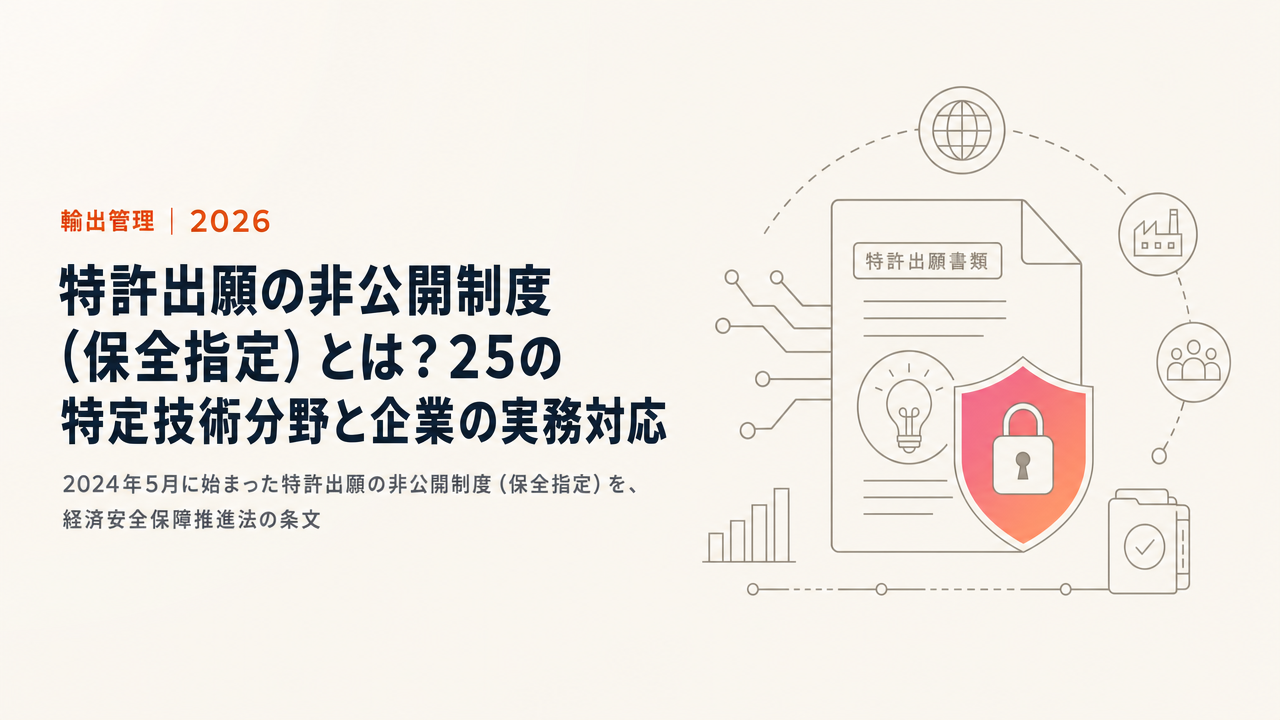
A patent is, at heart, a bargain: you disclose the substance of an invention to the world in exchange for a period of exclusivity. For anyone who wants to keep a technology hidden, it is actually a rather demanding arrangement. Yet some technologies, the moment they are made public, could fall into the hands of another country's military or intelligence services and become a national-security risk. The design of a nuclear weapon, a hypersonic engine, the autonomous control of a drone. Should even inventions like these keep being published automatically 18 months after filing, as always? Answering that long-standing question, Japan too launched its patent non-disclosure system (security designation) on May 1, 2024.
To be honest, I think many companies still feel this system "has nothing to do with us." And indeed, as I explain below, there has not yet been a single security designation. Even so, I believe that manufacturers, universities, and startups handling sensitive technology should understand it early. The reason is simple: even without ever reaching a designation, the first-filing obligation, "file in Japan first before filing abroad," changes the very premise of a patent strategy. If you also want to take stock of whether your technology touches an export-control list, start with the export-control classification check. In this article, I lay out the whole picture, the two-stage review, the 25 covered technology fields, the restrictions a security designation triggers, the penalties and compensation, and the practical steps companies should begin now, following the primary sources from the Cabinet Office and the Japan Patent Office.
Why Japan Finally Created a System to Keep Patents Unpublished
The starting point is the laying-open (publication) system in patent law. When you file a patent application, in principle the contents of the specification are published to the world as a laid-open gazette once 18 months have passed from the filing date (Patent Act, Article 64, Paragraph 1). This is an excellent mechanism for preventing duplicated R&D investment and encouraging follow-on research, but from a security standpoint it has an awkward side effect: even an invention tied to nuclear technology or advanced weaponry would, once filed, be readable by anyone a year and a half later.
Most major countries had long had non-disclosure systems to prevent this. Frameworks like the U.S. secrecy order, which keeps a sensitive application unpublished and restricts filing abroad, are not unusual. Japan had been said to be the only G7 country lacking such a system. What filled that gap was the Economic Security Promotion Act (formally, the Act on the Promotion of Ensuring National Security through Integrated Implementation of Economic Measures; Act No. 43 of 2022). The Act was enacted on May 11, 2022 and promulgated on May 18 of that year. It has four pillars: strengthening the supply chains for critical goods such as semiconductors and pharmaceuticals; prior review of core infrastructure such as electricity and telecommunications; public-private development support for specified critical technologies; and the fourth, the patent non-disclosure covered here. Of these, the Chapter 5 provisions on patent non-disclosure took effect later than the other pillars, on May 1, 2024.
The aim of the system, in one line, is to "temporarily halt the procedures for publication and rights-granting for inventions whose disclosure could impair national security, and to keep them secret only for the period necessary." It does more than simply hide things: it comes packaged with a mechanism for the State to compensate applicants for the disadvantage caused by that secrecy. If you want to grasp the structure of the Economic Security Promotion Act itself first, reading it alongside the complete overview of the Economic Security Promotion Act and the basics of economic security will make it clearer where this system sits.
How the Two-Stage Review Works: From the Patent Office's Screening to the Prime Minister's Security Designation
The first thing to understand about this system is that the review is split into two stages, and different government bodies handle the first and the second.
The first stage is the "first-stage review," handled by the Commissioner of the Japan Patent Office. Within three months of accepting an application, the Patent Office selects only those applications whose specification or other documents describe an invention falling within a specified technology field defined by Cabinet Order, and forwards them to the Prime Minister (Article 66, Paragraph 1; Enforcement Order, Article 13). This screening is carried out in an essentially formulaic way, using the International Patent Classification (IPC) assigned by patent examiners. Conversely, the vast majority of applications are judged at this stage to be "not in a specified technology field" and return to the ordinary examination route. An applicant may also request forwarding on their own initiative if they believe their invention could be sensitive, but such cases are very few.
The second stage is the "security review," handled by the Prime Minister, in practice the Cabinet Office. For an application forwarded from the Patent Office, it comprehensively assesses whether publication would create a strong risk of impairing national security, and what impact a designation would have on industrial development, and then decides whether a security designation is needed (Article 67, Paragraph 1). For an invention truly requiring secrecy, the Prime Minister issues a "security designation" (Article 70, Paragraph 1). Once designated, the patent-law procedures, such as laying-open, a decision to grant a patent, and a decision of refusal (Patent Act, Articles 49, 51, and 64, Paragraph 1), are withheld (Article 66, Paragraph 7), and no patent right can be obtained while the security designation remains in force. It helps to picture the rights-granting process being frozen.
Here is one practical point worth remembering. Being placed under security review alone does not restrict publication or disclosure of the invention. Restrictions begin only from the moment the applicant receives notice from the Prime Minister that the invention "may become a security-covered invention" (Article 67, Paragraph 9), after which the invention must not be published (Article 68). In other words, you need not rush to lock everything down internally just because "it went from the Patent Office to the Cabinet Office"; the formal notice is the trigger. Grasping this sequence lets you respond calmly. Note also that the forwarding from the Patent Office to the Prime Minister is not an administrative disposition but an internal procedure, so it cannot be contested. A security designation, by contrast, is an administrative disposition, and a request for administrative review under the Administrative Complaint Review Act is possible.
Replace siloed classification work with AI.
METI's FY2024 data shows 52% of foreign exchange law violations stem from classification errors. Download the TRAFEED product catalog covering features and rollout.
The 25 Specified Technology Fields and Their Additional Requirements
So which technologies count as a "specified technology field"? Article 12, Paragraph 1 of the Enforcement Order lists 25 fields using the International Patent Classification. It is easier to organize them into two broad groups. The first, (1) through (19), is a set of advanced technologies that could have a major impact on Japan's security. The latter, (20) through (25), is a set of highly destructive technologies that could cause severe damage to citizens' lives and economic activity.
Another important concept is the "additional requirements." Of the 25 fields, (1) through (9) and (20) through (25) become subject to security review simply by falling within the field. Fields (10) through (19), by contrast, are positioned as fields where a designation would have a large impact on industrial development (Enforcement Order, Article 12, Paragraph 2), and are covered only when, in addition to falling within the field, they also meet the additional requirements described below. You can read the design intent here: for technologies also widely used for civilian purposes, rather than fencing everything in at once, the net is narrowed to defense-related filings and filings involving the State.
| Category | Examples of fields (Enforcement Order, Art. 12, Para. 1) | Additional requirement |
|---|---|---|
| Advanced tech (1)-(9) | Camouflage/concealment of aircraft, unmanned aircraft and autonomous control, guided weapons, projectile trajectories, electromagnetic launchers, laser weapons and EMP munitions, anti-aircraft/anti-missile defense, attack-protection systems mounted on submarines, weapon sonar | Not required |
| Advanced tech (10)-(19) | Scramjets, solid-fuel rockets, submarines, unmanned underwater vehicles, submarine sonar, spacecraft thermal protection/re-entry/coupling-separation/meteoroid detection, spacecraft observation and tracking, quantum dot and superlattice semiconductor light-receiving devices, tamper-resistant housings, communications jamming | Required |
| Destructive tech (20)-(25) | Uranium/plutonium isotope separation, decomposition and reprocessing of spent nuclear fuel, heavy water, nuclear explosive devices, compositions for gas munitions, gas/powder dispersal munitions | Not required |
The additional requirements are set out in Article 12, Paragraph 3 of the Enforcement Order, and fall into three broad types. First, the invention is intended for use in Japan's defense or a foreign country's military (Item 1). Second, the invention pertains to a patent application filed by the State or a national research and development agency (Item 2). Third, the invention results from commissioned research subject to Japan's version of the Bayh-Dole system (Industrial Technology Enhancement Act, Article 17) or the Act on Vitalizing Science, Technology and Innovation, Article 22 (Items 3 and 4). Something easily overlooked in practice is the treatment of filings by national university corporations. Because a national university is not included in "the State," a filing by the university alone does not meet the Item 2 additional requirement. However, if it is the result of State-commissioned research, it may fall under Item 3 or 4. This is a point that university industry-collaboration offices should watch especially closely; it is safest to understand that the treatment changes depending on where the funding comes from.
Note that a partial-amendment Cabinet Order to the Enforcement Order, promulgated on November 20, 2024, updated the classification symbols for field (17), the quantum dot and superlattice semiconductor light-receiving devices and the like, in line with revisions to the International Patent Classification, taking effect on January 1, 2025. This merely aligned the classification symbols with the latest IPC, however, and made no substantive change to the scope of the covered technologies. Also, this system covers patent applications only; applications for utility-model registration are not subject to security review.
What Happens to a Company That Receives a Security Designation: The Six Restrictions
Security designations are made only rarely, but once one is made, heavy restrictions bear down on the applicant. Following the text of the Act, they can be organized into six broad categories.
First, the applicant cannot withdraw the patent application until the designation is lifted (Article 72, Paragraph 1). The intent is to close off the escape route of "it's too much trouble, so I'll withdraw and file in another country." Second, the applicant cannot work the security-covered invention themselves without the Prime Minister's permission (Article 73, Paragraph 1). That working becomes subject to permission bears directly on business plans. Third, except for justifiable reasons, the applicant must not disclose the invention's content to others (Article 74, Paragraph 1). Fourth, the applicant has a duty to implement necessary and appropriate proper-management measures to prevent information leakage (Article 75, Paragraphs 1 and 2). Fifth, sharing the invention's content with another business operator requires the Prime Minister's approval (Article 76, Paragraph 1). When you later add "invention-sharing operators," such as joint-research partners, manufacturing contractors, delivery destinations, or the patent attorney handling the filing, you must obtain approval each time. And sixth, the applicant cannot file abroad until the designation is lifted (Article 78, Paragraph 1). Because this sixth restriction has such a large impact, I explain it in a separate section below.
The designation runs for up to one year (Article 70, Paragraph 2), at most one year at a time. The Prime Minister reviews whether to continue it at least once a year (Article 70, Paragraph 3), extending it if continuation is needed and lifting it when it is no longer needed (Article 77, Paragraph 1). It is not frozen forever; the framework is one of periodic review.
Of these, the one you cannot ignore as a practical burden is the fourth, the proper-management measures. Article 10 of the Cabinet Office Ordinance sets out the measures to be taken in four categories: organizational, personnel, physical, and technical management measures. The key point is that the information on the security-covered invention is required to be handled as a "trade secret" (Cabinet Office Ordinance, Article 10, Item 1(d)). This overlaps with what you would do in trade-secret management: limiting access rights, confidentiality agreements, keeping records, and restricting removal of materials. The details are organized in the Cabinet Office's "Guideline on Proper-Management Measures." Turned around, the more a company routinely maintains a trade-secret management framework, the smaller the extra burden when a designation actually comes.
File in Japan First: The Disruptive Force of the First-Filing Obligation
What I most want to stress about this system is the "first-filing obligation," which, apart from whether a security designation is ever reached, bites on nearly every applicant handling sensitive technology. If you intend to describe, in foreign-filing documents, an invention that was made in Japan, falls within a specified technology field (and, for fields with additional requirements, also meets those requirements), and has not yet been made public, you must first file it in Japan and undergo the security review before filing it abroad (Article 78, Paragraph 1). In other words, the option of filing overseas first is, in principle, closed off for sensitive technology.
Here many staff misunderstand the scope of "foreign filing." It includes not only a direct filing with a foreign patent office, but also a PCT international application with the Japan Patent Office as the receiving Office. Furthermore, a provisional application under 35 U.S.C. Section 111(b), often used as a bridge before formal rights, also counts as "foreign filing." The more globally a company builds its patent portfolio, the more it will take the PCT route for granted, but for sensitive technology even that PCT filing becomes subject to the first-filing obligation, a point that demands caution.
That said, the prohibition is not permanent. Foreign filing becomes permitted in any of the following cases: when the application is not placed under security review; when ten months have passed from the domestic filing; when the security review results in no designation; and when a security designation is lifted or its period expires (proviso to Article 78, Paragraph 1). The most realistic in practice is the "ten-month lapse." You need to build your filing schedule with the time axis in mind: file domestically first, wait ten months, and you are, in principle, in a position to file abroad. Note that Cabinet Order Article 14 provides exceptions for filings under three agreements: the Japan-U.S. Defense Patent Agreement, the International Space Station Agreement, and the Japan-U.S. Framework Agreement on Space Cooperation.
For the worry of "I can't tell whether my invention is subject to the first-filing obligation," there is a prior-confirmation system. An applicant planning a foreign filing can pay the prescribed fee and confirm with the Patent Office whether the invention is one whose foreign filing is prohibited (Article 79). As I note below, this prior confirmation is used more than 900 times a year, a figure that shows the system is operating on the ground even with zero designations. Companies doing R&D premised on overseas expansion would do well to build this prior confirmation into their workflow, which makes it easier to avoid inadvertent violations.
Penalties and Loss Compensation: Disclosure Violations Carry Imprisonment; the State Makes Up Losses from Designation
What you must grasp for compliance is the severity of the penalties. If someone intentionally discloses, without justifiable reason, the content of a security-covered invention, they face up to two years' imprisonment, a fine of up to one million yen, or both (Article 92, Paragraph 1, Item 8). Not only the individual actor but also the corporation is subject to a fine of up to one million yen under the dual-liability provision (Article 97). Filing abroad in violation of the ban carries up to one year's imprisonment, a fine of up to 500,000 yen, or both (Article 94).
Something else not to overlook is the interplay with the Unfair Competition Prevention Act. If officers or employees disclose externally the information on a security-covered invention that is managed as a trade secret, with the purpose of obtaining a wrongful gain or causing damage to the company, this constitutes a violation of the Unfair Competition Prevention Act and can be subject to the heavy penalty of up to ten years' imprisonment, a fine of up to 20 million yen, or both (Unfair Competition Prevention Act, Article 21, Paragraph 1, Item 5). Part of the reason invention information is required to be handled as a trade secret under the proper-management measures is to bring this protection into play.
| Type of violation | Penalty | Basis |
|---|---|---|
| Unauthorized disclosure of a security-covered invention | Up to 2 years' imprisonment or a fine of up to 1 million yen (both may apply; corporations also up to 1 million yen) | Act Art. 92(1)(viii), Art. 97 |
| Violation of the ban on foreign filing | Up to 1 year's imprisonment or a fine of up to 500,000 yen (both may apply) | Act Art. 94 |
| Wrongful disclosure of a trade secret | Up to 10 years' imprisonment or a fine of up to 20 million yen (both may apply) | Unfair Competition Prevention Act Art. 21(1)(v) |
Alongside the penalties, a mechanism for the State to compensate losses is also in place. For those who suffer a loss because of a security designation, such as refusal of permission to work the invention (proviso to Article 73, Paragraph 1) or conditional permission (same Article, Paragraph 4), the State compensates for "losses that would ordinarily arise" (Article 80). Eligible parties are the designated patent applicant, or a person who was one. The compensation amount is calculated and decided by the Prime Minister (Article 80, Paragraph 3), with the review handled in practice by the Cabinet Office's review division. A claim for compensation is submitted to the Cabinet Office as a claim form accompanied by supporting materials (Cabinet Office Ordinance, Article 12). If you are dissatisfied with the decided amount, you may bring an action against the State seeking an increase within six months of the day you receive notice (Article 80, Paragraphs 5 and 6). It is a clear-eyed design: the trade-off for being stopped from obtaining rights is settled in money. The thinking behind loss compensation and the details of the claim procedure are organized in the Cabinet Office's "Q&A on Loss Compensation."
What Companies Should Start Now: Triage and a Management Framework
Building on all of the above, let me lay out concretely what a company handling sensitive technology should do. The first thing I recommend when I am consulted is pre-filing "triage." Could the invention you are about to file touch any of the 25 specified technology fields; if so, is it a field with additional requirements ((10) through (19)); and is there any circumstance, such as defense use or State-commissioned research, that would apply? Building this assessment into the pre-filing process is the starting point. You do not need to brace and scrutinize every application; only a small fraction can actually fall within scope. That is precisely why a mechanism that sifts, at the outset, which applications deserve careful review is so effective.
Next, for inventions you plan to file abroad, build the prior confirmation (Article 79) into your workflow. Aligning your overseas rights-granting schedule with the ten-month time axis from the domestic filing, and arranging things so as not to make a premature overseas filing, is itself violation prevention. The more globally an IP department manages filings, the more you should confirm that everyone understands PCT and U.S. provisional applications count as "foreign filing."
Third is an information-management framework that can withstand the proper-management measures. Rare as designations are, building a framework from scratch the moment one comes is not realistic. It is smarter to take stock of your everyday trade-secret management across the four categories of organizational, personnel, physical, and technical measures, and to keep access control, records management, and confidentiality running as a matter of course in the departments that handle sensitive invention information. If you raise the level of contracts and management in advance for relationships with invention-sharing operators such as joint-research partners, manufacturing contractors, delivery destinations, and agents, you can get up to speed faster when approval procedures become necessary. A company that maintains internal export-control rules (a Compliance Program) should be able to fold this in naturally as an extension of that. The way of thinking about classification itself is touched on in our explainer on METI's classification guidelines, so use it as a reference when building out your internal rules.
From Enforcement to Today: What the Track Record Reveals About the System
It has been about two years since the system began. The operational track record over this period is indispensable for describing what the system really is. According to the FY2025 (April 2025 to March 2026) status report published by the Cabinet Office and the Japan Patent Office, 106 applications were forwarded from the Commissioner of the Patent Office to the Prime Minister, of which 5 were on the applicants' own initiative. Against this, there were zero security designations. Requests for prior confirmation regarding the ban on foreign filing came to 922, and the number of applicants notified that their applications would not be forwarded to the Cabinet Office was 771. Since the system took effect, no security designation has been confirmed on a public-record basis.
How to read these figures? I take them to mean "designations are rare, but the system itself is quietly bearing on every applicant." Only a handful of inventions advance to the final stage of a security designation, and in fact zero has continued. That does not mean the system is spinning its wheels. The first-stage review, in which the Patent Office screens all applications by IPC within three months, turns over methodically every year, and the more than 900 prior-confirmation requests a year are a sign that companies are properly checking before filing abroad. Rather than growing complacent because the odds of designation are low, the real heart of practice is responding correctly to the "everyday-operation part," the first-filing obligation and the prior confirmation.
If I sum up what changed before and after enforcement in one line, it is this. Previously, even sensitive technology was automatically published 18 months after filing, and you could freely file overseas first. Now, sensitive technology may have its publication withheld, and, as standard, foreign filing takes Japan as the first country and, as needed, passes through prior confirmation. The "strong medicine" of a designation has not yet been used, but the unglamorous practice of pre-filing triage and arranging overseas expansion has, without question, changed.
Patent Non-Disclosure and Export Control Are Chasing the Same Sensitive Technologies
Finally, I want to ask you not to view this system in isolation. The technologies lined up as specified technology fields, unmanned aircraft, guided weapons, solid-fuel rockets, submarines, spacecraft, quantum semiconductors, and nuclear- and chemical-weapon-related technologies, are areas that can overlap heavily with the regulated goods and technologies set out in Appended Table 1 of the Export Trade Control Order and the appended table of the Foreign Exchange Order under the Foreign Exchange and Foreign Trade Act (the Foreign Exchange Act). It can genuinely happen that one and the same technology is caught simultaneously by three regimes: the patent non-disclosure system, the classification screening for exporting goods or technology, and deemed-export controls when providing technology to foreign nationals or overseas bases.
In particular, overseas rights-granting (PCT or local filings) and sharing invention content with overseas joint-research partners or manufacturing contractors require caution in a double sense. On the patent-non-disclosure side, the first-filing obligation or the approval for sharing may apply; on the Foreign Exchange Act side, the provision of technology can become subject to classification screening as a "deemed export." Showing sensitive technical information to a foreign researcher within Japan is also a deemed-export issue. The detailed practice around this overlap is explained in the specified categories of deemed export and how to handle them, so reading it together gives you a three-dimensional understanding. For confirming that a business partner or research collaborator is not a sanctioned party or an entity of concern, the complete picture of sanctions-list screening is also useful.
That is exactly why I recommend using your response to the patent non-disclosure system as a trigger to take stock, in one integrated effort, of Foreign Exchange Act classification and deemed-export controls for the same sensitive technology. Rather than building a trade-secret management framework under the proper-management measures separately from your internal export-control rules, designing them as a single, continuous economic-security compliance program reduces both the burden on the field and the risk of gaps. The TRAFEED we provide is, in Japan's security-focused export-control domain, the world's first AI agent (as of March 2026, per our own research); it supports classification screening in line with METI's standards and streamlines the screening of business partners and end users. Through joint field validation with Okayama University and others, we have confirmed AI classification accuracy of 95% or higher (against roughly 30,000 past review records, per our own research), but the premise remains unchanged: the final classification is made by your company's export-control officer. Think of it as a tool positioned to lower the load of screening and classification that human effort alone cannot keep up with, so that staff can focus on the points that truly require judgment.
Conclusion
Judged by designation counts alone, the patent non-disclosure system looks like a regime where "nothing has happened yet." But the center of gravity in practice lies less in the designation itself than in what comes before it: the first-stage review, the first-filing obligation, and the prior confirmation. Let me sum up the key points.
- The basis is Chapter 5 of the Economic Security Promotion Act; the patent non-disclosure provisions took effect on May 1, 2024.
- The review has two stages: the Patent Office screens by IPC within three months, and the Prime Minister issues a security designation after the security review.
- The scope is the 25 specified technology fields in Article 12 of the Enforcement Order; of these, (10) through (19) apply only when additional requirements such as defense use or State involvement are met.
- A security designation triggers six restrictions: no withdrawal, working subject to permission, a disclosure ban, proper-management measures, approval for sharing, and a ban on foreign filing.
- File sensitive technology in Japan first; PCT and U.S. provisional applications count as "foreign filing," and the ban is lifted, for instance, ten months after the domestic filing.
- Disclosure violations carry penalties including imprisonment, and the State compensates losses from a designation. The same sensitive technology can also overlap with Foreign Exchange Act classification and deemed exports.
Precisely because the odds of being designated are low, most companies should not brace themselves, yet should quietly get pre-filing triage and the arrangement of overseas filings in order. That, I think, is the realistic landing point. Patent non-disclosure and export control are, in the end, systems that view the same sensitive technology from different angles. Rather than tidying up one side and feeling safe, try designing them as a single, continuous economic-security response. If you get stuck on how to proceed or on taking stock of your own technology, feel free to reach out through an individual consultation on export control and economic security.
References