Hello, this is Ryuta Hamamoto from TIMEWELL.
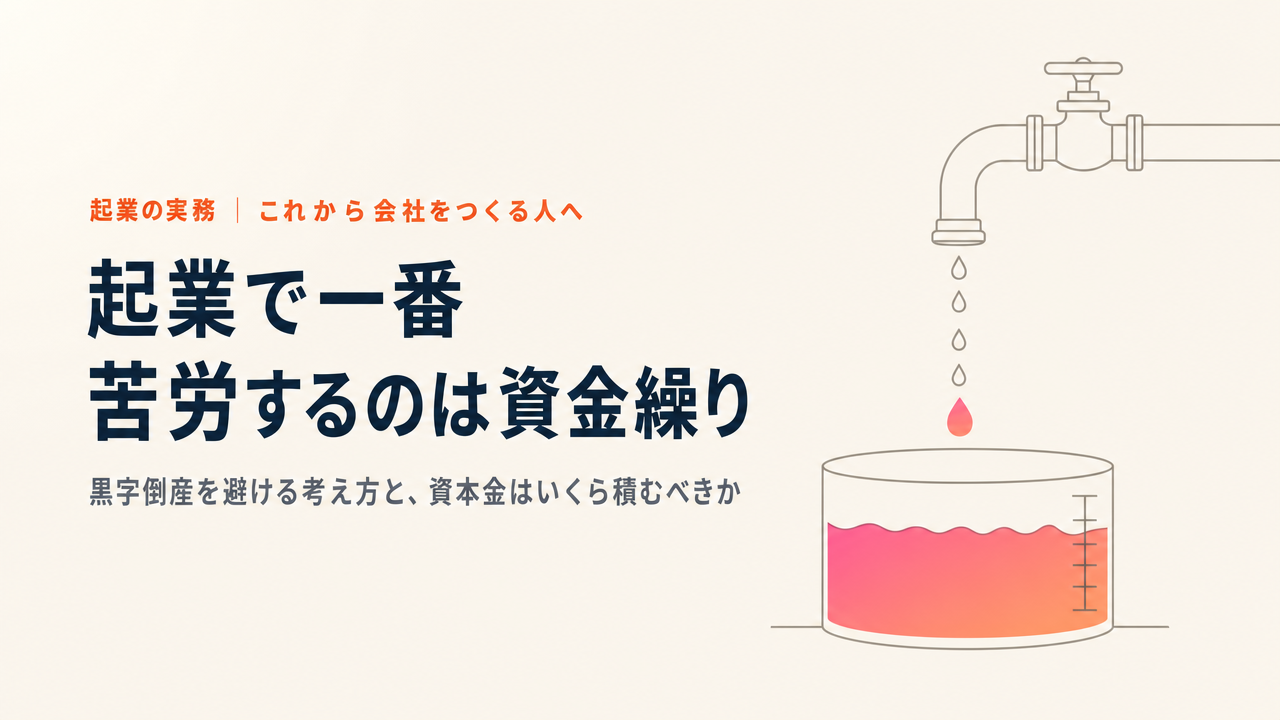
When I talk with people interested in starting a company, the conversation often gets going around "the business idea" or "marketing." Both matter, of course. But what keeps a founder awake, from the moment the company launches and long after, is usually something far plainer. Whether the money keeps moving. That is, cash flow.
When I studied finance for my MBA, I was taught the income statement (PL), the balance sheet (BS) and the cash flow statement (CF) as if they were three brothers standing side by side in a row. The set is called the three financial statements. You learn to read each one, and on the exam all three carry roughly equal weight. Yet once I had a business of my own, it hit me hard that these three are not remotely equals. What decides whether you live or die on a given day is, by a wide margin, the movement of cash. It is the cash flow.
This article is written for people about to start a company, or who have just started one. First I explain, from the terms up, why cash runs out, and what it means to fail while turning a profit. On that basis I list the moves that keep you from running short, and finally I sort out the question so many people wrestle with, "how much stated capital should I put in," from four angles: credibility, financing, consumption tax and licensing. Because this is a story about numbers and money, I intend to draw a clear line between confirmed facts and what are only general rules of thumb. If you also want to gauge, before you start, how well you can put AI and digital tools to work, running the free AI literacy self-check first will make the discussion of building a lean company read more concretely.
One note: this article is a general organising of information, not individual tax or legal advice. For decisions on actual amounts and procedures, always consult specialists such as a tax accountant, a certified public accountant, a labour and social security attorney (sharoshi), an administrative scrivener (gyoseishoshi) or a lawyer.
Side by side in the MBA, but on the ground it is cash flow that cuts
Let me briefly recap the three financial statements. This is a stretch full of technical terms, so I will bring along some analogies.
The income statement (PL) shows how much you earned over a set period. You subtract expenses from sales, and profit is what is left at the end. Think of it as the company's "report card." The balance sheet (BS) shows, at a point in time, what the company owns (assets), how much it owes (liabilities) and how much of the original stake remains (net assets). It is close to a "health check of the company's build and strength." And the cash flow statement (CF) shows how much cash actually came in and went out over the period. Think of it as the company's "blood flow."
When you learn them, you are taught it matters to line these three up and understand how they connect. That is correct in itself. But narrow the focus to the single question of whether a business can survive, and the priority is clear. The moment the cash on hand runs out, the company stops. However black the PL, however large the assets on the BS, if you cannot pay what you owe, that is where it ends. In human terms, even if the numbers on your health check look good, your life is in danger the moment your blood stops circulating. It is the same thing.
So on the ground of starting up, you develop the habit of looking, before "how much did I earn this month," at "how much is in the account right now, and will it last until the end of next month." Profit is an accounting concept, calculated after the fact. Cash is simply whether it is there right now or not. That gap in feel is, I sense, the biggest difference between someone who learned finance from a textbook and someone who has actually been chased by cash flow.
Why cash runs out even when you are profitable
This is the very core of the article. Many of you will have heard the phrase "insolvency while profitable" (kuroji tosan, literally "black-ink bankruptcy"). It refers to failing because, though the books show a profit, you run short of cash and cannot make payments. At first glance it seems contradictory, but once you break down the mechanism, you see it is actually only to be expected.
At the center of the cause is the timing gap between money coming in and money going out. Most commerce is not set up to receive cash on the spot. You deliver the work, issue an invoice, pass through the counterparty's closing date and payment date, and only then does the money land. This "period from booking a sale to receiving the cash" is called the collection cycle. Meanwhile the money you have to pay out, such as material costs, subcontracting fees, employees' wages and office rent, will not wait for your collection. If anything it often goes out first. This "period until you pay" is called the payment cycle.
Words alone are hard to grasp, so let me lay it out with a simple example.
| Date | Event | Cash movement | Cash on hand |
|---|---|---|---|
| April 10 | Buy materials and pay for them | −600,000 yen | 400,000 yen |
| April 20 | Pay subcontracting fees and wages | −300,000 yen | 100,000 yen |
| April 30 | Deliver 1,000,000 yen of work and issue the invoice (book the sale) | ±0 yen (no cash yet) | 100,000 yen |
| May 31 | The 1,000,000 yen payment finally arrives | +1,000,000 yen | 1,100,000 yen |
Cash on hand is the path assuming you started the period with 1,000,000 yen.
In this example, by the end of April you have a booked sale of 1,000,000 yen, and the PL is in the black. Yet only 100,000 yen of cash is left. If an unexpected payment of even 200,000 yen came up in the meantime, the money would run short at that instant. You have sales, you are due to make a profit, and you still cannot pay. This is the true nature of insolvency while profitable. It happens with no wrongdoing and no poor trading, simply because the money went out before it came in1.
And the awkward part is that the problem gets more serious the more the business is growing. As orders increase, the materials you buy in advance grow with them, and so do the subcontracting fees and wages you pay in advance. Collection is still one to two months out as ever. In other words, the more you grow, the larger the amount you have to bridge while waiting for money to come in. This cash you must always keep on hand to bridge payments made before collection is called working capital.
Working capital can be captured, roughly, as follows.
Working capital = accounts receivable (sales not yet collected, such as trade receivables) + inventory − accounts payable (purchases not yet paid, such as trade payables)
Receivables and inventory are, in effect, "money lying dormant in a state before it becomes cash." Payables are "money you have not had to pay yet," so that part is a help. The amount left after the subtraction is the cash you have to put up out of your own pocket to keep the business turning. If sales double, this working capital roughly doubles too, and holding that assumption keeps your sense of it accurate1. The cry of the founder who says "orders are up, which should be great, yet somehow the account keeps looking emptier" almost always comes from here.
Looking for AI training and consulting?
Learn about WARP training programs and consulting services in our materials.
Moves to keep from running out of cash
So how do you avoid the situation where cash runs out? There is no magic, but there are plenty of grounded moves. Let me go through them in order.
Build a cash flow forecast first
The first thing to do is build a cash flow forecast. This is a table that lines up the planned money coming in and going out for the next several months, month by month. It is a different thing from the income statement; it tracks only "when, and how much, cash moves." How much comes in next month, how much goes out, and how much is left in the account at month-end. Project that three to six months ahead, and you can catch a danger signal like "at this rate we run short at the end of August" months in advance.
Most companies that fall over on cash flow do not have this table. Because they do not have it, they only panic once the account balance has started to shrink. Apply for financing after you panic, and the review takes time and may not make it in time. Conversely, notice early and there are many moves you can make. A cash flow forecast can be built in Excel without difficult accounting knowledge. From the very day you start, I recommend running this first.
Borrow while you still can
When founding a company in Japan, the first thing many entrepreneurs consider is the startup financing offered by the Japan Finance Corporation (JFC). It is a government-affiliated financial institution, known as a window that will talk with you even in the founding period when you have no track record. Beyond this there is also the option of institutional financing, in which local governments work with credit guarantee associations. Because loan ceilings and own-funds requirements are revised frequently, always check the details of amounts against the latest official information2.
There is one important idea here. It is better to borrow money while you still have room, not once things get tight. Once results turn bad, reviews get harder to pass, and you may even have lost the very capacity to apply. Startup financing is best arranged with room to spare, on the assumption that the business launches as planned. If you set the borrowed money aside without using it there is an interest cost, but if you regard that interest as an insurance premium against the risk of losing the company to a cash shortage, it is by no means expensive.
Subsidies and grants: move early, but do not lean on them too much
Subsidies and grants are attractive because they are money you do not have to repay. There are many kinds, covering founding, capital investment and hiring, and if you can use them you should. But from a cash flow standpoint there are two cautions.
One is that many subsidies are paid after the fact (reimbursement). That is, the common setup is that you spend your own money first and part of the eligible cost comes back later. So if you place orders in advance counting on the subsidy, you separately need bridging funds to cover the gap until it comes back. There is a story, and it is no joke, of a founder who thought "we're fine, the subsidy is coming" and then ran out of cash in the several months before it arrived.
The other is the timing of application deadlines and awards. Application windows are limited, and it can take several months from applying to being awarded and paid. That is exactly why, for anything you have decided to use, moving early matters. Because the specific conditions and ceilings of each scheme change year by year, check the latest official information from the Small and Medium Enterprise Agency and each local government, and consult a specialist such as a registered SME management consultant (chusho kigyo shindanshi) if needed.
Build "body thickness" with own funds and stated capital
Financing and subsidies are money brought in from outside, but the foundation of all of it is the own funds you prepare yourself and the stated capital that is the company's original stake. If this is thin, a small delay in collection or an unexpected outlay quickly drains you dry. Conversely, with thickness here you can ride out some rough seas.
How to think about these own funds and stated capital is the very theme of the next chapter. Let me change chapters here and sort it out carefully.
How to design your cash flow, and where you should keep money, is a reading that is risky to shoulder alone, most of all right after founding. When we walk alongside owners in an AI consulting service called WARP, the first thing we look at together is usually this flow of cash. In particular, for those about to found a company or newly founded, we support the design of the business plan and the funding in parallel, under a track called WARP Entre (/en/warp/entre). Before flashy marketing, first build a shape in which cash keeps moving. Getting that order right is, I believe, the trick to surviving the first year.
How much stated capital to put in
"How much should I set the stated capital at" is a question that comes up in almost every founding consultation. To state the conclusion first, there is no single right answer. But the axes of judgment are clear. The practical way is to work backward from four angles: credibility, working capital, consumption tax and licensing. Let me go through them in order.
You can establish a company with 1 yen. But the question of credibility remains
First, the rules. Japan's current Companies Act has no minimum-capital rule. There used to be a minimum, such as 10 million yen for a stock company, but that has been abolished. So in theory it is said you can establish a stock company or a limited liability company (godo kaisha) with as little as 1 yen of stated capital3. This point lowered the barrier to starting a company enormously.
But "you can establish it" and "it goes well" are different stories. Stated capital is registered and is information anyone can see. When a business partner begins dealing with a new counterparty, or when a financial institution considers financing, stated capital is looked at as one rough measure of "how much staying power this company has." If a company with 1 yen of stated capital and a company with 3 million yen submit the same proposal, the latter inevitably gives more reassurance. The more a deal turns on credibility, the more this difference cannot be ignored. And as a practical matter, because stated capital is the business's original stake itself, if it is extremely small you simply lack working capital and start struggling with cash flow the moment you begin.
The consumption-tax exemption line as a fork in the road
In deciding stated capital, the point many people lose out on without knowing is the relationship with consumption tax. Because the National Tax Agency clearly sets out the criteria here, this is one of the few "confirmable numbers," and it is worth pinning down accurately.
Consumption tax has a mechanism called the small-business exemption. If the taxable sales in the base period (for a corporation, the fiscal year before last) are 10 million yen or less, you are in principle exempt from the consumption-tax filing obligation4. But a company that has just been established has no fiscal year before last. For a newly established corporation with no such base period, a different yardstick is used. That yardstick is stated capital.
Specifically, if the stated capital on the first day of the fiscal year is under 10 million yen, a newly established corporation is in principle exempt from the consumption-tax filing obligation for the first and second fiscal years. Conversely, if the stated capital is 10 million yen or more, that fiscal year makes you a taxable business, and you have to pay consumption tax from the start5. This difference bears directly on cash flow in the early days of founding. That is precisely why, absent a special reason, a design that keeps stated capital under 10 million yen is often chosen.
There are, however, important exceptions. Even with stated capital under 10 million yen, you become a taxable business if you fall under any of the following. The main ones the National Tax Agency lists are as below45.
| Main exceptions where you are not exempt | Content |
|---|---|
| Sales over the line in the specified period | Where taxable sales in the specified period (the first six months of the prior fiscal year) exceed 10 million yen |
| Invoice registration | Where you are registered as a qualified invoice issuer under the invoice system |
| Election to be a taxable business | Where you have filed a notification electing to be a taxable business |
| Specified newly established corporation | Where you are a newly established corporation controlled more than 50% by an entity with taxable sales over 500 million yen, etc. |
Invoice registration in particular calls for care. If your counterparties are mostly taxable businesses and yours is a line of work where you are asked to issue qualified invoices, the need to register for the invoice system can outweigh the exemption benefit. Whether to go for the exemption line or to prioritise invoice registration is a question whose answer changes with your counterparties and line of business. Do not judge this on your own; I strongly recommend deciding it in consultation with a tax accountant.
For the corporate-tax SME breaks, the line is 100 million yen of capital
Let me also touch on a criterion that bites once the scale grows. It is worth knowing for when you consider raising capital down the road.
A corporation with stated capital of 100 million yen or less at the end of each fiscal year is treated as a "small or medium corporation" and becomes eligible for various SME breaks, starting with the reduced corporate-tax rate (though an excluded business whose average income over the prior three fiscal years exceeds 1.5 billion yen falls out of scope)6. Turned around, once stated capital exceeds 100 million yen, you drop out of many of these preferences. Raising capital lifts the company's credibility, yet it can also cut against you on the tax side. It may be a distant story at founding, but it is worth holding the sense that "more stated capital is not simply better."
Some industries carry asset requirements for licences
Last, the wall of the industry. Certain businesses cannot start without obtaining a licence. And among licences, some set the condition of holding a certain amount of assets. This is called an asset requirement. For example, construction, and the employment placement and worker dispatch businesses that handle people, are said to require net assets or assets above a set amount. When a foreign national founds a company as its representative and obtains the "Business Manager" (keiei kanri) status of residence, there is also said to be a requirement relating to business scale.
The amounts of these asset requirements differ greatly by industry and can change with revisions to the rules. The monetary requirement for the "Business Manager" status in particular has been under continued review discussion in recent years, and it is an area where the numbers move easily. So in this article I avoid asserting specific amounts. Whether the business you intend to run needs a licence, and if so how large the asset requirement is, must be checked against the latest official information from the competent authority (the Ministry of Land, Infrastructure, Transport and Tourism or each prefecture for construction; the Ministry of Health, Labour and Welfare or the labour bureaus for people-related businesses; the Immigration Services Agency for the status of residence), and decided on stated capital after consulting a specialist such as an administrative scrivener7. In industries with an asset requirement for licensing, that requirement becomes the de facto floor for stated capital.
In sum, decide by working backward
Taking the four angles together, how to decide stated capital comes down to "working backward." What is the minimum you need as near-term working capital, how do you treat the consumption-tax exemption line, is there an asset requirement for licensing, and how do you want to be seen by counterparties and lenders. Stack these up, and the band that is right for your company comes into view naturally. For reference, and strictly as a general rule of thumb, let me put an image by business type into a table. Because the actual amount changes with circumstances, always decide it in consultation with a specialist.
| Business type | General guideline for stated capital (image only) | Main reason |
|---|---|---|
| Soft, no-premises (web, contract work, consulting, etc.) | A small amount can do (often considered from around tens of thousands to 1 million yen) | Capital investment is small and working capital is light. Still, take care not to go extremely low on the credibility side |
| Retail carrying inventory and purchases | Keep working capital thick (stack in inventory and the bridging for collection lag) | Purchases run ahead and collection comes later, so the working-capital load is heavy |
| Businesses with premises and equipment | Secure the initial investment plus several months of fixed costs | Fixed costs such as rent, fit-out and wages run ahead |
| Industries with an asset requirement for licensing | The asset requirement becomes the de facto floor | Construction, worker dispatch, employment placement, etc. Check the requirement amount against the competent authority's latest information |
| When mindful of the consumption-tax exemption | In all cases, a design keeping it under 10 million yen is common | With 10 million yen or more, even a new corporation becomes a taxable business from the first year |
A soft business can start as a "small, unburdened company"
Let me tie the discussion so far to a founding style that will be common going forward, namely a soft business that holds no shop and no factory and takes on no large workforce. Web services, contract development, consulting, content production and the like, where your own head and hands are the capital.
The strength of such a business is that fixed costs are light. Because you need no large equipment or inventory, the initial investment stays small. That means the working-capital load is also relatively light, and there is little need to force stated capital to be thick. In the table of the previous chapter, this is the type you can start with the least burden. Of course you should take care not to go extremely low on the credibility side, but compared with an industry where you cannot begin without preparing several million yen, the barrier to founding drops by a wide margin.
On top of that, there is a cash flow device unique to soft businesses. It is the design of directors' remuneration. In a company started by one person or a few, your own remuneration as president takes up a large share even among the company's fixed costs. Hold this down and you can compress the monthly cash going out of the company, giving cash flow some slack. Because directors' remuneration is also linked to your own social insurance premiums, holding remuneration down also holds down the company-side and personal-side social insurance premiums. As a lever for keeping the company unburdened in the early days of founding, this one has a large effect.
But there is one rule you absolutely must know here. Directors' remuneration cannot be raised or lowered freely whenever you like. To include directors' remuneration in the company's expenses (deductible expenses), you must in principle meet requirements such as "fixed periodic salary" (teiki dogaku kyuyo)8. Fixed periodic salary refers to a payment made at regular intervals of one month or less, with each payment being the same amount. And revisions to the amount must in principle be made within three months from the first day of the fiscal year (accounting period). Change the remuneration partway through the period after this deadline, and unless it fits an exception such as an extraordinary revision event or a business-deterioration revision event, it is not recognised as fixed periodic salary, and the increased or decreased portion may cease to be a deductible expense8.
In other words, an off-the-cuff change like "we did well this month, so let us raise the president's pay" or "it is tight this month, so let us cut it" does not, in principle, pass on the tax side. Regard directors' remuneration as something you set with a firm hand, looking at the year ahead, at an early stage around the start of the fiscal year. Take it lightly and move it mid-year, and an unexpected tax burden arises. The optimal balance, including personal living costs, income and residents' tax, social insurance premiums and how it will be seen in a future financing review, really does differ from person to person. I strongly recommend setting up the design of directors' remuneration properly at the outset, in consultation with a tax accountant or a labour and social security attorney.
For the groundwork of being an entrepreneur, and what capabilities an owner should hone from here, I go deeper in a piece organising the thinking on entrepreneur development. Read it together and you can see both wheels: the design of money and the growth of people.
Where to put the first step
This has run long, so let me set down, concretely, the first step for those about to start a company.
First, build one cash flow forecast. You need no accounting software and no advisory tax accountant yet. In Excel, just line up the "expected receipts" and "expected payments" for the next six months, month by month, and calculate the month-end balance. Whether or not you hold this changes, by months, when you can notice a crisis.
Next, work backward on stated capital from the four angles. Near-term working capital, the consumption-tax exemption line (whether it is under 10 million yen), whether there is an asset requirement for licensing, and how you will be seen by counterparties and lenders. Write these four out on paper and stack them up, and the band right for your company comes into view. Fixing the number is fine once you have consulted a tax accountant.
And I recommend handing part of the bookkeeping and tax work to AI and cloud mechanisms from an early stage, and starting with a lean setup. It is a waste for a solo president to burn out on both building the cash flow forecast and running the business. How to make the bookkeeping itself lighter is organised concretely in a piece organising the thinking on AI-driven accounting, so please refer to it as well.
The design of a company's numbers, especially the assembly of cash flow, stated capital and directors' remuneration in the early days of founding, is not something you get right in one go. Once the business starts moving, the premises change too. If your hand has stopped here, please talk to the WARP team. Specialists who have carried DX and data strategy at major companies walk alongside you month by month, from the business plan through to the design of funding. For those about to found in particular, under the WARP Entre track we work with you from the point of building a shape in which the first cash flow keeps turning. Before you give an idea form, first put in place a mechanism where cash does not run out. That, I believe, is the surest first step toward continuing the long contest of starting a company.
To sum up
Let me organise the key points at the end.
- The three financial statements are learned side by side, but what decides a business's life or death is, by a wide margin, cash flow (the movement of cash). Profit is a concept calculated after the fact; with cash, whether it is there right now is everything
- Insolvency while profitable arises from the timing gap between money coming in and money going out. Because a sale is booked while collection comes later and payment runs ahead, when the cash to bridge that (working capital) runs short, the money runs out even with black-ink books. The more the business grows, the more working capital increases
- The moves to keep from running short are four: build a cash flow forecast first, arrange startup financing while you still have room, move early on subsidies while assuming after-the-fact (reimbursement) payment and preparing bridging funds, and build "body thickness" with own funds and stated capital
- A company can be established with as little as 1 yen of stated capital, it is said (check the latest against the Companies Act original text on e-Gov), but the practical way is to work backward from the four angles of credibility, working capital, consumption tax and licensing. A new corporation with stated capital under 10 million yen is in principle exempt from consumption tax for the first and second fiscal years, but there are exceptions such as sales over the line in the specified period and invoice registration
- A soft business has light fixed costs and can start unburdened. Holding directors' remuneration down compresses fixed costs and social insurance premiums, but there is the fixed-periodic-salary rule (in principle, revise within three months of the fiscal year's start), and you cannot casually change it mid-year
- For individual judgments on tax, licensing, social insurance and status of residence, always consult a specialist such as a tax accountant, a labour and social security attorney or an administrative scrivener. This article is a general organising of information, not individual advice
Starting a company, you can set off if you have a good idea. But whether you can keep running turns on whether the cash runs out. Begin by building one cash flow forecast.
References and primary sources
Footnotes
-
The thinking on insolvency while profitable and working capital is an organising based on the general principles of accounting and finance (textbook knowledge). Working capital is representatively captured as "accounts receivable + inventory − accounts payable." For individual accounting treatment and your company's own cash flow estimate, consult a certified public accountant or a tax accountant. ↩ ↩2
-
Japan Finance Corporation (JFC), "New business and startup support funds" (guide to the financing scheme for founders). Because specific figures such as loan ceilings and own-funds requirements are revised frequently, check against the latest official information. https://www.jfc.go.jp/n/finance/sougyou/index.html ↩
-
The current Companies Act has no minimum-capital rule, and it is said you can establish a stock company or a limited liability company (godo kaisha) with as little as 1 yen of stated capital (the old minimum-capital rule was abolished under the Companies Act that took effect in 2006). Please check the original text of the articles against the Companies Act on e-Gov. This is a description based on the general understanding as of the time of writing. https://laws.e-gov.go.jp/law/417AC0000000086 ↩
-
National Tax Agency, Tax Answer No.6501 "Exemption from the filing obligation." On the point that you are in principle exempt from the consumption-tax filing obligation if taxable sales in the base period (for a corporation, the fiscal year before last) are 10 million yen or less, and on exceptions such as taxable sales over 10 million yen in the specified period, election to be a taxable business, and specified newly established corporations. https://www.nta.go.jp/taxes/shiraberu/taxanswer/shohi/6501.htm ↩ ↩2
-
National Tax Agency, Tax Answer No.6531 "When newly starting a business or newly establishing a corporation." On the point that, because a newly established corporation has no base period, it is in principle exempt from the filing obligation for the first and second fiscal years if the stated capital on the first day of the fiscal year is under 10 million yen, and becomes a taxable business for that fiscal year if it is 10 million yen or more (basis: Consumption Tax Act arts. 9, 9-2, 12-2). https://www.nta.go.jp/taxes/shiraberu/taxanswer/shohi/6531.htm ↩ ↩2
-
National Tax Agency, Tax Answer No.5432 "Small and medium corporations and SMEs under the Special Taxation Measures Act," etc. On the point that a corporation with stated capital of 100 million yen or less at the end of each fiscal year becomes eligible, as a small or medium corporation, for the various corporate-tax special measures, and on excluded businesses whose average income over the prior three fiscal years exceeds 1.5 billion yen. https://www.nta.go.jp/taxes/shiraberu/taxanswer/hojin/5432.htm ↩
-
The asset requirements for licensing (construction, fee-charging employment placement, worker dispatch, etc.) and the business-scale requirement for the "Business Manager" status of residence are all set by the competent authority's criteria, and the amounts can be revised. This article avoids asserting specific amounts. Check the latest official information from the Ministry of Land, Infrastructure, Transport and Tourism and each prefecture (construction), the Ministry of Health, Labour and Welfare and the labour bureaus (employment placement, worker dispatch), and the Immigration Services Agency (the "Business Manager" status of residence), and consult a specialist such as an administrative scrivener. The Immigration Services Agency's guide to "Business Manager" is here. https://www.moj.go.jp/isa/applications/status/businessmanager.html ↩
-
National Tax Agency, Tax Answer No.5211 "Remuneration to directors (for amounts resolved for payment on or after 1 April 2017)." On the definition of fixed periodic salary (paid in the same amount at regular intervals of one month or less), the point that revisions must in principle be made within three months from the first day of the fiscal year, and the point that a mid-year revision other than for an extraordinary revision event or a business-deterioration revision event may become non-deductible (basis: Corporation Tax Act art. 34). https://www.nta.go.jp/taxes/shiraberu/taxanswer/hojin/5211.htm ↩ ↩2