Hello, this is Ryuta Hamamoto from TIMEWELL.
When people come to me for advice on a new business, the topic that comes up most is money. And in most cases, they open with "which VC should I get to invest in me?" Open the internet and success stories about fundraising line up one after another, and an atmosphere has taken hold: fundraising means equity, and equity means VC. But that very atmosphere is the first trap where beginners lose money.
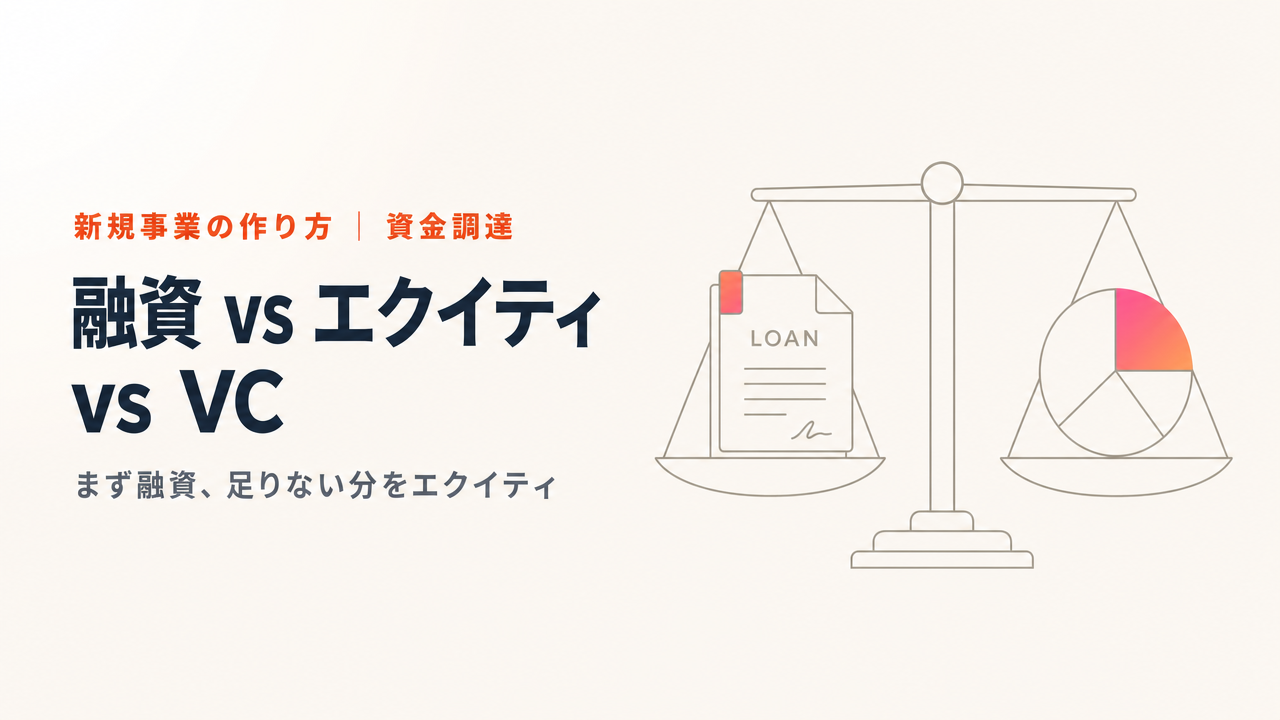
Let me give you the conclusion up front. Loans first, equity for the rest. That is the order. Japan has generous founder loans that let you borrow without handing over a single share, and most businesses get off the ground with them. Equity, in exchange for having no repayment, is also the most expensive money in the world. In this article, we will look together, working through a fictional new business hands on, at how loans, equity, and VC actually differ, why loans come first, and how to combine them to protect the founder's stake. If you want to make AI your partner in building a business and pressure-test the money design too, measuring where you stand first with the free three-minute AI literacy check will help the prompts in the second half land properly.
By the way, this article is one in a series that explains, step by step, how to build a new business. If you want to assemble the picture in order from the whole business first, take a look at the complete guide to new-business frameworks beforehand, and you will see at what stage the money question becomes necessary.
The cast of financing, and the minimum terms to keep in mind
There are several kinds of money providers. Going in order, the first is your own money, self-funding. Next is borrowing from family or friends, called the 3Fs after the English initials (Family, Friends, and Fools). Beyond that is other people's money from outside: angel investors, who invest from their own personal assets; VCs (venture capital), who pool money from multiple investors and invest it together; loans from public institutions and banks; and subsidies and grants, which you do not have to repay but which come with strict rules on use and screening. The table below lays out this cast by nature.
| Provider | Nature | Obligation to repay | Do you give up shares |
|---|---|---|---|
| Self-funding | Your own money | None | No |
| 3Fs (family, friends) | Borrowing or investment from those close to you | Repay if it is a loan | Depends on the case |
| Public / bank loans | Borrowing | Repay principal and interest | No |
| Subsidies / grants | Public benefit | None (in principle) | No |
| Angel investors | Investment by an individual | None | Yes |
| VC | Investment by a fund | None | Yes |
As a business grows, financing proceeds in stages. Typically it moves from the earliest pre-seed, through seed, Series A, B, and C, and finally toward an Exit (the exit where investors cash in their shares) via an IPO (going public) or M&A (acquisition). The further you follow these stages, the larger the amount that moves at once.
The vocabulary around shares is easier to handle if you nail it down early too. The list of who holds what percentage of the shares is called the cap table, and the fact that each new share issuance lowers existing shareholders' ownership percentage is called dilution. The pricing of the company is the valuation, and the investor who takes the lead in setting the terms in a given round is the lead VC. The pool set aside to give shares to employees in the future is the ESOP (stock option pool), and the document that summarizes the main terms of an investment on a single page is the term sheet. This much is the shared language. If an unfamiliar word comes up, come back to this paragraph.
Where beginners lose the most is "equity from the start"
The most typical failure is signing on the spot, without even knowing that public loans exist, to an angel's offer of "I'll put in 5 million yen, so give me 10 percent of your shares." When you hear there is nothing to repay, it feels like a bargain, as if you got money interest-free. That is the trap.
Let me peek inside an investor's head. They expect the money they put in to grow roughly tenfold in seven years. Ten times in seven years, converted to an annual rate, is about 39 percent. In other words, from the investor's expectation standpoint, equity is money worth about 39 percent a year. That is higher than a bank card loan. Of course, the contract does not say 39 percent; this is purely the expectation the investor carries in their mind. Even so, when you think in terms of the amount you actually give up when you succeed, the weight of that standpoint becomes clear.
Let me put concrete numbers on it. Say you had 5 million yen put in for 10 percent of your shares. Suppose the business goes well and one day reaches a company value of 1 billion yen. At that point, the 10 percent you gave up is worth 100 million yen. In exchange for receiving 5 million yen, the contract was to give up 100 million yen on success. If you had instead borrowed the same 5 million yen through a public loan at 1.5 percent a year over a seven-year repayment, the total repayment including interest would have come in at around 5.5 million yen. The difference is roughly 95 million yen. Of course, this is the case where the business is a huge success, and equity has the advantage that if you fail, the investor takes on that loss. Being able to shift repayment risk to someone else is exactly the value of equity. But the understanding that you "got a bargain, interest-free" completely misreads this structure.
This true cost is worth calculating once with the numbers of your own business. Here is a pressure-test prompt to have AI run the estimate. Copy it and use it as is.
You are a CFO well versed in capital policy. Show me with numbers how much more expensive, in real terms, the equity round I am considering is compared with a loan.
Steps:
(1) Using the VC expectation standpoint of "ten times in seven years = roughly 39% annualized," estimate how much value the percentage of shares given up will amount to giving away at a future Exit.
(2) Compare with the total repayment amount if I borrowed the same amount as a public loan (1 to 3 percent a year).
(3) State the difference explicitly as "the cost of choosing the wrong way to raise money."
(4) Judge whether equity is justified for this business (is it a high-risk, high-return business making a big bet over several years?).
* Also make clear that this is about the investor's "expectation standpoint," not a contract to pay 39% in cash. At the end, add "Confirm with a lawyer strong in startup law before signing."
--- Paste the following ---
- Offer from the angel or VC: {X million yen} for {X} percent of shares
- Assumed company-value range at Exit: {X hundred million yen}
- Interest rate and term if the same amount is borrowed as a loan: {X% per year, X-year repayment}
Looking for AI training and consulting?
Learn about WARP training programs and consulting services in our materials.
"Loans first" is Japan's weapon
For someone starting a new business in Japan, the biggest weapon is in fact public loans. Running to equity without using this to the full is not so much a waste as an outright loss.
At the center is the founder loan from the Japan Finance Corporation. It is now consolidated into a single scheme called the New Business Startup Fund; the former New Startup Loan Program was merged into it in April 2024. This consolidation removed the self-funding requirement, and as a rule you can now receive a founder loan with no collateral and no guarantor. The interest rate varies by timing and conditions, but the rough guide is in the 1 to 3 percent range per year. You give up no shares at all. On top of this you stack a credit-guarantee-backed loan from the credit guarantee association, or a local institutional loan provided by your municipality. Institutional loans sometimes come with a subsidy on the guarantee fee, which can make the effective burden even lighter.
Then, in 2023, came a major turning point: the Personal Guarantee Reform Program. Until then, when founders took out a loan, they were in many cases required to provide a personal guarantee known as the "management guarantee." It is a promise that if the company cannot repay, the president covers it personally. With that in place, failing at the business could cost you your home and personal assets, cutting off the path to trying again. What emerged as part of the reform program is the SSS guarantee (the Startup Creation Promotion Guarantee), which lets businesses within a set period from founding receive a guarantee-backed loan without the founder's personal guarantee. Conditions such as a ceiling amount and an eligibility window are defined, and in exchange for a slightly higher guarantee fee rate, it lets you remove the personal guarantee.
Here there is one thing I want to say plainly. The difference in the guarantee fee is small. Even if the add-on is on the order of 0.2 to 0.5 percent a year, on a loan of tens of millions of yen it often amounts to only around a hundred thousand yen or so a year. If that hundred-odd thousand yen protects your family's livelihood and your own path to trying again when you fail, I would choose no personal guarantee without hesitation. At the counter, say from the very start, "Based on the 2023 Personal Guarantee Reform Program, please walk me through the option with no personal guarantee." If you stay silent, you may be presented with the conventional guarantee-attached proposal.
Note that the SSS guarantee's ceiling amount, the eligible number of years from founding, and the treatment of the guarantee fee can change with scheme revisions, so before you actually apply, be sure to check the latest terms on the official sites of the SME Agency, the credit guarantee associations, and the Japan Finance Corporation. The numbers in this article are a guide as of writing. On subsidies and grants, they look attractive but take an enormous amount of time to apply for, have a limited acceptance rate, and are paid after the fact, in principle after the project is complete. I think the realistic view is not to make them your main source of funding but to aim for them as a side dish.
The true nature of equity, and the rule: "loans first, equity for the rest"
Reading this far, equity may look like the villain. It is not. Equity is the most expensive money, worth the equivalent of 30 to 40 percent a year, and at the same time it has a one-of-a-kind property: no repayment obligation. For businesses that take years before revenue comes in, such as deep tech like bio, drug discovery, semiconductors, and space, a loan that demands repayment will not let you last. For these businesses that "make a big bet over several years," equity is the right tool. In short, the problem is not equity itself but getting the order wrong.
So how do you allocate? The criterion is astonishingly simple, and there is just one. How many months until your first revenue comes in. As a guide, if the business generates revenue within six months, you can build it around loans. If it is deep tech that takes three or more years, it is equity-centered. In between, think hybrid. Businesses like SaaS, e-commerce, D2C, consulting, and traditional crafts have relatively light initial investment and earn quickly, so in most cases they can run fine centered on loans.
| Time to first revenue | Center of funding | Businesses that tend to fit |
|---|---|---|
| Within 6 months | Loan-centered | SaaS, e-commerce, D2C, consulting, traditional crafts |
| 6 months to 3 years | Hybrid | Hardware, regulated industries, services with deep R&D |
| 3 or more years | Equity-centered | Deep tech such as bio, drug discovery, semiconductors, space |
It also helps to have a rough ratio in mind so you do not waver. Covering 60 to 70 percent of the funding you need with loans and 30 to 40 percent with equity is a realistic balance that secures the money while keeping dilution down. For example, if you need 30 million yen in total, secure 15 million yen from the Japan Finance Corporation, 5 million yen from a local institutional loan, 20 million yen in loans altogether, and put in the remaining 10 million yen as equity. This keeps dilution to a minimum. If you try to take the whole amount as equity, your shares thin out at an early stage, and later it comes back to bite you.
To pin down exactly how much you need, you have to be able to see the structure of your business's revenues and costs. If this is fuzzy, the amount you need is itself a shot in the dark. If you have not nailed it down yet, drop your revenues and costs onto a single sheet in how to build a business model first, then come back to this article, and the precision of your required amount will improve. If you want a partner in AI to help you assemble this financing design itself, at our AI consulting service WARP we work through everything with you, from designing the order to pressure-testing the numbers.
Choosing the contract form, and defending a 50 percent founder stake
Once loans fall short and you decide to bring in equity, the next step is choosing the form of the contract. There are three representative options.
| Form | Assumed scenario | Characteristics |
|---|---|---|
| SAFE | Applying to overseas VCs or accelerators | English, based on U.S. law. Basically unnecessary if you are domestic-only |
| J-KISS | The standard for domestic seed | Japanese, Japanese law. Accounting treatment is natural too, and most seed rounds are covered by this |
| Preferred shares (Class A preferred) | A full-scale round with a confirmed lead and a large amount | Requires legal fees and registration and is heavy. Suited to Series A and beyond |
If domestic angels and seed VCs are the center of gravity, you can safely assume J-KISS first. If you are applying to overseas VCs or accelerators, use a SAFE. Only when the lead is firmed up and it becomes a full-scale round with an amount exceeding 50 million yen do preferred shares come into view. Bringing out preferred shares at the seed stage will tie you up in legal fees and the trouble of registration until you cannot move. The standard practice is to defer going to preferred shares and proceed lightly at seed with a SAFE or J-KISS.
And there is one line in capital policy I want you to defend above all else. Keep the founder's stake at a minimum of 50 percent or more as of the end of Series A. An ordinary resolution at a shareholders' meeting passes with a majority. Fall below this line and you lose the initiative in important decisions, and in the worst case you can even be removed as president. It bites in practical terms too. Series B and C VCs look at the cap table, and if the founder has thinned out to 30 percent, they may judge that "the management incentive is insufficient" and pass on investing. So get into the habit of reaching for a calculator at every round. What percentage will the founders total after this round, and if you are then diluted 20 percent at Series A, what percentage remains? Do not forget to also subtract the amount for securing the ESOP pool (generally 10 to 15 percent).
There is a misconception about choosing investors that beginners fall into too. The order of magnitude of the amount they will put in does not differ much between a famous fund and a domestic fund for the same round. The real difference is the "credit effect." Third-party endorsement from having a trusted investor on board multiplies the probability of success in later rounds, hiring, and sales. Conversely, taking money from an unknown investor carries three risks: it can work against you in later rounds, they may present bad terms, and they may not help you when it counts. There are even situations where it is better not to take it at all. The best way to size them up is to take references. Actually call three to five founders the investor has backed in the past and ask about their reputation. An investor who dislikes this is, for that reason alone, one I think you are better off avoiding.
Finally, the dangerous clauses in a term sheet. Clauses such as a 2x participating preferred, full ratchet anti-dilution, broad veto rights, and an overly long no-shop obligation exceeding 30 to 45 days cannot be undone later. The standard is a 1x non-participating, broad-based weighted average anti-dilution, and keeping a founder majority on the board. Filling in a template you found online and signing it yourself is out of the question; for both loan contracts and share contracts, always check with a lawyer strong in startup law before signing. An initial consultation runs around 10,000 to 30,000 yen. What you lose by pinching those few tens of thousands of yen is on a different order of magnitude.
Pressure-testing the financing design with AI (worked through with the fictional business SHIFTMATE)
From here is the hands-on part. Let me use as an example a SaaS called "SHIFTMATE," which has AI automatically build shift schedules for restaurant chains that satisfy both employees' preferences and labor law. The founders are two people, a CEO (a former store manager who knows the pain of the floor inside out) and a CTO, with a 55 percent stake for the CEO and 45 percent for the CTO. Self-funding is 2.5 million yen, and 900,000 yen of emergency living-expense reserves is left untouched. They have already started charging with an MVP, with three contracted stores and 50,000 yen in MRR, four months from founding. The funding needed is 30 million yen for the first year, broken down into 18 million yen to hire two engineers, 6 million yen for advertising, and 6 million yen for outsourced development. Five years out, they want to expand nationwide and make a big bet.
This business is SaaS, with light initial investment, and it already has revenue. Applying the criterion, it is the type you can build around loans. The design looks like this. First, secure 15 million yen through the Japan Finance Corporation's founder loan with the SSS guarantee, meaning no personal guarantee. Next, stack 5 million yen from a local institutional loan, for a loan total of 20 million yen. Raise the remaining 10 million yen with a J-KISS (post-money cap of 500 million yen), as a business making a big multi-year bet. The result is 66 percent loans, 34 percent equity. Bringing in 10 million yen at a 500 million yen cap keeps dilution on conversion to around 2 percent, and even after running through a 12 percent ESOP and 20 percent Series A dilution, the founders' total remains above 50 percent. Had they taken the full 30 million yen as equity, dilution would have exceeded 20 percent, the founders' stake would have thinned out early, and they would have carried the risk of being seen at Series A as having "insufficient management incentive."
Here is a prompt to have AI diagnose this order and ratio for your own business.
You are an advisor well versed in Japanese startup financing. For my business, following the golden rule of "loans first, equity for the rest," propose:
(1) the order in which I should take money,
(2) the recommended ratio of loans to equity (a guide is 60 to 70 percent loans),
(3) which of the Japan Finance Corporation, the credit guarantee association, local institutional loans, and the SSS guarantee I should approach first,
(4) a judgment on whether this is even a business that needs equity.
The main axis of the judgment is "how many months until first revenue comes in" (within 6 months means loan-centered, 3 or more years means equity-centered). At the end, always add "Confirm with a lawyer strong in startup law before signing" and "Confirm the latest terms of each scheme on the official Japan Finance Corporation and SME Agency sites."
--- Paste the business information below ---
- Business description: {in one sentence}
- What you want in five years: {enough to make a living in my generation / make a big bet over several years}
- Expected period until first revenue: {X months}
- Total funding needed and its use: {X million yen / breakdown across hiring, development, marketing}
- Self-funding: {X million yen} / amount kept as an emergency living-expense reserve: {X million yen}
- Current traction: {MRR, number of customers, etc.} / time since founding: {X months}
If you are anxious about the Japan Finance Corporation interview, having AI play the interviewer and running a mock interview works well.
You are a founder-loan officer at the Japan Finance Corporation. On the assumption that I am facing an interview for a founder loan (I want the SSS guarantee = no personal guarantee),
(1) give me 10 tough mock-interview questions. In particular, probe "the basis for the revenue plan (can you speak in terms of your own number of customers x unit price, not an industry average?)," "the source of the self-funding and the savings history," and "your preparation track record over this past year (customer interviews, MVP, trial contracts)."
(2) Give feedback on my answers and point out where I would fail,
(3) and give suggestions to improve the business plan (5 to 10 A4 pages, with three years of projections).
At the end, note that the latest scheme terms must be confirmed on the official Japan Finance Corporation site and that contracts must be checked with a lawyer.
--- Paste the following ---
- Desired loan amount / self-funding: {X million yen / X million yen (X months of savings history)}
- Assumptions of the revenue plan: {Year 1: X customers x X yen unit price = X yen a month / actual figures for years 2 and 3}
- Preparation track record: {X interviews, MVP, X trial contracts}
- Background and worst-case plan B: {   }
If you are worried about dilution, have it calculate the cap table all the way through.
You are a capital-policy specialist. From my cap table and financing terms, calculate in a staged table:
(1) the conversion percentage of each SAFE / J-KISS (investment amount / post-money cap),
(2) the cumulative dilution including the ESOP (assume 10 to 15 percent) expansion,
(3) the founders' total percentage after Series A (assume 20 percent dilution).
(4) If there is a risk that the founder stake falls below 50 percent at the end of Series A, warn me, and present measures such as revising the valuation cap, curbing the SAFE issuance amount, or shifting to loans.
Make clear that the figures are only approximate logic and that a formal calculation requires an Excel model and a review by a lawyer and an accountant.
--- Paste the following ---
- Founders and current stakes: {Founder A X% / Founder B X%}
- ESOP pool: {X% (write "none" if not yet secured)}
- SAFEs / J-KISS issued or planned: {each: investment X million yen / post-money cap X hundred million yen / discount X%}
- Assumed Series A: {raise X hundred million yen / pre-money X hundred million yen}
Once you receive a term sheet, having AI do a first read for dangerous clauses will make your meeting with the lawyer richer.
You are an advisor well versed in startup law (on the premise that final confirmation is left to a lawyer).
(1) From my situation, propose which of a SAFE, J-KISS, or Class A preferred share is best, following the principle of "J-KISS if the center is domestic angels or seed VCs, SAFE if you are applying to overseas VCs or accelerators, and preferred shares for a full-scale round with a confirmed lead and a large amount."
(2) Comb the term sheet presented to me for dangerous clauses (2x participating preferred, full ratchet, broad veto rights, a liquidation preference of 2x or more, a no-shop exceeding 30 to 45 days, cumulative dividends) and explain, with concrete examples, what each would cause.
(3) Present the standards to defend in negotiation (1x non-participating, broad-based weighted average, keeping a founder majority on the board).
Always close with "The drafting and execution of the contract require a lawyer's confirmation."
--- Paste the following ---
- Center of investors: {domestic angels / domestic seed VC / overseas VC or accelerator}
- Amount to raise and lead status: {X million yen / searching for a lead or confirmed}
- Main terms presented: {valuation, preference, anti-dilution, board, no-shop period, etc.}
These prompts are only for organizing your own thinking and preparing the groundwork before you talk to an expert. AI's output is a hypothesis, not fact and not legal advice. Verify the numbers with your own business's real data, the schemes with official sources, and the contracts with a lawyer before you act. If you want to estimate the time to revenue with precision, run the numbers on the size of demand in how to size a market, and your sense of the required amount and the scale of the round will waver less.
Summary
The first thing to do in financing is not to look for a VC. It is to decide the order. Finally, let me organize the points for moving from today.
- Decide first what you want in five years. If enough to make a living is fine, be loan-centered; if you are making a big bet, keep equity in view too.
- The criterion is one: "how many months until first revenue." Within 6 months means loan-centered, 3 or more years means equity-centered.
- Once you have self-funding and an emergency living-expense reserve in place, start with the Japan Finance Corporation's founder loan. Specify no personal guarantee (the SSS guarantee) from the outset.
- Equity is the most expensive money in exchange for no repayment. If you use it, keep it to 30 to 40 percent of the amount needed, and start the contract with a J-KISS or SAFE.
- Defend a founder stake of 50 percent or more at the end of Series A. Check dilution with a calculator at every round.
- For both loans and shares, always see a lawyer strong in startup law before signing. Confirm the latest scheme terms with official primary sources.
What I most want to convey is that money has an order. Simply keeping to the order lets you avoid giving up shares you did not need to give up, and lets you start the business in a form where you can try again even if you fail. Equity looks sweet, like a drug, but whether to take it is a decision you can make after you have built the foundation of loans, and it will not be too late. If you want to assemble the financing design itself together with AI and polish it all the way to the business plan, reach out from WARP's individual consultation. We will draw the order and the ratio that fit your business, together and with the numbers.
Note that this article is general information for organizing how to think about financing, and it is not advice on whether a particular loan or investment is possible, nor legal, tax, or accounting advice. Because the terms and amounts of the schemes are revised, before any actual application or contract, confirm the latest content with official primary sources such as the Japan Finance Corporation, the SME Agency, and the credit guarantee associations, and always consult a lawyer strong in startup law about the contract.
References
- SME Agency, "Personal Guarantee Reform Program" and related materials 1
- SME Agency, "Startup Creation Promotion Guarantee" 2
- Japan Finance Corporation, "New Business Startup Fund" scheme guide 3
- Y Combinator, "Standard SAFE" (primary source for the definition of the SAFE) 4