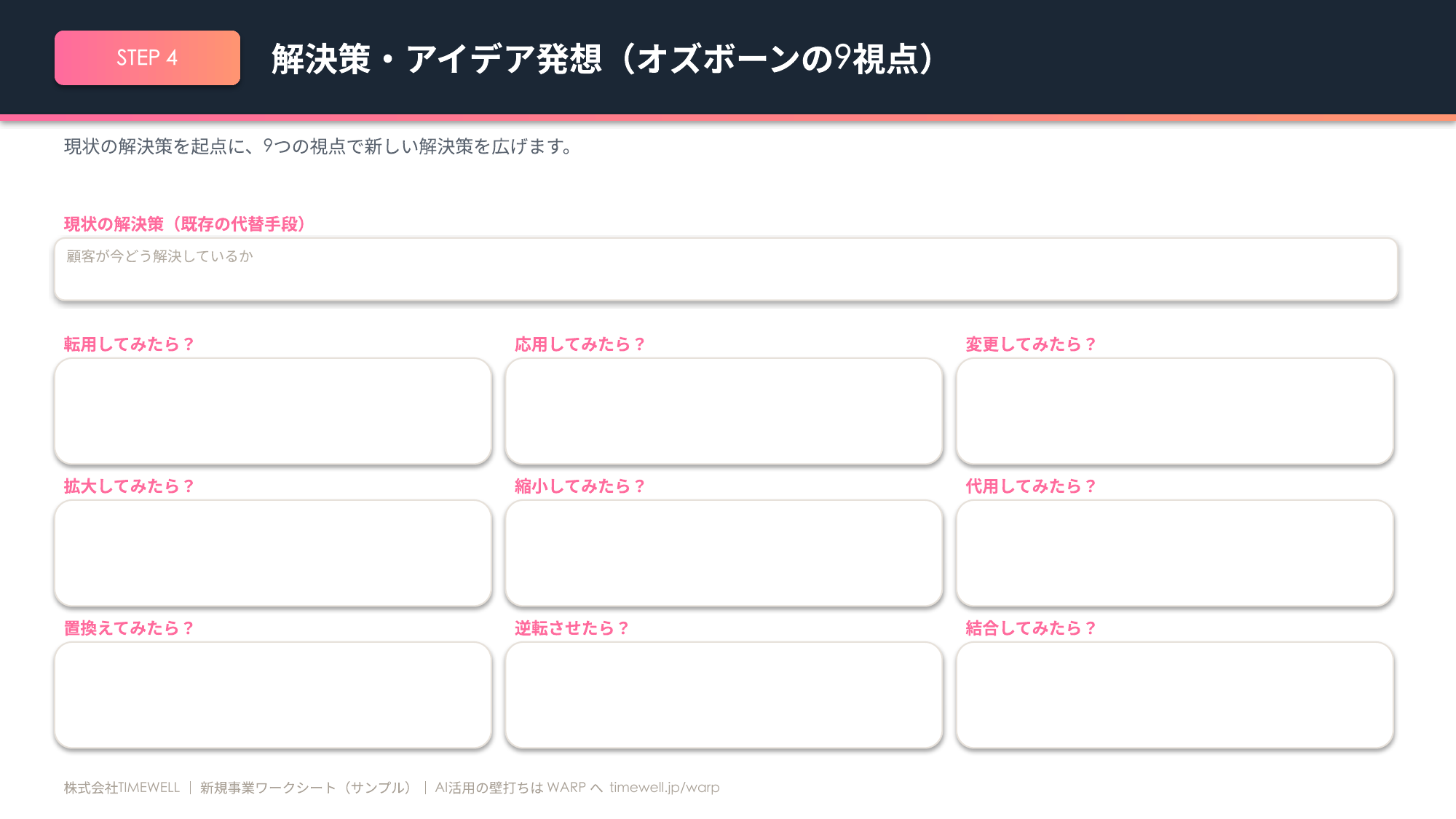
Idea Generation Worksheet (editable PPT)
An ideation template that expands new ideas from today’s solution using Osborn’s nine lenses.
Download the PPT (free)PowerPoint (.pptx) ・ no email required
Hello, this is Ryuta Hamamoto from TIMEWELL.
By far the most common concern I hear in new-business consultations is "I can't come up with a good idea." You set up a whiteboard in the meeting room, invite everyone to brainstorm freely, and almost always the silence just continues. If you wait for a stroke of genius, you never get started. But this is not a matter of talent. Most people simply assume that ideas are "something you conjure from nothing."
The methods professionals use go in exactly the opposite direction. You place something existing as your starting point, bombard it with questions that mechanically shift your perspective, and force ideas out. The leading examples of this "forced ideation" approach are Osborn's Checklist and SCAMPER. This article is STEP 4 of a nine-step process for building a new business, the step responsible for idea generation. Starting from the customer problem and value proposition you locked in during the previous step (the Value Proposition Canvas), we will work hands-on to mass-produce solutions that solve that problem, using a fictional coffee shop as our example. The full picture is laid out in the Complete Guide to the New Business Framework.
Let me start with three key points.
- Ideas are not conjured; they are wrung out. Starting from an existing subject and forcibly shifting your perspective to mass-produce ideas is the essence of Osborn and SCAMPER.
- Osborn's nine angles are strong on comprehensiveness; SCAMPER's seven elements are strong on memorability. The two are not in opposition but related by lineage, and for beginners it is realistic to start with SCAMPER.
- Always separate divergence (generating ideas) from convergence (selecting ideas). Mixing them stops the flow. At the end, distill everything into a one-line business idea statement and hand it off to validation.
If you first want a feel for how well you or your team could make AI a partner in ideation, start with the roughly five-minute AI Literacy Check.
Ideas Are "Wrung Out": The Idea of Forced Ideation
To begin with, there are several families of idea-generation methods. Brainstorming, where you throw out whatever comes to mind one after another. Mandala charts, which expand associations from a central theme. The KJ method, which groups similar pieces of information to grasp structure. The Five Whys, which digs into causes. Analogical thinking, which borrows similar structures from other fields. Each is suited to a different situation. Within all of this, Osborn's Checklist and SCAMPER belong to the "checklist method," an ideation approach that throws a fixed list of questions at a subject to forcibly change your perspective.
Why "forced"? Because left to its own devices, human thinking only stretches in the direction it is already good at. Ask a ramen shop owner to "think of a new ramen," and the conversation stays about flavor. But ask from the opposite direction, "what if customers didn't even have to come to the shop?", and other paths appear, such as delivery or a meal kit. Injecting, from the outside, an angle you would never think of yourself is exactly the role of the checklist method. Without relying on whether inspiration strikes, anyone who does it produces a certain volume of ideas. That, I believe, is its greatest value.
The person who first systematized this approach was Alex F. Osborn, a co-founder of an advertising agency. Known also as the proponent of brainstorming, he presented a "list of idea-spurring questions" in his 1953 book1. At the same time, he taught that there are four principles to uphold in a divergence session: prioritize quantity over quality, do not criticize the ideas that emerge, welcome the wildest ideas, and build on and extend others' ideas. These four principles form the very foundation of the ideation work here. If you evaluate as you go, thinking "but the budget," "that's not feasible," the volume suddenly dries up. Declare at the outset that during the divergence period, evaluation is temporarily sealed off, and then begin.
Osborn's Checklist: Nine Angles and How to Use Them
Osborn's Checklist poses questions about a subject from nine angles. In Japan it is commonly organized as the following nine items. To each I have added one concrete, everyday business example.
| Angle | Question to ask | Business example |
|---|---|---|
| Put to other uses | Is there another use for it? | Rent out the shop during unused hours as a pickup-locker hub for deliveries |
| Adapt | Can we borrow from something similar? | A monthly all-you-can-visit barber, adapting the subscription model to a hair salon |
| Modify | What if we change meaning, color, sound, or form? | Deliver stiff insurance explanations softly through short videos and chat |
| Magnify | What if we make it bigger, more, stronger? | A boxed-lunch shop specializing in extra-large sizes many times the norm |
| Minify | What if we make it smaller, lighter, or omit parts? | A lightweight app that narrows accounting software down to invoicing only |
| Substitute | What if we swap the people, things, materials, or means? | Unattended sales that replace staff service with an AI chat |
| Rearrange | What if we swap the order or elements? | A reservation-based shop that reorders "eat then pay" into "pay first to secure a seat" |
| Reverse | What if we flip it or reverse it? | Mobile sales that reverse "customers come to the shop" into "the shop goes to customers" |
| Combine | What if we combine things? | A laundry cafe that combines a coin laundry with a cafe |
Nine can feel like a lot, but this comprehensiveness is exactly Osborn's strength. People inevitably drift toward the easy-to-reach angles like Combine and Adapt, and skip over Eliminate, Reverse, and Minify. It is not uncommon for the very angles you skipped to hold ideas no one has mined yet. That is why, in the checklist method, you always make one full pass through every angle even when you are stuck. This is the unspoken rule.
Looking for AI training and consulting?
Learn about WARP training programs and consulting services in our materials.
SCAMPER's Seven Elements: Understanding It Through the Correspondence with Osborn
Osborn's nine angles are powerful, but memorizing nine of them and wielding them in the field is hard work. So in 1971, Bob Eberle reorganized Osborn's Checklist into seven initials, creating SCAMPER2. Originally devised as a mnemonic to nurture creativity in children, it later spread as a business ideation method. Since you can recall all seven angles just by tracing the letters, it is the smoothest place for a first-timer to start.
| Initial | Meaning | Question to ask |
|---|---|---|
| S (Substitute) | Substitute | Can something be replaced? |
| C (Combine) | Combine | What can be combined with it? |
| A (Adapt) | Adapt | What can we borrow from another field? |
| M (Modify, Magnify, Minify) | Modify, Magnify, Minify | What if we make it bigger, smaller, or change it? |
| P (Put to another use) | Put to another use | Is there another use for it? |
| E (Eliminate) | Eliminate | What can we remove? |
| R (Reverse, Rearrange) | Reverse, Rearrange | What if we reverse it or rearrange it? |
The place many people stumble here is "M." It is often taken to mean only Modify, but it actually includes Magnify and Minify. Make it extremely large; strip it down extremely small. Without using this range, your ideas suddenly narrow, so remember that "M" is a greedy item holding three angles at once. Note that the main business versions use A as Adapt, though some materials write it as Adjust. The meaning is nearly the same, an angle of borrowing from elsewhere and fitting it to your own subject.
Let me line up the relationship between SCAMPER and Osborn in a correspondence table. It is handy when you want to compare the two.
| SCAMPER | Corresponding Osborn angle |
|---|---|
| S Substitute | Substitute |
| C Combine | Combine |
| A Adapt | Adapt |
| M Modify, Magnify, Minify | Consolidates Osborn's three items (Modify, Magnify, Minify) into one letter |
| P Put to another use | Put to other uses |
| E Eliminate | Not in Osborn. A standalone item newly made explicit by SCAMPER |
| R Reverse, Rearrange | Consolidates Reverse and Rearrange into one letter |
Lining them up this way shows that SCAMPER compresses Osborn while adding the missing "Eliminate" angle as its own item. Eberle himself said he drew inspiration from Osborn's Checklist, so this is a matter of lineage rather than superiority. They share the point that both are tools to aid the divergence phase, and that the convergence phase, where you judge good from bad, is a separate process.
Let's Actually Do It: 21 Ideas with SCAMPER, Starting from a Coffee Shop
From here we work hands-on. You will not get lost if you run ideation in eight broad steps. Fix a single starting point. Declare the divergence rules (Osborn's four principles). Apply the checklist in order, forcibly. Make each angle's question concrete against your subject. Record every idea without judging. Focus your Put-to-another-use and Adapt passes around existing alternatives. Switch to the convergence phase and narrow to three promising options. Finally, put it into words as a one-line business idea statement. Let's run this flow through with our fictional coffee shop.
Our starting point is a small, old-fashioned coffee shop in a corner of a shopping street, where customers only come during the day. The owner runs it single-handedly, and it is reasonably lively until the afternoon with regular elderly customers and neighborhood homemakers, yet almost no one comes after early evening. Using this existing asset as our starting point, we apply SCAMPER's seven angles in order and wring out at least three ideas per angle. Forcing them out even when you are stuck is the essence of this method.
- S (Substitute) Keep the labor-intensive siphon coffee as-is, but substitute smartphone payment for ordering and checkout so one person can run it all. Replace the paper loyalty card with an app-based visit record. Replace the BGM CD with a playlist of songs the regulars bring in.
- C (Combine) Combine with retail so customers can buy the roasted beans they liked on the spot. Combine with the nearby florist to offer a coffee-and-small-bouquet set. Create seats with reading lamps and combine with a used-book shelf.
- A (Adapt) Adapt the drop-in model of shared offices to offer time-rental focus seats where one cup of coffee lets you stay a while. Serve a slightly luxurious breakfast set adapting the hotel morning. Adapt the daily special of a set-meal diner into a daily brewing-method experience.
- M (Modify, Magnify, Minify) Boldly minify the menu into a clean shop offering just one blend and one type of toast. Conversely, magnify it into a monthly all-you-can-drink subscription for regulars. Make the cups extremely large and sharpen the concept into "the extra-large mug shop."
- P (Put to another use) Put the empty weeknight space to use as a venue for small reading groups, language cafes, or bring-your-own wine gatherings. Put daytime empty seats to use as meeting spots for nearby freelancers. Put the regular closing day to use as a venue for cooking classes.
- E (Eliminate) Eliminate the process of ordering and serving at the table, making it a "no-line coffee shop" of advance orders and takeout only. Eliminate the menu and offer only the owner's recommendation. Eliminate the daytime hours and commit fully to an evening-only coffee shop.
- R (Reverse, Rearrange) Reverse "customers come to the shop" into a visiting coffee service that goes out to nearby offices and delivers fresh brews. Rearrange the time slots so it wears a different face by the hour: coffee in the morning, set meals at noon, a bar at night. Reverse "the owner chooses" into a made-to-order coffee shop where the customer specifies the beans and brewing method.
Three ideas each across seven angles, and we now have 21 ideas. Up to here we have not evaluated at all. We leave even the wild ideas on the sheet. On that basis, we pay attention to ideas rooted in existing alternatives. Suppose the people in this area have no place to gather in small groups and end up making do with chain cafes or family restaurants. That frustration lines up perfectly with the P (Put to another use) idea of "lending out the evening space as a venue."
Here we switch to the convergence phase. For evaluation axes, a two-axis matrix of feasibility (can we start with our own resources?) and impact (how much does it solve the customer's problem, and how large is the market?) is easy to handle. The most promising this time was the P (Put to another use) idea. It requires almost no additional investment, uses the seats, the space, and the atmosphere exactly as they are, and directly answers the area's concrete frustration of "there's no place to gather." Finally, we turn the narrowed idea into a one-line business idea statement: "A flat-rate evening community coffee shop that lends the evening hours of a coffee shop, otherwise used only during the day, with drinks included, to social hobby groups in the area who struggle to find a place for small gatherings." Only when you can put it into words this far does an idea become a "business idea."
Then comes validation. The assumption that would be fatal if it flipped was "how many small groups in the neighborhood actually need this place in the evening in the first place." Interview 10 organizers of local reading groups, language circles, and board-game meetups about where they gather now and what troubles them, and confirm it. From here on, the next step, the Business Model Canvas, builds all the way up to the revenue structure.
By the way, you can run this whole sequence alone. But working solo skews your angles, so it helps to use generative AI as a sounding board and push it to "give me more from this angle." In practice, I find that adding generative AI to a small team is the easiest way to proceed, securing a diverse range of angles while warming up the room.
Using AI as a Sounding Board: A Set of Ready-to-Paste Prompts
Generative AI is a tool that pairs extremely well with the checklist method. Applying seven or nine angles in order to mass-produce ideas is exactly the kind of comprehensive, repetitive work AI is good at. Humans concentrate on evaluating and selecting, while AI handles the volume production of divergence. This division of labor fits nicely. Here I have prepared prompts you can use as-is for each step. Replace what is inside the brackets with your own subject and paste it into the AI. At TIMEWELL's AI consulting service WARP, we build these kinds of prompt designs together with new-business teams.
First, the all-in-one SCAMPER prompt that runs divergence in one sweep.
You are a facilitator and business-development consultant for new-business ideation. For the "starting point" below, mass-produce divergent ideas using SCAMPER's seven angles.

<Starting point> [Enter the existing product / service / operation you want to improve or repurpose]
<Assumed customer> [Enter who they are: industry, size, role]

Steps:
(1) Summarize the starting point and assumed customer in 1-2 lines to align on assumptions.
(2) Apply SCAMPER's seven angles in order (S Substitute / C Combine / A Adapt / M Modify-Magnify-Minify / P Put to another use / E Eliminate / R Reverse-Rearrange).
(3) Produce three concrete ideas for each angle, 21 in total. Write each as one sentence conveying "for whom, what, and how it changes."
(4) Welcome wild ideas, and do not evaluate feasibility at this stage.

Output format (use this table): columns "Angle," "Idea name (about 5 words)," "Concrete content (who / what / how)," "What's new (one line)." Fill 21 rows (7 angles x 3).

Constraints:
- Ban abstract words (convenient, high-quality, efficient) and get specific down to the subject, numbers, and situation.
- When you use an unknown number (price, headcount), mark it "(assumed)" and state the premise or basis.
- Do not fabricate real company names, results, or data.
- At the end, select the 3 ideas whose demand is most doubtful (most in need of validation) and add one line of reasoning for each.
When you prioritize comprehensiveness and want to dig deep with Osborn's nine angles, use this one.
You are a business-development consultant for new businesses. Prioritizing comprehensiveness, generate solutions to the following problem by digging deep with Osborn's Checklist of nine angles.

<Problem to solve> [Enter whose inconvenience, and what kind, it is]

Steps:
(1) First restate the problem in 1-2 lines as "who / in what situation / struggles with what."
(2) Apply Osborn's Checklist of nine angles in order (Put to other uses / Adapt / Modify / Magnify / Minify / Substitute / Rearrange / Reverse / Combine).
(3) For each angle, write "what question you posed" paired with "two ideas that came from it" (18 total).
(4) At the end, select the top three most surprising ideas and add one line on why.

Output format (use this table): columns "Angle," "Question posed," "Idea 1," "Idea 2." Fill nine rows. Below the table, give a numbered list "Top 3 surprising" (idea name + one-line reason).

Constraints:
- Ban abstract words and get specific down to the subject, numbers, and situation.
- Mark unknown numbers "(assumed)" and state the premise.
- Do not fabricate facts (real companies or data).
- At the end, list the 3 ideas whose assumptions are most fragile and most in need of validation, each with its risk.
The trick to producing ideas with real demand is to start from how the customer is currently making do. I have also prepared a prompt that generates ideas from the frustrations with existing alternatives.
You are a business-development consultant skilled at reading customers' alternative behaviors. To produce ideas with real demand, ideate starting from how the customer is currently making do.

<Customer> [Enter industry, size, role]
<Problem> [Enter the inconvenience this customer faces]

Steps:
(1) List three alternatives the customer is currently using to get by ("enduring this problem / building it themselves / paying a lot for it").
(2) For each, infer the concrete frustration (which of time, cost, effort, or quality, and how).
(3) Using those frustrations as the starting point, use SCAMPER's Put-to-another-use (P), Adapt (A), and Substitute (S) to produce three new solution ideas each, nine in total.

Output format (use these two tables):
- Table A (alternatives): columns "Alternative," "Why they use it," "Concrete frustration." Fill 3 rows.
- Table B (ideas): columns "Frustration (starting point)," "Angle (P/A/S)," "Solution idea (who / what / how)." Fill 9 rows.

Constraints:
- Ban abstract words and get specific down to the subject, numbers, and situation.
- Mark unknown numbers (cost, time) "(assumed)" and state the basis for the inference.
- Do not fabricate real companies or data.
- At the end, list the 3 ideas where confirming the frustration truly exists is most necessary, each with the assumption to test.
Once divergence is done, have the AI help with convergence. Here is the prompt for evaluation and narrowing.
You are a business-development consultant supporting investment decisions for new businesses. Evaluate the ideas from divergence and narrow them to the promising ones.

<Idea list> [Paste the ideas from SCAMPER etc. as a bulleted list]
<Our resources> [Enter available people, assets, capital, and strengths]

Steps:
(1) Rate each idea on a five-point scale across two axes: feasibility (can we start with our own resources?) and impact (degree of customer problem solved x breadth of market).
(2) Add a one-line rationale for each score.
(3) Select the three most promising overall.
(4) List, one each, the biggest risk (the first assumption to validate) for each.

Output format (use this table): columns "Idea," "Feasibility (1-5)," "Feasibility rationale," "Impact (1-5)," "Impact rationale." Fill in all ideas. Below the table, give a numbered "Top 3 promising" (idea name + overall assessment + one biggest risk).

Constraints:
- Ban abstract words and get specific down to the subject, numbers, and situation.
- Mark unknown numbers such as market size "(assumed)" and write the premise and a rough calculation.
- Do not fabricate data.
- At the end, list 3 points where this evaluation's own assumptions are weak enough that the conclusion could flip (self-critique).
Finally, turn the narrowed idea into a one-line business idea statement and have it create the validation questions too. Once you get here, it is in a form you can hand directly to the next step.
You are a business-development consultant who designs hypothesis validation for new businesses. Put the narrowed idea into words as a one-line business idea statement and build the entry point to validation.

<Idea> [Enter the rough business idea]

Steps:
(1) Rephrase the idea into a one-line business idea statement of the form "solve [whose] [what problem] by [what method]."
(2) Identify the single "assumption that would be fatal if wrong" required for this idea to hold.
(3) Create five customer-interview questions to confirm that assumption at minimum cost.

Output format (use this structure):
- "One-line business idea statement": (one sentence)
- "Fatal assumption": (one sentence + why it is fatal)
- "Validation interview questions": numbered, five of them

Constraints:
- Ban abstract words and get specific down to the subject, numbers, and situation.
- Make the questions behavioral ("what did you actually do most recently") rather than opinion questions ("do you think..."), and do not lead the answer.
- Do not fabricate facts.
- At the end, list the 3 weakest parts of this one-line statement that most need validation.
I have compiled these prompts, along with a worksheet that runs the whole flow from divergence to convergence on a single page, into a ready-to-use slide format. You can project it directly in your team's ideation meeting.
Download the free sample PowerPoint template
Common Stumbling Blocks and How to Get Past Them
Finally, let me share the stumbling blocks I have seen again and again in the field. When ideation is not flowing well, it usually falls into one of these.
The most common is doing divergence and convergence at the same time. You evaluate as you generate, thinking "but the budget," "we can't do that," and the volume stops. As Osborn's principles say, separate evaluation completely into a later stage. The next most common is stopping at only the easy-to-reach angles. You keep running Combine and Adapt while skipping Eliminate, Reverse, and Minify. Since comprehensiveness is the value of the checklist method, make one full pass through every angle even when you are stuck.
Starting to run it without deciding the problem to solve in the first place is another common failure. Ideation itself becomes the goal, and ideas pile up while it remains blank whose inconvenience, and what kind, you are solving. Fix the starting-point customer and problem first, then begin. If this stays vague, your ideas scatter too widely to be usable. Relatedly, wringing ideas out on paper without researching existing alternatives is also dangerous. If you ideate without seeing how the customer is currently enduring, self-building, and paying to get by, you mass-produce ideas with no demand. Simply starting from the frustrations with alternatives makes the ideas far sharper.
If your hands come to a complete stop midway, there are three remedies. Force yourself to answer the next angle's question anyway; add one constraint to the subject (narrow the conditions, such as "if the budget were zero" or "if we started tomorrow"); and research the customer's alternatives once more. Constraints look like the enemy of ideation, but they are in fact the strongest primer. And the one people forget: do not try to turn an idea into a business as-is. Ideation is only a hypothesis. Distill it into a one-line business idea statement and hand it to validation. Skip that and start building, and you will usually miss.
Summary
- Ideas are not conjured; they are wrung out by forcibly shifting your perspective against an existing subject. Osborn's Checklist and SCAMPER are tools that let anyone perform this forced ideation to a certain volume.
- Osborn's strength is comprehensiveness across nine angles; SCAMPER's is memorability in seven letters. The two are related by lineage: use SCAMPER as a beginner, Osborn when comprehensiveness matters.
- Always separate divergence from convergence. In divergence, uphold Osborn's four principles (quantity over quality, no criticism, welcome the wild, build on others), and in convergence, narrow to three ideas on the two axes of feasibility and impact.
- Ideas with real demand come more easily when you start from the frustrations with the alternatives the customer currently endures. At the end, put it into words as a one-line business idea statement and hand it to validation.
- Leave the volume production of divergence to generative AI, and let humans concentrate on evaluation and selection. This division of labor moves an ideation meeting sharply forward.
Ideation is not talent; it is procedure. In the first 10 minutes of today's meeting, stop saying "think freely" and try applying SCAMPER's seven letters in order. The whiteboard that fell silent should fill up with ideas. How to validate the ideas that emerge and grow them into a business model is covered in each step of the Complete Guide to the New Business Framework. If you want to run an ideation meeting on your own subject, or make AI a partner in building your business, reach out through a WARP individual consultation. We will work hands-on together and shape that first idea.
References
Related Articles
- Complete Guide to the New Business Framework: 9 Steps from Idea to Business Plan
- How to Write a Value Proposition Canvas: Connecting Customer Problems and Value (STEP 3)
- How to Build a Business Model Canvas: Designing Your Business with Nine Blocks (STEP 5)
- The Customer Problem Empathy Map: Visualizing the Customer's True Feelings
Footnotes
-
Alex F. Osborn, Applied Imagination: Principles and Procedures of Creative Problem-Solving, Charles Scribner's Sons, 1953. The origin of the checklist method, which presented a "list of idea-spurring questions." ↩
-
Bob Eberle, SCAMPER: Games for Imagination Development, 1971. The origin that presented SCAMPER as a mnemonic reorganizing Osborn's Checklist into seven initials. ↩