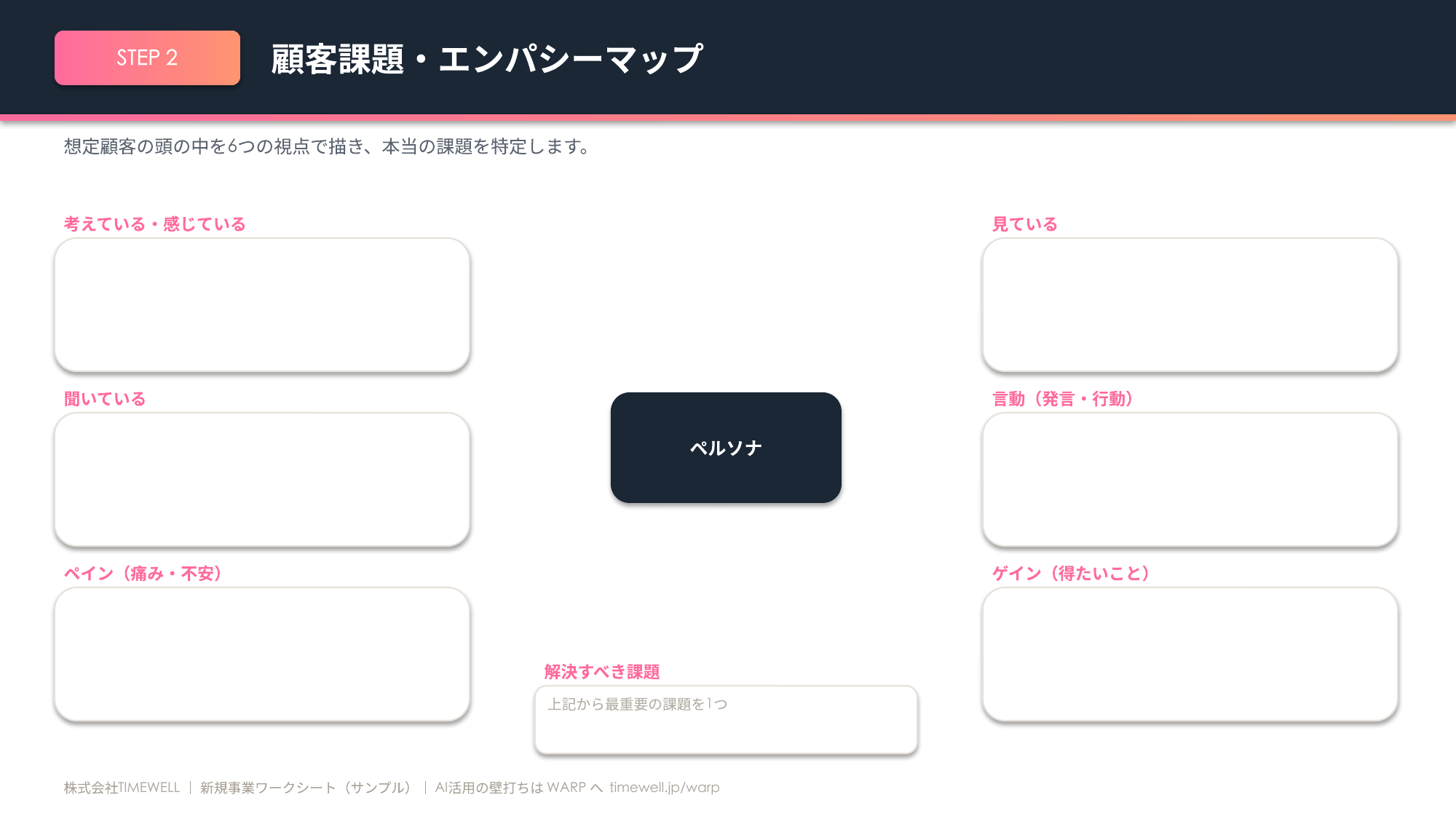
Customer Problem & Empathy Map Worksheet (editable PPT)
An empathy-map template that maps your target customer’s mind across six lenses to pinpoint the real problem.
Download the PPT (free)PowerPoint (.pptx) ・ no email required
Hello, this is Ryuta Hamamoto from TIMEWELL.
When a new venture fails, the cause usually lies not in the "solution" but on the "problem" side. A well-built app, a polished UI, attentive support. Everything is in place, yet it doesn't sell. The reason is simple: the problem you set out to solve was never one that customers were willing to spend money or time to solve. Put the other way around, if you have a firm grip on a deep problem, people will use your first product even if it's a bit clunky.
This article is STEP 2 of a series explaining the nine steps of building a new business. The full picture is laid out in the Complete Guide to the New Business Framework. Once you have decided "who to target" in STEP 1, How to Define Your Customer Segment, it's time to dig out that person's "real troubles." The tools for this are customer interviews and the empathy map. I'll describe how to use these two tools in enough detail that you can start moving your hands today.
First, three key points.
- Customer problems show up not in what customers "say," but in what they "do." The knack of problem discovery is to look for the gap between words and actions.
- An empathy map is not something you fill in from imagination. Use it as a container for organizing the primary data you get from customer interviews.
- AI is not a "substitute for the customer." Practically speaking, use it as a partner that organizes your thinking—bouncing draft questions off it, sorting transcripts, and so on.
If you want an objective view of where you're getting stuck in building your business, taking about ten minutes with the AI Literacy Check to take stock of where you stand before reading on will make it easier to see where this article fits.
Customer Problems Show Up in "Actions," Not "Words"
First, there are two kinds of problems. Manifest problems, which customers are aware of and can put into words, and latent problems, which even they can't articulate. "Managing bookings is a hassle" is a manifest problem. Ask, and it comes out. The tricky one is the latent problem, and here, if you ask the person directly, the answer is "I'm not really having any trouble." But watch their actions, and every night they spend 30 minutes reaching out to people by hand. The real problem sleeps inside this contradiction.
Here I want to recall a classic insight from marketing. People don't want a quarter-inch drill; they want a quarter-inch hole1. What customers want is not the means but the outcome. The moment you fall in love with the drill as a product and start thinking "let's build an even higher-performance drill," you're looking at your own product rather than at the customer. This is the accident most likely to happen in a new venture: you think you're digging into the problem, but before you know it you've mistaken the flip side of a solution—"there's no tool for X"—for the problem itself. "There's no tool" is not a problem. The real problem lies one layer deeper, at "why is this a struggle?"
As a tool for digging, the "5 Whys" used in the Toyota Production System2 works well. Systematized by Taiichi Ohno from Sakichi Toyoda's thinking, it's a method of repeatedly asking "why?" of a surface-level request to descend to the root cause. Ask "why is it a hassle?" of the comment "managing bookings is a hassle," and you get "because I can't answer the phone while I'm treating a client." Stack on "why is that a problem?" and you get "because I can't plug the gap left by no-shows." Continue once more with "why do you want to plug it?" and you arrive at the real heart of the matter—anxiety about revenue—which was invisible from the initial "hassle."
And the most important thing in problem discovery is the "gap between what people say and what they do" I touched on at the start. People want to look good, so in interviews they describe an idealized version of themselves. Someone says "I want to cook for my health," yet the fridge is lined with convenience-store bento. In this case, the action of continuing to buy convenience-store bento is closer to the truth than the spoken "I want to cook." That's why I never take a customer's statements at face value; I always confirm the action with "So, what do you actually do?" Because problems show up in actions, not words.
Looking for AI training and consulting?
Learn about WARP training programs and consulting services in our materials.
What Is an Empathy Map? How It Differs from a Persona, and the Six Elements
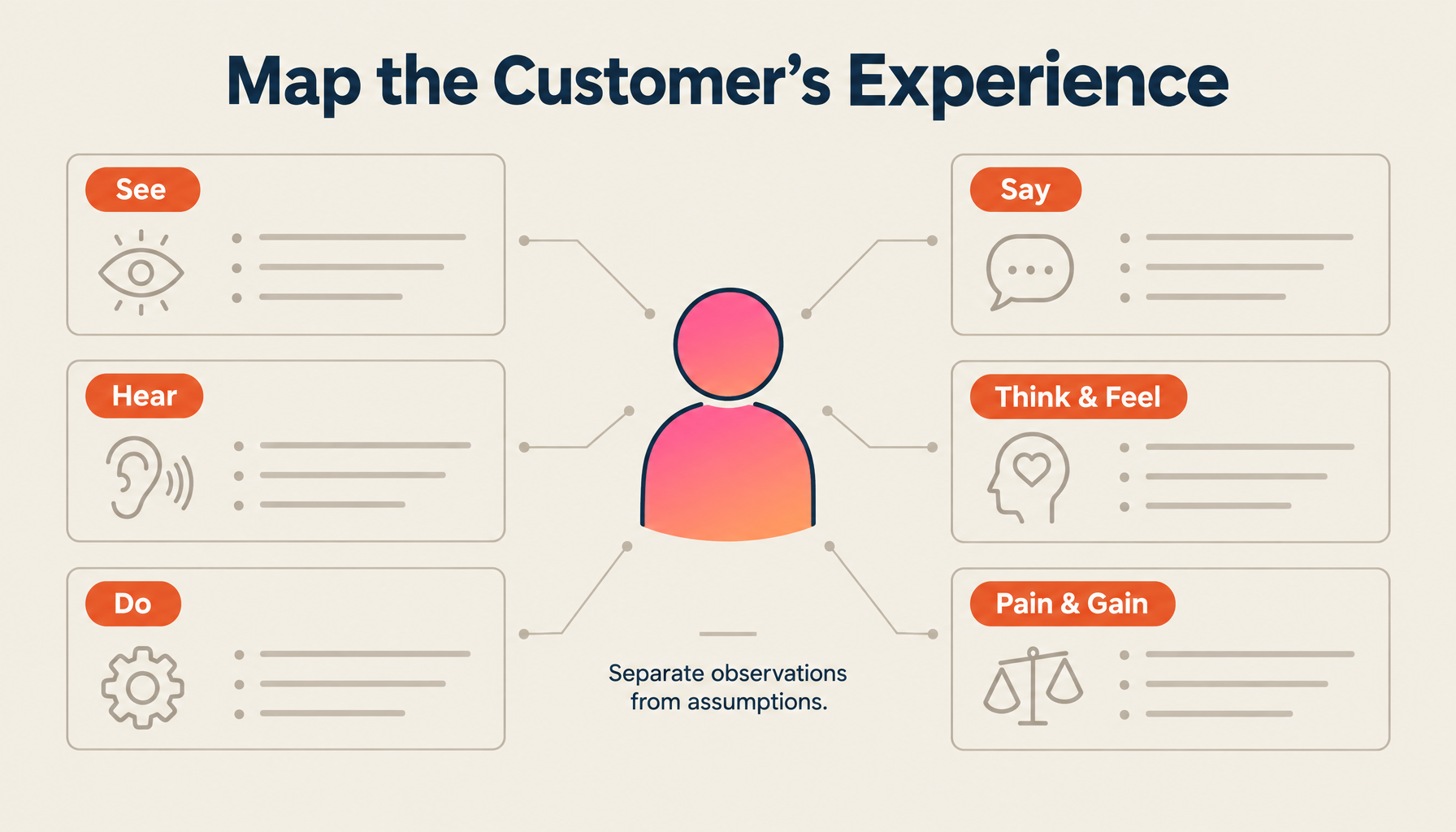
The empathy map was born to write out this "behavior" and "inner world" separately. It's a visual tool that Dave Gray of XPLANE devised for understanding customers, and it spread rapidly after being introduced in Alex Osterwalder's Business Model Generation3. The definition is simple: it's a collaboration tool for externalizing what you know about a specific customer onto a single sheet, building shared understanding across the team, and supporting decisions.
A common point of confusion is how it differs from a persona. A persona is a character definition of the customer figure itself—the "who"—corresponding to a profile that gathers a name, age, occupation, and goals. An empathy map, by contrast, is a visualization tool for understanding that person's "inner world." To sort out the relationship: lay out the facts gathered in interviews on the empathy map to deepen your understanding, then draw the persona based on that understanding. You won't get lost if you think of the empathy map as raw material that precedes the persona.
A traditional empathy map places the target person at the center and surrounds them with six elements.
| Element | What to write |
|---|---|
| See (the environment they see) | The market they see day to day, the behavior of people around them, the scenes in their surroundings |
| Say (what they say) | The words they actually spoke in the interview. Don't summarize; keep it as verbatim as possible |
| Do (what they do) | Actual actions and habits. Movements as facts, not words |
| Hear (voices they hear) | Voices reaching their ears from the people and environment around them, opinions influencing them |
| Think & Feel (thoughts and emotions) | The true feelings, hesitations, and emotions they don't voice. Inference enters here |
| Pain・Gain (pains and gains) | Obstacles, anxieties, frustrations (Pain), and desired outcomes, wants, and the definition of success (Gain) |
Whether there are six elements or four is a matter of school. In UX research and design-thinking classes, people sometimes draw it as four quadrants—Says, Thinks, Does, Feels. The names vary, but the essence is the same in all of them: to separate and visualize "the observable outside (behavior)" from "the inferred inside (thoughts and feelings)." If a debate over which quadrant to stick something in stalls you, it's better not to obsess over classification. Dividing things up is not the goal; the content is the goal.
There's a knack to the order of filling it in. First, decide the goal: "who, and for what purpose, do I want to understand?" Next, fill in the observable outside facts first (See, Say, Do, Hear). Finally, move to the inner inference (Think & Feel), and from there extract Pain and Gain. From outside to inside is the ironclad rule4. Just keeping this order sharply reduces the accident of suddenly imagining the inner world and jumping to conclusions.
The thing I most want to emphasize here is that an empathy map is not something you fill in from imagination. You fill it in based on primary data—that is, actual interviews and observation. A map built from imagination alone becomes a document that visualizes not the customer but the team's assumptions. And if a quadrant ends up with many blanks, that's not a failure. It's a result: "what we don't know yet" has been made visible. Just make those blanks the next research items. Don't finish the map in one go; treat it as a living document you update with every round of research.
How to Run Customer Interviews: Asking in a Way That Draws Out the "True Feelings"
The content of an empathy map is almost entirely determined by the quality of your customer interviews. And the most common mistake in interviews is asking what people think of your idea. Ask "Do you think a service like this is good?" and, out of consideration, they'll say "Yes, it's nice." But that's a false passing grade. Rob Fitzpatrick systematized this pitfall in The Mom Test, and the origin of the name is telling. Even if you ask your mom "Do you think my business will succeed?" she'll give you a flattering, untrue answer out of love. So the idea is to avoid the very questions that can only be answered with flattery5.
There are three principles. First, talk about the other person's life, not your idea. Second, ask about specific facts from the past, not opinions about the future or generalities. Third, let the other person talk rather than talking yourself. Just keeping these three changes the accuracy of an interview dramatically.
Let me line up some concrete good and bad questions.
- Bad: "If there were an automatic reminder feature, would you use it?" To fix it: "How did you send booking messages recently, and about how many minutes did it take?"
- Bad: "How much per month could you pay?" Turn this into asking about past track record: "Are you spending money or time on anything for that task right now?"
- Bad: "This is a problem for you, right?" This is leading, so ask: "When was the last time you struggled with it, and what did you actually do then?"
The difference is consistent. Throw out the future, the hypothetical, and the leading, and ask about actual past behavior and spending. People are creatures who overestimate their own future behavior, so answers to "would you use it?" or "could you pay?" are almost never reliable. What is reliable is what they've already done and the money they've already paid.
Let me also cover the practicalities of running them. If you gather around five to eight people, most of the major problems will come into view. Because it's qualitative research, you don't need statistical numbers. The one thing you must not compromise on, however, is who you recruit. If you only ask close acquaintances or people inside your own company, deference creeps in and you'll misjudge how serious the problem is. Be sure to include "other people who actually have that problem." In the actual session, have them tell you about a recent event or the flow of their day, and keep your own idea hidden until the very end. Maintain a state where the other person is doing 90 percent of the talking, and dig deeper with "why?" and "what specifically happened then?" Picture running the 5 Whys naturally within the conversation.
Keep your records verbatim as much as possible, without summarizing. The customer's exact words become the Say quadrant of the empathy map later. In addition, jot down the nonverbal cues—sighs, pauses, tone, facial expressions. These are the few pieces of evidence you'll have when filling in the Feel quadrant. Honestly, during an interview you're often too busy taking notes to have room to watch expressions, so if possible I recommend recording and listening back later.
Get Hands-On: The Nine Steps for Building an Empathy Map
From here it's practice. Using a fictional new venture as an example, let's trace the whole flow. The subject: an app for the owner of a hair salon run single-handedly, to reduce no-shows—a "LINE-integrated automatic reminder and prepayment app" (let's tentatively call it SalonLink). The overall procedure is the following nine steps.
- Narrow the target customer to one person (one persona). Make them concrete by "situation and role" rather than attributes.
- Recruit five to eight people for interviews. Prioritize other people who actually have the problem.
- Design your questions following The Mom Test, so they ask about specific past behavior.
- In the actual session, let the other person do 90 percent of the talking and keep your idea hidden until the end.
- Record statements verbatim and keep the nonverbal cues, like sighs and tone.
- Immediately after, fill in from the outside (in the order Say, Do, See, Hear).
- Next, fill in the inside by inference (Think, Feel). From there, extract Pain and Gain.
- Look for contradictions between quadrants and articulate the insight in one or two lines.
- Make the blanks the next research items. Update the map with each additional round of research.
The key is the order of steps 6 and 7. When the interview ends, while your memory is fresh, first fill in the facts you could observe (Say, Do, See, Hear). Here you must not mix in inference. After that, fill in the inner world (Think, Feel) by inference. Always separate fact from inference. If you don't keep to this, when you look back later you won't be able to tell "did the person actually say this, or did I just think so?"
Suppose that in a SalonLink interview, one owner said this: "Last week I got stood up twice again. The booking sheet was full, but in reality it was half empty. I want to send reminders by phone, but I can't while I'm treating a client. Then again, honestly, installing an app is a drag because it's one more thing to learn. Right now I send them one by one on LINE the day before." From this statement, the empathy map fills in like this.
| Element | Example entry (SalonLink owner) |
|---|---|
| Say (what they said) | "Installing an app is a drag," "I send them one by one on LINE the day before," "It was full but really half empty" |
| Do (behavior) | Sends LINE reminders by hand the night before. Still manages bookings on a paper booking sheet |
| See (the environment they see) | The booking sheet that should be full, the empty treatment chairs, competitors' social media posts |
| Hear (voices they hear) | Regulars' "Maybe next time," a fellow owner's resigned "No-shows are just how it is" |
| Think (inner thoughts, inferred) | "Learning new tools is a hassle," "But I can't leave the hole in revenue," "I'm bad with machines" |
| Feel (emotions, inferred) | Anger and resignation toward no-shows, anxiety about new technology, the pressure of running it all alone |
From here, extract the pains and gains. Pain: revenue loss from no-shows, the 30 minutes of manual reminders every night, fear of the learning cost of a new tool. Gain: wanting to reliably fill empty slots and stabilize revenue, wanting to be freed from tedious outreach, wanting to get by without greatly changing the current way of doing things. This third Gain pays off later.
The hunt for contradictions in step 8 is the highlight of this method. The owner voices resignation with "No-shows are just how it is" (Say, Hear). Yet in reality, they send LINE messages by hand every night (Do). What they say and what they do don't match. This contradiction is precisely the incontrovertible evidence that they are, in fact, deeply troubled. The insight you can draw from this is: the real problem lies less in "no-shows themselves" and more in "the effort of countermeasures and the fear of learning a new tool." If so, a feature-rich, sophisticated booking system would actually be disliked by this person. It's the paradox that the more you add features, the further away you get.
Finally, restate the extracted problem in the form of Jobs Theory. Jobs Theory is a framework in which customers don't "buy" a product; they "hire" it to get a job done—a task they want to accomplish in a given situation6. The form is: "When [situation], I want to [desired thing], because [motivation]." For SalonLink, it becomes this: "In the situation where I run the salon alone and can't reach out while treating a client, I want to reduce no-shows 'without adding new things to learn.' Because while losing empty slots hurts, even more than that I want to avoid 'the burden of having to learn something again.'" You can see a functional job (reduce cancellations) and an emotional job (avoid the burden of learning) coexisting. This single sentence becomes, as is, the hypothesis to validate in the next step. The Pain and Gain you dig out here can be carried over almost verbatim into the customer profile of STEP 3, the Value Proposition Canvas, so problem discovery and solution design connect in one continuous line.
When you get hands-on, a fill-in template speeds things up. I've combined this article's empathy map and the nine-step worksheet into one. Download the free sample PowerPoint template and pour your own venture's interview results into it.
Making AI a Partner in Problem Discovery
The work up to here is, honestly, unglamorous and labor-intensive. Which is exactly where AI comes in. But the first thing I want to nail down is this: AI is not a "substitute for the customer." Having AI play a fictional persona to generate answers, and using those in place of primary information from real customers—this is something you must never do. Synthesized answers look plausible, but because they aren't a real person's past behavior, they don't guarantee the seriousness of the problem. What AI is good at is not "creating" but "organizing and sounding out" the primary information you've gathered. Get the use case right and there's no more reliable partner.
First, interview design. Have AI create a first draft of a question list that follows The Mom Test.
You are a new-venture researcher deeply versed in The Mom Test (Rob Fitzpatrick), who has designed more than 100 customer-discovery studies. For the business below, design the customer interview questions that dig out the customer's "real problem."

[Business hypothesis] [                    ] (1-2 lines; e.g., a LINE-integrated automatic-reminder app that reduces no-shows for a solo hair-salon owner)
[Target customer] [                    ] (specify role and situation; e.g., a 30s-40s owner who runs the salon single-handedly with no staff)

Steps:
(1) First, tentatively state the customer's "job to be done" in one sentence, and list the open questions you must resolve to test it.
(2) For each open question, turn it into a question about the person's "specific past behavior, events, and spending."
(3) Lay out 15 questions in the flow: icebreaker -> current behavior -> a specific recent moment of difficulty -> current workaround and frustrations -> deeper probing.

Output format (fixed; do not change the column names):
| No | Phase | Question | The Mom Test principle it follows | Empathy-map quadrant it fills |
Below the table, show five common bad questions in this table:
| Bad question | Why it's bad | Rephrased as a good question |

Constraints:
- No future/hypothetical/leading questions such as "Would you use it if...", and no questions asking what they think of my idea.
- Don't ask using vague words like "convenient" or "a good service." Probe down to amounts, time taken, frequency, and the specific situation.
- Don't fabricate. For anything the hypothesis doesn't clearly establish, write the question on the premise of confirming it.
- Finally, name the three points this question set is most likely to miss (i.e., its weakest coverage), and add one supplementary question for each.
When the interview is over, have AI sort the transcript into each quadrant of the empathy map. A classification that takes 30 minutes by hand becomes a draft in tens of seconds.
You are a UX researcher specializing in customer-interview analysis. Sort the transcript below into the six elements of an empathy map.

[Transcript] [                    ] (paste the verbatim interview record)

Steps:
(1) First, split each statement into "observable facts (behavior)" and "inner content that requires inference."
(2) Assign the factual side to Say, Do, See, Hear, and the inferred side to Think, Feel.
(3) After filling in every element, extract three pains (Pain) and three gains (Gain).

Output format (fixed table; do not change the column names):
| Quadrant | Content | Fact/Inference | Supporting statement (verbatim) |
- Say = quote the actual words as verbatim as possible (do not summarize)
- Do = behavior, habits
- See = the environment/market they see
- Hear = voices reaching them from those around
- Think = unspoken true feelings, hesitations (inference; always cite the underlying statement)
- Feel = emotions as "adjective + situation" (inference; cite evidence)
Below the table, list Pain and Gain, three each, as bullet points.

Constraints:
- Always label inferred parts as "inference" and never mix them with facts. Don't add anything not in the transcript (no fabrication).
- Don't stop at vague words like "anxious" or "a hassle"; write specifically when, and toward what, each emotion arises.
- If Say and Do (what they say vs. what they do) contradict, always point it out.
- Finally, name the quadrants this transcript alone cannot fill (missing information), and propose three questions to confirm next.
When you want to dig one layer deeper into the problem, hand off the 5 Whys and the job-statement together.
You are a business-development consultant supporting problem analysis for new ventures. For the customer trouble below, repeat "why?" five times and dig down to the root problem.

[Customer trouble] [                    ] (one actual statement or event picked up from primary information)

Steps:
(1) Starting from the trouble, dig down through five "why?" stages, each asking about the previous stage's answer.
(2) At each stage, note whether the answer is fact-based (confirmed by interview or observation) or inference. If inference, state what would confirm it.
(3) Restate the root problem you reach in the form of Jobs Theory.

Output format:
| Stage | Question (why?) | Answer | Fact/Inference | If inference, how to verify |
Below the table, summarize the root problem in one sentence in the form "When [situation], I want to [desired thing], because [motivation]," and annotate where the functional, social, and emotional dimensions each appear.

Constraints:
- At each stage, self-check whether the digging has become the flip side of a solution ("there's no tool for X"); if so, re-ask "why is this a struggle?"
- If you use any unknown number (loss amount, frequency, etc.), label it "assumed" and write the premise and rough calculation. Don't fabricate.
- Finally, name the three stages with the weakest validation (where assumptions most easily creep in).
Once the map is filled in, have AI draw out insights and validation hypotheses from it. People are surprisingly bad at noticing contradictions between quadrants.
You are a business-development consultant supporting new-venture decisions. Read the empathy map (six elements) below and extract insights that matter for business judgment.

[Empathy map] [                    ] (paste See/Say/Do/Hear/Think・Feel/Pain/Gain)

Steps:
(1) Cross-check the quadrants and look for contradictions and surprises (especially the gap between what they say and what they do).
(2) From the contradictions found, derive the real problem hypotheses.
(3) Turn each hypothesis into a question that validates it through "past behavior and actual spending."

Output format:
(1) Three contradictions or surprising points between quadrants. For each, state which quadrant conflicts with which
(2) Three real problem hypotheses derived from them (one sentence each, in the spirit of Jobs Theory)
(3) For each hypothesis, show a validation design in this table:
| Problem hypothesis | Next question to confirm | Validation interview question (one, phrased to ask about past behavior) |
(4) Point out three perspectives where information is currently lacking (many blanks, thin evidence)

Constraints:
- Don't stop at vague words like "high demand"; always show which statement or action the insight rests on.
- Don't invent information beyond the map to build a conclusion (no fabrication). If you use an inference as grounds, label it "inference."
- Finally, choose the one of the three hypotheses most likely to be rejected (weakest evidence) and explain why.
To finish, have AI stress-test the completed problem hypothesis from an unsparing investor's viewpoint. On your own, you inevitably go easy on your own hypothesis.
You are a venture capitalist who judges new ventures strictly. Review my problem hypothesis critically and without holding back.

[Problem hypothesis] [                    ] (one sentence in the form "When [situation], I want to [desired thing], because [motivation]")
[Primary information it's based on] [                    ] (number of interviewees, their attributes, key statements)

Steps:
(1) For each perspective, rate it "Pass / Needs validation / Fail" and state the grounds for that judgment.
(2) Order the weaknesses from most to least fatal.
(3) Design the smallest next validation for rejecting or revising the hypothesis.

Output format:
| Perspective | Rating (Pass/Needs validation/Fail) | Grounds for the judgment | What's needed to strengthen it |
The four perspectives:
(1) Is this problem merely "nice to have," or a serious problem people would pay money or time to solve?
(2) The risk of a biased sample (insiders, small numbers, deference)
(3) Have I decided on a solution before the problem?
(4) Is the validation based on past behavior and actual spending rather than "opinions or future intentions"?
Below the table, propose the next validation concretely as "number of people / questions to ask / behavior to observe."

Constraints:
- Don't stop at vague verdicts like "promising"; show which statement or number led you to that judgment. If the grounds aren't in the primary information, label them "unconfirmed."
- Write no encouragement or flattery. Finally, list the three most likely scenarios in which this hypothesis fails, ordered from most to least fatal.
Turning this kind of AI mastery into standard team equipment, rather than an individual's knack, is the work we do together in our AI consulting service WARP. We don't just hand out prompts and call it a day; we design which parts of the business-building process to entrust to AI and for what, raising the quality of decision-making itself. If you're unsure about your company's level of AI use, first measure where you stand with the AI Literacy Check.
Summary
We've traced how to find customer problems and how to build an empathy map as one continuous flow. Let me leave the key points paired with your next step.
- Look at what customers "do," not what they "say." The real problem hides in the gap between words and actions.
- Don't fill in an empathy map from imagination. Use it as a container for organizing the primary data of customer interviews, in order from the outside (behavior) to the inside (thoughts and feelings).
- Restate the Pain and Gain you dig out as a single Jobs Theory sentence, and carry them into value-proposition design in the next STEP 3.
- AI is not a substitute for the customer. The right use is as an "organizer"—for bouncing draft questions off, sorting transcripts, and finding contradictions.
One last thing. Don't make "completing the empathy map neatly" your goal. The moment the sticky notes are all filled in and you feel satisfied, your thinking stops. What matters is not the filled cells but the empty ones, and the contradictions between quadrants. That's where problems no one has yet solved are sleeping. Next, move on to STEP 3, How to Build a Value Proposition Canvas, where you design "what to offer, and how" for that problem. If you want to look back at the previous step, head to STEP 1, How to Define Your Customer Segment. The full nine steps are laid out in the Complete Guide to the New Business Framework.
If you'd like to talk through everything from digging out the problem to where AI fits, tailored specifically to building your own business, let us hear from you at a WARP individual consultation.
References
Footnotes
-
Widely cited as the source of the idea "People don't want a quarter-inch drill; they want a quarter-inch hole." Theodore Levitt, "Marketing Myopia," Harvard Business Review (1960). ↩
-
The 5 Whys. A root-cause-analysis method used in the Toyota Production System. Systematized by Taiichi Ohno from Sakichi Toyoda's thinking. ↩
-
The original source of the empathy map. Dave Gray, Sunni Brown, James Macanufo, Gamestorming (O'Reilly Media, 2010). The catalyst for its spread was Alexander Osterwalder & Yves Pigneur, Business Model Generation (2010). ↩
-
The updated Empathy Map Canvas (Dave Gray, 2017). It recommends first defining the goal (who, and what, you want to understand), then filling in from the observable outside facts to the inner inference—"from outside to inside." ↩
-
The principles of customer interviews. Rob Fitzpatrick, The Mom Test (2013). ↩
-
Jobs To Be Done. Clayton M. Christensen et al., "Know Your Customers' Jobs to Be Done," Harvard Business Review (September 2016), and Competing Against Luck (2016). ↩