Customer Segmentation Worksheet (editable PPT)
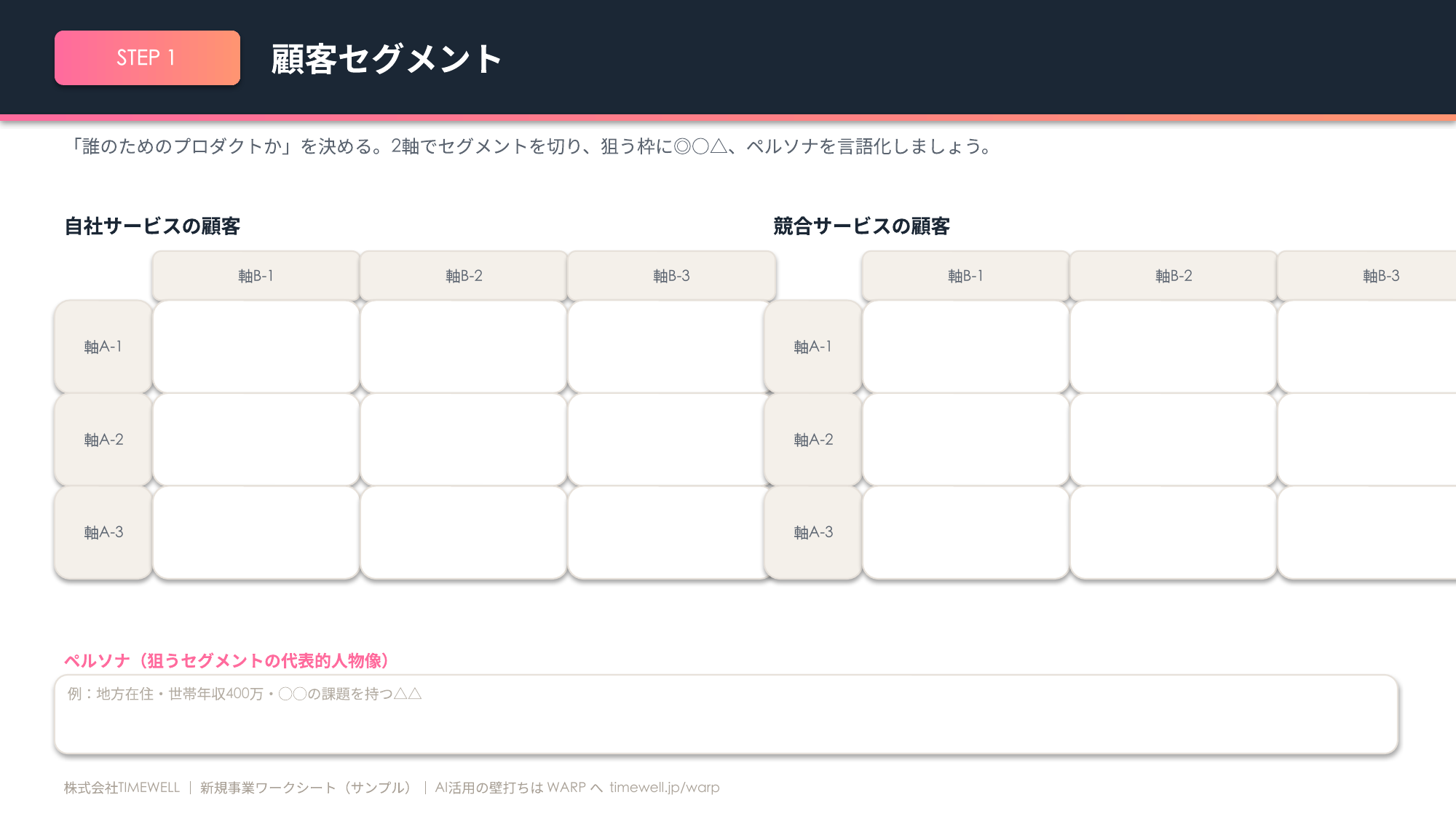
A fill-in template that splits segments along two axes, marks the target cells, and puts your persona into words.
Download the PPT (free)PowerPoint (.pptx) ・ no email required
Hello, this is Ryuta Hamamoto from TIMEWELL.
When a new business fails to get off the ground, the cause usually is not the quality of the product but the fact that "who to sell to" has never been decided. Aiming in every direction because "we want as many people as possible to use it" ends with a product that resonates with no one. This is the most common way new businesses fall over. Conversely, teams that have narrowed their first customer down to a single face find that development and messaging come together astonishingly fast.
This article takes the first step of the new-business framework, "how to define customer segments," and dedicates a whole piece to digging into it. It sits within the complete guide to launching a new business, which lays out the overall picture. The tool we use is STP analysis. The name sounds intimidating, but what you actually do follows a very simple order: divide the market, pick one target, and build a position inside that target's mind. In this article I have prepared nine steps, a worked example from a fictional business, and even prompts for sparring with generative AI, so you can work through it in that exact order. By the time you finish reading, the blank "customer picture" you started with should have taken shape as one concrete person.
If you want to check your own level of AI fluency before you start, begin with the free AI Literacy Check, which takes three minutes. The exercises in this article lend themselves directly to collaborating with generative AI, and the diagnostic result gives you a sense of "where you can hand work over to AI."
What STP Analysis Is: Divide the Market, Choose, and Set Your Position
STP analysis links three processes: segmentation, which divides a market into meaningful customer groups; targeting, which selects the market to pursue; and positioning, which builds a differentiated position against competitors in the chosen market. It is called STP after the three initials. In the marketing world it is treated as one of the most fundamental of fundamentals, and it is known for having been systematized and widely popularized by the management scholar Philip Kotler through works such as Marketing Management1.
The order matters. If you start thinking about position (P) out of nowhere, you spin your wheels unless you have decided who the position is for. So first divide the market (S), select the target (T), and then decide the position for that target (P). Not breaking this flow is the first trick to using STP well.
Let me touch briefly on the history. The researcher who first formally introduced the idea of subdividing a market into the marketing literature was Wendell R. Smith. His 1956 paper is considered the origin, proposing "market segmentation," dividing the market and targeting it, as an alternative path to "product differentiation," selling the same thing to everyone2. That an idea over sixty years old is still in active use is probably because the fact that people have different reasons for buying has not changed.
Why does STP come first in a new business? The reason lies in scarcity of resources. A large company can reach several customers at once, but a newborn business has no people, no money, and no time. Concentrate your limited ammunition on the target you are most likely to hit. STP is the way to decide that target. Personally, I think STP for a new business is less "precise marketing analysis" than "how to summon the courage to pick a single first customer." The analysis is only there to back up that courage.
Segmentation (S): By What Axes Do You Divide Customers?
The first process is dividing the market into groups. What matters here is "by what yardstick (axis) you divide," and there are four representative yardsticks.
The first is geographic variables. You divide by country, region, city size, climate, and so on. The second is demographic variables, the so-called demographics, which include age, gender, income, family structure, occupation, and education. The third is psychographic variables, which divide by inner traits such as values, lifestyle, interests, and personality. The fourth is behavioral variables. You divide by things like the situations in which the product is used, what people are seeking (the benefit), usage frequency, brand loyalty, and how far along someone is in their readiness to buy2.
Of these four, the one I consider most important is the fourth, behavioral variables. Cutting by age and gender is easy, but within a bucket like "35-year-old women" there are tens of thousands of people who shop in completely different ways. Even with the same attributes, if the problem they carry differs, so does the reason they buy. So do not be satisfied with demographics alone; always include at least one behavioral or benefit-based axis, namely "what problem does this person carry, and in what situation." The source of differentiation is usually born from this behavioral axis.
If your business is B2B (selling to companies), the kinds of axes change slightly. Instead of an individual's age or gender, you divide by company attributes such as industry, company size, region, department, purchasing process, and decision-making criteria. These are called firmographics. When you cross company attributes with the point person's pain, as in "a manufacturer with 300 or fewer employees where only one person handles export control," you can build a sharp segment even in B2B.
Once you have listed roughly five to ten axes, narrow them down to the two or three that best explain purchasing behavior. If you try to divide by every axis, the number of segments explodes and becomes unmanageable. Cross the two or three you narrowed to in a matrix (a table of vertical and horizontal axes), and creating about four to nine concrete segments is a manageable number. Be careful not to slice too finely, or you will end up with groups so small there is no way to reach them.
Looking for AI training and consulting?
Learn about WARP training programs and consulting services in our materials.
Targeting (T): A New Business Breaks Through With the "Concentrated" Type
Once the segments are lined up, the next step is deciding where to aim. This is targeting. There are three broad types of aiming: the undifferentiated (mass) type, which runs the same measures across the whole market; the differentiated type, which runs different measures for multiple segments; and the concentrated (niche) type, which pours resources into one or a few segments.
Let me give the conclusion first. For a new business, it is the concentrated type. The reason is the same as before: you have little ammunition. The differentiated type requires preparing separate products and messages for multiple segments, and only a large company can sustain it. The undifferentiated type is out of the question, since a message aimed at everyone stays in no one's memory. At first, pour everything into a single segment, win there, and then expand into the one next door. Teams that keep to this order survive.
So how do you choose which segment to concentrate on? Deciding by gut leads to rework when you later realize "the market was actually small" or "the competition was too strong." That is where evaluation criteria come in. A commonly used set in Japanese practice is the six yardsticks called 6R: market scale (Realistic scale), growth (Rate of growth), priority and ripple effect (Rank / Ripple effect), competitive situation (Rival), reachability (Reach), and ease of measuring results (Response). Score each segment on these six items and choose the one with the highest points.
In overseas textbooks, Kotler's five requirements for an effective segment are also widely used. They are that its scale and purchasing power can be measured (Measurable), that it is large enough to be profitable (Substantial), that it can be reached through promotion and distribution (Accessible), that its response differs clearly from other segments (Differentiable), and that effective action can actually be taken (Actionable)1. Whether you use 6R or the five requirements, both are just confirming "size, whether you can win, whether you can reach, and whether you can measure," so use whichever is easier for you.
There is one point I want to emphasize here. The scores are only a guide. A segment with a slightly lower score but a clear reason "why we can win here better than anyone" is in practice stronger than the segment with the highest total. Do not be satisfied gazing at the spreadsheet total; in the end, decide by whether you can state in one sentence "why we can win here." Call the single segment you chose your "beachhead," in the sense of your first foothold. Do not discard the runner-up segments; keep them on a reserve list as your number two and number three.
Positioning and Persona (P): Claim the Empty Lot in Their Mind
Once the target is decided, the final process is building a position in that person's mind. This is positioning. This way of thinking was advocated by Al Ries and Jack Trout from the late 1960s and systematized in their 1981 book Positioning: The Battle for Your Mind3. Their claim is simple: the contest is decided not by the product's performance but in "the prospect's mind." In practice, you draw a matrix (called a perceptual map or positioning map) using two axes that sway purchase decisions, place your competitors on it, and aim for an empty lot that no one has taken yet.
To make positioning concrete, you distill the target segment into a single individual. This is the persona. A persona is a half-fictional profile that, on top of attributes such as name, age, occupation, and family structure, writes in that person's goals, daily behavior, where they encounter information, what troubles (pains) they carry, and what they value. This concept was advocated by the software designer Alan Cooper and popularized in his 1999 book4. It originally came from the idea of "giving your intended user a single face in order to design an easy-to-use product."
Let me clearly distinguish between a segment and a persona here. The two are often confused, but they play different roles. A segment is a statistical group such as "health-conscious owners of a senior dog with a chronic illness." A persona translates that into one concrete individual with a name and a story, such as "Keiko Sato, 58." In other words, a persona is the deliverable of segmentation; you cannot build a persona out of nowhere without first deciding the segment.
Another important point is that, as a rule, a persona should be built on primary information. One built from simple interviews or surveys of real prospects is called a "research-based persona," and one built from the team's hypotheses alone is distinguished as a "proto-persona"4. A proto-persona itself is useful as a first draft, but a fantasy persona that merely writes down the wish "we hope a person like this exists" is dangerous. It leads you to build a product for a customer who does not exist. Color-code the fields you filled in with hypotheses, and verify them later through interviews. This bit of extra effort is what separates armchair theory from real practice.
Positioning gains a backbone when you state it in one sentence at the end. The template is: "For (persona), unlike (competitor), we offer (unique value)." This is called a positioning statement. STP does not end here; this position becomes the very foundation for the next process, namely thinking through your value proposition and your product, price, and go-to-market (the 4Ps). Do not be satisfied with the analysis; always carry it forward.
Let's Try It in 9 Steps: A Full Walkthrough of the Fictional Business "WanCare"
From here it is a demonstration. Using a fictional business as an example, we trace S to T to P in nine steps. Let the subject be "WanCare, a subscription that delivers vet-supervised food for senior dogs with chronic illnesses." Older dogs often carry chronic conditions in their kidneys or joints, and owners struggle with managing every meal; the business starts from that problem.
First, state the premise in one line (Step 1). Here we start from the problem "managing meals tailored to a senior dog's chronic illness is difficult, and owners struggle every time." In a new business, writing this "problem to solve (the job)" in one sentence up front keeps the later axes from wandering.
Next, list the segmentation axes (Step 2). Line up candidates from demographics (the owner's age bracket, household composition), behavior (how much effort they put into meals, how often they visit the animal hospital), and psychographics (how much money they will spend on their dog's health). The point here, as noted, is to always include not just attributes but a behavioral axis of "in what situation are they in trouble."
Narrow it to two axes and cross them (Step 3). Here we set the vertical axis as "the dog's health condition (a healthy adult dog, or a senior dog with a chronic illness)" and the horizontal axis as "the owner's particularity about food (price-focused, or health- and quality-focused)," and made four segments. Put each into words on a single card (Step 4), noting in one or two lines the sense of scale, the problem carried, the current alternative, and the motivation to pay money or time. At this stage, do a light interview with a few prospective customers to avoid armchair theory.
Then score with 6R (Step 5). Labeling senior dogs with chronic illness × health-focused owners as "Seg A," healthy adult dogs × price-focused as "Seg B," and senior dogs with chronic illness × price-focused as "Seg C," here is an example scored out of five points.
| Evaluation axis | Seg A (chronic × health-focused) | Seg B (healthy dog × price-focused) | Seg C (chronic × price-focused) |
|---|---|---|---|
| Market scale (Realistic) | 3 | 5 | 3 |
| Growth | 5 | 2 | 4 |
| Priority/ripple (Rank) | 5 | 2 | 3 |
| Competition (Rival) | 4 | 1 | 3 |
| Reach | 4 | 3 | 3 |
| Measurement (Response) | 4 | 3 | 3 |
| Total | 25 | 16 | 19 |
Based on this result, decide the targeting type and priority segment (Step 6). The type is concentrated. The first beachhead is decided as Seg A. Seg B is larger in market scale, so why Seg A? Because its problem is the most acute and the motivation to pay a premium is strong, it can be reached through animal hospitals and social media, and major players are thin there. It is a decision that prioritized the "reason we can win" over sheer market scale. Seg C, which differs in price band, stays on the reserve list as the runner-up.
Distill the chosen Seg A into a persona (Step 7). For example, a person like this. Keiko Sato, 58, lives in Kanagawa, shares her home with her husband, and her children are independent. Her dog is a toy poodle named "Mocha," 13 years old, diagnosed with kidney disease two years ago. Her daily concern is managing the morning and evening meals; Mocha will not readily eat the prescription diet, so she struggles every time. Her current alternatives are the animal hospital's prescription food and a patchwork of information off the internet, and she is dissatisfied that it is "expensive" and "fragmentary." She encounters information through dog accounts on Instagram, Google searches, and her regular vet. She herself makes the purchase decision; the clincher is the reassurance of "vet-supervised," while what stops her is the price and the hassle of switching. A line she might say: "I want this little one to stay well even a little longer. But I don't know what to feed her to get it right." Mark the fields filled in with hypotheses and confirm them later through interviews.
Once the persona is done, connect it to a positioning hypothesis (Step 8). Line up the options Keiko compares (the animal hospital's prescription food, off-the-shelf senior-dog food, homemade meals, and so on) on a perceptual map and look for the empty spot. The statement here came out like this: "For Keiko, who owns a senior dog with a chronic illness, unlike off-the-shelf prescription food, WanCare offers vet supervision, an individualized recipe tailored to each dog, and regular home delivery to her doorstep. This is because we partner with animal hospitals and can adjust the formulation based on each dog's health data." The procedure for digging deeper into differences from competitors is left to the article on positioning maps.
The last step is verification and updating (Step 9). STP is not finalized in one pass. The 6R "market scale" and "reach" involve guesswork, so back them up with a simple round of interviews at ten animal hospitals and a small-scale test with social media ads before moving to the next process. If it does not resonate, rearrange the axes or the priorities. STP is not a finished product but a hypothesis you keep iterating.
So you can fill this out directly, I have prepared a template that gathers the input frames, a 6R score table, and a persona sheet in one place. There is no need to build slides from scratch. Download the free sample PowerPoint template and fill it in with the words of your own business.
Use Generative AI as a Sparring Partner (Copy-and-Paste Prompt Set)
When you think through STP alone, your field of view inevitably narrows. Using generative AI (such as ChatGPT) as a sparring partner here makes it easier to notice missing axes and blind spots. The prompts below are written so you can paste them in as-is at each point in the nine steps. Replace the text in parentheses with the words of your own business.
First, a prompt to list segmentation axes.
You are a business-development consultant and marketing strategy partner for new businesses, with a track record of designing STP for both B2C and B2B. For the following business idea, list its segmentation axes.

[Business idea] (fill in one or two sentences, e.g. a subscription delivering vet-supervised food for senior dogs with chronic illnesses)
[Problem (job) to be solved] (fill in one sentence: who, in what situation, struggles with what)
[Business type] (fill in B2C or B2B)

How to proceed:
(1) First define the target market in one sentence, and list three ways prospects currently solve this problem today (the alternatives).
(2) From the four categories (geographic / demographic — firmographic for B2B / psychographic / behavioral), surface a total of 8-10 axes likely to explain purchasing for this business.
(3) Of those, always include at least three behavioral or benefit axes of "what problem, in what situation."
(4) Judge how strongly each axis sways purchasing, and recommend the two or three that, when crossed, produce the sharpest segment.

Output format (follow this structure strictly):
- Heading "1. Market definition and current alternatives": a one-sentence market definition plus three bulleted alternatives.
- Heading "2. List of segmentation axes": present as a table with these columns | No. | Category (geo/demo/psycho/behavioral) | Axis name | Example values | Why it explains purchasing for this business (one line) |. Clearly flag the behavioral/benefit axes as "behavioral."
- Heading "3. Recommended combination of axes": the recommended two or three axes and, in 3-5 lines, why crossing them yields a sharp segment.
- Heading "4. Top 3 assumptions most in need of verification": three weak premises that could make this axis list wrong, numbered.

Constraints:
- Do not stop at abstract words like "a broad demographic" or "health-conscious people"; push down to age bands, price ranges, frequency, and concrete situations.
- If you use any figure such as market size or a ratio, always mark it "(assumed)" and add one line of the premise behind it. Do not assert or fabricate figures as fact.
- Choose axes based on the customer's problems and behavior, not on what your company wants to sell.
Next, a prompt to have it evaluate the segments you listed with 6R. Use it in Step 5.
You are a targeting evaluation analyst for new businesses. Evaluate the following segment candidates using 6R (market scale / growth / priority and ripple effect / competitive situation / reachability / measurability of results), and recommend the single segment to concentrate on first.

[Our strengths and available resources] (fill in concretely: headcount, funding, technology, channels, existing customers, etc.)
[Problem (job) to be solved] (fill in one sentence)
[Segment candidates]
- Seg A: (fill in)
- Seg B: (fill in)
- Seg C: (fill in)

How to proceed:
(1) Score each segment on the six 6R items out of five points (5 = very good, 1 = very poor).
(2) For every score, always add one line of rationale for why you gave it. Mark anything involving guesswork as "needs verification."
(3) After computing totals, re-rank the segments by "the reason we can win most" separately from the raw total (a segment can rank higher even without the top total if its reason to win is clear).
(4) Assuming the new-business standard of the concentrated type, choose one beachhead to aim for first and one runner-up to keep in reserve.

Output format (follow this structure strictly):
- Heading "1. 6R score table": a table with these rows and columns | Evaluation axis | Seg A | Seg B | Seg C | (rows: market scale / growth / priority-ripple / competition / reach / measurement / total). Each cell holds the score only.
- Heading "2. Rationale for scores": one line of rationale per segment x 6R item. Append "needs verification" where relevant.
- Heading "3. Overall ranking and recommended beachhead": the ranking based on "the reason we can win most," the single recommended segment with its reason in one sentence, and one runner-up.
- Heading "4. Top 3 questions to verify": three places where the conclusion changes if the score's premise collapses, numbered.

Constraints:
- Do not stop at abstract words like "large" or "promising"; push down to concrete estimated customer counts, unit price, and growth rate.
- Always mark figures "(assumed)" and add one line stating the premise and a rough calculation. Do not assert or fabricate them as if real.
- Do not conclude from the total score alone; in the end, state in one sentence "why we can win here."
When distilling the chosen segment into a single persona, the following prompt is handy.
You are a UX researcher and marketer for new businesses. Distill the following target segment into one practical persona you can use directly for development and message design.

[Target segment] (fill in here, e.g. health-conscious owners of a senior dog with a chronic illness)
[Problem (job) to be solved] (fill in one sentence)
[Known primary information / interview notes] (paste if any; if none, write "hypothesis only")

How to proceed:
(1) Translate the segment's statistical traits into one concrete individual with a name and a story.
(2) Always depict the "situations" in which this person faces the problem, woven into the flow of a day.
(3) Distinguish the fields backed by primary information from those filled in with hypotheses.

Output format (fill in the following items in this order):
- Name / age, place of residence, family structure / occupation, role
- The flow of a weekday and a weekend (always include the situations where the problem arises)
- Three problems (pains) they carry, in order of urgency
- The alternatives they currently use for those problems, and their concrete dissatisfactions
- Frequently used information channels (social media / search / word of mouth / experts, down to the specific outlet)
- The purchase decision-maker / the trigger for the decision / the reason to stop buying (objections)
- One "raw voice" this person would realistically say (in quotation marks)
- At the end, a bulleted list of "items to verify later through interviews"

Constraints:
- Do not stop at abstract words like "cares about health" or "busy"; push down to concrete behavior, amounts, times, and proper nouns.
- Append "(hypothesis)" at the end of any field or figure lacking primary information. Do not assert or fabricate as if it were fact.
- Deduce from the reality of the segment, not from the wish "we hope a person like this exists." At the end, list the three shakiest assumptions in this persona.
When searching for the empty lot in positioning, use this.
You are a positioning strategy expert for new businesses. For the following persona and target, design a position that is differentiated from competitors and that no one has taken yet (an empty lot in their mind).

[Persona summary] (fill in: who, struggling with what, valuing what)
[Problem (job) to be solved] (fill in one sentence)
[The existing options this persona compares] (fill in, including your own, competitors, and "doing nothing")

How to proceed:
(1) List five candidate evaluation axes that sway purchase decisions in this category.
(2) Choose two of them that are weakly correlated and clearly separate the options, build a 2x2 perceptual map, and place each option on it.
(3) Identify an empty lot where competitors are weak, and state the rationale for aiming there.
(4) Distill the position into a one-sentence statement.

Output format (follow this structure strictly):
- Heading "1. Candidate evaluation axes (5)": numbered, each with one line on why it sways purchasing.
- Heading "2. Perceptual map": state the two chosen axes and show each option's position in a table with these columns | Option | Horizontal-axis position (low-high) | Vertical-axis position (low-high) | Note |.
- Heading "3. The empty lot to aim for": identify one position where competitors are weak and explain, in 3-5 lines, why it is a good target.
- Heading "4. Positioning statement": one sentence in the template "For (persona), unlike (competitor), we offer (unique value). This is because (rationale)."
- Heading "5. Evidence from us that backs the position": three items of track record, features, or experience, numbered.

Constraints:
- Do not use abstract words like "high quality," "convenient," or "easy to use" for the axes or unique value; push down to concrete features, figures, and experiences.
- If evidence does not yet exist, mark it "(unverified / to be prepared)" and do not assert or fabricate it as fact.
- At the end, list the three biggest risks that could collapse this position (a competitor moves into the same empty lot; the axis itself does not actually sway purchasing; and so on).
Finally, a prompt to have it critically review the entire completed STP. Having it stab at your weak points without pulling punches helps you notice blind spots before you go public.
You are a sparring partner for a new business. Critically review the STP I made (below) without deference, and point out gaps, blind spots, and leaps in logic. Rather than praising, frankly stab at the weak points that should be crushed before going public.

[Segmentation] (fill in)
[Chosen target / reason] (fill in)
[Persona] (fill in)
[Positioning] (fill in)

Points to check:
(1) Are the segment axes based on "the customer's problems and behavior" rather than "what we want to sell"?
(2) Is the target too broad (= resonates with no one) or too narrow (= not executable)?
(3) Is the persona based on primary information, not built on wishes or fantasy?
(4) Is the positioning genuinely differentiated from competitors (not aiming at territory that is not open, or an axis that does not sway purchasing)?
(5) Is the STP internally consistent (do segment -> target -> persona -> positioning connect as one line)?

Output format (follow this structure strictly):
- For each point (1-5), return a table with these columns | Point | The part I think is shaky (specifically) | Severity (high/medium/low) | Question to verify next |.
- After the table, a heading "Top 3 weaknesses to crush first": across all points, three fatal assumptions that could make the business collapse, numbered, each with why it is fatal.

Constraints:
- Do not settle for generalities like "be a bit more specific"; point out issues grounded in the proper nouns, figures, and logic actually written in the STP.
- Do not fill in facts that are absent from the input and evaluate on them; where a premise is missing, flag it as "premise not filled in."
- No need to list good points; concentrate on weaknesses and questions to verify.
The trick is to use AI not as a machine that hands you answers but as a partner that finds the gaps. Growing generative AI into a partner for building your business is an area we put effort into with our WARP service, too. If you want to organize "what, and how far, you can hand to AI" in the context of your own situation, do not hesitate to reach out.
Common Mistakes, and Iterating STP as a "Hypothesis"
Finally, let me list the points where people most often stumble with STP, in the order I have actually seen them.
The most common is aiming at the whole market and ending up resonating with no one. Consider "everyone is the target" to be nearly synonymous with "there is no target." The next most common is cutting the axes based on "what we want to sell." Axes should be chosen based on the customer's problems and behavior; working backward from your own product lineup always throws things off. The third is cutting only by demographics such as age and gender and forgetting to include a behavioral or benefit axis. This gives you no toehold for differentiation.
Slicing segments too finely, down to a size there is no way to reach, is also a common failure. Conversely, one that is too large to differentiate is also a problem, and it takes a feel for finding just the right granularity. Building a persona from fantasy with no primary information is dangerous, too. Even if you write down the wish "we hope a person like this exists," that person does not exist in the world. And deciding the target by intuition alone without using evaluation criteria, then later realizing "the market was small" or "the competition was too strong." Running 6R just once prevents a great deal of this rework.
One more thing that tends to be overlooked is "analysis for analysis's sake." People build an impressive STP, feel satisfied, and never connect it to the subsequent product design or messaging. STP exists to bridge the position you decided here to your 4Ps and value proposition. Do not treat building it as the end. And fixing an STP in place once decided is also a source of failure. STP is not a fact but a hypothesis. Verify it through interviews with the target, the response to your landing page, and early sales data, and if it does not resonate, rearrange the axes or the priorities. Whether you can hold this "iterate" mindset is what separates an armchair STP from a usable one.
Once your customer segments are decided, the next turn is to dig even deeper into the pains of the persona you chose. Continue to the article on the empathy map for digging into customer problems. Whenever you want to survey all nine steps of the new-business process, you can return to the complete guide to launching a new business anytime. Choosing a single first customer takes courage. But from the moment that one person comes into view, a business starts moving astonishingly fast. Start by filling in the first slide of the template, the one line for the premise. If you find you need to spar over a concrete business plan, we are waiting for you at an individual consultation.
References
Footnotes
-
Philip Kotler, Marketing Management. Systematized the STP framework and the requirements for an effective segment (Measurable, Substantial, Accessible, Differentiable, Actionable). ↩ ↩2
-
Wendell R. Smith, "Product Differentiation and Market Segmentation as Alternative Marketing Strategies," Journal of Marketing, 1956. The paper that first formally introduced the concept of market segmentation into the marketing literature. The basis for the variable classification of segmentation. ↩ ↩2
-
Al Ries and Jack Trout, Positioning: The Battle for Your Mind, 1981. The work that systematized the concept of positioning. ↩
-
Alan Cooper, The Inmates Are Running the Asylum, 1999. The work that advocated and popularized the persona method. The distinction between research-based personas and proto-personas. ↩ ↩2