Hello, this is Ryuta Hamamoto from TIMEWELL.
On November 26, Suzuki and ELIIY Power announced a plan to mass-produce lithium iron phosphate (LFP) batteries in Japan. The Ministry of Economy, Trade and Industry (METI) certified it as a battery supply assurance plan under the Economic Security Promotion Act1. Japanese newspapers described it as an "EV battery that uses no rare metals" that "reduces exposure to Chinese export controls"2.
I read it as a clear example of constraints driving innovation. The more a product depends on resources concentrated in a few countries or mines, the more it is at the mercy of other governments' policies and of market swings. That is why I think companies should build more products that work without rare metals, and start now.
The more upbeat the story, though, the more carefully the facts need to be drawn. The announcement itself mentions neither "rare metals" nor "China." LFP batteries still use lithium. And China's battery-related export controls reach LFP materials too. In this piece I check those facts against primary sources, then make the case for why this is the moment to build products that rely less on rare metals.
The short version
- What was certified is a plan by Suzuki and ELIIY Power for stationary lithium-ion batteries that can also be used in vehicles. Production starts in Kosai, Shizuoka in October 2029, with capacity of 0.48 GWh a year and funding of about 44.7 billion yen, including a subsidy of up to about 18.7 billion yen1.
- LFP batteries use no nickel or cobalt in the cathode. Lithium, however, is on METI's list of 31 rare metals, so the accurate description is "a battery without nickel or cobalt"3.
- China's battery-related export controls (Announcement No. 58 of 2025) cover high-performance LFP cathode material and synthetic graphite anode material too. The measure is suspended until January 10, 202745.
- Even so, the more a product is designed to use different elements, use less, or keep being used after its first life, the easier it is to keep a business running whichever country changes its policy. Substitute technologies rarely get adopted in calm times, so a period of visible supply risk is exactly when to commit to them6.
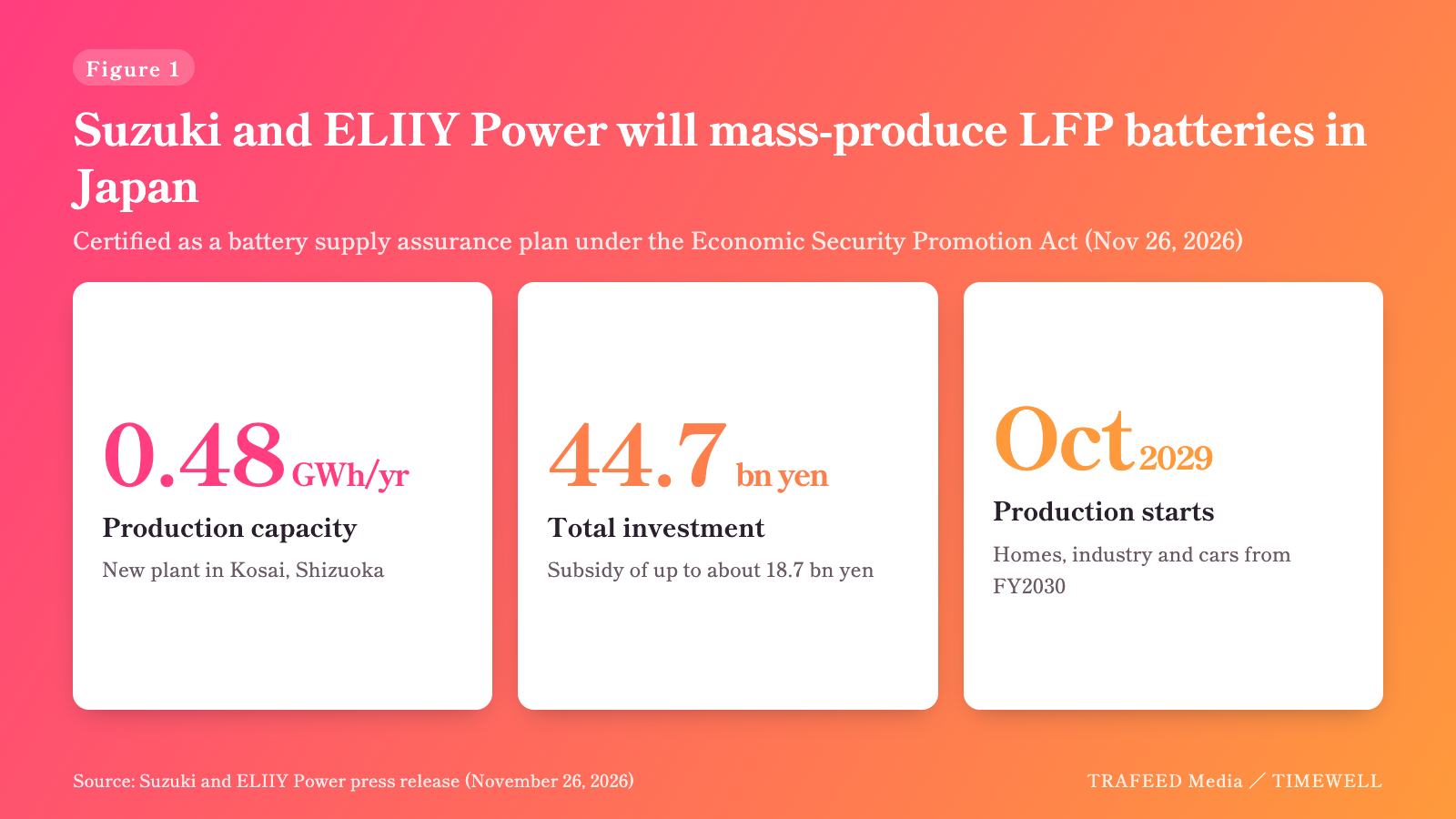 Figure 1. The plan in numbers. Source: Suzuki and ELIIY Power press release (November 26, 2026, in Japanese).
What Suzuki and ELIIY Power announced
Start with the announcement itself. A plan jointly submitted by the two companies to develop and mass-produce stationary lithium-ion battery cells and modules was certified by METI as a battery supply assurance plan under the Economic Security Promotion Act. The certification number is 2026 Battery No. 1-11.
| Item | Details |
|---|---|
| Certification date | November 26, 2026 |
| Product | Stationary batteries (designed to be shared with vehicle use) |
| Battery type | Lithium iron phosphate (LFP) |
| Location | Kosai, Shizuoka (a new domestic production base) |
| Production start | October 2029 |
| Capacity | 0.48 GWh a year |
| Funding | About 44.7 billion yen (subsidy of up to about 18.7 billion yen) |
| Planned use | Homes, business and industrial sites, and vehicles, from FY2030 |
The announcement also spells out who brings what. ELIIY Power contributes its LFP technology and know-how; Suzuki contributes its small-car development and production skills. The goal is a battery that combines high safety, the long cycle life stationary use demands, and the high energy density vehicles need. The companies also say they are designing in "repurposing" from the start, so that batteries can move from cars to stationary use after their first life1.
The partnership goes back to Suzuki's investment in 2012, followed by an additional investment and business alliance in November 2023. So this plan did not appear suddenly in response to China's measures, and I think that is worth keeping in mind. At the same time, receiving state support under the Economic Security Promotion Act places this battery squarely in the context of supply chain resilience, and the announcement names a stronger supply chain and a domestic production base among its goals1.
Replace siloed classification work with AI.
METI's FY2024 data shows 52% of foreign exchange law violations stem from classification errors. Download the TRAFEED product catalog covering features and rollout.
What "no rare metals" actually means
The headlines say "no rare metals." This is where the words need a closer look. METI designates 31 minerals as rare metals, and its list includes lithium, manganese, cobalt, nickel and the rare earth elements3. Rare earths are one group within the rare metals.
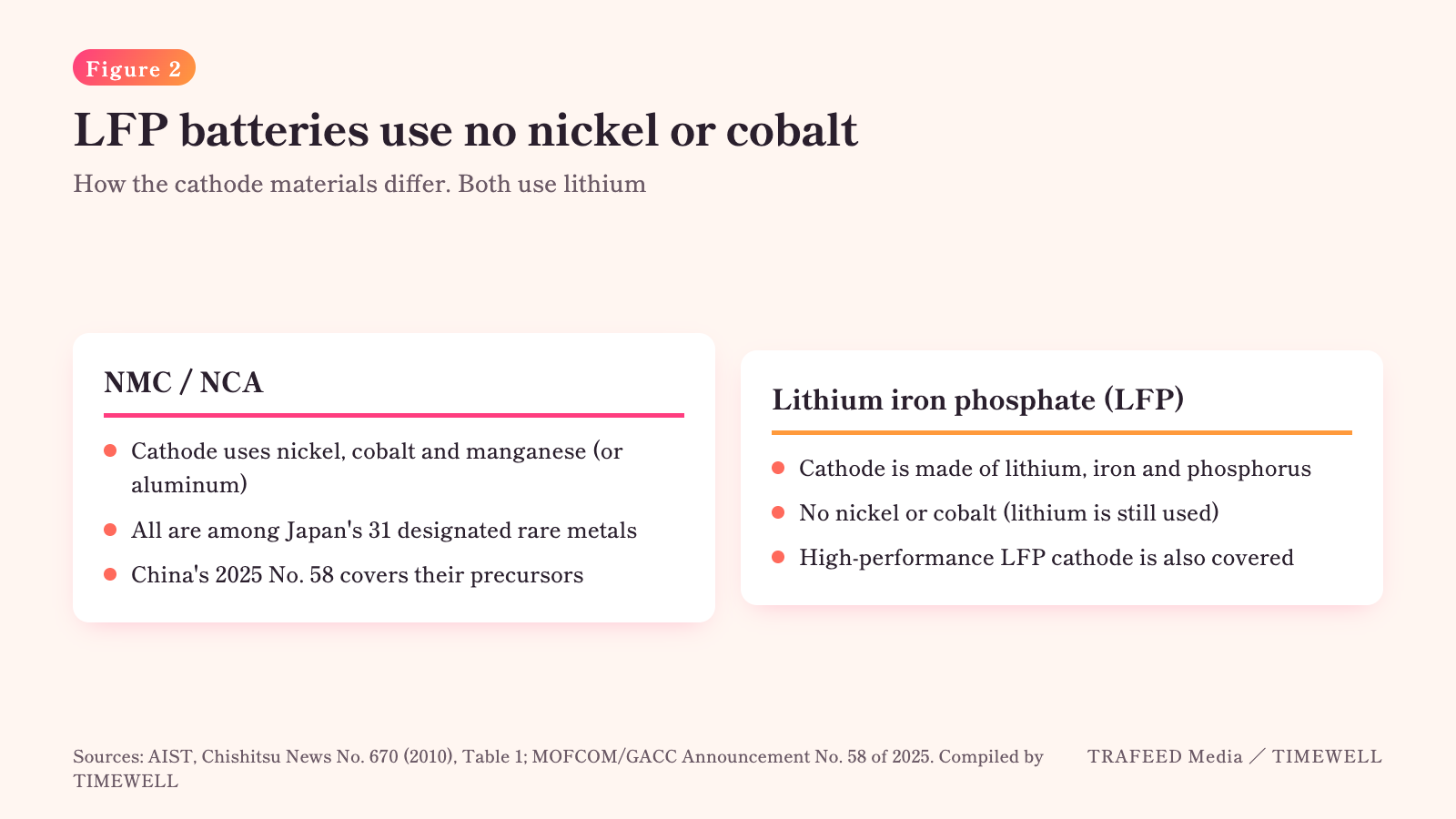 Figure 2. How NMC and LFP cathodes differ. Sources: AIST, Chishitsu News No. 670 (2010), Table 1; MOFCOM/GACC Announcement No. 58 of 2025. Compiled by TIMEWELL.
The NMC-type batteries widely used in electric vehicles use nickel, cobalt and manganese (or aluminum) in the cathode. China's export control notice itself describes NMC cathode precursors as "nickel cobalt manganese hydroxide" and "nickel cobalt aluminum hydroxide"4. LFP, as the name says, makes its cathode from lithium, iron and phosphorus. Leaving out nickel and cobalt is what sets LFP apart.
Lithium is still there, though. Since lithium is on the rare metals list, calling this "a battery with no rare metals at all" goes too far. The precise phrase is "a battery without rare metals such as nickel and cobalt." It might look like hair-splitting, but for a procurement team it matters, because the lithium supply question does not go away when you switch to LFP.
Dropping nickel and cobalt still counts for a lot. Fewer elements means fewer suppliers to vet and fewer countries' rules to track. Iron and phosphorus are not on the rare metals list. Designing toward common elements widens your procurement options on its own.
Looking clearly at China's export controls
The press coverage says this battery reduces exposure to Chinese export controls. That deserves a check against the original texts too. On October 9, 2025, China's Ministry of Commerce (MOFCOM) and General Administration of Customs (GACC) issued Announcement No. 58 of 2025, placing items related to lithium batteries and synthetic graphite anode material under export control, effective November 84. The notice cites safeguarding national security and interests and fulfilling international obligations such as non-proliferation.
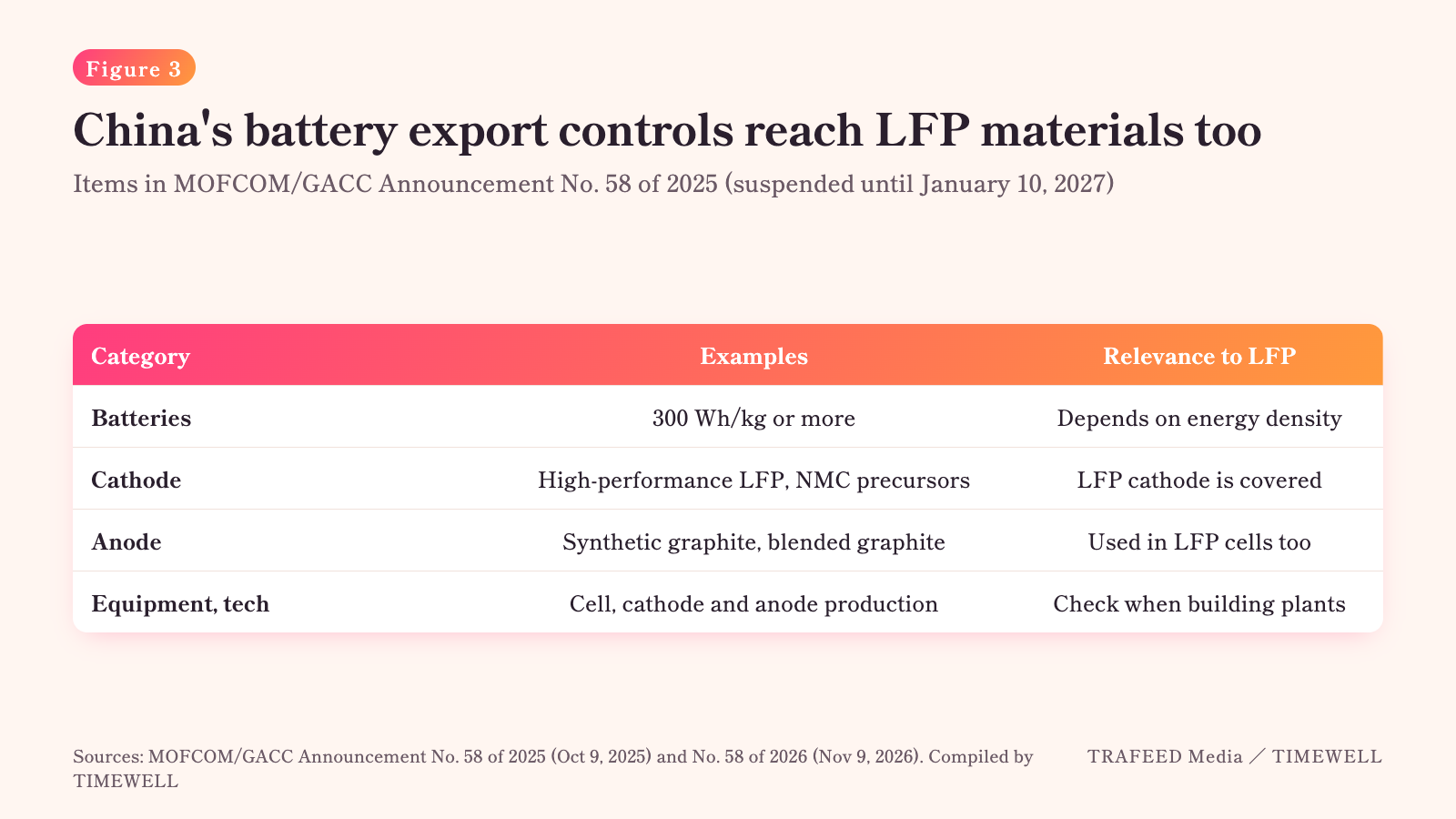 Figure 3. What China's battery-related export controls cover. Sources: MOFCOM/GACC Announcement No. 58 of 2025 (October 9, 2025) and No. 58 of 2026 (November 9, 2026). Compiled by TIMEWELL.
The list includes batteries with a gravimetric energy density of 300 Wh/kg or more; LFP cathode material with a compacted density of 2.5 g/cm³ or more and a capacity of 156 mAh/g or more; NMC precursors; synthetic graphite anode material; and equipment and technology for making batteries and their materials4. In other words, high-performance LFP cathode material and the graphite anodes used in LFP cells are both covered. You cannot say that switching to LFP takes you outside China's export controls.
The measure has been suspended since November 2025. On November 9, 2026, MOFCOM and GACC announced (Announcement No. 58 of 2026) that the suspension of Announcement No. 58 of 2025 and related notices would continue from November 11, 2026 to January 10, 20275. A suspension is not a repeal, and what happens after January 10, 2027 has not been decided.
So what does the Suzuki and ELIIY Power plan mean in relation to China's measures? Making cells in Japan clearly reduces dependence on imported finished batteries. Where the cathode material, anode material and production equipment will come from, however, is not stated in the announcement. Between now and the 2029 start of production, how far the companies can diversify their material sources will decide how much the plan really delivers. I am optimistic, and I intend to keep following it.
Precedents where constraints moved technology
Japan has been building technologies that rely less on rare metals as a matter of national policy for a long time. The national rare metal strategy rests on four pillars: exploration and development, recycling, development of substitute materials, and stockpiling, with work starting in fiscal 2006. The substitute materials pillar was carried by the Rare Metal Substitute Materials Development Project run by NEDO, Japan's New Energy and Industrial Technology Development Organization6.
| Target element | Main use | Approach |
|---|---|---|
| Neodymium, dysprosium | Magnets in motors for hybrid and electric vehicles | Substitution and reduced use |
| Cerium | Co-catalyst for cleaning car exhaust | Substitution and reduced use |
| Indium | Transparent electrodes in touch panels | Substitution and reduced use |
NEDO's documents describe the aim as establishing technologies that substitute for rare metals or cut how much is used, as a response ready for when supply concerns actually materialize6. The same document contains a telling line, which I translate as: "As long as rare metals can be obtained cheaply, there is no need to introduce new materials or technologies." Its analysis is that when performance and cost are equal, whether a substitute is adopted depends on rare metal prices and supply risk6.
I think that line is the key to reading this news. In calm times, substitute technologies rarely find a reason to make the switch. Only when supply concerns become concrete does the value of substitution or reduction show up in management decisions. With China's battery-related measures repeatedly suspended and extended, that value is easier to see now than it usually is.
Why now is the time to build products that need fewer rare metals
From here on, this is my opinion. The reason to build products that rely less on rare metals is not to avoid any particular country. It is to give yourself room, at the design stage, to keep the business going whichever country's policy or market moves. Export controls are not unique to China; the United States and Japan also control items and counterparties under their own laws. As long as resources are unevenly distributed, the chance that some government's decision will hit your supply never goes away.
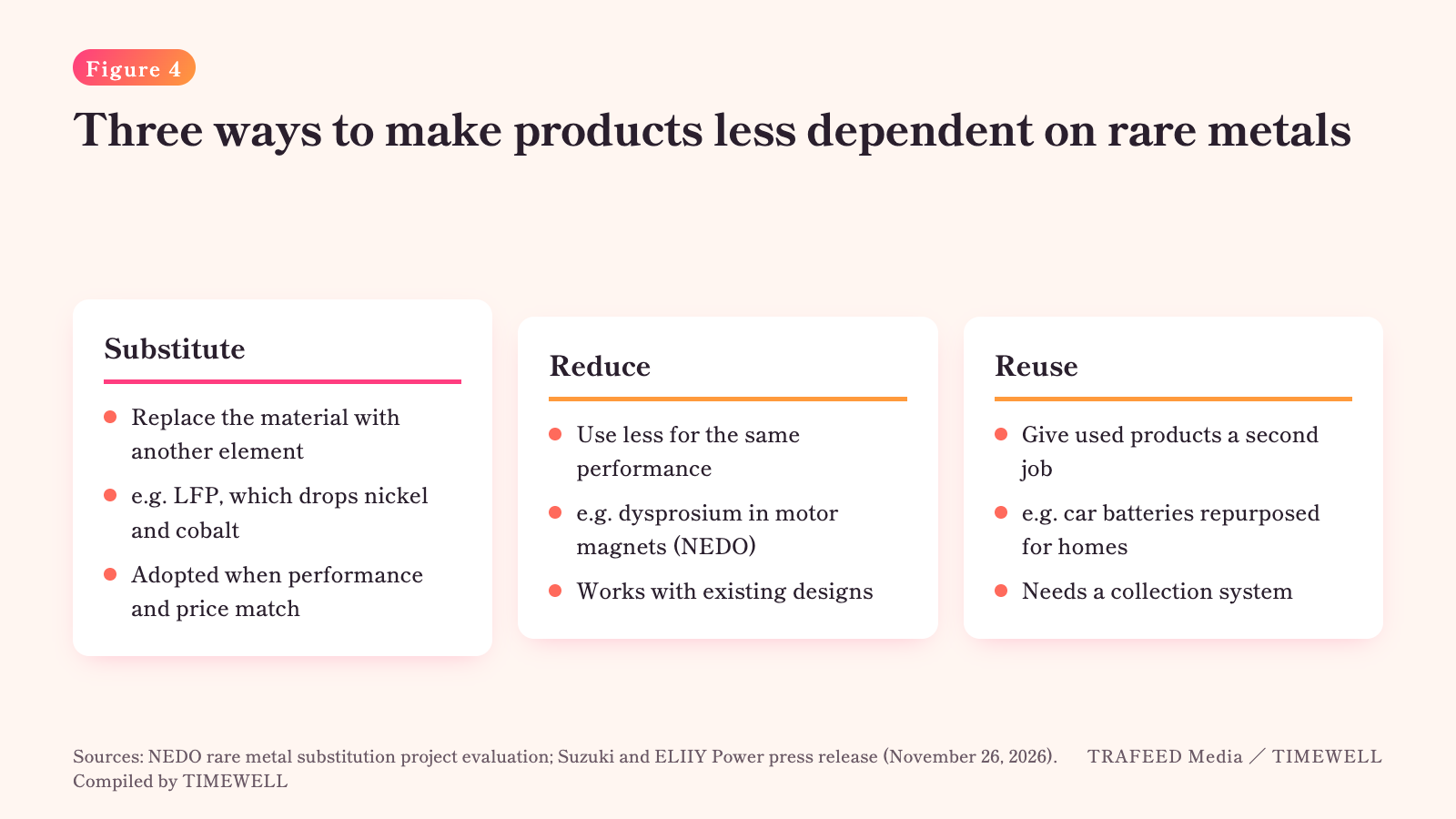 Figure 4. Three ways to make products less dependent on rare metals. Sources: NEDO rare metal substitution project evaluation; Suzuki and ELIIY Power press release (November 26, 2026). Compiled by TIMEWELL.
Broadly, there are three moves. The first is to substitute: replace the material with a different element. Suzuki and ELIIY Power's LFP battery, which drops nickel and cobalt, is a textbook case. The second is to reduce: use less of the material for the same performance. NEDO's work on cutting dysprosium and other elements in motor magnets falls here6. The third is to reuse: send used products to a second application or to recycling. Designing batteries from the start to move from cars to stationary use, as this announcement does, builds that idea into the product1.
What I find interesting about Suzuki's plan is that a single product aims at two of the three at once: a battery without nickel or cobalt, built so it can serve both cars and homes. It is a design that reduces how often resources are consumed over a battery's life. It also feels like a natural idea from a company that has spent decades squeezing performance out of small cars under tight constraints.
Substitution has costs, of course. Energy density has long been seen as LFP's weak point in vehicles, and I read the announcement's language about "combining" safety and longevity with "high energy density" as an acknowledgment of that. Substitution means weighing performance, price and supply side by side. Rather than jumping at one factor, companies need to look at which combination is realistic for their products, through both an engineering lens and a procurement lens.
What companies should check now
Here are five things worth checking now for companies that make, or buy, products with batteries or magnets.
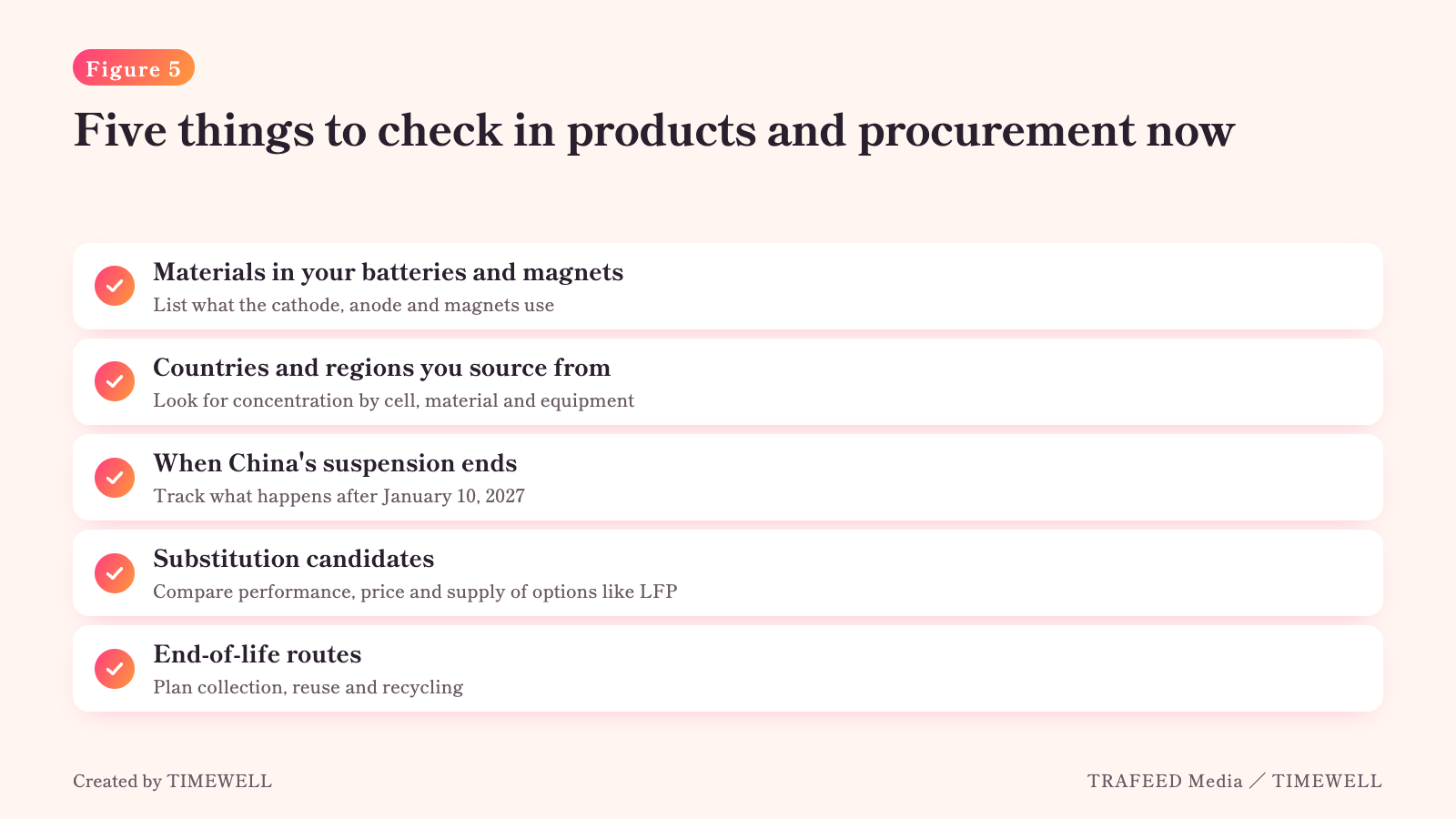 Figure 5. Five things to check in products and procurement now. Created by TIMEWELL.
First, list the materials in your products' batteries and magnets. Going down to the cathode, anode and magnet materials shows which rare metals you actually depend on. Second, map the countries and regions those materials come from. Splitting the view into cells, materials and production equipment shows where the concentration sits. I wrote about tracing suppliers all the way back to raw materials in my article on the EU battery passport.
Third, track the end of China's suspension. The battery-related measures stay suspended until January 10, 2027, and what comes after has not been decided. It helps to decide now who will check MOFCOM's notices around that date. Fourth, look at substitution candidates. Start with technologies such as LFP that already have a mass-production track record, and compare performance, price and supply outlook. Fifth, plan end-of-life routes: collection, reuse and recycling, mapped out at the product planning stage. Why finding alternative sources is so hard in practice is something I covered in my article on gallium, where by-product economics shape the whole picture.
There are many examples of companies from resource-poor countries turning constraints into products that compete worldwide. I hope Suzuki and ELIIY Power's plan adds a new one. I will keep following how far their material sourcing widens on the way to the 2029 start of production.
If you want a way to keep track of your source countries and regions and of changes in each country's export controls, talk to us about TRAFEED. Decisions on specific transactions and items should be made by your team and your advisers, based on the law and guidance from the relevant authorities.
Footnotes
-
Suzuki Motor Corporation and ELIIY Power Co., Ltd., "ELIIY Power and Suzuki's battery supply assurance plan for developing and mass-producing stationary lithium-ion batteries certified by METI" (November 26, 2026, in Japanese; title translated by the author). Certification No. 2026 Battery No. 1-1. https://www.suzuki.co.jp/release/d/2026/1126a/ (retrieved November 27, 2026) ↩ ↩2 ↩3 ↩4 ↩5 ↩6
-
Nikkei and Yomiuri Shimbun headlines, November 26, 2026 (in Japanese) ↩
-
Tetsuichi Takagi (AIST), "Japan's strategy for securing rare metals," Chishitsu News No. 670, pp. 4-7 (June 2010, in Japanese). Table 1, "Rare metals designated by METI." https://www.gsj.jp/data/chishitsunews/2010_06_03.pdf ↩ ↩2
-
MOFCOM and GACC Announcement No. 58 of 2025, decision to impose export controls on items related to lithium batteries and synthetic graphite anode materials (issued October 9, 2025; effective November 8, 2025; in Chinese). Full text as reprinted by Xinhua. https://www.news.cn/world/20251009/cd64ee37c024486893ac82ba6f76a9ff/c.html (retrieved November 27, 2026) ↩ ↩2 ↩3 ↩4
-
MOFCOM and GACC Announcement No. 58 of 2026, decision to continue suspending MOFCOM/GACC Announcements No. 55, 56, 57 and 58 of 2025 and MOFCOM Announcements No. 61 and 62 of 2025 (November 9, 2026; in Chinese). https://www.mofcom.gov.cn/zwgk/zcfb/art/2026/art_91466027f465467985942a639a9485f4.html (retrieved November 27, 2026) ↩ ↩2
-
NEDO, materials for the post-project evaluation of the Rare Metal Substitute Materials Development Project, R&D items 9-1, 9-3 and 10 (in Japanese). https://www.nedo.go.jp/content/100517097.pdf ↩ ↩2 ↩3 ↩4 ↩5