The Graduate Job Market Has Fundamentally Changed
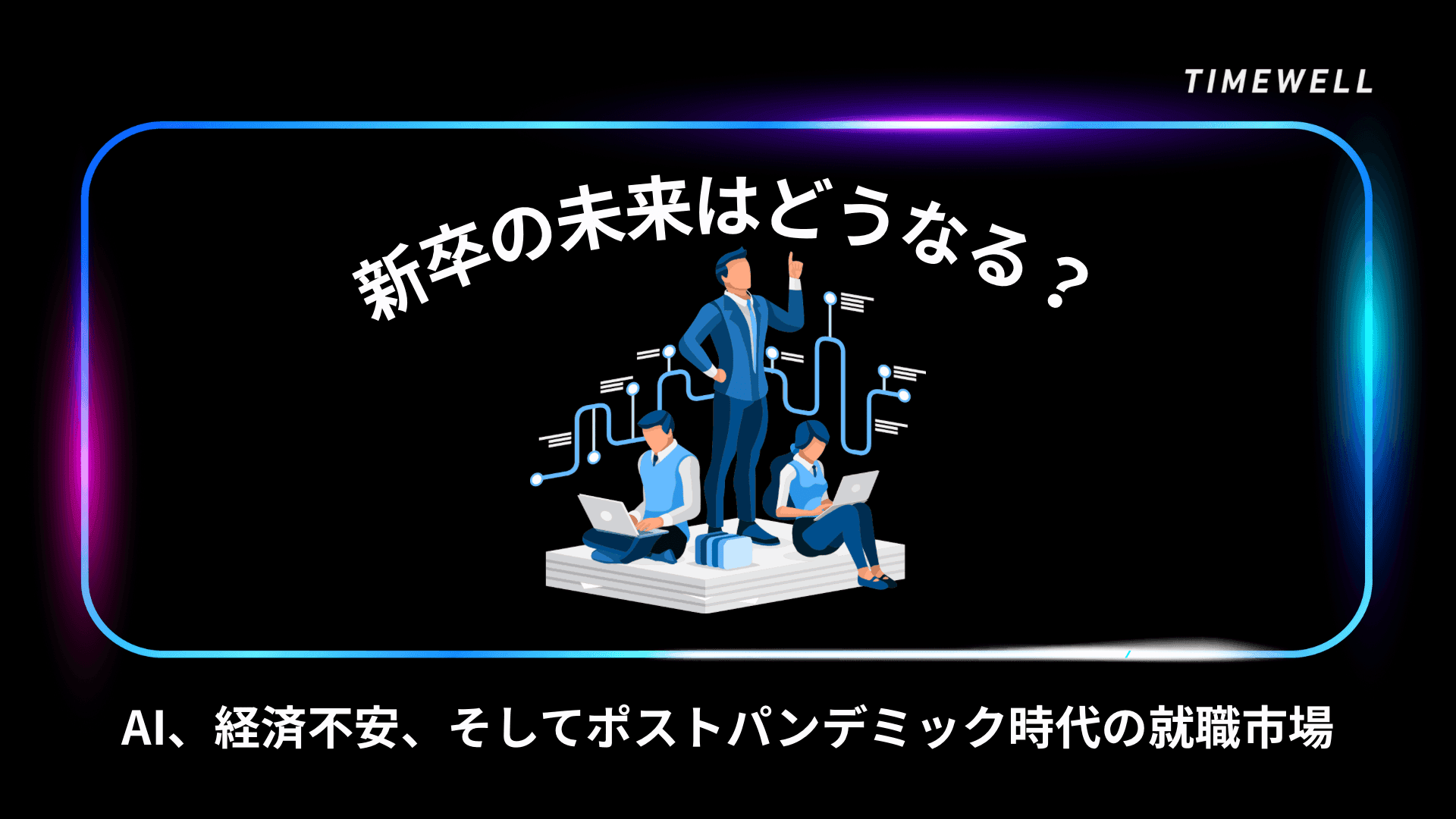
The job market for new graduates is in a state of disruption unlike anything in recent decades. The assumption that a university degree leads reliably to stable employment is no longer holding. Cases of graduates applying to 100+ jobs on LinkedIn with no interview offers — or submitting 647 applications with no offers at all — are not outliers. They reflect a widespread reality. Twenty years ago, graduating from university came with reasonable confidence that employment would follow shortly. Today that world has gone.
Multiple forces are converging: rapid AI adoption eliminating entry-level roles, global trade friction and government cost-cutting freezing corporate hiring, and post-pandemic dynamics reshaping who can find work and on what terms. This article analyzes all three and looks at what young people can realistically do in response.
Looking for AI training and consulting?
Learn about WARP training programs and consulting services in our materials.
Part 1: AI Is Taking Entry-Level Jobs
The Automation of Early-Career Work
The most visible force reshaping new graduate employment is AI's rapid absorption of entry-level white-collar work. Tasks that defined early-career positions — basic data analysis, email communication, elementary research, document formatting — are increasingly performed faster and more accurately by AI systems. Companies that previously hired graduates to handle these tasks are reconsidering whether human labor is required at all.
One content creator described watching their carefully developed scriptwriting skills become worthless overnight when their employer began using AI to mass-produce videos based on their work, bypassing the human writer entirely. A former YouTube channel writer described their skillset being replaced repeatedly by AI — work that had taken years to develop was replicated in a fraction of the time at a fraction of the cost.
The Changing Hiring Standard
Corporate hiring norms are shifting in direct response to AI capability. Where companies once hired young talent, invested in training, and expected long-term returns on that investment, many have shifted toward hiring experienced mid-career professionals — or those who can demonstrate specific AI literacy — at the entry level. The junior training model is becoming less economically attractive for employers with access to AI systems.
Multiple prominent business leaders and economists have warned publicly that AI could replace half of entry-level white-collar jobs within five years. Financial institutions and technology companies in particular have been cited in research showing AI adoption directly reducing new graduate hiring. Some companies have shifted to experienced-only hiring entirely. For young people, the door to entry is narrowing — not because they lack skills, but because those skills are increasingly replicated by machines at lower cost.
The Scope of Displacement
The displacement is not limited to office work. Creative fields — writing, copywriting, graphic design, animation — were once considered safe precisely because human creativity was seen as irreplaceable. AI now produces outputs in all of these domains from existing data and algorithms, often at speed and volume that human workers cannot match for standard commercial work.
The response from companies is increasingly a "human-AI coexistence" framing — but in practice this often means fewer humans doing higher-value work alongside AI handling the volume. Universities and professional schools are beginning to incorporate AI tools into curricula, recognizing that graduates need to demonstrate AI fluency to remain competitive. Governments in Europe and elsewhere are beginning to mandate human oversight of high-risk AI systems, which may preserve some roles that would otherwise be automated. These interventions slow the transition but do not reverse it.
Key dynamics to understand:
- Entry-level tasks are being replaced by AI at pace, significantly reducing hiring volume for new graduates
- Traditional skill sets are losing value; AI literacy and adaptability are becoming baseline requirements
- Companies are shifting toward fewer, more experienced hires who can work alongside AI effectively
- Graduates need to think seriously about specializing further or pursuing alternative career paths including entrepreneurship
Part 2: Global Economics and the Hiring Freeze
Why Companies Are Holding Back
Beyond AI, the macro environment is suppressing graduate hiring. In the US, new graduate unemployment has exceeded overall unemployment — an unusual pattern that reflects specific pressures on entry-level hiring. Global trade friction, government cost-cutting programs, and post-pandemic economic uncertainty are making companies reluctant to commit to the initial investment that hiring young graduates requires.
From a corporate perspective, hiring new graduates is an investment: onboarding costs, training costs, lower initial productivity. In uncertain economic conditions, that investment looks riskier. A Harvard economist has made this point explicitly: in unstable economic periods, investment activities — including large-scale hiring — are typically cut first. Young people bear the cost of that calculus disproportionately.
Ghost Jobs and the Application Trap
A compounding problem: companies are increasingly posting jobs that are not genuinely open for hiring — "ghost jobs" posted to maintain market presence, signal company growth, or manage internal morale. Reports suggest this practice is widespread. The result: applicants spend substantial time and energy on applications that were never going to lead anywhere. The psychological toll is significant — hundreds of applications leading nowhere reads as personal failure when the systemic cause is simply that many postings were never real.
Post-Pandemic Hiring Dynamics
The pandemic temporarily created conditions where some companies over-hired based on unusual demand patterns that subsequently reversed. The correction — layoffs followed by hiring freezes — has been particularly severe for entry-level positions. In addition, employees who experienced remote work's flexibility during the pandemic are less willing to leave stable positions voluntarily, which reduces turnover and thus reduces the openings that new graduates would typically enter.
LinkedIn data indicates that remote and hybrid positions represent roughly 20% of current job postings but attract more than 60% of applications — a severe mismatch that illustrates how the expectations set during the pandemic diverge sharply from the current reality of job availability.
The combined picture across major economies: China's growing graduate population facing intensifying competition, US new graduate unemployment above the general rate, UK and Australian graduates struggling to find adequate employment. The common factor across all these markets is a structural reduction in entry-level hiring that is unlikely to reverse quickly.
Part 3: Post-Pandemic Work — The Remote Collapse and Entrepreneurship as an Alternative
The Remote Work Reversal
The post-pandemic job market has seen a rapid reversal of remote work availability. What many graduates entering the market now expect — flexible working conditions learned from the pandemic era — is not what the market offers. Companies have pulled back toward office-required or hybrid arrangements, and the share of fully remote positions has fallen sharply from its pandemic peak.
Job-hopping as a career advancement strategy — which was effective from approximately 2020–2022, when the tight labor market rewarded movement with substantial salary increases — has also reversed. In 2025, job-changers saw salary increases of 7.7%; recent data shows the differential has collapsed to roughly 0.2%, with existing employees now seeing comparable or better raises. Companies are actively retaining existing talent rather than competing for new hires.
Entrepreneurship and Trades as Alternatives
Young people are responding to these conditions by looking seriously at alternatives to conventional employment. The 18–24 demographic shows significantly increased entrepreneurship activity. College degree attainment rates are declining as the value proposition of traditional four-year education weakens. Skilled trades and technical vocations are attracting renewed interest as paths that offer employment security AI cannot yet replicate.
One widely cited example: a 21-year-old who, after university disciplinary issues, built an AI-powered tool that helped candidates navigate corporate interview and testing processes, raised millions in startup funding, and bypassed the conventional job market entirely. The case illustrates how individual creativity and technical skill can open paths that the traditional employment structure cannot.
Freelancing has also grown as an alternative, with individuals building independent practices across multiple platforms. The challenges are real — administrative burden, tax complexity, client acquisition and retention — but business management software for small operators is improving. The overhead of running an independent practice is decreasing.
What Graduates Actually Need to Do
The combination of AI displacement, economic hiring freezes, and remote work reversal creates a genuinely difficult landscape for new graduates. The response cannot be passive. Specific actions that matter:
- Understand which specific skills are AI-resistant, not just which industries are nominally "safe"
- Build AI fluency as a baseline, not an advanced competency — being able to work with AI effectively is becoming a requirement, not a differentiator
- Online self-branding, social media presence, and portfolio development matter in ways that traditional resume and interview preparation did not prioritize
- Consider routes other than conventional employment: starting a business, freelancing, skilled trades, specialized technical training
- Student debt burdens make the risk profile of four-year degrees more complex — the credential is worth less when it doesn't reliably produce employment
The key message is not pessimism but realism: the specific form of this difficulty is temporary, because technology and economic conditions continue to change. What builds long-term security is the adaptability to move with those changes, not the expectation that conditions will return to the pre-AI, pre-pandemic graduate employment market.
Summary
The new graduate job market is facing several compounding structural pressures simultaneously. No single factor explains the current difficulty — it is the combination of AI replacing entry-level work, economic and trade-driven hiring freezes, post-pandemic labor market dynamics, and the collapse of remote work availability.
Key points:
- AI is replacing entry-level white-collar work at meaningful pace, reducing hiring volume for new graduates
- Global economic instability and trade friction are making companies risk-averse about new hiring
- Ghost jobs are wasting applicants' time at scale — many postings are not genuine opportunities
- Remote work expectations set during the pandemic diverge sharply from current market reality
- Entrepreneurship, freelancing, skilled trades, and technical specialization are increasingly viable alternatives to conventional employment paths
- AI literacy, adaptability, and online presence matter more than the traditional resume
The technology creating these difficulties will also create new opportunities — but only for those who prepare actively rather than waiting for conditions to improve on their own.
Reference: https://www.youtube.com/watch?v=yVc2ZhECTMg
Streamline event operations with AI | TIMEWELL Base
Struggling to manage large-scale events?
TIMEWELL Base is an AI-powered event management platform.
Proven Track Record
- Adventure World: Managed Dream Day with 4,272 participants
- TechGALA 2026: Centrally managed 110 side events
Key Features
| Feature | Impact |
|---|---|
| AI Page Generation | Event page ready in 30 seconds |
| Low-cost payments | 4.8% fee — industry's lowest |
| Community features | 65% of attendees continue networking after events |
Ready to make your events more efficient? Let's talk.