Hello, this is Ryuta Hamamoto from TIMEWELL.
I often hear this from people who are about to set up a company or start a sole proprietorship in Tokyo: "I hear there's startup support out there, but there are so many kinds that I have no idea which one to use." And it's true. Startup support in Tokyo is offered separately by the national government, the Tokyo Metropolitan Government, and the wards, and the details change every year. Plenty of founders never get a grasp of the full picture and end up missing subsidies or preferential treatment they could genuinely have used.
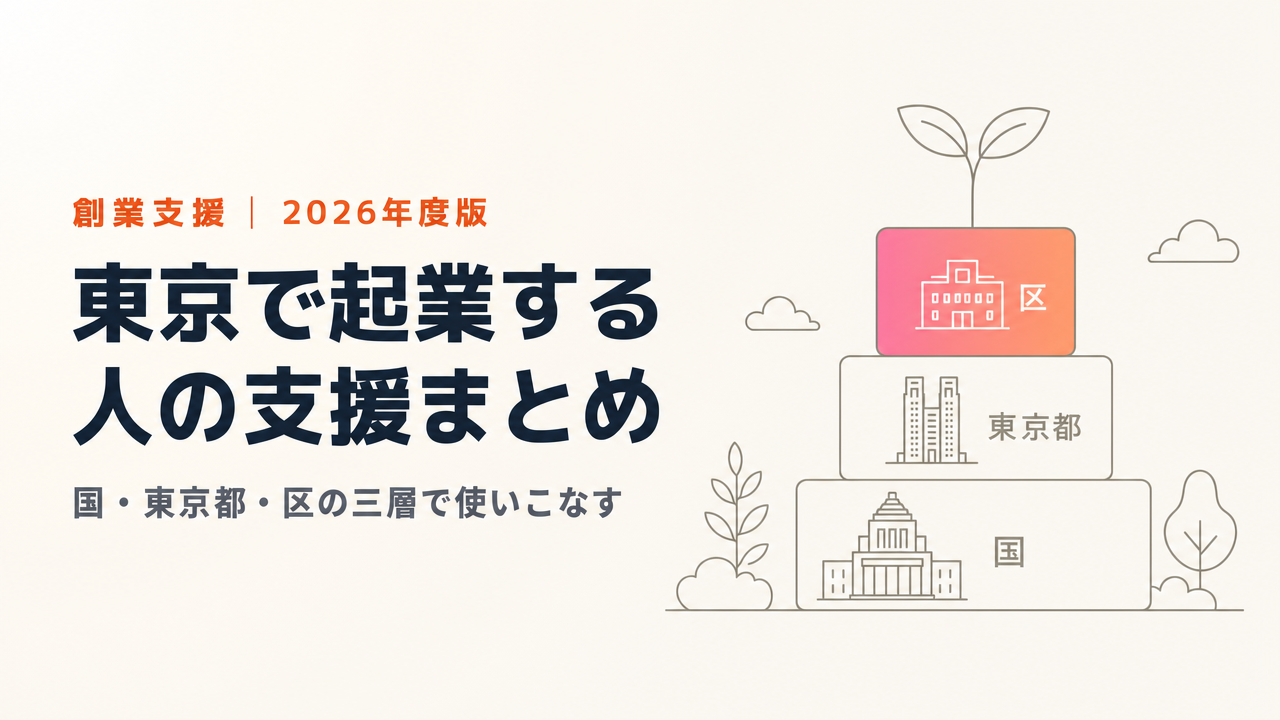
So in this article, for people about to start a business in Tokyo, I want to organize the whole landscape into three layers: the national government (Japan Finance Corporation), the Tokyo Metropolitan Government, and the wards. What can you use in each layer, and where do you apply? Let's go through it in order. I'll explain the jargon in plain terms, so it's fine even if this is your first time.
One note before we begin. The amounts and deadlines in this article are based on fiscal 2026 (Reiwa 8) information that could be confirmed from each institution's official website as of July 26, 20261234567. Startup support programs are updated every year, and application quotas, ceilings, deadlines, and requirements change. Before you apply, always confirm the latest guidelines with the relevant administering institution yourself. Please treat this article as a map for grasping the overall picture, nothing more.
Think of startup support in three layers: national, Tokyo, and ward
First, let me share the single most important way to think about this. Startup support in Tokyo is built from three overlapping layers.
| Layer | Main provider | What it does best | Representative programs |
|---|---|---|---|
| National | Japan Finance Corporation | Startup financing (borrowing) | New-business loan |
| Tokyo | Tokyo Metropolitan Government, Tokyo SME Support Center | Subsidies (no repayment), low-interest loans, ecosystem support | Startup Subsidy Program, Women/Youth/Senior Startup Support Program 2.0, SusHi Tech Tokyo |
| Ward (municipality) | Each ward's industrial promotion division and foundation | Certificate issuance (gateway to preferential treatment), ward-specific subsidies and interest subsidies | Certified Startup Support Program, ward startup subsidies |
The key point is that these are not an "either/or." They are meant to be combined.
For example, if you first obtain the certificate through your ward's Certified Startup Support Program (tokutei sogyo shien tou jigyo), the cost of setting up your company falls, and you get an interest-rate advantage on Japan Finance Corporation loans too. From there, you can borrow Japan Finance Corporation's new-business loan and also apply for the Tokyo startup subsidy. This kind of stacking is possible. The certificate works like a discount coupon that applies to other programs, so think of securing it early as a gateway that tends to pay off.
Let me also sort out the difference between money you have to pay back and money you don't.
- Loans (Japan Finance Corporation, institutional financing) are borrowed money, so of course you repay them later. But interest is low, and you can often discuss unsecured, no-guarantor terms, which are more favorable than what the private sector offers.
- Subsidies and grants are, in principle, money you do not repay. In exchange, there is a screening process, competition is intense, and eligible expenses and ceilings are defined in detail. Most work on a "pay it yourself first, then get part of it back later" (reimbursement) basis, so you still need working capital in the meantime.
With that distinction in mind, let's look at each layer.
Before we do, there is one thing worth touching on as part of your early preparation. In the current era, how well you use AI in the very act of planning your business has a large effect on how fast you can launch. If you want to know how AI-ready you and your team are, start by measuring where you stand with our free AI literacy check. It takes only a few minutes.
Tokyo's startup support
Tokyo's support broadly divides into three categories: subsidies (no repayment), low-interest loans (borrowing on favorable terms), and ecosystem support (non-monetary backing).
Tokyo's Startup Subsidy Program (sogyo josei jigyo)
The first thing to note is the Startup Subsidy Program (sogyo josei jigyo), commonly called the startup subsidy, run by the Tokyo Metropolitan Small and Medium Enterprise Support Center (TOKYO Startup Station)1. This is a non-repayable subsidy under which the metropolis subsidizes part of the expenses incurred in the early stage of a business.
Eligible expenses include rent, advertising costs, equipment and fixtures, employee personnel costs, and outsourcing fees paid to specialists. Here are the numbers.
| Item | Details |
|---|---|
| Subsidy rate | Up to two-thirds of eligible expenses |
| Subsidy ceiling | JPY 4 million (floor of JPY 1 million) |
| Project and personnel costs only | Up to JPY 3 million |
| Outsourcing costs only | Up to JPY 1 million |
| Eligible period | At least six months from the grant decision, up to two years |
A subsidy rate of up to two-thirds means, for example, that if you incur JPY 1.5 million in eligible expenses, up to JPY 1 million (two-thirds of that) can be eligible for the subsidy. The remaining third is your own contribution. The JPY 4 million ceiling is generous for an early-stage business, but because it is money you do not repay, competition is naturally on the higher side.
This startup subsidy has prerequisites. Eligible applicants are individuals planning to start a business in Tokyo, or small and medium enterprises founded less than five years ago, whose representative has less than a total of five years of management experience, and who have received designated startup support, such as completing plan consulting at TOKYO Startup Station Marunouchi or using the Certified Startup Support Program described later12. In other words, you cannot decide today and apply tomorrow. You need to arrange consultations and support in advance, so keep that in mind.
Applications are accepted several times a year. For fiscal 2026, two rounds (the first and second) have been announced, with the following approximate application periods2.
| Round | Application period (fiscal 2026) |
|---|---|
| First | April 7 to April 16, 2026 |
| Second | September 29 to October 8, 2026 |
For the second round, preliminary requirements have been indicated, such as starting plan consulting by August 22, 2026 and submitting the business plan by September 12, 20262. Rather than just the few days of the application window itself, assume the preparation beforehand takes several months, and work backward from there. That is the realistic approach.
Women/Youth/Senior Startup Support Program 2.0
Separate from subsidies, Tokyo also offers low-interest loans on favorable terms. The flagship is the "Women/Youth/Senior Startup Support Program 2.0" (josei/wakamono/senior sogyo support jigyo 2.0)3.
This is a loan program for women, young people (39 and under), and seniors (55 and over) in Tokyo who plan to start a business, or who founded one less than five years ago (seven years for women). Non-profit organizations and others are also eligible.
| Item | Details |
|---|---|
| Lending ceiling | Up to JPY 15 million (up to JPY 20 million for women) |
| Of which working capital only | Up to JPY 7.5 million (up to JPY 10 million for women) |
| Interest rate | Fixed, up to 1.25% per year |
| Repayment term | Up to 10 years (grace period up to 3 years) |
A fixed rate of up to 1.25% is quite favorable compared with a newly launched business borrowing unsecured from the private sector. On top of that, under this program, a local startup adviser gives advice on your business plan before the loan, and you can receive free management support after the loan as well3. What makes it distinctive is that it comes with hands-on accompaniment, not just money. Applications go through local financial institutions.
Tokyo Metropolitan Institutional Financing (startup menu)
There is one more. The institutional financing program (seido yushi), coordinated among the Tokyo Metropolitan Government, the Tokyo Credit Guarantee Corporation, and designated financial institutions, includes a "startup" menu for people about to start a business or who have recently done so4. Because the credit guarantee corporation provides the guarantee, it becomes easier to borrow from financial institutions and the interest burden is lighter.
The existence of the program itself is officially confirmed, but the specific fiscal 2026 figures, such as the lending ceiling, repayment term, and interest rate, could not be confirmed from the body text of the official page this time. I will avoid stating them definitively here, so if you are considering this option, please confirm the latest terms with the Tokyo Metropolitan Bureau of Industrial and Labor Affairs, the Tokyo Credit Guarantee Corporation's official page, or the financial institution you plan to work with4.
SusHi Tech Tokyo (ecosystem support)
Stepping slightly away from the money side, one thing you cannot leave out of Tokyo's startup support is SusHi Tech Tokyo5. This is a global-scale startup conference hosted by the Tokyo Metropolitan Government. Rather than direct cash subsidies, it is "ecosystem-type" support that fosters matchmaking, pitches, and business opportunities.
The 2026 edition was held from April 27 to 29, 2026 at Tokyo Big Sight, and according to the official announcement, it recorded 798 exhibitors, 60,779 visitors, and 25,140 business meetings5. The next edition is scheduled for May 20 to 22, 2027. It does not provide capital itself, but its value as a place to connect with investors, large enterprises, and other startups is significant, so it is worth following from the early stage of your business.
If you are interested in the bigger picture of how Tokyo is trying to transform into a global startup hub, I recommend also reading Conditions for Tokyo to Become a Global Startup Hub and Japan's Growth Strategy and Startup Development Package, which covers the moves at the national level.
Looking for AI training and consulting?
Learn about WARP training programs and consulting services in our materials.
What is the Certified Startup Support Program?
This is the part I most want you to know from this article. There is a program with a slightly stiff name, the Certified Startup Support Program (tokutei sogyo shien tou jigyo). The name is intimidating, but the substance is simple: "if you complete a ward's startup seminars, you receive a certificate that unlocks a number of preferential benefits."
To put it more precisely, this is a startup support program run by municipalities certified by the national government under the Industrial Competitiveness Enhancement Act (sangyo kyoso ryoku kyoka ho). When you attend and complete the startup seminars a municipality holds, that municipality issues you a "certificate of having received support under the Certified Startup Support Program"7.
As a rough guide to the national criteria, the expectation is that you learn across four areas, management, finance, human resource development, and market development, through continuous support of at least one month and at least four sessions7. It is not a single one-off seminar; think of it as learning the fundamentals of starting a business over a certain period.
What preferential treatment does the certificate unlock?
Once you obtain this certificate, you become eligible for the following benefits7.
- The registration and license tax at incorporation is halved. Registering a joint-stock company (kabushiki kaisha) or limited liability company (godo kaisha) requires paying registration and license tax, and this is reduced to half the usual amount. For a joint-stock company, the base is the greater of "capital times 0.7%" or "JPY 150,000," and roughly half of that applies. For a limited liability company, the guideline is that JPY 60,000 becomes JPY 30,000. That said, the halving is the statutory framework, so confirm the exact calculation with your Legal Affairs Bureau or local government.
- You can use the credit guarantee corporation's startup-related guarantee earlier. The unsecured startup-related guarantee, normally usable only from two months before starting your business, becomes usable from six months before. This makes it easier to prepare financing from the pre-launch stage.
- You become eligible for Special Interest Rate A on Japan Finance Corporation's new-business loan. With the certificate, you can use a rate lower than the standard rate on Japan Finance Corporation's flagship loan.
- It becomes easier to meet requirements for national subsidies. For example, you may meet the application requirements for the "startup track" of the Small Business Sustainability Subsidy, gaining benefits on startup-related subsidies.
Note that the exact amounts of finer details, such as add-ons to the credit guarantee limit, differ by program, fiscal year, and municipality. It is safest to confirm these against primary sources from the Small and Medium Enterprise Agency or the credit guarantee corporation7.
How to obtain the certificate
The flow is very simple.
- Check on the official page whether the ward (municipality) where you plan to register offers the Certified Startup Support Program. Many wards do.
- Attend and complete the startup seminars or continuous consultations that the ward holds.
- After completion, apply to the ward and have the certificate issued.
- With the certificate in hand, proceed to incorporation registration, your Japan Finance Corporation loan application, subsidy applications, and so on.
What matters is the order. If you obtain the certificate after you have already incorporated, it will be too late to reduce the registration and license tax. Do not forget the sequence of preparing the certificate before registration. Popular seminars can fill up their application slots quickly, so it is wise to check the ward's window early6.
Which ward you register in changes the support you get
Which of Tokyo's 23 wards you register your company in is a point that is surprisingly easy to overlook, yet it creates differences in the support available to you.
Many wards run the Certified Startup Support Program (certificate issuance), so on this point you can receive support in most wards. On the other hand, ward-specific startup subsidies, rent assistance, and interest subsidies or credit-guarantee-fee subsidies on institutional financing are add-on forms of support that vary widely by ward in content, amount, and application period. And they are updated every year.
Here I will introduce Minato Ward and Shibuya Ward, for which I was able to confirm fiscal 2026 details from primary sources this time, as generous examples with concrete figures. However, this does not mean "these wards are the best." The optimal ward changes depending on the nature of your business, where you live, and your office location, and other wards have their own good programs too. Please read this simply as an example for understanding "how much wards can differ."
The Minato Ward example
Minato Ward offers a Startup and Startup-Support Subsidy (sogyo/startup shien jigyo hojokin) for fiscal 20268. It is aimed at small and medium enterprises that were founded in Minato Ward, are less than two years old at the time of application, have an office in the ward, and have prepared a startup plan after receiving a business consultation.
| Item | Details |
|---|---|
| Subsidy rate | Two-thirds of eligible expenses (excluding tax) |
| Overall ceiling | JPY 2.5 million |
| Rent | Up to JPY 1.2 million (guideline: JPY 100,000 per month x 3 months in year one, plus JPY 100,000 per month x 9 months in year two) |
| Equipment costs | JPY 600,000 |
| Public relations costs | JPY 400,000 |
| Website creation costs | JPY 300,000 |
| First-year ceiling guideline | JPY 1.6 million |
For the application schedule, interviews begin March 23, 2026, and applications run from April 1, 2026 to January 15, 2027 (postmark valid)8. Including rent among the eligible expenses is a realistic help for founders setting up an office in central Tokyo.
In addition to this subsidy, Minato Ward's Industrial Promotion Center also issues certificates under the Certified Startup Support Program, runs fiscal 2026 startup seminars (the first on July 4, 2026), holds startup networking events, dispatches startup advisers (support for creating startup plans), provides startup after-follow-up mobile consultations, and offers startup support financing9. If you obtain the certificate, you also become eligible for the national preferential treatment described above, such as the registration-tax reduction.
The Shibuya Ward example
Shibuya Ward runs a "startup seminar (online fundamentals edition)" as its Certified Startup Support Program and issues certificates to those who complete it6. Obtaining this certificate makes you eligible for national preferential treatment such as the registration-tax reduction. It is popular and application slots fill up early, so early confirmation is necessary.
Shibuya Ward also runs a framework called Shibuya Startup Support, which offers entrepreneur support and development programs, development of the startup environment, proof-of-concept experiments (a "test-bed city" initiative), promotion of globalization, and procedural support related to the startup visa10. What makes it distinctive is that it provides hands-on support for international entrepreneurs on visas, investment, and business partnerships. This is centered on ecosystem-type support rather than cash subsidies.
About other wards
Many wards, including Chiyoda, Chuo, Shinjuku, Bunkyo, Ota, Setagaya, Edogawa, and Kita, have received certification for startup support plans under the Industrial Competitiveness Enhancement Act and operate the Certified Startup Support Program (from seminars and continuous consultations through to certificate issuance). Some wards also have their own startup subsidies, rent assistance, and interest subsidies or credit-guarantee-fee subsidies on institutional financing.
However, the only wards for which I could confirm specific fiscal 2026 amounts and deadlines from primary sources this time are Minato and Shibuya. For other wards, the content, amount, and application period vary widely by ward and are updated every year, so this article does not state figures definitively. On the official page of the industrial promotion division or industrial promotion foundation of the ward you are considering for registration, always confirm the latest fiscal 2026 (Reiwa 8) guidelines.
When comparing wards, it helps to look through these lenses.
- Does the ward run the Certified Startup Support Program (certificate)?
- Does it have a ward-specific startup subsidy, and what are the eligible expenses and ceiling?
- Are there rent assistance or interest subsidies on institutional financing?
- Is your industry or business content eligible?
- Does the application period align with your startup timing?
Japan Finance Corporation's startup loan
The bottom of the three layers, the national layer, is carried by Japan Finance Corporation (Nihon Seisaku Kinyu Koko, commonly called Nihon Koko or Koko). It is a government-affiliated financial institution and a dependable source of capital for businesses at the stage where they have just launched and find it hard to borrow from private banks.
The new-business loan
The flagship of Japan Finance Corporation's startup financing is the new-business loan (shinki kaigyo shikin, formally the new-business and startup support loan) under its National Life Business unit11.
| Item | Details |
|---|---|
| Lending ceiling | JPY 72 million (of which working capital up to JPY 48 million) |
| Repayment term for capital expenditure | Up to 20 years (grace period up to 5 years) |
| Repayment term for working capital | Up to 10 years (grace period up to 5 years) |
| Collateral and guarantor | Decided through consultation based on your wishes (unsecured, no-guarantor consultations possible) |
The JPY 72 million ceiling is the upper limit of the frame, not an amount everyone can borrow. The actual loan amount is decided based on the content of your business plan and your own capital situation. A "grace period" is an arrangement in which, during that period, you can defer repaying the principal and pay only the interest. It is a welcome feature for the early period after launch, when sales are unstable, because it keeps the repayment burden down.
Interest-rate preferences for women, youth, seniors, and others
A major appeal of Japan Finance Corporation is its interest-rate preferences. For the following people who are newly starting a business (or within roughly seven years of opening), the funds they need are subject not to the standard rate but to Special Interest Rate A (a reduced rate)11.
- Women
- Those under 35
- Those 55 and over
Furthermore, those who have received the certified Certified Startup Support Program and obtained the certificate are also eligible for Special Interest Rate A11. Obtaining the certificate at your ward pays off here too. Note that if you have received investment from a venture capital firm, for instance, and meet certain conditions, you may be offered an even more favorable rate category (Special Interest Rate B)11. The applicable rate is divided finely by how the funds are used and by requirements, so confirm the latest applicable terms at a Japan Finance Corporation window.
On the 2024 program revision (please verify)
Regarding Japan Finance Corporation's startup financing, it is generally reported that a major program revision took place in 2024 (Reiwa 6). The account is that the former "new startup financing program" (shin sogyo yushi seido, with its unsecured, no-guarantor special provision, a ceiling of JPY 30 million including JPY 15 million of working capital, and a one-tenth own-capital requirement) was consolidated into the "new-business loan" through this revision. Along with this, it is often explained that the ceiling was expanded to JPY 72 million (JPY 48 million working capital), the own-capital requirement that existed in the old program was abolished, and the grace period was extended.
That said, while the JPY 72 million ceiling and the application of the special rate could be confirmed on the official page, the wording "2024 revision," the "abolition of the own-capital requirement," and the "consolidation of the new startup financing program" could not be directly confirmed from the body text of the relevant Japan Finance Corporation page I referenced this time11. I will avoid stating this definitively, so for details I recommend verifying with a Japan Finance Corporation window or the latest brochure. In any case, it is worth keeping in mind the broader trend of startup-financing terms being revised in recent years in a direction favorable to founders.
Where to take your first step
You may feel overwhelmed by the sheer number of programs, but the order of what to do is simple. As a way to get moving toward starting a business in Tokyo, I recommend the following flow.
- Roughly shape your business plan. What will you sell, to whom, and at what price? How much initial cost and near-term working capital do you need? Put it into numbers, even if they are rough. Many support programs require a "startup plan," so starting to write it early makes the rest smoother.
- Check the Certified Startup Support Program in the ward where you plan to register, and go get the certificate. This is the gateway to preferential treatment. Because seminars take time, moving on this first is the smart play. Keep the order of preparing the certificate before registration.
- Decide your sources of capital. Combine money you do not repay (Tokyo's startup subsidy, ward subsidies) with money you borrow on favorable terms (Japan Finance Corporation's new-business loan, Tokyo's Women/Youth/Senior Startup Support Program 2.0). Subsidies are often reimbursed, so a realistic design is to secure working capital with loans in the meantime.
- Build your schedule by working backward from deadlines. As with the second round of the startup subsidy, some programs require preparation to begin several months before the application. Line up the deadlines on a calendar and work backward.
- Always confirm each institution's latest fiscal 2026 guidelines. The figures in this article are as of July 2026. Do a final check against primary sources before applying.
And I genuinely believe the early stage of a business is exactly when you should make AI your ally. From sparring on your business plan, to market research, to preparing materials, to early marketing, whether a small founding team can put AI to work makes a large difference to launch speed. TIMEWELL's AI consulting service WARP supports building this kind of AI-usage playbook. In particular, for people about to start a business or launch a new venture inside a company, we offer a program called WARP Entre that intensively trains entrepreneurs' ability to use AI. I write in more detail about how to build AI into entrepreneurship in How to Develop Entrepreneurs Who Master AI, so please read that alongside this.
Summary
Finally, let me organize the key points of this article.
- Startup support in Tokyo is built from three layers, the national government (Japan Finance Corporation), the Tokyo Metropolitan Government, and the wards, and the basic approach is to combine them.
- The ward's Certified Startup Support Program is the gateway to preferential treatment. Obtaining the certificate halves the registration and license tax, lets you use credit guarantees from six months before, and makes you eligible for Special Interest Rate A on Japan Finance Corporation loans. The iron rule is to obtain it before registration.
- Tokyo's startup subsidy is generous, non-repayable with a ceiling of JPY 4 million (subsidy rate up to two-thirds), but it has prerequisites and deadlines, and competition is on the higher side. Each round requires preparation starting several months ahead.
- Tokyo's Women/Youth/Senior Startup Support Program 2.0 is a favorable loan at a fixed rate of up to 1.25% with hands-on adviser accompaniment.
- The add-on support you can use varies by ward. Minato Ward has a fiscal 2026 subsidy with a JPY 2.5 million ceiling (two-thirds subsidy rate), and Shibuya Ward is a generous example with certificate issuance plus support for international entrepreneurs. Other wards have their own programs too, and the details change every year, so always confirm on the official page of the ward where you plan to register.
- Japan Finance Corporation's new-business loan has a ceiling of JPY 72 million (JPY 48 million working capital), allows unsecured, no-guarantor consultations, and offers interest-rate preferences for women, youth, and seniors, as well as certificate holders.
Startup support is a world where the more you know, the more you gain. Programs are updated every year, but the principles do not change: "think in three layers," "go get your ward's certificate first," and "work backward from deadlines." I would be glad if this article became the map for your first step in Tokyo. If you would like to talk through launching a business, including how to use AI, please reach out to the WARP team. You can start with a 30-minute online consultation.
Related articles
- Conditions for Tokyo to Become a Global Startup Hub
- Japan's Growth Strategy and Startup Development Package
- How to Develop Entrepreneurs Who Master AI
Footnotes
-
Tokyo Metropolitan Small and Medium Enterprise Support Center (TOKYO Startup Station), "Startup Subsidy Program (sogyo josei jigyo)." https://startup-station.jp/m2/services/sogyokassei/ ↩ ↩2 ↩3
-
TOKYO Startup Station, "Fiscal 2026 Startup Subsidy Program Application (First and Second Rounds)." https://startup-station.jp/m2/services/sogyokassei/ ↩ ↩2 ↩3 ↩4
-
Tokyo Metropolitan Bureau of Industrial and Labor Affairs, "Women/Youth/Senior Startup Support Program 2.0." https://www.sangyo-rodo.metro.tokyo.lg.jp/chushou/kinyu/yuushi/support ↩ ↩2 ↩3
-
Tokyo Metropolitan Bureau of Industrial and Labor Affairs / Tokyo Credit Guarantee Corporation, "Tokyo Metropolitan Institutional Financing (startup menu)." https://www.sangyo-rodo.metro.tokyo.lg.jp/chushou/kinyu/yuushi/yuushi/ ↩ ↩2 ↩3
-
Tokyo Metropolitan Government / SusHi Tech Tokyo Executive Committee, "SusHi Tech Tokyo." https://www.sushitech-startup.metro.tokyo.lg.jp/ ↩ ↩2 ↩3
-
Shibuya Ward, "Certified Startup Support Program (startup seminar and certificate issuance)." https://www.city.shibuya.tokyo.jp/jigyosha/shoko-rodo-sodan/sogyo-shien/ ↩ ↩2 ↩3
-
Small and Medium Enterprise Agency, "Certified Collaborative Startup Support Providers and the Certified Startup Support Program." https://www.chusho.meti.go.jp/keiei/chiiki/nintei/ ↩ ↩2 ↩3 ↩4 ↩5
-
Minato Ward Industrial Promotion Center, "Startup and Startup-Support Subsidy (fiscal 2026)." https://minato-sansin.com/sougyostartupsien/ ↩ ↩2
-
Minato Ward Industrial Promotion Center, "Certified Startup Support Program, startup seminars, and startup adviser dispatch." https://minato-sansin.com/founder-list/ ↩
-
Shibuya Ward, "Shibuya Startup Support." https://shibuya-startup-support.jp/ ↩
-
Japan Finance Corporation, "New-Business Loan (new-business and startup support loan)." https://www.jfc.go.jp/n/finance/search/01_sinkikaigyou_m.html ↩ ↩2 ↩3 ↩4 ↩5