(November 21, 2026) We removed "nationalities" from the checks on a joint research partner's lab and corrected them to whether members are non-residents or have contracts with, or benefits from, foreign corporations or governments. We also updated the violation statistics to METI's FY2024 analysis and corrected our description of METI's near-miss case book, which contains one such case (the international student support office knew of the scholarships but the export control office did not), not multiple cases where the university had not tracked them.
(November 22, 2026) We had named the issuer of the 2022 amendment to the services circular as METI's Trade and Economic Security Bureau. We have corrected it to the Trade and Economic Cooperation Bureau, the name shown in the circular's heading.
Hello, this is Hamamoto from TIMEWELL.
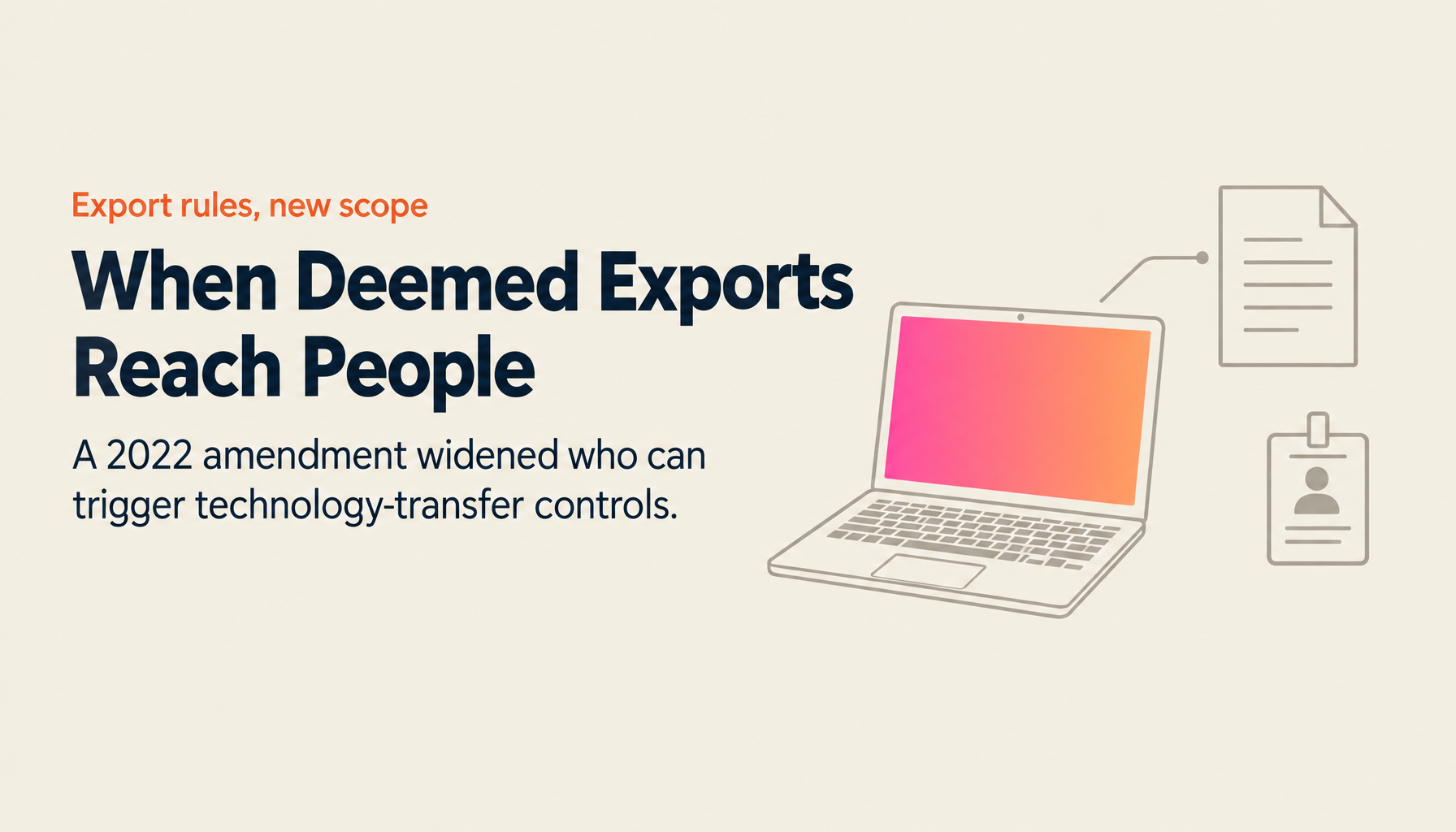
Hiring foreign engineers, joint research with overseas universities, accepting secondees from overseas subsidiaries—all of this is now standard practice for Japanese companies. Quietly operating behind it, however, is the clarification of "deemed export" administration that took effect on May 1, 2022, and it is steadily reshaping the work of HR, legal, and R&D teams. The text of the Foreign Exchange and Foreign Trade Act has not changed, but an amendment to the administrative notice means that, depending on circumstances, even Japanese researchers and long-term foreign engineers on staff—who had long been outside the scope—can now find themselves inside the "export" permission regime.
A common misconception is, "We don't ship things overseas, so this doesn't concern us." In reality, showing technical materials in a domestic office to a non-resident or to a person in a specified category (of any nationality), or sharing drawings with someone who is under contract with, and directed by, a foreign company or institution (with exceptions, such as where a contract with a Japanese corporation is agreed to take priority, or where the other party is a group company with a 50% or greater voting stake), can constitute a deemed export. My position is that this is an area where the state is clearly moving in with intent. Below, I break it down to a level of granularity that is usable in the field.
What Is a Deemed Export? A Regime Where Technology Does Not Need to Cross a Border
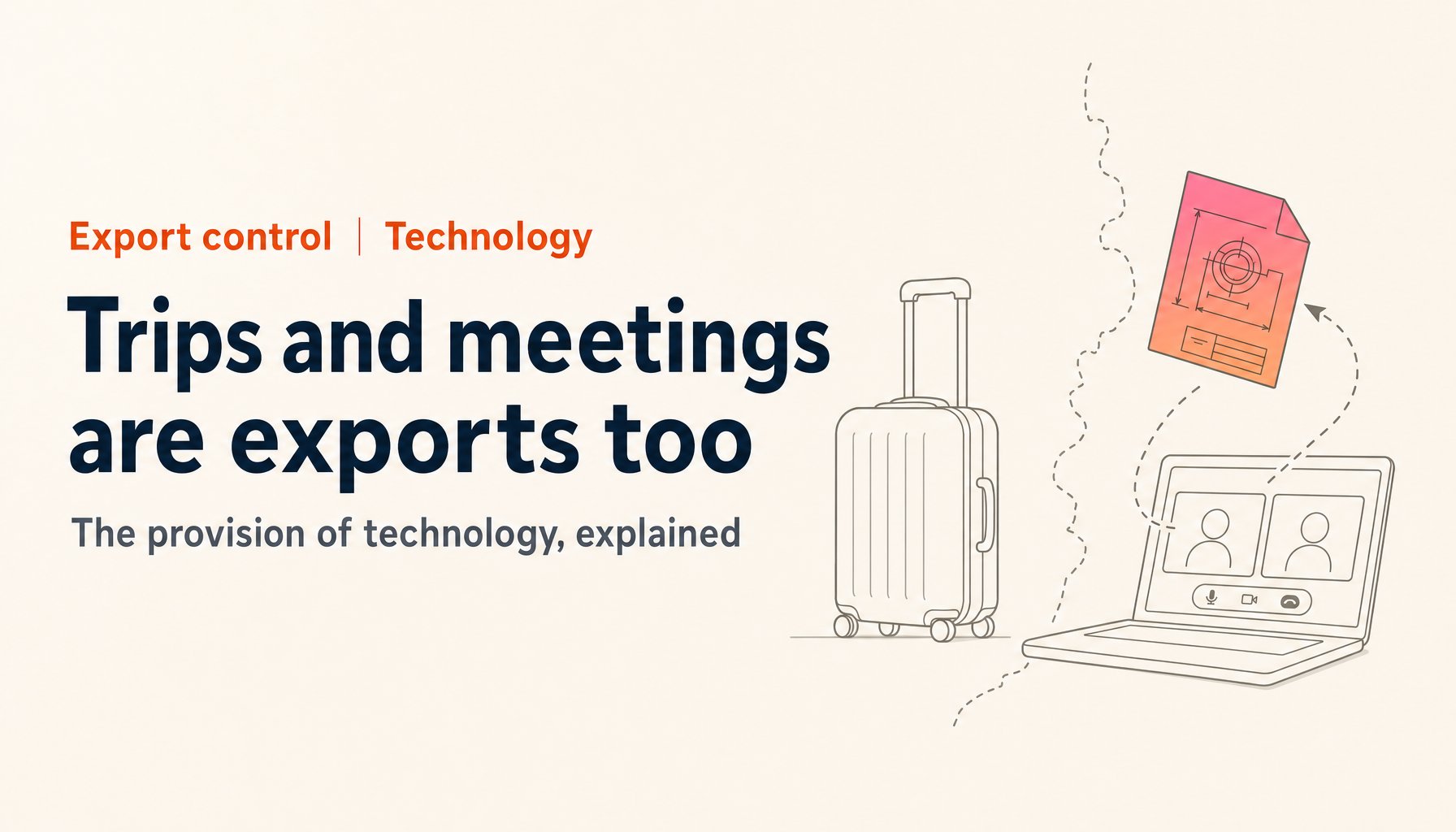
A deemed export is a concept rooted in Article 25(1) of the Foreign Exchange and Foreign Trade Act. It regulates the provision of specified technology from a resident to a non-resident in the same way as a goods export. The key point is that the technology does not have to cross a physical border. Showing technical materials in a Japanese conference room, explaining a design orally on an online call, granting access rights to an internal server, or walking through design philosophy at a joint-research kickoff—any of these can, depending on the counterparty, become an "export" requiring METI approval.
The technology in scope is either a "specified technology" tied to a list-regulation item, or a technology caught by catch-all controls. List regulation is enumerated in Rows 1 through 15 of Appendix 1 of the Export Trade Control Order and Rows 1 through 15 of the Appendix to the Foreign Exchange Order, covering a broad range: semiconductor manufacturing equipment, cryptographic technology, advanced materials, dual-use sensor technology, and know-how tied to machine tools meeting certain specifications. Even technologies that feel "not particularly military" can end up caught by list regulation depending on spec and intended use. METI's analysis of FY2024 violations, published in December 2025, found that 52% arose from classification (no classification or assuming the item was uncontrolled 32%, misclassification or misreading the rules 15%, relying on someone else's wrong classification 5%), ahead of the 36% attributable to the management system (in the FY2023 edition the figures were 70% and 21%). A classification error alone is enough to step into criminal-penalty territory.
Another point worth emphasizing: the deemed export regime is not only aimed at "technology outflow to hostile countries." Even for counterparties in friendly jurisdictions, if the target technology and the specified types test line up, a license is required. The conversation often gets framed in economic security terms, but the architecture of the regime itself exists to deliver on Japan's obligations under international regimes such as the Wassenaar Arrangement; the license question does not flip on and off based on whether a country is "adversarial." Operating under the misconception that "our counterparty is American, so we're fine" is exactly how compliance debt accumulates into a violation.
Replace siloed classification work with AI.
METI's FY2024 data shows 52% of foreign exchange law violations stem from classification errors. Download the TRAFEED product catalog covering features and rollout.
"Specified Types": When Residents Fall Back Into Scope—The Heart of the 2022 Amendment
The May 1, 2022 amendment to the Service Transaction Notice (4 Trade Bureau No. 492; its heading names the issuer as METI's Trade and Economic Cooperation Bureau) overturned years of interpretation around the "six months after arrival" rule. Before the amendment, foreigners who had been in Japan for more than six months, or who were employed at a domestic business site, were treated as "residents" and sat outside the deemed export regime. In other words, once someone became a resident, no further check applied—no matter how much foreign-government influence was in play.
The amendment introduced a new "specified types" concept. Even residents fall within scope if they fit into any of the following three types and therefore must be managed the same way as technology transfers to non-residents. First, anyone who has an employment or similar contract with a foreign corporation or similar entity (such as a foreign company or university) or a foreign government or similar entity, and who is subject to its direction or owes it a duty of care; there are exceptions, such as where the contract with a Japanese corporation is agreed to take priority, or where the other party is a group foreign corporation. People who keep an employment contract with a foreign corporation in which there is less than a 50% capital relationship can fall here. Joint research or commissioned research with a foreign institution is ordinarily not a "mandate, service or other contract" for category 1; it can become one only where, for example, a researcher works exclusively on research commissioned by one company and takes direction from that company on its direction and content (deemed export Q&A Q48). Someone who is under the direction of a Japanese corporation and also has a contract with a group foreign corporation (50% or more of the voting rights, held directly or indirectly, in either direction) is excluded under exception (b) of the services circular, 1(3)(sa)(1). Second, anyone who receives, or is promised, a large amount of money or other significant benefit from a foreign government or similar entity amounting to 25% or more of their annual income. The source must be a foreign government or similar entity; benefits from a foreign company do not count here. A foreign government scholarship can qualify if it reaches 25% of annual income, but scholarships received before employment generally do not (METI deemed-export Q&A, Q50). Third, anyone who receives instructions or requests from a foreign government or similar entity regarding their conduct in Japan (item 1(3)(sa) of the services circular). Nationality is not a criterion for any of the three.
What is tricky in practice is the procedure for checking that test. METI has published Attachment 1-3 to the Service Transaction Notice, "Guideline for Determining Specified Types," which frames the standard this way: if you check in line with the guideline, you are considered to have discharged the "duty of ordinary care." The method depends on the person. For people outside your direction and control (a joint research partner, for example), no further check is required unless the information in contracts and similar documents ordinarily obtained makes it clear that they fall within a specified type (Attachment 1-3, 1(1)). For people under your direction, such as employees, you check by self-declaration (a written declaration) when they come under your direction and require them to report if they later fall within a specified type (1(2)). Attachment 1-4 provides a model written declaration, which each organization can adapt to its own form as long as the substance is preserved. Checking in line with the guideline is what puts you on the side of having exercised ordinary care. Conversely, operating by "we just asked the person verbally" or "we read the CV but kept no record" is what turns catastrophic when a problem later surfaces.
Typical Risk Scenarios: Students, Secondees, Joint Research, Conference Talks
When I talk with clients, the moments where I find myself asking, "Really, you hadn't noticed this?" tend to cluster into four patterns. These are four typical cases seen in practice, separate from the three specific categories described above. All of them are routine parts of day-to-day life at Japanese companies and universities, which is exactly why unnoticed violations can pile up.
The first is hiring researchers and graduate students (of any nationality). The entry points are varied: postdocs at national R&D institutes, engineer hires at research-driven startups, lab assistants at major manufacturers' research arms. Some receive a foreign government scholarship, hold a post under an agreement with a foreign university, or have a contract with a foreign firm. If, while employed, they receive benefits from a foreign government or similar entity amounting to 25% or more of annual income, they can fall under type (2) (scholarships received before employment generally do not; Q50). METI's "Case Book on Near-Miss Incidents in Security Export Control at Universities and Research Institutes" (updated September 2023) includes a case in which the export control office checked students without employment contracts for the specified types by written pledge, but did not know that the university's international student support office already held information on the students' scholarships. The case book asks export control offices to work with other offices and always check scholarship receipts as well. Adding questions on "scholarships or research grants from a foreign government or similar entity" and "contracts with foreign corporations or governments," asked of everyone regardless of nationality, to the hiring checklist is all it takes to prevent this class of risk.
The second is accepting secondees and trainees from overseas subsidiaries or overseas parents. At global companies, assignments like "spend a year at the Japan head office doing a stint on our frontier development project" are routine, but METI's view is that secondees usually have an employment relationship with, and are under the direction of, the receiving company (deemed export Q&A, Q27). Where the sending company is a group foreign corporation with a 50% or greater voting relationship and the person is also under the direction of the Japanese corporation, the remaining contract with the sending company does not make them specified type (1) (services circular, 1(3)(sa)(1)(b)). The cases to watch are people received from partners with less than a 50% capital relationship, and trainees who sign no contract with the Japanese corporation; they can fall under type (1). Either way, the receiving company confirms status with a pledge or similar document (Q27). The situations requiring the most attention are secondments from US, Chinese, or European R&D hubs, where the counterparty country's own export control laws (US EAR and ECCN) layer on top and create a dual-regulation problem.
The third is joint research and contracted research. With overseas universities, NDAs and IP-allocation terms are often nailed down at the contracting stage, yet the deemed export lens is missing far more often than you would expect. Checking whether members of the partner lab are non-residents or fall under the specified categories through contracts with, or benefits from, foreign corporations or governments (affiliations, funding sources), classifying the technical information you plan to share, and evaluating whether the outputs contain technology that qualifies as "publicly known" are three layers that must be run in advance. If any one of them is skipped, a violation can be triggered at the very first kickoff meeting. Conference talks and online meetings work the same way: the "publicly known technology" exception is available if you do not impose confidentiality and the talk is widely open, but if participants are limited to a defined audience or confidentiality is imposed after the fact, the exception falls away.
The fourth is meetings with foreign sales representatives and consultants on the counterparty side. Someone employed by a Japanese subsidiary of a foreign company is not, on that basis alone, specified type (1) (deemed export Q&A, Q45; a shell SPC with no real business is different). They can fall under type (1) if they also have a contract with, and are directed by, a foreign corporation that has no 50% or greater capital relationship with their employer. Because they are outside your company, your internal pledge procedure does not reach them: classify the technology first, and if you will provide controlled technology, confirm the person's status through the documents you normally obtain in the transaction, such as the contract. There is also a human dimension: the longer the relationship, the harder it feels to ask.
Concrete Countermeasures for Companies and Universities: Pre-Screening, Specified-Type Checks, Access Control
From here, the conversation is about operational design. Understanding the rules is not enough; unless you can land them into the field, it stays a paper exercise. When I go in to build an export control policy with a company, there are six elements I insist on as the baseline.
The anchor is the "pre-screening mechanism." For every new hire, secondee intake, joint research contract, and external speaking engagement, there has to be a first-line filter that asks, "Could this case implicate deemed export?" If HR, legal, and R&D operate in silos, the filter fails, so the critical move is to hard-wire the workflow so the export control function (the export control officer at a company, or the security trade control officer at a university) is looped in. For mid-sized companies, even adding a simple "deemed export check needed" flag to the contract workflow system (set not by nationality but by whether non-residents are involved or there are contracts with, or benefits from, foreign corporations or governments) substantially boosts effectiveness.
Next is the "specified-type check (pledge)." For candidates, secondees, and potential co-authors on joint research, conduct interviews and collect documents in line with Attachment 1-3 of the services circular, applying the same procedure to everyone regardless of nationality. Include questions on employment or similar contracts with a foreign corporation or government (type 1) and on whether benefits from a foreign government or similar entity reach 25% of annual income (type 2). For type 3 (instructions or requests from a foreign government), METI notes that it is not normally expected to be confirmed by self-declaration (deemed-export Q&A, Q34). Adapt the sample pledge in Attachment 1-4 to your own form, without losing its purpose, and obtain a signed pledge from the person. That document becomes a lifeline in later exchanges with regulators.
Third is "classification and record-keeping." Even when a specified type applies, a license is not required if the technology being shared falls outside list and catch-all regulation. The final determination is therefore the product of "counterparty attributes" and "technology classification." Prepare a classification parameter sheet for each technology, and log the counterparty, date of provision, and method of provision as a set. These records make all the difference in customs post-clearance audits and METI site inspections. The fact that customs post-clearance audits were how 59% of violations came to light in METI's FY2024 analysis (43% in FY2023) shows exactly how dangerous undocumented cases are.
Fourth is "access control." For individuals who fall within a specified type, restrict the scope of access to internal systems and lab facilities to the minimum necessary for the job. Permissions in GitHub Enterprise, Notion, SharePoint, and lab NAS all need to be reviewed. This is a technical conversation, so co-designing it with your CSIRT or IT group is the realistic path.
Fifth is "training." Combine mandatory annual training with individual briefings on hire and on secondment intake. Case-based training is particularly effective for managers and project leads; even swapping in your own data for the four scenarios above and running a tabletop exercise will transform real-world effectiveness.
Finally, "audit and self-healing." METI's analysis of violation cases shows that a share of violations come to light within the company itself. Having a system to find violations through internal audits and report them yourself is a way to limit the damage on the assumption that violations will happen. Perfect operations are not realistic, so in the long run, owning a mechanism that assumes violations will occur and is built to detect and remediate them causes less damage.
Summary: Three Steps to Start Building the Framework
The core of the deemed export argument is a regime that runs against the intuition "we aren't moving any goods, so this doesn't apply to us." Domestic conference rooms, internal servers, online meetings, joint research—every one of them is a potential moment of export. With the 2022 notice amendment that introduced specified types, providing technology even to a resident is now controlled when that person works under the direction of a foreign entity or foreign government under a contract (Type 1), receives benefits from a foreign government worth 25% or more of their annual income (Type 2), or acts in Japan on the instructions or requests of a foreign government (Type 3). Nationality does not matter: Japanese researchers and employees can fall into these types too. The economic security debate continues in 2026, and having a checking procedure in place matters more than before.
What I recommend is not aiming for perfection, but locking down a minimum defense in three steps. First, physically embed a "specified types check" gate in the workflows for hiring, secondment, and joint research. Second, prepare a confirmation form (pledge) based on Attachment 1-3 (guidelines for judging whether a person falls under a specified type) and Attachment 1-4 (sample pledge) of the services circular, and keep the records. Third, put in place a case-level evidence system that joins classification with provision logs. With these three in place, even if a violation does occur, you will have a foundation from which to demonstrate that you discharged the "duty of ordinary care."
For practitioners thinking "I don't know where to start" or "I'm not confident our management regime has kept up with the rule changes," the place to begin is a current-state inventory. As related reading, pieces such as What to Check When Hosting Students and Researchers, Japan-China Export Control Tightening and Its Spillover on Japanese Companies, and The National Security Information Council and Economic Security will help you see how deemed export fits into the wider landscape.
The regime has moved past the point where "I didn't know" is a defense. The further you push global expansion in your core business, the more export control shifts from "defense" to "the foundation of business continuity." As a practitioner, I am hopeful that more companies will take up framework-building with that lens.
If you want specified-type checks, classification, and provision records to run as a routine process, you can contact us about TRAFEED. An overview of its features is in the TRAFEED product catalog (PDF).
References
- METI, "Deemed Export Control." https://www.meti.go.jp/policy/anpo/anpo07.html
- METI, "On the Clarification of Deemed Export Control." https://www.meti.go.jp/policy/anpo/law_document/minashi/meikakukanitsuite2.pdf
- METI, "Case Book on Near-Miss Incidents in Security Export Control at Universities and Research Institutes." https://www.meti.go.jp/policy/anpo/daigaku/jireishu.pdf
- METI, "Analysis of Violations of the Foreign Exchange and Foreign Trade Act (Security Trade) (FY2024)," December 2025. https://www.meti.go.jp/policy/anpo/gaitameho_document/ihanjireigaitamehou6.pdf
- METI, "Analysis of Violations of the Foreign Exchange and Foreign Trade Act (FY2023)." https://www.meti.go.jp/policy/anpo/gaitameho_document/ihanjireigaitamehou5.pdf
- CISTEC, "On Deemed Export Control." https://www.cistec.or.jp/service/webseminar/open/data/houjin/5006_minashi.pdf
- PwC Legal Japan News, "Clarification of Deemed Export Control under the Foreign Exchange and Foreign Trade Act." https://www.pwc.com/jp/ja/legal/news/assets/legal-20220125-jp-3.pdf