(November 21, 2026) We corrected the routing described in this article against the criminal complaint: the goods were transshipped to China through Singapore and Malaysia, and the paperwork falsely named customers in third countries such as Taiwan or Thailand. Later the same day we added the exports to Canada and Taiwan that the complaint also describes. We also corrected the explanation of China-bound controls on the H100/H200, which had relied on the rescinded AI Diffusion Rule's "Tier 3."
(November 21, 2026) We have corrected this article against the DOJ press release. We had called the case an attempted diversion; DOJ says at least $160 million of GPUs were exported or attempted to be exported, and that the GPUs were ultimately shipped to the PRC, Hong Kong, and other destinations. We had also said the two charged individuals had pleaded not guilty; DOJ's release says they were in custody pending further proceedings. The announcement date is December 8, 2025.
Hello, this is Ryuta Hamamoto from TIMEWELL.
“We’re not a U.S. company. This doesn’t apply to us.” I still hear that when export controls come up at mid-sized firms. Operation Gatekeeper, announced by the U.S. Department of Justice (DOJ) in December 2025, is a reminder that that assumption can be the most dangerous one.
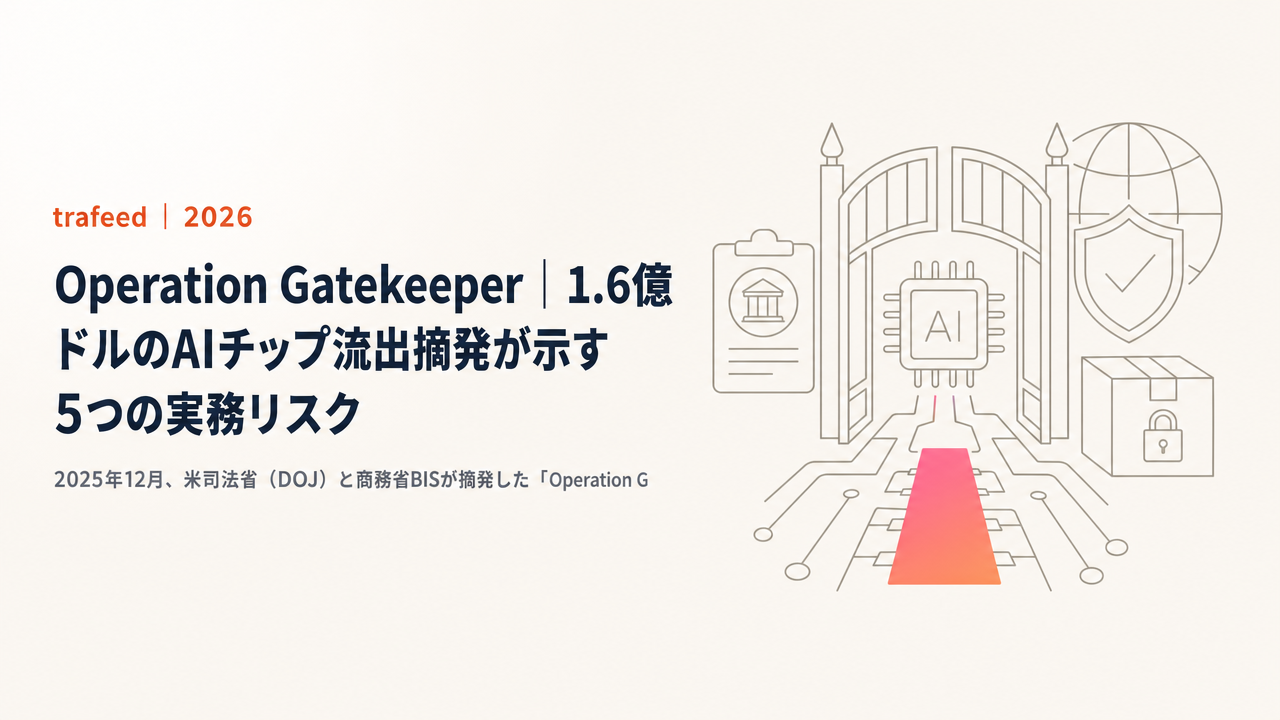
U.S. authorities described a network centered on a Texas company that, according to DOJ, exported and attempted to export at least $160 million worth of NVIDIA H100/H200 GPUs to China and Hong Kong. The method was simple on paper: strip NVIDIA labels, apply fake “SANDKYAN” labels, and route shipments to China through Singapore and Malaysia, with documents calling the goods “adapters” or “general computer parts” (per the criminal complaint and DOJ's release).
This is not a distant U.S. story only. Japanese trading companies, electronics distributors, and semiconductor equipment makers can be drawn into similar patterns. Below I map the public facts of the case and five practical steps you can start this week.
Where individuals have only been charged, this article treats allegations as allegations. One defendant has pleaded guilty; others have not been convicted. The facts below are regulatory and judicial outcomes, not character judgments of every party named in public materials.
What you will learn
- What Operation Gatekeeper is, and why Hsu's guilty plea drew attention
- The six-stage diversion path (straw purchase → warehouse aggregation → label fraud → third-country routing)
- The statutes at issue (ECRA / EAR Part 744 / FDPR) and penalties up to 20 years and $1 million
- Five red flags Japanese companies should check
- Five steps to strengthen controls this week
Three acronyms first (DOJ / BIS / ECRA)
| Acronym | Full name | Role |
|---|---|---|
| DOJ | Department of Justice | Criminal prosecution; oversees U.S. Attorneys’ offices and FBI |
| BIS | Bureau of Industry and Security | Administers the EAR; licensing and Entity List management |
| ECRA | Export Control Reform Act of 2018 | Statutory basis for criminal and civil export-control penalties (up to 20 years + $1M) |
In short: BIS writes and administers the rules; DOJ prosecutes; ECRA supplies the penalty framework. Gatekeeper followed that pattern. Keep the three roles separate when you brief management.
Case overview: announced 8 December 2025, at least $160M in unlawful exports
| Item | Detail |
|---|---|
| Operation name | Operation Gatekeeper |
| Public announcement | 8 December 2025 (DOJ Office of Public Affairs; updated 9 December) |
| Agencies | DOJ, BIS, FBI, HSI, U.S. Attorney’s Office for the Southern District of Texas |
| Seizures reported | About $50 million (GPUs and cash) |
| Value exported or attempted | At least about $160 million |
| Period | October 2024 – May 2025 (~7 months) |
| Items | NVIDIA H100 / H200 Tensor Core GPUs |
| Destinations | PRC, Hong Kong, and others (DOJ says the GPUs were ultimately shipped there) |
H100/H200 are top-tier NVIDIA GPUs for generative AI training and inference, often priced in the tens of thousands of dollars each. Moving at least $160 million over seven months (about ¥24 billion) is a very large amount for a single company.
Southern District of Texas U.S. Attorney Nicholas J. Ganjei stated that "Operation Gatekeeper has exposed a sophisticated smuggling network that threatens our Nation's security by funneling cutting-edge AI technology to those who would use it against American interests." I quote that as the prosecutor’s framing of the case.
The case was run through the Disruptive Technology Strike Force, a joint DOJ–BIS initiative launched in February 2023 and deployed across 12 metro areas to focus on advanced-technology diversion.
Replace siloed classification work with AI.
METI's FY2024 data shows 52% of foreign exchange law violations stem from classification errors. Download the TRAFEED product catalog covering features and rollout.
The three people named by DOJ
Alan Hao Hsu (43): guilty plea entered
- Residence: Missouri City, Texas
- Company: Hao Global LLC (Houston area)
- Plea: 10 October 2025, guilty to smuggling and illegal export charges
- Sentencing: DOJ said in December 2025 that it was set for 18 February 2026 (statutory exposure up to 10 years). As of 21 November 2026, we have not found a DOJ announcement of the sentence
- Wire transfers from the PRC: over $50 million
Local coverage (Click2Houston, 8 December 2025) described the plea as the first case of its kind. DOJ's Office of Public Affairs release does not use the word "first," and we have not confirmed that claim in a primary source.
Benlin Yuan (58, Canadian citizen): charged by criminal complaint
CEO of an IT services firm in Sterling, Virginia, and operator of a U.S. subsidiary of a Beijing-based company. Arrested 28 November 2025. Charged with conspiracy to violate ECRA (up to 20 years + $1M). The complaint alleges recruiting and organizing people in the U.S. to inspect mislabeled GPUs for a Hong Kong logistics firm.
Fanyue “Tom” Gong (43, Chinese citizen): charged by criminal complaint
A Brooklyn, New York resident who owns a New York technology company. Arrested in New York on 3 December 2025. Charged with conspiracy to smuggle goods from the United States (18 U.S.C. § 554; up to 10 years). The complaint describes directing warehouse work to strip NVIDIA logos/barcodes and apply “SANDKYAN” labels.
As of DOJ's December 2025 announcement, Yuan and Gong were in custody pending further criminal proceedings. DOJ notes that a criminal complaint is merely an allegation and that all defendants are presumed innocent until proven guilty. We have not been able to confirm later developments in a primary source as of 21 November 2026. Only Hsu has pleaded guilty among the three publicly named individuals. Treat the open cases as open cases.
Six-stage path: how U.S. GPUs were allegedly moved
[1] Straw purchase  →  [2] U.S. warehouse aggregation  →  [3] Label fraud  →
[4] Shipping document fraud  →  [5] Third-country routing  →  [6] PRC / Hong Kong arrival
| Stage | Alleged method |
|---|---|
| 1. Straw purchase | Buy GPUs via straw purchasers; invoices claim domestic or license-free third-country customers |
| 2. Warehouse aggregation | Aggregate GPUs in multiple U.S. warehouses (the criminal complaint describes warehouses in New Jersey and New York) |
| 3. Label fraud | Remove NVIDIA barcodes/logos; apply fake “SANDKYAN” labels |
| 4. Document fraud | Misclassify as “general computer parts” or “adapters” |
| 5. Third-country routing | Transship to China through Singapore and Malaysia (criminal complaint). The paperwork falsely named customers in third countries that would not require a license, such as Taiwan or Thailand. The complaint also describes exports filed as "no license required" with an ultimate destination of an air freight facility near Toronto International Airport in Canada (from March 12, 2025 through at least May 13, 2025, directed by an individual based in Hong Kong), and mislabeled GPUs booked for export to Taiwan by air on June 8, 2025 |
| 6. Final arrival | AI-related companies in the PRC and Hong Kong |
The “SANDKYAN” label
“SANDKYAN” is not a real company brand. It appears only as a cover label. On paper the goods were low-risk “adapters” or “general computer parts,” designed to pass document-only customs review. Classic three-layer divergence: contents, documents, and labels no longer match.
Straw purchasers
A straw purchaser buys to hide the true buyer. Here, multiple U.S. intermediaries allegedly bought NVIDIA GPUs while concealing China-bound intent. Straw buyers often look like ordinary U.S. customers: real addresses, real entities, real cards. That is exactly why end-user diligence is hard.
Statutes and penalty scale
Export Control Reform Act (ECRA)
- 50 U.S.C. §§ 4801–4852
- Penalties (50 U.S.C. § 4819)
- Criminal (willful): up to 20 years imprisonment + up to $1 million fine
- Civil: $300,000 or twice the transaction value, whichever is greater
Export Administration Regulations (EAR)
- 15 C.F.R. Parts 730–774
- Part 744 (end-use / end-user controls) is central here
- Supplement No. 4 to Part 744: Entity List
- As of December 2024 Federal Register actions, 140 entities were newly added, including Footnote 5 designations expanding FDPR
The criminal complaint classifies the H100 and H200 under ECCN 4A090.a and states that they require a BIS license for export to the PRC, including Hong Kong (15 CFR 742.6(a)(6)(iii)(A)). Gatekeeper is alleged to have evaded that license requirement. "Tier 3" was a country category in the rescinded AI Diffusion Rule and was removed by the rule of November 19, 2026.
Foreign Direct Product Rule (FDPR)
Critical for Japanese companies: foreign-made products produced with certain U.S. technology, software, or equipment can still fall under the EAR. Chips made in Japan with U.S. semiconductor equipment or EDA tools can be EAR-subject. Incorporating U.S.-origin parts or materials is a de minimis question rather than an FDPR question. “We’re not a U.S. company” is not a complete defense. I keep returning to that line because it is the one most teams still under-weight.
Smuggling and conspiracy
- 18 U.S.C. § 554 (smuggling from the U.S.): up to 10 years
- 18 U.S.C. § 371 (conspiracy): additional exposure
Five red flags for Japanese companies
Red flag 1: Large orders from brand-new companies
The New York technology company owned by Gong, who has only been charged, was reportedly formed on 2 November 2022, weeks after the October 2022 China semiconductor control package (we have not checked the registration record). Formation timing alone does not show wrongdoing, but a large order from a company formed right after a rule change is a reason to look harder.
Action: Check registration dates, capital, and formation history. Escalate unnatural bulk orders from newly formed entities.
Red flag 2: Residential, P.O. box, or shared odd addresses
Reporting described Hao Global LLC using a residential address and a Brooklyn firm sharing a basement with a 24-hour massage parlor.
Action: Physically sanity-check end-user addresses (e.g., Street View). Non-commercial shared addresses need scrutiny.
Red flag 3: Illogical third-country logistics
A route from U.S. warehouses to China via Singapore and Malaysia also contradicts the customer countries on paper (such as Taiwan or Thailand). Extra hops when direct shipping is cheaper are a classic diversion signal.
Action: Checklist logistics rationality. Require end-user certificates when multi-hop routing is common.
Red flag 4: Concentrated wires into a single small entity
Hao Global LLC allegedly received over $50 million in PRC wire transfers. That scale into a small Texas firm over seven months is abnormal.
Action: Integrate credit and export-control review. Flag sudden large inbound wires by bank/country/name to compliance automatically.
Red flag 5: Requests to misclassify
Customer requests to “change the HS code” or “use a lower ECCN” are effectively confessions. This case allegedly used low-risk classifications such as “general computer parts” and “adapters.”
Action: HS/ECCN decisions by dual control, not customer dictate. Auto-reconcile invoice / packing list / B/L / declaration consistency.
Five steps for this week
Step 1: Reconfirm EAR and Japanese FEFTA classification
Document product-by-product classification: U.S. content share, FDPR exposure, list controls, and catch-all.
Step 2: Automate restricted-party screening
The Entity List and the SDN List change frequently, and METI's End User List is also revised (most recently published on September 29, 2025 and applied from October 9, 2025). Re-checking by hand after every change does not keep up. AI-assisted continuous screening is now baseline for high-volume traders.
Step 3: Embed a red-flag checklist in the deal flow
Put the five red flags into new-customer onboarding so sales can spot issues early.
Step 4: Make end-use / end-user checks physical, not paper-only
Collect end-user statements, verify sites visually, and when needed confirm with third-country logistics providers. Align contents and documents.
Step 5: Prepare escalation and voluntary disclosure plans
U.S. Voluntary Self-Disclosure (VSD) and Japanese voluntary reporting can reduce penalties. Pre-agree counsel contacts and internal escalation paths.
FAQ
Q1. Why can’t H100/H200 go to China?
They are high-performance GPUs for generative AI training and inference. U.S. policy treats them as high-risk advanced computing items. Since the rule effective October 7, 2022, the U.S. has required licenses for exports of high-performance ICs to the PRC, including Hong Kong and Macau. The criminal complaint classifies the H100 and H200 under ECCN 4A090.a and says a BIS license is required for export to the PRC, including Hong Kong (15 CFR 742.6(a)(6)(iii)(A)). "Tier 3" was a category in the rescinded AI Diffusion Rule and was removed on November 19, 2026.
Q2. Can Japanese companies face Gatekeeper-style cases?
Yes. FDPR can bring Japan-made semiconductors and AI equipment under EAR jurisdiction. Japan’s FEFTA and Economic Security Promotion Act apply in parallel.
Q3. Whom do we call if a foreign customer looks suspicious?
In Japan: the METI division in charge of security export licensing (安全保障貿易審査課), which takes prior consultations on catch-all controls. In the U.S.: BIS Enforcement Hotline (1-800-424-2980). Internally, automated red-flag detection is recommended.
Q4. Does “we didn’t know” work?
No. ECRA's criminal penalties apply to willful violations, but under the EAR, "knowledge" (including "reason to know") covers not only positive knowledge but also awareness of a high probability, and it is inferred from conscious disregard of known facts or willful avoidance of facts (15 CFR 772.1). Believing customer statements on paper alone is a weak posture.
Q5. Have Yuan and Gong been convicted?
No. As of DOJ's December 2025 announcement, both were in custody pending further proceedings and are presumed innocent until proven guilty. We have not confirmed later developments in a primary source as of 21 November 2026. Hsu pleaded guilty on 10 October 2025; sentencing was scheduled for 18 February 2026, and we have not found an announcement of the sentence.
July 2026: the Japan–India summit
Gatekeeper’s core message, that advanced semiconductors sit inside national security, now runs parallel to Japanese policy. At the Japan–India summit in Delhi on 2 July 2026, the two governments issued the Japan–India Joint Declaration on Economic Security Cooperation, committing to project-based cooperation in five priority areas: semiconductors, critical minerals, information and communications technology, clean energy and pharmaceuticals. The two leaders also welcomed that about ¥2 trillion of investment had already been decided toward the ¥10 trillion private investment target set in 2025 (Ministry of Foreign Affairs of Japan, "Japan-India Summit Meeting and Luncheon," July 2, 2026, in Japanese). At the joint press announcement, Prime Minister Takaichi said both countries regard strengthening supply chains for critical goods as an urgent task (Visit to India (2), joint press announcement, Prime Minister's Office of Japan, 2 July 2026, in Japanese). Before departing, she had also named economic security cooperation as one of the visit's pillars (press conference on the visit to India, Prime Minister’s Office of Japan, 1 July 2026, before departure, in Japanese). Strategic goods are discussed not only as export yes/no questions but as supply-chain partnership design. Details: Japan–India Summit and economic security. Concrete operational impact on Japanese firms remains partly unsettled and should be watched as ministries put the joint statement into practice.
Key takeaways: turn a $160M lesson into operations
Operation Gatekeeper is a December 2025 DOJ–BIS case involving at least $160M of NVIDIA H100/H200 GPUs exported or attempted to be exported. Public pattern: straw purchase, warehouse aggregation, SANDKYAN label fraud, third-country routing. Alan Hao Hsu and Hao Global LLC pleaded guilty on 10 October 2025. The other two named individuals have only been charged.
Exposure under ECRA runs up to 20 years + $1M. FDPR can reach Japanese firms. The red flags worth wiring into sales tomorrow: new entities, residential addresses, odd routing, concentrated wires, misclassification requests. Five steps: classification, automated screening, red-flag sheet, physical end-use checks, voluntary disclosure plan.
Honestly, doing all of this by hand is not realistic at volume. Lists change frequently. Red flags hide in transaction data. Document consistency exceeds human attention spans.
If you want list screening and red-flag checks to run as a routine process, you can contact us about TRAFEED. An overview of its features is in the TRAFEED service catalog (PDF).
Related topics
- Foreign Direct Product Rule (FDPR) for Japanese companies
- What BIS budget growth means for enforcement intensity
- Entity List / MEU List / SDN List in 30 minutes
References
Primary U.S. government sources
- DOJ OPA: US Authorities Shut Down Major China-Linked AI Tech Smuggling Network
- Criminal complaint, United States v. Benlin Yuan, Case No. 4:25-mj-712 (S.D. Tex., filed 28 November 2025): Criminal Complaint (false third-country customers such as Taiwan and Thailand, "adapters" descriptions, routing through Singapore and Malaysia; retrieved 21 November 2026)
- DOJ SDTX: US Authorities Shut Down Major China-Linked AI Tech Smuggling Network
- Disruptive Technology Strike Force launch: Justice and Commerce Departments Announce Creation of Disruptive Technology Strike Force
- 50 U.S.C. § 4819 (ECRA penalties): U.S. Code
- Federal Register Entity List additions (Dec 2024): Federal Register Notice
Reporting
- CNBC, “U.S. uncovers scheme to reroute Nvidia GPUs worth $160 million to China despite export bans” (9 Dec 2025)
- Newsweek, “US Busts Network Smuggling Advanced Nvidia Chips to China”
- Axios, “2 businessmen detained over scheme to smuggle Nvidia chips to China” (9 Dec 2025)
- FOX 26 Houston, “Houston-linked 'Operation Gatekeeper' broke $160M A.I. chip smuggling pipeline to China”
- Washington Times, “DOJ operation busts $160 million network smuggling Nvidia chips to China” (9 Dec 2025)
- The Wire China, “Chasing the Chip Smugglers” (1 Mar 2026)
Law-firm commentary
- Arnold & Porter Enforcement Edge on Operation Gatekeeper
- Morrison Foerster, “Managing Export Control Risks in the AI Chip Ecosystem”
- Alvarez & Marsal, “AI Technology Export Enforcement: 5 Signals Companies Cannot Afford to Miss”
- The Export Practitioner, “China-Linked AI Chip Smuggling Network: Many Red Flags”
Japan-side references
- METI Security Export Control: official page
- Nagashima Ohno & Tsunematsu, “U.S.-Japan Export Controls and Recent Developments in Practice”