Redefining the Potential of the Desktop Environment
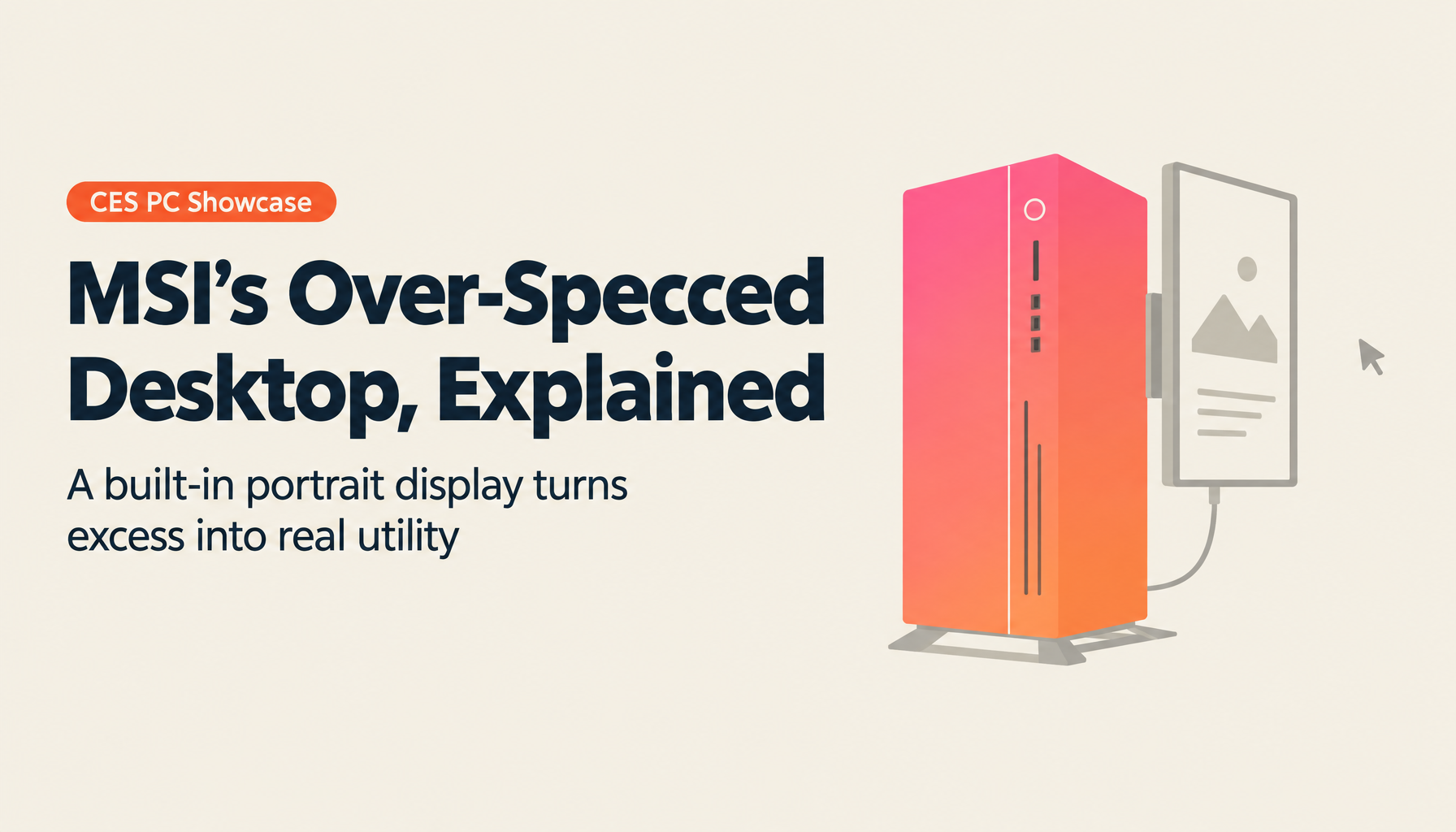
At CES, the premier technology event, MSI's gaming PC captured everyone's attention — going far beyond a high-performance machine to emerge as something that dramatically redefines the potential of the future desktop environment. We got a close look at the "Dragon" gaming laptop and the Meg Vision XAI, a genuine showcase of cutting-edge technology. An enormous external display — a 13-inch portrait-orientation screen mounted on the side of the PC case — whose sheer presence is overwhelming. But MSI gave this display not just aesthetic impact but genuine practicality, enabling its use as a second monitor. The hardware packed inside defies conventional description: an RTX 5090 GPU, a Core Ultra 9 285K CPU, gaming keyboard and mouse integrated right into the unit. The system crams in internal circuitry, abundant USB ports, analog audio jacks, Thunderbolt and Type-C connections, and every conceivable feature into a single chassis — massively over-specced, yet packed with genuinely usable functionality. The newly introduced dashboard feature allows CPU temperature, individual fan speeds, and scene-based mode switching to be handled from a simple graphical interface with zero friction.
This article delivers a comprehensive look at MSI's latest PC and external-display-equipped system in detail. We unpack the appeal of technological evolution and how "over-spec you can actually use" delivers surprise and convenience to everyday users.
- MSI's Vision of the Future Desktop — Where Design Meets Over-Spec
- Innovative Dashboard and Multi-Display Experience — The Appeal of Touch Controls and Scene Modes
- The Aesthetics of Over-Spec and User Experience — What MSI's Challenge Tells Us About the Future
- Summary
Take AI-driven development all the way to production
WARP is a hands-on program for teams who want more than headlines. Former enterprise DX and data strategy leads work alongside you until it runs.
MSI's Vision of the Future Desktop — Where Design Meets Over-Spec
MSI's newly announced system has stunned the world by transcending the frame of a conventional PC unit to become a device that delivers an "experience." Right off the bat, the exterior approach is strikingly bold. The approximately 13-inch portrait display mounted on the side of the PC case is a design move so audacious that it would be inconceivable in a standard gaming PC, and it's been the talk of gamers and enthusiasts everywhere. Known as the Meg Vision XAI, this external display is not mere decoration — it actually functions as a second monitor, presenting information in dashboard format based on system status and user actions. For instance, the ability to visualize CPU temperature, fan speeds, and power consumption — data usually buried in BIOS or dedicated software — in real time will be a fresh and innovative experience for many users.
The PC is equipped with the latest GPU, the RTX 5090, whose performance is expected to push monitor and gaming environments to their absolute limits. The interior features a staggering array of cabling: PCIe cables, power cables, USB ports, analog audio jacks, Thunderbolt and Type-C connectors in abundance. All designed so users can connect peripherals with complete freedom — and the traditional "MSI Dragon" essence is alive and well. Multiple dragon motifs are scattered throughout the PC case interior, with light choreography that makes it feel like a living work of art. This is not just a gaming machine — it's a symbol that reflects the user's lifestyle and individuality.
The most noteworthy aspect of this system is not merely its high-spec component list, but its delivery of comfortable operability and visual enjoyment to users. The dashboard displays at a glance the status of each PC component — temperature, fan speed — enabling intuitive system status awareness. The display also functions as a touchscreen, allowing users to interact with it directly — usable as a toolbar for applications and software. This interface is designed to eliminate the hassle of digging through cluttered menus, combining speed and intuitiveness of operation.
Beyond internal specs, the external design also holds much to admire. Large glass panels on the side of the PC case let users fully appreciate the beauty of the components and attention to detail. Users will also be charmed by the small accessories: a microfiber cloth for maintenance, parts installation, and internal cleaning. Cables and various switches within the case are positioned for maximum usability while also being intentionally visible — giving users the reassurance and pride of knowing "this PC is the real deal."
The system's thermal design is also highly ingenious. Abundant ventilation and an independent fan control system ensure heat doesn't accumulate even at high performance, making it easy to switch between silent and gaming modes. When users want to work in a quiet environment, they can manually reduce fan speed with a switch; during gaming or intensive workloads, the system instantly spins up to full performance and cooling capacity. This level of attention to user experience elevates MSI's approach from a spec sheet exercise to a genuine commitment to making advanced technology translate to real-world feel.
The system's key highlights can be summarized as follows:
- Overwhelming processing performance via the latest RTX 5090 GPU and Core Ultra 9 285K CPU
- 13-inch portrait display mountable as a second monitor
- Advanced dashboard for real-time system status monitoring
- Rich I/O: USB, Thunderbolt, Type-C, and more
- Cooling system switchable instantly between silent and gaming modes
These elements combine to realize a new type of desktop environment that is in a category of its own compared to conventional PC cases and gaming machines. The placement and appearance of each component isn't mere decoration — it's designed so users constantly feel the benefit of cutting-edge technology while customizing their workspace with personality. Overall, this MSI system demonstrates a level of technical and aesthetic achievement befitting the title of "PC of the future," with careful thought and attention to detail evident throughout. And this fusion is precisely what creates the new category of "over-spec you can actually use" — offering flexible customization aligned to user needs, striking visual impact, and outstanding performance all in one.
Innovative Dashboard and Multi-Display Experience — Touch Controls and Scene Modes
Within MSI's latest system, the standout feature is its proprietary dashboard. The large touchscreen built into the PC allows users to instantly grasp system status — but its design goes further, delivering immediate access to needed information at any moment. The display shows CPU and GPU operating temperatures, fan speeds, and power consumption — information usually checked via BIOS or dedicated software — in graphical format, making performance management intuitive. And because the screen is touch-capable, users can directly interact with their hands to switch settings and modes smoothly. Preset modes — gaming mode, working mode, meeting mode, entertainment mode — are available for different scenarios, switchable in an instant to match the situation.
MSI's dashboard is also designed with visual beauty in mind: RGB lighting animations synchronize beautifully with the illumination of internal components. The result is an entire room bathed in fantastical lighting that feels like a time slip to the future. In meeting mode, for example, the screen displays a sophisticated, dim gradient that creates a calm, business-appropriate atmosphere. In gaming mode, vivid and dynamic lighting patterns switch rapidly, producing a design that brings focus and excitement to the player.
A feature of this dashboard that feels genuinely innovative — unlike conventional PC management software — is the ability to change settings directly at hand. Many users previously checked performance metrics and temperature data through separate monitoring applications. MSI's system consolidates all of that on a single screen, dramatically improving convenience while offering the flexibility to easily realize each user's vision of their "personal PC environment." Users can change screen themes and customize lighting effects as desired — choosing, say, colorful lights streaming across a dark background, or a simple design with soft gradients. These features provide constant freshness and surprise to the user's desktop, as if the PC itself were a work of art.
The touchscreen also serves as an active operational tool, not just an information display. Application software toolbars and shortcuts can be easily placed on it, providing immediate access to needed functions in Photoshop or intensive editing software — a major advantage. For users who find mouse operation alone insufficient, the ability to directly touch and interact with the screen is a significant step forward, and speaks to how next-generation PC experiences are being designed with the user at the center. Live demonstrations showed users drag-and-dropping to rearrange icons within software, and pausing animations to check the current system state as a still image — proving the high operability of the interface.
Additionally, the dashboard is driven by integrated graphics rather than the discrete GPU — meaning it operates independently at all times without occupying the resources of high-performance graphics cards like the RTX 5090. This allows users to work and game simultaneously on separate screens without degrading normal display output. For users managing multiple windows and applications while simultaneously monitoring system status, this multi-display experience is highly effective in enabling comfortable multitasking.
Equally noteworthy is the flexibility of instant mode switching via the built-in dashboard. When a user wants to shift from hours of gaming directly into work mode, or change modes just before entering a video meeting, a single tap of a preset button on screen instantly sets up the optimal environment. These switches go beyond mere visual changes — fan speeds and power supply adjustments are optimized at the system level too, resulting in a low-stress operating feel. This distinguishes the feature clearly from mere decorative lighting, directly connected to actual performance enhancement and safety maintenance.
Overall, the dashboard and multi-display experience MSI is proposing is not simply a decorative upgrade. It is the embodiment of what a truly future-ready PC looks like — an environment that can be instantly adjusted to match the many scenarios users face: gaming, creative editing work, business meetings. This collection of innovative features gives users the convenience and multi-functionality of what feels like multiple specialized modules integrated into a single machine — and it will undoubtedly become a major force in pushing the standard of future PC design upward.
The Aesthetics of Over-Spec and User Experience — What MSI's Challenge Tells Us
MSI's latest system goes beyond being a mere high-performance machine to embody what might be called the "aesthetics of over-spec" — a major project that represents contemporary technology at its finest. The ultimate specs housed within — Core Ultra 9 285K and RTX 5090 at the head, the abundant cables throughout the case, the dragon motif extending to every corner of the design — appeal strongly to users' sense of ownership and pride, not merely performance enhancement. Opening the case, you encounter the fresh scent of factory-new components alongside countless small details of care. Extra PCIe cables, power cables, spare screws, and tools are provided — every component is generously supported for long-term, worry-free use.
MSI also pursues flexible customizability in this system, adapted to each user's usage scenario. The internal LED lighting — CPU, RAM, fans, GPU, and even the CPU cooler all synchronized — shifts with every interaction, giving the impression of a living machine breathing. Users can leverage default presets and provided themes to build their own "personal" environment, experiencing improved work efficiency and focus alongside the visual changes each mode brings. Gamers praise the system's ability to automatically switch to "gaming mode" for full focus during play, and there is equal value in the smooth transition to classic meeting mode during conferences or office work.
Behind the development of this system is MSI's persistent pursuit of "user-centered design" — a philosophy of improving the quality of user experience, not just upgrading specifications. The internal component layout, cable management, and implementation of a practical yet beautiful interface are the result of years of trial and error by engineers. And the product that emerged from this process — optimized for every scene while housed in a single unit — is rightfully called the "desktop of the future."
Furthermore, MSI's challenge proposes a new value system: the concept of "over-spec you can actually use." Rather than stopping at making a high-performance CPU and GPU the conversation topic, this system converts that power into adjustment functionality adapted to real user interactions and environments, making over-spec an element that elevates the entire experience. This enables a wide range of users — dedicated gamers, businesspeople, video editors, and designers — to enjoy an optimized environment tailored to themselves, all from the same single machine. Each time users engage with this system, they will be stunned by the flamboyant internal LED lighting, the interface animations, the array of ports and expandability — truly overwhelmed by both the evolution of technology and its aesthetic dimension.
MSI's challenge also breaks new ground in the fusion of software and hardware as a new domain. The way the entire system operates autonomously as a single "smart device" through the dedicated dashboard is a potential guiding light for future PC design. The development team has built in mechanisms for intuitive feedback even for unintended user actions — making it easier to handle errors and issues, providing peace of mind in everyday use. Users feel as if the system itself is alive in their interactions, discovering something new and surprising each time they engage.
In this way, the "aesthetics of over-spec" that MSI is proposing is not merely a product that stuffs in the latest technology — it is an entirely new PC experience in itself, offering flexibility and operability adapted to each user's usage scenario. And this challenge will not only influence the entire PC market going forward and intensify competition among manufacturers — it will serve as a sure guide for each individual user to build their own ideal desktop environment. MSI's product this time is not confined to the frame of a mere high-spec machine — it is a revolutionary product with the potential to fundamentally transform future life and creative work.
Summary
MSI's new system has shocked the market as a future-oriented PC that goes beyond sheer over-spec to combine improved user experience, beautiful design, and flexible customizability. The 13-inch touchscreen mounted on the exterior has arrived as an innovative tool that goes well beyond a simple second monitor — enabling intuitive use of diverse functions from system status management to mode switching. The overwhelming specs of the RTX 5090 and Core Ultra 9 285K deliver sufficient performance not just for gaming but for creative work and business applications, while the abundant I/O ports, internal LED lighting, and flexible cooling system switching ensure comfortable operability even under extreme conditions. Users can smoothly handle settings changes and feature checks through dashboard touch controls, realizing both work efficiency and a comfortable environment simultaneously. MSI's "over-spec you can actually use" has the potential not only to overturn conventional PC concepts but to become the new standard for future desktop environments. As products that balance technological innovation and a user-first perspective continue to emerge in the market, MSI's challenge will remain a major draw for users — bringing stimulation and convenience to everyday life and creative work.
Reference: https://www.youtube.com/watch?v=1ZFlsDXiynM
TIMEWELL AI Consulting
TIMEWELL is a professional team supporting business transformation in the AI agent era.
Services
- AI agent implementation support: Business automation leveraging GPT-5, Claude Opus 4.5, and Gemini
- GEO strategy consulting: Content marketing strategy for the AI search era
- DX advancement and new business development: Business model transformation using AI
In 2026, AI is moving from "something you use" to "something you work alongside." Let's think through your AI strategy together.