This is Hamamoto from TIMEWELL
This is Hamamoto from TIMEWELL.
Looking for AI training and consulting?
Learn about WARP training programs and consulting services in our materials.
CES 2025, Held in Las Vegas on January 6, 2025
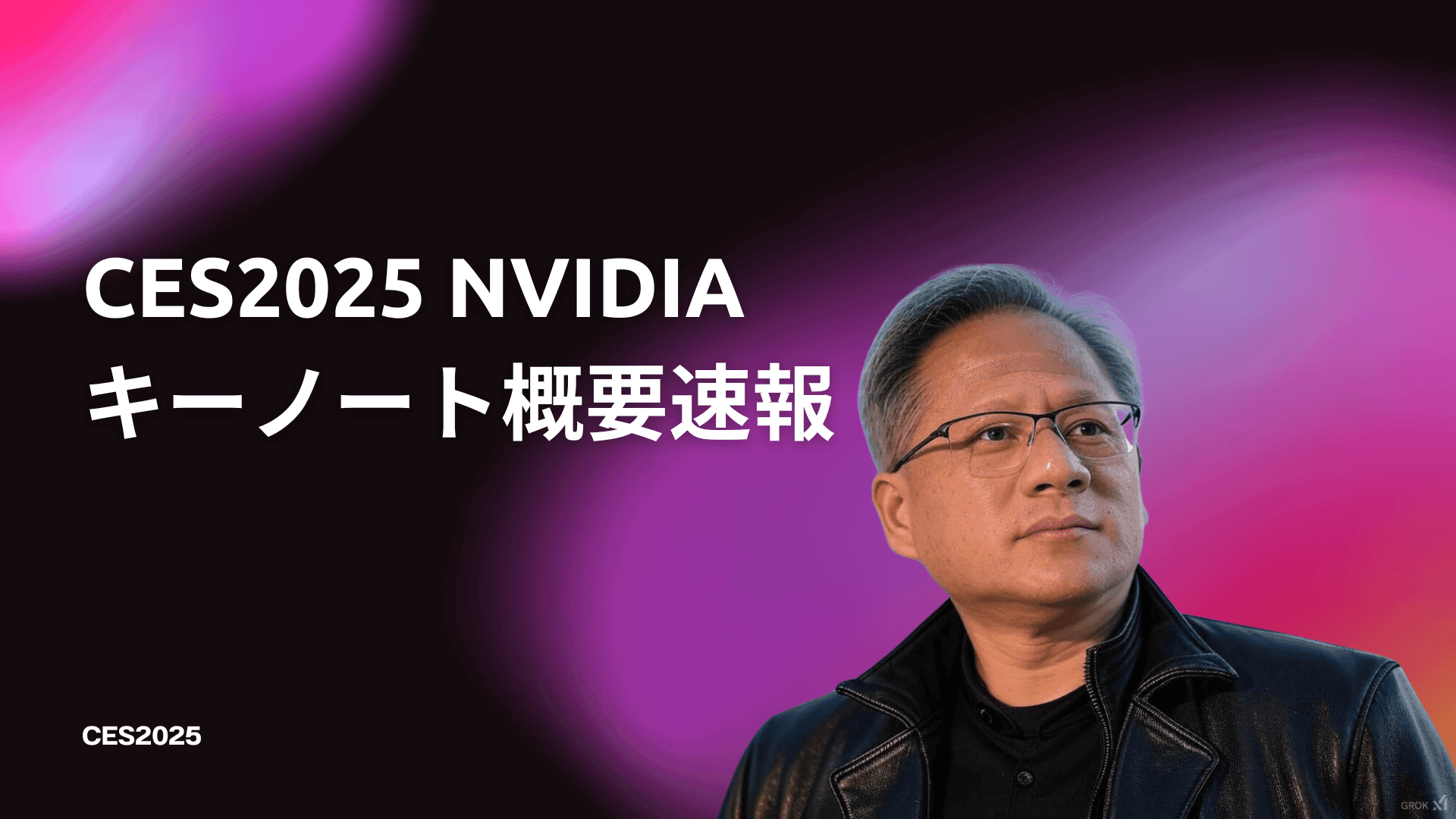
CES 2025 opened in Las Vegas on January 6, 2025—and once again, NVIDIA CEO Jensen Huang took the stage for his keynote to kick things off.
This annual event has become must-watch for everyone from PC gamers to AI researchers. This year delivered exactly what the audience expected: a relentless stream of groundbreaking announcements.
Huang spoke passionately about revolutionary advances in AI, accelerated computing, and industrial digitization, all of which are transforming every sector. He emphasized that generative AI is ushering in "a new era of computing," and explained how NVIDIA's latest technologies are accelerating that evolution.
Here's a detailed look at the announcements.
- The GeForce RTX 50 Series Has Arrived
The latest generation of gaming GPUs, the GeForce RTX 50 Series, has finally been announced. Built on the Blackwell architecture, it delivers a massive performance leap over the previous Ada Lovelace generation.
The RTX 5090 delivers 2.6x the performance of the RTX 4090. It features 32GB of GDDR7 memory and a staggering memory bandwidth of 1,792 GB/s.
The RTX 5080 comes with 16GB of GDDR7 memory and matches the performance of the RTX 4090.
The RTX 5070 Ti
The RTX 5070 Ti packs 16GB of GDDR7 memory and surpasses the RTX 4080.
The RTX 5070 comes with 12GB of GDDR7 memory, significantly outperforms the RTX 4070 Ti, and is priced at 108,800 yen—offering impressive value for money.
All models ship with DLSS 4, enabling smoother gameplay through AI-powered frame generation. The fifth-generation Tensor Cores and fourth-generation RT Cores also bring substantial improvements to AI processing and ray tracing performance.
Alongside the RTX 50 Series announcement, NVIDIA also revealed slim, lightweight gaming laptops built with Max-Q technology.
At just 19mm thick and under 2kg, they deliver the full performance of the RTX 50 Series.
Equipped with a 120Hz high-refresh-rate display for smooth gameplay.
Long battery life for comfortable gaming on the go.
These laptops strike a balance between portability and high performance, giving gamers a compelling new option.
Huang Emphasized That Generative AI Is Revolutionizing
Huang emphasized that generative AI is revolutionizing content creation, drug discovery, marketing, and more. He demonstrated how NVIDIA's GPUs are accelerating AI development across these fields.
NVIDIA Picasso: A cloud-based generative AI service capable of generating images, video, and 3D models from text.
NVIDIA BioNeMo: A generative AI cloud service for drug discovery, applicable to protein structure prediction and drug design.
These services leverage NVIDIA's GPU and AI technologies to generate high-quality content at speed.
- Toyota's Next-Generation Vehicles to Feature DRIVE AGX Orin
AI in the automotive sector also drew significant attention. Huang announced that Toyota's next-generation high-performance vehicles will be equipped with NVIDIA's DRIVE AGX Orin SoC.
DRIVE AGX Orin is a system-on-chip that provides the high-performance computing power needed for autonomous driving systems. This partnership is expected to enable advanced autonomous driving capabilities in Toyota's next-generation vehicles.
This collaboration underscores the growing importance of AI in the automotive industry and will likely have a major impact on the future development of self-driving technology.
5. The Evolution of the Industrial Metaverse: Omniverse
- The Evolution of the Industrial Metaverse: Omniverse
NVIDIA's industrial metaverse platform, Omniverse, continues to evolve.
Omniverse Cloud: A cloud-based platform enabling access to Omniverse from anywhere.
Omniverse Avatar Cloud Engine (ACE): A tool for easily creating interactive AI avatars.
These updates make Omniverse an even more powerful and accessible tool. Expect broad adoption in manufacturing, architecture, engineering, and more.
Huang highlighted the importance of AI- and CUDA-powered data processing pipelines in an era of massive data volumes. The NVIDIA Grace Hopper Superchip combines CPU and GPU via high-speed NVLink to accelerate large-scale data processing.
This technology will bring breakthroughs to fields that handle vast amounts of data, including data centers and AI research.
- "Eos" Becomes the World's Fastest AI Supercomputer
And the Final Announcement
The final announcement was "Eos," a new AI supercomputer built by NVIDIA. It reportedly surpasses Japan's Fugaku supercomputer in performance, claiming the title of the world's fastest AI supercomputer.
Eos is composed of 4,608 NVIDIA DGX H100 systems and delivers 18.4 exaflops of AI computing performance. This extraordinary computational power will be applied in drug discovery, climate change research, large language model development, and more.
Jensen Huang's keynote once again made clear that AI is evolving across every domain and having a profound impact on our lives.
The arrival of the GeForce RTX 50 Series will elevate the gaming experience even further. And the applications of AI—from generative AI to autonomous driving to industrial metaverse—continue to expand. The arrival of Eos will accelerate progress in AI research.
NVIDIA will continue to lead the evolution of AI technology and bring innovation to a wide range of fields. There is certainly no shortage of developments to watch.
Related Articles
- From Full-Time to Part-Time: Life After Two Maternity Leaves and How My View of Work Changed | TIMEWELL
- Before Paternity Leave (Part 2): Three Things You Absolutely Must Do to Take Leave During Busy Season
- Staying True to the Field: How the 5th-Generation Head of a Construction Firm Found His Own Way | Fujita Construction