Hello, this is Ryuta Hamamoto from TIMEWELL.
This one is for you if you buy parts, materials or machinery from China, run a plant or subsidiary there, or resell Chinese-made goods into third countries such as Southeast Asia. If your business touches construction equipment, dredging (removing silt and sand from harbor and river beds) or drones, please read it closely.
In one line: China has rewritten its list of goods that need a government license to export. It redrew the drone threshold, which takes some airframes out of scope, and it added tunnel boring machines, dredger parts and other items.
Why now? China's Ministry of Commerce (MOFCOM) has published the Dual-Use Items Export Control List of the People's Republic of China (《中华人民共和国两用物项出口管制清单》, liangyong wuxiang chukou guanzhi qingdan) in a version that reflects amendments through November 18, 2026. The original says "更新至2026年11月18日," updated to November 18, 20261. A trade newspaper reported that MOFCOM posted it on its website on November 182. On the same day, three announcements issued on October 19 took effect345. So from this month on, a Chinese supplier may tell you that an item now needs a license, or that a shipment is being held at customs.
I could not confirm an official English title from MOFCOM, so the English names in this article are my own renderings. I call the document "the Dual-Use List" and give the Chinese name the first time each document appears.
Background reading. The overall structure of China's Export Control Law and the Dual-Use Items Export Control Regulations is in China's export control legal framework. The table that ties items to customs codes (the Catalogue) is in the 2026 Import/Export License Management Catalogue. This article sits between the two and deals with the Dual-Use List itself.
The short version
- The Dual-Use List decides what counts as a controlled item. It is a different document from the customs-code table (the Catalogue) and from the lists of restricted parties (the mingdan)
- The November 18 version has 205 control codes, a net increase of 32 from 173 in the first version of November 2024 (our count). Most of the new codes are ones the List attributes to "other national security" reasons
- New entries include three kinds of construction machinery, such as shield tunneling machines, with their parts and technology, plus dredge pumps and related parts. For drones, the airframe threshold went up, which takes some aircraft out of scope, while motors, propellers and other components went in
- For a company that buys from China, three things come first: confirm the control code of what you buy, build possible customs holds into lead times, and keep a record of where China-origin goods end up when you move them to a third country
Here are the terms I use throughout.
| Term | In one line |
|---|---|
| Dual-use items (两用物项) | Goods, software and technology with both civilian and military uses. The same concept as dual-use items under the EAR or the EU regime |
| Dual-Use List (清单, qingdan) | The list of dual-use items that need an export license. This is the document that was updated |
| Catalogue (目录, mulu) | A table that maps List items to China's 10-digit customs commodity codes. In recent years the next year's edition has come out at the end of December |
| Party lists (名单, mingdan) | Lists of counterparties subject to restrictions, such as the Control List (管控名单) and the Watch List (关注名单). They list parties, not goods |
| Control code (管制编码) | The five-character code on each List entry (for example, 2B906) |
| Export certificate (出口凭证) | Proof of export obtained through registration and filing instead of a license. Available for some items |
| Inquiry and identification (质疑、鉴别) | Customs asks whether goods might be controlled (inquiry), and MOFCOM has experts determine it (identification) |
If you work under the EAR, a rough mapping helps: the Dual-Use List does the job of the Commerce Control List (CCL), and the party lists do a job closer to the Entity List.
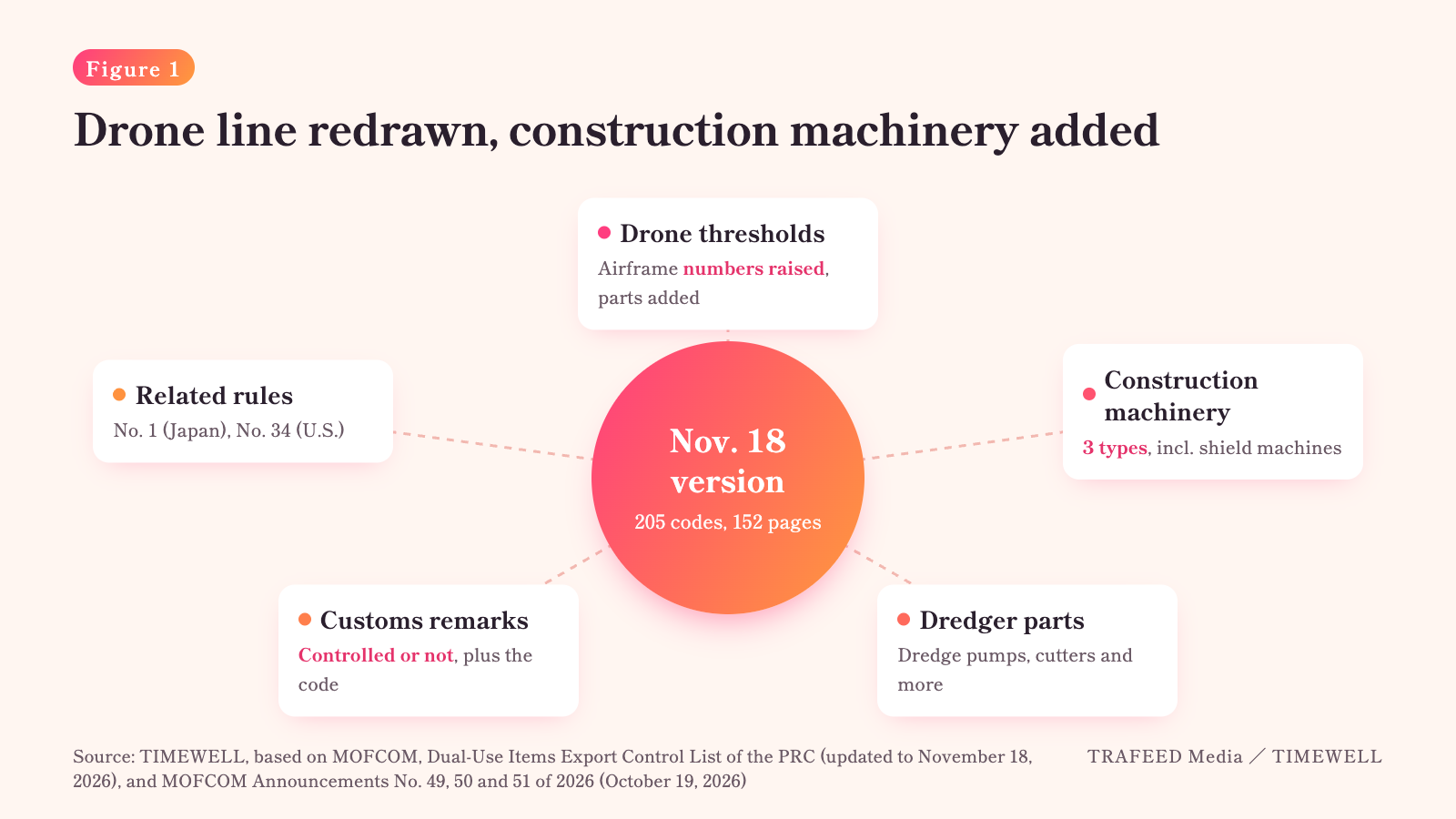 Figure 1. The five changes in the November 18 version. The center is this version, and the five around it are the changes that matter for companies sourcing from China. Source: TIMEWELL, based on MOFCOM, Dual-Use Items Export Control List of the People's Republic of China (updated to November 18, 2026), and MOFCOM Announcements No. 49, 50 and 51 of 2026
What the Dual-Use List is, and how to read its five-character codes
The Dual-Use List is China's list of goods that need a license to export, and every entry carries a five-character code. By the end of this section you should be able to look at a code and tell roughly what kind of item it is.
The legal basis is Article 9 of the Export Control Law, in force since December 1, 2020, and Article 11 of the Dual-Use Items Export Control Regulations (State Council Decree No. 792), in force since December 1, 2024. Both provide that MOFCOM, together with the relevant departments, formulates, adjusts and publishes the list67. The first version came out with MOFCOM Announcement No. 51 of 2024 on November 15, 2024, and took effect on December 1, the same day as the Regulations. The announcement was issued jointly by MOFCOM, the Ministry of Industry and Information Technology, the General Administration of Customs (GACC) and the State Cryptography Administration, and it repealed 11 older announcements on its effective date8. It pulled into one book the lists that used to be annexed to separate regulations and measures for the nuclear, missile, biological and chemical fields, along with more than ten announcements1.
The confusing part is that China's export controls have at least three things you could call a list. The Dual-Use List is the authoritative document on what is controlled. The Catalogue (《两用物项和技术进出口许可证管理目录》, Dual-Use Items and Technologies Import/Export License Management Catalogue) maps List items to 10-digit customs codes and is what customs officers work from. The party lists (名单) say who you face restrictions with. They include the Control List and the Watch List, and each announcement sets out what is prohibited or restricted. If a part is on the Dual-Use List, shipping it to any company in any country needs a license. Even when its customs code is missing from the Catalogue, a license is still needed if the part meets the List's specifications, as I explained in the Catalogue article. How to follow the party lists is covered in our weekly tracker of China's countermeasure lists.
Now the codes. Each entry has a five-character control code in the form "one digit, one capital letter, three digits"1. The first digit is the category, with ten categories from 0 to 9. The second character is the type of item: A for systems, equipment and components, B for test, inspection and production equipment, C for materials, D for software and E for technology. The third character gives the reason for control: 0 conventional weapons, 1 delivery systems for weapons of mass destruction (missiles, unmanned aerial vehicles and similar systems able to carry at least 500 kg over at least 300 km), 2 nuclear nonproliferation, 3 chemical and biological weapons, 4 monitored chemicals (chemicals monitored under the Chemical Weapons Convention), 5 temporary controls and 9 other national security.
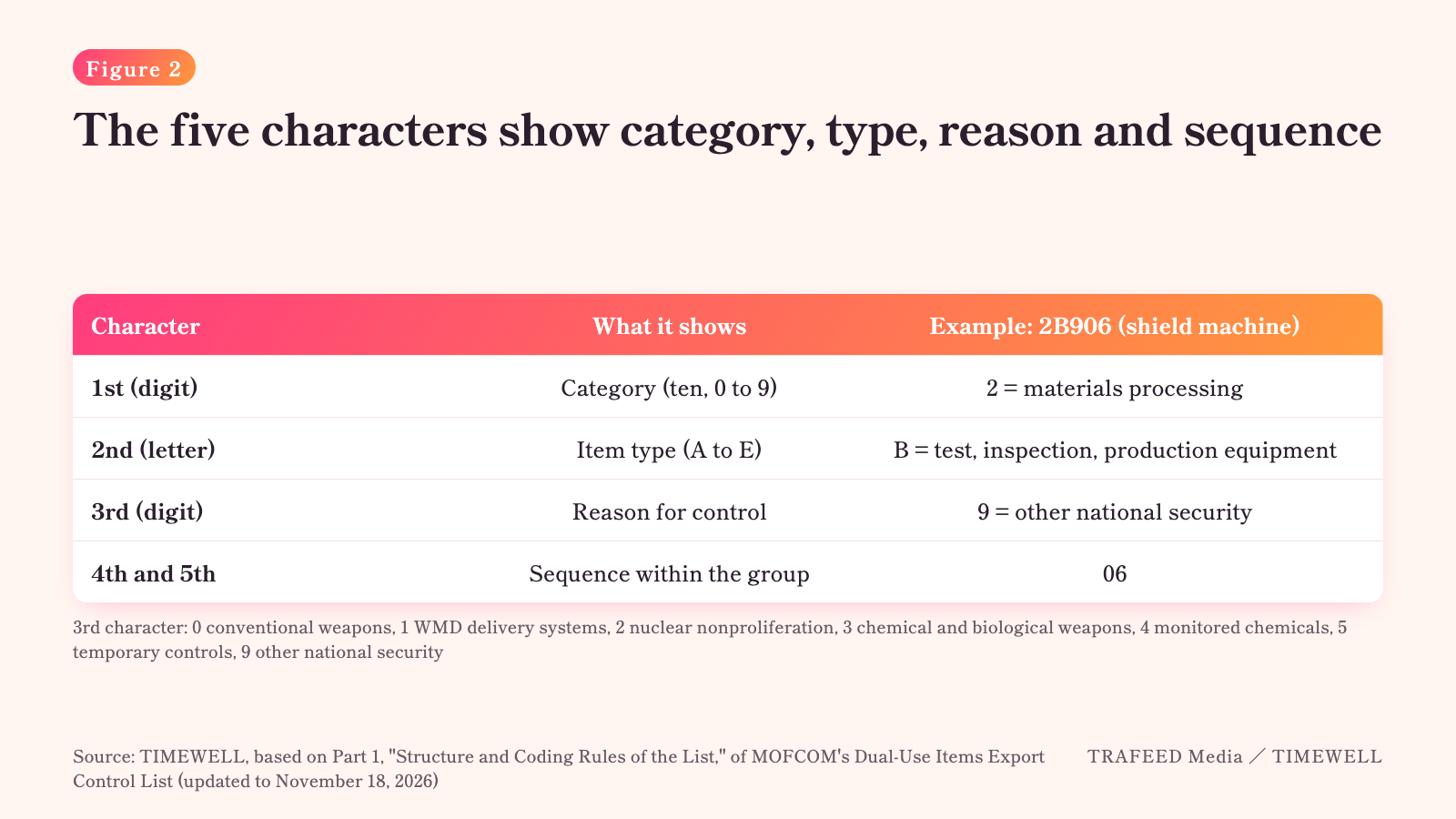 Figure 2. How to read 2B906, the code for shield tunneling machines. Reading one character at a time from the top tells you the field, the type of item and the reason it is controlled. Source: TIMEWELL, based on Part 1 of the List, "Structure and Coding Rules of the List" (清单结构和编码规则)
If you classify under the EAR, this will look familiar. An ECCN also takes the form digit, letter, three digits, and in an ECCN a third character of 0 means National Security, 1 Missile Technology, 2 Nuclear Nonproliferation and 3 Chemical and Biological9. Some codes are even identical. 1C351 covers human and animal pathogens in both systems, and 9A012 is unmanned aerial vehicles in both110.
The two systems part ways at the top end of the third character. Here they are side by side.
| Third character | China's control code | U.S. ECCN (15 CFR 738.2(d)(1), Table 1) |
|---|---|---|
| 0 | Conventional weapons | National Security (NS) |
| 1 | Delivery systems for weapons of mass destruction | Missile Technology (MT) |
| 2 | Nuclear nonproliferation | Nuclear Nonproliferation (NP) |
| 3 | Chemical and biological weapons | Chemical and Biological (CB) |
| 4 | Monitored chemicals | Not listed in Table 1 |
| 5 | Temporary controls | Firearms, "spacecraft" and related items (500 series) |
| 6 | Not used in the coding rules | Wassenaar Munitions List or former USML items (600 series) |
| 9 | Other national security | Plurilateral NS and Regional Stability (900 to 979); Crime Control and Short Supply (980 to 989); Anti-terrorism, RS and UN sanctions (990 to 999) |
Two things follow from this for anyone used to ECCNs19. A 9 in the third position does not mean the same thing. In an ECCN it points to plurilateral or unilateral controls such as AT, CC, RS or UN sanctions. In China's code it is a residual bucket for "other national security" reasons, and as the next section shows, it is where most of the recent growth has been. A 5 in China marks a temporary control, not a 500-series item.
So a Chinese code tells you whether an item sits in a field the multilateral regimes have debated for years, such as nuclear or missiles, or whether it was added on "other national security" grounds. The same code does not guarantee the same parameters, though. Always classify against the numbers in the List's text.
Replace siloed classification work with AI.
METI's FY2024 data shows 52% of foreign exchange law violations stem from classification errors. Download the TRAFEED product catalog covering features and rollout.
What changed in the November 18 version: 205 codes
By count, the List grew from 173 to 205 control codes in two years. The fastest growth is in codes whose third character is 9, "other national security."
I obtained the three versions MOFCOM has published and counted the code headings in each table of contents. The first version of November 2024 (138 pages) has 173, the version reflecting the 2025 additions (147 pages) has 189, and the November 18 version (152 pages) has 2051811. The second version is a file that replaced the attachment on the 2024 announcement page of MOFCOM's export control site, dated June 12, 2026. The file itself was created on December 31, 2025. It carries no "as of" date, so I treat it as the version that reflects additions made during 2025. Several items can sit under one code, so the code count is not the number of items. It is still a fair yardstick for how fast the List is expanding.
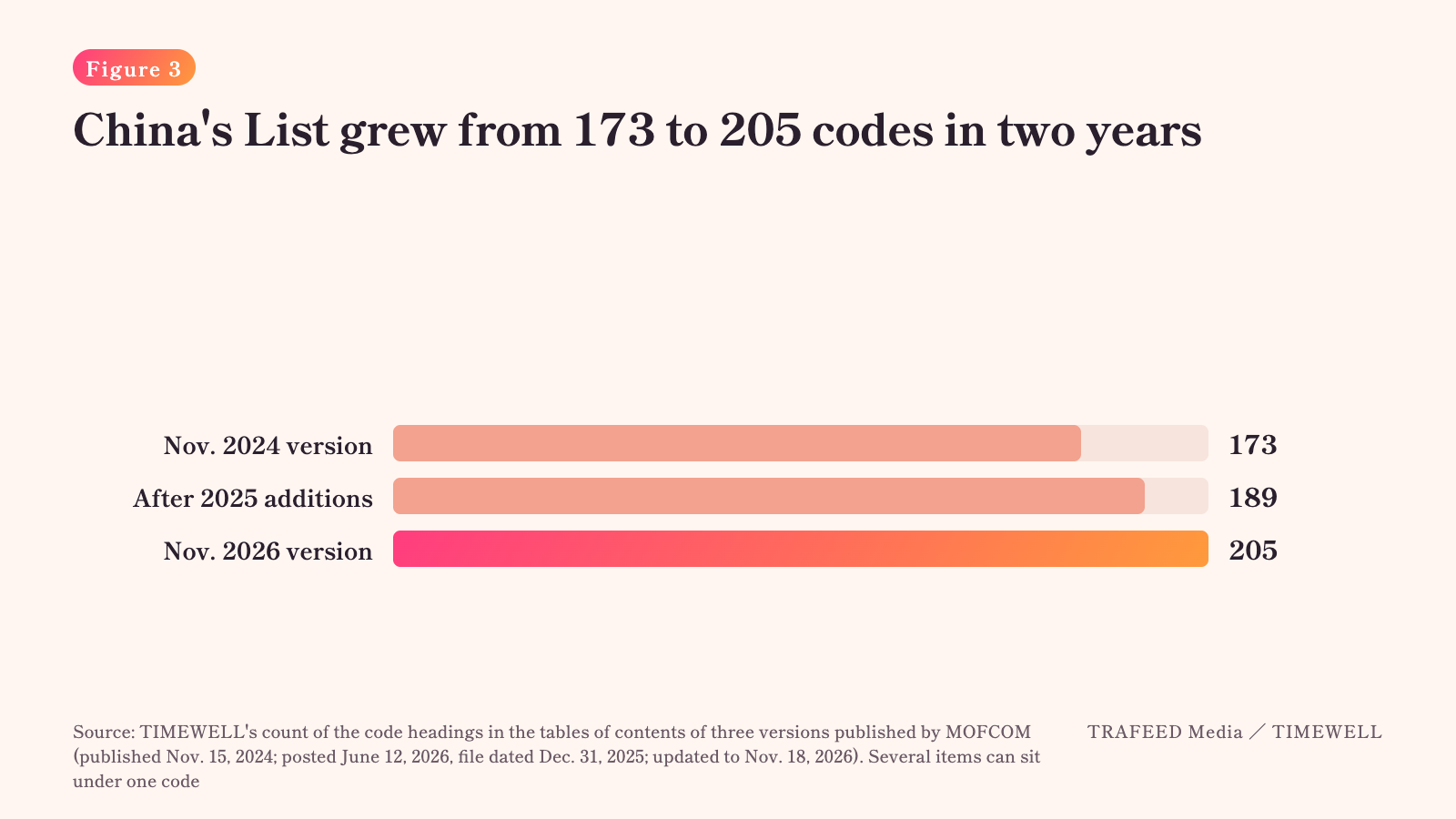 Figure 3. Number of control codes in the three versions. A longer bar means more codes. Source: TIMEWELL's count of the tables of contents of the three versions of the List published by MOFCOM
The 16 codes added in 2025 cover items related to tungsten, tellurium, bismuth, molybdenum and indium (MOFCOM and GACC Announcement No. 10 of 2025, February 4) and seven rare earth elements including samarium and yttrium (Announcement No. 18 of 2025, April 4)1213. The new version adds 17 codes and drops one. Eight of the additions are the three construction machines with their parts and technology, and seven are drone airframes, components, software and technology. One covers technology for drone autopilots and related items (7E103), and one covers technology for civilian counter-drone systems (0E903). The code that disappeared is 9A501, a temporary-control code whose content moved to 9A112. The October 2025 Announcements No. 55 to 58 (holmium and other rare earths) remain suspended until January 10, 2027 under Announcement No. 58 of 2026, and their items are not in this version either14. The background is in what to check after China's suspension deadlines.
What stands out is how fast the 9 codes are growing: 13 in the 2024 version, 20 after the 2025 additions and 35 now. In the List's explanation, reasons 0 to 4 relate to conventional weapons, delivery systems for weapons of mass destruction, nuclear, chemical and biological weapons, and monitored chemicals, while 9 relates to "other national security factors"1. The seven rare earth elements added in 2025 fall under 9, and so do this year's shield tunneling machines, dredger parts and drone components.
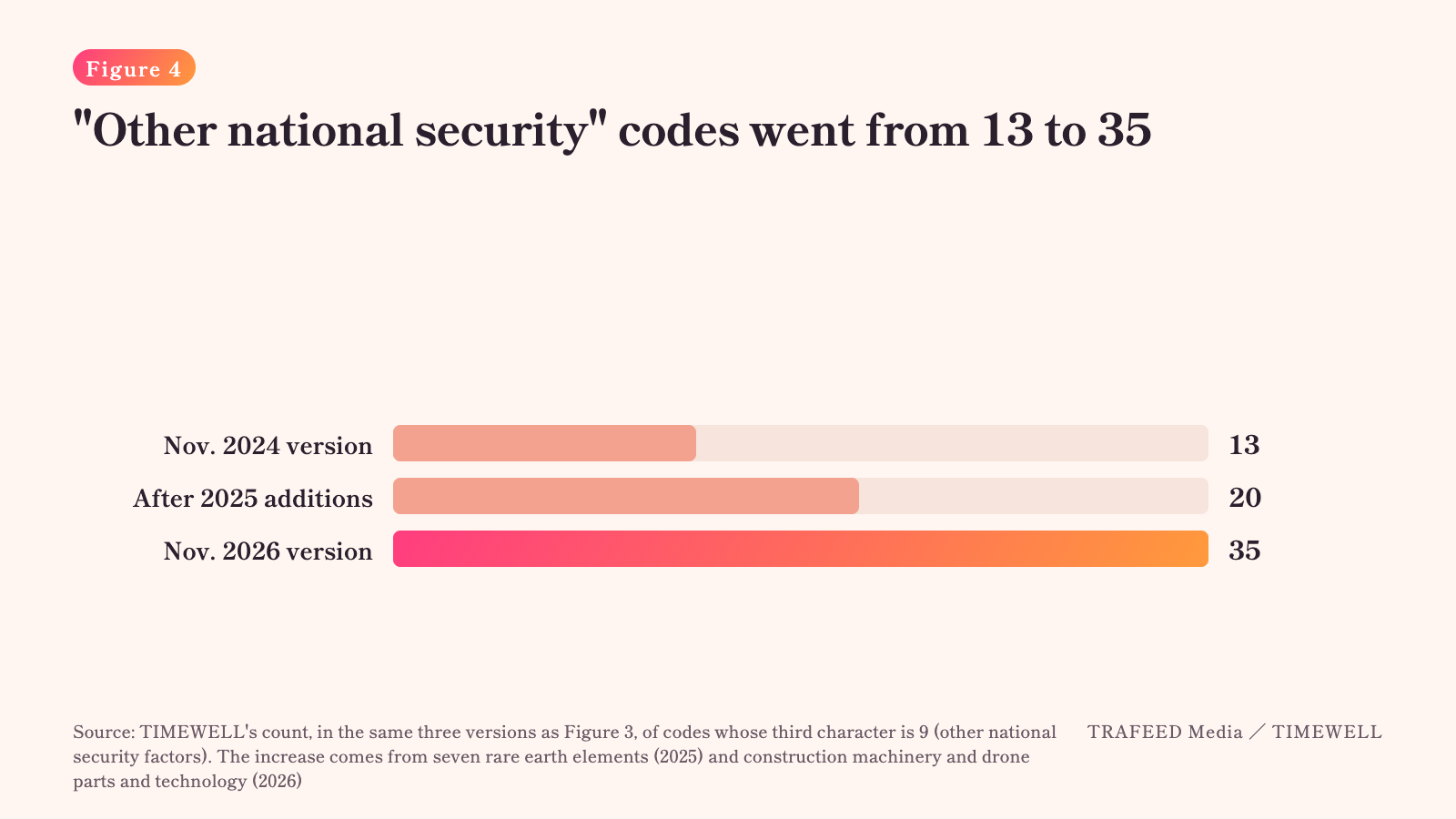 Figure 4. Number of codes with 9 as the third character. The count nearly tripled in two years. Source: TIMEWELL's count of the same three versions as in Figure 3
Here is how this looks from Japan, as one example. Items 2 to 15 of Appended Table 1 to Japan's Export Trade Control Order follow the international regimes for nuclear, chemical, biological, missile and conventional weapons (the structure is explained in the Appended Table 1 guide). When I checked Appended Table 1 as in force from October 16, 2026 on e-Gov, the item descriptions did not contain the Japanese words for boring (掘進), dredging (浚渫), tunnel or shovel15. Picture a construction-machinery part that your team has recorded as not listed under Japan's rules. Shipped out of China, that same part can be a controlled item that needs a license. In my view, this mismatch is the part of the update with the most practical bite.
The logic is not specific to Japan. An EAR99 determination in the United States, or a not-listed finding under Annex I of the EU Dual-Use Regulation, says nothing about how the same item is treated when it leaves China. Goods you buy from China, or make in a Chinese plant, need their own check against the codes on the Dual-Use List.
New items, and items whose thresholds went up
This section goes through the items that moved under the three announcements: drones first, then construction machinery, then dredgers. The main new codes are in the table.
| Code | Item | Main conditions (from the announcement text) |
|---|---|---|
| 2B906, 2A906, 2E906 | Shield tunneling machines and rock tunnel boring machines, parts such as cutterheads, and remanufacturing technology | Covered regardless of type, including earth pressure balance and slurry shield machines |
| 2B904, 2E904 | Walking excavators (diggers that move over rough terrain using legs and wheels) and their hydraulic control technology | Any one of: crossing vertical obstacles higher than 1.2 m, wading deeper than 1.5 m, and others |
| 2B903, 2A903, 2E903 | High-altitude wet shotcrete machines (which spray concrete) used 3,000 m or more above sea level, with parts and technology | All conditions met, such as engine power over 75 kW |
| 8A901.f | Dredge pumps, pump casings and impellers, dragheads and cutters | Suction inlet inner diameter of 0.55 m or more, and others |
| 9A901 | Drone motors, electronic speed controllers and carbon-fiber propeller blades | Rated voltage of 48 V or more and rated power of 3 kW or more, and others |
| 9A112 | Drones with a range of 300 km or more, or with spraying systems of more than 80 L | Previously 9A501, with sprayers of 20 L or more |
For drones, some airframes leave scope while new components come in. Announcement No. 49 of 2026, issued by MOFCOM, GACC and the Equipment Development Department of the Central Military Commission, covers drones that can be flown under control beyond the operator's visual line of sight (9A012.a) if their endurance (how long they can stay airborne) is three hours or more. It also covers those with endurance of at least 30 minutes but under three hours if they can take off and fly stably in gusts of 46.3 km/h (25 knots) or more3. In the previous version, the line was one hour11.
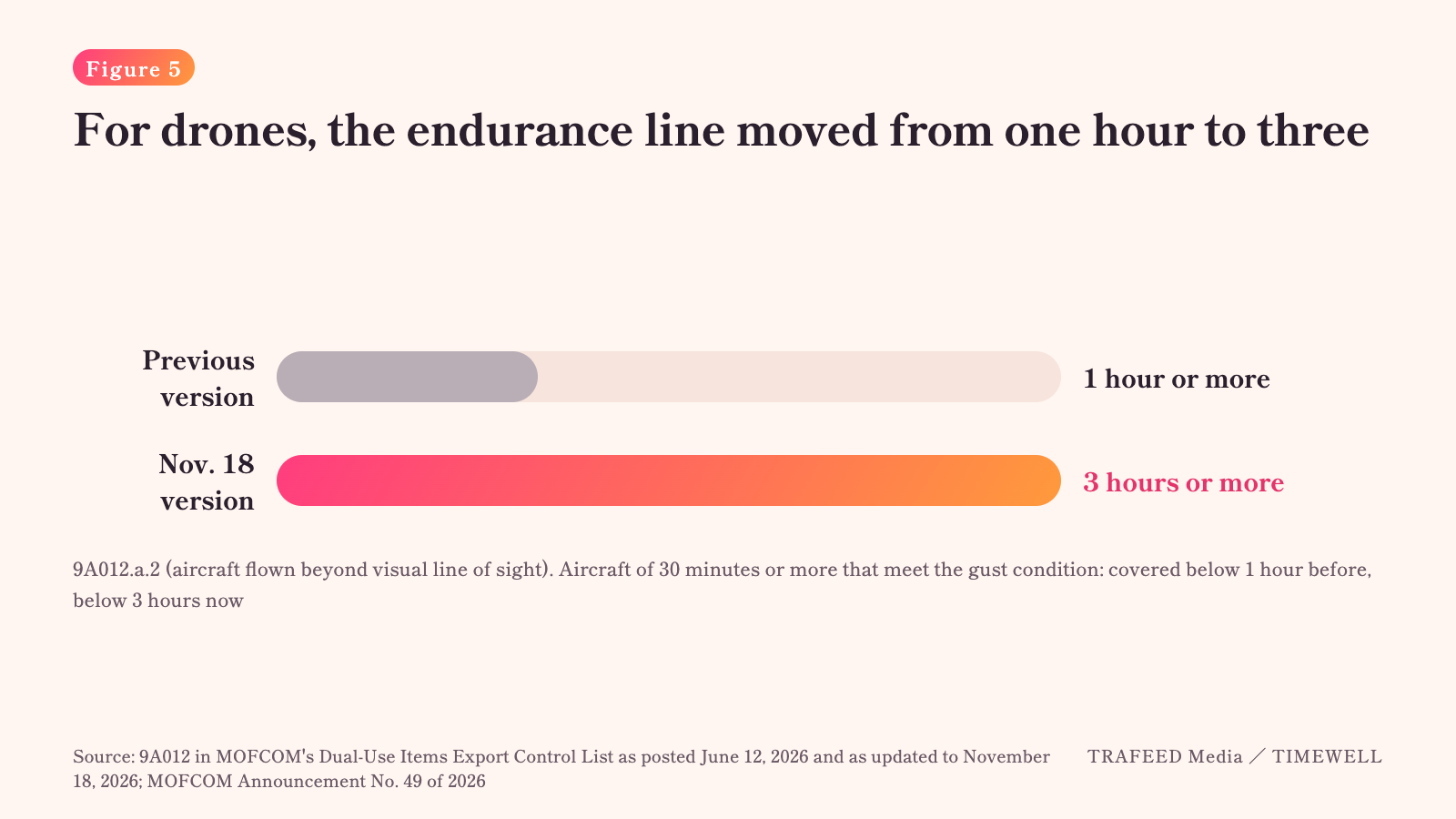 Figure 5. The endurance line for coverage without the gust condition. A longer bar means an aircraft has to fly longer before it is covered, so scope narrowed. Source: 9A012 in the version of the List posted on June 12, 2026 and in the version updated to November 18, 2026; MOFCOM Announcement No. 49 of 2026
MOFCOM's spokesperson said some products that were once advanced have since become mass-market consumer goods, and that the review drew on the latest industry and technology situation reported by industry16. At the same time, the announcement adds brushless motors specially designed for drone propellers, meeting all of these: rated voltage of 48 V or more, rated power of 3 kW or more, power density of 3 kW/kg or more and rated speed of 3,000 rpm or less. The matching electronic speed controllers and carbon-fiber propeller blades come in under the same code (9A901), and technology for flight control, autonomous navigation, detect-and-avoid and similar functions comes in under 9E9013. Say your company buys motors for large agricultural drones from a Chinese plant. Even if the airframe has dropped out of scope, you still need to check whether the motor specs hit 9A901.
U.S. importers should watch one more link. For exports to the United States, MOFCOM Announcement No. 34 of 2026 says exports of List-controlled drones and their key components and technology will be reviewed strictly case by case and will not get facilitation measures. When the List's thresholds move, the reach of that announcement moves with them17.
The spraying drones that sat under 9A501 in the previous version moved to 9A112, and the sprayer capacity line went up from 20 L or more to more than 80 L. The third character changed from 5 (temporary control) to 1 (delivery systems for weapons of mass destruction). Article 12 of the Regulations limits each temporary control to two years at a time and says that items needing longer control should go onto the List7. I read the move as following that mechanism. MOFCOM has not explained it, so this is my own reading. The previous 9A501 also carried a note saying that drones not on the List still cannot be exported if the exporter knows they will be used for weapons of mass destruction or military purposes. I could not find that note under 9A112 in the November 18 version111. The general rule is still there, though: Article 12(3) of the Export Control Law requires a license for items off the List when the exporter knows of such uses6.
Construction machinery came in under MOFCOM and GACC Announcement No. 50 of 20264. What matters most here is that treatment depends on the destination. The announcement requires a license for exports to "sensitive countries and regions that have disputes with China" (与中国存在争议的敏感国家和地区). Exports to all other countries and regions can go ahead on an export certificate obtained by registration. In that case, the exporter and the end user must undertake not to transfer the items to those countries or regions without a license. The announcement adds that organizations and individuals outside China must not, without a license, transfer or provide China-origin items of this kind to those countries or regions. It does not say which countries and regions it means. MOFCOM's spokesperson said that countries and regions with which China has export control dialogue mechanisms were notified in advance18.
For dredgers, the vessels themselves were already covered under 8A901: trailing suction hopper, cutter suction and other types above set levels of hopper capacity or dredging depth. Announcement No. 51 of 2026 adds parts under 8A901.f, namely dredge pumps with their casings and impellers, dragheads and cutters, and these need a license whatever the destination5.
So the three moved in three different ways. Drones were loosened at the airframe and tightened at the component and technology level. Construction machinery is split by destination. Dredger controls were extended down to parts. The List itself says nothing about destination-based treatment or the registration facilitation, so always read the List and the announcements together.
What it means in practice: sourcing, China subsidiaries and third-country transfers
The effect on companies outside China is easiest to sort into three situations: buying from China, a China subsidiary exporting, and moving China-origin goods on to a third country. I use Japanese companies as the example because that is the market I work in every day, but the same structure applies to a U.S., European or Taiwanese buyer.
The first is buying parts or machinery from China. Your Chinese supplier needs a MOFCOM license or an export certificate every time it ships a List item. Announcements No. 50 and No. 51 require the exporter to write "belongs to dual-use items" (属于两用物项) and the control code in the remarks field of the customs declaration. Where an item's parameters are close but it is not controlled, the exporter writes "not a controlled item" (不属于管制物项) and the specific parameters45. If customs has doubts, it opens an inquiry, which follows the procedure in Announcement No. 52 of 202619.
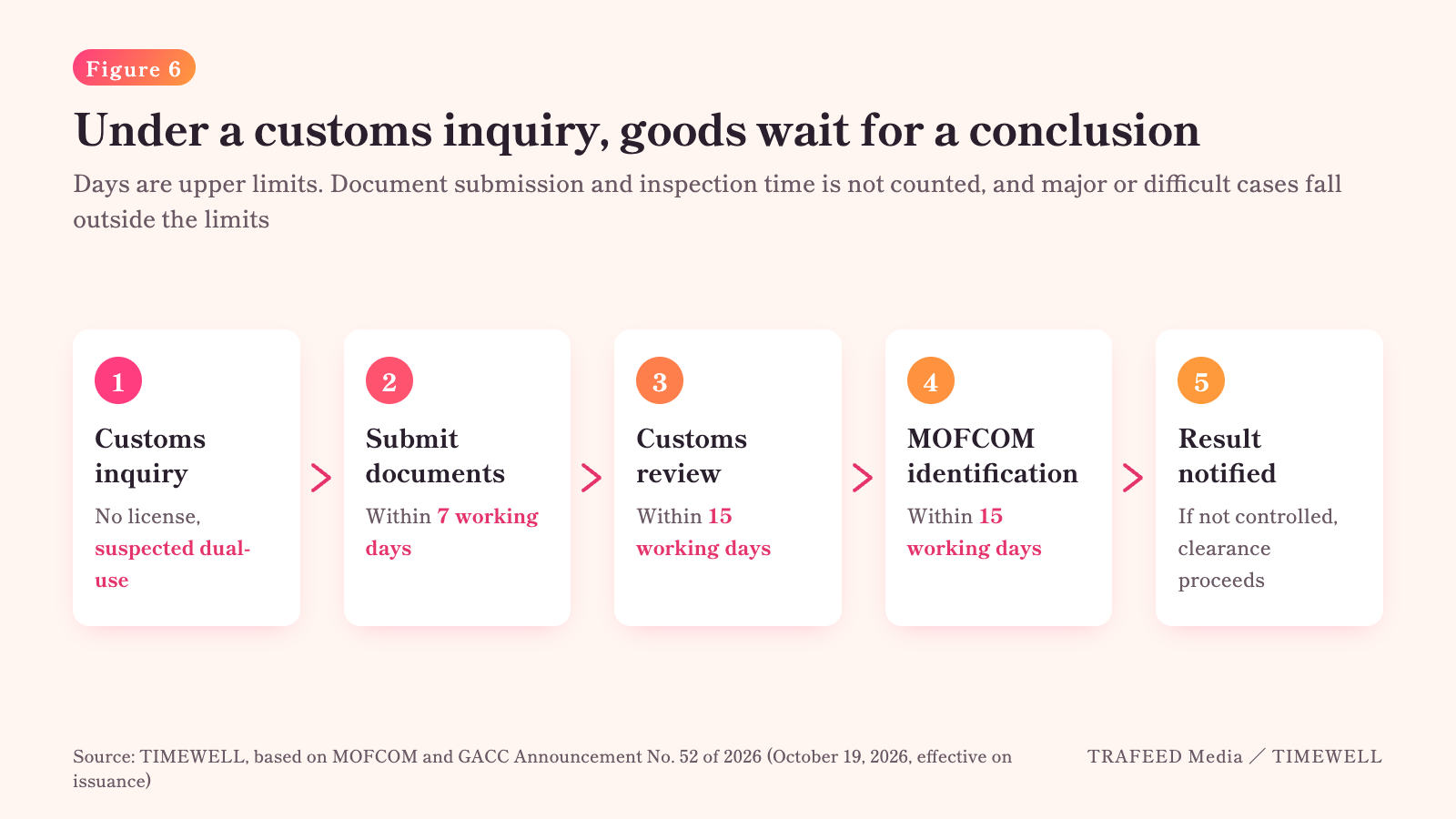 Figure 6. From inquiry to notice of the result. The process runs left to right, and at no stage can the goods leave until there is a conclusion. Source: MOFCOM and GACC Announcement No. 52 of 2026
Under No. 52, the exporter submits contracts, invoices, technical documents and the like within 7 working days of being notified, with Chinese translations of anything in a foreign language. Customs decides within 15 working days after the documents are complete, or asks MOFCOM for identification, and MOFCOM reaches its conclusion within 15 working days. Time spent submitting documents or on inspection is not counted, and major or difficult cases are not bound by these limits. Throughout, the goods are not released19. Add up the upper limits and you get 37 working days, roughly seven weeks. If dredge pump parts due to ship at the end of the month are caught in an inquiry, next month's project schedule could take the hit.
License applications require proof of the end user and end use, and the end user undertakes not to change the use or pass the items to a third party without permission (Articles 15 and 16 of the Export Control Law)6. That is why buyers get requests from suppliers for end-use statements and written undertakings. Separately, MOFCOM Announcement No. 1 of 2026 prohibits exports of all dual-use items to Japanese military users, for military uses, or to any end user or end use that would help enhance Japan's military capabilities20. Because it covers "all dual-use items," the natural reading is that the prohibition reaches more items as the List grows. I have not seen MOFCOM's interpretation on this point, so treat it as my reading. The details of No. 1 are in our analysis of Announcement No. 1.
The second is a subsidiary or joint venture in China that exports. Under Chinese law, that entity is itself the exporter. It needs to know which code each of its products falls under, or which parameter takes it out of scope, in a form it can write straight into the remarks field. Companies whose internal compliance program (内部合规制度) works well may qualify for facilitation such as general licenses (Article 14 of the Export Control Law; item 4 of Announcement No. 49)63.
The third is moving China-origin goods to a third country. Article 45 of the Export Control Law applies the law to re-exports, and Article 44 provides for legal liability for violations by organizations and individuals outside China6. Article 49 of the Regulations provides that when goods containing certain China-origin dual-use items are transferred outside China to specified countries and others, MOFCOM may require the businesses involved to handle them with reference to the Regulations7. Announcement No. 50 on construction machinery writes that idea into specific items. Suppose a Japanese trading company delivers a Chinese-made shield tunneling machine to a tunnel project in Southeast Asia. It should confirm what undertaking the supplier gave MOFCOM to obtain the export certificate, and keep a copy of it together with the final installation site. The extraterritorial provisions as a whole are covered in China's extraterritorial application.
In other words, a company outside China rarely applies for a Chinese license itself. It still becomes a party to the process. It supplies the information its supplier needs for the application and for customs, and it has to keep to the destination that was promised.
How it differs from your home-country classification, and what to check tomorrow
Japan's, China's and America's lists look alike, but they differ in scope and in how they handle items off the list and transfers abroad. Figure 7 lines them up.
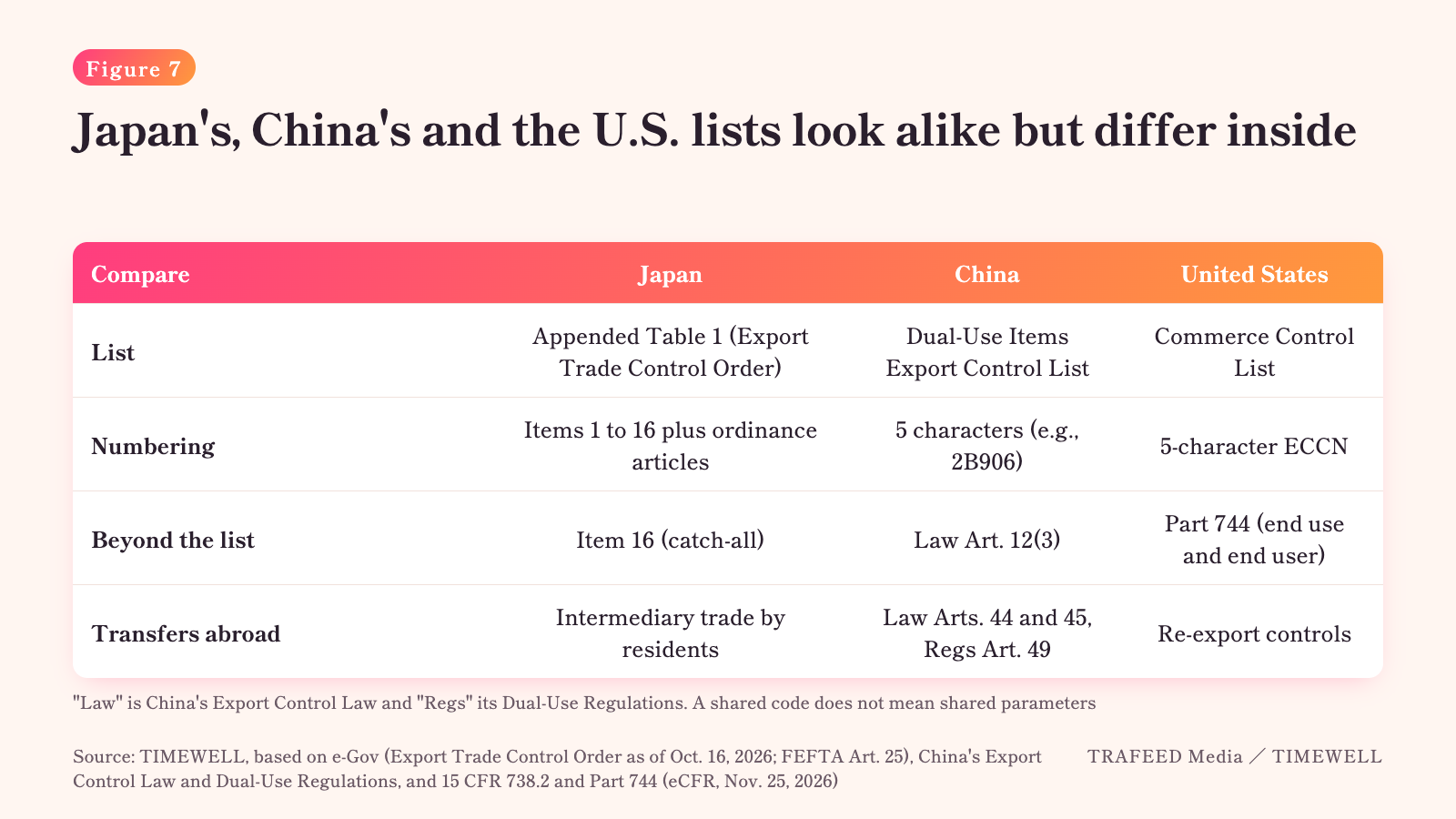 Figure 7. The three countries' lists compared. Read across each row to compare the three. Source: TIMEWELL, based on e-Gov, the Export Trade Control Order and the Foreign Exchange and Foreign Trade Act; China's Export Control Law and Dual-Use Items Export Control Regulations; and 15 CFR 738.2 and Part 744
Japan's Appended Table 1 uses item numbers 1 to 16, with specifications set out in the articles of a ministerial ordinance. It does not use five-character codes like China's List or the CCL. Controls on items beyond the list are item 16 (catch-all) in Japan, Article 12(3) of the Export Control Law in China and Part 744 of the EAR (end-use and end-user controls) in the U.S.15621. On transfers outside the country, Japan's Foreign Exchange and Foreign Trade Act requires a license when a resident buys or sells goods between foreign countries with a non-resident, which is intermediary trade (Article 25(4))22. China, through its law, regulations and announcements, reaches as far as transfers of China-origin goods outside China. The U.S. has its re-export controls.
Mapping Chinese codes mechanically onto Japanese item numbers or onto ECCNs with a correspondence table is risky. For items with reasons 0 to 4, the code is a useful clue for finding the same field. Unmanned aerial vehicles, for example, sit in item 4 (missile-related) of Japan's Appended Table 1 as "unmanned aerial vehicles or equipment or tools for their manufacture," and under 9A012 on both the Chinese and U.S. lists15110. The parameters still differ from country to country. For items with reason 9, there is no guarantee of a matching entry in Japan's items 1 to 15 or under any ECCN. The basic rule is to classify each country's side against that country's own text and numbers.
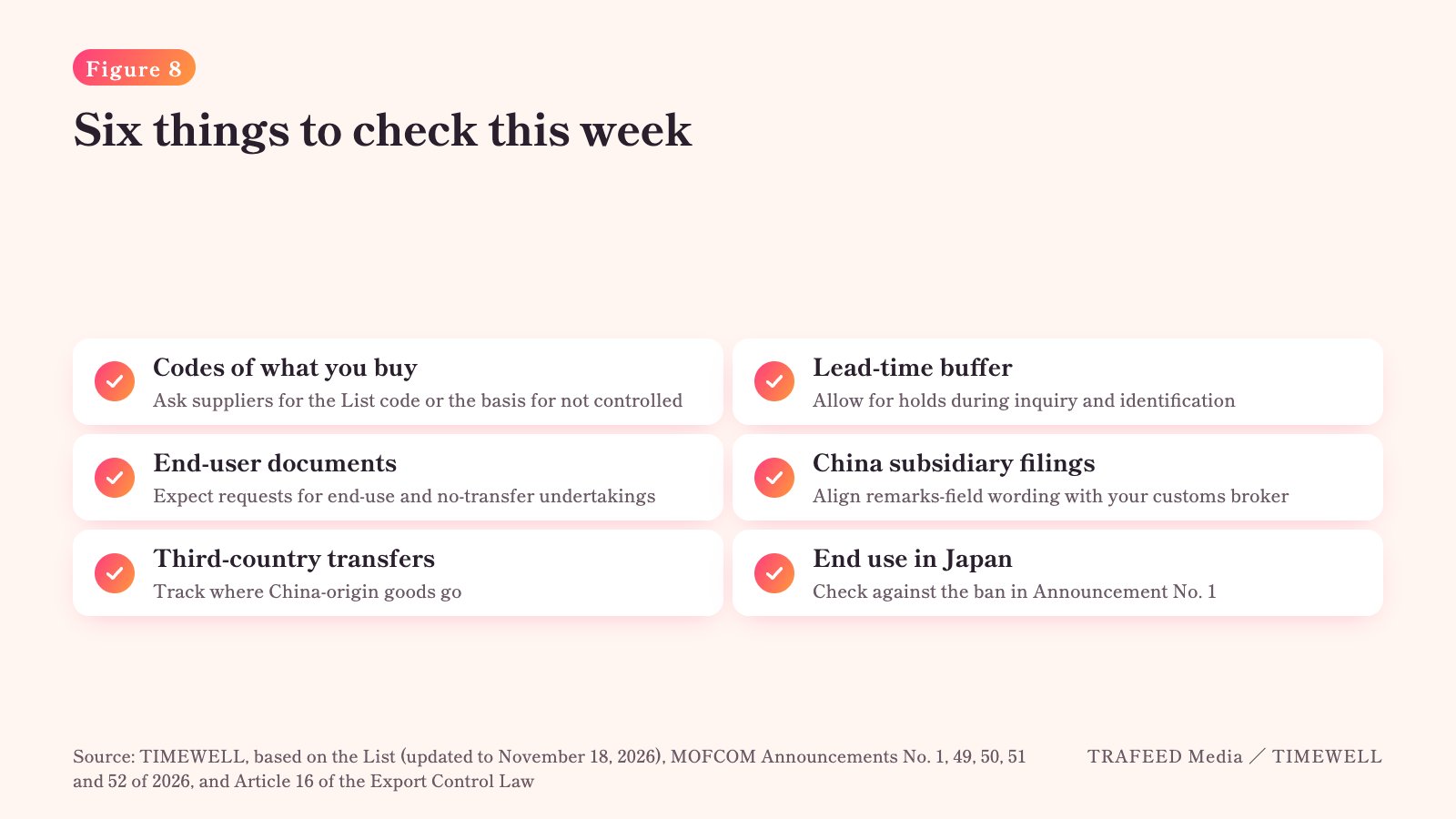 Figure 8. Read left to right, top row then bottom row: sourcing, lead time, documents, subsidiaries, third countries, and end use in Japan. Source: TIMEWELL, based on the List (updated to November 18, 2026), MOFCOM Announcements No. 1, 49, 50, 51 and 52 of 2026, and Article 16 of the Export Control Law
If you do one thing tomorrow, ask your Chinese suppliers. The request can be short. In Chinese, this works: 「请提供该产品在《两用物项出口管制清单》(更新至2026年11月18日)中的管制编码;如不属于管制物项,请提供判断依据的参数。」 It asks the supplier to give the control code for the product in the List updated to November 18, 2026, or, if the product is not controlled, the parameters behind that conclusion. Record the code and parameters you get back in your item master, together with the version date of the List.
Technology exports also fall under a separate list, the Catalogue of Technologies Prohibited or Restricted from Export (中国禁止出口限制出口技术目录). On October 16, 2026, MOFCOM and the Ministry of Science and Technology sought comments on a draft revision in Announcement No. 48 and started a temporary pre-export registration measure. MOFCOM's FAQ says technology that appears on both the Dual-Use List and the technology catalogue needs only a dual-use export license23. If your China site sends drawings or software back to headquarters, check this side too.
For a form that walks through one transaction at a time, covering the Export Control Law and the Regulations, the critical-mineral announcements and the four party-list systems in order, we offer the China-Related Transactions Screening Sheet (registration required; a listing is a regulatory designation, not a judgment about any company).
Keep your home-country classification and your China classification as two separate records. On the China side, get the code and the parameters from the supplier and store them with the version date. Make those two things habits, and updates like this one become much easier to absorb.
Summary
In the two years since it took effect in December 2024, China's Dual-Use List has grown from 173 to 205 codes. Most of the growth is in items controlled for "other national security" reasons, and there is no guarantee that those items have a counterpart in Japan's items 1 to 15. I expect to see more cases where an item classified as not listed at home turns into a licensed item when it leaves China.
This revision did not only tighten. It raised the drone airframe threshold and set up a registration-based facilitation. Rather than asking only whether China's rules are strict, follow which item, which destination and which procedure, using the codes and numbers in the original text. At the start of each week, compare the version date of the List with the codes you have on file from suppliers. It is unglamorous work, but I think this small habit is the most direct way to keep shipments from getting stuck at customs. We also cover new Chinese announcements in our weekly regulatory update.
TRAFEED, our AI support for export control decisions, helps track list changes across countries and check counterparties. The final classification decision rests with your company's export control officer.
Footnotes
-
Ministry of Commerce of the People's Republic of China, 《中华人民共和国两用物项出口管制清单(更新至2026年11月18日)》 (Dual-Use Items Export Control List of the People's Republic of China, updated to November 18, 2026; 152 pages; Part 1, "清单结构和编码规则" and "清单的规范性说明," and the table of contents and text of Part 2). Retrieved November 28, 2026. https://exportcontrol.mofcom.gov.cn/upload/uploadfile/attach/202611/19/20261119102925281.pdf ↩ ↩2 ↩3 ↩4 ↩5 ↩6 ↩7 ↩8 ↩9
-
International Business Daily (国际商报), "商务部发布最新两用物项出口管制清单" (November 19, 2026, as reposted on Sohu; reports that MOFCOM posted the List on its website on November 18). News report. https://www.sohu.com/a/1103447132_122014422 ↩
-
MOFCOM, GACC and Central Military Commission Equipment Development Department Announcement No. 49 of 2026, "公布优化调整无人机相关物项出口管制措施的决定" (October 19, 2026; effective November 18; the List updated at the same time). Retrieved November 28, 2026. https://www.mofcom.gov.cn/zcfb/blgg/gg/2026/art/2026/art_7f1108392a314a2586e106b81b68f54f.html ↩ ↩2 ↩3 ↩4
-
MOFCOM and GACC Announcement No. 50 of 2026, "公布对盾构机等物项实施出口管制的决定" (October 19, 2026; effective November 18). Retrieved November 28, 2026. https://www.mofcom.gov.cn/zcfb/blgg/gg/2026/art/2026/art_f7d68c3377714ca790b204114c9d3f1d.html ↩ ↩2 ↩3
-
MOFCOM and GACC Announcement No. 51 of 2026, "公布优化调整挖泥船相关物项出口管制措施的决定" (October 19, 2026; effective November 18). Retrieved November 28, 2026. https://www.mofcom.gov.cn/zcfb/blgg/gg/2026/art/2026/art_f929cbb4a8034f46a35136a2811f06cd.html ↩ ↩2 ↩3
-
《中华人民共和国出口管制法》 (Export Control Law of the People's Republic of China, effective December 1, 2020), Articles 4, 9, 12, 14, 15, 16, 44 and 45. Retrieved November 28, 2026. http://exportcontrol.mofcom.gov.cn/article/zcfg/gnzcfg/flfg/202111/226.html ↩ ↩2 ↩3 ↩4 ↩5 ↩6
-
《中华人民共和国两用物项出口管制条例》 (Dual-Use Items Export Control Regulations of the People's Republic of China, State Council Decree No. 792, promulgated September 30, 2024, effective December 1, 2024), Articles 11, 12, 14, 15 and 49. Retrieved November 28, 2026. http://exportcontrol.mofcom.gov.cn/article/zcfg/gnzcfg/gzjgfxwj/202410/1057.html ↩ ↩2 ↩3
-
MOFCOM Announcement No. 51 of 2024, "关于发布《中华人民共和国两用物项出口管制清单》的公告" (November 15, 2024; MOFCOM, Ministry of Industry and Information Technology, GACC and State Cryptography Administration; effective December 1, 2024, repealing 11 announcements the same day), and the List attached at the time (138 pages). Retrieved November 28, 2026. http://exportcontrol.mofcom.gov.cn/article/hgfw/lywxcx/gzqd/202411/1067.html and http://images.exportcontrol.mofcom.gov.cn/uploadfile/attach/202411/21/20241121095108223.pdf ↩ ↩2
-
eCFR, 15 CFR 738.2(d)(1), "Composition of an entry," and Table 1 to paragraph (d)(1) (structure of an ECCN and reasons for control by number range). Version current as of November 25, 2026, retrieved November 28, 2026. https://www.ecfr.gov/current/title-15/subtitle-B/chapter-VII/subchapter-C/part-738/section-738.2 ↩ ↩2
-
eCFR, 15 CFR Part 774, Supplement No. 1, "The Commerce Control List" (ECCNs 1C351, 9A012 and others). Version current as of November 25, 2026, retrieved November 28, 2026. https://www.ecfr.gov/current/title-15/subtitle-B/chapter-VII/subchapter-C/part-774 ↩ ↩2
-
The List attachment that replaced the earlier file on the announcement page above, dated June 12, 2026 (147 pages; file created December 31, 2025; no "as of" date). Retrieved November 28, 2026. https://exportcontrol.mofcom.gov.cn/upload/uploadfile/attach/202606/12/20260612151240357.pdf ↩ ↩2 ↩3
-
MOFCOM and GACC Announcement No. 10 of 2025, "公布对钨、碲、铋、钼、铟相关物项实施出口管制的决定" (February 4, 2025). Retrieved November 28, 2026. http://exportcontrol.mofcom.gov.cn/article/hgfw/lywxcx/gzqd/202502/1102.html ↩
-
MOFCOM and GACC Announcement No. 18 of 2025 (April 4, 2025; seven medium and heavy rare earth elements including samarium, 1C902 to 1C908). Retrieved November 28, 2026. https://www.mofcom.gov.cn/zwgk/zcfb/art/2025/art_9c2108ccaf754f22a34abab2fedaa944.html ↩
-
MOFCOM and GACC Announcement No. 58 of 2026 (November 9, 2026; continues the suspension of Announcements No. 55 to 58 and No. 61 and 62 of 2025 from November 11, 2026 to January 10, 2027). Retrieved November 28, 2026. https://www.mofcom.gov.cn/zcfb/blgg/gg/2026/art/2026/art_a07d112c0b994050900d5de039df828a.html ↩
-
e-Gov Law Search, Export Trade Control Order (Cabinet Order No. 378 of 1949, version in force from October 16, 2026), Appended Table 1. Retrieved November 28, 2026 through the e-Gov Law API v2. https://laws.e-gov.go.jp/law/324CO0000000378 ↩ ↩2 ↩3
-
China Export Control Information Network, "商务部新闻发言人就优化调整无人机相关物项出口管制措施答记者问" (MOFCOM spokesperson's answers on adjusting export control measures for drone-related items, October 2026). Retrieved November 28, 2026. http://exportcontrol.mofcom.gov.cn/article/gndt/202610/1325.html ↩
-
MOFCOM Announcement No. 34 of 2026, "公布加强无人机相关两用物项对美国出口管制" (August 5, 2026; exports to the United States of List-controlled drones, key components and technology are reviewed strictly case by case, without facilitation measures). Retrieved November 28, 2026. https://www.mofcom.gov.cn/zcfb/blgg/gg/2026/art/2026/art_7283a8a8c3824db3852106ae981b7a90.html ↩
-
China Export Control Information Network, "商务部新闻发言人就盾构机等物项实施出口管制、优化调整挖泥船相关物项出口管制措施答记者问" (MOFCOM spokesperson's answers on shield tunneling machines and dredger-related items, October 2026; states that countries and regions with dialogue mechanisms were notified in advance). Retrieved November 28, 2026. http://exportcontrol.mofcom.gov.cn/article/gndt/202610/1326.html ↩
-
MOFCOM and GACC Announcement No. 52 of 2026, "公布进一步优化两用物项出口管制质疑和鉴别工作有关事项" (October 19, 2026; effective on issuance; repealing GACC Announcement No. 123 of 2025). Retrieved November 28, 2026. https://www.mofcom.gov.cn/zcfb/blgg/gg/2026/art/2026/art_92d6cb97a5de472d8ffeaf93be12a30f.html ↩ ↩2
-
MOFCOM Announcement No. 1 of 2026, "关于加强两用物项对日本出口管制的公告" (January 6, 2026; effective on issuance). Retrieved November 28, 2026. https://www.mofcom.gov.cn/zcfb/blgg/gg/2026/art/2026/art_5acdf51490094b39b7ffb381280b2a3b.html ↩
-
eCFR, 15 CFR Part 744, "Control Policy: End-User and End-Use Based." Version current as of November 25, 2026, retrieved November 28, 2026. https://www.ecfr.gov/current/title-15/subtitle-B/chapter-VII/subchapter-C/part-744 ↩
-
e-Gov Law Search, Foreign Exchange and Foreign Trade Act (Act No. 228 of 1949, version in force from August 12, 2026), Article 25(4). Retrieved November 28, 2026 through the e-Gov Law API v2. https://laws.e-gov.go.jp/law/324AC0000000228 ↩
-
China Export Control Information Network, "两用物项常见问题解答之六(无人机相关物项)" (Dual-use FAQ No. 6, drone-related items: interpretation of "specially designed," national standards for endurance and wind-resistance tests, end users and uses excluded from registration, export certificates valid for one shipment and 60 days, and the relationship between the List and the technology catalogue). Retrieved November 28, 2026. http://exportcontrol.mofcom.gov.cn/article/cjwt/202610/1327.html ↩