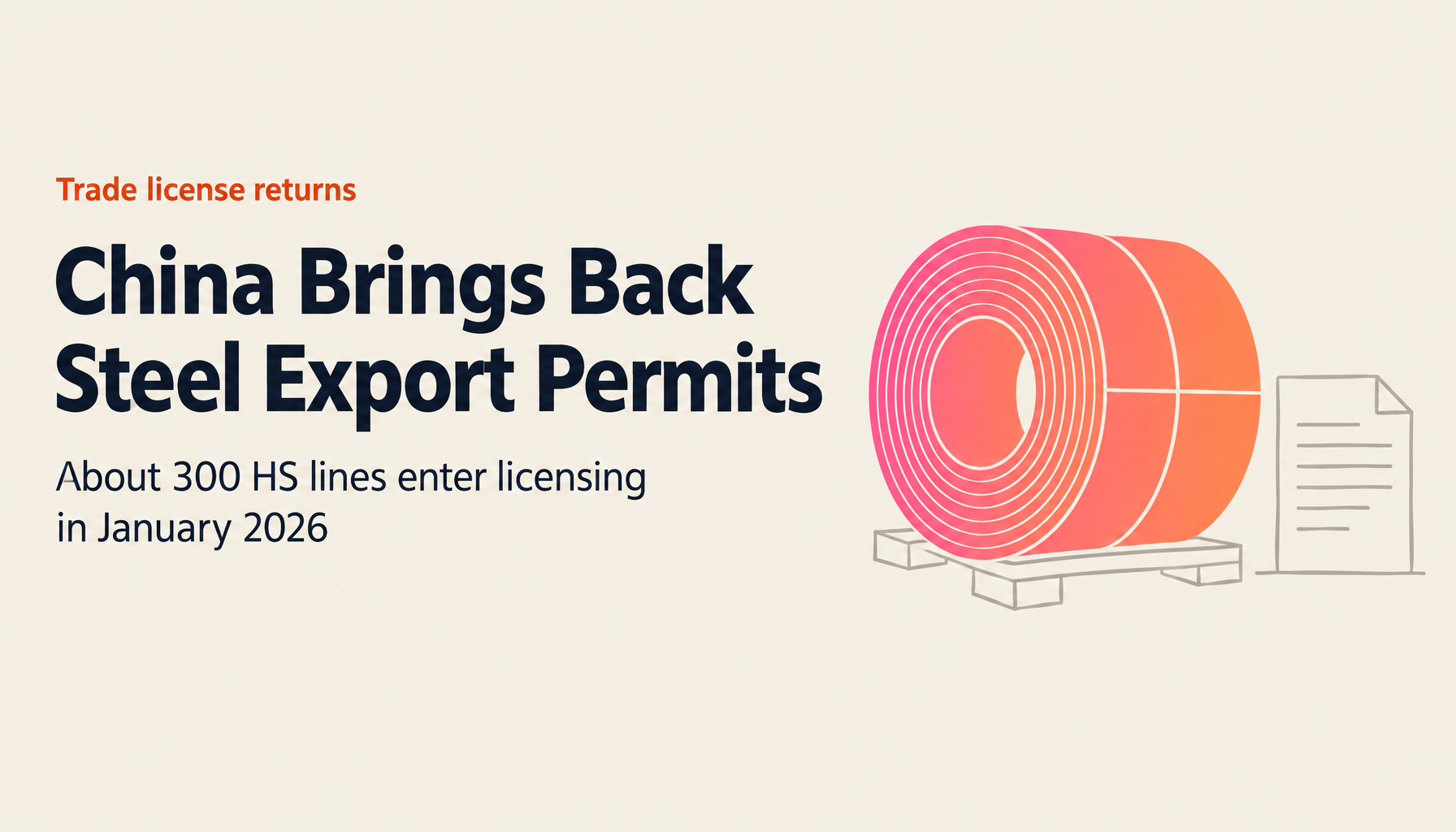
Hello, this is Ryuta Hamamoto from TIMEWELL. On January 1, 2026, China reintroduced export licensing for steel products after a 16-year gap. The scope is about 300 lines at the 10-digit HS level, from pig iron feedstock through finished H-beams and seamless steel pipe, covering essentially the full sweep of Chinese steel exports.
Based on the original text of MOFCOM Announcement 2025 No. 79 and CISTEC's summary, I walk through the regime for beginners. Chinese official explanations and overseas readings sit side by side. The focus is facts, not scorekeeping.
What You Will Get From This Article
- The full picture of MOFCOM Announcement 2025 No. 79 (about 300 items, effective January 2026, reintroduced after 16 years)
- The important distinction that this is ordinary trade management under the Foreign Trade Law, not dual-use export control
- The application process (goods export contract + quality inspection certificate) and the expansion from the 2008 regime (83 items)
- A side-by-side comparison with U.S. Section 232, EU safeguards, and Canadian surtaxes
- Impact on Japanese steel procurement and five practical steps
Three Terms to Learn First
Export license management. Under China's Foreign Trade Law, certain goods require a license from MOFCOM or a local commerce authority before export. Without a license, customs clearance is not available. Covered goods appear in the "Catalogue of Goods Subject to Export License Management," revised and published by MOFCOM each year-end. The 2025 edition (published December 31, 2024) listed 43 categories. Announcement No. 79 effectively adds steel products to that catalogue.
Foreign Trade Law. China's basic trade statute, enacted in 1994 and amended in 2023. Article 15 provides that the state may restrict or prohibit imports of relevant goods and technology where national security, public interest, domestic supply shortages, or serious disruption of export order are at stake. The legal basis for this announcement is Article 15. That is a different track from the dual-use export control regulations that govern dual-use items.
Steel excess capacity. A state in which production capacity chronically exceeds real demand. It is a core topic of the Global Forum on Steel Excess Capacity (GFSEC, with the OECD as secretariat). As of 2023, global excess capacity was estimated at 551 million tons. That background informs the debate, but the Chinese official explanation of this measure does not use the term "excess capacity."
Overview of Announcement 2025 No. 79
| Item | Content |
|---|---|
| Issuing bodies | Ministry of Commerce of the PRC, Department of Foreign Trade / General Administration of Customs |
| Document number | MOFCOM / GACC Announcement 2025 No. 79 |
| Date of issuance | December 9, 2025 |
| Effective date | January 1, 2026 |
| Legal basis | Foreign Trade Law; Regulations on the Administration of Import and Export of Goods; Measures for the Administration of Export Licenses for Goods |
| Number of covered items | About 300 lines at the 10-digit HS level |
| Application documents | Goods export contract; product quality inspection certificate issued by the producer |
The body of the announcement is simple: (1) incorporate certain steel products into the 2025 Catalogue of Goods Subject to Export License Management; (2) require an export license based on a goods export contract and a producer-issued quality inspection certificate; and (3) implement from January 1, 2026 (based on CISTEC's provisional translation).
Covered Items (About 300 HS Lines)
The annexed catalogue of steel products brought under export license management covers the full steel industrial chain from feedstock to finished goods.
| Category | Main content |
|---|---|
| Feedstock / primary forms | Non-alloy pig iron, alloy pig iron, spiegeleisen, sponge iron, recycled stainless feedstock, alloy steel scrap, iron and steel powders, iron and non-alloy steel ingots |
| Semi-finished products (billets) | Rectangular-section billets, continuous-cast slabs, continuous-cast round billets for wheels |
| Hot-rolled products | Patterned hot-rolled coils, pickled hot-rolled coils, various hot-rolled products from 1.5 mm to 10 mm |
| Cold-rolled products | Various cold-rolled coils from 0.3 mm to 3 mm; other cold-rolled wide flat products |
| Coated products | Tin-plated, lead-plated, and zinc-plated non-alloy steel wide flat products |
| Other steel products | H / I / U / angle sections; alloy steel seamless pipe for high-temperature and pressure service |
Representative HS examples include 7201100000 (non-alloy pig iron), 7203100000 (direct-reduced iron), 7204100010 (recycled iron and steel feedstock), 7207120010 (continuous-cast slabs over 400 mm thick), and 7208100000 (patterned hot-rolled coils). Stainless, alloy steel, H-beams, and seamless pipe are all included. CISTEC color-codes the annex (red for re-listings from the 2008 list; blue for further subdivision of 2008 lines).
Replace siloed classification work with AI.
METI's FY2024 data shows 52% of foreign exchange law violations stem from classification errors. Download the TRAFEED product catalog covering features and rollout.
Important Distinction: Not Dual-Use Export Control
News coverage often blurs two tracks. China's export-related regulation has two major systems. If I had to pick one thing readers get wrong, it is this distinction.
A. Dual-use export control
- Basis: Regulations on Export Control of Dual-Use Items and Technologies
- Examples: rare earths (seven permanently controlled elements + five suspended), gallium, germanium, antimony, tungsten, semiconductor materials
- Character: security-oriented management of dual-use items; same category as the U.S. EAR and Japan's FEFTA
- Extraterritorial reach: 0.1% rule, 50% rule, and similar (some currently suspended)
B. Ordinary trade management under the Foreign Trade Law (export license management)
- Basis: Foreign Trade Law; Regulations on Import and Export of Goods; Measures for Export License Administration
- Examples: the roughly 300 steel lines in this case
- Character: ordinary trade management for trade order, industrial policy, domestic supply security, and similar reasons
- Extraterritorial reach: none
CISTEC explicitly notes that this measure is grounded in Article 15 of the Foreign Trade Law as ordinary trade management, not in the dual-use export control regulations used for rare earths and similar items. Lumping it with rare-earth controls under a single "China is tightening export controls" headline risks misreading the legal framing and the presence or absence of extraterritorial reach. Draw the line first.
Application Process and Expansion from the 2008 Regime
Application Process
Required documents are two: (1) a goods export contract (buyer/seller, item, quantity, value, and so on); and (2) a product quality inspection certificate issued by the producer. Issuing authorities are the MOFCOM License Bureau for central enterprises (large state-owned enterprises under direct central supervision) and the provincial or sub-provincial municipal commerce authority of the exporter's location for other enterprises. The announcement does not spell out license criteria (whether quantity limits exist, review timelines, or denial conditions) — that remains an operational question.
Toyo Keizai Online has reported that requiring contracts and quality certificates is expected to deter "mai dan" exports (the practice in which a firm without export rights purchases customs documents under another company's name).
Comparison with the 2008 Regime
China also operated steel export licensing in 2007–2008.
| Item | 2007–2008 regime | 2026 regime |
|---|---|---|
| Basis announcement | Announcement 2007 No. 41 | Announcement 2025 No. 79 |
| Start | April 2007 | January 1, 2026 |
| Number of covered items | 83 categories | About 300 lines (10-digit HS) |
| Scope | Some steel products | Full industrial chain from feedstock to finished goods |
| Abolition | Removed in the 2009 catalogue (December 2008) | Not determined |
The 2007 introduction had a strong export-suppression character against the backdrop of tight global steel demand and domestic supply security, and it was deleted from the 2009 catalogue after the global financial crisis. This time the item count expands by roughly 3.6× and spans feedstock, semi-finished, finished, and coated products. It is closer to "a redesigned regime with a wider scope" than to "the 2008 version revived."
Global Steel Market Impact: Official Chinese Explanation and Overseas Readings in Parallel
The announcement itself does not state reasons for introduction, so Chinese official explanations and overseas readings are shown side by side.
Official Chinese Explanation
MOFCOM spokesperson He Yadong has described the purpose as "encouraging exporters to emphasize product quality and R&D investment," "promoting high-quality development of China's steel industry," and "improving the accuracy of export statistics and monitoring" (Global Times, December 18, 2025). The official explanation does not use terms such as "excess capacity" or "dumping." Domestically, a five-ministry "Work Plan for Steady Growth of the Steel Industry (2025–2026)" published in August 2025 cites "supply-demand imbalance" and calls for "strengthening export management of steel products and maintaining competitive order in exports."
Chinese Steel Export Trends (Factual Data)
| Period | Export volume |
|---|---|
| Full year 2024 | 110.7 million tons (+22.7% year on year; all-time high) |
| January–November 2025 | 107.7 million tons (+6.7% year on year) |
| January–February 2026 | 15.6 million tons (−8.1% year on year; January alone −31.4% month on month) |
(Sources: MEPS International, GACC, CISTEC, S&P Global / Platts)
Overseas Readings
- GFSEC (Global Forum on Steel Excess Capacity, OECD secretariat): The October 2024 ministerial joint statement noted that global excess capacity rose to 551 million tons in 2023, exceeding GFSEC members' steel production (478 million tons), and that it is "facilitated by non-market policies and practices of certain countries." The October 2025 statement agreed to strengthen monitoring of non-member non-market practices.
- Japan Iron and Steel Federation Chairman Tadashi Imai (December 11, 2025): Evaluated the measure as "focused mainly on suppressing off-spec exports, with limited effect on export volumes or market prices," and noted that "more than half of Chinese steel production is by state-owned enterprises" (Nikkei).
- CRU Group: Analyzed that "legitimate exporters can continue business; this is a monitoring measure, not a quota," while also noting that "it will act as a factor reducing exports in 2026."
Chinese authorities frame "promoting high-quality development"; overseas observers frame "response to excess capacity" and "limited effect." I do not rank those framings. Both sit here in parallel.
Side-by-Side Comparison with U.S. Section 232, EU Safeguards, and Canadian Surtaxes
China's export licensing and U.S., EU, and Canadian steel tariffs against China share a structural background in global steel excess capacity, but the direction of the policy tools differs.
| Country / region | Measure | Character | Timing |
|---|---|---|---|
| United States | Section 232 surtaxes (25% → 50%) | Import restriction (tariff) | June 2025 |
| EU | Safeguard (25%) and successor proposal (18.3 million ton quota + 50% tariff) | Import restriction (tariff-rate quota) | Extended June 2024; successor from June 2026 |
| Canada | 25% surtax on Chinese steel; quota tightening for non-FTA countries | Import restriction | October 2024; July and November 2025 |
| China | Steel product export license management (300 items) | Procedural management on the export side | January 1, 2026 |
Key point: U.S., EU, and Canadian measures restrict imports (protect the domestic market). China's measure requires a license to export. The policy tools point in opposite directions. The shared background is global steel excess capacity as a structural problem. WTO consistency can be debated for any of these measures; as of this writing, no formal challenge to this licensing regime has been confirmed. I do not judge which measure is "correct" or "excessive." I simply record that each jurisdiction is acting under its own legal and policy judgments.
Impact on Japanese Companies
Direct Impact
- Steel importers and end users: Confirm Chinese suppliers' export license status; revise contract and quality-certificate formats; manage lead-time risk from delayed license review.
- Japanese companies with manufacturing sites in China: Exporting steel produced at a Chinese plant to third countries requires an export license as a Chinese legal person. Non-central enterprises obtain licenses from provincial commerce authorities, so local operating differences matter.
Indirect Impact
- Third-country markets: Reduced Chinese exports can support prices in Southeast Asia, the Middle East, and Africa, while some observers note that "if Middle East-bound Chinese exports stop, Japanese markets are also affected" (Japan Iron and Steel Federation; Nikkei, March 2026).
- Diversion and certificates of origin: Past cases of Chinese steel diverted via Southeast Asia mean more origin-verification moments are possible.
- Domestic prices: Easing of low-price Chinese export pressure could be a support factor, but industry analysts broadly expect limited short-term impact.
Five Practical Steps
- Inventory at the 10-digit HS level. List steel imported from China or exported from Chinese entities to third countries at the 10-digit HS level and match against the annex to Announcement 2025 No. 79. Stainless, alloy steel, H-beams, and seamless pipe are in scope.
- Interview Chinese suppliers. Confirm license status (obtained / pending / not applied). Issuing authorities differ for central enterprises (MOFCOM License Bureau) versus local enterprises (provincial commerce authorities); map the application route and real lead times.
- Revise contract and quality-certificate formats. Build operating flows for goods export contracts and producer-issued quality inspection certificates. Re-check supply-chain transparency for "mai dan" (customs clearance under another company's name).
- Bake in lead-time risk. Increase safety stock assuming delayed review; pre-evaluate alternative sources (Japan, Korea, Taiwan, Vietnam, and others); clarify how to identify third-country diversion.
- Reflect in internal workflows. Add license-status confirmation to purchasing checklists. Consider embedding "export license is the seller's obligation" clauses in contract templates. If you have a Chinese legal person, build the application workflow to the provincial commerce authority of its location.
HS classification and control determination get lighter with tools that match against overseas regulation, including Chinese regimes. The export-control AI agent TRAFEED is built for that kind of work.
Common Misconceptions / FAQ
Q1. Is this an "export ban" or a "quantity limit"? The announcement body does not set a quantity ceiling. Formally it is a license-application system; an export contract and quality inspection certificate are enough to apply. Analysts such as CRU Group evaluate it as "a monitoring measure, not a quota." Operationally, delayed review or denials can still produce a de facto export-suppression effect.
Q2. Is this dual-use export control? No. This is ordinary trade management under the Foreign Trade Law — a different category from the dual-use export control regulations used for rare earths, gallium, germanium, and similar items. CISTEC also makes this distinction explicit.
Q3. How does this differ from U.S. and EU tariffs against China? U.S. and EU measures restrict imports into their own markets (tariffs / TRQs). China's measure requires a license at export. The policy tools point in opposite directions. The shared background is global steel excess capacity.
Q4. How does this differ from the 2007–2008 regime? The item count expands from 83 categories to about 300 lines, and the full industrial chain from feedstock to finished goods is covered — that is the main difference.
Q5. Why now, and what about WTO consistency? The announcement does not state reasons. Objective facts in parallel include: (a) Chinese steel exports hit an all-time high of 110.7 million tons in 2024; (b) U.S., EU, and Canadian tariff measures have tightened; and (c) the August 2025 steel steady-growth work plan called for stronger export management. On WTO consistency, the relationship between export licensing and GATT Article XI (prohibition of quantitative restrictions) can be debated, but no formal challenge to this measure has been confirmed as of this writing.
Latest Developments as of July 2026
After this article's first publication, reframing of critical-goods supply chains, including steel, inside economic-security frameworks has continued. The 16th Japan–India annual summit on July 2, 2026 produced a joint declaration on cooperation in five fields: semiconductors, critical minerals (rare earths), clean energy, ICT, and pharmaceuticals, with investment on the order of about 2 trillion yen (Japan–India summit press conference (Prime Minister's Office of Japan, July 2026)). Steel itself is not named as a target item, but the direction of reducing dependence on any single country overlaps the steel-sourcing diversification discussed here. My reading is that such intergovernmental frameworks can support corporate evaluation of alternative sources. Related developments are summarized in the 2026 Japan–India summit — economic-security issues.
Summary
If you only act on one thing this week, inventory Chinese steel at the 10-digit HS level against Announcement 2025 No. 79. Then remember the legal category:
- Overall regime: under MOFCOM / GACC Announcement 2025 No. 79, about 300 steel product lines (10-digit HS) re-enter export license management from January 1, 2026. Scope expands roughly 3.6× from the 2008 regime (83 items) to cover feedstock through finished goods.
- Category distinction: legal basis is Article 15 of the Foreign Trade Law, ordinary trade management. Separate track from dual-use export control of rare earths and similar items; no extraterritorial reach.
- Neutral framing: Chinese authorities stress "high-quality development"; overseas observers stress "response to excess capacity" and "limited effect." U.S. Section 232, EU, and Canadian import restrictions and China's export licensing point in opposite policy directions, against a shared background of global steel excess capacity.
- Japanese practice: impact runs through steel procurement, Chinese-entity exports, markets, and compliance. The five practical steps above organize the first response.
Related Articles
- China Rare Earth Export Control Map — Seven Permanent Elements + Five Suspended
- China Export Risk 2026 — Regulatory Trends Japanese Companies Should Watch
- China–Japan Export Control 2026 — Dual-Use vs. Ordinary Trade Management
If You Want to Streamline Export Control That Includes Chinese Rules
Chinese export licensing, the U.S. EAR, the EU dual-use regulation, and Japan's FEFTA: each regime grows denser by the year, and HS classification plus control determination keep piling up.
TIMEWELL's export-control AI agent TRAFEED supports METI-aligned control determination, HS classification, and multilingual regulatory checks end to end. Distinguishing ordinary trade management under China's Foreign Trade Law from dual-use export control is designed to be checked cross-wise against the regulatory database.
If you are reviewing workflows for steel procurement or Chinese entity operations, contact us or review the TRAFEED service catalog (PDF).
References
Chinese Government Primary Sources
- MOFCOM / GACC Announcement 2025 No. 79, "Implementing Export License Management for Certain Steel Products" (December 9, 2025)
- MOFCOM Announcement, "Catalogue of Goods Subject to Export License Management (2025)" (December 31, 2024)
- MOFCOM / GACC Announcement 2007 No. 41 (April 30, 2007; reference for the 2007–2008 regime)
- Foreign Trade Law of the PRC (amended January 1, 2023)
- Five ministries including MIIT, "Work Plan for Steady Growth of the Steel Industry (2025–2026)" (August 6, 2025)
Japanese Public Summaries
- CISTEC Secretariat, "On China's Reintroduction of Export Licensing for Steel Products" (December 18, 2025)
- JETRO, "China to Start Export License Management for Certain Steel Products from January 2026" (December 2025)
- JOGMEC, "China Reimplements Steel Export License Management After 16 Years" (December 19, 2025)
- METI, "GFSEC Ministerial Meeting Joint Statement (Japanese provisional translation)" (October 9, 2024)
- METI, "GFSEC Ministerial Statement" (October 10, 2025)
International Organizations and Analysts
- USTR, "Remarks at the Global Forum on Steel Excess Capacity" (October 8, 2024)
- OECD GFSEC Ministerial Meeting 2024
- CRU Group, "Export licence will reduce, not halt Chinese steel exports in 2026"
- Global Times, "China's latest steel export license aims to promote high-quality devt of steel industry" (December 18, 2025)
EU, U.S., and Canadian Measures
- European Commission, "EU prolongs steel safeguard measure until June 2026" (June 25, 2024)
- European Commission, "Commission strengthens protection for EU steel industry" (March 25, 2025)
- Government of Canada, "Support for the Canadian Steel Sector" (July 16, 2025)
Major Media Coverage
- Reuters, "China to regulate steel exports with a licence system" (December 13, 2025)
- Bloomberg, "China Commerce Ministry to Introduce Export Licensing for Certain Steel Products from 2026" (December 12, 2025)
- Nikkei, "China Puts Export Licensing on Certain Steel — Response to 'Deflationary Export' Criticism?"
- Toyo Keizai Online, "Behind China's Introduction of Steel Export Licensing"