Hello, this is Ryuta Hamamoto from TIMEWELL.
This one is for legal, IP and export control teams at companies that license technology from Chinese firms, invest in or acquire Chinese companies, or run R&D centres in China. If you work in AI, cell and gene therapy, or solar manufacturing, it matters more than usual.
In short, China wants to add 40 AI, biomedicine and solar technologies to its list of technologies that may not, or may only with a licence, leave the country. The list itself is still a draft. But registration before exporting any of those technologies has been required since October 16.
Why now? The comment period closed on November 15, and the final revision is pending1. Once it is final, the restricted technologies move to a licensing regime, and a contract does not take effect until the licence is issued. If you are planning to receive technology from a Chinese partner in these fields, it is much easier to check the scope now than to reshuffle a deal timeline later.
Background reading. For the overall structure of China's export controls (the Export Control Law, the dual-use regulations and individual announcements), see our guide to China's export control legal framework. The technology export catalog discussed here is a separate list from the dual-use items list.
Key points
- MOFCOM/MOST Announcement No. 48 of 2026 (October 16) proposes adding 40 technologies to the Catalogue of Technologies Prohibited or Restricted from Export: 23 in AI, 5 in biomedicine and 12 in solar. Fourteen would be prohibited and 26 restricted
- The catalog change is a draft, but pre-export registration for the listed technologies has applied since October 16, and it covers deals already in progress
- Registration is the Chinese exporter's job. Foreign partners are on the receiving end of requests for recipient details, end use and value
- According to MOFCOM, buying products, using AI through an API or SaaS, and technology already in the public domain are out of scope
A few terms first.
| Term | In plain words |
|---|---|
| Catalogue of Technologies Prohibited or Restricted from Export | China's list of technologies that may not be exported and those that need a licence (《中国禁止出口限制出口技术目录》) |
| Technology export | Moving technology from inside China to outside it, including assigning patents or other rights, licensing, and a change of the owner or controller to a foreign party |
| Restricted and prohibited | Restricted items can be exported with a licence; prohibited items cannot. Entry numbers ending in X are restricted, those ending in J are prohibited |
| Registration | An interim filing on MOFCOM's system before export, until the revised catalog takes effect |
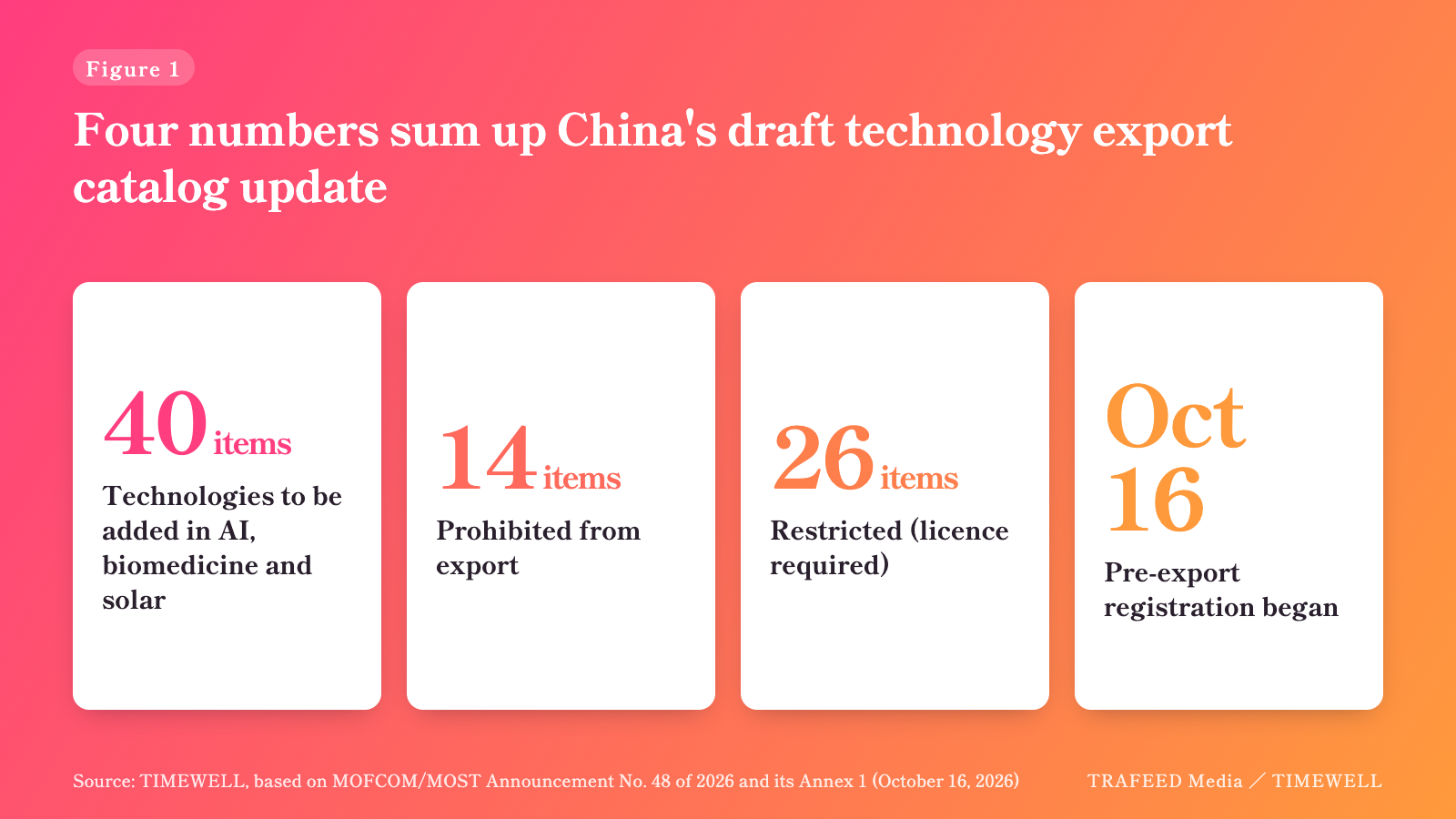 Figure 1: The draft at a glance. Forty technologies would be added, 14 prohibited and 26 restricted, and registration before export began on October 16. Source: TIMEWELL, based on MOFCOM/MOST Announcement No. 48 of 2026 and its Annex 1 (October 16, 2026)
What Announcement No. 48 actually does
Start with where the catalog sits. China manages technology exports under the Regulations on Technology Import and Export, issued by the State Council. Article 30 says prohibited technologies shall not be exported. Article 31 says restricted technologies are subject to licensing and may not be exported without a licence2. The catalog is what tells you which technologies fall into each group.
The catalog has been revised many times since 2001. MOFCOM's spokesperson described this round as routine technology trade management that is "not aimed at any specific country, region or entity"3. The last full revision was Announcement No. 57 of 2023 on December 21, 2023, which, according to the Ministry of Science and Technology, trimmed the list from 164 to 134 entries (24 prohibited and 110 restricted)4. Announcement No. 28 of 2025 on July 15, 2025 adjusted part of it and stated that dual-use technologies fall under export control management5. I will not judge the merits of the revision here; the aim is to lay out what the announcement and its annex say, and what that means in practice.
Announcement No. 48 of 2026 does two things at once1. The first is a public consultation on adding 40 AI, biomedicine and solar technologies. The consultation ran from October 16 to November 15 and is now closed. As of November 30, the final revision has not been published.
The second is registration, which has already started. From the date of the announcement until the revised catalog takes effect, anyone exporting a listed technology must register it beforehand on MOFCOM's technology trade management system. The announcement says that exports that have started but are not yet complete fall within the registration requirement. So even a contract signed before October 16 can be caught if technology still has to be handed over.
Say you signed a licence this summer to receive solar cell manufacturing know-how from a Chinese equipment maker, with technical documents due early next year. The Chinese side needs to register before the handover. Honestly, this is the line I would underline first: "it is only a draft" does not mean today's deals are unaffected.
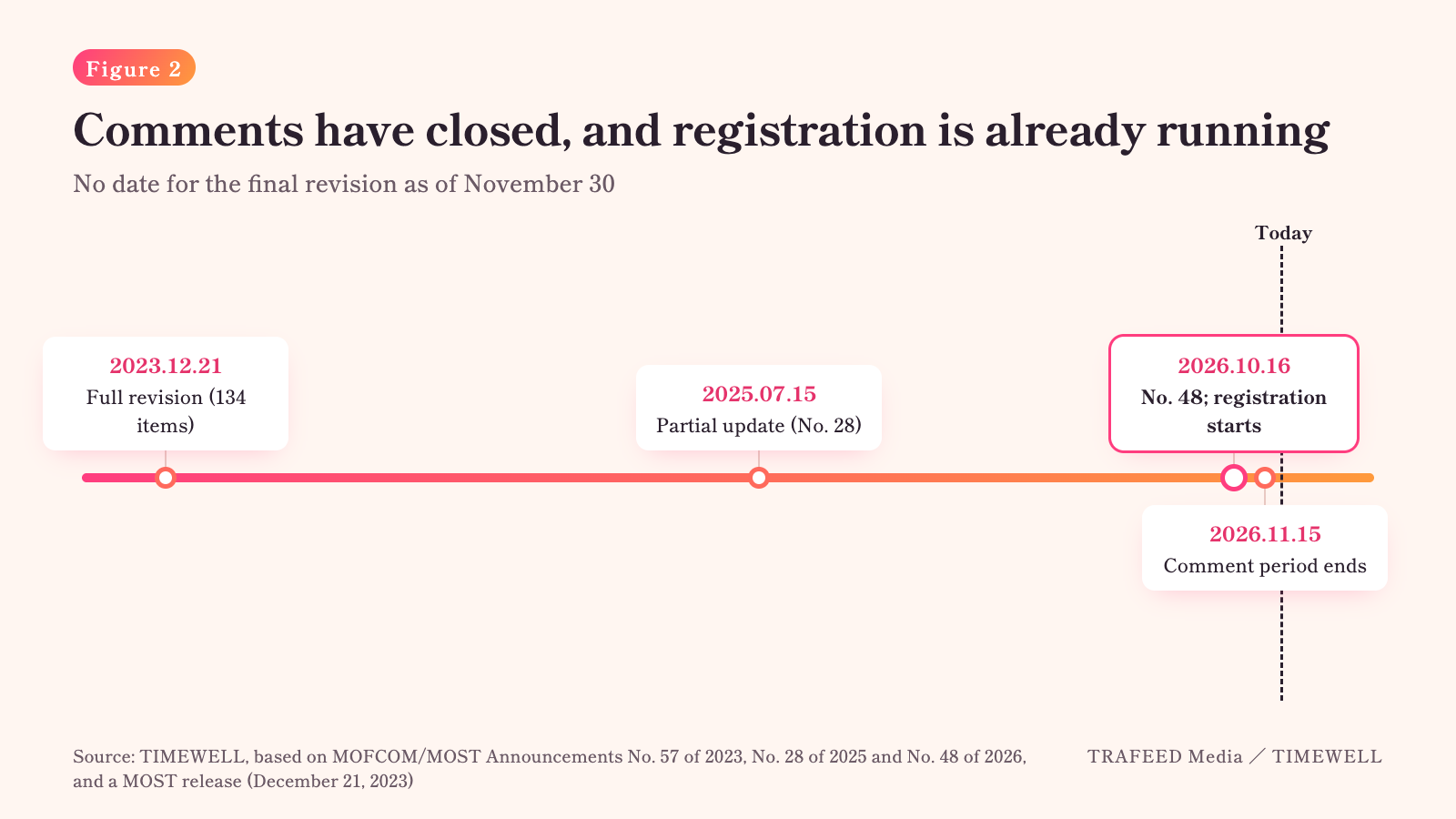 Figure 2: Recent revisions to the catalog and the milestones of Announcement No. 48. No date for the final revision had been published as of November 30. Source: TIMEWELL, based on MOFCOM/MOST Announcements No. 57 of 2023, No. 28 of 2025 and No. 48 of 2026, and a MOST release (December 21, 2023)
The 23 AI technologies: what is in and what is out
AI is the largest group: six prohibited and 17 restricted, 23 in all6. Annex 1 gives each technology an entry number and its "control points", most with numerical thresholds.
The six prohibited items sit under four entries. The first is deepfake detection technology for systems used to prevent and handle security risks in cross-border transfers of Chinese network data, with detection accuracy and recall of 95% or more (266401J). The second covers three offensive techniques (266402J): AI-driven generation and mutation of malicious code, adaptive evolution that detects and escapes sandboxes while rewriting its own behaviour, and mass generation and deployment of evasive variants, all described as usable against critical information infrastructure, defence and core government systems. The last two are large models trained on China's "core data" and then offered as a service (266501J), and high-performance AI agents designed for those highly sensitive settings (266502J).
Among the 17 restricted items, the one most companies will notice is large models (266504X). It covers models trained on China's "important data", and the "core technology" of models that reach any of three thresholds: training compute of 10²⁶ floating-point operations or more, two trillion parameters or more, or capabilities in the global top ten. Core technology here means weights, key checkpoints, source code, architecture design, and training optimisation and inference acceleration techniques. There is a carve-out for important data: a model trained on a tiny amount (0.1% or less) that does not materially improve its capability in that field, with de-identification so the data cannot be reproduced in outputs, or trained on important data that can be lawfully obtained in public, falls outside the first item.
The other restricted items cover AI agents (breaking instructions into 20 or more steps, 60 or more agents working together, 200 or more integrated tools), AI processor and memory chip design (14nm or below, 3D NAND storage density and so on), interconnect and fault recovery for compute clusters with more than 10,000 AI accelerator cards, AI-assisted vulnerability discovery, voiceprint recognition, translation for Chinese and minority languages, and high-accuracy deepfake detection (98% or more) and steganography.
The exclusions are spelled out too. The announcement keeps technology that is already public through open source or academic papers out of scope1. The spokesperson added that products made with the listed technologies are not covered, and that offering a large model through API calls, apps or web pages, SaaS, or lightweight on-device deployment is not an export of large model technology3. Deploying a restricted model locally on servers abroad is within scope, though deployment on a company's own overseas cloud, where risk is easier to control, can get "automatic licensing" and similar facilitation. The same facilitation applies to open-sourcing, Chinese companies' own overseas computing centres, chip tape-outs abroad, joint R&D using overseas resources, and work on international standards.
So a company that calls a Chinese model through an API, or buys AI servers made in China, is not asked to do anything under this draft. The draft bites when the weights, source code, or chip and cluster design know-how themselves are handed over by assignment or licence.
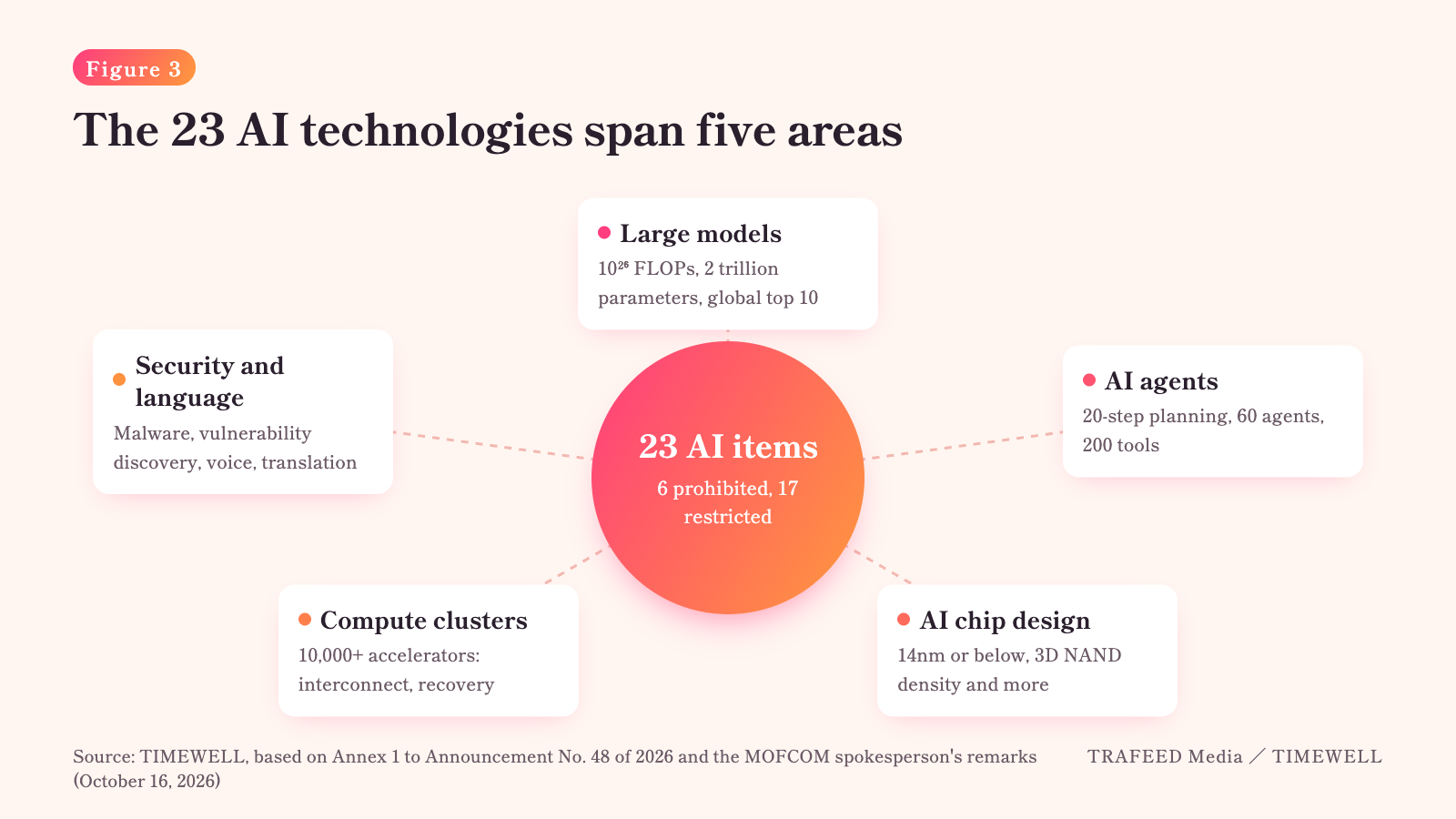 Figure 3: The AI technologies in the draft, by area, with key thresholds. Six prohibited and 17 restricted. The thresholds are the figures in Annex 1. Source: TIMEWELL, based on Annex 1 to Announcement No. 48 of 2026 and the MOFCOM spokesperson's remarks (October 16, 2026)
Replace siloed classification work with AI.
METI's FY2024 data shows 52% of foreign exchange law violations stem from classification errors. Download the TRAFEED product catalog covering features and rollout.
Biomedicine and solar: ownership-only bans and equipment in scope
Biomedicine has five items6. Three would be prohibited: proprietary cell and gene therapy technology platforms (262704J), proprietary siRNA drug technology platforms (262705J), and gain-of-function work on pathogenic microorganisms (267302J). Two would be restricted: technologies for discovering and validating new cell and gene therapy and siRNA targets that have not been disclosed anywhere in the world.
The wording of the bans matters. For the cell and gene therapy and siRNA platforms, the notes say only the transfer of ownership abroad is prohibited. Licensing, and contract research and manufacturing using the platform, are outside the scope. So is technology needed for partnering or business development deals on a specific drug at any stage. The spokesperson said that licensing out the new-target technologies would get automatic licensing and similar facilitation3. Most in-licensing deals by foreign pharma companies are licences, so the outright ban reads as limited to buying the platform itself.
Solar has 12. The five prohibited items are polysilicon made by cold hydrogenation in a fluidised bed (250,000 tonnes a year or more of trichlorosilane per line) or by silane fluidised bed (20,000 tonnes a year or more), wafers 70 micrometres thick or less, edge passivation for wafers 182 to 230mm per side and 140 micrometres or thinner, and perovskite and tandem cell production (efficiency of 30% or more and other thresholds). The seven restricted items are polysilicon plant engineering (30,000 tonnes a year or more per line), reduction furnaces, monocrystalline ingot pulling and machining, ultra-thin large wafers, and TOPCon, back-contact (XBC) and heterojunction (HJT) high-efficiency cell manufacturing.
The easy thing to miss in solar is that key equipment carrying these technologies is also in scope. Annex 1 lists fluidised bed reactors for cold hydrogenation, reduction furnaces, ingot pullers, wafer slicing equipment, TOPCon deposition tools (LPCVD and PECVD), atomic layer deposition (ALD), and PVD for heterojunction transparent conductive films, among others6. The spokesperson noted that solar technology exports usually come with the export, installation, commissioning and upgrading of production lines, and that such activity needs a technology export licence. Technologies below the thresholds, and equipment not on the list, are in principle outside this announcement.
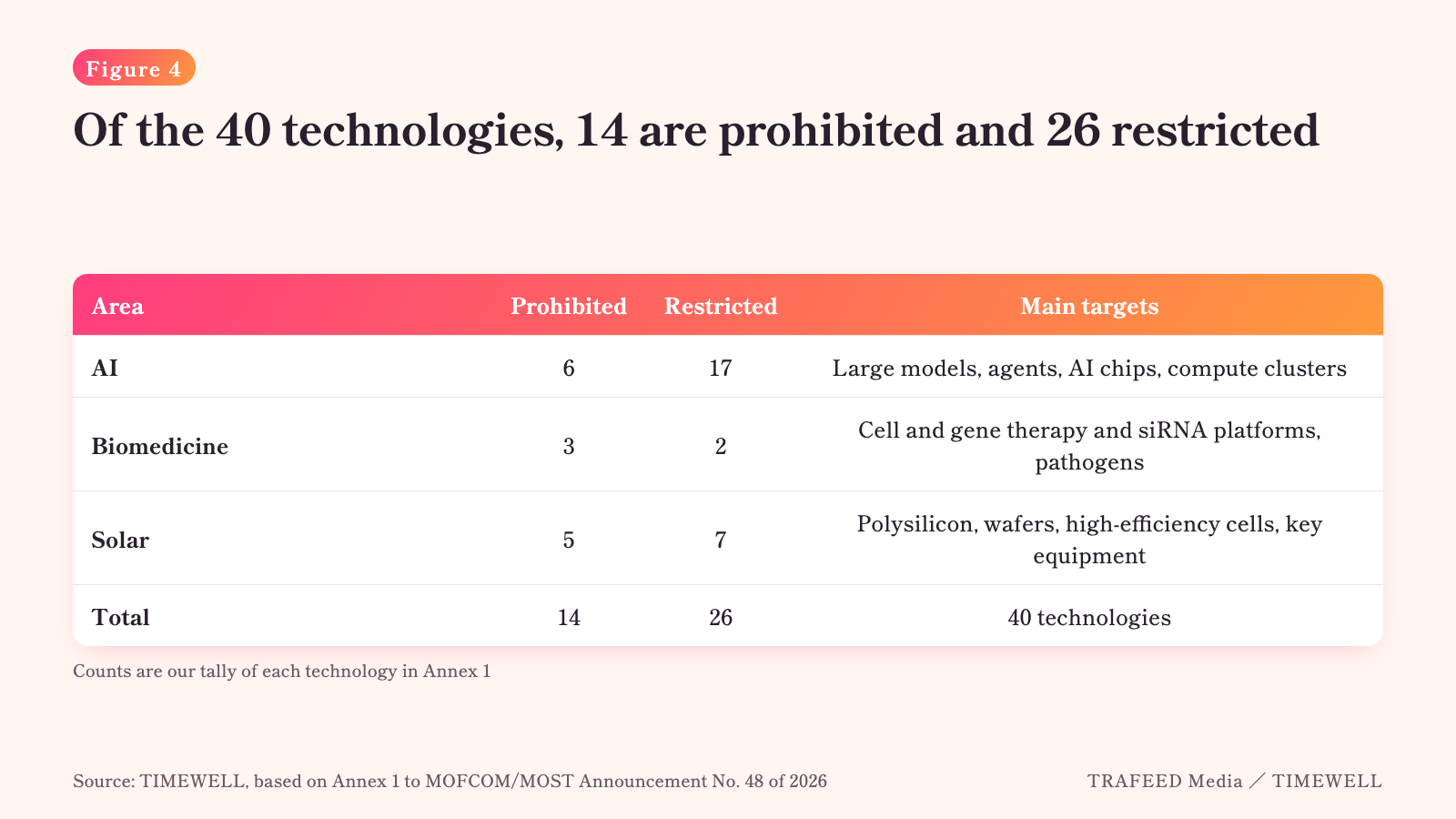 Figure 4: The 40 technologies in the draft by area and by prohibited or restricted. The counts are our tally of each technology in Annex 1 and match the announced 14 and 26. Source: TIMEWELL, based on Annex 1 to MOFCOM/MOST Announcement No. 48 of 2026
Who registers, and which deals are caught
The registration is made by the party exporting the technology from China1. Foreign companies do not file with Chinese authorities. The spokesperson asked exporters to judge for themselves whether a technology falls within the interim registration3.
The announcement lists four situations that need registration: assigning ownership of technology abroad, such as transferring IP rights; licensing technology in China for use abroad; a change of the owner or actual controller of technology in China to a foreign party; and any other case MOFCOM specifies by notice. The spokesperson added that exports of the listed key solar equipment all need registration.
The filing asks for basic information about the exporter and the recipient, the destination country or region, the technology and its intended use, and the expected value. Several technologies going to the same recipient at once can be combined in one filing. From the foreign partner's side, that means a request along the lines of "please send us your company details and how you will use the technology" is likely to arrive.
The third situation, a change of owner or controller, is about investment and M&A. If a foreign company acquires control of a Chinese company that holds a listed technology, my reading of the text is that the Chinese company would need to register. If a foreign group's R&D subsidiary in China licenses technology it developed to its parent abroad, that looks like the second situation, licensing for use abroad. Both are my interpretation; check individual deals with Chinese counsel and your counterparty.
The procedure gets heavier once the revision is final. Restricted technology exports need a licence. Under the regulations, MOFCOM reviews the application with the Ministry of Science and Technology and decides within 30 working days, issuing a letter of intent first (Articles 33 and 34)2. Only after that can the applicant negotiate in substance and sign the contract; it then applies for the licence, which is decided within 15 working days (Article 35). The contract takes effect on the day the licence is issued (Article 36). By contrast, technologies that are free to export only need contract registration, and the contract takes effect when it is concluded (Article 37).
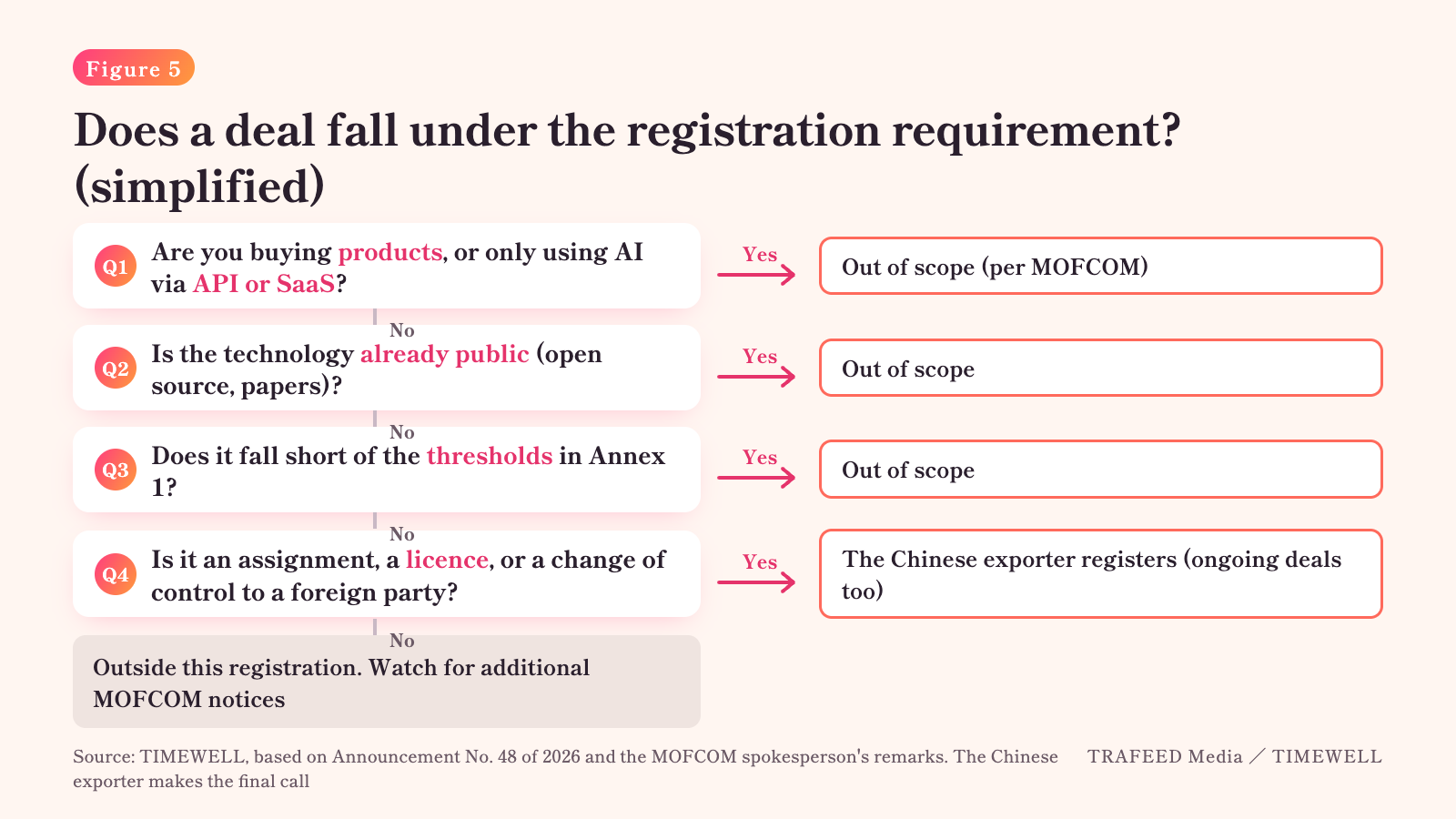 Figure 5: A simplified order for checking whether a deal to receive technology from China falls under the registration in Announcement No. 48. The Chinese exporter makes the final call. Source: TIMEWELL, based on Announcement No. 48 of 2026 and the MOFCOM spokesperson's remarks (October 16, 2026)
What to check now
Here is what I would check on the receiving side before the final revision lands. Each item maps to the announcement or the regulations, but the list itself is my suggestion.
First, map every deal that brings technology out of China: in-licensing, results brought home from joint research, production lines bought from Chinese equipment makers (including installation and commissioning know-how), investments in and acquisitions of Chinese companies, and technology flowing from your Chinese subsidiaries, in AI, biomedicine and solar. If MOFCOM's explanation holds, you can drop product purchases and AI used through APIs or SaaS.
Second, compare with the thresholds in Annex 1. Most entries carry numbers, and technology below them is out of scope. For solar wafers, for example, making wafers 70 micrometres thick or less is prohibited, while slicing technology for wafers of 130 micrometres or less (such as tungsten wire of 28 micrometres or less) is restricted. Check the specs of what you will receive and agree with your partner which entry it is closest to. That also speeds up their registration.
Third, ask about your partner's registration and decide what you will share. Ongoing deals are covered, so confirm the Chinese side has registered before the handover. Settle in advance how much recipient and end-use information you can provide, so you do not hold them up.
Fourth, plan for licensing after the revision. Restricted items go through a letter of intent, the contract and then the licence, and the contract waits for the licence to take effect. It is worth talking now about conditions precedent, delivery timing and what happens if a licence is refused. If an item turns out to be prohibited, an ownership transfer simply cannot be structured.
Fifth, remember your own export controls. If you pass technology received from China on to a third country, your home country's rules on technology transfers apply separately. Whether something is on China's catalog and how it classifies under your own rules are two different checks.
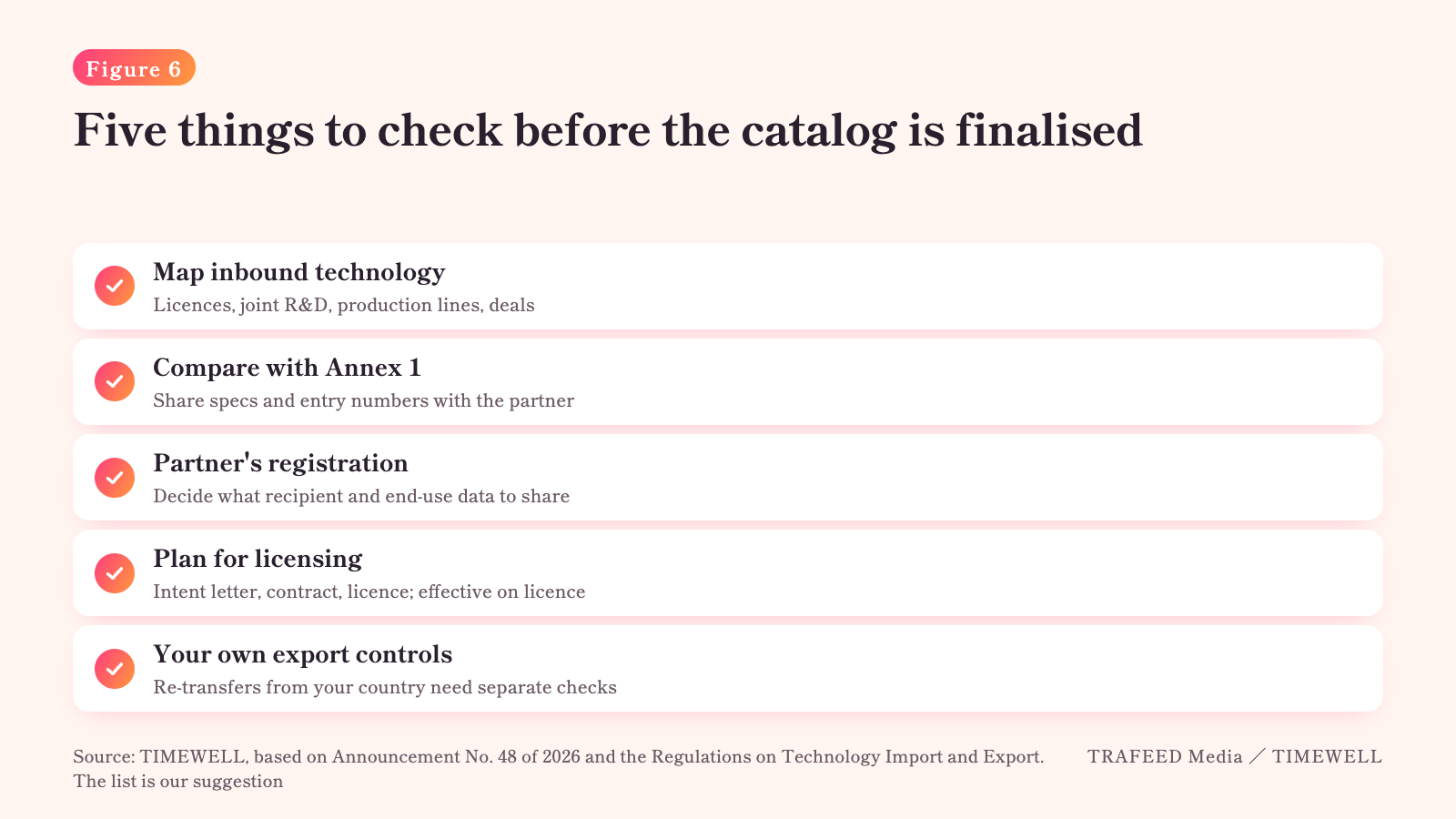 Figure 6: What companies receiving technology from China should check before the final revision. Working from the top gives you what you need for the next step. Source: TIMEWELL, based on Announcement No. 48 of 2026 and the Regulations on Technology Import and Export. The list is our suggestion, not a legal requirement
Summary
China's draft revision adds 40 AI, biomedicine and solar technologies to its technology export catalog. The revision is still a draft, but registration before export has already started.
- Announcement No. 48 of 2026 (October 16) proposes 14 prohibited and 26 restricted technologies. Comments closed on November 15, and no final version had been published as of November 30
- Registration before exporting the listed technologies has applied since October 16 and covers ongoing deals. The Chinese exporter registers
- According to MOFCOM, buying products, using AI through APIs or SaaS, and public-domain technology are out of scope
- Once final, restricted items need a licence, and the contract waits for the licence to take effect
If I had to pick one sentence that matters most in practice, it is not the list of 40 technologies but the line saying ongoing exports are covered. If you have a deal to receive technology from a Chinese partner, start by asking them whether they have registered. TRAFEED Media will add the date and the final content to this article once the revision is published.
We track regulatory changes in China and elsewhere in TRAFEED Media's regulatory updates and the weekly digest. If you want to build screening of partners and technology into your process, TRAFEED applies each country's rule changes and runs the checks in one place.
Related articles
- China's export control legal framework guide
- China's dual-use export control list
- China's export control whistleblower system
References
Footnotes
-
MOFCOM and Ministry of Science and Technology of the People's Republic of China, Announcement No. 48 of 2026 on public consultation on revising the Catalogue of Technologies Prohibited or Restricted from Export and interim registration for related technology exports (October 16, 2026, in Chinese). https://www.mofcom.gov.cn/zcfb/blgg/gg/2026/art/2026/art_05e2643a8ca04eb9adf9dd0542991fe4.html (retrieved November 30, 2026) ↩ ↩2 ↩3 ↩4
-
Regulations of the People's Republic of China on Technology Import and Export (State Council Decree No. 331 of 2001, amended 2011 and 2019), Articles 30 to 37 (in Chinese). State Council Gazette, Supplement 2019 No. 1. https://www.gov.cn/gongbao/content/2019/content_5468926.htm (retrieved November 30, 2026) ↩ ↩2
-
MOFCOM, spokesperson's answers on revising the Catalogue of Technologies Prohibited or Restricted from Export (October 16, 2026, in Chinese). https://www.mofcom.gov.cn/syxwfb/art/2026/art_a4acff07e134447fbe7bbeb486df3ea6.html (retrieved November 30, 2026) ↩ ↩2 ↩3 ↩4
-
Ministry of Science and Technology, "MOFCOM and MOST revise and issue the Catalogue of Technologies Prohibited or Restricted from Export" (December 21, 2023, Announcement No. 57 of 2023, in Chinese). https://www.most.gov.cn/kjbgz/202312/t20231221_189242.html (retrieved November 30, 2026) ↩
-
MOFCOM and MOST, Announcement No. 28 of 2025 on adjusting the Catalogue of Technologies Prohibited or Restricted from Export (July 15, 2025, in Chinese). https://www.mofcom.gov.cn/zcfb/blgg/gg/2025/art/2025/art_aaaf4e92c93b4809a1edc45d8ab9c070.html (retrieved November 30, 2026) ↩
-
Annex 1 to Announcement No. 48 of 2026, scope of AI, biomedicine and solar technologies proposed for the catalog (consultation draft, in Chinese). Retrieved from the MOFCOM announcement page on November 30, 2026, converted from the original WPS file to text; the compute threshold was checked against the superscript in the original (10 to the 26th power) ↩ ↩2 ↩3