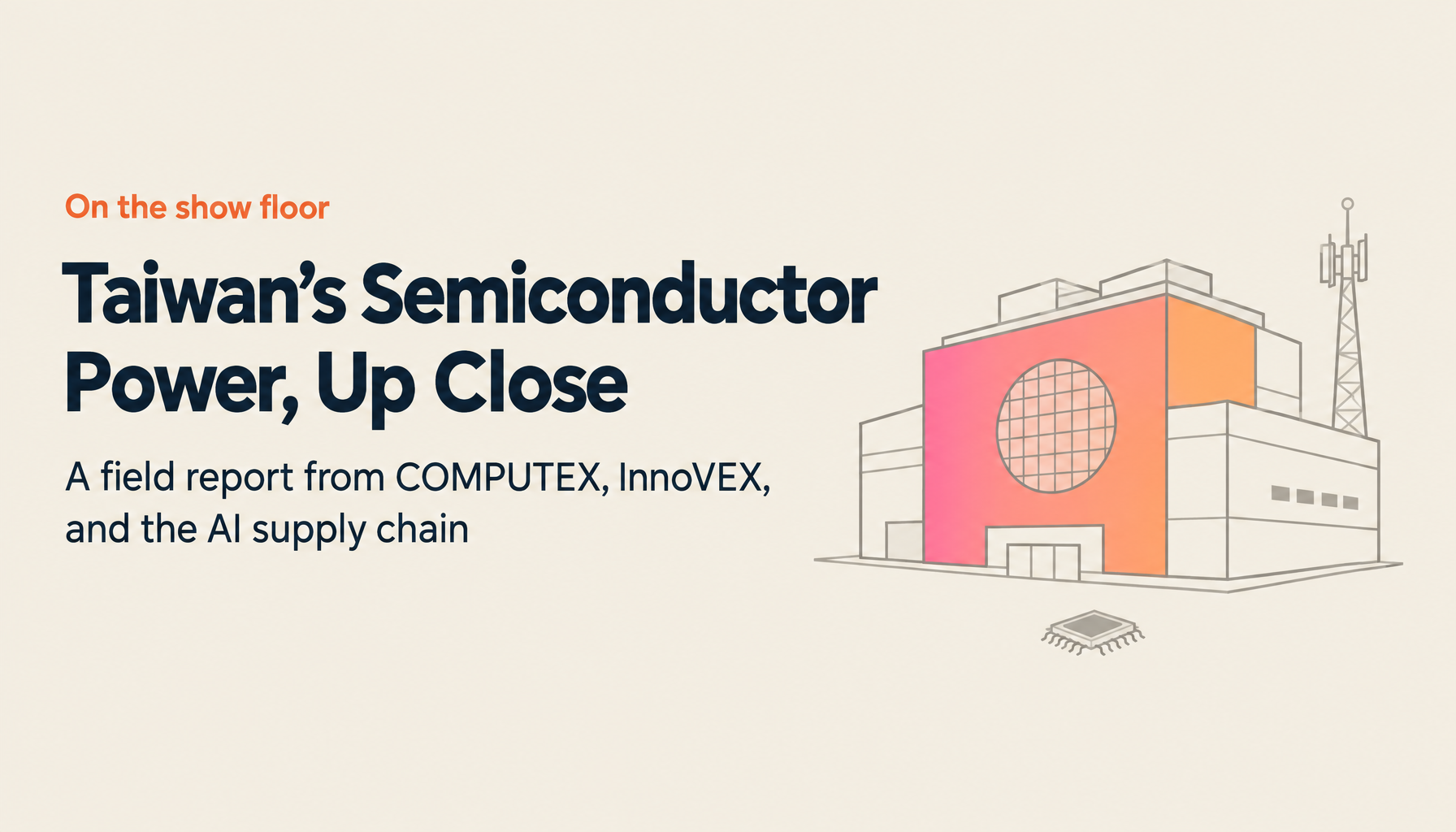
Hello, this is Ryuta Hamamoto from TIMEWELL. In June 2026 I traveled to Taipei, Taiwan for COMPUTEX 2026 — one of Asia's largest tech events — and the co-located startup event InnoVEX 2026 (June 2-5). This is my on-site report. I've written it from the history and background forward, so it should make sense even if Taiwan, COMPUTEX, and InnoVEX are all new to you.
Let me lead with the three things I most want to convey from this trip.
- COMPUTEX 2026 ran under the theme "AI Together," gathering 1,500 companies from 33 countries and regions and reaching its largest scale ever. NVIDIA CEO Jensen Huang declared that the next-generation Vera Rubin platform had entered full production, marking a turning point as AI expands from cloud computation into "physical AI" (robotics) in the real world.
- Taiwan's place at the center of the world's semiconductors is no accident. It is the cumulative result of innovations — the founding of ITRI and the technology transfer from RCA in the 1970s, the Hsinchu Science Park in 1980, and the founding of TSMC in 1987 — and Taiwan now produces over 90% of the world's advanced logic chips.
- We at TIMEWELL exhibited the world's first export control AI agent, TRAFEED, at InnoVEX, and gave a pitch at the Japan Pavilion on June 3. The geopolitical reality of US-China semiconductor friction and tightening export controls is the very challenge TRAFEED set out to solve.
There is something I felt again and again on the show floor: conversations about semiconductors and AI always land, in the end, on a question of security — whom do you trust to send your goods and technology to? I wrote this report to share that texture.
What COMPUTEX Is, to Begin With
COMPUTEX is a computer trade show that began in Taipei in 1981. It is organized by TAITRA (the Taiwan External Trade Development Council), Taiwan's foreign trade promotion body, and the Taipei Computer Association (TCA). It started as a platform for exporting Taiwanese-made electronics, but over 45 years it grew enormous alongside the rise of the global ICT industry. Every year more than 40,000 buyers gather in Taiwan, and it is known as a stage where global companies unveil era-defining products.
The 2026 edition ran from June 2 to 5 under the theme "AI Together." The venue was spread across four sites — Halls 1 and 2 of the Taipei Nangang Exhibition Center, the World Trade Center, and the Taipei International Convention Center — straddling the Nangang and Xinyi districts to become one of the world's largest multi-venue exhibitions. 1,500 companies from 33 countries and regions exhibited, filling 6,000 booths and setting a new record for the largest scale ever. President Lai Ching-te and Premier Cho Jung-tai attended the opening ceremony.
TAITRA Chairman James Huang said "AI is opening a new chapter in human civilization," and described this year's COMPUTEX through the concept of an "AI life ecosystem." The idea is to map AI computing onto the soul and brain, robotics and smart mobility onto the limbs, and add next-generation technologies to draw a complete blueprint stretching from the cloud to physical deployment. Alongside regulars such as Acer, ASUS, Delta Electronics, Foxconn, Intel, MediaTek, MSI, and Pegatron, the newly established "AI Robotics Pavilion" stood out.
The Future of AI as Drawn by Each CEO — From the Keynotes
NVIDIA's Jensen Huang
The de facto opening keynote was Jensen Huang's talk on the morning of June 1 at the Taipei Music Center, part of the co-located "GTC Taipei." Taiwan-born Huang is a local star, and his parents were invited to the talk. The atmosphere in the hall was unlike any other. I could feel firsthand that he is a source of pride for Taiwan.
The heart of the talk was this: "agentic AI is already here, working, and generating profit — every token is a unit of revenue." Huang said "AI is now something that generates profit, something that generates GDP," and argued that Taiwan's GDP would grow nearly 10% this year on the back of NVIDIA's supply chain.
The biggest announcement was that the next-generation platform "Vera Rubin" had entered full production. "Vera Rubin is in full production. The supply chain we built for it is twice the scale of Grace Blackwell. What once took two hours to assemble a single rack now takes five minutes." Vera Rubin combines the in-house Vera CPU (88 cores) with the Rubin GPU, involved 40,000 engineers, and is manufactured on TSMC's 3nm process. The Vera Rubin NVL72 links 36 Vera CPUs and 72 Rubin GPUs over sixth-generation NVLink, and is said to deliver up to 10x better power efficiency per inference and one-tenth the cost per token compared with the previous-generation Blackwell. At the COMPUTEX Best Choice Awards, a single product won three top honors for the first time in the awards' history. That said, while full production was declared, volume shipment is targeted for the summer of 2026 onward, and broad availability to customers for the second half of 2026. When reading the coverage, it's worth keeping in mind that "full production" and "volume shipment" are not the same thing.
Huang also announced NVIDIA's full-scale entry into the PC market. The Arm-based PC superchip "RTX Spark" (development codename N1X, the same chip) fuses a Blackwell RTX GPU with a 20-core Grace CPU co-developed with MediaTek over NVLink-C2C. It is an SoC built on TSMC's 3nm process with roughly 70 billion transistors, and it will ship in Windows PCs from Microsoft, Dell, HP, ASUS, Lenovo, and MSI in the fall of 2026. "The PC is being reinvented. This is as big an event as the phone being reinvented into the smartphone." Alongside this, the 55-billion-parameter MoE open model "Nemotron 3 Ultra" was also announced.
CNBC's Jim Cramer remarked that this talk made the case for AI infrastructure investment with the message "compute is revenue," and lifted related stocks. Indeed, Taiwanese stocks broke through 45,000 points on June 1 to set a new all-time high, and the combined market capitalization of the presenting companies exceeded $10 trillion.
Qualcomm, Intel, and Others
The opening keynote was delivered by Qualcomm President and CEO Cristiano Amon on the afternoon of June 1. Under the theme "AI computing is becoming ubiquitous," he spoke about Snapdragon's expansion into AI PCs and smartphones, industrial AI, robotics, and the data center.
Intel CEO Lip-Bu Tan took the stage on June 2 under the title "The Next Era of AI." With AMD sitting out its keynote this year, Intel was the only x86 vendor present. As the first Intel CEO who can speak Mandarin, he positioned himself as a member of the Taiwanese community, which left an impression. Intel announced the ramp of 18A (a 1.8nm-class node). Perplexity CEO Aravind Srinivas appeared and demonstrated "hybrid inference," processing confidential data locally on the device and everything else in the cloud. It was a symbolic moment showing that protecting confidential data is being built into the very design philosophy of computing architecture.
Marvell's Matt Murphy and NXP's Rafael Sotomayor also took the stage. NXP focused on "physical AI" and the intelligent edge, arguing that AI is moving toward autonomous real-world systems that demand safety, low latency, and real-time performance. The COMPUTEX Forum was its largest ever, with 28 sessions over three days. TrendForce forecasts that the robotics LLM market will surpass $100 billion by 2028, with a compound annual growth rate of 48.2% from 2025 to 2028. Compal's "POLYMEDX" platform for smart hospitals, built in partnership with NVIDIA, also stuck with me as a concrete example of physical AI.
InnoVEX — A Place to Discover Startups
InnoVEX began in 2016 as COMPUTEX's dedicated startup zone. It is organized by the TCA and TAITRA. In its first year, 217 companies from 22 countries exhibited, 35% of them from overseas. The original goal was to discover and support IoT startups.
The reason InnoVEX works so well is that Taiwan has the world's strongest ICT supply chain. Exhibitors can negotiate directly with majors such as TSMC, MediaTek, Delta Electronics, and Wistron, gaining funding, R&D, manufacturing partners, and sales channels all at once. In 2016, a delegation from the accelerator Garage+ reported having "completed 65 meetings with the likes of TSMC and MediaTek by the second day." Its strength is having all five elements in place: exhibitions, demos, forums, a pitch competition, and matchmaking.
In 2026, roughly 500 companies from 22-23 countries gathered, an 11% increase year over year and the largest turnout ever. Under the theme "AI Together," it ran from June 2 to 5 in Hall 2 of the Nangang Exhibition Center. Nine countries set up national pavilions: France, Japan, South Korea, Thailand, Australia, Israel, Canada, Italy, and the Czech Republic. The total prize pool for the pitch competition was upgraded to US$60,000 (up to US$30,000 for a single team), and the finals were held in eight minutes (a five-minute pitch and three minutes of Q&A, in English). Japan exhibited as the "Japan Bizcrew Pavilion" and held "Discover the Next Disruptors" on the InnoVEX Center Stage on June 3. The official COMPUTEX media also featured the Japanese contingent under "10 Japanese Innovators Showcasing AI, Deep Tech and Mobility at InnoVEX 2026."
Replace siloed classification work with AI.
METI's FY2024 data shows 52% of foreign exchange law violations stem from classification errors. Download the TRAFEED product catalog covering features and rollout.
What TIMEWELL and TRAFEED Saw on the Ground
We at TIMEWELL exhibited the world's first export control AI agent, TRAFEED, at InnoVEX 2026. We gave our pitch in the Japan Pavilion slot from 14:00 to 14:30 on June 3. As a result, we received several partnership inquiries and a trial sign-up from a customer, making it a rewarding occasion (since the parties involved are confidential, I'll describe our counterpart vaguely as "a major IT company").
To be honest, before exhibiting I had a slight worry: would a subject as unglamorous as export control resonate at a cutting-edge semiconductor event? Once the doors opened, that worry proved entirely unfounded. Because Taiwan is the heart of the world's semiconductors, it is precisely the place most sensitive to export control and supply chain security. Why was the response so strong? The answer is deeply tied to the geopolitical themes in the second half of this report.
Why Is Taiwan's Semiconductor Industry So Strong?
This is the core of the report. How could an island of roughly 24 million people become the single most important player in the world's most important industry?
From a Secret Talk at a Breakfast Shop to TSMC
The story begins in 1974. At a certain breakfast shop in Taipei, seven men held a meeting that would shape Taiwan's future. Among them were Y.S. Sun (孫運璿), the Minister of Economic Affairs; Wang Zhao-zhen (王兆振), president of ITRI; Fei Hua (費驊), Secretary-General of the Executive Yuan; and Wen-Yuan Pan (潘文淵), director of research at RCA (the Radio Corporation of America). Over a single breakfast, the blueprint for Taiwan's semiconductors was drawn. Hearing this anecdote again on the ground, I felt the weight of what a nation's will can be.
In 1973, the government established ITRI (the Industrial Technology Research Institute). In 1976, ITRI signed a technology transfer and licensing agreement with RCA of the US. For three years Taiwan paid RCA US$1 million annually, receiving technology and talent development in return. The first 19 people sent to the US included Robert Tsao (曹興誠), later chairman of UMC; Tsai Ming-kai (蔡明介), later chairman of MediaTek; and F.C. Tseng (曾繁城), later vice chairman of TSMC. The technology they brought in was a 7-micron process that was already outdated, but it was the starting point for everything.
In 1980, ITRI spun off its 4-inch wafer technology to establish Taiwan's first IC company, UMC (United Microelectronics Corporation). That same year, the Hsinchu Science Park opened. Then in 1985, a turning point arrived. Morris Chang (張忠謀), who had built a 25-year career at Texas Instruments (TI) in the US, crossed over to Taiwan at the invitation of Premier Y.S. Sun and Minister without Portfolio K.T. Li (李國鼎), becoming president of ITRI. During his time at TI, Chang had watched the Japanese plants achieve twice the productivity of the US plants, and had become convinced that "the future of advanced manufacturing lies in Asia."
The Invention of the Foundry Model
K.T. Li told Chang, "I want you to start a semiconductor company in Taiwan." Chang looked at reality with a cool eye. Taiwan had neither IC design capability nor access to the global market, and its manufacturing technology lagged the industry leaders by 2.5 generations. Competing head-on, it could not win.
So he conceived the "pure-play foundry" model. Rather than designing and selling its own products, the company would devote itself solely to manufacturing chips designed by others. The conventional wisdom of the day was "real men have fabs" — in other words, the integrated device manufacturer (IDM) model that spanned design, manufacturing, and sales (Intel and Samsung being the archetypes) was taken for granted, and a pure-play foundry was seen as something that "couldn't possibly work."
But Chang's read was right. For "fabless" companies that own no factories, a trustworthy third-party manufacturing service was something they craved. TSMC adopted the principle of "never competing with its customers" and became the partner of the fabless firms. This enabled the rise of Qualcomm, NVIDIA, Broadcom, and MediaTek, and the more they grew, the larger TSMC became — a self-reinforcing loop.
On February 21, 1987, TSMC (Taiwan Semiconductor Manufacturing Company) was founded. The capital came 48.3% from Taiwan's government National Development Fund, 27.5% from Philips of the Netherlands, with the remainder borne by local entrepreneurs. The fact that both Intel and TI declined Chang's request for investment, and only Philips agreed, speaks to how heterodox the model was seen to be at the time. The first plant set out with 3-micron, 6-inch wafer technology — several generations behind the industry. It posted losses in its founding year and in 1990, but from 1991 onward it never posted a loss again and kept growing. Its technical catch-up was astonishing too, advancing nine generations from 2.0μm to 0.18μm between 1987 and 1999.
Where in the Value Chain Is Taiwan Strong?
The semiconductor industry broadly divides into design, front-end (wafer fabrication), and back-end (packaging and testing). Taiwan is strong across nearly all of these domains. In design, MediaTek is the world's top mobile chip design company. In the front-end, TSMC is the world's largest foundry, leading the cutting edge at 3nm and 2nm almost exclusively. In the back-end, ASE Technology is the world's largest OSAT company, with $18.54 billion in OSAT revenue in 2024, accounting for roughly 44.6% of the top 10. ASE is also a key partner to TSMC in the back-end of CoWoS.
Why Did It Cluster in Hsinchu?
On December 15, 1980, Taiwan's government opened the Hsinchu Science Park. Modeled on Silicon Valley in the US, it was built adjacent to National Tsing Hua University and National Chiao Tung University, and ITRI's laboratories relocated there as well. A place that had once been derelict farmland was transformed into the heart of the world's semiconductor supply chain. The success factors were preferential tax treatment and startup support; industry-academia collaboration with universities and research institutions; the return of Taiwanese-American talent who had gained experience in Silicon Valley; sustained investment in power, water, and transportation; and the geographic proximity that put specialty gases, wafers, packaging, and testing all within a few hours' drive. K.T. Li also brought the concept of venture capital to Taiwan. Today, more than 500 companies are clustered in the Hsinchu Science Park, employing about 160,000 people.
The Silicon Shield and Global Share
Taiwan's semiconductor concentration gave rise to the geopolitical concept of the "Silicon Shield." The idea is that because Taiwan's semiconductor industry is indispensable to the global economy, it deters a forced unification by China and, were one to occur, would prompt intervention by foreign powers (especially the US).
In numbers, Taiwan's position is overwhelming. TSMC alone manufactures over 90% of the world's most advanced chips. A US ITC working paper also notes that "Taiwan supplies over 90% of the market for advanced logic chips, and it would be difficult for US buyers to find alternatives." Across the foundry market as a whole, TrendForce puts TSMC's full-year 2025 share at 69.9% (up from 64.4% the prior year), 62.7 points ahead of second-place Samsung's 7.2%. TSMC's 2025 revenue was $122.54 billion (up 36.1% year over year).
That said, the phrase "Taiwan makes 90% of advanced semiconductors" calls for care. That figure is limited to advanced logic; across "advanced silicon as a whole," including DRAM and NAND, Taiwan's share is much lower. Semiconductor analyst Scotten Jones has also objected to the loose use of this number. As someone who shares information publicly, I make a point of using the precise wording: "over 90% of advanced logic chips."
Where Exactly Is Manufacturing Especially Strong?
The Most Advanced Processes
TSMC began volume production of 7nm in 2018, 5nm in 2020, and 3nm in December 2022, and in the fourth quarter of 2025 entered volume production of its 2nm-class "N2" with a nanosheet transistor (GAA) structure. Compared with N3E, N2 delivers a 10-15% performance gain at the same power, or a 25-30% power reduction at the same performance. Intel's 18A also entered volume production in the fourth quarter of 2025, so three options line up at the 2nm class — but over 90% of design tape-outs are concentrated on TSMC N2. Even when there are options, everyone ends up gathering at TSMC. That's the reality.
CoWoS, the Real Bottleneck
This is surprisingly not well known, but the supply constraint for AI chips lies less in wafer fabrication than in the advanced packaging called "CoWoS (Chip on Wafer on Substrate)" in the back-end. CoWoS is a 2.5D technology that connects the compute die and HBM (high-bandwidth memory) with high-density wiring on a silicon interposer, and it is indispensable to NVIDIA's Blackwell and AMD's MI355. Even with a finished 3nm wafer, you don't get a functioning AI chip unless it passes through the CoWoS process. It breaks through the "memory wall" — the inability to pack enough memory inside the chip — by placing HBM right next to the compute chip.
TSMC CEO C.C. Wei (魏哲家) candidly acknowledges that "CoWoS capacity is extremely tight, and the sold-out state will continue from 2025 into 2026." TSMC is expanding its CoWoS capacity roughly fourfold in under two years — from about 35,000 wafers per month in late 2024 to about 130,000 by the end of 2026 — yet it still can't meet demand. NVIDIA has secured the majority of 2026 CoWoS capacity, and TSMC outsources some processes to ASE and Amkor. As AI chips have grown so large that they exceed the limit of what a single exposure can print, there is also a shift toward the CoWoS-L method that "stitches together" multiple chiplets.
TSMC's Overseas Expansion
In response to geopolitical risk diversification and the requests of various governments, TSMC is advancing its overseas expansion. In Arizona in the US, it plans to invest a total of $165 billion to build six advanced fabs and more, with the first fab starting volume production at 4nm in the fourth quarter of 2024. JASM in Kumamoto, Japan (a joint venture with Sony and Denso) began volume production at the first fab on mature processes at the end of 2024, turned its first profit in the first quarter of 2026, and changed its plan for the second fab from the originally planned 6nm to 3nm in response to AI demand. ESMC in Dresden, Germany is scheduled to start volume production at the end of 2027. These are also discussed in terms of a "Silicon Shield 2.0" — deepening interdependence with diverse democracies to raise the resilience of the supply chain. At the same time, some argue that if advanced production is dispersed, "the shield grows thinner," and the debate continues.
Geopolitics and Security — The Challenge TRAFEED Solves
Taiwan's semiconductor supremacy is also the front line of US-China rivalry. In October 2022, the US introduced export restrictions on advanced logic chips and manufacturing equipment to China. Since then, the rules have been repeatedly tightened and adjusted in stages. In 2025, the Trump administration added 42 Chinese companies to the Entity List in March and 23 more in September, and required a license to sell NVIDIA's H20 GPU to China. On the other hand, following President Trump's announcement on December 8, 2025, the US Commerce Department's BIS moved on January 13, 2026 to ease restrictions toward allowing the H200 and MI325X to be exported to China subject to review — the rules swinging between tightening and easing.
China responded with countermeasures of its own, retaliating with export restrictions on gallium, germanium, and rare earths, and in April 2026 promulgated the "Industrial and Supply Chain Security Regulations" (State Council Order No. 834). In the US Congress, more than 20 export control bills are under deliberation — the largest such slate ever — including the "MATCH Act" that would further strengthen equipment restrictions.
This complex, frequently shifting regulatory environment is exactly the challenge our export control AI agent, TRAFEED, set out to solve. Keeping up with regulatory changes by human effort alone is nearing its limit. At the InnoVEX COMPUTEX Forum, "data intelligence, governance, and security" was one of six major themes, and in his opening remarks President Lai Ching-te said, "The next stage of AI development requires trusted partners who share common values and can collaborate together globally." Export control, I realized anew on the ground, is precisely the practical guarantee of being such a "trusted partner."
The Cultural Closeness of Japan and Taiwan
Taiwan is one of the most pro-Japan places in the world. According to the Japan-Taiwan Exchange Association's "FY2024 Public Opinion Survey on Japan in Taiwan," 81% of Taiwanese people feel a sense of affinity toward Japan, and 76% named it their "most-liked country or region" — both record highs. Surveys on the Japanese side likewise find that more than 70% of Japanese feel close to Taiwan.
This closeness, even as it holds complicated memories of the Japanese colonial period from 1895 to 1945, gives rise to a distinctive "affinity." After the Great East Japan Earthquake of 2011, donations from Taiwan reached about ¥25.3 billion, the largest in the world. In business settings too, Taiwanese people are friendly and place deep trust in Japanese companies. The warm welcome the Japan Pavilion received at InnoVEX exists precisely because of this soil. I myself was helped on the ground by the kindness of many Taiwanese people. Even without formal diplomatic ties between the governments, a privately led relationship described as "officially strangers, unofficially friends" has taken root. I recalled that phrase many times during my stay.
How These Technologies Will Change the World
The direction COMPUTEX and InnoVEX pointed to was clear. AI has moved from a competition to "train ever-larger models" to a stage of "deploying in the real world."
The data center is becoming the "AI factory." NVIDIA noted that the cost of one gigawatt of AI infrastructure reaches $100 billion, signaling an era in which power efficiency translates directly into revenue. AI is dispersing from the cloud to the edge and devices, and "hybrid inference" — processing confidential data locally — is becoming standard. Security and privacy are being built into the core of design. And then there's physical AI: AI gaining limbs in the physical world, permeating manufacturing, logistics, elderly care, and healthcare.
These technologies will change the very nature of how we work, the structure of industries, and the shape of society itself. And the greater the change, the more the importance grows of the "foundation of trust" — export control and security. This trip only strengthened that conviction.
As Next Actions
Finally, let me leave a few practical suggestions for different positions.
To Japanese startups. InnoVEX is a rare place where you can access Taiwan's world-strongest ICT supply chain directly. Prepare your exhibit by roughly four weeks before the pitch competition registration deadline. A national pavilion via JETRO or Japan Bizcrew can offer fee reductions and exposure support. If your technology falls into AI, robotics, the semiconductor periphery, or security, and you're seeking the Asian market or deals with majors, it is well worth exhibiting.
To companies involved in the semiconductor supply chain. Advanced packaging capacity such as CoWoS will remain a bottleneck throughout 2026. Securing advanced nodes like N2 now requires reservations and prepayment half a year in advance. Move your procurement plans forward.
To those responsible for export control and compliance. US-China regulations are shifting frequently between tightening and easing. If your transactions touch AI chips, manufacturing equipment, or exports to China, keeping up by human effort alone is no longer feasible. We have reached the stage where you should consider continuous monitoring by an AI agent like TRAFEED.
Make Export Control a System That Never Stops
The more semiconductors and AI move the world, the heavier export control becomes — the work of judging who may receive what, and how far. Regulations shift week by week, and both the items and the targeted companies keep multiplying. Sustaining all this on the manual labor and willpower of a single person in charge is no longer sustainable.
TIMEWELL's TRAFEED, as the world's first export control AI agent, supports everything from monitoring the latest regulatory developments to assisting with classification (gaihi) decisions and screening counterparties. It complies with METI standards and supports multiple languages. If you face challenges like "every regulatory revision throws the company into confusion" or "we want to eliminate the over-reliance on specific individuals for classification decisions," please feel free to Contact us · TRAFEED product catalog (PDF). If you'd like a partner to walk with you on AI adoption strategy more broadly, please also consider WARP consulting.
TIMEWELL aims to remain a company that supports the "foundation of trust" connecting the world and Japan, now and going forward.
References
- NVIDIA official blog, GTC Taipei keynote (June 2026)
- TrendForce (foundry share, March 12, 2026 release and others)
- CNBC, Tom's Hardware, ServeTheHome, DigiTimes reporting
- US ITC working paper, US Commerce Department BIS announcements
- Japan-Taiwan Exchange Association, "FY2024 Public Opinion Survey on Japan in Taiwan"
- COMPUTEX / InnoVEX 2026 official announcements