Are You Spending Too Much Time Creating Presentation Materials?
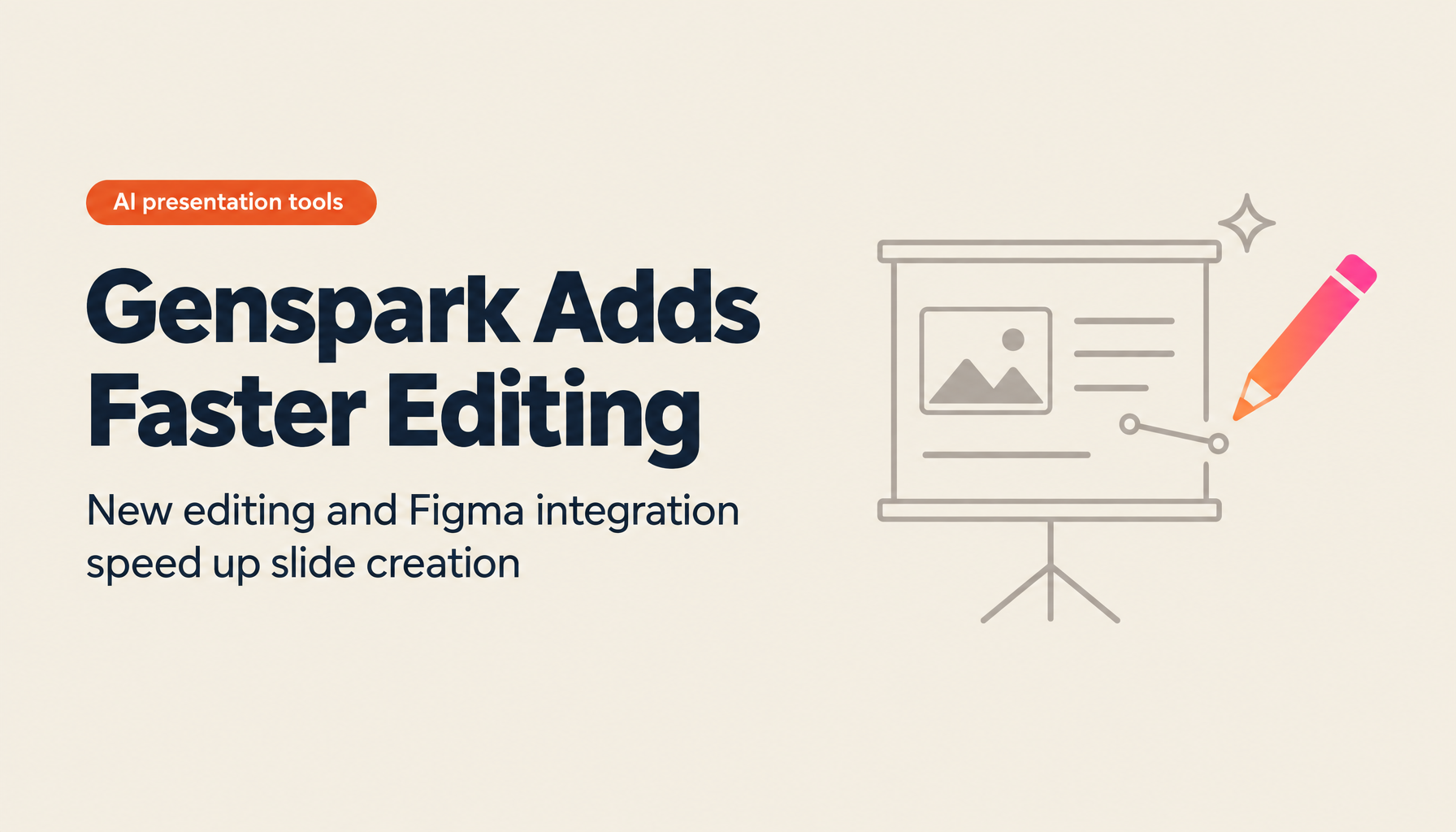
Are you spending too much time creating presentation materials? You have the ideas, but design skills and tool complexity keep getting in the way — a frustration many business professionals share. AI has finally arrived to solve this problem. The tool we're looking at today, "Genspark," creates professional-quality materials with remarkable speed and simplicity. It doesn't just challenge the existing image of AI presentation tools — recent updates have added long-awaited editing features and strengthened integration with external design tools, dramatically increasing both flexibility and quality.
This article provides a comprehensive guide to the evolved Genspark: how to use the new editing features, how to further refine generated materials in Figma or Canva, and a concrete walkthrough of creating YouTube presentation materials as a real-world use case.
- Genspark Evolves: New Editing Features, External Tool Integration, and What's Changed
- Creating YouTube Materials with Genspark: The Secret to Generating High-Quality Output from Prompts
- Advanced Editing in Figma with the HTML to Design Plugin: Workflow and Best Practices
- Next-Generation High-Speed, High-Quality Material Creation with Genspark and Figma
Take AI-driven development all the way to production
WARP is a hands-on program for teams who want more than headlines. Former enterprise DX and data strategy leads work alongside you until it runs.
Genspark Evolves: New Editing Features, External Tool Integration, and What's Changed
Until recently, AI presentation tools shared a common frustration: "you can't fine-tune the output after generation." You'd get a solid draft, but with no way to adjust the details, manual rework was inevitable. Genspark has broken through this limitation. The latest update dramatically strengthened the ability to directly edit generated materials.
Specifically, text editing is now fully flexible. Select any text box and you can edit the content, change font type and size, apply bold or italic formatting, adjust text color, and control alignment (left, center, right) — all intuitively. This means adjusting wording, emphasizing specific keywords, and other fine-tuning work can now all be done within Genspark. Previously, making even small changes like "I want to rephrase this" or "I want to make this font stand out" required exporting to another tool first. That friction is gone entirely.
Object editing has also become more robust. You can duplicate elements, delete unwanted objects, and fine-tune placement — all with simple mouse operations. If you want to reuse a design element you like on another slide, one click duplicates it, and drag-and-drop moves it into position. The ability to make quick, in-place edits is a significant quality-of-life improvement, and it has noticeably elevated both the speed and quality of material creation.
Genspark has also made major strides in integration with external tools. Generated materials can be exported in PowerPoint format — though honestly, layouts tend to break significantly at this point, so this feature still needs improvement and isn't something we'd strongly recommend yet. What is worth noting is the ability to export to major design tools like Canva and Figma. The Figma integration in particular is very powerful: you can take the skeleton Genspark creates and import it into Figma for advanced editing. This combination of Genspark's ease of use with Figma's precise design capabilities creates what is arguably the most powerful material creation workflow available. There has always been a gap between AI auto-generation and manual fine-tuning, but Genspark's new features and external tool integration are closing that gap — elevating the collaboration between AI and human creative work to a new level.
Creating YouTube Materials with Genspark: The Secret to Generating High-Quality Output from Prompts
Genspark's material creation capability is particularly powerful for visual content like YouTube. Here's a detailed look at the actual workflow for creating YouTube materials and the prompt techniques that consistently produce high-quality output.
The process starts with gathering information on your topic. Say you're creating materials for a YouTube video about "new features in Claude (Anthropic's AI model)." Copy the latest information from relevant websites and news articles — then feed that content into Genspark. But the key to great results lies in the quality of your prompt.
Here are the key prompt principles:
State a clear objective. Specify both what you're creating and what deliverables you need: "Based on the following Claude new features, create a complete YouTube outline, script, and slides." Being explicit about the goal — outline, script, and materials — is essential.
Specify the format. YouTube thumbnails and screen compositions call for "16:9" aspect ratio. Genspark is smart enough to generate appropriate proportions in most cases, but being explicit ensures it.
Set a quality direction. Adding something like "consultant-quality" prompts Genspark to generate materials with a more professional, authoritative tone. This effectively communicates the quality level you're aiming for.
Control information density. "Don't overload the slides with information" is critically important. AI tends toward thoroughness, wanting to include as much of the provided information as possible — but information-dense slides are hard for viewers to follow. This single instruction results in concise, clean slides.
Set an engaging title. Rather than leaving the title entirely to AI, give it some direction. For example: "ChatGPT-5.2 Rival? Claude Now Has Deep Research! Advanced Search Across Web and Internal Documents. Gmail, Drive, Calendar Integration Too!" A title with specific keywords that hook viewers will drive clicks.
Request supplementary information. Asking "What are some other use cases for this?" prompts Genspark to surface related information and practical usage ideas, making the materials richer and more actionable.
With these prompt techniques, Genspark generates remarkably high-quality materials. Looking at a "Claude new features explainer" generated with instructions like these: the output opens with a catchy title slide, followed by a clear table of contents. The main content on new feature introductions organizes sections like "Integrations" and "Advanced Research," with detailed descriptions for each. Particularly impressive is how Genspark auto-generates nearly perfect contextually relevant icons — a magnifying glass icon for "web search capability," connection imagery for "workspace integration," and so on, placed appropriately throughout.
Diagrams and charts are also used effectively. For detailed explanations of Advanced Research, the system generates schematic diagrams of how it works, example prompts for market research report creation, and even sample visualizations of what the resulting charts might look like. The level of specificity in these suggestions is genuinely "consultant-quality." The ability to generate example prompts is particularly useful — it serves as a reference for actually crafting AI instructions.
In this way, given the right prompts, Genspark produces everything YouTube material creation requires — from structural outline to specific slide designs to supplementary reference information — comprehensively and at high quality. With appropriate information density control, it creates materials that are clear and compelling for viewers.
Advanced Editing in Figma with the HTML to Design Plugin: Workflow and Best Practices
While Genspark alone can produce very high-quality materials, there are times when you want even more design control or finer detail. That's where Figma integration comes in. Figma is a professional-grade design tool used by designers worldwide, and importing Genspark materials into Figma unlocks pixel-level adjustments and more complex design elements. Here's a step-by-step guide to editing Genspark materials in Figma — specifically using the "HTML to Design" plugin.
First, you need to install the "HTML to Design" plugin in Figma. This plugin is a powerful tool that reproduces design elements in Figma based on HTML code or a website URL. Search for "HTML to Design" in Figma's plugin search and install it. Once installed, run the plugin in your Figma workspace (any file).
Running the plugin presents several import options. The two main approaches are: pasting HTML code directly, or importing by specifying a web page URL.
Method 1: Using HTML code directly from Genspark. In Genspark's editing view, copy the HTML code for a specific slide or element (in most web tools, you can view and copy element HTML through browser developer tools). Paste that HTML code into the "HTML to Design" plugin's input field and click "Create." The plugin parses the HTML and reproduces the slide design on your Figma canvas. This method works well when you want to import specific sections to Figma precisely. Elements imported into Figma are recognized as individual layers — text, shapes, and images each editable independently. You can change fonts, adjust colors, fine-tune layouts, and use Figma's full suite of editing features to achieve exactly the design you want.
Method 2 (recommended): Bulk import via URL. This method lets you import an entire Genspark presentation into Figma incredibly quickly and easily. The process: once your Genspark material is complete, set it to "Published" and select "View and Export" from the export options. A unique public link is generated for the material — copy it. In Figma, launch the "HTML to Design" plugin and select "Import via URL" or a similar option. Paste the Genspark material URL into the plugin's input field. Set language, theme (dark/light mode, etc.), and viewport size as needed, then click "Import." Wait a few seconds to tens of seconds and all slides from the Genspark material (say, 10-plus pages) are reproduced on your Figma canvas all at once. Compared to copying and pasting HTML one slide at a time, the time savings are enormous.
Materials imported into Figma are organized with each slide as a separate frame, with text, shapes, and images within each slide all placed in editable states. This means you can revise the text on specific slides, do a global color change, or use Figma's advanced design capabilities — auto layout, components, and more — to polish the design to a professional level. By combining Genspark's rapid drafting capability with Figma's precise design editing, you can achieve both speed and quality in material creation simultaneously.
This Figma integration is available on Genspark's free plan. If you're looking to streamline your material creation workflow, it's well worth trying this Genspark plus "HTML to Design" plugin combination. For YouTube materials, Genspark alone is often sufficient — but for more polished corporate presentation materials, this integration becomes a powerful asset.
Next-Generation High-Speed, High-Quality Material Creation with Genspark and Figma
This article has detailed the remarkable evolution of AI material creation tool "Genspark" — particularly the newly added editing features and the powerful integration with external design tools like Figma, with concrete use cases throughout. Genspark is no longer just "a tool for generating rough drafts." It has evolved into a next-generation material creation platform that generates professional-quality materials from a single prompt, then lets you intuitively edit and customize that output.
The ability to do text editing, font adjustment, object duplication and deletion, and other basic editing functions entirely within Genspark will significantly reduce the small daily friction points of material creation work. And as the YouTube material creation example demonstrated, giving well-crafted prompts produces high-quality output covering everything from structural outline to specific design to reference examples — in one pass. That's a compelling advantage no other tool can match.
The Figma integration — especially the smooth URL-based import via the "HTML to Design" plugin — is a genuine revolution in the material creation workflow. Rapidly generating the overall structure and design in Genspark, then adding fine-tuning and custom design elements in Figma, strikes an ideal balance between speed and quality. Being able to import large numbers of slides into Figma at once dramatically improves efficiency even for large-scale presentations. And much of this is available on the free plan — there's no reason not to try it.
There's also the possibility of setting up templates aligned with your brand or organizational identity in Genspark in advance, enabling anyone to easily create consistently high-quality materials. That's not just a benefit for individual productivity — it could be a major contribution to team and organizational productivity as well.
Material creation is unavoidable work for most business professionals, yet it often demands significant time and effort. Putting Genspark and its integrations to work can substantially reduce that burden, freeing up time for more creative, higher-value work. Experience the power of this evolved AI for yourself — and reinvent how you create materials.
Source: https://www.youtube.com/watch?v=rAJhbjUVYfQ
Streamline Event Management with AI | TIMEWELL Base
Struggling to manage large-scale events?
TIMEWELL Base is an AI-powered event management platform.
Proven Results
- Adventure World: Managed a Dream Day event with 4,272 attendees
- TechGALA 2026: Centrally managed 110 side events
Key Features
| Feature | Benefit |
|---|---|
| AI Page Generation | Event page ready in 30 seconds |
| Low-Cost Payments | 4.8% transaction fee (among the lowest in the industry) |
| Community Features | 65% of attendees continue engaging after the event |
Feel free to reach out to discuss how we can make your event operations more efficient.
Related Articles
- Accelerating Growth in the AI Semiconductor Market: Latest 2026 Trends and Strategies from TSMC and NVIDIA
- ElevenLabs 2026: Valuation Reaches $11 Billion, ARR Surpasses $330 Million, Dominating the Voice AI Market
- From 2026 to 2027: The Reality of AGI's Arrival, Anthropic CEO Confident It's "Within a Few Years"