This is Hamamoto from TIMEWELL.
Two major strategic announcements defined the AI platform landscape at Google I/O and in the surrounding period: Google's comprehensive generative AI integration across its full ecosystem, and OpenAI's bet on a screenless hardware device designed with former Apple chief designer Jony Ive. This article covers both, and what they mean for business strategy in the generative AI era.
Google I/O: Unified Generative AI Strategy
The Platform Scope
Google's announcement wasn't a single product — it was a declaration that generative AI would be integrated across every major Google platform simultaneously.
Android OS: Generative AI embedded into camera, voice recognition, and assistant functions. On Pixel devices, users can opt-in to share personal data (such as Gmail) with the AI, enabling personalized responses specific to the user's own context. This moves the AI from generic answers toward responses calibrated to individual history and behavior.
Chrome Browser — Project Mariner: An agentic capability that doesn't just display search results but executes tasks on the web based on user instructions. The scenario: user asks to buy a product, AI automatically adds it to the shopping cart and completes checkout. The gap between searching for information and taking action closes. This represents a qualitative shift in what a browser does — from navigation tool to execution agent.
Search: Moving from a list of links to AI-generated contextual answers. Rather than presenting ten URLs to click through, the search result itself becomes the answer, with supporting sources linked for verification.
Veo 3 — Video Generation: A new video generation model capable of natural video production with synchronized audio. Professional-quality video content becomes accessible without specialist production skills.
Scale at Announcement
Google's Gemini AI chat had reached 400 million monthly active users by the time of the I/O announcements, with over 150 million users across the broader Gemini ecosystem. The platform scale means AI integration changes the experience for an enormous existing user base, not just early adopters.
Looking for AI training and consulting?
Learn about WARP training programs and consulting services in our materials.
Apple's Position — Under Pressure
The Competitive Gap
Google's comprehensive integration creates a challenging context for Apple. The AI competition isn't about raw model capability — it's about ecosystem integration depth.
Apple's initial AI moves: selective feature rollouts, a ChatGPT partnership for email drafting. User reports indicated many Apple users were disabling "Apple Intelligence" notifications, finding the features more disruptive than useful.
The strategic gap: Apple's ecosystem coherence — historically its competitive advantage — requires AI that works as a unified layer, not as add-on features powered by external models. Outsourcing AI capability to ChatGPT or Google creates a dependency inconsistent with Apple's platform model.
The 6-12 month assessment: For Apple to maintain platform differentiation in the generative AI era, development of genuinely proprietary AI integrated across voice, natural language processing, and privacy-protected personalization was needed within a year. The Siri-Gemini partnership announced in January 2026 addresses capability, but represents a different strategic position than building it internally.
Screen vs. Voice as the Interface Question
The deeper strategic question the AI era raises: screens have been the primary interface for decades, but AI-first interactions are voice-centric. In public settings, voice interfaces that work without displaying information may be more practical than screen-based interactions. If AI-first devices that don't center on a display gain traction, the product category where Apple has excelled — premium displays as the user experience foundation — faces a different kind of challenge.
OpenAI's Hardware Bet — The Screenless Device
The $6.5 Billion Project
OpenAI partnered with Jony Ive (the designer most associated with the original iMac, iPod, iPhone, and Apple Watch design language) on a new hardware concept, with approximately $6.5 billion in investment.
The device concept:
- No screen
- Primary interfaces: voice, camera, sensors
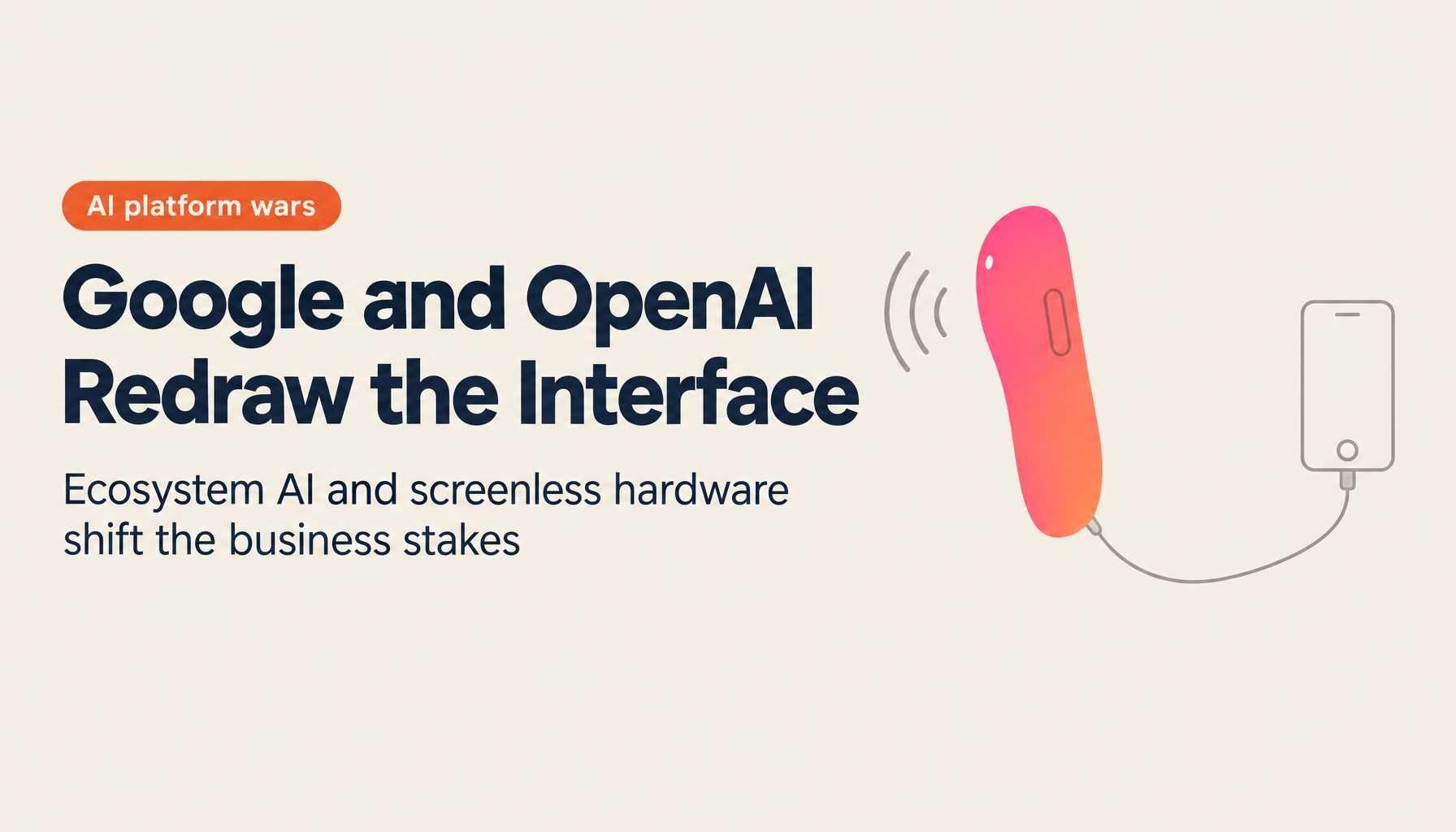
- Works in conjunction with a smartphone (tethering model, not standalone computing)
- Captures ambient conversational data in real time
- Enables retrieval of past conversations and environmental context
Why This Matters
The concept challenges a fundamental assumption: that the screen is the interface. If an AI-native device can handle the most frequent daily interactions through voice and ambient sensing — checking information, setting reminders, remembering context from earlier conversations — without requiring the user to look at a display, it potentially addresses limitations that screens create in many contexts.
The "tethered to smartphone" model is significant for feasibility. Rather than requiring standalone computing power that makes the device expensive and power-hungry, it offloads processing to an existing device. This is how wearables that complement smartphones rather than replace them have succeeded.
Jony Ive's involvement: Design execution matters in consumer hardware. Products with superior industrial design and interaction design have consistently outperformed technically equivalent products in consumer markets. Ive's track record with Apple's hardware era makes his participation a signal about the ambition level of the product.
What This Means for Business Strategy
The Ecosystem Investment Question
For businesses, the practical question isn't which company wins — it's which platforms to build on and bet for future capability. Several observations:
Google's unified AI strategy creates deep integration: Organizations already operating in Google Workspace will receive AI capability improvements across tools they use daily. Project Mariner-type agent capabilities could fundamentally change how web-based work gets done.
AI agents change workflow assumptions: When Chrome can execute multi-step web tasks on instruction, the manual workflows that involve searching, comparing, and completing purchases change. Workflows built on human operators executing web-based tasks face efficiency pressure.
Hardware form factor is an open question: The OpenAI device concept represents a bet that the current smartphone paradigm isn't the final form for AI-first computing. Organizations evaluating long-term AI infrastructure should track hardware evolution alongside software.
Privacy and personalization trade-offs: Google's opt-in personal data model for personalized AI responses raises an explicit trade-off: more useful AI in exchange for personal data access. Enterprise deployment policies will need to address how these opt-in decisions are handled for organizational devices.
Summary
Two strategic vectors are reshaping the AI platform landscape:
Google's approach: Comprehensive integration of generative AI across every major platform — Android, Chrome, Search, Workspace. Unified ecosystem strategy with 400M+ user scale.
OpenAI's approach: Hardware-first bet on a screenless, voice-and-sensor-centric device designed to complement smartphones rather than replace them. $6.5B investment with top-tier design talent signals serious platform ambition.
Apple's position: Under pressure to develop proprietary AI capability that integrates coherently with its ecosystem, rather than relying on external partnerships.
For business leaders, the generative AI platform competition requires attention not just as a technology trend but as a strategic environment that will change the tools available for work, the workflows that are efficient, and the competitive dynamics in technology-adjacent markets.
Reference: https://www.youtube.com/watch?v=W6ilp7hJSQ4