This is Hamamoto from TIMEWELL
This is Hamamoto from TIMEWELL.
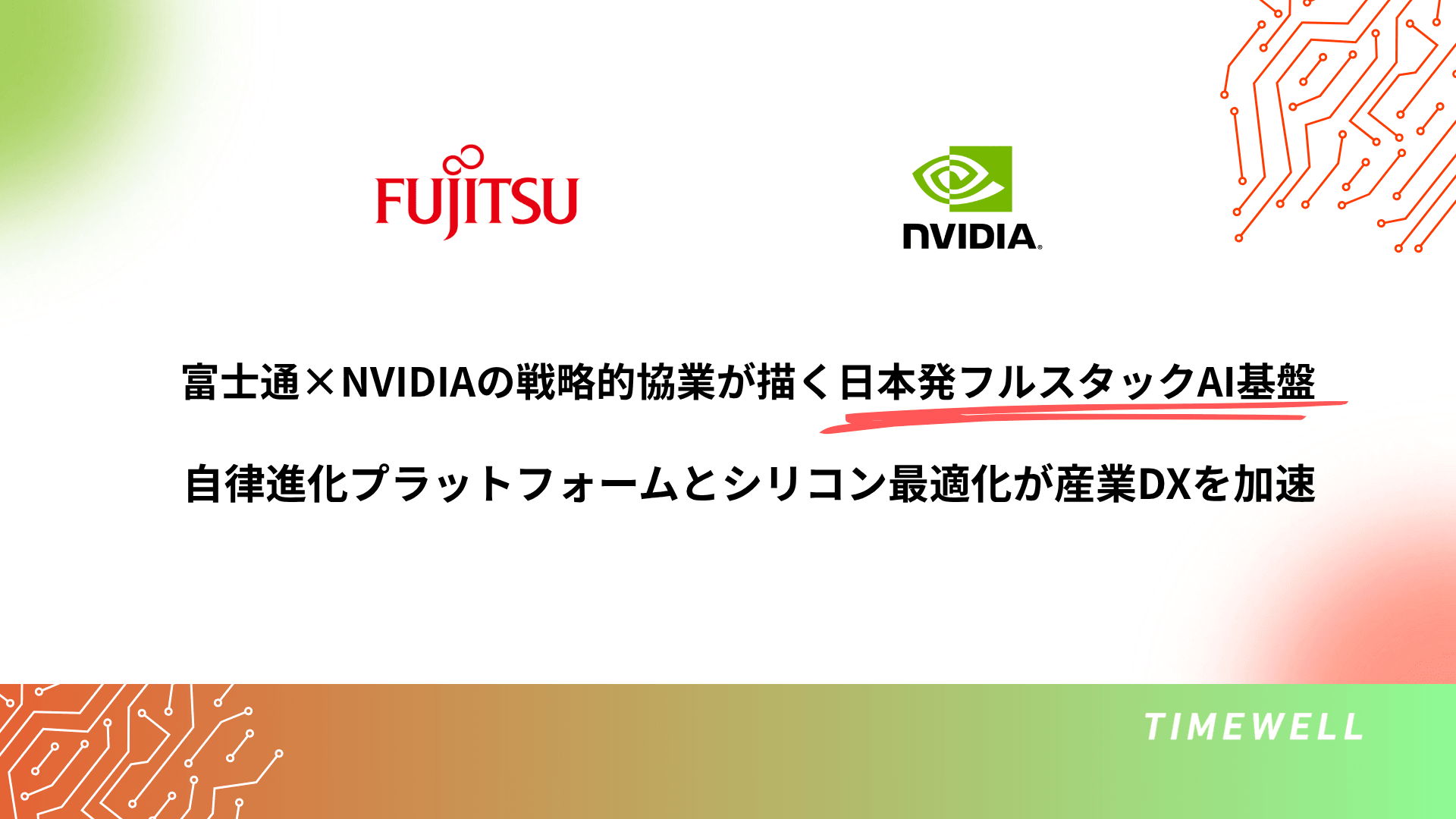
On October 3, 2025, Fujitsu Announced an Expansion of Its Strategic AI Partnership with NVIDIA
On October 3, 2025, Fujitsu President Takahito Tokita announced an expansion of the company's strategic AI partnership with NVIDIA. At the core of the announcement is the joint development of a "full-stack AI infrastructure" — optimizing everything from AI agents and large-scale models at the upper layer down to CPU-GPU integration, networking, security, and operations, all in one integrated approach. The vision is to combine Fujitsu's AI platform "Kozuchi," its low-power, high-performance "MONAKA" CPU series, and NVIDIA's GPU lineup and AI software stack into a platform where models and agents can continuously improve autonomously — achieving both massive compute performance and energy efficiency simultaneously.
Robotics was identified as the first area of societal deployment, with plans to expand to healthcare, manufacturing, telecommunications, government, and finance. Further, by incorporating the HPC lineage connected to Fugaku NEXT and looking ahead to future hybrid connections with quantum computing, the announcement emphasized a message of "designing AI together with Japan and for Japan" — positioning AI as foundational infrastructure on the same level as electricity and the internet.
- The Backbone of the Partnership: "Autonomously Evolving AI Platform" and "Silicon Optimization"
- The Front Lines of Deployment: From Robotics to Healthcare, Manufacturing, and Telecommunications
- Fugaku NEXT and the Quantum Horizon: Designing Long-Term Competitive Advantage with AI × HPC × Quantum Hybrid
- Summary
Struggling with AI adoption?
We have prepared materials covering ZEROCK case studies and implementation methods.
The Backbone of the Partnership: "Autonomously Evolving AI Platform" and "Silicon Optimization"
This partnership has a clear character across two layers — platform and computing.
At the upper layer, Fujitsu's Kozuchi is combined with NVIDIA's AI stack including NeMo and CUDA to build an autonomous mechanism where agents and models continuously learn from real-world operational environments. The security, auditability, multi-tenancy, and workload orchestration that enterprise production environments demand are areas where Fujitsu excels — laying out a path for rapidly launching industry-specific agents and accumulating results directly tied to on-site KPIs.
At the Lower Layer, the Arm-Based MONAKA Series and NVIDIA's GPUs
At the lower layer, the Arm-based MONAKA series and NVIDIA's GPUs are tightly coupled via NVLink and similar technologies, with compute resources spanning CPUs and GPUs optimized all the way down to the software layer. Rather than simply adding hardware together, the design premise includes the AI software foundation — which means that training, inference, and numerical computing workloads can all be procured and operated under a single unified policy.
This integrated design carries important implications for both research and commercial use. On the research side, exploration from algorithms to architecture can be accelerated. On the commercial side, there is a clearer path to stable performance delivery within TCO and power constraints. Supporting the "AI-driven society" that President Tokita described requires a substrate where data, processing capacity, and computational power grow together in a reinforcing cycle. The full-stack approach is precisely the "soil cultivation" work that makes this possible.
The Front Lines of Deployment: From Robotics to Healthcare, Manufacturing, and Telecommunications
Robots that require autonomous mobility and collaborative control need an integrated approach to perception, contextual understanding, planning, execution, and safety. Fujitsu bundles computing and networking together and connects to NVIDIA's AI stack to design a system that cyclically improves agents while continuously refining on-site data.
The announcement described a vision for collaboration with major domestic robot manufacturers — not just advancing industrial robots, but also moving into service applications in non-manufacturing sectors like healthcare and finance. In healthcare, agents capable of supporting clinical decision-making and hospital operations are envisioned, with a sovereign, secure inference foundation as a prerequisite for handling sensitive data while maintaining high availability.
In Manufacturing, the Direction Shown Spans Design BOMs Through Equipment Sensors
In manufacturing, the direction shown spans design BOMs through equipment sensors, quality records, and supply chain data — using generative AI and simulation to expand design exploration and automate predictive maintenance and anomaly detection.
In telecommunications, AI operates within 5G/6G networks to simultaneously pursue traffic optimization, fault prediction, and power consumption reduction. For industries where edge and private-domain operations are essential, running AI while maintaining location and data sovereignty is a non-negotiable requirement — and this is where Fujitsu's concept of "sovereign computing infrastructure" comes into its own.
What matters is that these deployments don't remain isolated proof-of-concept projects, but reach the stage where agents are embedded as standard operating procedures within business operations. The framework of simultaneously aligning platform, compute resources, and operational design is precisely the mechanism designed to drive that "standardization."
Fugaku NEXT and the Quantum Horizon: Designing Long-Term Competitive Advantage with AI × HPC × Quantum Hybrid
The partnership extends beyond current commercial AI. It is positioned as part of a larger movement to merge scientific computing and AI, continuous with the HPC flagship concept of Fugaku NEXT.
In Areas Where Numerical Simulation Is Indispensable
In areas where numerical simulation is indispensable — disaster prevention, meteorology, drug discovery, materials science, energy — accuracy and speed are simultaneously required. By extending the cooperative optimization of CPUs and GPUs all the way through the AI software layer, it becomes possible to increase outputs directly linked to decision-making without slowing the pace of research.
Fujitsu also mentioned a target of developing 1,000-qubit-class quantum systems by 2026, referencing the concept of a hybrid computing center integrating quantum and HPC, along with work on quantum machine learning. The idea is to treat quantum not as an experimental add-on, but as part of practical workloads naturally connected to classical computing and AI — an approach that is inherently "extensible by design," built to accommodate future upgrades.
If new GPUs, new CPU architectures, or quantum generational shifts can be incrementally upgraded while maintaining full-stack connectivity, industries can repeat lower-layer refreshes while maintaining abstraction at the use-case level. This is a significant advantage from the perspectives of long-term TCO, energy constraints, and compliance.
Jensen Huang said that AI will become as essential as electricity and the internet, and used the phrase "designing for Japan and with Japan" to convey the meaning of this partnership. Fujitsu has not changed its human-centric stance — using technology for human well-being — since its founding.
The joint development of a full-stack AI infrastructure is nothing less than an implementation plan that aligns this stance with the demands of the present. With an autonomously evolving platform and silicon optimization as its backbone, it advances implementation from robotics, healthcare, manufacturing, and telecommunications — connecting to Fugaku NEXT for HPC, and hybridizing in quantum.
By Organically Bundling Individual Technical Elements
By organically bundling individual technical elements, the goal is to create a state where AI operates stably deep within society — achieving sovereignty, flexibility, and security simultaneously. The announcement made clear the structural framework for responding — with a design-first approach — to the realities Japan's industry faces: labor shortages, energy constraints, latency requirements, and data sovereignty.
The day when agents become a normal part of on-site work, and the cycle where cutting-edge research connects directly to industrial value — driving both of these wheels is what this partnership's vision, built on Japan-native design, represents.
Reference: https://www.youtube.com/watch?v=EbpcHwr7vzM
Related Articles
- From Full-Time to Part-Time: Life After Two Maternity Leaves and How My View of Work Changed | TIMEWELL
- Before Paternity Leave (Part 2): Three Things You Absolutely Must Do to Take Leave During Busy Season
- Staying True to the Field: How the 5th-Generation Head of a Construction Firm Found His Own Way | Fujita Construction