Hello, this is Ryuta Hamamoto from TIMEWELL.
"Foreigners will no longer be able to buy land near Japanese bases." That is how a bill now before Japan's Diet often gets summarized. It amends what is usually called the Important Land Act (my translation of the full title: the Act on the Investigation and Regulation of the Use of Land and Buildings around Important Facilities and on Border Islands). The government submitted it on October 23, 2026, and the House of Representatives passed it on November 2412.
Read the bill itself and the picture is a little different. In the new "regulated zones" it creates, anyone transferring ownership of land or buildings would need government approval, whatever their nationality. The bill then defines who would in principle be refused, and it draws that line by a buyer's relationship with a foreign government, not by citizenship. Being a foreign individual or a foreign company is not, by itself, a reason for refusal.
I worked from the Cabinet Office's published summary, outline and comparison table of the bill, and the bill text on the House of Representatives website. I start with how the current law works, since most readers outside Japan have never had a reason to look at it. The zone names in English are my own translations.
Status as of November 26, 2026 The bill has passed the House of Representatives and is before the House of Councillors. It has not been enacted. Here is the timeline so far23.
- October 23, 2026: the government submitted the bill to the Diet, starting in the House of Representatives
- November 10: referred to the lower house's Cabinet Committee
- November 20: passed by the Cabinet Committee
- November 24: passed by the lower house plenary in a standing vote, with a majority in favor, and sent to the House of Councillors the same day
- November 26: the upper house's records still show no committee referral and no vote
Japanese media expect it to pass in the current Diet session, but even then it would take effect on a date set by Cabinet Order within 18 months of promulgation. Once it passes, I will add the upper house vote date, the promulgation date, and the law number here.
The short version
- Inside today's "monitored zones" and "special monitored zones," the bill adds a third tier: "regulated zones." These cover roughly 1,000 meters around defense and coast guard facilities with sensitive equipment such as fighter aircraft or radar, plus uninhabited border islands1.
- In a regulated zone, any transfer of ownership of land or buildings needs the Prime Minister's prior approval, with no minimum size. Without approval the transfer has no legal effect. This applies to everyone, regardless of nationality.
- Approval is in principle refused to people and bodies tied to a foreign government or military, and to entities in which they hold half or more of the votes or board seats. Anyone, Japanese buyers included, can be refused if there are reasonable grounds to suspect the land would be used to damage the facility.
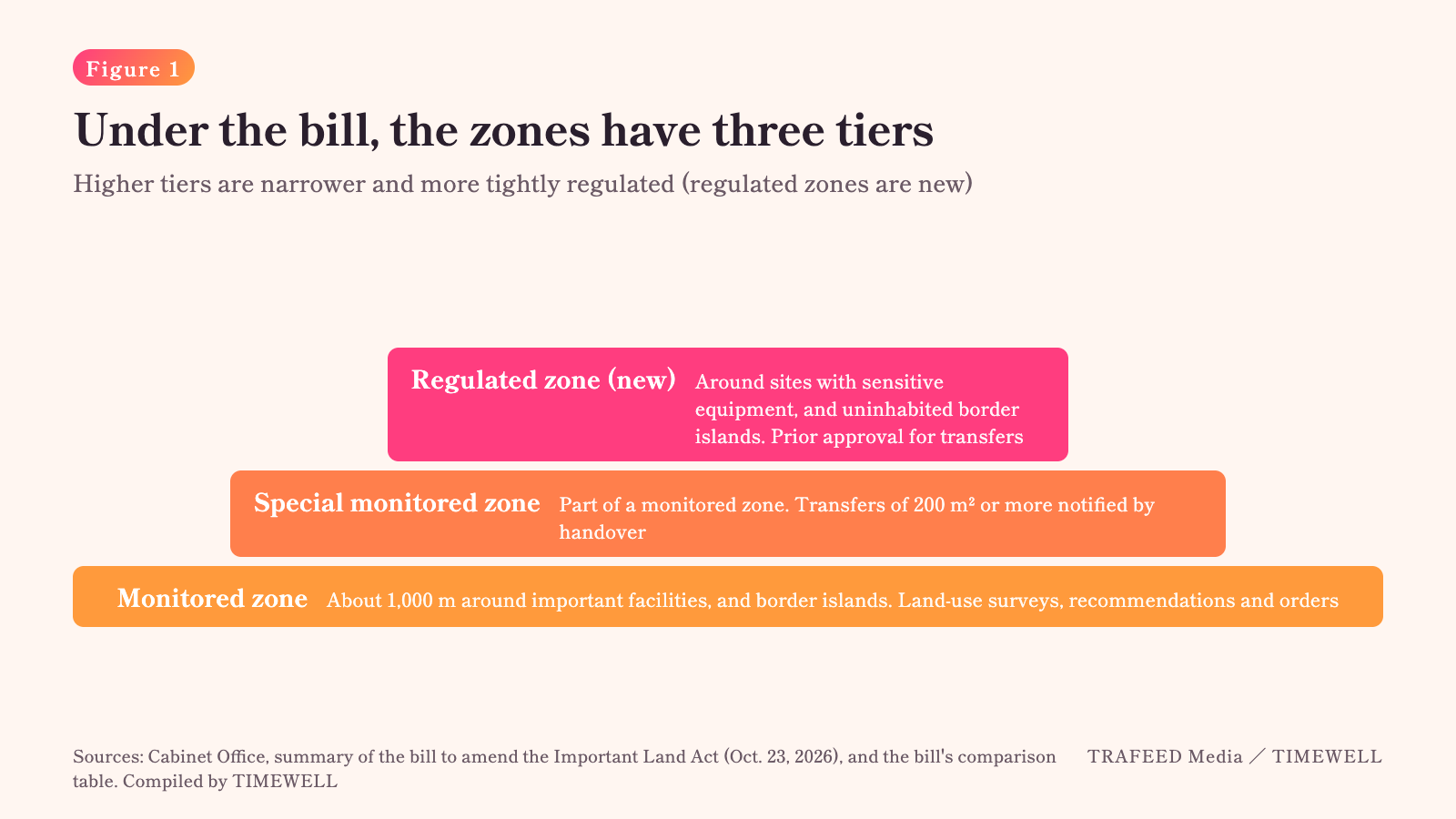
Figure 1. Under the bill, the zones have three tiers. Sources: Cabinet Office, summary of the bill to amend the Important Land Act (October 23, 2026), and the bill's comparison table. Compiled by TIMEWELL.
What the Important Land Act does today: two kinds of zones and a notice requirement
The current law was promulgated on June 23, 2021, and took full effect on September 20, 20224. It aims to stop land and buildings around "important facilities" (Self-Defense Forces and U.S. military facilities, coast guard facilities, nuclear facilities and certain airports) and on border islands from being used to interfere with those facilities.
It works through two kinds of zones. "Monitored zones" are designated by the Prime Minister within roughly 1,000 meters of an important facility or on border islands (Article 5). In a monitored zone, the government surveys how land and buildings are used, using property registers and other sources, and if it finds land being used, or clearly at risk of being used, to interfere with a facility, it can recommend that the use stop and then order it (Articles 6 and 9). "Special monitored zones" are a subset covering facilities with command, surveillance or air defense functions and uninhabited border islands (Article 12). There, both buyer and seller must notify the Prime Minister before signing a contract to transfer 200 square meters or more (Article 13)5.
The current law does not stop anyone from buying land. It surveys, collects notices, and asks for problems to be corrected. According to the Cabinet Office, its FY2024 survey covered 583 zones. In those zones, 113,827 parcels and buildings changed hands through sales or new construction. Foreign nationals and foreign-affiliated companies accounted for 3,498 of them, or 3.1%, and 79.6% of those buyers lived in Japan. By country or region, the largest groups were mainland China including Hong Kong, then Taiwan, South Korea, the United States and Vietnam6. As of September 30, 2026, the government had never issued a single recommendation or order against harmful land use under the act7.
| Zone | What the current law does | What the bill adds |
|---|---|---|
| Monitored zone | Land-use surveys, recommendations and orders | Adds the Imperial Palace, the Diet building, the Prime Minister's Office and crisis-management ministry buildings as important facilities |
| Special monitored zone | Notice before signing contracts for 200 m² or more | Notice deadline moves to "by handover" |
| Regulated zone (new) | None | Prior approval for ownership transfers; after-the-fact notice for leases |
Replace siloed classification work with AI.
METI's FY2024 data shows 52% of foreign exchange law violations stem from classification errors. Download the TRAFEED product catalog covering features and rollout.
What the bill changes: regulated zones and prior approval for transfers
The government's summary gives two reasons for the bill: the new ways of fighting seen in Russia's invasion of Ukraine, including the use of drones, and repeated incursions into Japan's territorial waters. Its argument is that preventing attacks carried out by methods that are hard to detect in advance requires regulating land around facilities at the point of acquisition, not just its use1. The act's title would change accordingly, from regulating "use" to regulating "use and acquisition."
Regulated zones are carved out of special monitored zones (amended Article 14). One type surrounds what the bill calls specially designated important facilities: defense or coast guard facilities whose function could be seriously damaged by hard-to-detect acts from nearby land, and would be hard to restore. The government's summary gives fighter aircraft and radar as examples of the equipment involved and refers to a radius of roughly 1,000 meters. The other type covers uninhabited border islands where harmful acts would be hard to detect in advance and the damage hard to undo. To designate a zone, the Prime Minister must consult the relevant ministries, hear a council's opinion, and publish the designation in the official gazette.
Inside a regulated zone, ownership of land or buildings can be transferred only with the Prime Minister's approval, obtained by the time of handover (amended Article 15). Unlike the 200 m² threshold for notices in special monitored zones, there is no minimum size. A transfer that requires approval has no legal effect without it, and the government's summary says the land registry will not accept it1. Property inside a zone will also be marked as such in the registry (amended Article 35).
Some transfers are exempt: transfers to national or local governments, bequests to heirs and divisions of an estate, cases set by Cabinet Order, and deals whose underlying contract was signed before the zone was designated. The application must state the parties, the location and size of the property, the transaction, and the intended use after the transfer. If the buyer is a company, it must also disclose who holds its voting rights and who sits on its board (amended Article 16). That last item feeds directly into the question of who gets refused.
Who would in principle be refused: the line is drawn by ties to a foreign government, not nationality
This is the part most often misread. The bill does not use "foreigner" or "foreign company" as its test. Amended Article 17(1), which sets out when approval must be refused, has two parts.
The first part is about who the buyer is. (a) A foreign government, government agency, local authority, political party or other political organization, or a person designated by Cabinet Order as having especially significant influence over a foreign government's activities. (b) A person currently engaged in the activities of a foreign military or similar organization. (c) A person obliged, under a contract with a foreign government or under foreign law, to support or cooperate with that country's military, to tolerate its use of the land in the event of an armed attack, or to cooperate with intelligence gathering that could compromise the facility. (d) A company or other organization in which persons in (a) to (c) tied to the same foreign country hold, directly or indirectly, half or more of the voting rights, or make up half or more of the officers.
The second part does not depend on who the buyer is. Approval is refused where there are reasonable grounds to believe the buyer would use the land to damage the facility, to gather information for that purpose, or to seriously impair a border island's function. Nationality is irrelevant here. A Japanese buyer can be refused on this ground too. Before refusing on this basis, the government must hear the council's opinion (Article 17(3)).
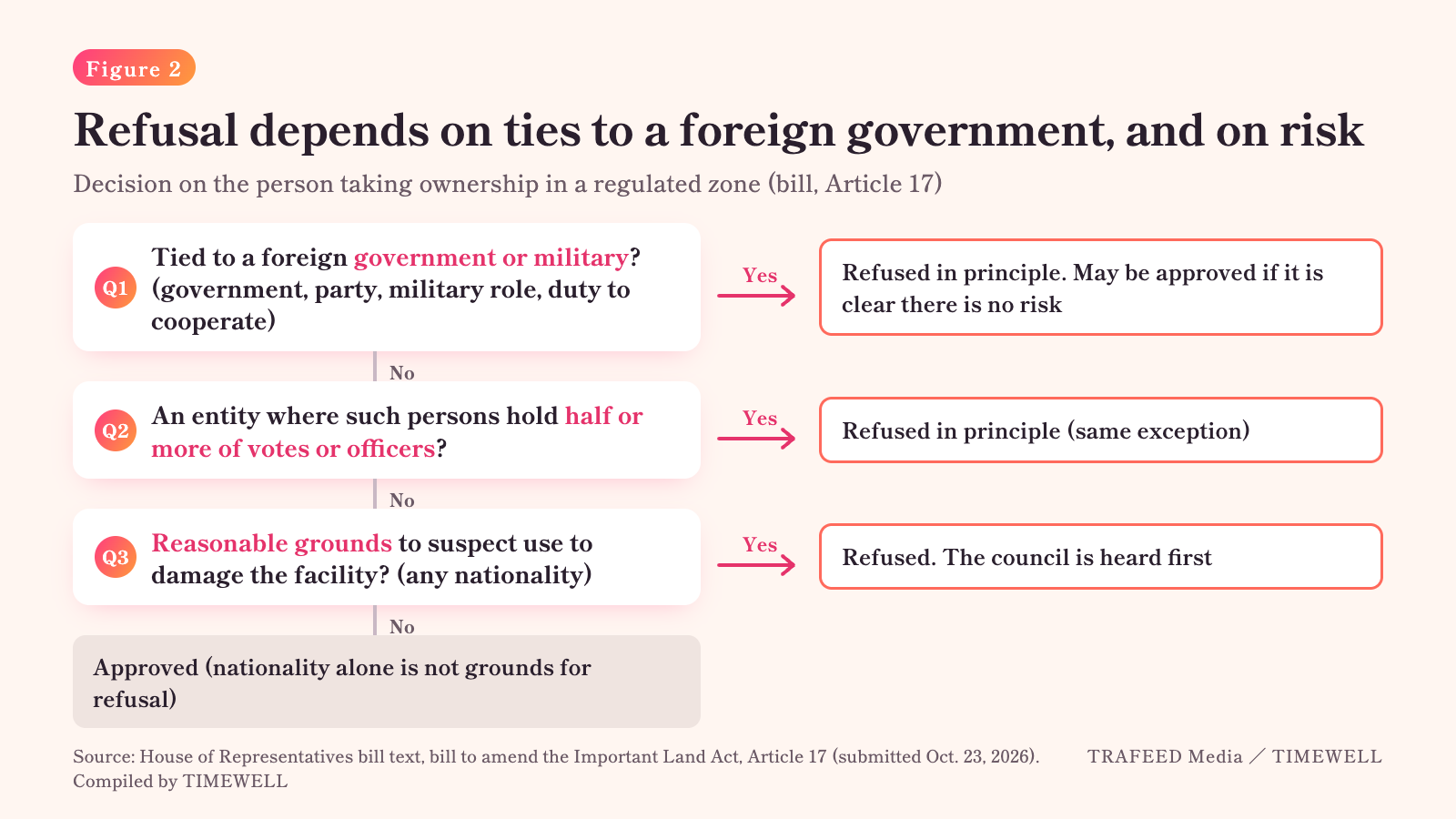
Figure 2. How approval in a regulated zone would be decided. Source: bill to amend the Important Land Act, Article 17 (House of Representatives bill text, submitted October 23, 2026). Compiled by TIMEWELL.
Even the first part has an exception. Article 17(2) allows approval where special circumstances make it clear the buyer will not use the land to damage the facility. The first part is a rule of thumb for refusal, with room left for exceptions.
The numbers matter too. A Japanese company with some foreign shareholders does not fall under (d) just because of that. It falls under (d) only if persons tied to a foreign government or military, as defined in (a) to (c), together hold half or more of its votes or board seats. How indirect holdings are counted will be set by Cabinet Office Ordinance. In practice, buyers will need to trace their ownership chain to see who ultimately controls them. A separate bill in the same Diet session would have the government collect information on companies' beneficial owners, the individuals who ultimately control them8. I explained the concept in What is a beneficial owner?.
After the purchase, and leases: mergers, changes of control, lease notices and government powers
The bill also covers what happens after a purchase. If a company acquires land in a regulated zone through a merger or demerger, it must notify the government within 30 days (amended Article 18). If the company falls under the first part of Article 17(1), or there are reasonable grounds to suspect it would misuse the land, the government can, within three months of the notice, order it to sell the property within one year. If it does not sell, the government can apply for a court auction.
A company that already owns land in a regulated zone must also notify the government within 30 days of learning that its shareholders or officers have changed so that persons tied to a foreign government now hold half or more of its votes or board seats (amended Article 19). A sale order within one year is possible here too, unless every fact behind the change occurred before the zone was designated.
Leases need a notice, not approval. Creating or transferring a surface right, lease or similar right to use land or buildings in a regulated zone must be reported within 15 days (amended Article 20).
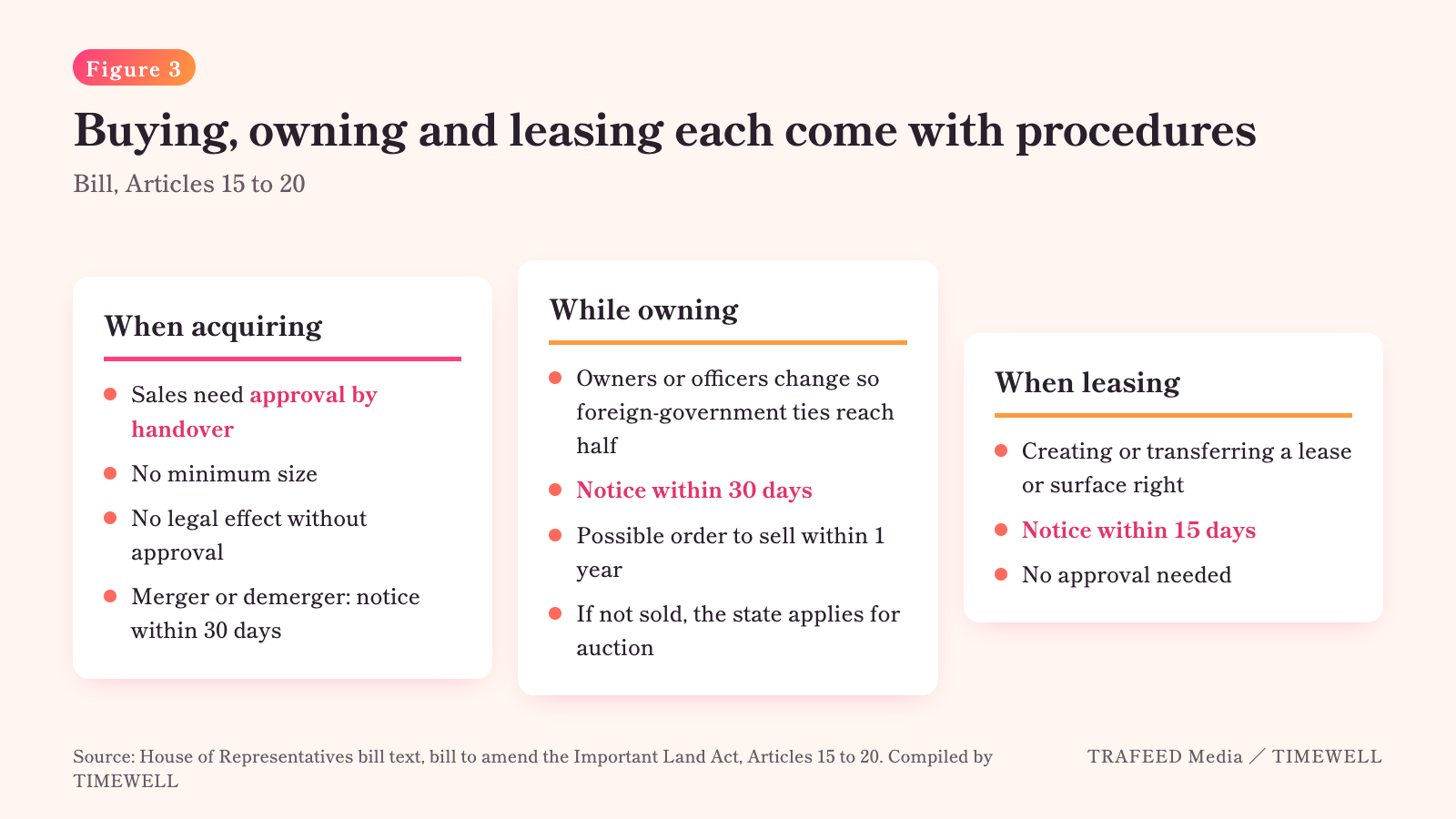
Figure 3. Procedures in a regulated zone. Source: bill to amend the Important Land Act, Articles 15 to 20 (House of Representatives bill text). Compiled by TIMEWELL.
Government powers expand as well. Where urgent action is needed to prevent serious, hard-to-reverse damage to a facility, the government can issue orders without first making a recommendation (amended Article 21). Cabinet Office staff can enter land in a regulated zone to investigate, but they may enter a private home only with the occupant's consent or in a particular emergency, and the bill states that this power is not to be read as a criminal investigation power (Article 22). The Commissioner General of the National Police Agency can ask the Prime Minister to issue recommendations or orders and can direct prefectural police to investigate (Article 23).
The bill also adds the Imperial Palace, the Diet building, the Prime Minister's Office and the buildings of ministries handling crisis management as important facilities, which allows monitored zones around them. In special monitored zones, the notice deadline moves from "before signing the contract" to "by handover." The penalties (amended Articles 37 to 41) are as follows.
| Violation | Penalty |
|---|---|
| Handing over property without approval, or obtaining approval by deception | Up to 3 years' imprisonment or a fine of up to ¥3 million |
| Breaching an order issued after a recommendation, or an emergency order | Up to 2 years' imprisonment and/or a fine of up to ¥2 million |
| Failing to notify, or giving a false notice | Up to 6 months' imprisonment or a fine of up to ¥1 million |
| Failing to report, or obstructing an on-site investigation | Fine of up to ¥300,000 |
If a violation is committed in the course of a company's business, the company can be fined as well as the individual.
What property buyers and companies should check, and when
Timing first. Even if enacted, the law would take effect on a date set by Cabinet Order within 18 months of promulgation (Supplementary Provisions, Article 1). Regulated zones would then be designated one by one after hearing the council and published in the official gazette, so approval will not be required anywhere on day one. I expect the zones to appear on the Cabinet Office's online map, where today's monitored zones can already be looked up by address or lot number7. Contracts signed before a zone is designated do not need approval.
For both buyer and seller, the key is to plan backward from the handover date. Approval must be in hand by handover, and how long the review will take is unknown until the ordinances and practice are settled. If you are dealing in land inside a regulated zone, I would put a clause in the contract covering what happens if approval is not granted, such as a condition precedent or a right to cancel. Real estate brokers will also need to check zone status more often when explaining a property.
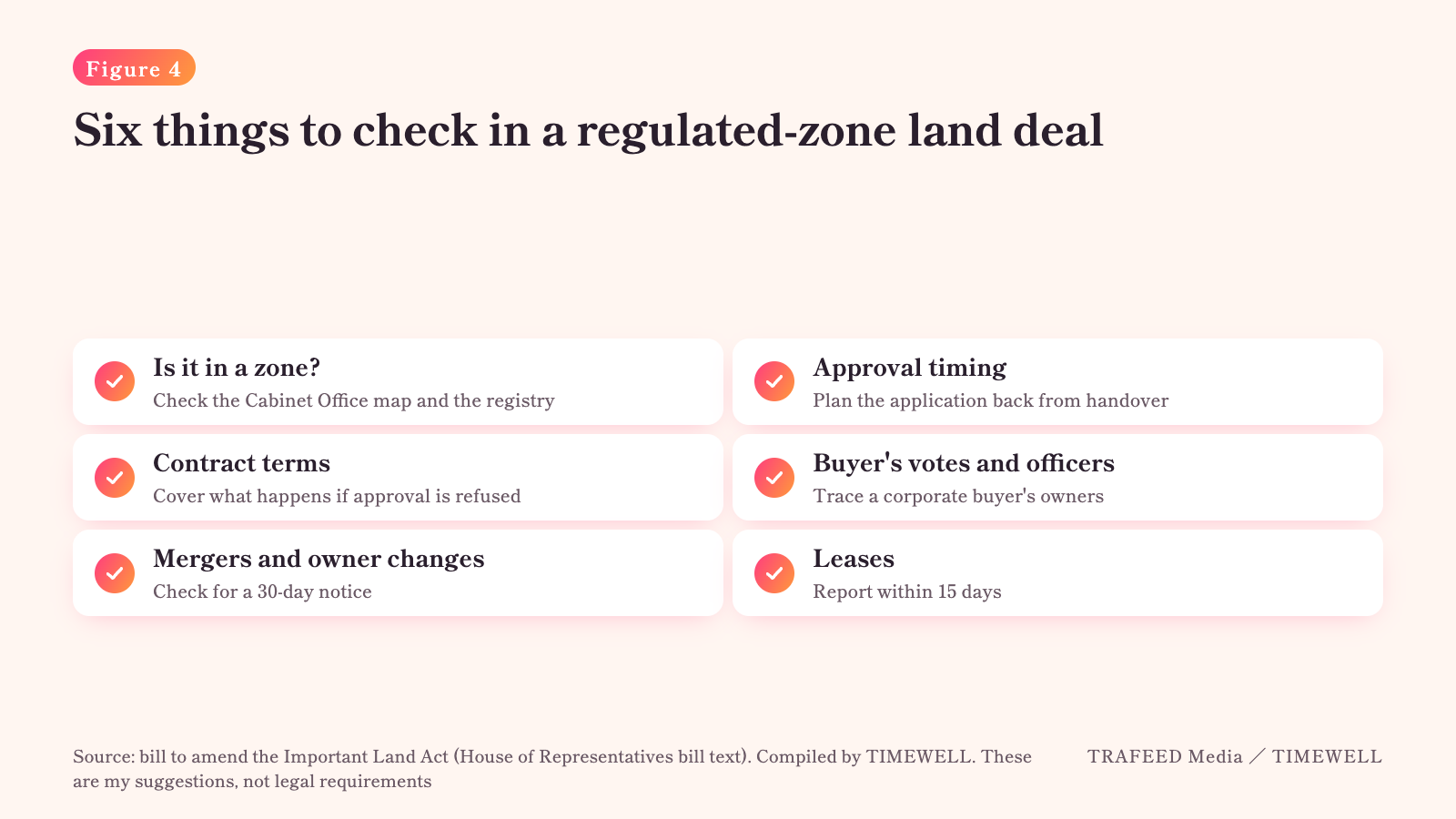
Figure 4. What to check in land deals in a regulated zone. Source: bill to amend the Important Land Act (House of Representatives bill text). Compiled by TIMEWELL. These items are my suggestions, not legal requirements in themselves.
For companies, mergers and acquisitions get one more item on the checklist. A buyer that inherits land in a regulated zone through a merger or demerger must notify within 30 days, and so must any company whose shareholders or officers change in a way that brings it under Article 17(1)(d). Companies with foreign shareholders should know whether any of them is a foreign government, a state-linked body or someone under its influence, together with their voting share. The counterparty screening record kit (Excel, in Japanese) can be adapted to record that ownership tracing.
National security and corporate deals intersect well beyond land. I looked at a foreign defense company's talks to acquire a plant in Japan, alongside the inward investment screening rules, in Anduril's talks over Nissan's Oppama plant.
Open questions, and what comes next
In the lower house vote, the Liberal Democratic Party group, the Chudo group, the Japan Innovation Party, the Democratic Party for the People group, Sanseito, Team Mirai and Shishi no Kai voted in favor, and the Japanese Communist Party voted against2. Japanese media coverage has flagged concerns about the effect on transactions and the challenge of building a review process that is both fast and strict9.
I am watching three things. The first is how many regulated zones there will be and how large. The bill says they will be drawn from special monitored zones, but which facilities qualify is decided at designation. The wider the zones, the more ordinary transactions, such as selling a house or selling after an inheritance, would need approval. The second is the content of the Cabinet Orders and ordinances: who counts as having "especially significant influence" over a foreign government, which transfers are exempt, how indirect voting rights are counted, and what the application must include. The third is transparency. The supplementary provisions require a review five years after the law takes effect. The current law has never produced a recommendation or order, and how the number of approvals and refusals is published will be the main way to judge the new system.
Debates about foreigners buying land tend to get emotional. What this bill actually sets out is an approval procedure in limited zones and refusal criteria built around ties to foreign governments. As a reader, I find it more useful to replace the headline with concrete questions: is my property in a zone, and who exactly is on the other side of the deal? I will update this article with the enactment date, law number and any amendments once the upper house acts.
If you want to put checks on counterparties' shareholders and officers on record, talk to us about TRAFEED. Whether a specific transaction needs approval should be decided by your team and advisers based on the law and guidance from the responsible authorities. This article is not legal advice.
Footnotes
-
Cabinet Office, summary and outline of the bill to amend the Important Land Act (submitted to the 222nd Diet session, October 23, 2026), in Japanese. https://www.cao.go.jp/houan/222/index.html (retrieved November 26, 2026) ↩ ↩2 ↩3 ↩4
-
House of Representatives, bill deliberation record for the bill to amend the Important Land Act (222nd session, Cabinet bill No. 18), in Japanese. https://www.shugiin.go.jp/Internet/itdb_gian.nsf/html/gian/keika/1DE36CA.htm (retrieved November 26, 2026). Bill text, supplementary provisions and reasons: https://www.shugiin.go.jp/Internet/itdb_gian.nsf/html/gian/honbun/houan/g22209018.htm ↩ ↩2 ↩3
-
House of Councillors, bill information (222nd session, Cabinet bill No. 18), in Japanese. https://www.sangiin.go.jp/japanese/joho1/kousei/gian/222/meisai/m222080222018.htm (retrieved November 26, 2026) ↩
-
Cabinet Office, Important Land Act page, in Japanese. https://www.cao.go.jp/tochi-chosa/ (retrieved November 26, 2026) ↩
-
Act No. 84 of 2021, Articles 5, 6, 9, 12 and 13, via e-Gov, in Japanese. https://laws.e-gov.go.jp/law/503AC0000000084 (version in force from June 1, 2025, retrieved through the e-Gov law API on November 26, 2026) ↩
-
Cabinet Office, acquisitions of land and buildings around important facilities in FY2024 (published December 2025), in Japanese. https://www.cao.go.jp/tochi-chosa/doc/kohyor6.pdf (retrieved November 26, 2026). "Foreign nationals" covers foreign citizens living in Japan and people abroad believed to be foreign; "foreign-affiliated companies" covers foreign companies and Japanese companies whose representative is a foreign national ↩
-
Cabinet Office, zone designations and the status of recommendations and orders, in Japanese. https://www.cao.go.jp/tochi-chosa/kuiki.html , https://www.cao.go.jp/tochi-chosa/kankoku.html (retrieved November 26, 2026) ↩ ↩2
-
House of Representatives, list of bills in the 222nd session (Cabinet bill No. 19, on collecting information on companies' beneficial owners), in Japanese. https://www.shugiin.go.jp/Internet/itdb_gian.nsf/html/gian/kaiji222.htm (retrieved November 26, 2026) ↩
-
Sankei News and 47NEWS, both November 24, 2026, reporting the bill's passage through the House of Representatives (in Japanese) ↩