This is Hamamoto from TIMEWELL.
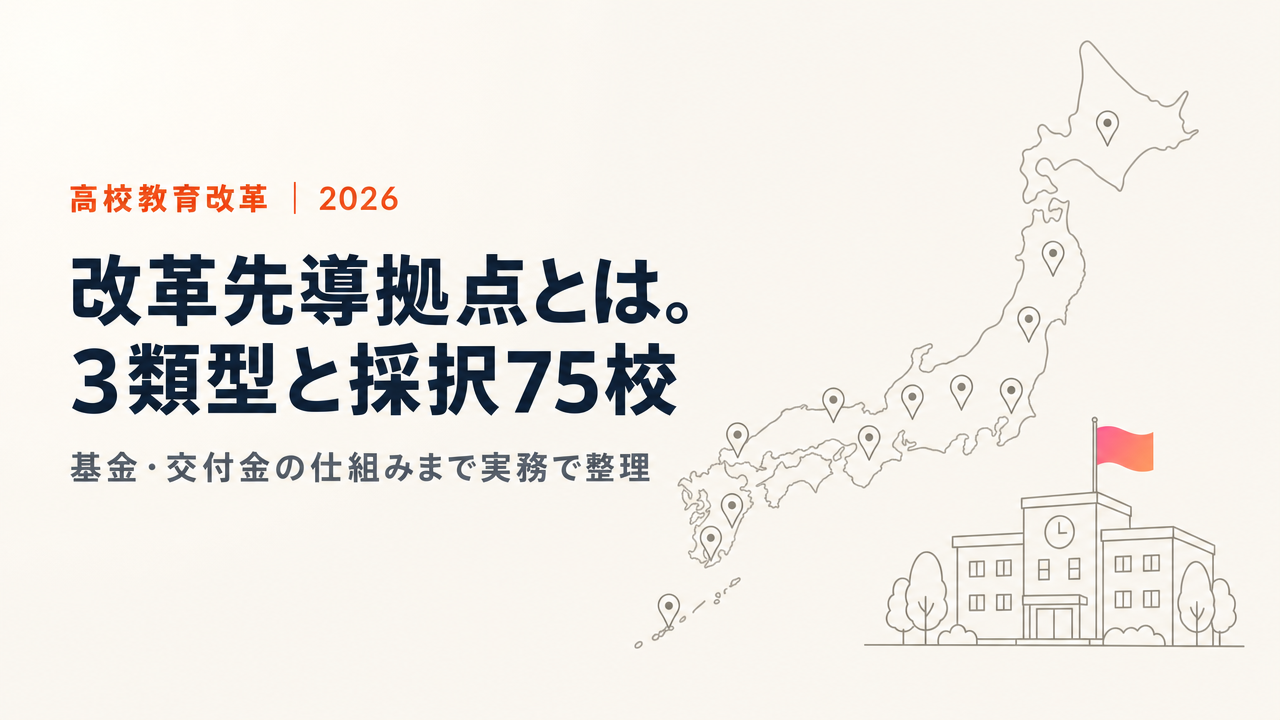
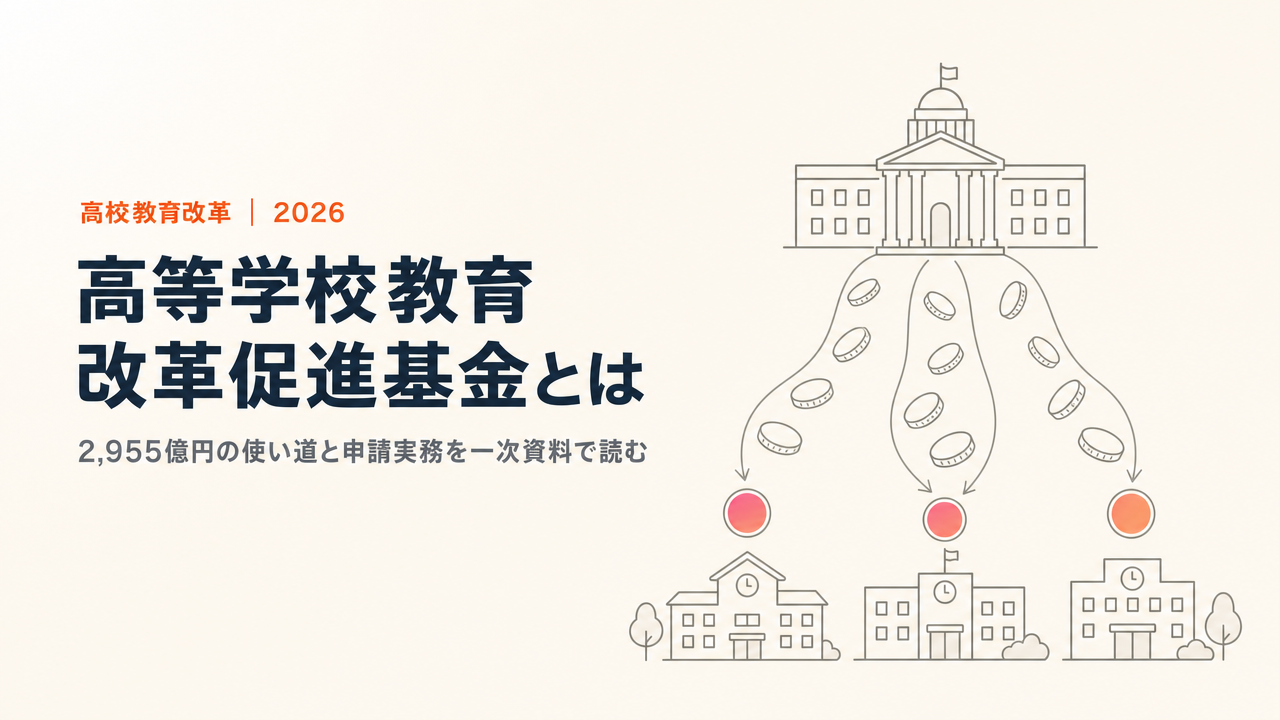
The High School Education Reform Promotion Fund (Kōtō Gakkō Kyōiku Kaikaku Sokushin Kikin) is a fund the Japanese government created in the FY2025 supplementary budget to support high school education reform financially, with a total of 295.5 billion yen. The Ministry of Education, Culture, Sports, Science and Technology (MEXT) provides each prefecture with the money to establish a fund, and the prefectures then deliver it to reform initiatives at high schools in their region12. The breakdown: 295.0 billion yen for a promotion program that supports the creation of reform pilot sites, and 500 million yen for a hands-on support program run through the private sector. On June 30, 2026, the results for the first through third application rounds were published, selecting 75 sites across 38 prefectures. The ceiling per site runs from 250 million yen to 3.9 billion yen3. In this article, I lay out how the money flows and what schools and boards of education need to know about applying and using it, based solely on MEXT primary sources.
To be honest, when I first read the fund's founding documents, I double-checked the number of digits. Up to 3.9 billion yen for a single high school. I know of no other national high school policy in Japan that attaches this much money to individual schools. Three key points up front.
- The fund was created with 295.5 billion yen in the FY2025 supplementary budget and is established in each prefecture at a subsidy rate of ten tenths. Prefectures bear no cost of their own.
- The financial support does not end with the fund: it is designed in three layers, including a grant (provisional name) under consideration in the FY2027 budget process and a bond scheme (provisional name) covering FY2026 through FY2031.
- The applicant is the prefecture. Schools cannot apply to MEXT on their own, so how early you begin the dialogue with your board of education decides the game.
What is the fund, and what is inside the 295.5 billion yen?
This fund was born from a political agreement. The Comprehensive Economic Package approved by the Cabinet on November 21, 2025 contains the following passage.
In order to expand support for public high schools and specialized high schools alongside so-called free high school tuition, based on an agreement between political parties and premised on securing stable revenue sources and building a new financial support framework such as grants, urgent initiatives in line with the "Grand Design for High School Education Reform 2040 (provisional name)" to be presented by the national government during FY2025 shall be supported in advance through funds established in the prefectures.1
In other words, expanded support for public and specialized high schools was agreed between the parties as a set with the free-tuition debate, and this fund was created as the vehicle. The Grand Design promised there was published on February 13, 2026 as the "Basic Policy on High School Education Reform (Grand Design): The N-E.X.T. High School Vision for 2040"4. I cover the vision as a whole in the guide to the N-E.X.T. High School Vision.
The 295.5 billion yen splits into two programs.
| Program | FY2025 supplementary budget | Counterpart | Outline |
|---|---|---|---|
| High School Education Reform Promotion Program for Developing Industrial Innovation Talent | 295.0 billion yen | Prefectures | Creating reform pilot sites and more. Support period of around three years, subsidy rate of ten tenths1 |
| Hands-on Support Program for Accelerating High School Education Reform | 500 million yen | Private sector | Expert support that accompanies schools and boards of education through reform1 |
The detail that is easy to miss but matters enormously in practice is the subsidy rate. The promotion program is funded at ten tenths — entirely national money — so prefectures are not asked to shoulder any of the cost. That means even fiscally weak prefectures can raise their hands. The details of managing the fund are set out in the Fund Management and Operation Guidelines, decided on December 26, 2025 by the Director-General of the Elementary and Secondary Education Bureau5.
The 500 million yen hands-on support program also deserves attention. Its counterpart is not the prefectures but the private sector. The state, in other words, has built into the scheme from the start the assumption that schools and boards of education will borrow outside expertise rather than complete the reform alone. The amount is small, but this design philosophy connects to the practical side of applying, which I discuss below.
Why this scale? The backdrop is demographics. Japan's population of 15-year-olds is projected to fall from about 1.06 million in 2024 to about 700,000 in 2039, a drop of roughly 30 percent4. The fund's founding documents also cite an estimate that the number of first-year high school students will fall by about 36 percent by 20401. Even today, about 64 percent of municipalities have zero or one public high school4. A future of mergers and closures is already concretely visible if nothing is done. Invest in remaking what high schools teach before they shrink — that, as I read it, is the philosophy of this fund in a single sentence.
How the money flows: a three-layer structure of fund, grant, and bond
Looking at the 295.5 billion yen figure alone, it can seem like a one-off splurge. Step back and look at the whole design, and the financial support is structured in three layers arriving at different times.
| Scheme | Role | Period and timing | Current status |
|---|---|---|---|
| High School Education Reform Promotion Fund | Advance support for urgent initiatives | Established in the FY2025 supplementary budget. Promotion program support period around three years | Established. Selections under way1 |
| High School Education Reform Grant (provisional name) | Full-scale support based on prefectural implementation plans | Under consideration in the FY2027 budget process | Under consideration4 |
| High School Education Reform Promotion Bond (provisional name) | Bond issuance for facilities, with local allocation tax measures for debt service | Project period from FY2026 through FY2031 | Planned4 |
The fund is strictly a mechanism to "support in advance." The main event lies with the High School Education Reform Implementation Plans that each prefecture will formulate based on the national Grand Design, and with the grant (provisional name) that will support them. The Grand Design envisions prefectures taking up to about one year to formulate their plans, then pushing reform intensively over the following five years4. Run urgent initiatives on the fund, draft the implementation plan in parallel, and hand over to plan-based grants from FY2027 onward. That is the timetable.
What this structure means for schools is clear. Schools that missed this round of the fund have another wave coming. But because the grant is being designed around implementation plans, a concept that is not written into the plan cannot ride the next wave either. Now, before plan formulation gets going in earnest, is exactly the time when bringing your school's concept to the prefecture pays off.
It is worth tracing the money's path, too. MEXT provides each prefecture with the money to establish its fund, and the national government also covers prefectural administrative costs1. Seen from a school, the money never arrives directly from MEXT; it always comes through the prefecture. That structure directly determines how applications work, as we will see.
The substance of the reform pilot sites this fund creates — the three types and what these schools look like — is covered in detail in the article on reform pilot schools. Here I stay focused on the money and the application process.
Looking for AI training and consulting?
Learn about WARP training programs and consulting services in our materials.
Reading the 75 selected sites through the money
On June 30, 2026, MEXT published the selection results for the FY2025 High School Education Reform Promotion Program for Developing Industrial Innovation Talent3. Seventy-five pilot schools were selected from 38 prefectures, plus one institution established by a board of education that works directly with students' learning, such as a hub for remote classes (the Okunoto Future Creation Center, provisional name)6. The review was conducted by a committee of external experts convened by MEXT6.
The ceiling per site ranges from 250 million yen to 3.9 billion yen, the largest being 3.9 billion yen for Wakayama Technical High School in Wakayama Prefecture6. A few of the published examples:
| School | Prefecture | Focus of the initiative | Ceiling |
|---|---|---|---|
| Kurosawajiri Technical High School | Iwate | Semiconductor talent and industrial DX | 2.93 billion yen |
| Shizuoka Chuo High School | Shizuoka | Diverse learning built around correspondence education | 2.22 billion yen |
| Takasaki High School | Gunma | A STEAM hub for interdisciplinary science-math inquiry | 1.3 billion yen |
One caveat belongs right next to those figures. The published list states that ceilings "may be reduced after confirmation and scrutiny from a technical standpoint in the upcoming grant procedures"6. Selection does not mean the full amount arrives automatically. Cost estimates are scrutinized during the grant procedures, and rough equipment budgeting gets exposed at exactly this stage.
Which departments were selected is also telling. By department count, the published tally is as follows6.
| Department | Selected count |
|---|---|
| General studies (futsūka) | 34 |
| Industrial | 22 |
| Agricultural | 14 |
| Science-mathematics | 6 |
| Commercial | 6 |
| Fisheries | 5 |
| Integrated studies | 4 |
| Other | 4 |
| Nursing | 1 |
| Home economics | 1 |
With 75 sites but 97 departments in total, a fair number of sites clearly span multiple departments. General studies leads with 34, followed by industrial at 22 and agricultural at 14 — while information studies and welfare stand at zero. Given the program's name mentions industrial innovation talent, it is easy to assume this is a scheme for specialized vocational schools, but the fact that general-studies departments are the most numerous says a lot: this fund is aimed at transforming high school education as a whole.
A word on the amounts. From the published examples, industrial programs involving equipment renewal tend to be large, and general-studies inquiry hubs somewhat smaller. That said, this is my own reading of a limited set of published examples; the real pattern should be verified once grant decisions for all 75 sites are out.
The practical side: schools cannot apply on their own
Now for the practical heart of the matter, starting with the structure. Under the scheme laid out in the fund's founding documents, the promotion program's counterpart is the prefecture1. Schools and municipal boards of education do not apply directly to MEXT; the prefecture compiles the plans in its region and applies, and after selection the money flows from the fund established in that prefecture. For public high schools, the practical point of contact is the prefectural board of education. Eligible schools are public high schools, the latter stage of secondary education schools, and the upper secondary departments of special needs schools, with municipal schools included at the prefecture's discretion4.
Applications were reviewed under the review guidelines decided on February 13, 2026 by the Director-General of the Elementary and Secondary Education Bureau7. What has been published covers the first through third application rounds3. Whether there will be a fourth round or beyond is something I have not been able to confirm from MEXT's published materials as of this writing. Since the results are titled as covering "the first through third application rounds," the structure leaves room for more, but this is not confirmed information — I recommend checking the call-for-applications page8 regularly.
So what should the school side prepare? Working backward from the selected plans and the policy documents, I see four main tasks.
First, connect your concept to your region's numbers. The Grand Design requires that pilot-site initiatives be positioned within the prefecture's implementation plan and tied to projections of the regional employment structure and population4. "Here is the education our school wants to deliver" is not enough on its own; it slips down the priority list when the prefecture compiles its application. How do this school's graduates matter to this region's industries? A concept that can state that cause and effect in numbers is a strong one.
Second, build cost estimates that can survive scrutiny in the grant procedures. As noted above, ceilings can be reduced during those procedures6. Equipment purchase and maintenance costs, honoraria for outside experts, system renewal costs — you need to specify what will be spent on what, and when, within the roughly three-year support period1. This is almost identical to how a private company builds a capital investment plan.
Third, bring partners in from the concept stage. The Grand Design lists the use of regional coordinating bodies and alignment with post-graduation pathways involving industry and universities among its points of attention4. The depth of your partner list is the clearest evidence of your plan's ability to execute. For specialized high schools aiming at Type 1, developing advanced essential workers, the connections to industry laid out in the guide to advanced essential workers carry particular weight.
Fourth, start talking to your board of education early. As long as the prefecture is the applicant, sharing the status of the prefectural implementation plan and the maturity of your school's concept with the responsible division of the board of education is the precondition for everything else. The selected plans were not written overnight. If you are aiming for the next opportunity, preparation starts today.
Incidentally, for schools not at the scale this fund assumes, there is another route. The High School DX Acceleration Program, known as DX High School, carries 5.2 billion yen in the FY2025 supplementary budget and provides about 10 million yen each to roughly 100 newly selected schools9. It covers private as well as public schools9. Two orders of magnitude smaller than the fund, but the direction is the same: promoting advanced informatics and mathematics coursework and building digital inquiry environments. Shore up the basics at the tens-of-millions scale, then aim for a bigger concept on the next wave. That two-step approach strikes me as entirely realistic.
Preparing for the FY2027 second wave
For schools that were not selected — or never applied — the important thing is that this is not a one-shot contest. The grant (provisional name) is under consideration in the FY2027 budget process4, and the Grand Design calls for considering the creation of reform pilot sites in every prefecture and for spreading their practices and results to other high schools in the region4. The pilot sites' work is designed to become the standard for many high schools within a few years.
For the selected schools, the real issue is self-sufficiency. The promotion program's support period is around three years1. Even 3.9 billion yen of equipment leaves nothing but maintenance costs the moment support ends, unless there is a curriculum and people who can put it to use. I believe investment in the machinery that keeps things running — teacher training, outside partnerships — will separate schools three years from now far more than one-time equipment purchases. Inquiry-based learning designed around generative AI is a prime example, and I wrote up the concrete steps in the practical article on high school inquiry-based learning and generative AI.
We at TIMEWELL are involved in this change from the corporate side. Through WARP for Schools, our program for schools and educational institutions, we design inquiry-based learning that uses generative AI and walk alongside students as they build products with their own hands. We have been involved in developing more than 500 people and have worked on a partnership project with the Tokyo Metropolitan Government (WARP ENTRE). If your school or board of education is looking for outside partners as you build a concept with the fund or the coming grant in view, feel free to start with a simple exchange of information.
Summary
- The High School Education Reform Promotion Fund was created with 295.5 billion yen in the FY2025 supplementary budget (a 295.0 billion yen promotion program plus 500 million yen for hands-on support), established in the prefectures at a subsidy rate of ten tenths.
- The financial support has three layers: the fund (advance support), a grant (provisional name, under consideration in the FY2027 budget process), and a bond scheme (provisional name, FY2026 through FY2031).
- On June 30, 2026, 75 sites across 38 prefectures were selected, with ceilings of 250 million to 3.9 billion yen per site. Ceilings may be reduced under scrutiny during grant procedures.
- The applicant is the prefecture. The practical essentials for schools are four: tying the concept to regional numbers, estimates that survive scrutiny, securing partners, and early dialogue with the board of education.
- The support period is around three years. Investing in the machinery that keeps things running, more than in the equipment itself, will decide what the school looks like after support ends.
I take the 295.5 billion yen figure as proof that high school education has become a main arena of Japan's growth investment. The money framework is in place. What remains is what each school chooses to conceive. Whether your school's name appears on the next selection list starts being decided by what you prepare today.
References
Related articles
- What Are Reform Pilot Schools? The Three Types Under the N-E.X.T. High School Vision and the 75 Selected Schools
- What Is the N-E.X.T. High School Vision? A Clear Guide to MEXT's High School Reform
- What Are Advanced Essential Workers? Strengthening Japan's Specialized High Schools
- High School Inquiry-Based Learning × Generative AI: Practical Steps to Empower Students
Footnotes
-
MEXT, "Establishment of the High School Education Reform Promotion Fund" (Industrial Education Working Group, Reference Document 2, February 20, 2026) ↩ ↩2 ↩3 ↩4 ↩5 ↩6 ↩7 ↩8 ↩9 ↩10
-
MEXT, selection results for the FY2025 High School Education Reform Promotion Program for Developing Industrial Innovation Talent (June 30, 2026) ↩ ↩2 ↩3
-
MEXT, "Basic Policy on High School Education Reform (Grand Design): The N-E.X.T. High School Vision for 2040" (February 13, 2026) ↩ ↩2 ↩3 ↩4 ↩5 ↩6 ↩7 ↩8 ↩9 ↩10 ↩11
-
MEXT, "High School Education Reform Promotion Fund Management and Operation Guidelines" (December 26, 2025, decision by the Director-General of the Elementary and Secondary Education Bureau) ↩
-
MEXT, list of selected sites for the High School Education Reform Promotion Program for Developing Industrial Innovation Talent (June 30, 2026) ↩ ↩2 ↩3 ↩4 ↩5 ↩6
-
MEXT, review guidelines for the High School Education Reform Promotion Program (February 13, 2026, decision by the Director-General of the Elementary and Secondary Education Bureau) ↩
-
MEXT, call for applications for the FY2025 High School Education Reform Promotion Program for Developing Industrial Innovation Talent ↩
-
MEXT, application briefing document "6. Related Measures" ↩ ↩2
![High School Inquiry-Based Learning × Generative AI: Practical Steps to Empower Students [The N-E.X.T. High School Era]](/images/columns/highschool-inquiry-based-learning-ai/cover.en.png?dpl=dpl_GTagW71VKjD4VDo3w4ymrXrCfn1y)