This is Hamamoto from TIMEWELL.
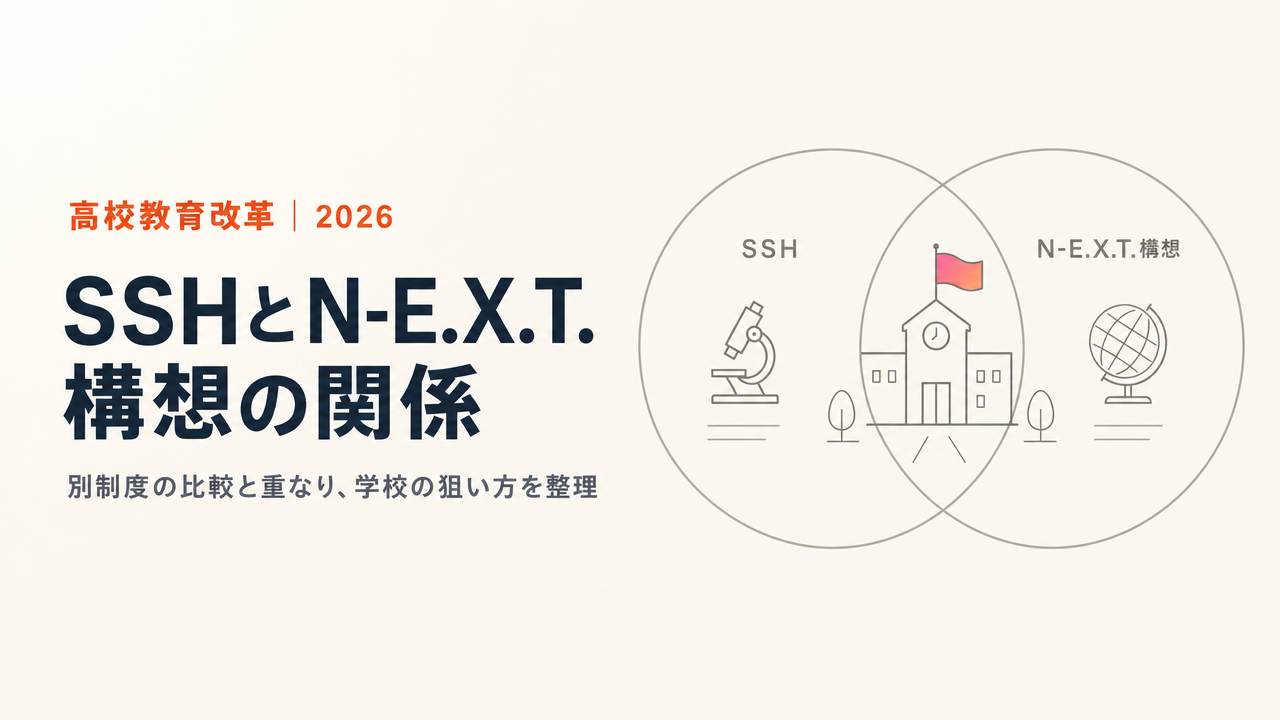
SSH (Super Science High School) and the N-E.X.T. High School Vision are both national initiatives that put money into science, math, and inquiry-based learning at Japanese high schools — but officially, they are separate programs. SSH is a designation program that began in FY2002, supporting roughly 230 schools nationwide through the Japan Science and Technology Agency (JST) with 6 to 12 million yen per year under its core track. The N-E.X.T. High School Vision is the grand design for high school reform formulated in February 2026, which channels a 295.5 billion yen fund created in the FY2025 supplementary budget into 75 reform pilot schools, each with a funding ceiling of 250 million to 3.9 billion yen. Nowhere in the primary sources I have reviewed is there any statement that the two will be merged or that one will transition into the other. In this article, I compare how the two programs are built, look at schools that have actually been selected under both, factor in the "program reform from FY2027" announced on the SSH side, and lay out how schools should move — grounded solely in primary sources.
Three key points up front.
- SSH and the N-E.X.T. High School Vision are separate programs with different bureaus in charge and different flows of money. No primary source currently indicates a merger or transition.
- The overlap in direction is real, though. N-E.X.T.'s Type 2 (STEM talent development) describes learning that resembles SSH's interdisciplinary core track, and schools such as Tokushima Prefectural Wakimachi High School have been selected under both.
- On the SSH side, a "program reform from FY2027" has been announced, with early pilots already running in FY2026. This is the single biggest thing to watch when thinking about how the two programs relate.
The conclusion first: officially, they are separate programs
"Will SSH be absorbed into the N-E.X.T. vision?" I hear this question more and more from boards of education and schools. The short answer: no official statement of a merger or transition can be found at this point. I read through the grand design itself1, the document establishing the High School Education Reform Promotion Fund2, and the FY2026 SSH support program materials3, and found no language anywhere about integrating SSH into the N-E.X.T. vision or migrating SSH into the fund program. More strikingly, the proper noun "SSH" does not appear in the grand design text at all — at least as far as my read-through of the full document goes. For a document that talks this much about science and math education to omit the name of a flagship program that has run for a quarter century feels like a deliberate separation.
The plumbing of the two programs is also different. SSH is handled by MEXT's Science and Technology Policy Bureau and supports schools through JST's operating grant3. The N-E.X.T. fund program, by contrast, sits with the Elementary and Secondary Education Bureau: the national government establishes funds at the prefectural level, and money reaches schools by way of the prefectures2. Different bureaus, different pipes. As a matter of administrative practice, the two are running fully in parallel today.
So why does the impression that "these must be related" keep spreading? I think the reason is plain. The N-E.X.T. reform pilots include a type called "STEM talent development support," and its content looks a lot like what SSH schools do. The timing overlapped, too. The FY2026 SSH new designations were announced on March 25, 20264, and the N-E.X.T. reform pilot selections were published on June 30 of the same year5. Within barely three months, the news cycle carried two rounds of large-scale support for STEM education. No wonder people on the ground read them as one continuous story. That is exactly why it pays to pin down the outline of each program from primary sources first.
What SSH is: a designation program refined over a quarter century
Start with the veteran. The Super Science High School program began in FY2002 and is approaching its 25th year6. The FY2026 program materials state its purpose as follows: to designate and support high schools conducting research and development in advanced science and math education or in interdisciplinary fields, thereby "developing the science and technology talent that will drive future innovation"3.
There is a second face to SSH that tends to be overlooked. Designated schools may organize curricula beyond the framework of the national Courses of Study, and the state uses this to "obtain empirical data that contributes to improving science and math curricula in high schools"3. SSH is support for schools, and at the same time a testing ground where the state trials the next generation of curricula. Keep this character in mind — it matters when we come back to the relationship between the two programs.
The core of the framework is the basic track. Designation runs in periods of five years in principle, stepping up from Period I through Period IV and on to a leading-reform period. Support is 6 to 12 million yen per year. Schools that complete Period IV move to a "certified track," running on their own funding while serving as model schools that spread their results3. From FY2026 there is also an interdisciplinary core track, for R&D in science and math education that creates and applies "integrated knowledge." The first three schools named were Fukushima Prefectural Aizu High School, Toyo University Ushiku Junior and Senior High School, and Hiroshima Prefectural Kokutaiji High School4.
On top of designation, a priority track adds 10 to 13 million yen per year across three types — wide-area collaboration, international collaboration, and innovation co-creation — and the innovation co-creation type explicitly names "entrepreneurship education and the like," a sign that SSH's reach now extends beyond pure science and math3. Support for SSH coordinators placed with managing organizations (around 20 organizations in FY2026) is also in motion3.
Now the scale, in numbers. The FY2026 core-track school count is about 229 on a budget-proposal basis, while JST's site lists 233 schools nationwide (as of July 2026; the gap reflects the different nature of a budget estimate versus a posted actual)37. I will call it "about 230 schools" in this article. The program budget for FY2026 is 2.3 billion yen in the proposal3. Averaged out, that is on the order of 10 million yen per school per year — the scale of a research grant. Not flashy, but this is the program that has quietly underpinned science and math education across Japan for a quarter century.
Looking for AI training and consulting?
Learn about WARP training programs and consulting services in our materials.
What the N-E.X.T. High School Vision is: high school reform powered by a 295.5 billion yen fund
Now the other side. The formal name is the "Basic Policy for High School Education Reform (Grand Design): The N-E.X.T. High School Vision for 2040," formulated by MEXT on February 13, 20261. With the population of 15-year-olds projected to fall roughly 30 percent, from about 1.06 million in 2024 to about 700 thousand in 2039, it is a blueprint for rebuilding high school education around three pillars: strengthening vocational high schools, reforming the general course, and securing access to learning1. I covered the full picture in the guide to the N-E.X.T. High School Vision, so here I will keep to the skeleton.
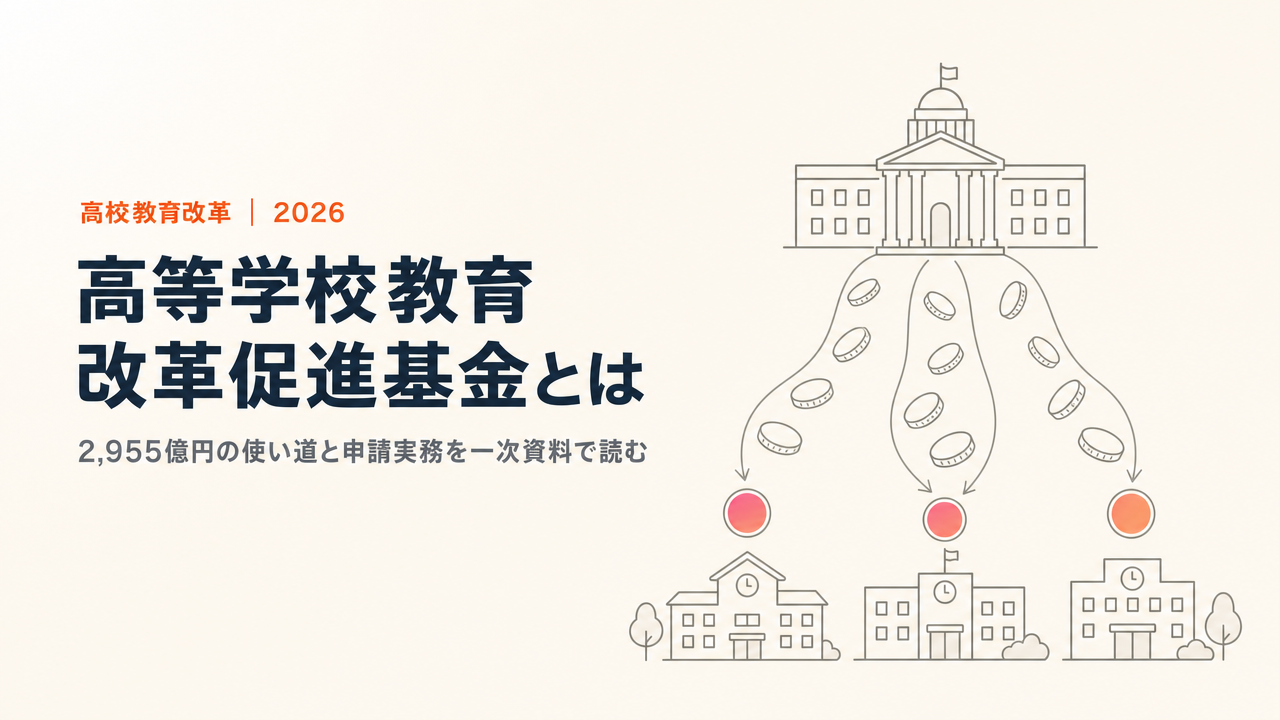
The engine of execution is the High School Education Reform Promotion Fund, created in the FY2025 supplementary budget: 295.5 billion yen in total, with a 10/10 subsidy rate, established as funds within each prefecture2. The open call and screening for "reform pilot schools" that draw on this fund ran through the first half of 2026, and on June 30 the selection of 75 sites across 38 prefectures was published5. The funding ceiling per site ranges from 250 million to 3.9 billion yen, the largest being 3.9 billion yen for Wakayama Prefectural Wakayama Technical High School (with the caveat that ceilings may be reduced during the grant procedure)8. The lineup of selected schools and the mechanics of the fund are covered in the article on the reform pilot schools.
The reform pilots come in three types: Type 1 supports the development of advanced essential workers, Type 2 supports STEM talent development, and Type 3 secures learning opportunities for diverse needs1. In relation to SSH, the spotlight naturally falls on Type 2. Among the selections, Gunma Prefectural Takasaki High School was picked as an interdisciplinary STEAM inquiry hub with a ceiling of 1.3 billion yen — large-scale plans built around science, math, and inquiry8. Money of an entirely different order from SSH's roughly 10 million yen a year has begun to flow into STEM education.
One more thing worth noting is what comes after the fund. The grand design states that a new financial support mechanism — a "High School Education Reform Grant (tentative name)" — will be considered in the FY2027 budget process1. Prefectures, following the national policy, will each draw up a High School Education Reform Implementation Plan and then push reform intensively for five years after formulation1. In other words, N-E.X.T. is not a one-off event that ends with 75 selections; it is the opening move of a long campaign that will spread nationwide through grants and implementation plans.
The two programs side by side: different money, different purpose, different counterpart
Here is everything above in one table. Every figure is from a primary source.
| Item | SSH | N-E.X.T. reform pilot schools |
|---|---|---|
| Launch | FY20026 | Selections published June 30, 20265 |
| Positioning | Designation and support of schools doing R&D in science and math education3 | Pilot schools realizing the grand design ahead of the pack1 |
| Bureau and delivery | MEXT Science and Technology Policy Bureau, support via JST3 | MEXT Elementary and Secondary Education Bureau, funds established in prefectures2 |
| Scale | About 230 schools in the core track37 | 75 sites in 38 prefectures5 |
| Funding | Core track: 6 to 12 million yen per year3 | Ceiling of 250 million to 3.9 billion yen per site (support period of about 3 years)28 |
| Program size | FY2026 budget proposal: 2.3 billion yen3 | Fund of 295.5 billion yen (FY2025 supplementary budget)2 |
| Duration | Five years per period in principle (Periods I to IV, then leading reform)3 | Support of about 3 years; implementation plans run five intensive years12 |
| Eligibility | National, public, and private high schools (the FY2026 list includes private Ritsumeikan High School, among others)4 | Mainly public schools (municipal schools possible at the prefecture's discretion)1 |
Put the numbers next to each other and the difference in character comes through. SSH's core track pays 6 to 12 million yen a year — money for curriculum development and the travel and materials costs of student research3. N-E.X.T. pays hundreds of millions to 3.9 billion yen per site — money for rebuilding a school wholesale, facilities and equipment included. The assumed use of the money is different from the start. At the program level, 2.3 billion yen in a single year versus a 295.5 billion yen fund: even discounting the difference between an annual budget and a multi-year fund, that is two orders of magnitude.
The counterpart you deal with also differs. In SSH, each school's R&D plan is screened by an external expert panel (the SSH planning and evaluation council) — essentially a school-by-school contest4. The N-E.X.T. fund is built as a national-to-prefecture transfer, so a school must be positioned within its prefecture's plan, and the prefectural board of education looms far larger2. And here is the difference people rarely notice: the N-E.X.T. reform pilots are for public schools, and private high schools are not eligible1. SSH is open to national, public, and private schools alike — the FY2026 list includes private Ritsumeikan High School and Toyo University Ushiku4. Lump the two together as "similar programs" and you will trip over precisely this practical difference.
Where they do overlap: Type 2, interdisciplinary learning, and schools selected under both
I have been stressing the differences, but the overlap is real too. Here are three points that can be confirmed in primary sources.
First, the direction of learning. The grand design describes Type 2 as realizing "interdisciplinary learning, looking ahead to higher education, in which students acquire a foundation in science and math while posing their own questions and conducting research to solve them"1. The fund establishment document lists Type 2 examples such as making "Basic Science and Math Inquiry" and "Science and Math Inquiry" required subjects, converting departments into interdisciplinary inquiry tracks, and building regional hubs for STEM inquiry activities2. SSH, for its part, gained an interdisciplinary core track built around "integrated knowledge" from FY20263. Interdisciplinary learning, inquiry, science and math — the same words appear simultaneously in the official documents of two separate programs. That is the heart of the overlap. Given that the state wants the same kind of talent, it seems natural to me that the substance converges even while the programs stay separate.
Second, schools actually selected under both. Tokushima Prefectural Wakimachi High School appears on the FY2026 SSH designation list under the certified track4, and at the same time on the N-E.X.T. reform pilot selection list under the STEM type8. Other names appear on both the SSH school list and the N-E.X.T. selection list as well — Hokkaido Sapporo Keisei High School and Tottori Prefectural Tottori Nishi High School among them (based on my own cross-check of the two lists, not an exhaustive matching)98. At minimum, no published rule preventing coexistence of the two programs can be found. That is the fact as of today.
The Wakimachi case is suggestive. SSH's certified track is the stage at which a school that has completed Period IV shifts from national support to self-sustained operation3. A school at that stage went after the N-E.X.T. fund — money of a different order — and won. My reading is that the R&D track record built up over years in SSH carried weight in the N-E.X.T. screening as well. To be clear, the screening deliberations are not public, so this is inference on my part. Still, the two lists show that the route of "build strength in SSH, then leap with N-E.X.T." actually exists.
Third, the movement on the SSH side. The FY2026 SSH program materials attach explicit notes: the new "priority allocation" is a "preliminary and trial implementation toward the program reform from FY2027," and the "acceleration support for the certified track" is a "partial advance implementation of the program reform from FY2027"3. In other words, at the very moment the N-E.X.T. vision started moving, SSH announced a remaking of itself. The content of that reform has not been published. There is no basis for asserting that this is a prelude to a merger, and I do not think one should write it that way. But the fact that a quarter-century-old program has put the words "program reform" into its official materials carries weight. The FY2027 budget request on the SSH side, and the design of the grant (tentative name) on the N-E.X.T. side — once those two pieces are on the table, the relationship between the programs will come into much sharper focus.
Which program should your school pursue? Practical guidance by position
Rather than stopping at program taxonomy, let me go one step further into how schools should move. Thinking by position is fastest.
If you are already an SSH school: treat N-E.X.T. Type 2 not as a rival but as a different vessel of a different size. The R&D plans and results reports you have been writing for SSH become prime material when your prefecture drafts its implementation plan. The key is your distance from the prefecture. Because the fund flows only through prefectures, whether your school's vision makes it into the prefectural board of education's implementation plan is the gateway to everything. Do not keep SSH results inside the school walls; translate them into the language of the prefecture's high school reform and deliver them. The dual-program route taken by Wakimachi High School is, I think, the realistic extension of exactly that practice.
If you are an undesignated school that wants to build strength in STEM: think in two tracks. SSH's annual call continues — 31 schools won new core-track designations for FY20264. For N-E.X.T., on the other hand, the published results are explicitly labeled "applications from rounds one through three," and whether additional calls will follow cannot be confirmed from primary sources at this point5. The realistic play is to pursue the SSH call, whose window is verifiably open, while simultaneously working on your prefecture's implementation plan. In either application, the core is the same: a design for inquiry in which students pose their own questions, and a concrete picture of learning that crosses the humanities-sciences divide. That work keeps its value no matter which way the programs evolve.
If you are a private school: the N-E.X.T. reform pilots target public schools, so this fund is not available to you1. If you want a STEM flagship, SSH is the realistic option — the FY2026 list indeed includes Ritsumeikan High School and Toyo University Ushiku4. Personally, I read this moment as one in which SSH's relative value for private schools has actually risen.
There is a core common to every position: inquiry in which students pose their own questions, learning that crosses the humanities-sciences divide, and the use of technology — AI above all. The grand design places "abilities AI cannot replace" at the center of high school reform1, and SSH has been widening its range toward interdisciplinary learning and entrepreneurship education3. Whatever names the programs end up carrying, both sets of documents make clear that this core will be the backbone of high school education toward 2040. For concrete ways to combine inquiry and AI, see the guide to AI for Science and the practical article on high school inquiry-based learning with generative AI.
At TIMEWELL, through WARP for Schools, we help schools design inquiry-based learning that uses generative AI and provide hands-on support in which students shape products with their own hands. We have been involved in developing more than 500 people and have worked on a partnership project with the Tokyo Metropolitan Government (WARP ENTRE). How do you turn the vision written into an SSH or N-E.X.T. application into practice in the classroom? If you are a school stakeholder who wants to think that through together, an exchange of information is a fine place to start.
Summary
- SSH and the N-E.X.T. High School Vision are separate programs with different bureaus and different flows of money. No primary source currently indicates a merger or transition.
- SSH provides about 230 schools with 6 to 12 million yen a year in R&D support; N-E.X.T. invests up to 250 million to 3.9 billion yen in each of 75 reform pilots. Different scale, different character.
- Yet N-E.X.T. Type 2 and SSH's interdisciplinary core track point in overlapping directions, and schools like Wakimachi High School have been selected under both.
- SSH has announced a "program reform from FY2027," with advance pilots already running in FY2026 — alongside the design of the grant (tentative name), the biggest thing to watch.
- For school practice, the realistic course is a two-track one: pursue the SSH call while working to be included in the prefecture's implementation plan.
Programs are living things. SSH, born in 2002, matured over a quarter century — and now a 295.5 billion yen vessel has appeared beside it. What relationship the two will form should become visible through the FY2027 SSH program reform and the design of the new grant. Until the pieces for that answer are on the table, I will keep chasing primary-source updates rather than making pronouncements. And I intend to rewrite this article as soon as things move.
References
Related articles
- What Is the N-E.X.T. High School Vision? A Clear Guide to MEXT's Grand Design for High School Reform
- What Are Reform Pilot Schools? The N-E.X.T. High School Vision's Three Types, the 75 Selected Schools, and How the Fund Works
- What Are "Abilities AI Cannot Replace"? How High School AI Education Will Change
- What Is AI for Science? How AI Is Changing Scientific Research, and Japan's National Strategy, Explained Clearly
- High School Inquiry-Based Learning × Generative AI: Practical Steps to Empower Students
Footnotes
-
MEXT, "Basic Policy for High School Education Reform (Grand Design): The N-E.X.T. High School Vision for 2040" (February 13, 2026) ↩ ↩2 ↩3 ↩4 ↩5 ↩6 ↩7 ↩8 ↩9 ↩10 ↩11 ↩12 ↩13
-
MEXT, "Establishment of the High School Education Reform Promotion Fund" (Industrial Education Working Group, Reference Material 2, February 20, 2026) ↩ ↩2 ↩3 ↩4 ↩5 ↩6 ↩7 ↩8 ↩9
-
MEXT / JST, "Super Science High School (SSH) Support Program" (Attachment 2, FY2026) ↩ ↩2 ↩3 ↩4 ↩5 ↩6 ↩7 ↩8 ↩9 ↩10 ↩11 ↩12 ↩13 ↩14 ↩15 ↩16 ↩17 ↩18 ↩19 ↩20
-
MEXT, "FY2026 SSH Designated Schools (Preliminary Decision)," Attachment 1: List of Schools (March 25, 2026) ↩ ↩2 ↩3 ↩4 ↩5 ↩6 ↩7 ↩8
-
MEXT, "FY2025 Program for High School Education Reform Contributing to Industrial Innovation Talent Development: Selection Results" (June 30, 2026) ↩ ↩2 ↩3 ↩4 ↩5
-
Japan Science and Technology Agency (JST), "Super Science High School" ↩ ↩2
-
MEXT, "Selection Results List: Program for High School Education Reform Contributing to Industrial Innovation Talent Development" ↩ ↩2 ↩3 ↩4 ↩5
-
Japan Science and Technology Agency (JST), "List of SSH Designated Schools (by Prefecture)" ↩
![High School Inquiry-Based Learning × Generative AI: Practical Steps to Empower Students [The N-E.X.T. High School Era]](/images/columns/highschool-inquiry-based-learning-ai/cover.en.png?dpl=dpl_GTagW71VKjD4VDo3w4ymrXrCfn1y)