Hello, this is Ryuta Hamamoto from TIMEWELL.
Made in China 2025 has been in the news for almost a decade. It surfaced during the US-China tariff fight, faded from view, and now returns in discussions of rare earth export controls, often with the phrase "a national strategy to increase dependence on China." Yet very few people, even in trade compliance, have read the original document from start to finish. Until I wrote this piece, I had been relying on secondary impressions for parts of the story.
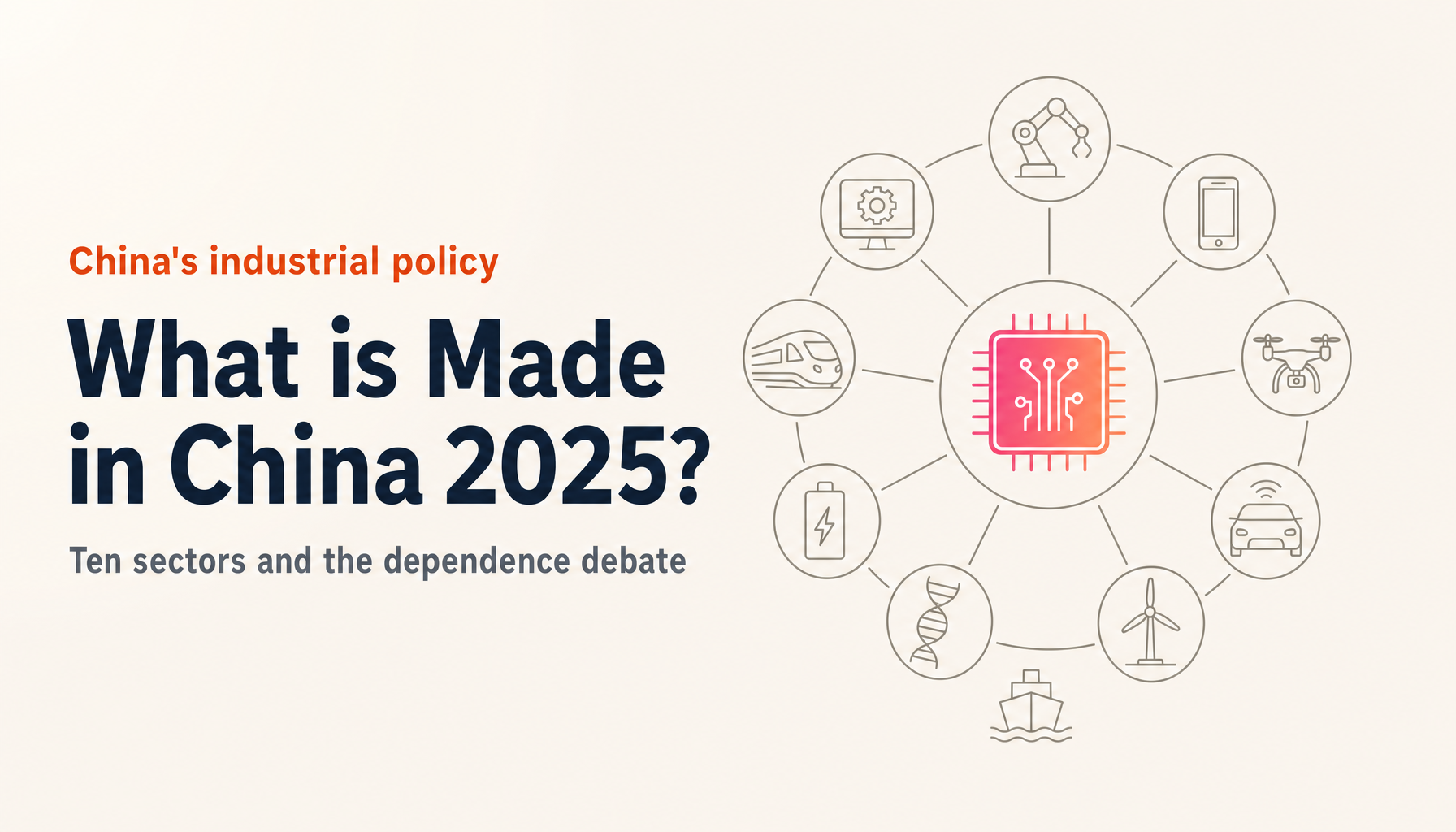
The short answer first. Made in China 2025 is a ten-year manufacturing plan that the State Council issued in May 2015. It names ten priority sectors and sets three stages toward becoming a manufacturing power: around 2025, 2035, and the centenary of the People's Republic. The numbers it states concern things like R&D intensity and the self-sufficiency of core components. A goal of "increasing other countries' dependence on China" does not appear in it. But Xi Jinping did write in 2020 about tightening the dependence of international industrial chains on China, and US research institutions now assess that China's industrial policy is deepening foreign dependence. These are three different things, and this article keeps them apart: what I could verify in the primary text, and what someone else argues.
You will find here what the original says, which numbers I could confirm, what happened after the name disappeared, who describes China's strategy as a dependence strategy and in which documents, and what Japanese companies can do. The details of China's export control rules are covered elsewhere on this site, so I stay with the link to industrial policy.
Terms to settle first
The table below covers the words that recur in this article.
| Term | Meaning | Everyday analogy |
|---|---|---|
| State Council | China's central government, comparable to a cabinet | The management committee of the whole company |
| Industrial policy | Plans and support a government sets up to grow particular industries | A town deciding to develop one street as a shopping district |
| Self-sufficiency rate | Share of core parts and materials that can be secured domestically | Share of stock and seasonings a kitchen makes in-house |
| Five-Year Plan | China's basic medium-term plan for the economy and society; the 15th covers 2026 to 2030 | A five-year business plan |
| New quality productive forces | A term Xi Jinping introduced in 2023 for growth driven by technological innovation | Not expanding old equipment but redesigning how the kitchen is built |
| Industrial chain, supply chain | The links from raw materials to parts, finished goods, and sales | The path from purchasing ingredients to serving a dish |
| Dual-use items | Goods and technology usable for both civilian and military purposes; subject to export control | A tool, like a knife, that can serve more than one purpose |
| Weaponization | Using supply or trade as a means of pressure | A supplier halting deliveries not over price but as a bargaining chip |
"Dependence" runs in two directions in this article. One is China reducing what it relies on others for. The other is other countries relying more on China. The first is about self-reliance, the second about effects on others. Check which one is meant each time.
What the 2015 text says
The official title is "Notice of the State Council on Issuing Made in China 2025," document number Guofa [2015] No. 28. It was written on May 8, 2015 and posted by the Chinese government portal on May 19. The posted page carries a note that the text has been abridged1. So I cannot rule out that what I read is not the full text.
The skeleton has three parts: guiding principles, three stages of goals, and ten sectors with numeric indicators. The guiding line lists innovation-driven development, quality first, green development, structural optimization, and people-oriented talent. The basic principles include "market-led, government-guided" and "independent development, open cooperation." Both independence and openness appear in the same text, a point that matters later.
The three-stage goal is called the "three steps" in the original. Step one is to enter the ranks of manufacturing powers within ten years, with industrialization largely achieved by 2020. Step two says that by 2035 China's manufacturing as a whole should reach the middle level of the world's manufacturing powers. Step three, "when the People's Republic reaches its centenary," is for overall strength to enter the front rank1. Notice that the number 2049 does not appear in the original. The centenary of a state founded in 1949 is 2049, and summaries such as those from the US Congressional Research Service (CRS) write 2049, but the original wording is "the centenary."
The numeric indicators are given for 2020 and 2025. These are the ones I could confirm.
| Indicator | 2020 | 2025 |
|---|---|---|
| R&D spending as a share of revenue, large manufacturers | 1.26% | 1.68% |
| Valid invention patents per 100 million yuan of revenue | 0.70 | 1.10 |
| Broadband penetration | 70% | 82% |
| Penetration of digital design tools | 72% | 84% |
| Numerical control rate of key processes | 50% | 64% |
These measure research and digitalization. None names a specific foreign company or product. The closest thing to localization sits in Column 3, on strengthening the industrial base: "by 2020, 40% of core basic components and key basic materials will be self-sufficient, and by 2025, 70%"1. The target is core components and materials, not all products. The text also states its purpose: to gradually ease the situation of being constrained by others.
This is where popular impressions and the original diverge. A figure like "70% semiconductor self-sufficiency by 2025" is something I could not find in the main text. Sector-level targets for domestic market share are said to sit in a separate technology roadmap. The CRS describes targets for 2025 to 2030 of over 90% for agricultural machinery and basic materials, 80% for items such as advanced ships, electric vehicles, and batteries, and 70% for industrial robots and advanced medical devices2. I have not read the roadmap itself, so I treat that as "according to the CRS."
The ten sectors, in the original's order, are below. I added what each means in everyday terms.
| No. | Sector (as in the original) | Everyday examples |
|---|---|---|
| 1 | Next-generation information technology | Semiconductors, telecom equipment, software |
| 2 | High-end numerically controlled machine tools and robots | Metal-cutting machines, industrial robots |
| 3 | Aerospace equipment | Airliners, satellites, rockets |
| 4 | Ocean engineering equipment and high-tech ships | Offshore rigs, specialized large vessels |
| 5 | Advanced rail transit equipment | High-speed rail, metro cars |
| 6 | Energy-saving and new energy vehicles | EVs, batteries, fuel cell vehicles |
| 7 | Power equipment | Generators, transmission gear |
| 8 | Agricultural machinery | Tractors, harvesters |
| 9 | New materials | Special metals, lightweight strong materials, electronic materials |
| 10 | Biomedicine and high-performance medical devices | New drugs, diagnostic imaging |
These overlap heavily with areas where Japanese companies trade every day: manufacturing equipment, materials, batteries, auto parts, medical devices. It is not someone else's national plan in the abstract.
Replace siloed classification work with AI.
METI's FY2024 data shows 52% of foreign exchange law violations stem from classification errors. Download the TRAFEED product catalog covering features and rollout.
The name faded, the direction stayed
Now the sequence after the original. Most of this section rests not on official Chinese documents but on assessments and news reports by US and European bodies. Evaluators have their own positions, so I note who is speaking each time.
| When | What happened | Whose account |
|---|---|---|
| May 2015 | State Council issues Made in China 2025 | The original text1 |
| 2016 to 2017 | MERICS in Germany, the EU Chamber of Commerce in China, and the US Chamber of Commerce publish assessments warning that state-led industrial policy may distort markets | As quoted in a later report3 |
| 2018 | The US applies tariffs on most Chinese imports under Section 301; the CRS says Made in China 2025 was a focus of US policy | CRS2 |
| December 2018 | Reported that the plan was dropped from a list of local government priorities | Caixin4 |
| March 2019 | Reported that the 35-page government work report did not mention the plan | TIME4 |
| October 2020 | Xi Jinping's article refers to self-controllable industrial chains and to the dependence of international chains on China | Xi's original text5 |
| September 2023 | Xi raises "new quality productive forces" during a visit to Heilongjiang | China Social Sciences Network6 |
| May 2025 | Rhodium Group publishes "Was Made in China 2025 Successful?" finding many targets approached but gaps in advanced semiconductors and other areas | As described in a later report3 |
| March 2026 | The National People's Congress adopts the outline of the 15th Five-Year Plan | Xinhua7 |
What I take from this is that the name vanishing is not the content vanishing. For the 2019 omission, one explanation was the length limit of the work report, and another view saw sensitivity toward Washington. Reporting carries both4. What I can confirm is that the name was absent from the report, and no more.
The word that now stands in for the old name is "new quality productive forces." Chinese state media report that Xi proposed it in Heilongjiang in September 2023 and explained it systematically at a Politburo study session in January 20246. In the 15th Five-Year Plan outline, Part 3 is titled "Accelerating high-level scientific and technological self-reliance to lead the development of new quality productive forces," and the introduction to Part 2 speaks of "accelerating the building of a manufacturing power" while "maintaining a reasonable share of manufacturing"7. The goal of being a manufacturing power appears to have survived under other names.
A limit on what I checked. Searching the outline for the name "Made in China 2025" turned up nothing, but I did not read every line, so I will not claim it never appears.
The outline's Part 2, Chapter 4, Section 2, "Raising the level of self-control of industrial chains," includes language on establishing a risk assessment and response mechanism for industrial and supply chain security and on "continuing to strengthen competitive advantages in rare earths, rare metals, and superhard materials"7. That sentence connects to the next section.
Separating fact from assessment on the "dependence strategy"
The request behind this article included the view that "there is also a national strategy to increase dependence on China." The phrase is strong, so I test it in three layers rather than accept it whole.
Layer one is the 2015 text. It aims to raise the share of core parts and materials that China can secure domestically. That is "China relies less on others." I found no wording about raising other countries' dependence on China. The CRS also describes the core of the plan as moving up the value chain and reducing reliance on foreign firms in core technologies2.
Layer two is Xi Jinping's 2020 article, "Several Major Issues of the National Medium- and Long-Term Economic and Social Development Strategy," based on a speech of April 10, 2020 and published in Qiushi. It says, in substance, that industrial and supply chains must not break at critical moments; that important products and supply channels should have at least one alternative source; and, as part of extending long boards, that China should "tighten the dependence of international industrial chains on China, and form a strong countermeasure and deterrent capacity against deliberate supply cutoffs by foreign parties"5.
The same article also states firm opposition to politicizing and weaponizing industrial and supply chains5. This matters. It is a fact that a leader's official writing contains the idea of using others' dependence as deterrence. It is also a fact that the same text opposes weaponization. Saying "China plans to weaponize dependence" fits the text no better than saying "no such thinking exists officially." My reading is that the text is framed defensively, as preparation against being cut off and deterrence against others cutting China off. From the viewpoint of a country that is the dependent party, though, the effect is the same.
Layer three is third-party assessment. A report by Rhodium Group dated May 11, 2026, with a preface by the US Chamber of Commerce, says Chinese industrial policy has widened into an "industrial policy of everything," that foreign dependence on Chinese supply chains is deepening, and that the number of products where China holds over 50% of global exports rose from 192 to 315 between 2021 and 2024. It also assesses that Beijing uses policy tools to deter foreign diversification3.
Consider the evaluator's position. This is a report by a US private think tank with a preface from a US business group. Its numbers draw on public statistics, but the claim that Beijing deliberately uses tools to discourage diversification is the report's assessment, not something the Chinese government has acknowledged. The EU Chamber's 2017 report likewise warned about state-driven measures, but I could not access the original and confirmed it only through quotation in the Rhodium report3.
| Layer | Who | Which document | What it says | Nature |
|---|---|---|---|---|
| 1 | State Council | Guofa [2015] No. 28 | Raise self-sufficiency in core parts and materials | Official goal |
| 2 | Xi Jinping | Qiushi article (2020) | Tighten foreign chains' dependence on China; build countermeasure and deterrence capacity; oppose weaponization | Leader's official writing |
| 3 | Rhodium Group | Report (May 2026) | Dependence is deepening; tools discourage diversification | Third-party assessment |
| 3 | US CRS | In Focus (updated June 2026) | Reduce reliance on foreign firms; aim to lead in all parts of supply chains | Analysis by a congressional research body |
My own view is this. "National strategy to increase dependence on China" is a handy phrase, but I would use it carefully, because no official plan states that as a goal. At the same time, procurement concentrating on China, and changes in Chinese export control practice reaching foreign buyers directly, is a structural reality visible in statistics. Rather than assert intent, look at structure and prepare. I think that is the sturdier stance for a practitioner.
For the architecture of China's export control law, see our guide to China's Export Control Law and the dual-use regulations.
The link to export controls
Industrial policy and export control are separate systems that act on the same industrial chains. Industrial policy builds domestic supply capacity. Export control sets the rules for sending what has been built abroad. Even when the systems are independent, they meet at the level of the items.
China's Export Control Law was adopted by the NPC Standing Committee on October 17, 2020 and took effect on December 1, 2020. Article 1 states its purposes: safeguarding national security and interests, fulfilling non-proliferation and other international obligations, and strengthening and standardizing export control8. The stated purpose is security and non-proliferation, not industrial policy. I want to be precise on that.
The practical effects, however, overlap with the results of industrial policy. For gallium, USGS statistics put China at around 99% of world primary low-purity production. When export control practice changes for an item like this, foreign purchasing is directly affected9. The 15th Five-Year Plan's wording on strengthening competitive advantages in rare earths and rare metals can be read in the same context7. Still, the plan text and the operation of export controls run through different documents, and I could not read the outline as directing any specific export control measure.
Item-by-item rules are in our earlier articles. Element-level rare earth controls, suspended measures, and the deadline are in the China rare earth export control map, and why gallium and germanium resist "de-China-ization" is in the gallium and germanium alternatives piece. This article explains the policy stream those controls sit in.
A note on neutrality. Fostering industries and controlling exports are both parts of policy that countries run for their own reasons. Japan has its own Economic Security Promotion Act and a system for stable supply of specified critical materials. This article is not a verdict on Chinese policy. It is an attempt to help companies see, from primary text, what could happen to their procurement and trade.
What it means for Japanese companies, and how to prepare
The size of the impact differs by business. The following example is hypothetical, not about any real company.
Suppose a parts maker buys magnets for EV motors from a trading company in China. What matters is not only the magnet supplier. It is where the rare earths in the magnet are refined, further upstream, and whether any of those steps fall under Chinese export controls. Whether you can see the second and third tiers determines how fast you can respond when rules move.
The order I suggest runs as follows.
Start with an inventory of the bill of materials. Mark materials and parts with a single supplier, concentration in one country, or no easy alternative. You cannot do everything, so start with items where "if it stops, the business stops."
Next, look past direct suppliers. Many companies know their first tier but not where the raw materials and processing sit beyond it. When the second and third tiers are invisible, you cannot explain the scope of impact when a rule or a disaster hits.
Third, make your alternative sourcing and inventory policy explainable. Adding suppliers, building stock, and redesigning for other materials all cost money. That is why you need to be able to say to your own management and to customers why you chose a given level.
Fourth, the export control side. Set up a routine for checking how changes in Chinese rules reach your counterparties and items. Keep the announcement number, date, covered items, and any extraterritorial reach as records, not as a colleague's memory. For reading China's measures aimed at Japanese entities, see how China's lists targeting Japan work.
Finally, connect to domestic law. The four pillars of the Economic Security Promotion Act and the specified critical materials system are laid out for beginners in our economic security law primer. Knowing whether you are on the receiving end of support or of reporting requirements helps set priorities for reviewing procurement.
One point I want to stress. You do not need a goal of "no Chinese parts." For many Japanese companies China is a large market and an important source. The goal is to understand what the dependence consists of and to have an alternative when something stops. Make it visible rather than cut it off. That is where I would start.
Common misunderstandings, and what remains to be checked
Here are the misunderstandings I hear most often.
The first: "Made in China 2025 ended in 2025." The plan's horizon is 2025, but the original's three stages run to 2035 and the centenary. Even as mentions of the name declined, the aim of building a manufacturing power appears to have carried into the 15th Five-Year Plan outline7.
The second: "The original is full of detailed localization rates." The localization-type figures I confirmed in the main text were 40% (2020) and 70% (2025) self-sufficiency for core basic components and key basic materials1. Sector-level market share targets are said to be in a separate roadmap, which I have not read2.
The third: "The targets were met, so China succeeded." Rhodium Group assesses that many targets were approached while gaps remain in high-end semiconductors, advanced aerospace, and biomedicine3. The CRS likewise notes continued reliance on foreign firms in advanced logic chips and aerospace2. Success and gaps coexist.
The fourth: "Industrial policy and export control are the same thing." The stated purpose under the Export Control Law is security and non-proliferation8. They do meet at the level of items and affect foreign procurement, as described above.
Here is what I could not confirm. I did not read the original technology roadmap, the original MERICS and EU Chamber reports, or the 2018 USTR Section 301 report. I also did not obtain Japanese government material on how Japan positions Made in China 2025 in this round. I will update this article when I can confirm them.
If you do one thing after reading, pick three materials from your bill of materials that rely heavily on China and are hard to replace. Writing down just three makes the next question for your company concrete. Procurement review sounds large, but the first step is a small inventory.
If you want help with counterparty checks or building an export control process, you can look at the materials for TRAFEED, our AI agent for export control. The final classification decision rests with your company's export control officer. TRAFEED is designed to lighten the work of screening counterparties and keeping records of judgments. For individual consultations, please use the contact form.
Footnotes
-
State Council of the People's Republic of China, "Notice of the State Council on Issuing 'Made in China 2025'," Guofa [2015] No. 28 (written May 8, 2015; posted by the Chinese government portal May 19, 2015). The posted page carries an abridgement note. Guiding principles, the three steps, the ten key sectors, Column 3 self-sufficiency figures (40% by 2020, 70% by 2025), and the indicator table were checked. Accessed November 6, 2026. https://www.gov.cn/zhengce/content/2015-05/19/content_9784.htm ↩ ↩2 ↩3 ↩4 ↩5
-
Karen M. Sutter, Made in China 2025 and China's Industrial Policies, Congressional Research Service In Focus IF10964, updated June 1, 2026 (a congressional research body's analysis, not the Chinese government's view). The sector-level domestic demand share targets are the CRS's description of a roadmap; the roadmap itself was not read. Accessed November 6, 2026. https://www.everycrsreport.com/files/2026-06-01_IF10964_5212a2c3e736cf26cddacd12bbe525ef8e251171.pdf ↩ ↩2 ↩3 ↩4 ↩5
-
Camille Boullenois, Malcolm Black, and Alessia Caruso (Rhodium Group), China's Next-Generation Industrial Policy, May 11, 2026 (with a preface by the US Chamber of Commerce). The quotations from MERICS (2016), the EU Chamber of Commerce in China (2017), and the US Chamber of Commerce (2017), the May 2025 assessment, and the increase from 192 to 315 products over 50% of global exports are all as reported in this document. A third-party assessment, not the Chinese government's view. Accessed November 6, 2026. https://rhg.com/research/chinas-next-generation-industrial-policy/ ↩ ↩2 ↩3 ↩4 ↩5
-
Caixin, "Chart of the Day: 'Made in China 2025' Dropped From List of Local Government Priorities" (December 12, 2018), https://www.caixinglobal.com/2018-12-12/charts-of-the-day-made-in-china-2025-dropped-from-list-of-local-government-priorities-101358524.html . TIME magazine article of March 6, 2019 (notes that the 35-page work report did not mention the plan), https://time.com/5545587/china-npc-parliament-economy-li-keqiang . Both are news reports. Accessed November 6, 2026. ↩ ↩2 ↩3
-
Xi Jinping, "Several Major Issues of the National Medium- and Long-Term Economic and Social Development Strategy," Qiushi, 2020 No. 21 (posted online October 31, 2020; based on a speech to the 7th meeting of the Central Financial and Economic Commission, April 10, 2020). Accessed November 6, 2026. https://www.12371.cn/2020/10/31/ARTI1604128572880515.shtml ↩ ↩2 ↩3
-
China Social Sciences Network, "Accelerating the formation of new quality productive forces" (December 2023), which records the September 2023 proposal in Heilongjiang: https://cssn.cn/glx/glx_tpxw/202312/t20231220_5719784.shtml . For the January 2024 Politburo study session, see the explanatory piece at https://www.12371.cn/2024/03/18/ARTI1710746163954458.shtml . Accessed November 6, 2026. ↩ ↩2
-
Xinhua, full text of the Outline of the 15th Five-Year Plan for National Economic and Social Development (posted March 13, 2026), https://www.news.cn/politics/20260313/085af5de5a4b4268aa7d87d90817df2f/c.html . The NPC resolution approving it is dated March 12, 2026: https://www.news.cn/20260313/f2c5c2043ca34805835e1384958782da/c.html . The introduction to Part 2, Part 2 Chapter 4 Section 2, the title of Part 3, and the Chapter 3 goals were checked. The name "Made in China 2025" was not found in the searched text. Accessed November 6, 2026. ↩ ↩2 ↩3 ↩4 ↩5
-
Export Control Law of the People's Republic of China (adopted October 17, 2020 by the 13th NPC Standing Committee; effective December 1, 2020). The statement of purpose in Article 1 is from the full text published in People's Daily. Accessed November 6, 2026. https://paper.people.com.cn/rmrbwap/html/2020-10/29/nw.D110000renmrb_20201029_1-14.htm ↩ ↩2
-
U.S. Geological Survey, Mineral Commodity Summaries 2026: Gallium. Accessed November 6, 2026. https://pubs.usgs.gov/periodicals/mcs2026/mcs2026-gallium.pdf ↩