Hello, this is Ryuta Hamamoto from TIMEWELL.
In my day-to-day work I sit down with business owners and the people on their shop floors to design how AI gets brought into their work. Alongside that, I serve as a Project Associate Professor at Shinshu University, so I spend time inside the world of education as well, and I have no shortage of chances to talk with teachers. From that vantage point, I make a habit of reading the MEXT White Paper (文部科学白書) all the way through at least once each year.
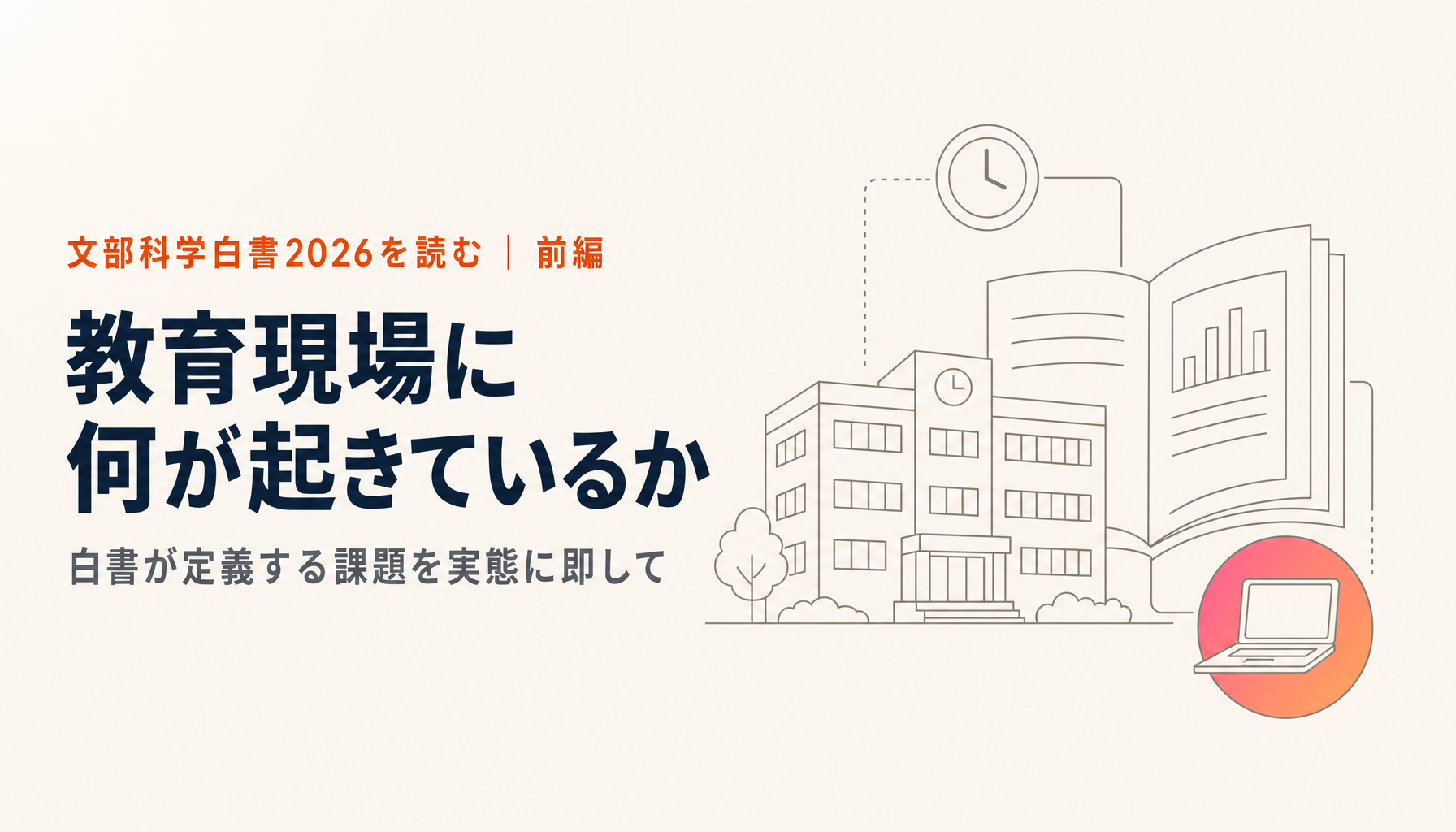
On 24 July 2026, the FY2025 MEXT White Paper was released1. A white paper is the government's official record, written in its own words, of what it treated as a challenge that year and where it put its energy. Because the numbers and the policies are laid out as primary information, I find it an ideal document for checking where education stands right now. This article, as Part 1, organises how the white paper defines "what is happening on the ground in education," set against what I actually see there. The policy talk runs on for a while, but I will try to break it down plainly, so I would be glad if it reached not only people involved in education but anyone interested in growing talent for the age of AI. In Part 2 to follow, I plan to take up the direction of reform, meaning what should be changed and how in response to these challenges.
I should add that the talk of workstyle and generative AI ahead runs continuously with how companies grow their people. If you are curious about your own distance from AI, checking where you stand first with the free AI literacy self-check will, I think, make the second half of this piece feel more like your own concern.
First, be sure which white paper you are reading
Because this trips people up more often than you would expect, let me start with the matter of editions. What was released this time is, formally, the FY2025 MEXT White Paper1. Yet the footer of the pages is printed "MEXT White Paper 2025." That is because it covers FY2025, meaning the 2025 fiscal year, so the name and the printed year merely look out of step. The FY2024 edition put out the year before was released in July 2025 and is a separate document, with a different feature theme from this one. When you cite it, it is safest to hold it in mind as "the FY2025 edition (released July 2026)."
This white paper has two features. Feature 1 is "Toward Schools Where Teachers Can Face Each Child One by One: Realising Both 'Ease of Work' and 'Meaning in Work,'" and its subject is teacher workstyle reform and improving pay2. MEXT states plainly that it treats this as the single most important challenge for education administration. Feature 2 is "International Sporting Events Held in Japan," covering the Asian Games and Asian Para Games held in 2026, among others1. On the strength of that single point alone, that the state declared teachers' way of working its most important issue, the situation the ground now faces comes through. From here on, I read with Feature 1 as the axis.
The challenge the white paper names most important is teachers' workstyle and pay
The first thing Feature 1 shows is the reality of teachers' working hours. The numbers here are laid out solidly, so let me present them as they are. For the FY2024 situation grasped through the "visualisation" survey conducted by boards of education, the monthly average of overtime hours spent at school is shown as roughly 31 hours for elementary school teachers, about 40 hours for lower secondary school teachers, about 33 hours for upper secondary school teachers, about 21 hours for teachers at schools for special-needs education, and about 15 hours for kindergarten teachers2. "Overtime hours spent at school" is a rough measure that sums up the time spent at school beyond regular working hours, and the like. The lower secondary figure of 40 hours tells, I think, of how busy the school workplace is, including club activity supervision.
At the same time, signs of improvement show in the numbers too. The share of teachers at or below 45 hours a month rose across all school types: 77.8 percent for elementary schools (up 2.4 points from the year before), 60.5 percent for lower secondary (up 2.9 points), 72.6 percent for upper secondary, 92.2 percent for special-needs schools and 95.8 percent for kindergartens2. The share exceeding 80 hours a month also fell across all types, at 1.3 percent for elementary, 7.4 percent for lower secondary and 5.6 percent for upper secondary. Compared with the FY2022 survey of working conditions, when the average overtime hours at school for teachers stood at about 47 hours a month, roughly three times that of general administrative staff in local governments at the time, things have moved in the direction of improvement2. On that basis, the white paper holds up a target, set in the revised Kyutoku Law and related legislation, of reducing average overtime hours at school to around 30 hours a month by FY2029.
That the numbers are heading toward improvement matters as a fact. Yet the paper also states clearly that the pool of people willing to become teachers is thinning. The hiring-examination ratio for teachers is at a record low, falling to 2.0 for elementary schools in FY20252. A falling ratio means the room to be selective in choosing people shrinks. The white paper goes further and puts the term "teacher shortage" in writing, meaning the state of not being able to secure the numbers needed because temporary instructors and others cannot be found. Even as it tries to cut long working hours, the structure comes into view: there are simply not enough people to do the work in the first place.
The overhaul of pay and staffing levels is the largest in roughly half a century
Against these challenges, the white paper also sets out concrete responses on the policy side. Since this is policy, let me present only the facts, plainly.
One is pay. Under the revised Kyutoku Law and related legislation enacted in 2025, the teaching-adjustment allowance is being overhauled2. The teaching-adjustment allowance is the mechanism by which teachers, rather than being paid overtime individually, receive a set percentage of their monthly salary added on. The existing 4 percent is to be raised in stages to 10 percent by FY2030. Because a substantial revision touching salary is the first since 1974, the white paper positions this as the first pay improvement in roughly 50 years. Alongside it, the post of chief teacher, offering higher treatment than a regular teacher, is newly created, and an added allowance for homeroom teachers is included. In the white paper's own estimates, for example, a teacher in their tenth year would see an increase of roughly 440,000 yen a year, and someone starting their first year in 2026 would see a salary roughly 800,000 yen higher than in 20242. Because the increment for each year is set in part by cabinet order, the confirmed figures will need to be checked as the system operates, but the direction, toward making pay more generous, comes through.
The other is staffing. Under the revised Standard Law for Compulsory Education, the standard class size for lower secondary schools is being lowered from 40 students to 352. The standard class size is a rough upper limit on the number of students per class. The reduction at lower secondary is the first in roughly 40 years, applied in order from first-year students in FY2026 as they move up through the grades. The standard for placing more than one school nurse is also lowered, and a plan to improve teacher staffing levels is moving too. According to the white paper, the FY2026 budget foresees improvements amounting to 7,596 positions, and 24,605 positions across the whole planning period, with the breakdown including the shift to 35-student classes in lower secondary, teachers responsible for student guidance, and the fuller use of subject-specialist teaching in elementary schools2. My understanding is that the framework of Feature 1 as a whole is to create, from both the pay and the staffing sides, room for teachers to face each child one by one.
Looking for AI training and consulting?
Learn about WARP training programs and consulting services in our materials.
The challenges schools carry are growing more varied and complex
Inseparable from the workstyle question is the weight of the challenges schools face themselves. The white paper shows, through several numbers, that the challenges schools must handle are growing more varied and complex.
For instance, the number of serious bullying cases at elementary schools rose from 398 in FY2014 to 1,129 in FY2024, roughly 2.8 times2. A serious case is a legal category referring to situations such as when there is suspicion of major physical or mental harm caused by bullying. The situation with non-attendance is grave too: the number of non-attending children at public elementary and lower secondary schools rose from 118,787 in FY2014 to 344,185 in FY2024, roughly 2.9 times2. Lined up as bare numbers they feel heavy, but this is by no means a story of blaming children or families. There is an aspect of children's signals being picked up more carefully than before, and behind it lie changes in families and in society. In response to this, the white paper aims to answer with measures such as more generous placement of teachers responsible for student guidance.
What matters is the fact that each of these responses rests on teachers' time and effort. Even as the paper tries to cut long working hours, the challenges to be faced are increasing. In the coexistence of these two things lies the difficulty of the school today, I think.
Amid a declining birthrate, the scale of schools is being reconsidered too
The falling number of children is another large current the white paper takes as a premise. The declining birthrate affects the very shape of schools. As children decrease, some regions will find it hard to keep the same number of classes and schools as before.
On that basis, the white paper depicts the declining birthrate not merely as a reason to shrink scale, but also as a turning point for responding to each child in fine detail. Elementary schools completed the shift to 35-student classes back in FY2025, and, as noted earlier, lower secondary schools too are beginning the move to 35-student classes2. As the number of students per class falls, teachers gain more time to keep an eye on individual children. Lowering the standard for placing more than one school nurse, and strengthening the arrangement of joint school administrative offices that handle the paperwork of several schools together, sit as extensions of the same idea. You can read in it an attitude of connecting a phase of fewer children to raising the quality of education.
Academic achievement is high, but there are signs worth watching
Since the talk of challenges has run on, let me set down the facts on academic achievement accurately too. The achievement of Japanese children remains high by international standards. According to the white paper, in the 2022 PISA, the international survey of learning attainment, Japan placed at the top level in the world in all three areas of mathematical literacy, reading and scientific literacy3. In the 2023 TIMSS, the international survey of trends in mathematics and science education, it maintained a high level too. This is a point that I think we can simply appreciate first.
On that footing, the white paper also shows a few signs worth watching. A survey tracking change over time within Japan found scores tending to fall in four of five subjects3. The falling share of children who think of the sciences and mathematics as their "strong" subjects, and the fact that study time at home is decreasing while time spent on games and smartphones is increasing, are also raised as challenges. That the overall level of achievement is high is heartening in itself, and at the same time it reads as a call to pay attention to what lies behind the numbers, such as the will to learn and a familiarity with the sciences.
Education DX is moving forward, but is still only partway
Another thing I read with particular attention is education DX. The white paper devotes a chapter of Part 2 to the digitalisation of education and the strengthening of information dissemination4.
The foundation is the GIGA School Initiative. This is the policy of providing one learning device per child, and those devices, several years on from distribution, have entered the stage of being replaced over about five years from FY20244. A large budget is allocated for the replacement, and a mechanism has been arranged for bulk procurement using prefectural funds. For upper secondary schools, the equipment rate is said to have exceeded 100 percent nationwide as of the start of FY2024. Alongside this, a three-year plan for ICT environment upgrades covering FY2025 through FY2027 is under way, with single-year project costs of 146.4 billion yen, up 3.2 billion yen from the year before4.
Yet even as the environment comes into shape, the parts still only partway are shown clearly too. An easy example is communication networks. The share of schools securing the communication speed needed for classes stood at only 63.9 percent as of 1 December 20254. That is a rise of roughly 40 points compared with two years earlier, so improvement is proceeding at a rapid pace, but turned around, it means that a little over one school in three still does not reach the speed it needs. The devices have been handed out, but at some schools the line to use them comfortably has not caught up. This overlaps with what I often hear on the ground.
The way of engaging with generative AI is organised too. In December 2024, MEXT revised its guideline on using generative AI in primary and secondary education to Ver. 2.05. This guideline neither uniformly bans nor mandates the use of generative AI in schools, placing human-centred use at its base. Efforts to designate pilot schools and build up cases, and demonstration research on generative AI specialised for the education field, are also under way. In addition, MEXCBT, the online system for learning that MEXT operates, is said to have registration from nearly all municipalities, roughly 30,000 schools, as of January 2026, and the foundation is widening, including the digitalisation of school administration4. The policies and the tools have come into place. My reading is that we have entered the stage of how to make them take root in daily learning.
In companies too, it is the same: merely introducing a tool does not make it settle. Rather than ending at learning, use it repeatedly inside the actual work on the ground, and share the ways of using it that went well. That plain, steady accumulation is what starts to tell. In WARP, the AI consulting we provide, we treat as important not ending at introduction but walking alongside month by month to make it settle in a form that puts no unreasonable strain on the ground. The same way of thinking applies to DX in education too, I feel.
What to change next: the policy is beginning to move too
Beyond defining the challenges, the white paper also touches on the policy revision that lies ahead. That is the review of the standards for curricula, meaning the Courses of Study. On 25 December 2024 the Minister of Education referred the question to the Central Council for Education, and on 25 September 2025 an interim summary of issues was compiled6. The interim summary is a mid-stage document on the way toward a formal report and then a revision, and neither its content nor its name is settled yet.
This interim summary lays out three directions running through the revision debate. To properly implement proactive, interactive and deep learning; to embrace a diverse range of children; and to make all of this achievable on the ground rather than a rice cake in a picture6. While securing the overall framework of instructional hours, it examines creating an "adjustable instructional hours system" that makes the allocation across subjects more flexible, and, in light of the development of generative AI, fundamentally raising information-use ability. That expressions like creating "margin," meaning breathing room, for teachers and children line up in an official document is itself, I think, a sign of alarm about exhaustion on the ground. I plan to take up the substance of this reform in detail in Part 2.
From here on, my own view: the structural problem I feel on the ground
Up to here I have organised the facts the white paper presents. From here on, as one person involved in education at Shinshu University who also stands on the ground of growing talent in companies, I will write what I feel, as opinion. Because I want to keep facts and opinion separate, I deliberately change the section.
The first thing I want to say frankly is that many teachers are truly worn out. The white paper's numbers show a trend toward improvement, but 40 hours of overtime a month is by no means a light level. And on top of that, with responding to bullying and non-attendance, coordinating with guardians, and handling the new measures that keep coming in, the work asked of them is if anything increasing. What I feel on the ground is that this is by no means a story of individual teachers not trying hard enough. As a structure, one teacher shoulders too much. That is exactly why the white paper's attempt to act on both the pay and the staffing sides is, as a direction, reasonable, I think. This is not a story of blaming teachers, but a story of how to lighten the mechanism.
There is one more thing I want to write as a view based on my own observation: I feel there is a structural weakness in how teachers' careers are built. Many teachers in Japan step onto the podium straight out of university and stay long in education without ever having worked in a private company. This is by no means a bad thing, and there is an expertise that comes precisely from having devoted oneself to education. And yet the places most students head to after graduation are private workplaces. What is happening there, what abilities are asked for, how careers move: teachers have a structurally hard time getting the chance to feel that in their bones. As a result, guidance on paths and advice on careers can, I suspect, tend to grow thin. This is not a matter of individual quality, but a structural problem arising from how the teaching profession is built.
That is exactly why I think a mechanism to connect schools and society is needed. People working in the private sector engaging with the classroom, teachers getting chances to touch the workplaces of society, outside talent supplementing the talk of paths and careers. The review of duties and the use of outside talent the white paper holds up can also become the footing for advancing such connections. As AI keeps changing the shape of work from here, the importance of this connection grows all the more, I feel.
On the education of culture and history, let me set down the facts accurately
Finally, on the handling of history, morals and traditional culture, which comes up from time to time around education, let me confirm the facts accurately too. Because it is a point where misunderstanding spreads easily, let me first organise it in line with what the white paper writes.
As a fact, under the current Courses of Study, education relating to tradition, culture and morals is not in the direction of reduction but in the direction of enrichment3. A policy is held up of enriching learning that deepens understanding of tradition and culture, through subjects such as Japan's language culture, local cultural properties, annual events, Japanese musical instruments and martial arts, and washoku cuisine and traditional dress. As for morals, it was made a subject as "Special Subject: Morals" from FY2018 in elementary schools and FY2019 in lower secondary, which is a move that strengthened its position rather than shrinking it. In upper secondary schools too, subjects such as History Synthesis and Public have been newly created. The next Courses of Study are, as touched on earlier, under deliberation at the stage of the September 2025 interim summary, and whether particular subjects or fields will be increased or decreased is not settled at this point3. The white paper contains no statement that history, morals or traditional culture will be reduced.
On that basis, here is my own view. As I wrote in another article before, AI can be used the same way anywhere in the world. If so, strength from here will be decided, I think, on that shared ground of how you use AI, by what a country can multiply into it that is uniquely its own. Japan has an inherent asset in a long, continuous culture. Letting the next generation hold such culture and history as their own context is, I believe, exactly what pays off in the age of AI. This is not fact but only one person's opinion, so please take it that way. On the relationship between culture and education, I wrote in more depth in How Should High School Education Change in the Age of AI?, so I would be glad if anyone interested read it alongside this.
To sum up
It ran long, so let me organise the key points of Part 1.
- What was released in July 2026 is the FY2025 MEXT White Paper. The printed pages read "MEXT White Paper 2025," and it is a separate document from the previous FY2024 edition, so care is needed not to confuse them
- In Feature 1, the white paper places teacher workstyle reform and improving pay as the single most important challenge for education administration. The average overtime hours at school for lower secondary teachers is roughly 40 hours a month, on an improving trend, while the hiring ratio is at a record low and a teacher shortage is stated in writing
- Under the revised Kyutoku Law the teaching-adjustment allowance rises from 4 percent to 10 percent by FY2030, and under the revised Standard Law lower secondary moves to 35-student classes, an overhaul of pay and staffing on the largest scale in roughly half a century
- Serious bullying cases and non-attendance are increasing, and the challenges schools face are growing more varied. The declining birthrate is also depicted as a turning point for responding in fine detail
- Academic achievement stays high by international standards, while there are signs such as scores falling over time and study time decreasing. Education DX is moving forward, but at 63.9 percent of schools securing the communication speeds they need, it is still only partway
- From here on, as the author's own view, I wrote that teacher exhaustion is a structural rather than an individual problem, that a career structure in which teachers rarely gain private-sector experience tends to lead to thin guidance on paths, and that an education that grows culture is, I believe, exactly what pays off in the age of AI
The white paper carefully defines the challenges, then shows measures such as pay, staffing levels, education DX and the review of the Courses of Study. So what, then, should be changed and how beyond that? How to lighten teachers' burden, how to make AI an ally, how to connect society and school. In Part 2, I will think through the direction of this reform, in a form that puts no unreasonable strain on the ground. The continuation is in Reading the 2026 MEXT White Paper (Part 2). Along with it, A guide for educators in the AI-driven age, which organises concretely how to use AI on the ground in education, should be a useful reference too.
If, at a school or a local government, you would like to stand up a review of teachers' workstyle or the use of AI as a structure, please talk to the WARP team. Specialists who carried DX and data strategy at major companies walk alongside you month by month, designing it together in a form that puts no unreasonable strain on the ground.
References and primary sources
Footnotes
-
FY2025 MEXT White Paper (MEXT, released 24 July 2026). https://www.mext.go.jp/b_menu/hakusho/2026/mext_00004.html ↩ ↩2 ↩3
-
FY2025 MEXT White Paper, Feature 1 "Toward Schools Where Teachers Can Face Each Child One by One," main PDF (MEXT). https://www.mext.go.jp/content/20260724-mxt_soseisk01-000050974_5.pdf ↩ ↩2 ↩3 ↩4 ↩5 ↩6 ↩7 ↩8 ↩9 ↩10 ↩11 ↩12
-
FY2025 MEXT White Paper, Part 2 Chapter 2 (primary and secondary education, academic achievement and Courses of Study), main PDF (MEXT). https://www.mext.go.jp/content/20260724-mxt_soseisk01-000050974_8.pdf ↩ ↩2 ↩3 ↩4
-
FY2025 MEXT White Paper, Part 2 Chapter 9 "Advancing Education DX and Strengthening Information Dissemination Using ICT," main PDF (MEXT). https://www.mext.go.jp/content/20260724-mxt_soseisk01-000050974_15.pdf ↩ ↩2 ↩3 ↩4 ↩5
-
"Guideline on the Use of Generative AI in Primary and Secondary Education (Ver. 2.0)," December 2024 (MEXT, Elementary and Secondary Education Bureau). https://www.mext.go.jp/content/20241226-mxt_shuukyo02-000030823_001.pdf ↩
-
Special Subcommittee on Curriculum Planning, "Interim Summary of Issues," 25 September 2025 (MEXT). https://www.mext.go.jp/content/20251020-mxt_kyoiku01-000045486_06.pdf ↩ ↩2
![High School Inquiry-Based Learning × Generative AI: Practical Steps to Empower Students [The N-E.X.T. High School Era]](/images/columns/highschool-inquiry-based-learning-ai/cover.en.png?dpl=dpl_GTagW71VKjD4VDo3w4ymrXrCfn1y)