Hello, this is Ryuta Hamamoto from TIMEWELL.
On November 26, CNBC reported that companies selling Nvidia GPUs are telling neoclouds they will not be able to buy the chips if any of their computing capacity will be rented by Chinese companies1. A neocloud, if the term is new to you, is a cloud provider built around AI: it buys GPUs in bulk and rents out the computing power by the hour.
Notice who is being cut off. It is not Chinese companies directly. It is the buyer who might rent to them. Export controls have reached past the company buying the chips to that company's customers. How did we get here? The starting point is a US rule that took effect on November 192.
Who this is for: operators of data centers and GPU clouds in Japan or elsewhere; companies that buy, sell or distribute advanced GPUs and servers; companies developing AI on overseas GPU clouds, including those with subsidiaries in China; and export control and screening teams.
In one sentence: the US now requires a license not only to sell advanced AI chips to China, but also to rent their computing power to China-linked companies at scale. As a result, chip sellers are checking who rents their buyers' cloud capacity.
Why now: the rule took effect on November 19. Data centers already supplying large-scale compute to China-linked companies must obtain a license by February 17, 2027, or face future export restrictions2. Contracts and customer checks need a review before then.
Four terms will come up repeatedly.
| Term | In plain words |
|---|---|
| Neocloud | A cloud provider that buys GPUs in bulk and rents AI computing power by the hour |
| Remote access | Using a data center's computing power over a network, without having the chips on hand |
| TPP | Total Processing Performance, the yardstick US rules use for chip performance |
| D:5 | A US country group under arms embargo. It includes China |
The short version
- The sellers' condition comes from CNBC's reporting, based on two people familiar with the matter. Nvidia and BIS did not immediately respond1.
- What we can verify is the US rule. If you know that advanced chips are going to a data center anywhere in the world that will supply more than 12 million aggregate TPP (about 760 H100s) to companies headquartered in China or Macau, or whose ultimate parent is, you need a license. Review is case by case2.
- In my view, sellers are drawing a stricter line than the rule because the rule uses a fixed volume rather than a percentage, and a data center that cannot provide KYC information is presumed to give the exporter "knowledge."
- Japan is not outside the rule. The milestones are the comment deadline (January 19, 2027) and the license deadline for existing supply (February 17, 2027).
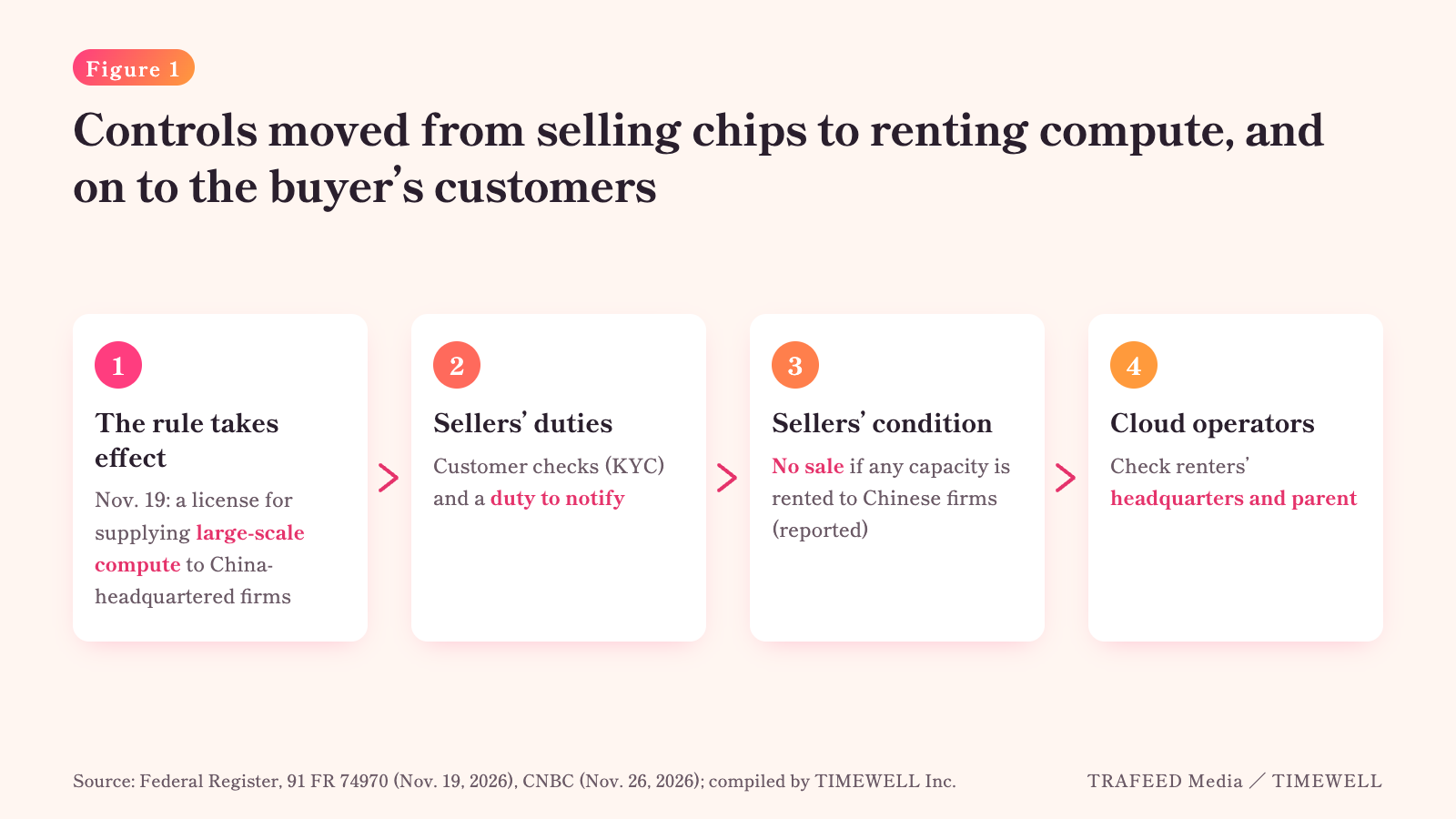 Figure 1. From the rule to the sellers' condition. Read it left to right: the further right you go, the further the rule's effect spreads beyond the chip buyer. Sources: Federal Register, 91 FR 74970 (Nov. 19, 2026); CNBC (Nov. 26, 2026)
What the reporting says: the sellers' condition
Start with the report itself. According to CNBC, neoclouds are being told they will not be able to purchase Nvidia chips if any of the computing capacity will be rented by Chinese companies. Sellers passed on the message after the rule was announced on November 16. The sources were two people familiar with the situation who asked not to be named1.
This is tighter than the earlier line. CNBC says that before the rule was announced, Nvidia had said it would not sell to customers renting more than 50% of their GPUs to Chinese companies1. Take a cloud operator with 1,000 GPUs. Under the earlier line, it could still buy while renting 400 GPUs' worth of capacity to Chinese companies. Under the reported new condition, even one GPU's worth is enough to lose access.
A day earlier, on November 25, CNBC had reported that sellers were looking for new buyers for Nvidia GPUs. Two of the three people it spoke to said the sellers seemed to be offloading chips originally meant for data centers where Chinese companies would rent access1. US Trade Representative Jamieson Greer told CNBC the same day that the Commerce rules were meant to close off "indirect access," both smuggling through places like Southeast Asia and remote access from data centers in third countries1.
There is plenty we do not know. Nvidia and BIS did not immediately respond to CNBC1. Which sellers are imposing the condition, on which customers and since when has not been confirmed by any company. I also could not find an official Nvidia document setting out the earlier 50% policy.
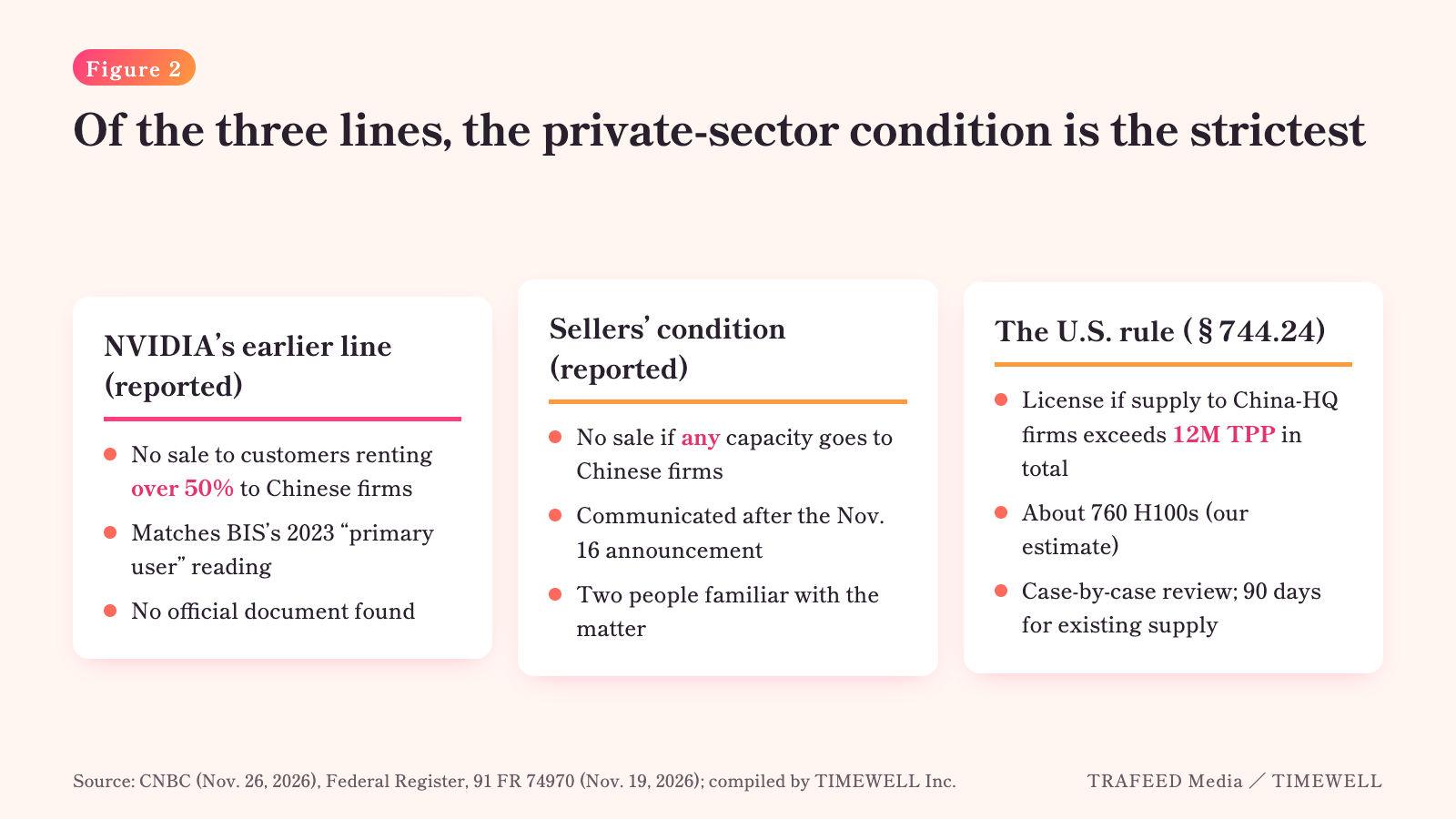 Figure 2. Three lines compared. The point to notice: the strictest line is the private one in the middle, not the rule on the right. Sources: CNBC (Nov. 26, 2026); 91 FR 74970
So what is happening is that private sellers are redrawing the line on their own, a step short of where the rule draws it. Keep the rule's line (right) and the sellers' line (middle) apart when you read the news.
Replace siloed classification work with AI.
METI's FY2024 data shows 52% of foreign exchange law violations stem from classification errors. Download the TRAFEED product catalog covering features and rollout.
Why renting became the target
Since October 2022, the US has restricted sales of advanced AI chips to China. As CNBC puts it, the sale of Nvidia's most advanced chips to Chinese companies and their import into China have effectively been banned1. But those controls work by stopping goods from crossing a border.
AI development does not require the chips to sit in your building. A company in China could, for example, rent GPUs in a data center in Southeast Asia over the internet and train a model on them. The chips never enter China, so controls on physical exports never trigger. That is the remote access gap this rule is meant to close.
The US had not ignored the gap. In its October 2023 rule (the AC/S IFR, 88 FR 73458), BIS explained that an export counts as "for" a China-linked company when that company is the exclusive or primary remote user of a data center's capacity, meaning more than 50% of total compute. The new rule's preamble restates that reading23. My read is that Nvidia's earlier 50% line followed it, although Nvidia has not explained its reasoning.
The 50% line had a limit. At a large data center, even a minority share can be enough compute to train a frontier-class model. The new rule changes this by drawing the line at a fixed volume rather than a share. It also formally rescinds the January 2025 "AI Diffusion Rule" (90 FR 4544)2.
The US government frames the rule as a national security measure. The preamble says large-scale computing power can be used to train and run advanced models that could support military and intelligence activities, such as developing weapons of mass destruction or carrying out cyberattacks2. That is the US government's stated reasoning, not an assessment of any country or company. China's Ministry of Commerce said on November 17 that the US was overstretching the concept of national security and abusing export controls, expressed strong dissatisfaction and firm opposition, and said China would take countermeasures if the US pressed ahead4.
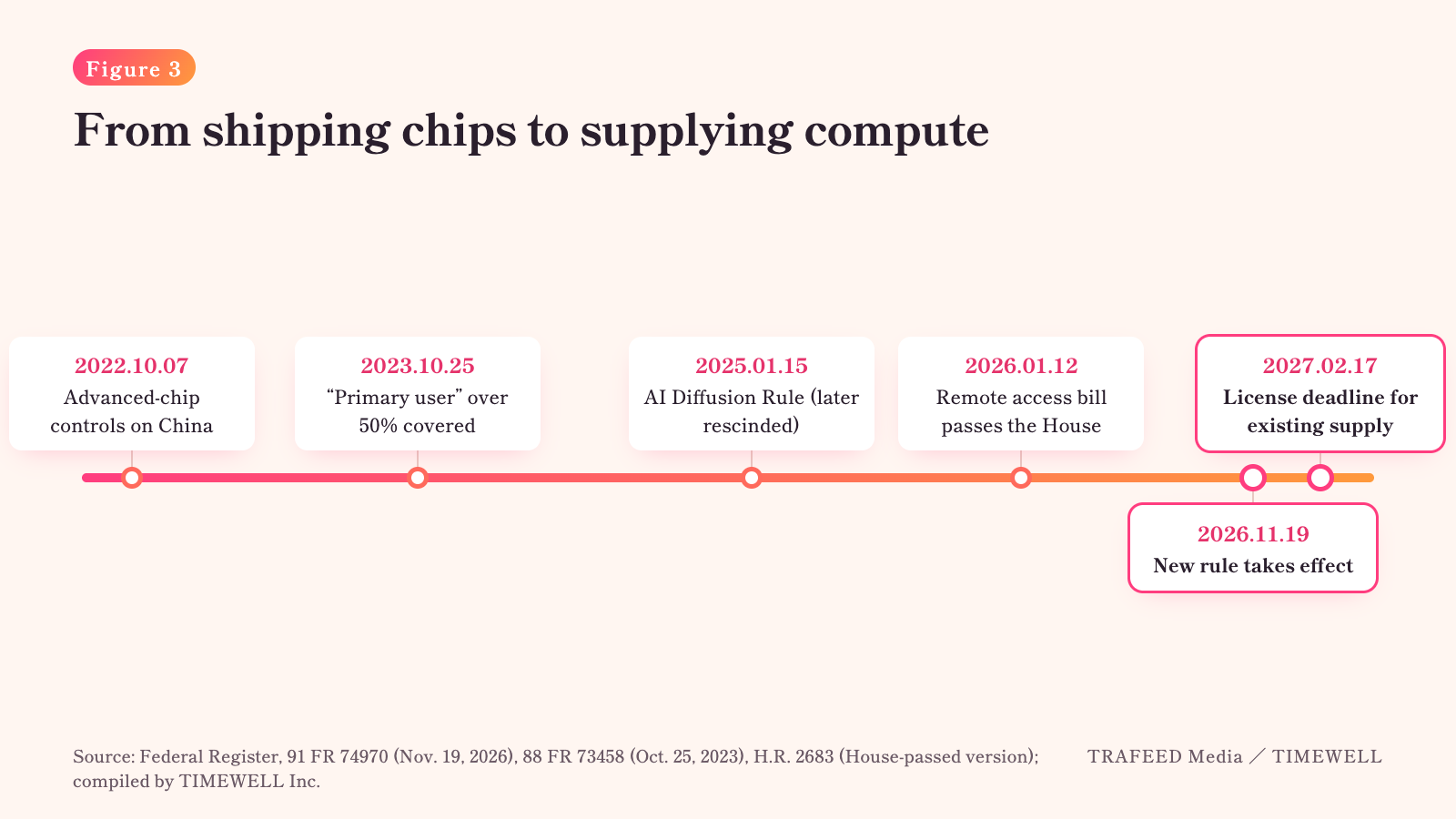 Figure 3. A timeline of remote access controls. Read it left to right: the focus moves from shipping chips to supplying compute. Sources: 91 FR 74970; 88 FR 73458; H.R. 2683 (House-passed version)
One practical note if you read the rule itself: it says "SI" (Super Intelligence) where you would expect "AI." The wording follows Executive Order 14434, and it means AI2.
The rule in four questions
The core of the rule is a new section of the Export Administration Regulations, §744.242. The text is long, but whether it reaches you comes down to the four questions in Figure 4.
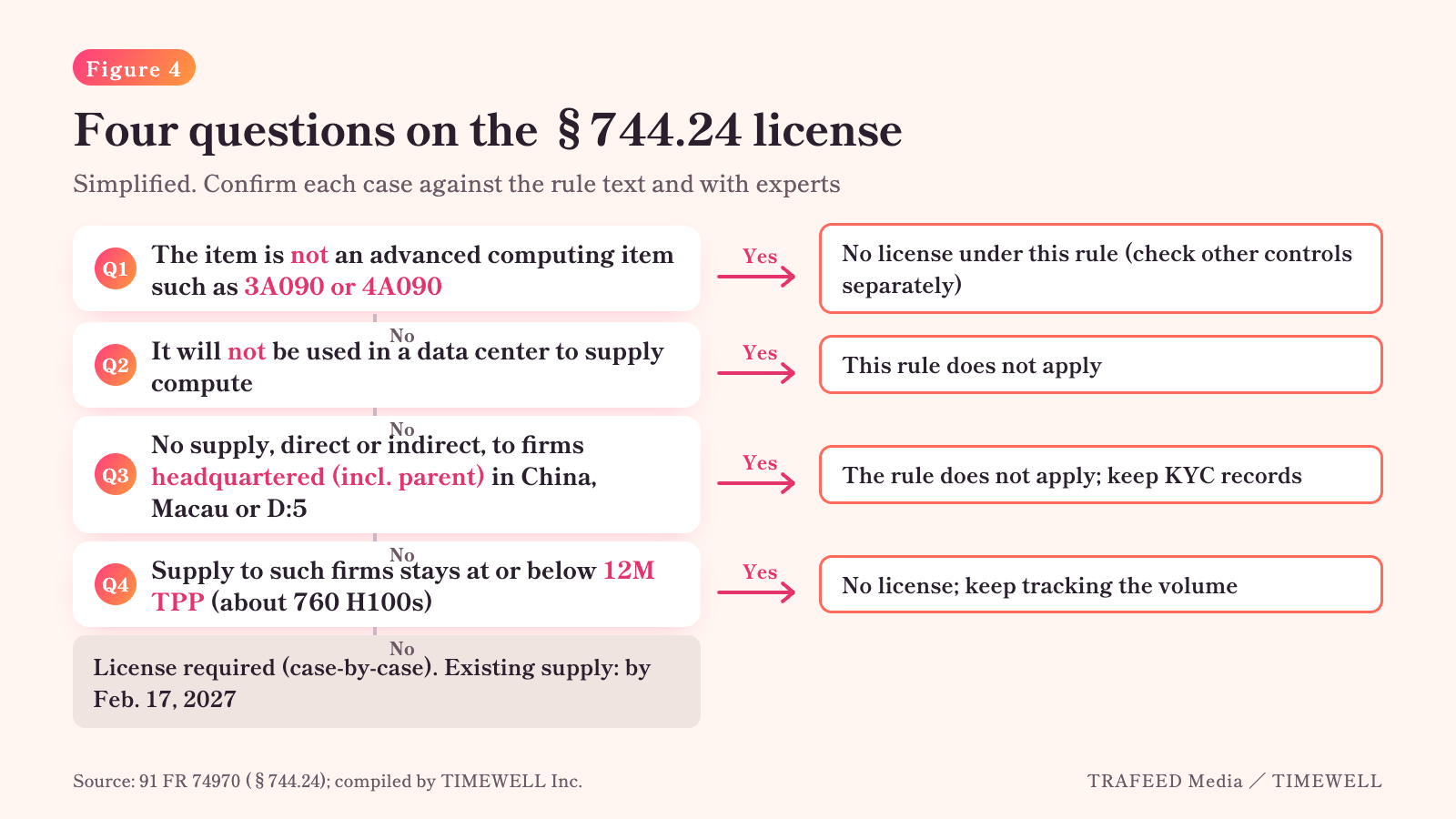 Figure 4. The §744.24 decision flow. Answer from the top; if all four apply, you need a license. Source: 91 FR 74970 (§744.24). If any question is unclear, ask an expert
The first question is the item. The rule covers advanced computing chips and the computers that contain them, classified under export control numbers such as 3A090 and 4A090, along with related software and technology2. Nvidia's leading GPUs and the servers built around them fall into this group.
The second and third questions are about use and customer. Will the GPUs be used in a data center to supply compute to a company headquartered in China, Macau or another D:5 country, or to a company whose ultimate parent is headquartered there? The supply does not have to be direct. The preamble says the rule also covers a non-D:5 customer that trains models for a D:5 company2. Think of a Japanese firm that rents GPUs and uses them to train a model commissioned by a Chinese company.
The fourth question is volume: does the total exceed 12 million TPP? The rule's technical note defines TPP as 2 × MacTOPS × the bit length of the operation, counted on dense (not sparse) operations2. Working from Nvidia's published H100 specifications, one H100 comes to a TPP of about 16,0005, so 12 million TPP is roughly 760 H100s. That is our estimate; one law firm's analysis puts it at about 750 H100s or 330 B200s6. Data centers that are linked over a network and run as one are added together2.
If all four apply, you need a license to export, reexport or transfer in-country, and applications are reviewed case by case. There is one exception: compute used only for commercial recommender systems is excluded if you submit the required information to BIS. Generative AI that produces text, images or other content does not qualify2. Data centers already supplying significant compute to China-linked companies must obtain a license within 90 days of the effective date, by February 17, 2027, or face future export restrictions2.
One more point matters: data centers inside the US. The rule controls exports, not cloud services as such, so it does not reach data centers in the US, as one law firm's analysis notes6. A bill to close that gap, the Remote Access Security Act (H.R. 2683), would let the US control remote access itself. It passed the House on January 12, 2026; as of November 27, I could not confirm passage in the Senate7.
Why sellers go all the way to "no Chinese renters"
The rule's line is "more than 12 million TPP in total." The sellers' reported line is "not a single Chinese renter." Why would a seller go further than the rule? I see five features of the rule that push it there.
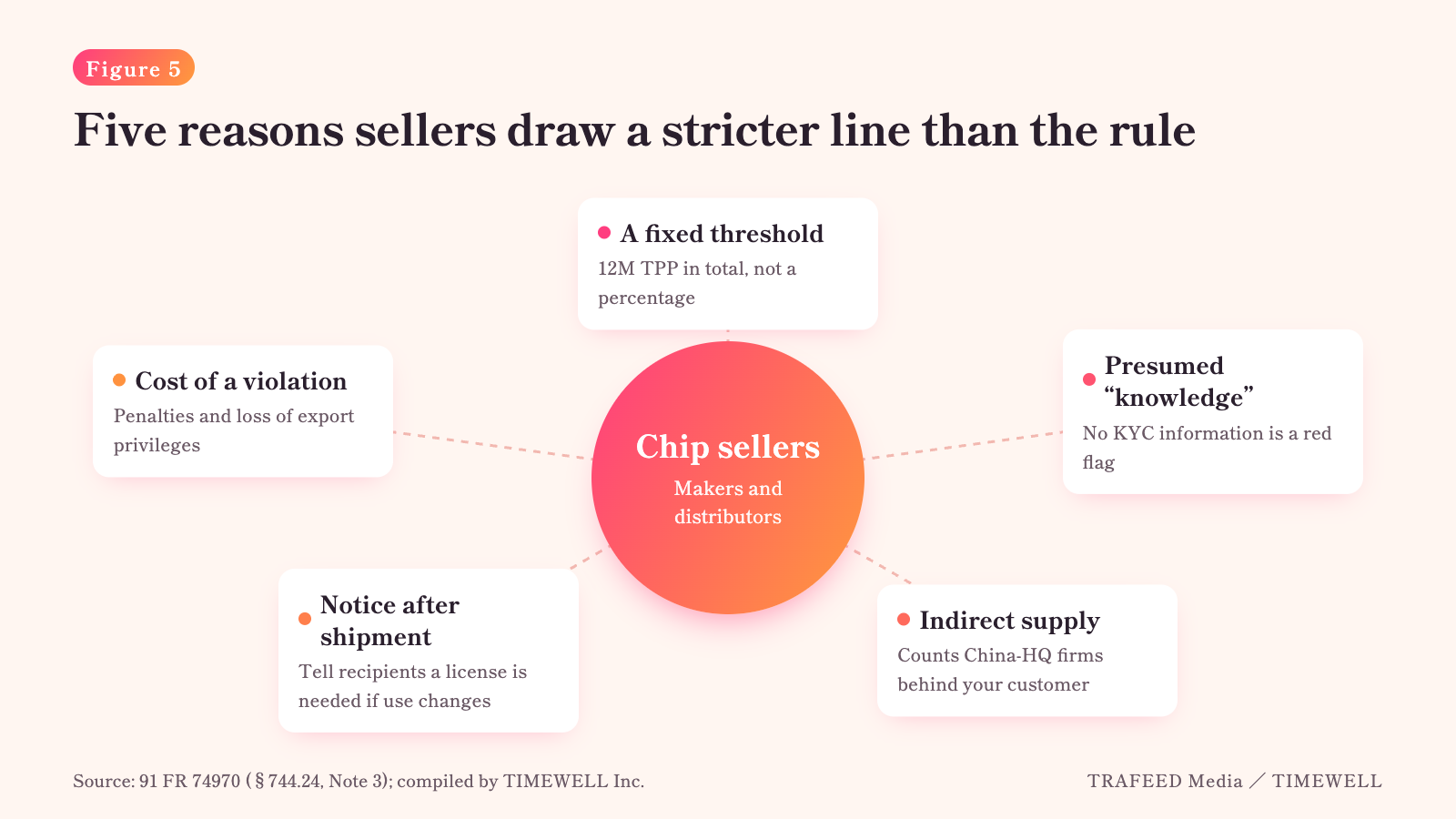 Figure 5. Five reasons sellers draw a stricter line. Read it as five separate duties all landing on the seller in the middle. Source: compiled by TIMEWELL from 91 FR 74970 (§744.24 and Note 3)
First, the threshold is a fixed volume. A percentage gives large customers headroom; a fixed volume does the opposite, so the larger the data center, the easier it is for even a small China-linked share to cross the line6. Second, there is presumed knowledge. Note 3 to the rule expects exporters to obtain and be able to provide KYC information from the foreign data center. If the data center declines or cannot provide it, that is a red flag that presumptively gives the exporter "knowledge" unless resolved2.
Third, indirect supply counts: a China-linked company sitting behind a non-China customer is covered2. Fourth, there is a duty to notify after shipment. Even when an exporter ships without a license, it must tell the recipient that a license is required if the use changes, and that the recipient must follow BIS's know-your-customer guidance2. Fifth, violations are costly, with penalties up to and including loss of export privileges.
From a seller's seat, then, a customer with "a few Chinese renters" is expensive and risky on every count: volume tracking, checks on indirect customers, notices. The only line that is safe for certain is zero, which is what the reported condition amounts to. It is private over-compliance, stricter than what the rule requires. CNBC also notes that neocloud stocks have come under renewed pressure1.
Do not confuse this with the US "50% rule" that made headlines in November. That rule extends controls to affiliates 50% or more owned by listed companies, and it is suspended until January 10, 2027. Same number, different rule.
What it means for companies in Japan, and the dates ahead
Japan is not one of the five countries (Indonesia, Malaysia, Singapore, Thailand and Brazil) that now need a license for advanced chips; I covered those in yesterday's article. But the §744.24 data center control applies to data centers anywhere in the world2. The impact depends on where you sit.
If you run a data center or GPU cloud in Japan, you need to check not just your customers' headquarters but their ultimate parent. The Japanese subsidiary of a Chinese company is a Japanese company, but its parent is headquartered in China, so it counts. Expect chip sellers to ask for customer information and written undertakings more often.
If you use overseas GPU clouds, note that, on my reading of the text, a Japanese company's subsidiary in China may count as a "company headquartered in" China. If that subsidiary uses GPU cloud at scale for AI development, the provider may ask questions. When in doubt, check BIS guidance or ask an expert. And if you sell or broker GPUs and servers, expect to add post-shipment notices and limits on resale and sub-rental to your contracts, as US sellers are doing.
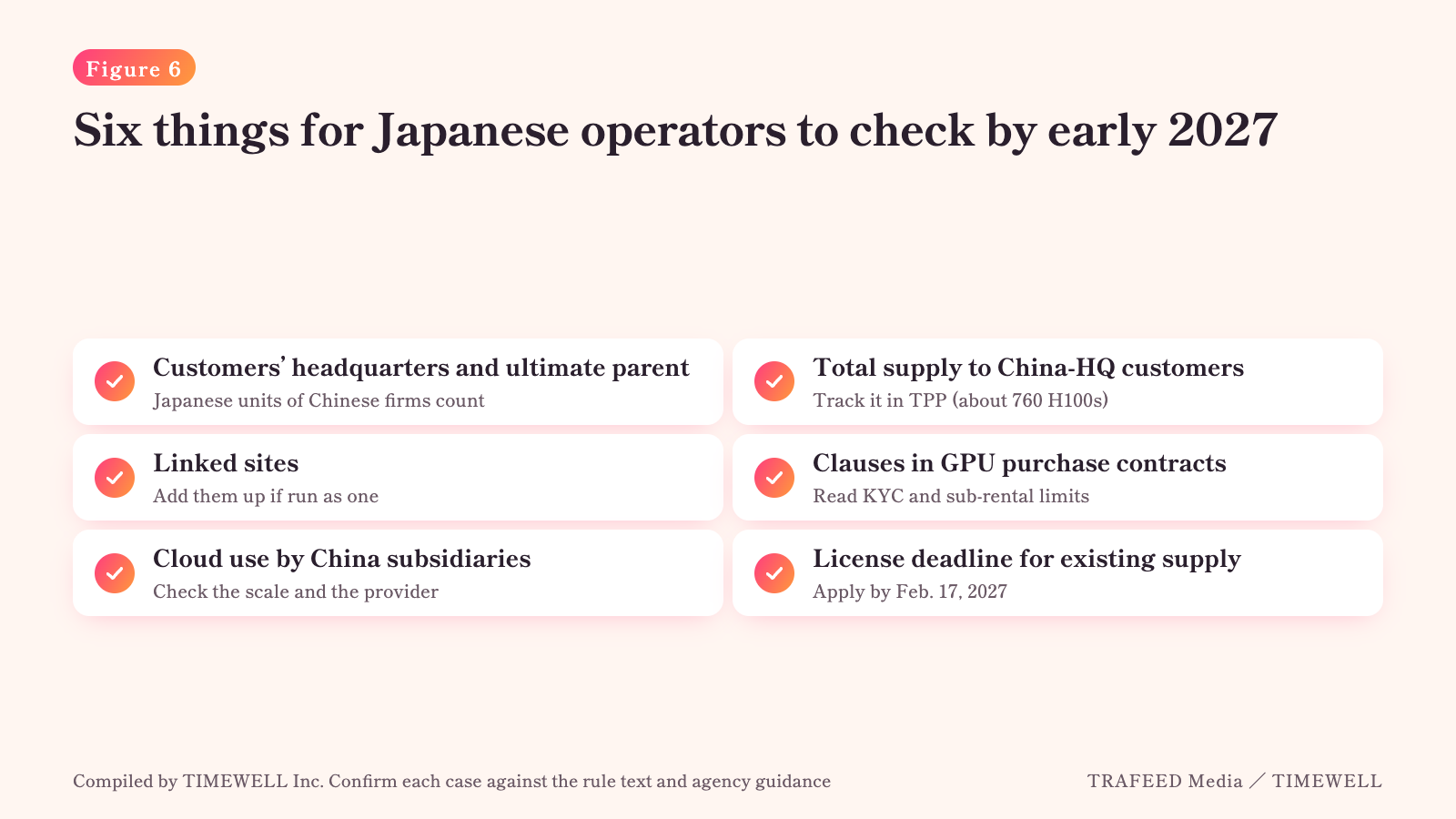 Figure 6. A checklist for operators in Japan. Work through it from the top to see which items apply to you. Source: compiled by TIMEWELL from 91 FR 74970
The dates ahead: comments on the rule are due January 19, 2027, and the license deadline for existing supply is February 17, 20272. A final rule is expected after BIS reviews the comments. In Congress, the question is what the Senate does with the remote access bill7. China has said it will take countermeasures4.
| Date | What happens |
|---|---|
| November 19, 2026 | Rule takes effect (91 FR 74970) |
| January 19, 2027 | Comment deadline |
| February 17, 2027 | License deadline for data centers already supplying China-linked companies (90 days) |
| TBD | Final rule; Senate action on the remote access bill |
A word that matters in any export control article: the rule classifies companies by where they are headquartered. It is not a judgment on any individual company. Most companies headquartered in China run legitimate civilian businesses, and the sellers and cloud operators involved are themselves working out how to comply.
Summary
- CNBC reported that sellers of Nvidia GPUs are telling neoclouds they will not sell if any capacity is rented to Chinese companies. The sources were two people familiar with the matter; Nvidia and BIS did not immediately respond.
- The background is the US rule in force since November 19: supplying more than 12 million TPP (about 760 H100s) of compute to companies headquartered in China or Macau, from a data center anywhere, requires a license.
- In my view, sellers go to zero because of the fixed threshold, presumed knowledge, indirect supply, the duty to notify and the cost of violations.
- Japan is not outside the rule. Data center operators need to check customers' ultimate parents.
- The milestones are the comment deadline (January 19, 2027) and the license deadline for existing supply (February 17, 2027).
Chip controls have moved from stopping goods to checking where computing power goes. If you do one thing on Monday morning, open your GPU cloud contracts and see whether they include a clause on your customers' headquarters and parent company. If they do not, that is your first task.
TRAFEED, our AI for export control, helps with counterparty screening and with tracking rule changes across countries. Final determinations rest with your export control officer.
Footnotes
-
CNBC, "Nvidia chip buyers told to rule out Chinese renters to buy GPUs" (November 26, 2026). https://www.cnbc.com/2026/11/26/neoclouds-nvidia-china-ai.html ↩ ↩2 ↩3 ↩4 ↩5 ↩6 ↩7 ↩8 ↩9
-
Federal Register, 91 FR 74970, "Addressing Remote Access to Advanced Semiconductors" (published and effective November 19, 2026; FR Doc. 2026-23529; comments due January 19, 2027). §744.24, the preamble and the Technical Notes to ECCN 3A090. https://www.federalregister.gov/documents/2026/11/19/2026-23529/addressing-remote-access-to-advanced-semiconductors ↩ ↩2 ↩3 ↩4 ↩5 ↩6 ↩7 ↩8 ↩9 ↩10 ↩11 ↩12 ↩13 ↩14 ↩15 ↩16 ↩17 ↩18 ↩19
-
Federal Register, 88 FR 73458, "Implementation of Additional Export Controls: Certain Advanced Computing Items; Supercomputer and Semiconductor End Use" (October 25, 2023; the AC/S IFR), as cited in the preamble to 91 FR 74970 (p. 74973). https://www.federalregister.gov/documents/2023/10/25/2023-23055/implementation-of-additional-export-controls-certain-advanced-computing-items-supercomputer-and ↩
-
Ministry of Commerce of the People's Republic of China, spokesperson's remarks on the US measures restricting remote access to advanced semiconductors (November 17, 2026). https://www.mofcom.gov.cn/xwfb/xwfyrth/art/2026/art_c9c0beb01b8640d3ba9160b73d315716.html ↩ ↩2
-
Nvidia, H100 Tensor Core GPU specifications (FP16 Tensor Core: 1,979 TFLOPS with sparsity; we halved it for dense operations). https://www.nvidia.com/en-us/data-center/h100/ ↩
-
Ashurst Perkins Coie, "BIS Issues Interim Final Rule Restricting Remote Access to Advanced US AI Chips" (November 16, 2026). https://www.ashurstperkinscoie.com/en/insights/bis-issues-interim-final-rule-restricting-remote-access-to-advanced-us-ai-chips/ ↩ ↩2 ↩3
-
H.R. 2683, Remote Access Security Act, House-passed version (January 12, 2026). https://www.govinfo.gov/content/pkg/BILLS-119hr2683eh/html/BILLS-119hr2683eh.htm ↩ ↩2