Hello, this is Ryuta Hamamoto from TIMEWELL.
On November 26, Japan time, the Financial Times reported that Nvidia had asked its server manufacturing partners to stop shipping to Malaysia, Singapore, Thailand and Indonesia1. Japanese newspapers picked it up within hours, most of them under the words "shipment halt."
Read only the headline and it sounds as if Nvidia decided on its own to pull back from the region. Follow the story back, though, and it starts with a US export control rule. On November 19, the Commerce Department's Bureau of Industry and Security (BIS) put into effect an interim final rule that requires a license to send advanced computing chips to those four countries and to Brazil2. The reported pause is described as something that happened while companies work out how to comply.
In this piece I separate what the US Federal Register and government statements confirm from what is still only reported, then look at what changes for Japanese companies and what gets decided next. I am not here to judge Nvidia or its partners.
The short version
- The pause comes from FT reporting based on three people familiar with the matter. As of November 26, Nvidia, Dell and Supermicro had not explained it publicly, and nobody has said whether it is temporary1.
- The rule is what we can confirm. Since November 19, sending advanced computing chips, or computers that contain them, to Indonesia, Malaysia, Singapore, Thailand or Brazil requires a license, reviewed case by case2.
- The only carve-out is for consignees or end users headquartered in the United States, and it depends on monthly reporting. Sites owned by Japanese-headquartered companies do not qualify2.
- The dates to watch are December 21 (the cutoff for shipments already in transit), January 19, 2027 (comments due) and February 17, 2027 (the license deadline for existing data center services).
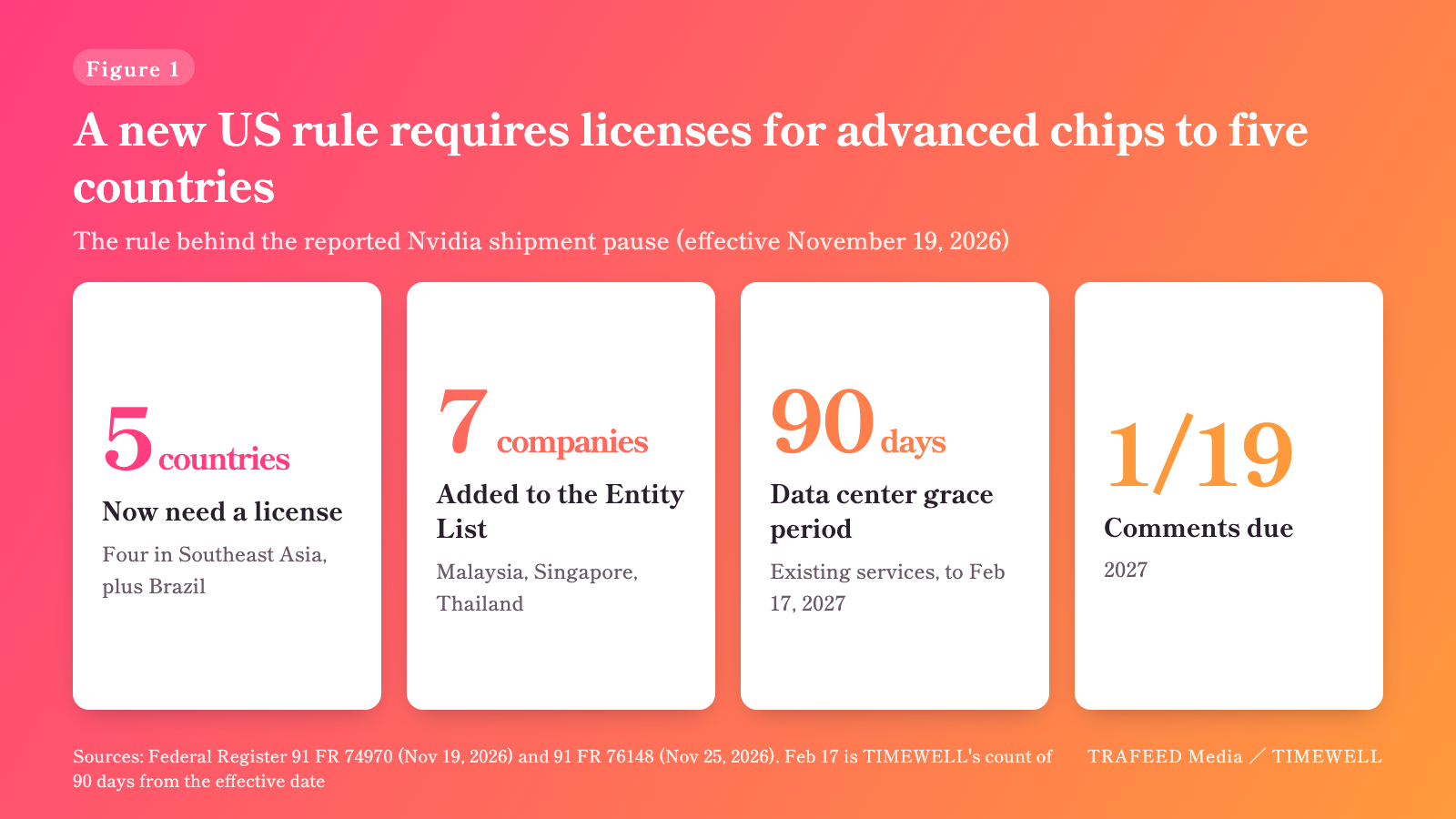 Figure 1. The numbers behind the reported pause. Sources: Federal Register 91 FR 74970 (November 19, 2026) and 91 FR 76148 (November 25, 2026). February 17 is my count of 90 days from the effective date.
What the reports say, and what they don't
Start with the reporting itself. According to Reuters' account of the FT story, Nvidia asked manufacturing partners not to ship servers containing its chips to the four countries. Dell and Supermicro, which build Nvidia chips into servers, reportedly told buyers in those countries that Nvidia would not allow their orders to ship. The FT cited three people familiar with the matter and said it was unclear whether the pause was temporary1.
The FT also reported that Nvidia and its partners were trying to find a way to comply with the new rule, and quoted a regional cloud executive who said nobody knew how to apply for the license while the 90-day clock was running3. Nvidia, Dell and Supermicro did not immediately respond to Reuters1. So the scope (every order, or only new ones), the length of the pause and the products involved have not been confirmed by the companies.
| Category | What | Basis |
|---|---|---|
| Confirmed in primary sources | A rule effective November 19 requires licenses for advanced items going to five countries. Seven companies in Malaysia, Singapore and Thailand were added to the Entity List effective November 23 | Federal Register24 |
| Reported only | Nvidia asked manufacturing partners to stop shipping to four countries. Dell and Supermicro told buyers | Reuters, citing the FT1 |
| Not confirmed | Scope and duration of the pause, products affected, license applications, what happens with Brazil | No company statement as of November 26 |
The "four countries" in the headlines deserve a second look. The rule actually names five: the four Southeast Asian countries plus Brazil2. Nothing I read says what is happening with shipments to Brazil. My own reading is that "halt" here means holding shipments that now need a license until the license comes through. Without a company statement I cannot confirm that, so please treat it as my interpretation.
Replace siloed classification work with AI.
METI's FY2024 data shows 52% of foreign exchange law violations stem from classification errors. Download the TRAFEED product catalog covering features and rollout.
What the November 19 rule does
The rule is an interim final rule titled "Addressing Remote Access to Advanced Semiconductors." BIS filed it for public inspection on November 16 (US Eastern time) and it was published and took effect on November 192. An interim final rule applies immediately, before public comments, and can be revised afterward in light of them. Comments are due January 19, 2027. The rule was made public on November 16, ahead of publication, and Singapore responded the next day5.
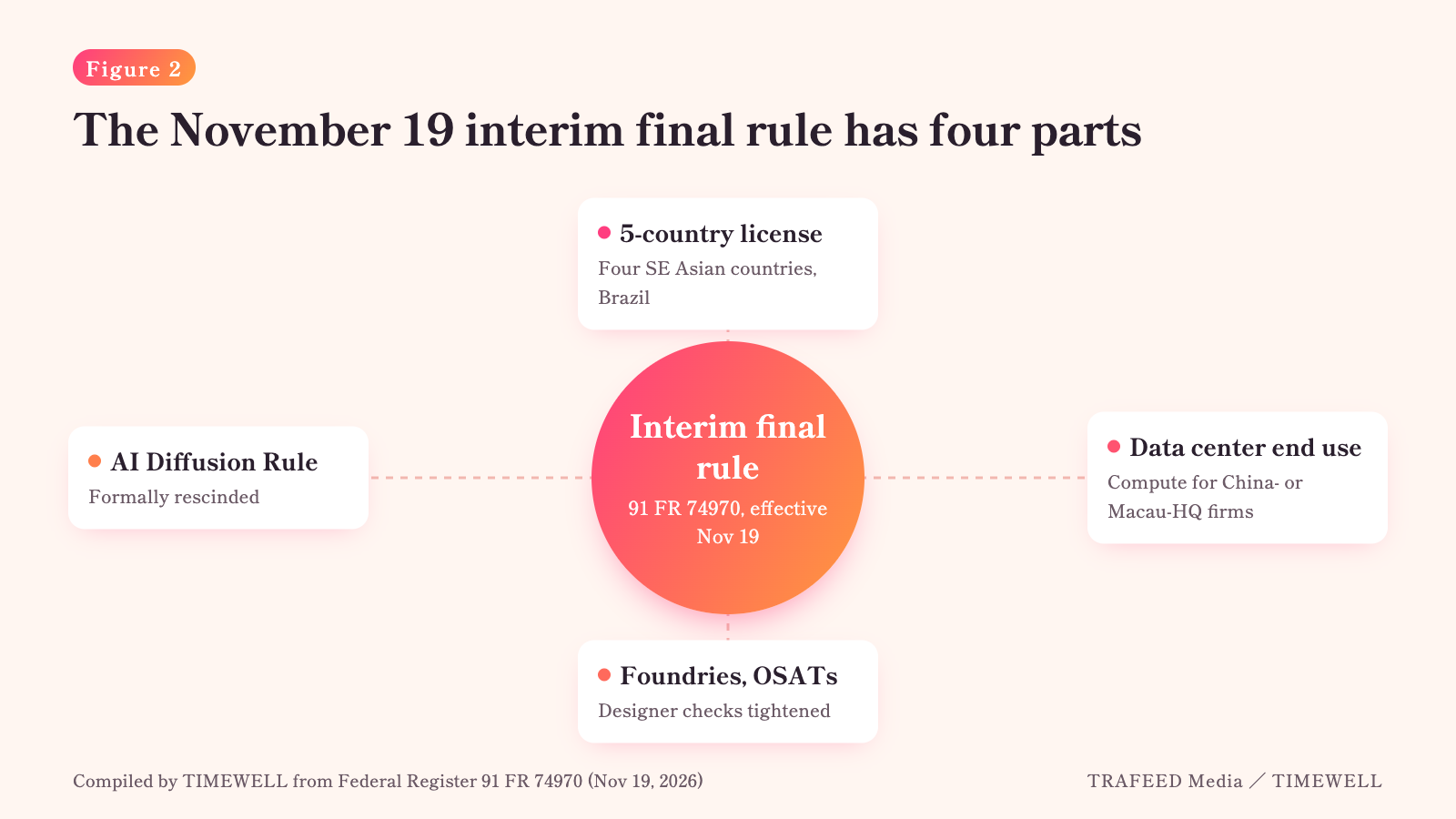 Figure 2. The four parts of the rule. Source: compiled by TIMEWELL from Federal Register 91 FR 74970 (November 19, 2026).
There are four parts. The first is a data center end-use control. Wherever a data center is located, a license is required to export, reexport or transfer advanced chips if you know they will be used to provide large amounts of compute to companies headquartered in China (Country Group D:5 in US terms) or Macau. The second is the one behind the reported pause: the license requirement for five countries. The third tightens the rules for front-end foundries and back-end packagers (OSATs), making clear that a license is needed to make and ship advanced logic chips for designers that are neither approved nor authorized. The fourth formally removes the AI Diffusion Rule, which the previous administration issued in January 2025 and BIS said in May 2025 it would rescind2.
One small detail if you search the text: the rule writes "SI," for "Super Intelligence," where you would expect "AI." A footnote says this follows Executive Order 144342.
The rule explains that the five countries were added because covered items are being diverted to entities and countries of concern without authorization2. That is the US government's assessment. The rule does not find that any particular government or company in those countries was involved in diversion.
A license for four countries and Brazil, with a carve-out only for US companies
Now the five-country requirement in more detail. It covers items under ECCN 3A090 (except 3A090.c), 4A090, the ".z" items such as 3A001.z and 4A003.z through 4A005.z, and related software and technology2. Put simply: advanced computing chips such as data center GPUs, and servers that contain them. It applies to reexports and in-country transfers as well as exports, so a distributor in Singapore handing a server to a local customer needs a license too. That breadth fits the report that manufacturing partners paused shipments to buyers across all four countries.
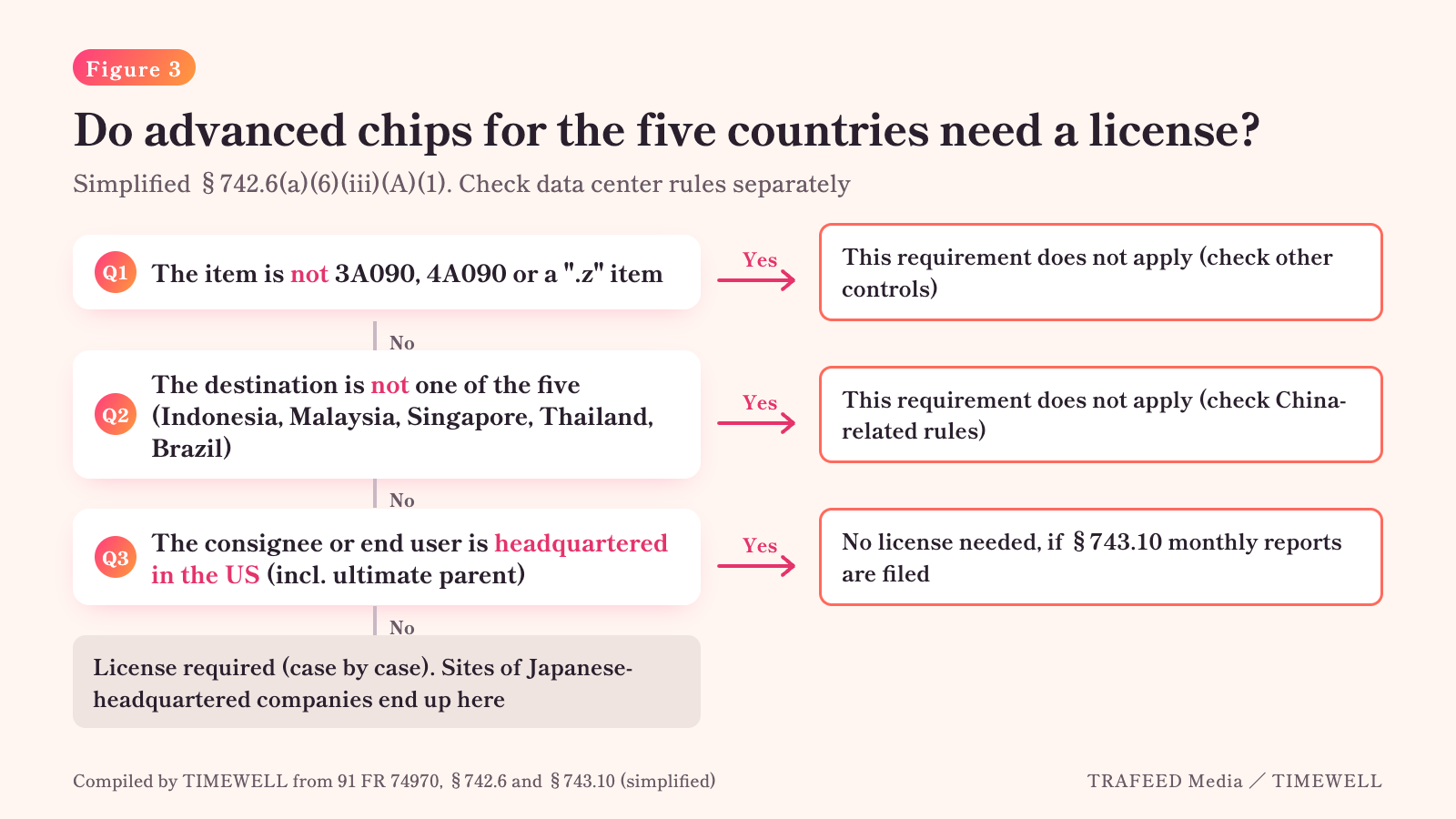 Figure 3. Does a shipment to the five countries need a license? (simplified). Source: compiled by TIMEWELL from 91 FR 74970, §742.6 and §743.10.
There is exactly one carve-out. No license is needed if the consignee or end user is headquartered in the United States, or its ultimate parent is, and the exporter files the reports required by the new §743.102. The reports include the names and addresses of the parties and the ultimate parent, and they are due by the first business day of the month after the transaction. For November shipments, the first deadline is December 1. US cloud providers with data centers in the four countries can probably use this route. That is presumably what Malaysian officials meant when they said, according to local reports, that data center investment was on track because US hyperscalers are exempt6.
For Japanese companies, the key point is that the carve-out is limited to US headquarters. A Japanese-headquartered company running GPU servers at a factory in Thailand or Indonesia, or at an office in Singapore, does not qualify. Even when it buys from a local reseller, the reseller needs a license. The reverse case works differently: a Japanese company shipping to the local site of a US-headquartered customer can use the carve-out, but the reporting duty falls on the company that ships.
Applications are reviewed case by case, and the rule says destinations will be judged on how effective their export control systems are and how well they coordinate with BIS on enforcement2. For countries that tolerate evasion, the rule lists possible consequences including import restrictions, new license requirements, a downgrade in the country's export control status, and Entity List designations. The Commerce Secretary can also add countries after consulting the Secretary of State and others. Nothing in the text says the list stops at five.
Alongside the rule, BIS added seven companies in Malaysia, Singapore and Thailand to the Entity List (the US list of parties that need a license for transactions) in the November 25 Federal Register, effective November 234. The names in the Federal Register are MSFusion Sdn. Bhd., PT Megaspeed International and Speedmatrix Sdn Bhd in Malaysia; Apex Enterprise Solutions (Singapore) Private Limited, Megaspeed International Pte. Ltd. and Swiftdata Pte. Ltd. in Singapore; and Megaspeed (Thailand) Co., Ltd. in Thailand. The stated reason is a significant risk of involvement in diverting advanced computing items to unauthorized end uses or end users. All items subject to the EAR now need a license, reviewed under a presumption of denial. An Entity List designation is a regulatory classification. It does not mean a violation has been established. When you screen, include spelling variants and affiliates.
The data center control reaches Japan too
The data center end-use control is separate from the five-country requirement and is not limited by geography. The text says "any destination worldwide"2. A data center in Japan is covered too: if you know the chips will be used to provide more than 12,000,000 aggregate TPP (a combined measure of chip processing performance) to companies headquartered in China or Macau, including customers they control indirectly, buying advanced chips for it requires a license.
| Item | What the rule says | What it means for Japanese companies |
|---|---|---|
| Threshold | More than 12,000,000 aggregate TPP provided to companies headquartered in China or Macau | Mainly large GPU cloud operators |
| Customer checks | A foreign data center that declines or is unable to provide customer due diligence information is a red flag | Suppliers may ask for customers' headquarters and ownership |
| Existing services | A license must be obtained within 90 days of the effective date, or future export restrictions may follow | About February 17, 2027 (my count) |
| Exclusion | Compute used only for commercial recommender systems | Training or running generative models is not excluded |
I covered this part in more depth in my November 19 article on GPU clouds and export controls. The point here is that the Southeast Asia story and the data center due diligence story are two parts of the same rule. The "90-day clock" that regional cloud operators are worried about belongs to the data center side3.
The third part, on foundries, also has a date that matters for Japanese chip designers. Until December 31, designers headquartered in Japan, Taiwan and other A:1 or A:5 destinations that agree to give the foundry certain information count as "authorized IC designers." After that, they also need to have applied to become approved IC designers2. If you order advanced logic from a foundry, my article on what foundries ask chip designers to confirm is worth reading alongside this one.
How governments responded, and what happens next
Governments in the affected countries reacted as soon as the rule became public. In a joint statement on November 17, Singapore's Ministry of Digital Development and Information (MDDI) and Ministry of Energy, Trade and Industry (METI) said they were studying the details, talking with affected companies, consulting US authorities on the scope and implementation, and exploring how to secure "trusted access" for Singapore companies5. The same statement said Singapore does not condone companies using their association with Singapore to circumvent or violate the laws of other countries.
Thailand's deputy commerce minister reportedly told CNBC before the rule came out that the country was ready and would tighten checks on chip importers. Indonesia's government communications office told Bloomberg it was studying the rule and would seek input from industry7. Malaysia's Ministry of Investment, Trade and Industry (MITI) said on November 13 that it had never approved two of the companies later added to the Entity List, and that it was working with customs to check whether imported servers had been reexported, according to local reporting6. Malaysia has approved about RM385.7 billion of data center and AI infrastructure investment since 2021, so the license requirement matters for big local projects6.
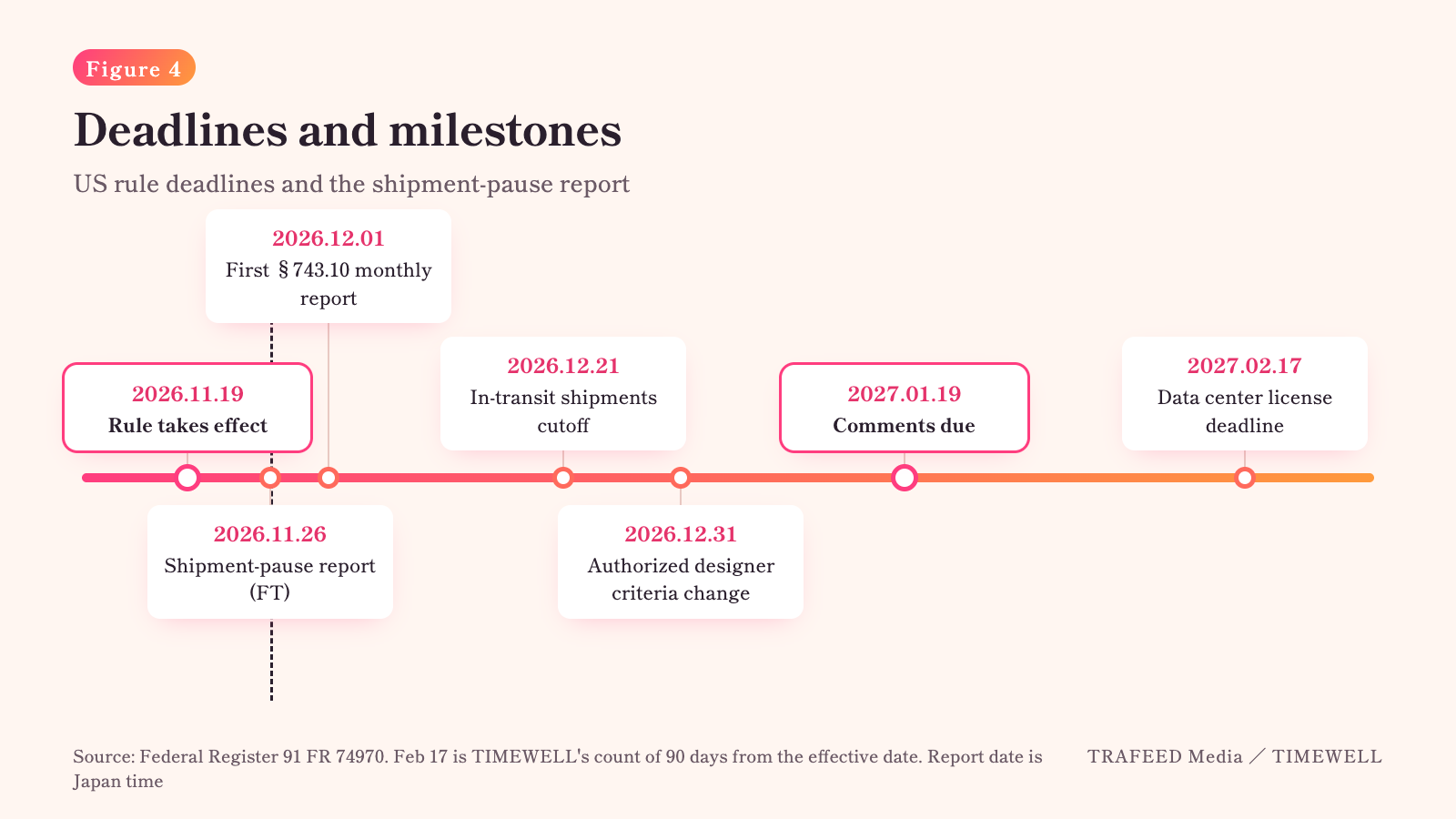 Figure 4. Deadlines and milestones. Source: Federal Register 91 FR 74970. February 17 is my count of 90 days from the effective date. Report dates are Japan time.
Besides the dates in Figure 4, shipments that were in transit when the Entity List additions took effect can proceed under the previous rules if completed by December 234. In Congress, the chair of the Senate Banking Committee reportedly sent letters asking Nvidia's CEO to appear at a hearing on December 3 and the Commerce Secretary on December 10. As of the November 12 report these were requests, not confirmed dates8. The Senate's version of the defense authorization bill reportedly also includes provisions on verifying where chips end up8.
I am watching three things. First, how quickly licenses come through and on what conditions. Until we see case-by-case decisions, procurement in the region will be hard to plan. Second, whether country- or company-level arrangements emerge, along the lines of the "trusted access" Singapore is asking for. Third, whether countries are added or dropped. Since the rule uses the effectiveness of each country's export controls as a yardstick, stronger national systems could change how a country is treated. All three should start to show in the comments due by January 19, 2027 and in any revisions that follow.
What Japanese companies should check now
I have boiled it down to five things worth checking this week.
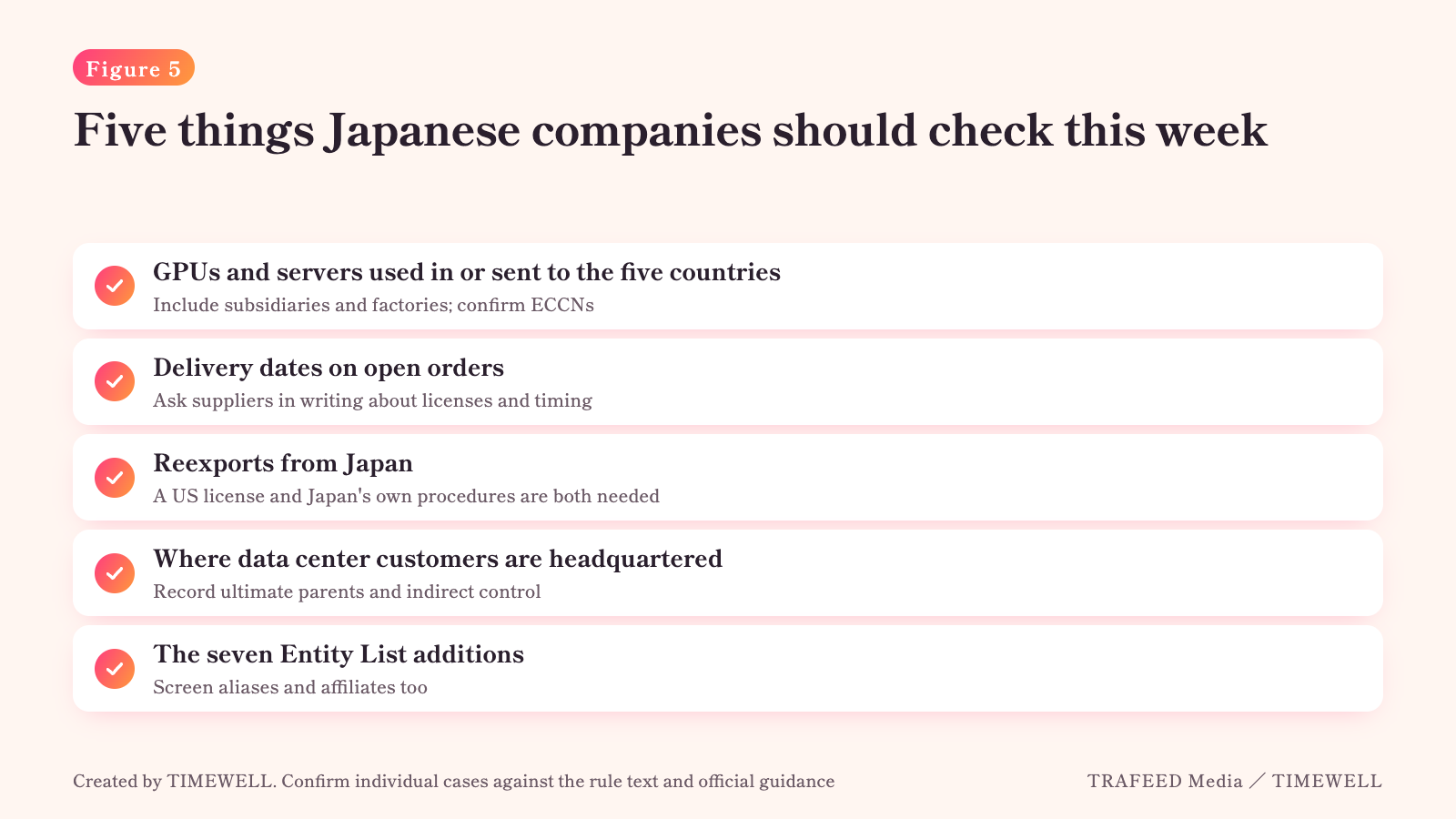 Figure 5. Five things to check this week. Created by TIMEWELL.
First, list the servers and GPUs your company and subsidiaries use in, or ship to, the five countries. AI-based inspection at a factory, R&D computing and an internal cloud at a local office all count: if the item falls under 3A090 or 4A090, a license is needed, data center or not. The quickest way to know is to ask the supplier for the ECCN. I explain how to calculate TPP in my guide to 3A090 performance determinations, and there is a 3A090 performance calculator for TPP and performance density (Excel, in Japanese) that works it out from datasheet values.
Second, check delivery dates on open orders. If the reports are accurate, shipments may be held on the manufacturing partner's side. Ask your supplier in writing whether a license is needed and when they expect it, and build that into the local schedule. Third, look at shipments from Japan to the five countries. Sending a server with US-made chips from Japan is a reexport under US rules and needs a license. Japan's own Foreign Exchange and Foreign Trade Act procedures apply separately.
Fourth, if you run a data center or sell compute, record where each customer and its ultimate parent are headquartered and whether anyone controls them indirectly. That way you can answer when a supplier asks. Fifth, screen counterparties for the seven new Entity List companies, their aliases and affiliates. My playbook for the day a US rule changes walks through the steps, and the US rule change impact triage sheet (Excel, in Japanese) puts deadlines, six screening questions, case sorting and §743.10 monthly report records in one place.
"Shipment halt" is a strong phrase, but what is actually moving is a license process required by a US rule. We won't know the details of Nvidia's step until the company explains it. Rather than stopping deals in a hurry, I think the better use of this week is to check your own items and your counterparties' headquarters, and to find the transactions that need a license early. That is what keeps procurement delays small. I will update this article when the companies or regulators say more.
If you want to build counterparty checks and decision records into a routine, talk to us about TRAFEED. Whether a specific transaction needs a license should be decided by your team and your advisers, based on the rule text and guidance from the authorities.
Footnotes
-
Reuters, "Nvidia halts server shipments to four Southeast Asian countries, FT reports" (November 26, 2026, reporting on the Financial Times story). https://www.investing.com/news/stock-market-news/nvidia-halts-server-shipments-to-four-southeast-asian-countries-ft-reports-5052112 (retrieved November 26, 2026) ↩ ↩2 ↩3 ↩4 ↩5
-
Federal Register, 91 FR 74970 (document 2026-23529), Bureau of Industry and Security, "Addressing Remote Access to Advanced Semiconductors," interim final rule. Filed for public inspection on November 16, 2026 (US Eastern time); published and effective November 19, 2026. Comments due January 19, 2027 (regulations.gov BIS-2026-0628, RIN 0694-AK50). See §742.6(a)(6)(iii)(A)(1), §742.6(b)(10)(iii)(A)(1), §743.10, §744.23(a)(3)(i)(C) and §744.24. https://www.federalregister.gov/documents/2026/11/19/2026-23529/addressing-remote-access-to-advanced-semiconductors (retrieved November 26, 2026) ↩ ↩2 ↩3 ↩4 ↩5 ↩6 ↩7 ↩8 ↩9 ↩10 ↩11 ↩12 ↩13 ↩14
-
The National, "Nvidia halts chip shipments to South-East Asia amid US crackdown" (November 26, 2026, reporting on the Financial Times story). https://www.thenationalnews.com/future/technology/2026/11/26/nvidia-halts-chip-shipments-to-south-east-asia-amid-us-crackdown/ ↩ ↩2
-
Federal Register, 91 FR 76148 (document 2026-23999), Bureau of Industry and Security, "Additions to the Entity List." Published November 25, 2026; effective November 23, 2026. https://www.federalregister.gov/documents/2026/11/25/2026-23999/additions-to-the-entity-list (retrieved November 26, 2026) ↩ ↩2 ↩3
-
Singapore Ministry of Digital Development and Information (MDDI) and Ministry of Energy, Trade and Industry (METI), "MDDI-METI Joint Media Statement on US Interim Final Rule on Addressing Remote Access to Advanced Semiconductors" (November 17, 2026). https://www.meti.gov.sg/newsroom/mddi-meti-joint-media-statement-on-us-interim-final-rule-on-addressing-remote-access-to-advanced-semiconductors/ ↩ ↩2
-
The Rakyat Post, "No Permit, No Chips: U.S. Trade Rule Puts Malaysia's Data Centres On Ice" (November 26, 2026). The November 13 statement by Malaysia's Ministry of Investment, Trade and Industry is as summarized in this article; I could not retrieve the original. https://www.therakyatpost.com/news/malaysia/2026/11/26/no-permit-no-chips-u-s-trade-rule-puts-malaysias-data-centres-on-ice ↩ ↩2 ↩3
-
W.Media, "Singapore, Thailand, Indonesia respond to new US chip export rule" (November 17, 2026). https://w.media/singapore-thailand-indonesia-respond-to-new-us-chip-export-rule/ ↩
-
Roll Call, "Calls for Nvidia probes, new chip export limits intensify" (November 12, 2026). https://rollcall.com/2026/11/12/calls-for-nvidia-probes-new-chip-export-limits-intensify/ ↩ ↩2