Hello, this is Ryuta Hamamoto from TIMEWELL. Have you heard of CoreWeave and Nebius? One is a company in New Jersey, the other is in Amsterdam. Neither is a household name, yet in the AI industry of 2026 they are among the most closely watched companies anywhere: NVIDIA has invested in them directly, and Microsoft, Meta and OpenAI have signed contracts with them worth tens of billions of dollars.
What they do can be stated in one line: secure more NVIDIA GPUs than anyone else, and rent them to companies that want to build AI. Why has such a simple business grown so large, and why is it so strong? And what should Japan do as it watches? My own view is that Japan needs to keep expanding its GPU infrastructure while protecting data sovereignty, and that this becomes even more important in the era of physical AI, meaning AI that moves in the real world such as humanoids and drones. This piece introduces both companies in as much detail as their filings allow, then explains the reasons for their strength and what it means for Japan, in a way that makes sense even if this is your first time reading about the topic. If you would like to check where your own AI foundation stands first, our AI readiness assessment is a good place to start.
What a neocloud is, and how it differs from a hyperscaler
Some vocabulary first. General-purpose clouds such as AWS, Microsoft Azure and Google Cloud are known in the industry as hyperscalers: providers that deliver hundreds of services, email, databases, storage, video delivery, authentication, on one enormous platform. By contrast, a new type of cloud provider that focuses on securing GPUs (graphics processing units, the chips best suited to AI computation) for AI training and inference and renting them out has, since around 2023, been called a neocloud.
What does renting GPUs mean in practice? To build an AI model you need tens of thousands of GPUs running without pause for months. Buying tens of thousands of chips that cost millions of yen each, providing the buildings and power to house them, cooling them and preparing for failures is not the core business of a company that builds AI models. So there is a need for a company that provides the GPUs, the buildings and the power as a package and rents them by the hour. As a hotel rents rooms, a neocloud rents computing capacity. The difference from a hotel is the order of events: rather than finding guests once rooms are empty, a neocloud signs multi-year contracts with customers before the building exists, borrows against those contracts, and then builds.
That is the single most important thing to understand about neoclouds. Read their filings and you find figures for "revenue backlog" and "contracted power" many times larger than revenue. Backlog is future revenue already promised by contract. Contracted power is how many gigawatts of electricity have been secured for the data centres still to be built. Data centre scale is now measured in power rather than server counts. One gigawatt is roughly the output of one nuclear reactor. Facilities that use that much electricity for GPU computation alone are being built around the world.
Let me line up the terms that recur in this piece. "Training" is the process of building an AI model from large volumes of data, the heaviest computation of all, running tens of thousands of GPUs for months. "Inference" is the process of putting a question to a finished model and getting an answer; the computation that happens when we use a chat tool. An "open-weight model" is a model whose internals (weights) are published, so anyone can download it and run it on their own servers. A "region" is the geographic unit in which a cloud provider locates its facilities; the Tokyo region means computation physically happens in a data centre in Japan. "ARR" is annualised run-rate revenue, the last month's revenue multiplied by twelve; "backlog" is contracted revenue yet to be recognised; "megawatts" and "gigawatts" are the electricity a data centre can draw. With these in hand, both companies' filings become readable.
The strength of a neocloud lies in this execution: fill capacity with contracts first, secure the power, raise the money, and build faster than anyone. Hyperscalers do the same, but they also use GPUs for their own services and do not necessarily prioritise renting to others. That left room for companies devoted solely to renting GPUs. In 2026, Microsoft, Meta and OpenAI have all been adding contracts to rent from neoclouds because building on their own is not enough.
CoreWeave in profile: from cryptocurrency mining to a 104 billion dollar backlog
CoreWeave was founded in 2017 and is headquartered in Livingston, New Jersey1. It originally assembled GPUs for cryptocurrency mining, and as the crypto market swung it pivoted to renting GPUs for AI. That pivot turned out to be the decision best matched to its era.
On 28 March 2025 the company listed on Nasdaq. The offering priced at 40 dollars a share, below the initially indicated range, and the stock closed flat at 40 dollars on its first day, but the raise reached 1.5 billion dollars2. What made the company famous around the time of its listing were its contracts with major customers. With OpenAI it agreed up to 11.9 billion dollars in March 2025, added 4 billion in May and 6.5 billion in September, bringing the total to about 22.4 billion dollars3. With Meta it signed a contract worth up to 14.2 billion dollars through December 2031 on 30 September 20254, and in April 2026 Meta was reported to have added a further 21 billion dollars4.
Then on 26 January 2026, NVIDIA invested 2 billion dollars in CoreWeave, buying shares at 87.20 dollars each to accelerate CoreWeave's plan to build more than 5 gigawatts of AI factories (NVIDIA's term for AI data centres) by 2030. NVIDIA CEO Jensen Huang said in the announcement that "CoreWeave's deep AI factory expertise, platform software and unmatched execution velocity are recognized across the industry"5. The company that makes GPUs invests in a company that buys them, and praises not the silicon but the "execution velocity". That shows how important the neocloud category is to NVIDIA. NVIDIA's "AI factory" is a metaphor: line up tens of thousands of GPUs, feed in electricity, and intelligence (trained models and inference results) comes out. The faster a company builds factories, the sooner and in greater volume it buys NVIDIA's newest GPUs. The investment is also a way of locking in that relationship.
Now the numbers. In its Q2 2026 results published on 11 August 2026, revenue was 2.575 billion dollars, up 112 percent from 1.212 billion a year earlier. Adjusted EBITDA (earnings before interest, tax, depreciation and amortisation) was 1.51 billion dollars, a 59 percent margin. Net loss, however, was 626 million dollars. Revenue backlog stood at about 104 billion dollars as of 30 June. Active power capacity was 1.5 gigawatts, up about 500 megawatts in the quarter alone, with contracted power at about 3.7 gigawatts. Capital expenditure was 6.422 billion dollars in the quarter and 14.117 billion in the first half1. The quarter also brought new customers including Caterpillar, Grammarly, Isomorphic Labs and Sunday Robotics, and expansions with existing customers such as Databricks and Runway ML1.
One thing to note if you are seeing these figures for the first time. How can a company whose revenue doubled, with a 59 percent margin, lose more than 600 million dollars? The answer is interest. It carries enormous debt from buying GPUs and buildings up front, and the interest payments exceed its earnings. A neocloud is a business that borrows now and builds now against the collateral of contracts, "promises of future revenue". The 104 billion dollar backlog is the size of that promise and, at the same time, the size of the obligation that must be fulfilled. I think it is risky to say "AI infrastructure companies make money" without understanding this structure. Being a strong company and being a high-risk company are not mutually exclusive.
One more point newcomers tend to miss. A large share of the 104 billion dollar backlog comes from a handful of customers, chiefly OpenAI and Meta. A business dependent on a few large customers is secure as long as contracts renew, but it can be shaken at once if those customers' plans change. That CoreWeave named Caterpillar and Grammarly, companies that are not AI specialists, among its new Q2 customers1 looks to me like an effort to dilute that concentration. The fact that a construction equipment maker and a writing tool company now rent GPUs is itself evidence that AI demand is spreading beyond AI companies.
Struggling with AI adoption?
We have prepared materials covering ZEROCK case studies and implementation methods.
Nebius in profile: born from Yandex, heating a Finnish town with server exhaust
Nebius is an AI cloud provider headquartered in Amsterdam. Its origins are a little complicated: it was Yandex N.V., the Dutch holding company of the Russian search giant Yandex. It completed the sale of its Russian businesses in July 20246, renamed itself Nebius Group in August, and resumed trading on Nasdaq on 21 October 20247. What remained after the Russian businesses were carved out was a data centre in Finland and a team of cloud engineers.
That core site is the data centre in Mäntsälä, Finland. An expansion is under way to triple capacity from 25 megawatts to 75 megawatts, enough for up to 60,000 GPUs. The facility recovers about 20,000 megawatt-hours of server heat a year and uses it to heat local homes8. Heat from AI computation warms a town. It is a very Nordic idea, but with power and cooling now the biggest constraints on data centres, this is not just a nice story but part of the company's competitiveness.
In December 2024 Nebius raised 700 million dollars in a private placement joined by NVIDIA, Accel and Orbis9. Here too NVIDIA came in as a shareholder. Then on 8 September 2025 it announced its Microsoft contract: AI infrastructure delivered from a new data centre in Vineland, New Jersey, with a total contract value of about 17.4 billion dollars through 2031, rising to about 19.4 billion if Microsoft takes additional services or capacity10. In November it also signed a five-year contract with Meta worth about 3 billion dollars.
The Q2 2026 results published on 12 August 2026, together with the shareholder letter from founder and CEO Arkady Volozh, describe where the company stands. Revenue was 582.3 million dollars, up 454 percent from 105.1 million a year earlier. The core AI cloud business was 575 million dollars, up 514 percent, and 98 percent of group revenue. Annualised run-rate revenue reached 3 billion dollars. Adjusted EBITDA was 236.2 million dollars, with an adjusted EBITDA margin of 50 percent in the AI cloud business11.
On capacity, the company raised its target for contracted power at the end of 2026 from the "more than 4 gigawatts" indicated a quarter earlier to 5 gigawatts, and plans to deploy more than 1 gigawatt a year from 2027. Its footprint spans Finland, Estonia, the UK, France, Spain and Israel, and in the United States Kansas City, New Jersey, Missouri, Oklahoma, Pennsylvania and Minnesota. All capacity tranches for Microsoft have been delivered, and construction for a second Meta agreement is on track to come online in early 2027. Customer commitments stand at 40 billion dollars, and the letter expects more than 9 billion dollars in customer prepayments during 202611.
Another key to understanding Nebius is the software layer above GPU rental. The company runs Token Factory, a managed inference service (a service that exposes trained models as APIs), carrying open-weight models such as Kimi K3, GLM-5.2, MiniMax 3 and NVIDIA Nemotron. Inference workloads on it more than tripled in Q2. Beyond building its own data centres, it has begun an "asset-light" model that deploys Nebius's software platform in partners' data centres11. You can see a company that started at the infrastructure layer moving steadily up toward more usable, application-adjacent layers. I will return to this as a difference from CoreWeave.
Offering open-weight models as an inference service connects directly to this piece's later theme of data sovereignty, so a short aside. Because their weights are published, open-weight models can in principle run on Nebius's cloud, on a Japanese provider's cloud, or on your own servers. In other words, "who made the model" and "where the model runs" can be separated. That is why a model built by a Chinese research lab can run in a European data centre with the data never leaving Europe. Nebius, as a European provider, stocking Token Factory with open-weight models of various origins can be read as selling exactly this value: customers decide the choice of model and the location of data independently.
In August 2026 the company also issued convertible notes totalling 5.75 billion dollars12. Like CoreWeave, Nebius raises enormous sums up front to build.
Why they are strong: three shared patterns and each company's character
Having lined up the numbers, what is the real source of their strength? As I read it, three patterns are common to both.
First, they lock in demand through contracts before anything else. Both have backlogs and customer commitments far ahead of revenue: CoreWeave's 104 billion dollar backlog, Nebius's 40 billion dollars of commitments. This is not speculative GPU buying; it means building only after signing multi-year contracts with Microsoft, Meta and OpenAI, the customers that need AI computation more than anyone in the world. Nebius's letter describes a three-tier contract mix: short-term (three to six months, at a premium), mid-term (one to three years, the core business) and long-term (investment-grade customers, used as collateral for financing)11. The way contracts are combined is itself the business design.
Second, they secure power and land before they secure GPUs. You can buy GPUs, but without power to run them no data centre gets built. CoreWeave's "3.7 gigawatts contracted" and Nebius's "5 gigawatts by the end of 2026" show that their commercial effort is directed at negotiations with utilities and municipalities rather than at chip procurement. Nebius routing its exhaust heat into district heating in Finland is another way of turning power and thermal constraints into an advantage.
Third, the relationship with NVIDIA. With GPU supply tight worldwide, companies in which NVIDIA itself is a shareholder receive the newest generation early and reliably. That NVIDIA's investment announcement for CoreWeave mentions rolling out next-generation products such as the Rubin platform, Vera CPUs and BlueField storage5 means both companies are not merely customers but also the first large-scale proving grounds for NVIDIA's new products. From NVIDIA's point of view, a partner that immediately buys its newest product by the tens of thousands, puts it into service and builds the software around it is worth nurturing. I read Jensen Huang's "unmatched execution velocity" as exactly that assessment.
Their characters differ, though. CoreWeave's strength is delivering gigawatt-scale capacity wholesale to very large customers such as OpenAI and Meta. Contracts are huge and so is the backlog, but customers are concentrated in a few names and the interest burden is heavy. Nebius holds its large Microsoft contract while thickening a layer of services such as Token Factory and AI Studio that smaller developers can use on their own. Stocking open-weight models to sell inference, and deploying its platform in partners' data centres, are moves to earn from "usability" beyond GPU rental. Honestly, I do not know which pattern wins in the end. But what Japanese companies and government should learn from, I think, is the latter: holding the foundation while building usability on top of it yourselves.
The main figures side by side, all from Q2 2026 filings111:
| Item | CoreWeave | Nebius |
|---|---|---|
| Headquarters | Livingston, New Jersey, US | Amsterdam, Netherlands |
| Listing | Nasdaq (IPO 28 March 2025) | Nasdaq (trading resumed 21 October 2024) |
| Q2 2026 revenue | $2.575 billion (+112% YoY) | $582.3 million (+454% YoY) |
| Future contracts | Backlog about $104 billion | Customer commitments $40 billion; ARR $3 billion |
| Power capacity | 1.5 GW active, about 3.7 GW contracted | Target of 5 GW contracted by end-2026 |
| Major customers | OpenAI, Meta | Microsoft, Meta |
| NVIDIA relationship | $2 billion investment, January 2026 | Joined $700 million placement, December 2024 |
| Distinctive layer | Gigawatt-scale capacity provision | Token Factory (inference), asset-light deployment |
Points to check as a Japanese user: sites, contracts and where data goes
Let me switch from an investor's view to a user's. Japanese companies rarely use neoclouds directly, at least for now. Even so, it is common for the overseas AI startups that provide services to be renting these GPUs behind the scenes, and if you trace where the computation behind an AI service you subscribe to actually happens, you can end up at a neocloud.
The first thing to check is location. The sites listed in Nebius's shareholder letter referenced here are in Finland, Estonia, the UK, France, Spain, Israel and various US states; Japan does not appear11. CoreWeave's results release likewise contains no mention of a Japanese site1. Handing data to an AI service that runs on these GPUs therefore means, at present, that the data is most likely processed in the United States or Europe. Whether that is a problem depends on the nature of the data, but there is a difference between handing it over unknowingly and handing it over knowingly: only the latter can be explained afterwards.
Second, contracts. Neocloud contracts are primarily multi-year agreements with large customers, and their terms are not public. When a Japanese company uses them indirectly, its direct counterparty is the AI service provider sitting on top. How far your data flows down the stack, where it is stored and who can access it can only be confirmed with that direct counterparty. I recommend getting written answers to the three questions in the next section, where computation happens, where data is stored, and whether it is used for training.
Third, continuity of supply. As both companies' filings show, neoclouds grow while carrying heavy debt and depending on a few large customers. As long as growth continues there is no issue, but if a large contract is revised or interest rates move and the premises of the business change, the pricing and terms of services built on top can change too. For AI services embedded in your operations, having an alternative and keeping your own data stored in a form you can take back are the practical ways to prepare for supply-side volatility.
Where Japan stands: METI's certified plans and how to read an order-of-magnitude gap
So where is Japan today? Let me check the numbers.
Under the Economic Security Promotion Act, the Japanese government has designated "cloud programs" as a critical material and runs a scheme that subsidises providers whose GPU cloud supply-assurance plans are certified. Critical materials are goods the state designates because a supply disruption would seriously affect daily life and economic activity; alongside semiconductors, batteries and critical minerals, AI cloud foundations are counted among them. Think of it as a legal recognition that the cloud running GPUs, like electricity or gas, must not be allowed to fail. METI's published list of certified plans begins with the University of Tokyo in April 2023 (a quantum-computing cloud, up to about 4.2 billion yen), then Sakura Internet (about 6.8 billion, 0.6 billion and 50.1 billion yen), SoftBank (about 5.3 billion and 42.1 billion yen), KDDI (about 10.24 billion yen), Highreso (about 7.7 billion yen), GMO Internet Group (about 1.93 billion yen), RUTILEA and AI Fukushima (about 2.56 billion yen) and Zeureka (about 1.1 billion yen); the maximum subsidies across the eleven certifications total roughly 132.6 billion yen13. In October 2025, KDDI, Sakura Internet and Highreso founded the "Japan GPU Alliance" for mutual resale of GPU capacity and related cooperation14.
Set that 132.6 billion yen beside the two companies. CoreWeave's capital expenditure in the three months of Q2 2026 alone was 6.422 billion dollars1. At 150 yen to the dollar that is about 960 billion yen. One company, in one quarter, invested more than seven times the combined ceiling of all the subsidies the Japanese government has certified so far. Nebius's expected customer prepayments in 2026 alone exceed 9 billion dollars11, about 1.35 trillion yen. An order of magnitude apart; that is the plain fact.
But reading this as "Japan is losing" is not accurate. The two companies' money comes not from government subsidies but from customer contracts, borrowing against those contracts, and capital markets. The real gap is not the size of subsidies but how many customers in Japan will commit to buying several years of GPU capacity at once, and whether there are providers who can run the "build against that commitment" model. Sakura Internet and KDDI continuing to invest, and the alliance pooling supply, are steps toward that model, as I see it. And given Japan's power situation and land constraints, building several gigawatt-scale data centres in the country is not realistic, so copying the neocloud model outright is not the goal either.
Japan has two realistic goals, I think. One is to hold enough GPU capacity, spread across several providers, to cover the computation the country needs. The other is to build, in Japan, a layer like Nebius's Token Factory that runs open-weight models on domestic GPUs and lets companies choose which model to run and where. A state in which the option of using the newest overseas models and the option of models that run in Japan sit side by side and can be chosen on equal terms. That is the minimum condition for what I call an AI foundation with data sovereignty. The second goal matters especially because putting GPU boxes in Japan is not, by itself, something companies can use. What companies actually need is a counter that answers "I want to run this model, on this data, in this place", and Nebius expanding into inference services and partner models is precisely the building of that counter. Japanese providers may struggle to win the global GPU procurement race, but in the race to build the "counter where you can choose" for domestic companies, they have home advantage. For which models run in Japanese regions, see our guide to whether LLMs can run in domestic regions.
Breaking "data sovereignty" into three parts: where computation happens, where data lives, whether it is used for training
On its own, "data sovereignty" does not say what is being protected, so let me break it into three questions any company can check in practice.
The first is "where does the computation happen?" When you put a question to an AI, is it processed in a data centre in Tokyo, or in the United States or Europe? This is determined by the provider's "region" setting. The same model may be offered in a domestic region or only in overseas regions. Before contracting, confirm in the provider's official documentation which region the model you want to use runs in.
The second is "where is the data stored?" Even if computation happens in Japan, a configuration in which logs and input data are stored overseas is possible. Separate the storage location, the backup location and where the provider's operations staff can access from, and check each. The legal mechanisms by which foreign governments can reach data differ by country; as I set out in whether foreign governments can reach data on overseas servers, read from the statutes, this is not settled by one sentence in a contract.
The third is "will our data be used to train the model?" This is independent of the first two: even with computation and storage in Japan, if the provider's terms allow your data to be used to train its next model, that knowledge stays inside the provider's model. Check whether "not used for retraining" is stated in the contract, and whether that is the standard condition or an option.
Separating these three, an AI foundation with data sovereignty is one that lets you choose an answer to each of the three questions that fits your circumstances. Closing everything inside Japan is not the right answer. Some work is better done with the newest overseas model in an overseas region. What matters is being able to choose per task, and being able to explain the choice yourself. Data protection law is a consideration that comes into play after these three checks, not the starting point for them.
Why data sovereignty becomes a bigger problem in the physical AI era
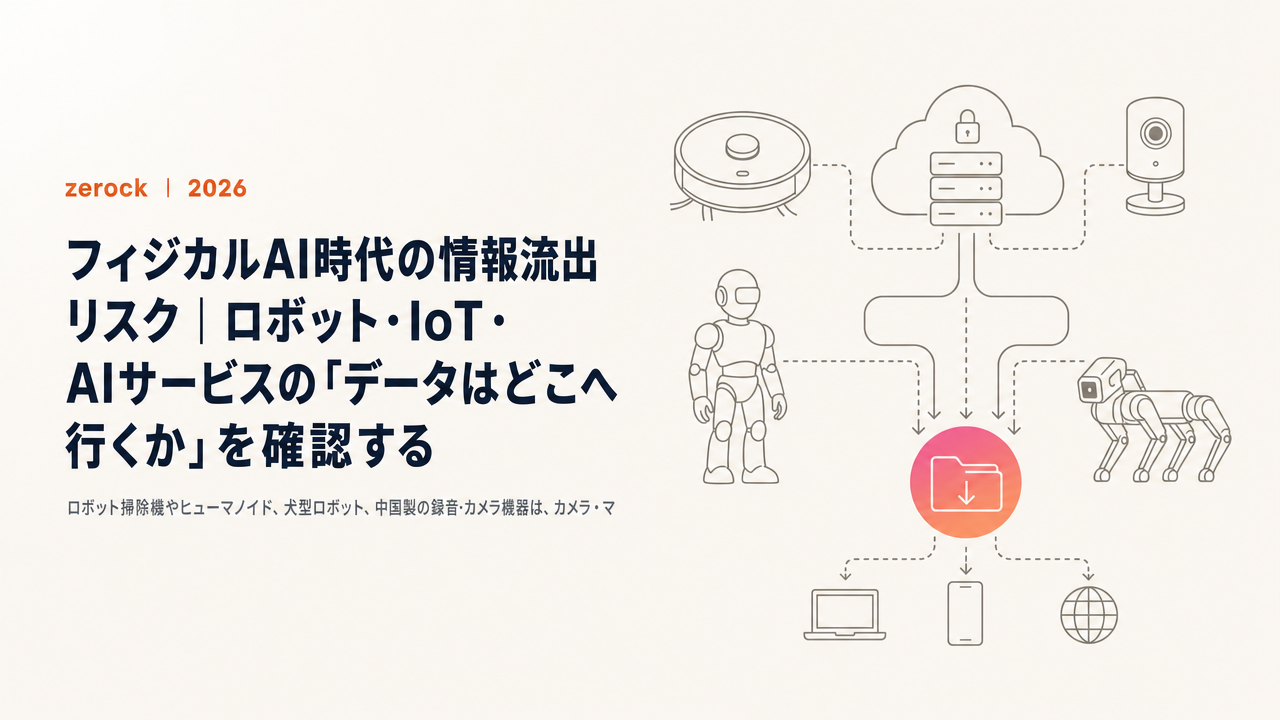
So far this has been about AI as software. What grows over the next few years is AI that moves in the real world: humanoid robots, industrial robots, drones, autonomous vehicles, so-called physical AI. Neoclouds are moving into this area too. On 9 June 2026 Nebius launched a "Physical AI Living Lab" for robotics startups in the UK and Europe, a six-month programme giving access to NVIDIA's simulation and synthetic data tools such as Isaac Sim, Isaac Lab and Cosmos on Nebius's cloud, with the first cohort starting in September 2026. Nebius's head of physical AI said: "Most robotics teams can build a strong model — the bottleneck is getting the simulation, synthetic data, and compute in place to take it further"15.
Why does data sovereignty become a bigger problem with physical AI? Simply because robots and drones are bundles of sensors. Cameras, microphones, depth sensors, LiDAR, tactile sensors. A humanoid moving through a factory or a home means that factory's layout, the placement of machines, workers' movements, the home's floor plan and the family's conversations are recorded continuously as video and audio and become training data. Software AI handled documents and questions that people typed. Physical AI handles the inside of the room itself.
Picture it concretely. Put a humanoid in a manufacturing plant, and to learn its tasks the robot keeps recording the placement of jigs, how parts are held, the hand movements of skilled workers and the sequence of processes. That is the manufacturing know-how the plant has honed over decades. A household robot records the floor plan, the faces and voices of the family and the rhythms of daily life. A logistics drone accumulates aerial footage of warehouses and sites. None of this can be "checked before handing over" the way a document can. As long as the sensors are running, the data keeps flowing.
When that data is sent to an overseas provider's cloud and used for training in an overseas jurisdiction, what do Japanese companies and individuals lose? Three things, I think. First, control over the results of training: the intelligence a robot gains from data gathered in a Japanese factory does not necessarily belong to the company that gathered it. Second, continuity of supply: services stopping, terms changing or provision to particular countries being restricted at the decision of an overseas provider or government has happened repeatedly in recent years. Third, the ability to decide where and by whom that data can be seen. These are questions of who controls the business, before any question of data protection law. On the possibility of robot communication modules becoming regulated items, see our piece on humanoid robots and the US Covered List; on where physical AI data goes, see information leakage risk in the physical AI era.
That is why you need a foundation that lets you choose where computation happens and where data lives. There are certainly cases where the newest overseas model is the right choice. But for data that can never be recovered, video from inside a factory, audio from inside a home, you should hold the option of training and inferring on domestic GPUs with the data kept in Japan. What the neoclouds' moves show is that the gap between countries that "have" that option and countries that do not is about to widen.
Our ZEROCK is this way of thinking turned into an enterprise AI foundation. The cloud infrastructure runs in AWS's Japan region (Tokyo), and AI models can be pinned to the domestic region through Amazon Bedrock. Some of the newest models infer in global regions, but in no case is your data used to retrain models. Company documents and drawings stay in Japan while GraphRAG structures the organisation's knowledge and models are chosen by use case. See the ZEROCK page for details. For areas such as physical AI sensor data, where many companies have not yet decided how to handle things, we design on the same principle.
Closing: what companies should choose now to become a country that "has" the option
CoreWeave and Nebius took a seemingly simple business, renting GPUs, and scaled it into giants through a pattern of locking in demand by contract, securing power, partnering with NVIDIA and building fastest. CoreWeave has a 104 billion dollar backlog and 3.7 gigawatts of contracted power; Nebius has 3 billion dollars of annualised revenue and a 5 gigawatt target for the end of 2026. Both are running while carrying enormous debt; their strength and their risk are two sides of the same coin.
Japan's position: the ceiling on government-certified subsidies totals about 132.6 billion yen, and a provider alliance has begun. The scale differs by an order of magnitude, but the real gap lies in the business model that cycles contracts, capital and power, and in the domestic demand that supports it, not in subsidy amounts. And in the physical AI era, the "inside of the room" gathered by robots and drones becomes training data, so whether you can choose where computation happens and where data lives will determine who controls the business itself.
Finally, the questions to put to AI service and cloud providers. Is this processing done in a Japanese region? Where are input data and logs stored and backed up? From which countries can operations staff access them? Is our data used to train your models or third parties' models, and where in the contract does it say it is not? And when the service ends, in what format and by when is our data returned? If a provider can answer these five clearly, the rest of the discussion can proceed constructively. If they cannot, that is itself an answer.
What companies can do now is not hard. Write down, once, which data in your AI use leaves the country and which should stay in Japan. Configure things so that the newest overseas models and models that run in Japan can be chosen on equal terms. And when considering physical AI, confirm at the contract stage where sensor data goes. Decide these three, and you keep your options whichever way the neocloud story turns. If you want to design your AI foundation to keep data in Japan, or are undecided about how to handle physical AI data, reach out through our consultation form. We will listen to your situation and work out the architecture together.
References
All figures are from each company's published materials as of 12 September 2026. Yen conversions use a rough rate of 150 yen to the dollar and are indicative only.
Footnotes
-
CoreWeave Reports Strong Second Quarter 2026 Results — CoreWeave, Inc. — 11 August 2026 ↩ ↩2 ↩3 ↩4 ↩5 ↩6 ↩7
-
Nvidia-backed CoreWeave closes flat at $40 after biggest U.S. tech IPO since 2021 — CNBC — 28 March 2025 ↩
-
CoreWeave Expands Agreement with OpenAI by up to $6.5B — CoreWeave, Inc. — 25 September 2025 ↩
-
CoreWeave stock closes up 12% after company lands $14 billion deal with Meta — CNBC — 30 September 2025 (expansion: Meta commits to spending additional $21 billion with CoreWeave — CNBC — 9 April 2026) ↩ ↩2
-
NVIDIA and CoreWeave Strengthen Collaboration to Accelerate Buildout of AI Factories — NVIDIA — 26 January 2026 ↩ ↩2
-
YNV announces successful completion of the divestment of its Russia-based businesses — Nebius Group N.V. — July 2024 ↩
-
Nebius Group confirms schedule for resumption of trading on Nasdaq — Nebius Group N.V. — 21 October 2024 ↩
-
Nebius to triple capacity at Finland data center to 75 MW — Nebius Group N.V. — 2024 ↩
-
Nebius announces oversubscribed strategic equity financing of USD 700 million — Nebius Group N.V. — 2 December 2024 ↩
-
Nebius announces multi-billion dollar agreement with Microsoft for AI infrastructure — Nebius Group N.V. — 8 September 2025 ↩
-
Nebius reports second quarter 2026 financial results (press release and shareholder letter from founder and CEO Arkady Volozh) — Nebius Group N.V. — 12 August 2026 ↩ ↩2 ↩3 ↩4 ↩5 ↩6 ↩7
-
Nebius Group announces closing of private offering of convertible senior notes, with aggregate gross proceeds of approximately $5.75 billion — Nebius Group N.V. — August 2026 ↩
-
Cloud programs (certified supply-assurance plans under the Economic Security Promotion Act) — METI (Japanese) ↩
-
KDDI, Sakura Internet and Highreso establish the "Japan GPU Alliance" for mutual resale of GPU capacity — Sakura Internet Inc. — 21 October 2025 (Japanese) ↩
-
Nebius launches Physical AI Living Lab for UK and European robotics startups built with NVIDIA technologies — Nebius Group N.V. — 9 June 2026 ↩