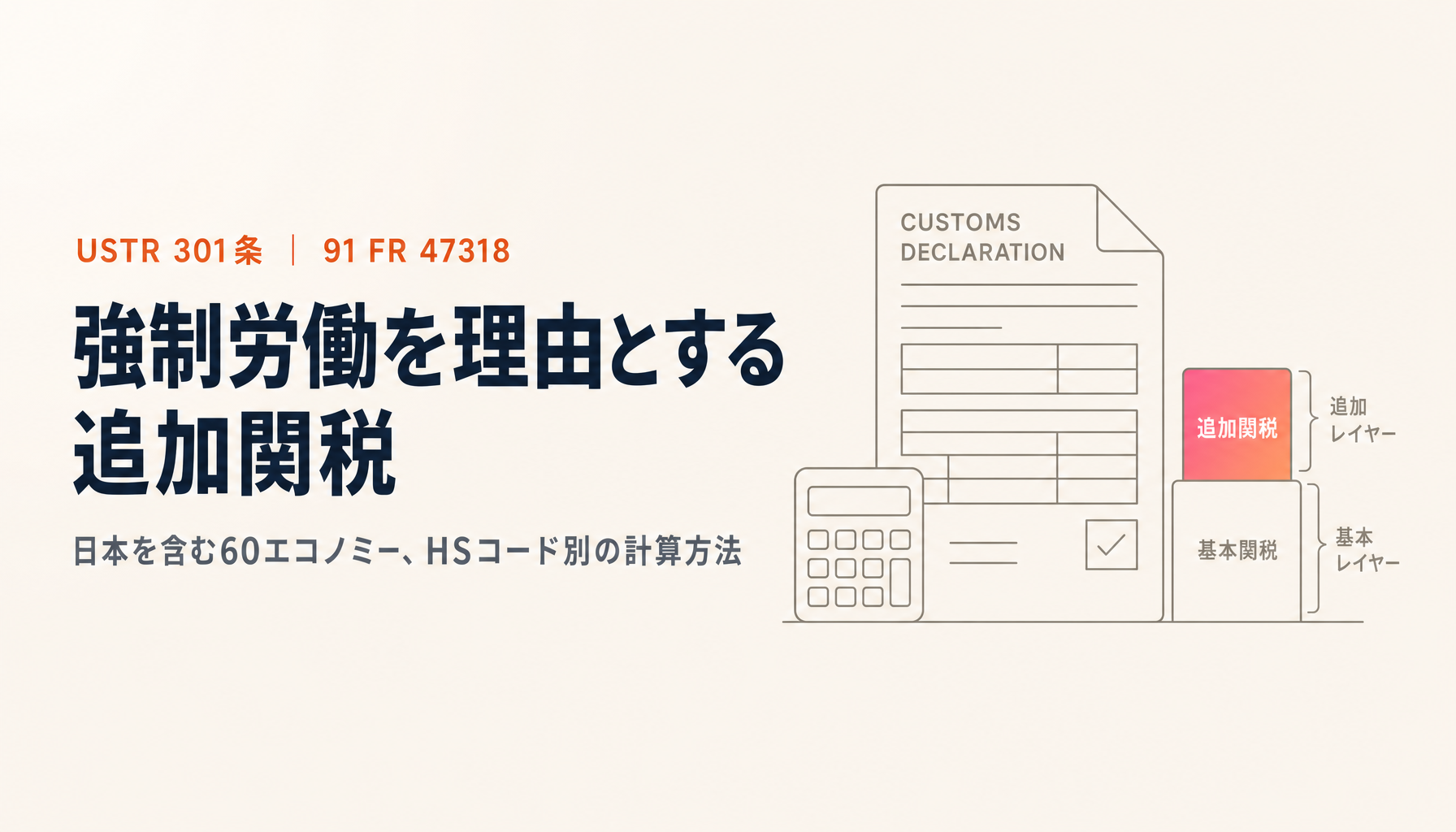
This is Ryuta Hamamoto from TIMEWELL. On July 28, 2026, the Federal Register carried a USTR notice running some 345 pages, from 91 FR 47318 to 47662, under document number FR Doc. 2026-15181. It imposes additional duties under Section 301 of the Trade Act of 1974 on products of 60 economies, including Japan, on the grounds that each has failed to impose, or to effectively enforce, a prohibition on the importation of goods produced with forced labor1.
The bottom line first. For Japanese-origin goods, the total duty in the United States converges on the higher of the column 1-General MFN rate or 12.5%. Where the MFN rate is below 12.5%, the difference is added as the Section 301 duty and the sum is 12.5%; where the MFN rate is 12.5% or higher, the Section 301 duty is zero and nothing changes. This "net of MFN" design applies to only five of the 60 economies, and Japan is one of them.
One point belongs at the very top of this article. Being covered by these duties is not a finding that forced labor exists in that country's companies or products. What was investigated is an institutional fact - whether each economy has an import prohibition and enforces it - and the reason Japan landed in a tariff category is the absence of such a regime. USTR states in the notice that Section 301(c)(3)(B) empowers action against goods and sectors "without regard to whether or not such goods or economic sector were involved in the act, policy, or practice that is the subject of such action," and that the investigations are broader than any particular industry or supply chain1. A company running an ordinary commercial business being swept into a broad, product-wide category is a consequence of how the instrument is built. When you explain this internally or to a customer, that distinction is where I would start.
What this measure turns on is whether you have an import prohibition and can show how it is enforced: We publish a supply-chain due-diligence self-check sheet covering human rights, forced labour, and conflict minerals. It walks you through how far beyond your first-tier suppliers you can actually trace, how to identify the processes and regions carrying the most forced-labour risk, and what evidence to keep when you ask a counterparty. Fill it in and you can attach it directly when a customer or a partner asks what your company checks. → Download the Supply-Chain Due Diligence Self-Check Sheet (Free. Your company name and work email are required.)
What was actually published
The formal title is long, so in practice it is easier to hold onto the document numbers.
| Item | Detail |
|---|---|
| Document | Notice of Actions in Section 301 Investigations of Acts, Policies, and Practices of Various Economies Related to the Failure of Each Economy To Impose and Effectively Enforce a Prohibition on the Importation of Goods Produced With Forced Labor |
| Citation | 91 FR 47318-47662 (Vol. 91, No. 143, July 28, 2026, Notices Part II) |
| Document number | FR Doc. 2026-15181 (Filed 7-27-26; 8:45 am) |
| Dockets | USTR-2026-0265 / USTR-2026-0266 |
| Authority | Sections 301(b) and 304(a) of the Trade Act of 1974 (19 U.S.C. 2411 et seq.) |
| Signed | Jennifer Thornton, General Counsel, USTR |
| Upstream document | Presidential Memorandum of July 23, 2026 (91 FR 47717-47778, FR Doc. 2026-15274) |
The rate design comes directly from the July 23 memorandum. Section 1(a)(ii) directs that, for a product of Japan, Korea, or Switzerland whose MFN tariff is less than 12.5 percent, the Trade Representative shall impose a Section 301 tariff so that the sum of the MFN tariff and the Section 301 tariff is 12.5 percent, and where the MFN tariff is 12.5 percent or greater, the Section 301 tariff shall be zero. It adds that capping total duties in this manner is feasible, consistent with the terms of the Agreements on Reciprocal Trade or similar arrangements, and appropriate2. Section II.B.28 of the notice (Japan) carries the same determination1.
The procedural history is all traceable to primary sources. The investigations were initiated on March 12, 2026 under Section 302(b)(1) of the Trade Act (19 U.S.C. 2412(b)(1)), with notice at 91 FR 12884 (published March 17). On June 2 the Trade Representative determined all 60 to be actionable and issued a comprehensive report; the determinations and the proposed actions - 10% and 12.5% rates plus a textile mechanism - were published in the June 5 notice (91 FR 34272), with comments due July 6, drawing more than 1,600 written submissions. Hearings ran July 7, 8, and 9, with more than 100 witnesses. The presidential memorandum followed on July 23, and the final notice on July 281. Two details are not in the notice itself but in USTR's press release: that consultations under Section 303(a) covered more than 45 partner governments, and that a first round of hearings was held on April 28 and 29. That release also describes the investigations as a whole as involving "two rounds of public hearings, more than 2,100 public comments," a wider count than the notice's figure for written comments on the June 5 proposal - worth keeping straight when you cite either number internally3.
Why Japan is covered: the test is institutional
The June 2 determinations split the 60 economies into two groups. Fifty-four, including Japan, were found to "have failed to impose and effectively enforce a prohibition on the importation of goods produced with forced labor." Six - Canada, Ecuador, the European Union, Indonesia, Mexico, and Pakistan - were found to "have failed to effectively enforce a prohibition." Confusingly, the notice then adds that all of the investigated economies failed to satisfy both factors1. Either way, the line was drawn on institutional facts - whether a prohibition exists and whether it is enforced - not on an assessment of what any company did.
What is worth noticing is that USTR deliberately set aside each partner's domestic anti-forced-labor record. Section III.B.2 says that excluding economies or granting a lower rate based on efforts to address forced labor within their own jurisdictions, such as ratification of ILO conventions or domestic enforcement, would not achieve the elimination of the investigated acts, policies, and practices, and that while the Trade Representative "applauds the efforts of our trading partners to eliminate forced labor within their jurisdictions," those efforts "are not pertinent" to what these investigations target1. The line was drawn on one question only: whether an import prohibition is in place.
The gap between the 10% and 12.5% categories is likewise not a ranking of good and bad countries. The closing paragraph of Section I lists economies that imposed forced labor import prohibitions after the June 5 proposal and government-to-government consultations - Cambodia, Guatemala, Honduras, India, Sri Lanka, and Trinidad and Tobago - and one that undertook commitments regarding such a prohibition in an ART, Jordan. All seven ended up in the 10% category1. The differential traces to procedural facts: whether a regime was adopted, or a commitment made in an agreement.
As for the U.S. position, Ambassador Jamieson Greer said that "decades of moral suasion have not eradicated forced labor from global supply chains," and that the United States "has had a forced labor import ban for nearly a century, and rigorously enforces it; it's well past time for our trading partners to do the same"3. The fact sheet states that the action reaches "the top 60 U.S. trade partners covering 99.4% of U.S. imports," and also asserts that the United States is "the only country in the world to adopt, and effectively enforce, a ban on imports made with forced labor" - the latter being USTR's own characterization rather than a comparative finding I have verified against other jurisdictions' regimes4.
Replace siloed classification work with AI.
METI's FY2024 data shows 52% of foreign exchange law violations stem from classification errors. Download the TRAFEED product catalog covering features and rollout.
The 60 economies fall into three tariff mechanics
Pulling all 65 headings from HTSUS 9903.05.20 through 9903.05.84 (60 economies, with two headings each for the net-of-MFN group) from USITC data gives three clean categories5.
| Mechanic | Rate column text | Economies | Example headings |
|---|---|---|---|
| Flat add-on of 12.5% | "The duty provided in the applicable subheading + 12.5%" | 38 | China 9903.05.31, Vietnam 9903.05.84 |
| Flat add-on of 10% | "The duty provided in the applicable subheading + 10%" | 17 | United Kingdom 9903.05.81, India 9903.05.44, Mexico 9903.05.55 |
| Net of MFN | Total duty capped | 5 | Japan 9903.05.48 / 9903.05.49 |
The 17 economies in the 10% category are Argentina (9903.05.22), Bangladesh (.26), Cambodia (.28), Canada (.29), Ecuador (.35), El Salvador (.37), Guatemala (.40), Honduras (.42), India (.44), Indonesia (.45), Jordan (.50), Malaysia (.54), Mexico (.55), Pakistan (.62), Sri Lanka (.72), Trinidad and Tobago (.78), and the United Kingdom (.81)5.
The 38 in the 12.5% category include Algeria, Angola, Australia, the Bahamas, Bahrain, Brazil, Chile, China, Colombia, Costa Rica, the Dominican Republic, Egypt, Guyana, Hong Kong (China), Iraq, Israel, Kazakhstan, Kuwait, Libya, Morocco, New Zealand, Nicaragua, Nigeria, Norway, Oman, Peru, the Philippines, Qatar, Russia, Saudi Arabia, Singapore, South Africa, Thailand, Türkiye, the United Arab Emirates, Uruguay, Venezuela, and Vietnam5.
The net-of-MFN group has just five members, split across two caps.
| Economy | Cap on total duty | Heading where MFN meets or exceeds the cap (no add-on) | Heading where MFN is below the cap |
|---|---|---|---|
| Japan | 12.5% | 9903.05.48 | 9903.05.49 (rate column reads "12.5%") |
| South Korea | 12.5% | 9903.05.70 | 9903.05.71 (same) |
| Switzerland | 12.5% | 9903.05.73 | 9903.05.74 (same) |
| EU member states | 10% | 9903.05.38 | 9903.05.39 (rate column reads "10%") |
| Taiwan | 10% | 9903.05.75 | 9903.05.76 (same) |
Reading the two headings that apply to Japan
Only two headings apply to Japanese-origin goods, and the HTSUS text makes the sorting rule explicit6.
- 9903.05.48: except for products described in headings 9903.05.85 through 9903.05.92, articles the product of Japan with an ad valorem (or ad valorem equivalent) rate of duty under column 1 equal to or greater than 12.5 percent. The General and Special rate columns read "The duty provided in the applicable subheading" - no Section 301 add-on. Column 2 reads "No change."
- 9903.05.49: the same opening language, for articles with a column 1 rate of duty less than 12.5 percent. The General and Special columns read "12.5%." Column 2 reads "No change."
What settles the arithmetic is the closing language of U.S. note 52(k) in Annex I: "For headings 9903.05.49, 9903.05.71 and 9903.05.74, articles for which the applicable column 1 duty rate is less than 12.5 percent, the sum of the column 1 duty rate and the additional ad valorem rate of duty is 12.5 percent ad valorem," and for headings 9903.05.39 and 9903.05.76, the equivalent sentence with 10 percent1. Because note 52(a) opens with "Except as provided in ... subdivisions (b) through (k) of this note," subdivision (k) controls for Japanese, Korean, and Swiss goods, and the total stops at 12.5%.
The flat add-on group has no such stop. Note 52(a) provides that, notwithstanding U.S. note 1 to the subchapter, all products subject to the additional ad valorem rates shall also be subject to the general rates of duty under subheadings in chapters 1 to 97, and further that - except as provided in subdivisions (b) through (k) of the note - products subject to the additional rates under headings 9903.05.20-9903.05.84 shall also be subject to any additional duty provided for in that subchapter or in subchapter IV of chapter 991. In other words, the duty is built to stack with other Chapter 99 programs. I have not reconciled it against the current rates of individual programs, so I am not going to publish a combined-rate estimate.
Worked examples using real HS codes
Column 1-General rates measured against USITC HTS, applied to a Japanese-origin scenario6.
| HTSUS | Description | Column 1-General (MFN) | Applicable heading | Section 301 add-on | Total |
|---|---|---|---|---|---|
| 8471.30.01.00 | Portable automatic data processing machines weighing not more than 10 kg (laptops etc.) | Free | 9903.05.49 | 12.5% | 12.5% |
| 3926.90.99 | Other articles of plastics | 5.3% | 9903.05.49 | 7.2% | 12.5% |
| 8482.10.50 | Ball bearings, other | 9% | 9903.05.49 | 3.5% | 12.5% |
| 6110.30.30 | Sweaters, pullovers and similar articles of man-made fibres, other | 32% | 9903.05.48 | 0% | 32% |
Read that table again, because the effect runs counter to intuition. The lower the MFN rate, the larger the add-on; the higher the MFN rate, the smaller it gets, down to zero. Precision instruments and electronics that used to enter free now carry the full 12.5%, while apparel that was already at a high rate takes no additional burden at all. The exposure profile depends entirely on your product mix, which is why the internal briefing document you want is a table of add-on percentage points by major HS code - not a single headline rate.
Goods without an ad valorem rate need an AVE
Where column 1 is not ad valorem - 2206.00.15 (cider) carries a column 1-General rate of 0.4 cents per liter, for instance6 - you need an ad valorem equivalent to run the threshold test, and the formula is spelled out in note 52(k). For any good of an EU member state, Japan, South Korea, Switzerland, or Taiwan subject to a specific or compound rate under column 1-General, the ad valorem equivalent is determined by dividing the amount of duty payable under column 1-General by the customs value of the good. The notice's own illustration: a specific duty of 50 cents per kilogram on one kilogram entered at a customs value of $10 yields 5 percent1.
Note that the only express reference to column 1-Special specific or compound rates being converted the same way is for goods of South Korea1. There is no parallel sentence for Japan, so the treatment of a claimed preferential rate cannot be settled from the text.
Where the exclusions live
For Japanese-origin goods, the search space is narrower than the page count suggests. The determination text in Section II.B refers, for Japan and for Korea, only to "Annex I and Annex II, Part A." Among the other three net-of-MFN economies, the EU gets "Parts A and C," Switzerland "Parts A and D," and Taiwan "Parts A and K" - economy-specific exclusion parts that Japan and Korea do not have1. Same tariff mechanic, different exclusion footprint.
Start with the eight economy-wide exclusion headings in Annex I15.
| Heading | Scope of exclusion |
|---|---|
| 9903.05.85 | In-transit goods (loaded onto a vessel at the port of loading and in transit on the final mode of transit before 12:01 a.m. ET July 24, 2026, and entered before 12:01 a.m. ET July 28, 2026) |
| 9903.05.86 | The HTSUS provisions listed in note 52(b) - the economy-wide exclusion list, corresponding to Annex II Part A |
| 9903.05.87 | The 16 items in note 52(c) (etrogim; sesame, mustard, and safflower seeds for sowing; baked goods for religious use; açaí; coconut water; eucalyptus plywood, among others) |
| 9903.05.88 | Civil aircraft (all aircraft other than military aircraft) and their engines, parts, and ground flight simulators meeting the requirements of HTSUS general note 6 |
| 9903.05.89 | Goods for use in pharmaceutical applications, limited to the HTSUS provisions listed in note 52(e) |
| 9903.05.90 | Goods covered by Section 232 actions, limited to those provided for in the Chapter 99 headings listed in note 52(f) |
| 9903.05.91 | Donations by persons subject to U.S. jurisdiction, intended to relieve human suffering (food, clothing, medicine) |
| 9903.05.92 | Informational materials (publications, films, posters, photographs, CD-ROMs, works of art, news wire feeds, and the like) |
One nuance worth checking yourself: the opening language of note 52(a) frames the exclusions broadly, as "headings 9903.05.85-9903.06.21." Everything from .93 onward, though, is economy-specific - Canada (9903.05.93), Mexico (.94), CAFTA-DR textiles and apparel (.95), the United Kingdom (.96), the EU (.97), Switzerland (.98), Malaysia (.99) and so on - and not one of them cross-references the Japanese headings1. The Japanese headings themselves say "except for products described in headings 9903.05.85-9903.05.92," so the search closes at eight5.
In practice 9903.05.90 is probably the one that bites hardest. Its article description covers articles of aluminum, steel, or copper and derivative aluminum or steel articles; passenger vehicles (sedans, SUVs, CUVs, minivans, cargo vans) and light trucks and their parts; medium- and heavy-duty vehicles and their parts; wood products; and semiconductor articles, with the Chapter 99 cross-references listed in note 52(f): derivative aluminum and steel at 9903.82.02 and 9903.82.04-9903.82.26; passenger vehicles, light trucks, and their parts across the 9903.94 series; wood products at 9903.76.01-.03 and .20-.24; medium- and heavy-duty vehicles, buses, and their parts across the 9903.74 series; and semiconductors at 9903.79.011. The logic is that where Section 232 duties already apply, Section 301 is not layered on top - so whether your goods sit on the 232 side changes the answer, and it is worth checking at the heading level.
There is also a second effective date. Part B of Annex I provides that, effective for goods entered on or after 12:01 a.m. eastern time on July 31, 2026, the article description of heading 9903.05.90 is modified by inserting "patented pharmaceutical articles;" after "wood products;", and note 52(f) is amended to add a new item (8), "patented pharmaceutical articles provided for in headings 9903.04.60-9903.04.66"1. As of July 30, 2026, the USITC HTS article description for 9903.05.90 does not yet contain that language, because the change takes effect on July 315. If you handle pharmaceuticals, treatment differs between an entry filed on July 30 and one filed on July 31.
Annex II (91 FR 47394-47662) is a three-column table - HTSUS, Description, Scope Limitations - listing exclusions at the 8-digit level. It opens with the common Part A (Goods of Any Investigated Economy) and continues with economy-specific parts: Part B United Kingdom, Part C any EU member state, Part D Switzerland, then parts for Malaysia, Cambodia, Guatemala, El Salvador, Argentina, Bangladesh, Taiwan, Indonesia, Ecuador, and Jordan, closing with Part O for textile and apparel goods of Jordan, or of El Salvador or Guatemala, entered free of duty under CAFTA-DR. The Scope Limitations column uses "Ex" (limited by the description), "Aircraft" (civil aircraft use only), and "Pharma" (pharmaceutical use only)7. For Japanese-origin goods, Part A is the only part you need to search.
On changes from the June 5 proposal, Section III.D states that the Trade Representative determined in each investigation to exclude an additional 471 products. The categories include certain animal products, seeds, vegetable products, in-quota sugar and sugar-containing products, unflavored instant coffee, certain fertilizer and pesticide inputs, certain animal hides and leather, certain wood products, pig iron and certain ferrous inputs and scrap, aluminum scrap, certain semiconductor manufacturing equipment, certain pharmaceuticals and pharmaceutical inputs, used clothing, and certain antiques, works of art, and collectibles. Section III.C.2, though, narrowed some chemical exclusions to "pharmaceutical applications," which puts non-pharmaceutical uses back in scope1. Where the Scope Limitations column says "Pharma," the answer turns on whether you can document the use.
Seven traps worth circulating internally
The following comes from the text of the notice, with the points that rest on the memorandum flagged as such12.
- The duties reach back before the publication date. The DATES section applies them to entries on or after 12:01 a.m. eastern time on July 24, 2026, and the notice is dated July 28. How entries filed July 24-27 are handled is one of the first things to confirm.
- In-transit relief is narrow. Heading 9903.05.85 requires both that the goods were loaded onto a vessel at the port of loading and in transit on the final mode of transit before 12:01 a.m. ET July 24, and that they were entered before 12:01 a.m. ET July 28. Anything entered on or after July 28 is outside the wording. Whether air cargo can be read into "loaded onto a vessel" is not something the text settles, so put that on the list to confirm against CBP guidance.
- You cannot park goods in an FTZ and wait. Products subject to the additional duty that are admitted into a U.S. foreign trade zone may be admitted only as "privileged foreign status" under 19 CFR 146.41, other than goods eligible for "domestic status" under 19 CFR 146.43. The rate is fixed at admission.
- Chapter 98 is generally out of scope, with the 9802 provisions carved back in. Note 52(a) does not apply the additional duties to goods properly entered under a Chapter 98 provision, except for subheadings 9802.00.40, 9802.00.50, 9802.00.60 and heading 9802.00.80. For the first three, the additional duties apply to the value of the repairs, alterations, or processing performed; for 9802.00.80, to the value of the article assembled abroad less the cost or value of the U.S. products.
- Preferential treatment and temporary reductions do not get you out. Products eligible for special tariff treatment under general note 3(c)(i), or for temporary duty exemptions or reductions under subchapter II to chapter 99, are still subject to the additional ad valorem rates under headings 9903.05.20-9903.05.84 except as otherwise provided in the note.
- AD/CVD continues in parallel. Products covered by the note remain subject to antidumping, countervailing, and other duties, taxes, fees, exactions, and charges.
- There is no product exclusion window. Section III.G says an exclusion process lowering tariffs on additional products would be inconsistent with the President's direction, and points to Section 307 of the Trade Act (19 U.S.C. 2417) for modification and review of necessity. Section 3(e) of the memorandum likewise lets the Trade Representative modify or terminate tariffs, exemptions, or TRQs subject to the President's specific direction, including pursuant to Section 307. There is no company-level route in; changes happen at the policy level.
On textiles, Section 2 of the memorandum directs tariff-rate quotas for Bangladesh, Cambodia, Indonesia, and Malaysia, based on each economy's imports of U.S. cotton and textile goods, for an initial period of three years, to be established when the Trade Representative determines it feasible. Section 2(c) provides that until those TRQs are established, the applicable Section 301 tariff under Section 1(a) - here 10 percent - applies2. Section III.F of the notice says the textile mechanism will be established in a separate notice, and that the establishment and effective date of the TRQs will be published in the Federal Register. So as of this notice, neither quantities nor start dates are set1.
One structural point: the actions are expressly severable. Section IV states that each tariff action as to an economy in one investigation is separate from every other action, and that should a court hold the implementation of any tariff action invalid, only that tariff in that investigation should be treated as invalid. Section 4 of the memorandum says the same12. Read practically, the arithmetic for Japanese-origin goods stands on its own regardless of what happens to another economy's action.
What primary sources cannot yet settle
Being straight about this matters. Everything above is grounded in the notice text and live HTSUS data, but several points that bear directly on practice remain open.
- CBP operational guidance. How the Chapter 99 numbers are reported on entry, what corrective process applies to the retroactive July 24-27 window, and how 9903.05.48 and 9903.05.49 are used in practice all need to be confirmed against CBP CSMS messages. I could not obtain those as primary sources while writing this, so I am not going to state filing procedures.
- Whether "column 1" reaches preferential rates. Headings 9903.05.48 and .49 say "rate of duty under column 1," and note 52(k) says "the applicable column 1 duty rate." The only express reference to column 1-Special is the South Korea sentence on specific and compound rates. Take 9506.31.00.00 (complete golf clubs): column 1-General is 4.4%, and the Special column reads "Free (A,AU,BH,CL,CO,D,E,IL,JO,JP,KR,MA,OM,P,PA,PE,S,SG)," including "JP" for the U.S.-Japan Trade Agreement6. Which heading applies to a good whose General rate is 12.5% or more but whose claimed preferential rate is lower cannot be determined from the text. This article therefore limits itself to the certain case: if the General rate is below 12.5%, the total is 12.5%.
- The Japanese government's response. As of July 30, 2026, I have not been able to confirm official positions from METI or MOFA as primary sources. The opening remarks published for the Chief Cabinet Secretary's press conferences contain no reference to this action, but only the opening remarks are published - there is no Q&A record - so I cannot conclude that the topic went unmentioned.
- Litigation. I have not checked whether any challenge has been filed or decided. All that is confirmed is the presence of severability provisions in Section IV of the notice and Section 4 of the memorandum.
- Stacking with other Chapter 99 duties. Note 52(a) provides for stacking, but I have not reconciled it against the current rates of individual programs, so no combined-rate estimate appears here.
A practical checklist
Here is the order in which I would work through this, from both the Japanese exporter's and the U.S. importer's side.
- Pull the full list of 8- or 10-digit HTSUS numbers for everything you ship to the U.S. The number the U.S. importer actually declares is the operative one. It is not unusual for it to differ from what the Japanese side assumed, so start by reconciling the two lists.
- Measure the current column 1-General rate for each number in USITC HTS. Use the live rate, not memory or an old file. For specific or compound rates, derive the ad valorem equivalent using the note 52(k) formula (duty payable divided by customs value).
- Split the list at 12.5%. Everything with a General rate below 12.5% falls under 9903.05.49 for a total of 12.5%; everything at or above falls under 9903.05.48 with no add-on. Tabulate the add-on in percentage points (12.5 minus General) by product.
- Test exclusions in four passes. Section 232 coverage (9903.05.90 and the headings cross-referenced in note 52(f)), civil aircraft (9903.05.88), pharmaceutical-use goods (9903.05.89), and the 8-digit numbers in Annex II Part A. For pharmaceuticals, also check the July 31 amendment.
- Carve out in-transit and retroactive shipments. Goods loaded and in transit before 12:01 a.m. ET July 24 and entered before 12:01 a.m. ET July 28 fall under 9903.05.85. Put entries filed July 24-27 on a separate list to confirm against CBP guidance.
- Inventory transactions using 9802 provisions, FTZs, or bonded arrangements. The duty base for repairs, alterations, and foreign assembly, and the FTZ status designation, each apply case by case.
- Check who absorbs the add-on under your contracts. Incoterms and the price clause decide it. If you ship DDP, the burden starts on the Japanese side; on FOB terms, with the U.S. importer.
- Draft the internal and customer-facing explanation. State plainly that this is a category based on an institutional fact, not an assessment of your own labor practices. Customers do ask whether there is a forced labor concern, so being able to point to the relevant passages of the notice shortens that conversation considerably.
This is a different layer from an import ban
The last thing worth separating out is the layering. U.S. measures on forced labor come in two forms: one stops goods, the other taxes them. Import prohibitions under UFLPA and 19 U.S.C. 1307 are the first kind - if goods are covered, they do not enter. This Section 301 action is the second - goods enter, but the duty burden rises. The first digs into products and supply chain facts; the second applies across the board by which economy the goods are a product of, subject to the exclusion lists. Conflate them, and someone internally will conclude that the company has been accused of something.
The due diligence work itself continues along the lines already established. For the UFLPA framework and how rebuttal works in practice, see our guide to UFLPA; for how far up the chain to trace and what evidence to retain, see supply chain due diligence for forced labor. For the wider picture on U.S. export controls and tariffs, see U.S. export controls and Trump tariffs on the ground, and for the import-prohibition side under Japanese law, prohibited imports under the Customs Act. Reading them together makes it much easier to tell which layer a given question belongs to.
TRAFEED, the export control AI agent we build, handles counterparty screening and export classification - it does not compute duty rates. But the work of taking a few hundred pages of primary regulatory text and extracting only the portion that touches your own products and counterparties is identical across export control and customs practice. Do not reduce how often you go to the source; reduce how much of it you have to read. In this case, out of 345 pages, what governs Japanese-origin goods is two headings, eight common exclusions, the general provisions of note 52, and Annex II Part A.
Summary
- On July 28, 2026, USTR published a notice imposing Section 301 duties on products of 60 economies including Japan (91 FR 47318, FR Doc. 2026-15181), applicable to entries on or after 12:01 a.m. eastern time on July 241
- Total duty on Japanese-origin goods is the higher of the column 1-General MFN rate or 12.5%: below 12.5%, heading 9903.05.49 brings the sum to 12.5%; at or above, heading 9903.05.48 applies no add-on156
- The net-of-MFN design covers only Japan, South Korea, and Switzerland (12.5% cap) plus the EU and Taiwan (10% cap). Of the rest, 38 economies take a flat +12.5% and 17 a flat +10%5
- Exclusions for Japanese-origin goods are limited to the eight common headings in Annex I (9903.05.85-.92) and Annex II Part A. Section 232 goods are excluded via 9903.05.90; patented pharmaceutical articles join that heading effective July 311
- Falling into a tariff category is not a finding of forced labor in a country's companies or products. The test was institutional, and Section 301(c)(3)(B) itself permits action without regard to involvement in the practice at issue1
- CBP operational guidance, the threshold test when a preferential rate is claimed, and the textile TRQ terms are unsettled as of this writing. Track them as open items rather than assumptions
Reading primary regulatory text is unglamorous work, but the teams that pin down the handful of lines that apply to them decide faster than everyone else. Turn what is above into a table of add-on points by major HS code and it is immediately usable in pricing and quotation reviews.
References
- Office of the United States Trade Representative. Notice of Actions in Section 301 Investigations ... Related to the Failure of Each Economy To Impose and Effectively Enforce a Prohibition on the Importation of Goods Produced With Forced Labor. 91 FR 47318 (July 28, 2026; FR Doc. 2026-15181, including Annex I and Annex II)
- The White House. Memorandum of July 23, 2026: Actions by the United States in the Investigations Under Section 301 of the Trade Act of 1974 ... 91 FR 47717 (FR Doc. 2026-15274)
- U.S. International Trade Commission. Harmonized Tariff Schedule of the United States (Chapter 99 subchapter III, headings 9903.05.20-9903.06.21, and column 1 rates for individual provisions)
- Office of the United States Trade Representative. USTR Takes Action in Forced Labor Section 301 Investigations (press release, July 23, 2026)
- Office of the United States Trade Representative. Fact Sheet: USTR Section 301 Action in Response to the Failure of 60 Economies to Ban Imports Produced with Forced Labor (July 23, 2026)
- U.S. Government Publishing Office. Federal Register FR-2026-07-28 package (notice PDF)
Footnotes
-
Federal Register, "Notice of Actions in Section 301 Investigations of Acts, Policies, and Practices of Various Economies Related to the Failure of Each Economy To Impose and Effectively Enforce a Prohibition on the Importation of Goods Produced With Forced Labor," 91 FR 47318 (July 28, 2026; FR Doc. 2026-15181), full text. https://www.federalregister.gov/documents/full_text/text/2026/07/28/2026-15181.txt ↩ ↩2 ↩3 ↩4 ↩5 ↩6 ↩7 ↩8 ↩9 ↩10 ↩11 ↩12 ↩13 ↩14 ↩15 ↩16 ↩17 ↩18 ↩19 ↩20 ↩21 ↩22 ↩23 ↩24
-
Federal Register, "Memorandum of July 23, 2026: Actions by the United States in the Investigations Under Section 301 of the Trade Act of 1974 of the Acts, Policies, and Practices of 60 Economies ...," 91 FR 47717 (FR Doc. 2026-15274), full text. https://www.federalregister.gov/documents/full_text/text/2026/07/28/2026-15274.txt ↩ ↩2 ↩3 ↩4
-
Office of the United States Trade Representative, "USTR Takes Action in Forced Labor Section 301 Investigations" (July 23, 2026; Ambassador Greer's statement and procedural summary). https://www.ustr.gov/about/policy-offices/press-office/press-releases/2026/july/ustr-takes-action-forced-labor-section-301-investigations ↩ ↩2
-
Office of the United States Trade Representative, "Fact Sheet: USTR Section 301 Action in Response to the Failure of 60 Economies to Ban Imports Produced with Forced Labor" (July 23, 2026; USTR's own characterization of the action). https://www.ustr.gov/about/policy-offices/press-office/fact-sheets/2026/july/fact-sheet-ustr-section-301-action-response-failure-60-economies-ban-imports-produced-forced-labor ↩
-
U.S. International Trade Commission, Harmonized Tariff Schedule bulk export for Chapter 99 headings 9903.05.20-9903.06.21 (article descriptions and rate columns by heading). https://hts.usitc.gov/reststop/exportList?from=9903.05.20&to=9903.06.21&format=JSON&styles=true ↩ ↩2 ↩3 ↩4 ↩5 ↩6 ↩7 ↩8
-
U.S. International Trade Commission, Harmonized Tariff Schedule search (headings 9903.05.48 and 9903.05.49, and column 1 rates for 8471.30.01.00, 3926.90.99, 8482.10.50, 6110.30.30, 9506.31.00.00, and 2206.00.15). https://hts.usitc.gov/reststop/search?keyword=8482.10.50 ↩ ↩2 ↩3 ↩4 ↩5
-
U.S. Government Publishing Office, Federal Register FR-2026-07-28 package, PDF of FR Doc. 2026-15181 (used to confirm the structure of Annex II and the Scope Limitations notations). https://www.govinfo.gov/content/pkg/FR-2026-07-28/pdf/2026-15181.pdf ↩