Hello, this is Ryuta Hamamoto from TIMEWELL.
(November 22, 2026) We corrected our summary of Article 49 of the Dual-Use Items Export Control Regulations and the table that matched Announcement No. 62 to the U.S. FDPR. Article 49 covers the transfer or provision, by organizations and individuals outside China, of three types of items involving Chinese-origin items or technology; the provision that brings in items made abroad with Chinese-origin technology, with no threshold, is item 1(2) of Announcement No. 61, not No. 62. We also made clear that the 50% provision in No. 61 is a licensing policy: export applications for the items in that announcement to listed importers and end users, including their subsidiaries and branches held 50% or more, are in principle denied.
MOFCOM Announcements No. 61 and No. 62, issued on October 9, 2025, were the first full-scale operation of extraterritorial application in Chinese export control. On floors that handle rare-earth procurement and NdFeB magnets, "0.1% rule" and "50% rule" arrived together. Confusion followed, and I still hear the same questions.
Update, November 20, 2026: On November 9, 2026, BIS published a rule in the Federal Register extending the stay of the Affiliates Rule (the 50% rule) through January 10, 2027, effective the same day (91 FR 70789). The U.S.-side statements in the body have been updated to reflect this. MOFCOM said in its September 28, 2026 explanation of the latest talks that the two sides agreed to extend the Kuala Lumpur joint arrangement to January 10, 2027 (item 8). As of November 20, I have not found an announcement amending the November 10 suspension deadline set by Announcement No. 70.
Update, November 22, 2026: MOFCOM also announces measures through spokesperson answers to press questions, not only through formal announcements. In its answer of November 9, 2026, it said that the suspension of the measures under Announcement No. 21 of 2025 (which placed 16 U.S. entities on the Control List) and under the Unreliable Entity List notice of April 4, 2025 would continue for another two months from November 10 (MOFCOM spokesperson answer). Neither that answer nor the same-day answer on the Unreliable Entity List mentions Announcement No. 70, and we found nothing amending its deadline in the regular press conferences of November 12 and 19 or in the 2026 announcement list checked on November 22.
Where things stand on November 20, 2026: the six announcements including Nos. 61 and 62 were suspended under Announcement No. 70 until November 10, 2026. That date has passed, and MOFCOM's announcement list, checked on November 20, shows no announcement amending the deadline. MOFCOM's September 28 explanation says the two sides agreed to extend the Kuala Lumpur joint arrangement to January 10, 2027. On the U.S. side, BIS published a rule on November 9 extending the Affiliates Rule stay through January 10, 2027, effective the same day.1 Because China has not put an extension into an announcement, I would not assume either that the suspension continues or that the controls have resumed; confirm each transaction against MOFCOM announcements and your counterparties' license status.
This article lines up the original MOFCOM announcements with commentary from Japan's METI, CISTEC, JETRO, and others, inside the same sovereign export-control frame as the U.S. EAR and Japan's FEFTA. I avoid interpretive labels such as "Chinese FDPR" or "retaliation" and stay with facts and functional structure.
Apply this to your own transactions, one at a time: A fill-in working sheet that screens a single China-related transaction against China's export-control regime (the Export Control Law and the Dual-Use Items Export Control Regulations), the controls on critical minerals (gallium, graphite, rare earths and others), and the four counterparty-list systems (Control List, Watch List, Unreliable Entity List, countermeasure list). It is not a roster of who is listed but a procedure for what to confirm before a shipment, including whether extraterritorial application and re-export (Article 49 of the Dual-Use Regulations) could reach the transaction. Use it as the written record of your review, or as the draft you work from when you explain those checks to a customer (listing is a regulatory designation, not a judgment of the company). → Download the China-Related Transactions Screening Sheet (Free. Your company name and work email address are required.)
Then and Now: What Has Changed Since the October 4 Update
| Item | Earlier version (October 4, 2026) | Now (November 20, 2026) |
|---|---|---|
| China's suspension deadline (Announcement No. 70) | Through November 10, 2026 | No amending announcement found as of Nov 20. MOFCOM's Sep 28 explanation says the two sides agreed to extend the arrangement to Jan 10, 2027 |
| U.S. Affiliates Rule stay | Through November 9; extension not on the Federal Register as of October 3 | BIS published a rule on November 9 extending the stay through January 10, 2027, effective the same day1 |
| Outlook | US and China announced an extension to January 10, 2027 | The U.S. has implemented the extension by rule. China has not issued an announcement |
| China's separate April 2025 controls on seven medium and heavy rare earths | Not covered | Not part of the suspension and still in force. A license is needed independently of Nos. 61 and 62 (Announcement No. 70 suspends Nos. 55–58, 61, and 62, not No. 18; confirmed in the text of No. 70 and in MOFCOM's announcement list checked on November 20) |
The last row matters most. Even with Nos. 61 and 62 paused, the license regime for seven medium and heavy rare earths that began in April 2025 keeps running. "It is suspended, so we can ship without a license" is not a safe statement.
What You Will Get From This Article
- The relationship between Article 49 of China's Dual-Use Export Control Regulations and Announcements No. 61 and No. 62
- The content of the 0.1% rule (Chinese de minimis) and the 50% rule (Chinese Affiliates Rule)
- Functional symmetry with the U.S. EAR (FDPR, de minimis, Affiliates Rule)
- Meaning of the temporary suspension under Announcement No. 70 of November 7, 2025 (through November 10, 2026)
- Five practical steps Japanese companies handling NdFeB magnets or EV traction motors should check
Three Terms to Learn First
Chinese announcement texts quote many statutory articles. Without the terms, they are hard to parse. Three minimum terms:
Extraterritorial application. A mechanism by which a country's laws apply to conduct outside that country's territory. Also called "long-arm jurisdiction." The United States, the EU, Japan, and China each adopt it with different scope and conditions. It is not a rare idea in export control. For China, Article 49 of the Dual-Use Export Control Regulations (effective December 2024) is the governing provision.
De minimis. Latin for "of minimal things." In export control, a threshold rule that excludes application when domestic-origin parts or technology fall below a certain share. The U.S. EAR uses 25% in general, 0% for certain semiconductors, and Announcement No. 61 uses 0.1% on a value basis. Thresholds differ by item.
50% rule (Affiliates Rule). The Affiliates Rule that U.S. BIS introduced in September 2025 automatically extends Entity List and similar controls to subsidiaries and affiliates in which a listed company holds 50% or more. China's Announcement No. 61 of October 2025 provides that export applications for the items it covers to importers and end users on the Control List or Watch List, including their subsidiaries and branches held 50% or more, are in principle not approved (paragraph 2). Both have been temporarily suspended since November 2025.
Replace siloed classification work with AI.
METI's FY2024 data shows 52% of foreign exchange law violations stem from classification errors. Download the TRAFEED product catalog covering features and rollout.
Content of Announcement No. 61 (Goods) and No. 62 (Technology)
On October 9, 2025, MOFCOM issued six rare-earth-related announcements at once (Nos. 55, 56, 57, 58, 61, and 62). The lead roles here are No. 61 (goods), which requires Chinese licenses for certain items made outside China, and No. 62 (technology), which controls exports of rare-earth-related technology and support provided abroad.
Announcement No. 61: Three Control Types
No. 61 classifies rare-earth-related items manufactured outside China into three types.
| Type | Target | Threshold | Planned effective date (pre-suspension) |
|---|---|---|---|
| Type 1 | Items manufactured outside China that "contain, integrate, or mix" Chinese-origin controlled rare earths | 0.1% or more on a value basis | December 1, 2025 |
| Type 2 | Items manufactured outside China using Chinese-origin rare-earth production technology | No threshold (0%) | December 1, 2025 |
| Type 3 | Reexport of Chinese-origin controlled rare-earth items themselves | — | October 9, 2025 (immediate) |
In short: third-country products containing 0.1% or more Chinese-origin rare earths, and third-country products made with Chinese-origin rare-earth production technology, become MOFCOM export-license targets.
Announcement No. 62: Technology, Media, and Support Conduct
No. 62 controls the foreign transfer of rare-earth-related technology and media embodying technology (drawings, data, software, and similar). Specific domains include:
- Technology for rare-earth mining, separation and refining, metal smelting, magnetic-materials production, and secondary-resource recycling
- Technology for assembly, adjustment, maintenance, repair, and upgrade of related production lines
- "Substantial support or cooperation" by Chinese citizens, legal persons, or unincorporated organizations, without a license, for the above activities outside China
"Export" in No. 62 covers moving the technology from inside China to abroad and providing it to foreign organizations or individuals either inside or outside China (paragraph 2). Because it licenses exports of the technology itself, no value-share threshold applies. The provision that brings in items manufactured abroad using Chinese-origin technology, with no threshold, is item 1(2) of No. 61 (Type 2 in the table above), not No. 62.
The 0.1% Rule (Chinese De Minimis)
The core of No. 61 is a threshold rule: in "individually usable products," Chinese-origin controlled rare earths at 0.1% or more of value put the product in scope.
| Comparison | China Announcement No. 61 | U.S. EAR de minimis | U.S. EAR FDPR |
|---|---|---|---|
| Threshold | 0.1% (value basis) | 25% (general) / 10% (Country Groups E:1, E:2) / 0% (certain semiconductors, etc.) | No threshold (use of U.S.-origin technology itself is the requirement) |
| Calculation | Value basis | Value basis | Origin presence, not calculation |
| Target | Foreign-made products containing Chinese-origin rare earths | Foreign-made products containing U.S.-origin content | Foreign-made products made with U.S.-origin technology or software |
Do not simply compare "0.1% is 250 times stricter than 25%." I see that math a lot, and it misleads. The United States also uses 0% de minimis (effectively equivalent to FDPR) for China-bound semiconductor controls, and the target items differ. The same "value-based threshold" means very different things depending on which items and for what purpose it is set.
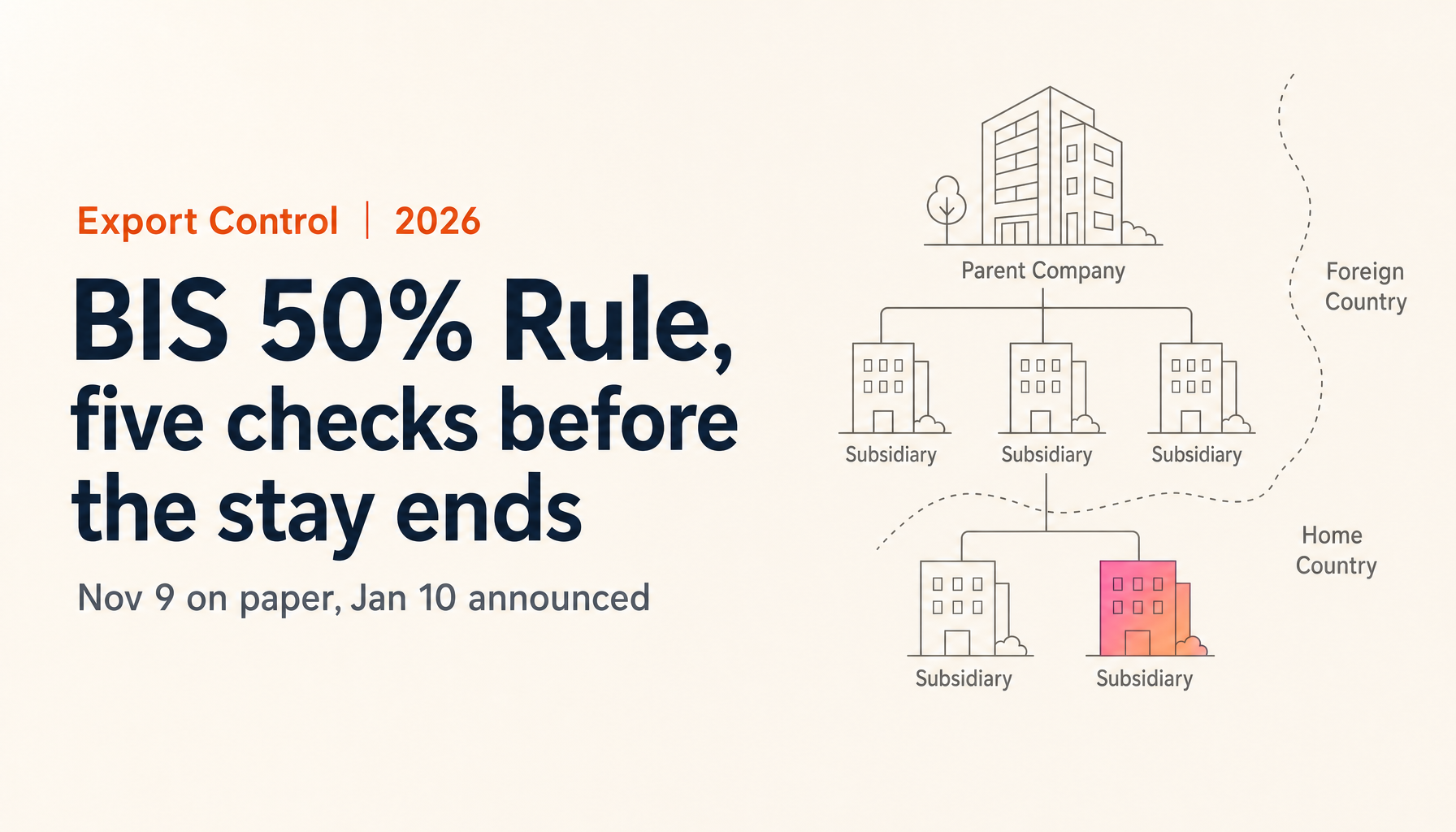
The 50% Rule (Chinese Affiliates Rule)
No. 61 also provides that export applications to importers and end users on the Control List or Watch List are in principle not approved, and extends this to subsidiaries, branches and other units in which a listed party holds 50% or more (paragraph 2: "包括其控股50%及以上的子公司、分公司等分支机构"). Unlike the U.S. Affiliates Rule, which extends the effect of the list itself, it is written as a licensing policy for the items in this announcement.
| Comparison | China 50% rule | U.S. BIS Affiliates Rule (50% rule) |
|---|---|---|
| Introduction | October 9, 2025 (Announcement No. 61) | September 2025 (BIS) |
| Ownership threshold | 50% or more | 50% or more |
| Effect | License applications subject to "presumptive denial" | Entity List effect automatically extends to subsidiaries |
| Current status | Suspended by Announcement No. 70 from November 7, 2025 to November 10, 2026 (date passed; no amending announcement as of November 20) | Stayed from November 10, 2025 (originally through November 9, 2026); extended on November 9, 2026 through January 10, 2027 (91 FR 70789) |
The picture so far is that the United States and China introduced parallel rules at nearly the same time and, under a U.S.–China understanding, suspended them for about the same period. The U.S. extended its stay on November 9 through January 10, 2027; China has not yet put an extension into an announcement. The dates are laid out in the latest on the BIS 50% rule extension.
Why Article 49's "First Full-Scale Operation" Matters
To place Announcements No. 61 and No. 62 in time, a short map of China's export-control architecture helps.
- December 2020: Export Control Law of the PRC takes effect (extraterritorial basis already exists in the text)
- December 1, 2024: Dual-Use Export Control Regulations take effect (Article 49 fleshes out extraterritorial application)
- October 9, 2025: Announcement No. 61 first operationalizes the three types in Article 49 in concrete form (No. 62, issued the same day, controls technology exports)
The "article" of Article 49 existed from December 2024. The concrete announcement of which items, at which thresholds, how applied, did not appear until October 2025. No. 61 is the first full-scale implementation case of that article.
Article 49 provides that where organizations or individuals outside China transfer or provide the following items, outside China, to specific destination countries or regions or to specific organizations or individuals, MOFCOM may require the operators concerned to follow the relevant provisions of the Regulations (per CISTEC's provisional translation):
- Dual-use items manufactured abroad that contain, integrate or are mixed with specific Chinese-origin dual-use items
- Dual-use items manufactured abroad using specific Chinese-origin technology or other dual-use items
- Specific Chinese-origin dual-use items
Items 1(1) to 1(3) of Announcement No. 61 follow the same structure, with the items (Annex 1) and the 0.1% threshold spelled out. No. 62 covers exports of technology from inside China and support provided abroad by Chinese citizens and legal persons, a separate mechanism from the three types in Article 49. Against the U.S. EAR's history since 1959, Chinese extraterritorial application is still developing in both text and practice — a fair reading.
Structural Comparison with the U.S. EAR: Functionally Symmetrical Regimes
The U.S. EAR has three representative extraterritorial mechanisms. China's Announcements No. 61 and No. 62 can be read as a functionally parallel structure.
| U.S. EAR | Mechanism | Chinese counterpart concept |
|---|---|---|
| FDPR (Foreign Direct Product Rule) | Treats products manufactured outside the United States using U.S.-origin technology or software as U.S.-controlled | Announcement No. 61, item 1(2), "foreign manufacture using Chinese-origin technology" (Type 2) |
| De minimis (25% / 10% / 0%) | Treats products containing U.S.-origin parts or technology above a threshold as controlled | Announcement No. 61 "0.1% rule" (Type 1) |
| Affiliates Rule (50% rule) | Automatically extends Entity List effect to 50%-or-more subsidiaries | Announcement No. 61, paragraph 2 (export applications for its items to listed parties and their 50%-or-more subsidiaries and branches are in principle denied) |
Important: the two regimes are functionally parallel, but purpose, operating culture, and transparency design differ. The United States has case law and operational accumulation since 1959 and a thick EAR body and FAQ updated roughly every six months. China only made extraterritorial basis explicit in the 2024 regulations, so operational Q&A and past cases are still thin.
EU Regulation 2021/821 (Annex I) and Japan's FEFTA also have limited extraterritorial effects. "Extraterritorial application equals a peculiarly Chinese regime" is inaccurate. Major export-control systems share this function.
Temporary Suspension Timeline (Announcement No. 70, Through November 10, 2026)
Nos. 61 and 62 were issued on October 9, 2025 and then suspended early after U.S.–China talks. Timeline:
2024 Dec  1  Dual-Use Export Control Regulations take effect (Article 49 extraterritorial basis)
2025 Apr       Medium/heavy rare-earth export licensing (individual announcements)
2025 Oct  9  Announcements Nos. 55–58, 61, 62 issued together
              — No. 61: rare-earth items manufactured outside China (0.1% / 50% rules)
              — No. 62: rare-earth-related technology
2025 Oct 30  U.S.–China summit (Korea / APEC)
2025 Nov  1  China indicates intent to partially suspend export controls
2025 Nov  7  Announcement No. 70 issued
              — Temporarily suspends implementation of Nos. 55, 56, 57, 58, 61, 62
              — Suspension period: November 7, 2025 – November 10, 2026
2026 Nov 10  End of temporary suspension as written (passed; no amending announcement as of Nov 20)
A common misunderstanding is "suspension equals withdrawal." Announcement No. 70 temporarily suspends implementation of the six announcements including Nos. 61 and 62. The legal instruments themselves remain valid. The U.S. BIS Affiliates Rule is stayed over almost the same period (originally through November 9, 2026 on the Federal Register; BIS extended it on November 9, 2026 through January 10, 2027, 91 FR 70789)1, so the current picture is parallel suspension of both measures. See our BIS 50% rule guide.
For practitioners, the key is simpler: as of November 20, no announcement has set out the treatment after November 10, 2026. Depending on U.S.–China talks, extension, permanentization, or expiry are all possible.
Impact on Japanese Companies
Even during the suspension period, Japanese companies should push supply-chain visibility. Three issues:
NdFeB Magnets and EV, Industrial Motors, Wind, MRI Domains
China accounts for most of the world's rare-earth production and separation/refining, and Chinese-origin material also dominates feedstock for NdFeB magnets (neodymium-iron-boron permanent magnets). EV traction motors, industrial high-torque motors, wind turbines, MRI, industrial robots, and defense equipment are typical domains that use Chinese-origin rare earths.
When these products are manufactured in Japan and exported to the United States, Europe, or third countries, post-suspension MOFCOM export-license applications may be required.
Japanese Companies with Chinese Subsidiaries (50% Rule)
In February 2026, China placed a total of 40 Japanese companies and organizations on dual-use Export Control List and Watch List, and on June 29 added another 40 through Announcements No. 27 and No. 28 (80 in total; the background and structure are in China's Export Control Law and the designation of 40 Japanese companies). List placement is a regulatory designation, not a moral judgment on those entities. If paragraph 2 of Announcement No. 61 is operating, export applications for No. 61 items to subsidiaries and branches in which a listed company holds 50% or more will also in principle be denied.
When a Japanese company operates joint ventures or subsidiaries in China, regularly confirming that local partners and investors do not appear on Control List or Watch List is basic risk management.
Companies Handling Technology and Know-How (No. 62)
Cases in which rare-earth refining/separation technology or magnetic-materials manufacturing technology is obtained in China and operated in a third country fall within No. 62's reach. "Substantial support or cooperation" by Chinese engineers outside China is also in scope. When signing technology contracts, license contracts, secondment contracts, or consulting contracts, clarify technology origin and transfer destination.
Five Practical Steps
Until an announcement settles the treatment, these five steps make any resumption or redesign much easier to handle. If I had to pick one, start with supply-chain visibility.
- Supply-chain visibility
Inventory where and to what extent Chinese-origin rare earths and Chinese-origin technology appear in your products. NdFeB magnets, heavy rare earths such as Dy, Tb, and Gd, and modules incorporating rare-earth permanent magnets are representative targets. List items at 0.1% or more on a value basis.
- Compliance-notice management
Announcement No. 61 requires Chinese exporters to issue a "compliance notice" to buyers. As buyers, Japanese companies should confirm whether past, present, and future Chinese-origin rare-earth procurement contracts include such notices.
- Secure alternative sources
A value-based 0.1% is an extremely low threshold. Continuing Chinese-origin rare earths after suspension ends raises license-application burden. Run U.S., Australian, and European alternatives (MP Materials, Lynas, Arafura, Iluka, and others), recycled materials, and magnet-free design in parallel.
- 50% check on Chinese subsidiaries and local partners
For Chinese subsidiaries and joint ventures, check at least once a year: your ownership ratio, local partner background, and whether the local partner has investment from other Control List companies.
- Monitor the latest announcements
MOFCOM announcements issue irregularly. Watch METI, JETRO, CISTEC commentary, and alerts from major law firms such as White & Case and Jones Day. The suspension end date (November 10, 2026) has passed, so check at least weekly whether an announcement on extension or operation has appeared.
Common Misconceptions / FAQ
Q1. May we call this the "Chinese FDPR"?
A. Functional similarity leads general media to use that label, but strictly it is not accurate. U.S. FDPR logic is "use of U.S.-origin technology automatically puts the product in scope," with no de minimis threshold. China's Announcement No. 61 combines a threshold type ("0.1% or more Chinese-origin rare earths") and an origin type ("use of Chinese-origin technology"). I stick to the neutral term "China's extraterritorial application provisions."
Q2. Does 0.1% mean 250 times stricter than the U.S. 25%?
A. That simplification does not hold. The U.S. EAR also uses 0% (no de minimis) for some items; for China-bound semiconductor controls, the effective threshold is near zero. China's 0.1% is a threshold set for the specific domain of rare earths; the U.S. 25% is a general default rule. You cannot rank "which is stricter" by the number alone.
Q3. If it was suspended, can we ignore it?
A. No. The legal instruments remain valid; implementation was suspended by Announcement No. 70 through November 10, 2026. That date has passed, and no announcement amending it had appeared as of November 20. Given the possibility of resumption, and the de facto need for supply-chain visibility even during the suspension, compliance posture should be maintained.
Q4. If a Japanese company exports magnets using Chinese-origin rare earths to the United States, what happens?
A. During the suspension period under Announcement No. 70 (through November 10, 2026), the additional licenses created by Announcement No. 61 were not required. No announcement sets out the treatment after that date, so check each transaction. The license regime for seven medium and heavy rare earths that began in April 2025 (Announcement No. 18) is outside the suspension, so a separate license is needed (No. 70 suspends Nos. 55–58, 61, and 62, not No. 18). After suspension ends, if Chinese-origin rare-earth value in the magnet is 0.1% or more, a MOFCOM export-license application may be required. The practical recommendation is to advance supply-chain visibility, alternative sources, and compliance-notice management before suspension ends.
Q5. How does the 50% rule apply in practice?
A. Example: Company A is on China's Control List and holds 60% of subsidiary Company B. Even if B is not explicitly listed, applications to export No. 61 items to B are in principle denied, just as for A (paragraph 2). The provision is limited to No. 61 items and was suspended under Announcement No. 70. Japanese companies with Chinese subsidiaries should confirm that local partners and investors do not appear on Control List or Watch List.
Q6. Does Japan's FEFTA have a similar regime?
A. Japan's FEFTA is principally territorial; extraterritorial reach is more limited than China's or the United States'. Catch-all (complementary export controls) can still bring non-list items into licensing where WMD or conventional-weapons concern exists. EU Regulation 2021/821 also has catch-all provisions and limited extraterritorial effect for cyber-surveillance technology and similar.
Developments as of July 2026: Diversifying Supply
While the fate of the suspension of Announcements No. 61 and No. 62 (deadline as written: November 10, 2026) remains unannounced, countries are hedging against single-country dependence on Chinese rare-earth supply. At the Japan–India summit in Delhi on July 2, 2026, the two governments issued the Japan–India Joint Declaration on Economic Security Cooperation, committing to project-based cooperation in five priority areas: semiconductors, critical minerals, information and communications technology, clean energy and pharmaceuticals. The two leaders also welcomed that about ¥2 trillion of investment had already been decided toward the ¥10 trillion private investment target set in 2025 (Ministry of Foreign Affairs of Japan, "Japan-India Summit Meeting and Luncheon," July 2, 2026, in Japanese). At the joint press announcement, Prime Minister Takaichi said both countries regard strengthening supply chains for critical goods as an urgent task (Visit to India (2), joint press announcement, Prime Minister's Office of Japan, July 2, 2026, in Japanese). Chinese-origin rare-earth license applications may return after suspension ends, so source diversification is continuous with the practical task of securing alternative routes. Related issues are in the Japan–India summit and economic security.
Summary
If you only act on one thing now, finish a Chinese-origin rare-earth and technology map for your main products. The rest of the picture:
- MOFCOM Announcement No. 61 is the first full-scale operation of the three types in Article 49 of the Dual-Use Export Control Regulations (effective December 2024)
- No. 61 introduces the 0.1% rule (Chinese de minimis) and a provision denying in principle export applications to listed parties and their 50%-or-more subsidiaries; No. 62 licenses exports of rare-earth-related technology and support provided abroad
- The structure is functionally parallel to the U.S. EAR's FDPR, de minimis, and Affiliates Rule, but Chinese operational accumulation and transparency are still developing
- Under Announcement No. 70 of November 7, 2025, the six announcements including Nos. 61 and 62 were temporarily suspended through November 10, 2026 (suspension is not withdrawal; the date has passed and no amending announcement had appeared as of November 20)
- Even during the suspension, companies handling NdFeB magnets, EV traction motors, and similar should advance supply-chain visibility, compliance-notice management, and alternative sources
As a next step now that the November 10 date has passed, the full rare-earth control map, China Rare Earth Export Control Map, shows where your own items fall. If you are deciding how far to check each individual transaction, read also about China's counter-legislation such as the Anti-Foreign Sanctions Law.
If you want checks on where counterparties sit on each country's lists and ownership chains to run as a routine process, you can contact us about TRAFEED. An overview of its features is in the TRAFEED service catalog (PDF).
References
Chinese Government Official
- MOFCOM (English portal): http://english.mofcom.gov.cn/
- MOFCOM Announcement 2025 No. 61 original (PDF): http://interview.mofcom.gov.cn/mofcom_interview/front/opdata/downlodePdfNew?id=439da9350b8d439cba2b9f0ed57a1de6
- CSET Georgetown English translation and commentary on No. 61: https://cset.georgetown.edu/publication/mofcom-notice-2025-61/
Japanese Public Bodies and Industry Associations
- METI, "On Temporary Suspension of Chinese Export Control Measures" (via JSIA): https://jsia.or.jp/
- JETRO Business Brief, "China Places 40 Japanese Companies and Organizations on Export Control List and Watch List" (February 2026): https://www.jetro.go.jp/biznews/2026/02/e4f19a798abdc080.html
- CISTEC, "On China's Strengthening of Export Controls on Rare-Earth-Related Goods and Technology" (October 9, 2025): https://www.cistec.or.jp/service/keizai_anzenhosho/china/data/20251009.pdf
- CISTEC, provisional translation of China's Dual-Use Items Export Control Regulations, ver. 3 (October 23, 2024), Article 49 (in Japanese; checked November 22, 2026)
- Council of Local Authorities for International Relations, official gazette translation of MOFCOM Announcement 2025 No. 61: https://www.jicc.org/kanpou_file/20251010_china_04.pdf
- CLAIR official gazette translation of MOFCOM Announcement 2025 No. 62: https://www.jicc.org/kanpou_file/20251010_china_03.pdf
Major Law-Firm Commentary
- Anderson Mori & Tomotsune, "Analysis of Rare-Earth Control Announcements Under the PRC Export Control Law and Impact on Japanese Companies": https://www.amt-law.com/asset/pdf/bulletins5_pdf/251016.pdf
- Akasaka International Law & Accounting Office, "MOFCOM Announcement 2025 No. 61: Decision on Implementing Export Controls on Foreign-Related Rare-Earth Items": https://ailaw.co.jp/blog/post16893/
- White & Case, "China imposes extraterritorial jurisdiction and a 50% Rule for export controls on rare earth elements and other items": https://www.whitecase.com/insight-alert/china-imposes-extraterritorial-jurisdiction-and-50-rule-export-controls-rare-earth
- Jones Day, "BIS Suspends Affiliates Rule, China Pauses Rare Earth Export Controls" (November 2025): https://www.jonesday.com/en/insights/2025/11/bis-suspends-affiliates-rule_china-pauses-rare-earth-export-controls
- Mayer Brown, "PRC Announces New Export Controls on Rare Earth and Battery Materials and Technology": https://www.mayerbrown.com/en/insights/publications/2025/10/prc-announces-new-export-controls-on-rare-earth-and-battery-materials-and-technology
Comparison with the U.S. EAR and FDPR
- 15 CFR §734.4 De minimis U.S. content: https://www.ecfr.gov/current/title-15/subtitle-B/chapter-VII/subchapter-C/part-734/section-734.4
- CISTEC, "Q&A on EAR Reexport Controls": https://www.cistec.or.jp/service/uschina/12-ear_qa.pdf
Footnotes
-
Federal Register, 91 FR 70789 (BIS, "Extension of the Suspension of Expansion of End-User Controls for Affiliates of Certain Listed Entities," published and effective November 9, 2026; FR Doc 2026-22793). Checked via the federalregister.gov API on November 20, 2026: https://www.federalregister.gov/documents/2026/11/09/2026-22793/extension-of-the-suspension-of-expansion-of-end-user-controls-for-affiliates-of-certain-listed ↩ ↩2 ↩3