(November 21, 2026) We corrected our summary of the QA on "support other than research funding" to match the original: it is considered to include not only financial support but also offers of posts and provision of goods.
Hello, this is Ryuta Hamamoto from TIMEWELL.
"A research security questionnaire arrived. How exactly are we supposed to answer this?"
Of everything people have brought to me over the past few months, that question is the most concrete and the most urgent. Explainers about the regime itself have multiplied. Almost nothing has been written about what to put in the boxes on the form in front of you. And the timing is awkward by design: the questionnaire reaches you from the funding agency after your project has been shortlisted. It arrives when you have no slack left.
So this piece is about the operational work. What gets asked, where each answer's raw material comes from, what to do when it does not come, and how to think about the items that feel uncomfortable to answer. I will follow the Cabinet Office procedures manual and stay as specific as I can. For how research security became a condition of application in the first place, see Research Security as a Funding Condition, and for the wider picture, the complete guide. If you also want a quick read on where your own export control arrangements stand, our export compliance self-check starts at five questions.
When the questionnaire arrives, and who receives it
Let me set the premises straight first, because a lot of anxiety comes from assuming the wrong ones.
The questionnaire does not go to everyone who applies to a Specified Research and Development Program. Reading JST's application guidelines, it is sent separately to the principal investigator of a shortlisted project that has been made subject to risk management1. The sequence runs: application, shortlisting, confirmation that the project is in scope, then the questionnaire.
The Acquisition, Technology & Logistics Agency's (ATLA) Innovative Science and Technology Initiative for Security (FY2026 call guidelines) words this differently. For both the subsidy and the commissioned tracks, the questionnaire response (the result of risk management) is to be submitted by the lead research institution of a project selected for the interview screening, by around mid-July, and the exact deadline is notified to the principal investigator by email or similar2. So for ATLA the clock starts at selection for interview screening, not at becoming a selection candidate. The general sequence above follows JST's wording. (Added 20 November 2026 after checking the call guidelines directly.)
Submission comes with conditions attached. The PI submits by the stated deadline, having obtained the agreement of the main co-investigators and confirmation from the responsible departments at both the PI's institution and the co-investigators' institutions1. This is where the time actually goes. It is not a form you can fill in and send on your own.
If several partner institutions are involved, you need to reach the right department at each of them. And if a partner has no department that owns research security, your first task is finding a counterpart at all. Work backwards from the deadline and you reach an uncomfortable conclusion: starting only when the questionnaire lands may not leave enough time. That is the single point I most want to get across in this article.
Submission is not the end either. JST and MEXT review the responses and may request additional risk mitigation measures where they consider them necessary1. Build your schedule assuming at least one round trip.
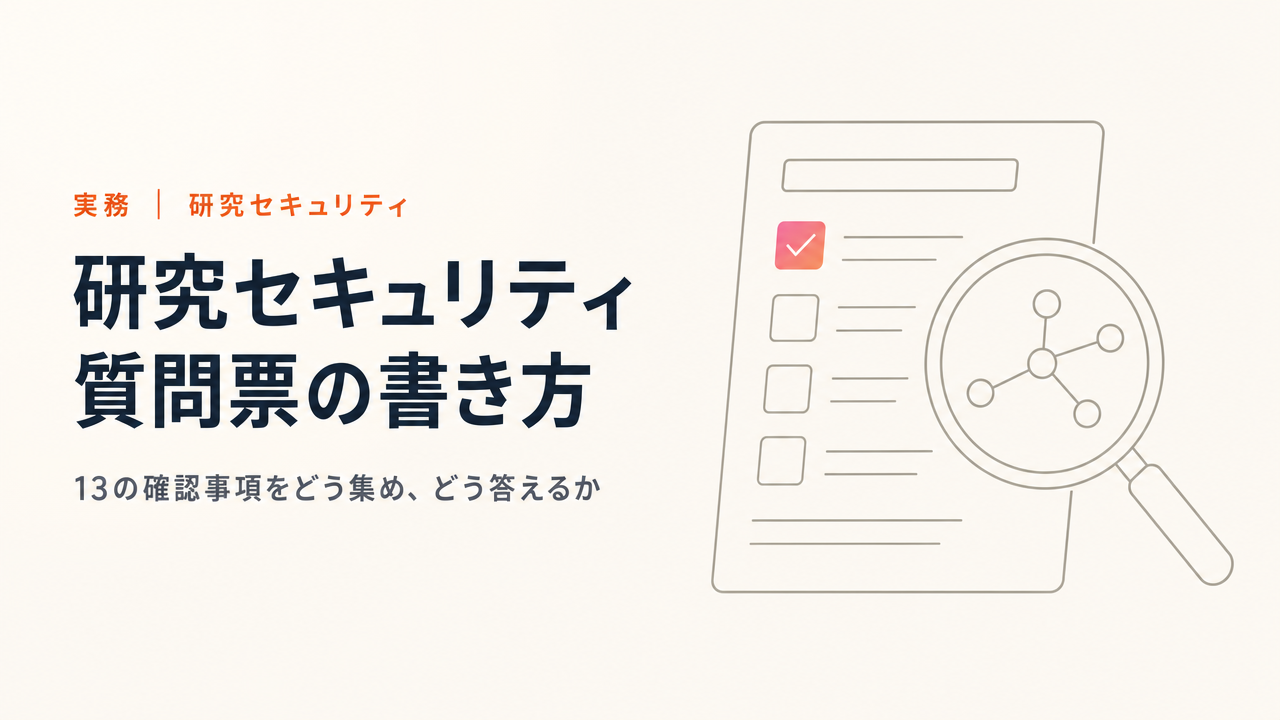
What gets asked: the 13 verification items
Funding agencies design their own form, but the substance comes from the Cabinet Office procedures manual. The manual lists 13 items that the lead institution should verify for the PI, for research participants belonging to that institution, and for Co-PIs3.
| # | Item to verify | Past three years |
|---|---|---|
| 1 | Academic background, including supervisors where relevant | — |
| 2 | Research and employment history | — |
| 3 | Research funding received | ● |
| 4 | Support other than research funding received | ● |
| 5 | First, corresponding and co-authors on published papers | ● |
| 6 | Patent filings, including co-inventors and co-applicants | ● |
| 7 | Participation in foreign talent recruitment programmes | ● |
| 8 | Disciplinary history under the guidelines | ● |
| 9 | Whether the person appears on a list | — |
| 10 | Whether the person belongs to a listed institution | ● |
| 11 | Whether the person has relationships with researchers at listed institutions | ● |
| 12 | Status as a "non-resident" or under a "specific category" in security export control | — |
| 13 | Anything else the funding agency deems necessary | — |
Items 3 through 8, plus 10 and 11, cover the past three years, including the fiscal year in which you apply3. That column is the part worth staring at. The manual is not asking for a single-year snapshot. It is asking for a history, and histories are much harder to reconstruct after the fact than current status is.
What the Cabinet Office Q&A (updated 26 August 2026) clarifies
The Cabinet Office has answered points the manual leaves open in its "Q&A on the procedures manual"4. Here are the ones that matter when preparing the questionnaire.
| Open point | The Q&A's answer |
|---|---|
| Which period is "the past three years"? | The fiscal year containing the application (or appointment) date and the two before it. For an appointment on 1 June 2026: FY2026, FY2025 and FY2024 |
| Are administrative staff subject to due diligence? | Staff supporting the application and operation are among the "persons involved in operation," but the due diligence a research institution performs covers the researchers taking part in the programme |
| How far does "support other than research funding" go? | The procedures define it as "remuneration and salary, scholarships, donations, the grant of honorary titles and the like, and concurrent positions" (2-1(2)(iv)), so honorary titles and concurrent posts are included. The QA says it is considered to include not only financial support (fees, salaries, scholarships and the like) but also offers of posts and provision of goods. The specific scope to declare follows the institution's own rules and judgement4 |
| How much patent information is needed? | Filings within three years counting from the filing date, including the application year; published or not, including personal filings the institution does not know about. Anonymised submission is acceptable. Where detailed disclosure is difficult, the Co-PI's institution can first assess the risk and report to the lead institution that there is no concern, or that risk mitigation measures will be taken (Q&A 14) |
| Do we need to check past affiliations with institutions effectively controlled by a listed institution? | The starting point is past affiliation with listed institutions. Checking affiliation with institutions they effectively control is desirable but, given the burden on institutions, not mandatory (Q&A 5, asked about the due diligence a funding agency performs on people involved in running a programme) |
| How do we check international joint research that research-funding records do not show (e.g. funded only by the partner country)? | The manual asks for due diligence based on information normally obtainable, such as self-declarations and open sources. At the funding agency's discretion, co-author information and conference presentations may also be checked (Q&A 6, in the same section as above) |
| What is a "foreign talent recruitment programme"? | The manual has in mind the list under the U.S. National Defense Authorization Act |
| Can HR records stand in for education and career history? | Yes, provided the researcher confirms they are current and accurate; achievements at other institutions still need a fresh declaration |
| Who holds the Co-PI's forms? | The lead institution obtains the Co-PI's declaration, consent form and attestation, normally through the collaborating institution's administration |
| Is there a standard declaration form? | No. Follow the form each funding agency prepares or specifies |
| Can we collect by electronic form, or substitute a researcher directory? | Check the call guidelines and proceed in consultation with the funding agency |
| Can due diligence use a different list designated by the partner country? | Consult the funding agency and follow its instructions |
Note that the last three answers all come back to "consult the funding agency." The fine detail of forms and methods is set agency by agency, so check the call guidelines you are applying under before adapting the questionnaire template for your institution.
The population in scope deserves attention too. It is not only the PI and Co-PIs. Research participants belonging to the lead institution are included, and research participants include students3. Depending on how your lab is staffed, the headcount can be several times what people first assume. The contractual side of including students is something I cover separately in Taking On Students and RAs Under Research Security.
What ATLA's questionnaire (Annex 5) asks
The FY2026 call guidelines for the Innovative Science and Technology Initiative for Security (commissioned research) include the questionnaire that applicants actually receive, as Annex 5, "Questionnaire on research security"2. Its structure follows Annex 3 of the procedures, but three points make a practical difference.
| Point | What Annex 5 says |
|---|---|
| Terms | PI = principal investigator (研究代表者), lead institution = 代表研究機関, research participant = co-investigator (研究分担者), partner institution = 分担研究機関, Co-PI = representative of the partner institution (for commissioned research; for subsidy projects, follow the alternative terms in brackets in Annex 5) |
| Period | Section 3(1) uses the manual's wording, "the past three years, including the fiscal year that contains the application date". The boxes for items 3 to 8, 10 and 11 say "FY2023 (Reiwa 5) to the present" |
| Self-declaration | The self-declaration for the questionnaire follows the attached form |
The FY2026 call was open from 13 March to noon on 20 May 20262. Japan's fiscal year runs from 1 April to 31 March, so an application made in March falls in FY2025 and the three years are FY2023 to FY2025, which matches the boxes. An application made from April onward falls in FY2026, and counting the Q&A way (FY2024 to FY2026) would leave FY2023 out. Where a funding agency's questionnaire states a period, collect for that period.
Replace siloed classification work with AI.
METI's FY2024 data shows 52% of foreign exchange law violations stem from classification errors. Download the TRAFEED product catalog covering features and rollout.
Where the information for each item comes from
Here is the core of it. Splitting the 13 items into three groups by the nature of their source makes the work far easier to organise.
Items filled in by self-declaration (1 to 4, 7, 8, 12)
Academic background, research and employment history, research funding and non-funding support received, participation in foreign talent recruitment programmes, disciplinary history, and status under the deemed export rules. These are things only the individual really knows. You rely on declaration.
This is where accumulated routine work pays off. The manual treats collecting information declared by researchers on the basis of a research integrity checklist as one of the measures institutions should carry out as ordinary, day-to-day practice, and it categorises that as "necessary"3. In other words, the information you have already been gathering under the research integrity framework is meant to become the raw material for the questionnaire. The inverse is also true. If your integrity declarations have quietly become a box-ticking exercise, this is where you will grind to a halt. Honestly, that is the situation at more institutions than people admit out loud.
Item 4, support other than research funding, is the one most often missed. The procedures define it as "remuneration and salary, scholarships, donations, the grant of honorary titles and the like, and concurrent positions" (2-1(2)(iv)), so it covers more than money. Separately, the government's 2021 policy describes support other than research funding as including research facilities, equipment, instruments or services received free of charge5. The QA likewise says that, beyond financial support (fees, salaries, scholarships and the like), offers of posts and provision of goods are considered to be included4. Build your form on the assumption that these need declaring even when no money has moved. Being offered a post by a foreign institution, borrowing an instrument at no cost, or having analysis done for you as a favour can all fall inside it. Where exactly to draw the line is for the institution's own rules and judgement4. When I raise this in conversation, the reaction is usually a pause, then a "wait, does that count?" It can.
On item 12, the deemed export specific categories, I have written about the underlying concepts in What Are Dual-Use Items?. The sentence I would keep close at hand is METI's explanation: falling under a specific category does not mean the person is regarded as posing a security concern (p. 3 of "On the Clarification of Deemed Export Management"; we checked the original on November 21, 2026)6. It is a procedural grouping of cases that require individual verification during screening, nothing more. When you ask a researcher to confirm their status, attach that sentence. Whether the request reads as "we are checking a procedural classification" or as "we suspect you" changes everything about how it is received on the ground, and the difference costs you nothing to get right.
Items you can confirm from public sources (5, 6, 9, 10)
Authorship on published papers, patent filings, listing status, and affiliation with a listed institution. For these, declaration can be cross-checked against public information.
The manual names the tools to use for due diligence: academic paper databases, portals such as Google Scholar, research databases such as e-Rad and researchmap, IP databases such as J-PlatPat, METI's End User List, and the United States consolidated screening list3.
Two things about lists are worth saying plainly before anyone starts matching names. Appearing on a control list is a regulatory designation. It reflects how a government has categorised an entity for licensing and screening purposes, and it is not a finding that the institution or the individual did anything wrong. Treat items 9 and 10 as classification questions, not character questions, and the whole exercise stays proportionate.
The manual then adds something reassuring. Due diligence is to be carried out "using self-declared information, open source information and other information that each lead institution can ordinarily obtain"3. Nobody is asking you to run an investigation. The standard is what you can ordinarily obtain, and it is written down in the manual, which means you can point to it when an internal discussion starts spiralling into "but what if we missed something."
Checking the affiliations of direct counterparts against the lists (11)
Then there is item 11, which behaves differently from all the others.
Whether the person has relationships with researchers at listed institutions. The manual defines this "relationship" as a record of joint or commissioned research, co-authored papers, or named oral co-presentations at conferences and similar events (3-3(1)(i)(11))3. A named co-presentation counts on its own, even where no paper came out of it. Patent co-inventors and co-applicants are declared under item 6 and are not part of item 11's definition.
Items 9 and 10 are matching problems. Compare a name or an institution name and you have your answer. Item 11 is not that. The researcher in front of you appears on no list. Their institution appears on no list. You still have to check whether any of their joint research partners or co-authors is a researcher at a listed institution.
What you check is the direct relationship from the person: over three years, the affiliations of their joint research partners, co-authors and co-presenters, compared with the listed institutions. Name matching alone does not finish the job. You have to check each counterpart's affiliation, so the work grows with the number of papers and projects. The manual does not say at which point in time the affiliation should be checked. My recommendation is to look at the affiliation at the time of the relationship and record the date you checked and the source, which makes the result easier to explain later. Then do it for every PI, every Co-PI and every research participant including students, every time a proposal goes out. For an institution whose research administration office has a handful of staff, calling that workload unrealistic is not an exaggeration.
The manual anticipates this. Right after listing the tools, it adds that "where the information gathered using these tools alone makes adequate due diligence difficult, using commercial information analysis tools or commissioning investigations from firms may also be considered"3. My reading is that a government document explicitly contemplating commercial tooling is a direct consequence of what item 11 asks for. Nothing else on the list has that shape.
Annex 3 (the questionnaire template), question by question
Annex 3 of the procedures manual, the "Research Security Questionnaire (template)," is a template that each funding agency adapts to its program3. The questionnaire you actually receive differs by agency, but this is its skeleton. The lead institution answers it, and the template says the funding agency may, where needed, ask for "a list of the persons subject to due diligence" and "the information the lead institution collected" about them. Having both ready before you answer saves a scramble.
| Question | What is asked | Options | What to prepare |
|---|---|---|---|
| 1(1) The lead institution | If it is not a university, inter-university research institute, technical college, national R&D agency or public research institute (for example, a company): submit its financial condition, capital structure (for companies), whether it is on the lists, and so on | Submitted / required but not submitted / not required | Universities normally answer "not required"; companies need financial documents and screening records |
| 2(1) Collaborating institutions | The same three items for collaborating institutions outside that scope | Same | Documents from the collaborating institution; ask early if a company is involved |
| 3(1) Risk check and due diligence | Whether the 13 items (items 3–8, 10 and 11 for the past three years including the application year) were checked for every member — PI, Co-PI and research participants — and due diligence was carried out | Done / not done / done, but some information could not be obtained (list which items) | Declarations and DD records for everyone; the items not obtained and why |
| 3(2) People needing mitigation | Whether, after due diligence, anyone should be subject to risk mitigation measures | Yes / no | A note of the reasoning |
| 3(3) Adding researchers | Agreeing to run the same due diligence and consult the funding agency before adding a Co-PI or participant | "We will follow this" | The internal procedure for additions |
| 3(4)(5) The four contract items | Whether the lead institution and each collaborating institution have checked the appropriateness of cooperation content, access to research data, handling of IP, and confidentiality in the joint research contracts and other contracts and agreements they conclude with the other side (the collaborating or lead institution) and any other individuals or organisations | Yes / no (per institution) | The relevant contract clauses (ten checks for joint research contracts) |
| 4(1) Mitigation measures | If 3(2) is "yes," which measures (facility access, research location, meeting participants, governance through employment contracts, training, data access rights, cyber defense, other) | Multiple choice | Owner and timing for each measure |
| 4(2) Feasibility | Confirmation that the measures are feasible | "Confirmed" | Agreement of the responsible office |
| Final confirmation | Consent of the PI, Co-PI and participants, and confirmation by the responsible offices of the lead and collaborating institutions | Both must be ticked before research can start (note) | Everyone's consent forms and the offices' confirmation |
"Done, but some information could not be obtained" in 3(1) is a legitimate option. The template itself says due diligence relies on "information already obtained and information normally obtainable through self-declaration and public information." Record what could not be obtained, and why, in your internal file. The note on the final confirmation says research cannot start unless both boxes are ticked, so start collecting consent forms at the application stage.
Draft answers and records in one workbook: a draft-answer sheet with the 13 verification items as rows and the PI, Co-PIs and research participants as columns. Enter the application date and it works out the three fiscal years as the Q&A counts them. It has columns for the result, the source, the date checked and any item that could not be obtained (with the reason), plus a due diligence log. → Research security self-check and due diligence kit (Excel, in Japanese)
When the information does not arrive, and when an item does apply
Two situations come up in practice every single time. Both are addressed in the manual, and both are widely misread.
When you cannot gather the information. The manual states that for individuals where adequate due diligence is difficult because the necessary information cannot be obtained, implementing risk mitigation measures as needed is desirable3. Not proceeding with a blank field. Not excluding the person as a matter of policy. You acknowledge what could not be confirmed and cover that gap with measures. A researcher who has just arrived from overseas, or whose previous employment records are hard to obtain, is a real and frequent case. The answer there is access rights design, not exclusion.
When an item does apply. This is the biggest misunderstanding of all. A co-author works at a listed institution. Someone participated in a foreign talent recruitment programme. Neither of those means you cannot apply. What the manual asks for is reasonable handling proportionate to the degree of risk, and the mitigation measures it offers as examples are modest: managing access rights to facilities and equipment, securing off-campus or otherwise separated research locations, considering who attends meetings based on the sensitivity of what is discussed, strengthening governance through employment contracts where the research participant is a student, training, managing access rights to research data, and hardening against cyberattack3. Falling under an item is an entrance, not an exit.
The manual also states that, in judging whether a counterpart is a trustworthy partner, there must be no discriminatory treatment on grounds of nationality, race, religion, culture or the like3. MEXT writes the same thing7. When the regime itself has been designed to prevent overreaction, there is no reason for the people operating it to be stricter than the design. If I had to pick one place where institutions do damage to themselves, it is here: an internal rule invented out of caution that goes beyond what the government asked for, and quietly makes the institution a worse place to collaborate with.
Sort out the personal data handling before you collect anything
One last thing, and it belongs at the start of your work rather than the end of this article.
The information you collect from researchers for the questionnaire is personal data. It may also be provided to third parties, namely the funding agency and relevant government bodies. In light of Japan's Act on the Protection of Personal Information, the manual states that institutions should require a consent form when receiving declarations of personal data from researchers3.
The manual also spells out what the consent form should cover. First, that the researcher declares the personal data to the institution for the purpose of risk management aimed at ensuring research security, and that the institution uses it only for that purpose. Second, that the institution may provide that personal data to third parties for that purpose3.
A written declaration is required alongside it: that the personal data declared is, to the signatory's knowledge, current as at the time of declaration, and contains no false content and no omissions3.
Preparing those two documents before you start collecting is the correct order. Collect first and go back for consent afterwards and you have doubled your own work while spending goodwill you will need later. JST's application guidelines also state that personal data provided may be used within the necessary scope by JST, MEXT, the Cabinet Office and other government bodies1, so I would build your explanatory material to cover that too. Researchers are far more cooperative when they can see the whole path their information takes.
Making this run in practice
Let me reorder everything above into the sequence I would actually work in.
Prepare the consent form and the written declaration first. Take stock of what you already collect through the research integrity checklist and map it against the 13 items, so you know which boxes are already filled and which are empty. For the empty ones, particularly items 5, 6, 10 and 11, decide now how you will confirm them from public sources. Get the contact details for the responsible department at each partner institution before you apply, not after. And decide how you are going to handle the relationship check in item 11. Five things.
That item 11 carries a disproportionate share of the load should be clear by now. The manual notes that where adequate due diligence is difficult with the listed public tools alone, commercial information analysis tools or commissioned investigations may also be considered3.
What goes on the questionnaire, though, is decided by the research institution. The manual assigns risk assessment and the choice of mitigation measures to the institution, and that is the right place for them. What you can hand off is assembling the material; keeping it in a form that explains, later, why a conclusion was reached stays with the institution.
What to take away
- The questionnaire is not sent to every applicant. JST sends it to the PI of a shortlisted project made subject to risk management; the Acquisition, Technology & Logistics Agency asks the lead institution of a project selected for interview to submit by around mid-July. Check the timing for each programme
- Submission requires the agreement of co-investigators and confirmation from the responsible departments at both institutions. Starting only when it arrives may not leave enough time
- The substance is the manual's 13 verification items. Items 3 to 8, plus 10 and 11, cover the past three years. Research participants, students included, are in scope
- Due diligence is to be done with information you can ordinarily obtain, and the manual says so explicitly
- Where information cannot be gathered, the answer is mitigation measures, not exclusion. Falling under an item is not a ground for exclusion either
- Prepare the consent form and written declaration before you collect anything. Getting the order wrong costs you twice
As paperwork, the questionnaire is tedious. I will not pretend otherwise. But read the items one by one and something else shows through: what is being asked is that you can explain who you work with, what you work on, where your support comes from, and how the collaboration is structured. That is research transparency. It is the kind of thing you ought to be able to answer whether or not anyone asks. Reframing it that way makes the form noticeably lighter to pick up.
So here is my recommendation, and it is deliberately narrow. Do not wait for a questionnaire to arrive before touching any of this. Write the consent form and the written declaration this quarter, run one PI through the 13 items as a dry run, and see where you get stuck. Whatever breaks in that rehearsal is exactly what would have broken later, on a deadline, with a funding decision attached.
If you want questionnaire checks and relationship mapping to run as a routine process with sources and records kept, you can contact us about TRAFEED.
References and primary sources
Footnotes
-
Japan Science and Technology Agency (JST), "FY2026 Strategic Basic Research Programs (CREST, PRESTO, ACT-X) Application Guidelines" https://www.jst.go.jp/kisoken/boshuu/teian/koubo/2026youkou.pdf ↩ ↩2 ↩3 ↩4
-
ATLA, "FY2026 Innovative Science and Technology Initiative for Security (Subsidy and Commissioned Research) Call Guidelines," March 2026, sections 5.12.3 (subsidy) and 5.13.3 (commissioned). The call period is in section 4.3.2 of the commissioned research guidelines (13 March to noon on 20 May 2026), and the period covered is in section 3(1) of Annex 5, "Questionnaire on research security" (checked against a copy obtained on 20 November 2026; in Japanese) https://www.mod.go.jp/atla/funding/koubo/r08/r08koubo_full_hojo.pdf https://www.mod.go.jp/atla/funding/koubo/r08/r08koubo_full_itaku.pdf ↩ ↩2 ↩3
-
Expert Panel on Ensuring Research Security and Research Integrity, "Procedures Manual for Ensuring Research Security," December 2025 (Cabinet Office) https://www8.cao.go.jp/cstp/kokusaiteki/integrity/yushikisha/guidelines_v1.pdf ↩ ↩2 ↩3 ↩4 ↩5 ↩6 ↩7 ↩8 ↩9 ↩10 ↩11 ↩12 ↩13 ↩14 ↩15 ↩16
-
Cabinet Office, "Q&A on the Procedures Manual for Ensuring Research Security" (in Japanese), last updated 26 August 2026. https://www8.cao.go.jp/cstp/kokusaiteki/integrity/security_qa_v1.pdf . Checked 20 November 2026. ↩ ↩2 ↩3 ↩4
-
Integrated Innovation Strategy Promotion Council, "Policy on Ensuring Research Integrity Against New Risks Accompanying the Internationalisation and Opening of Research Activities," 27 April 2021 https://www8.cao.go.jp/cstp/kokusaiteki/integrity/integrity_housin.pdf ↩
-
METI, Trade Control Department, Security Export Control Policy Division, "On the Clarification of Deemed Export Management" https://www.meti.go.jp/policy/anpo/law_document/minashi/meikakukanitsuite2.pdf (7 pages). Page 3 states that the specific categories are "simply a typological grouping of cases requiring individual verification during screening," and that falling under one "does not mean the person is regarded as posing a security concern." Original checked (November 21, 2026). The same caveat also appears in a reference sheet on the specific-category approach posted by Tokyo Metropolitan University (May 2022): https://bunnkei-kanribu.jim.tmu.ac.jp/site/wp-content/uploads/2023/08/%E3%80%90%E5%8F%82%E8%80%83%E8%B3%87%E6%96%991%E3%80%91%E2%91%A4%E7%89%B9%E5%AE%9A%E9%A1%9E%E5%9E%8B%E3%82%A2%E3%83%97%E3%83%AD%E3%83%BC%E3%83%81%E3%81%A8%E3%81%AF-2022.5%EF%BC%88%E6%97%A5%E3%83%BB%E8%8B%B1%EF%BC%89.pdf ↩
-
MEXT, Science, Technology and Innovation Policy Bureau, "Direction of Concrete Measures on Research Security in MEXT-Related Programmes for Universities and Other Institutions," 18 December 2024 https://www.mext.go.jp/content/20241218-mxt_kagkoku-000039402_1-1rrr.pdf ↩