This is Hamamoto from TIMEWELL
This is Hamamoto from TIMEWELL.
In Today's World, eBook Monetization Is an Attractive Field
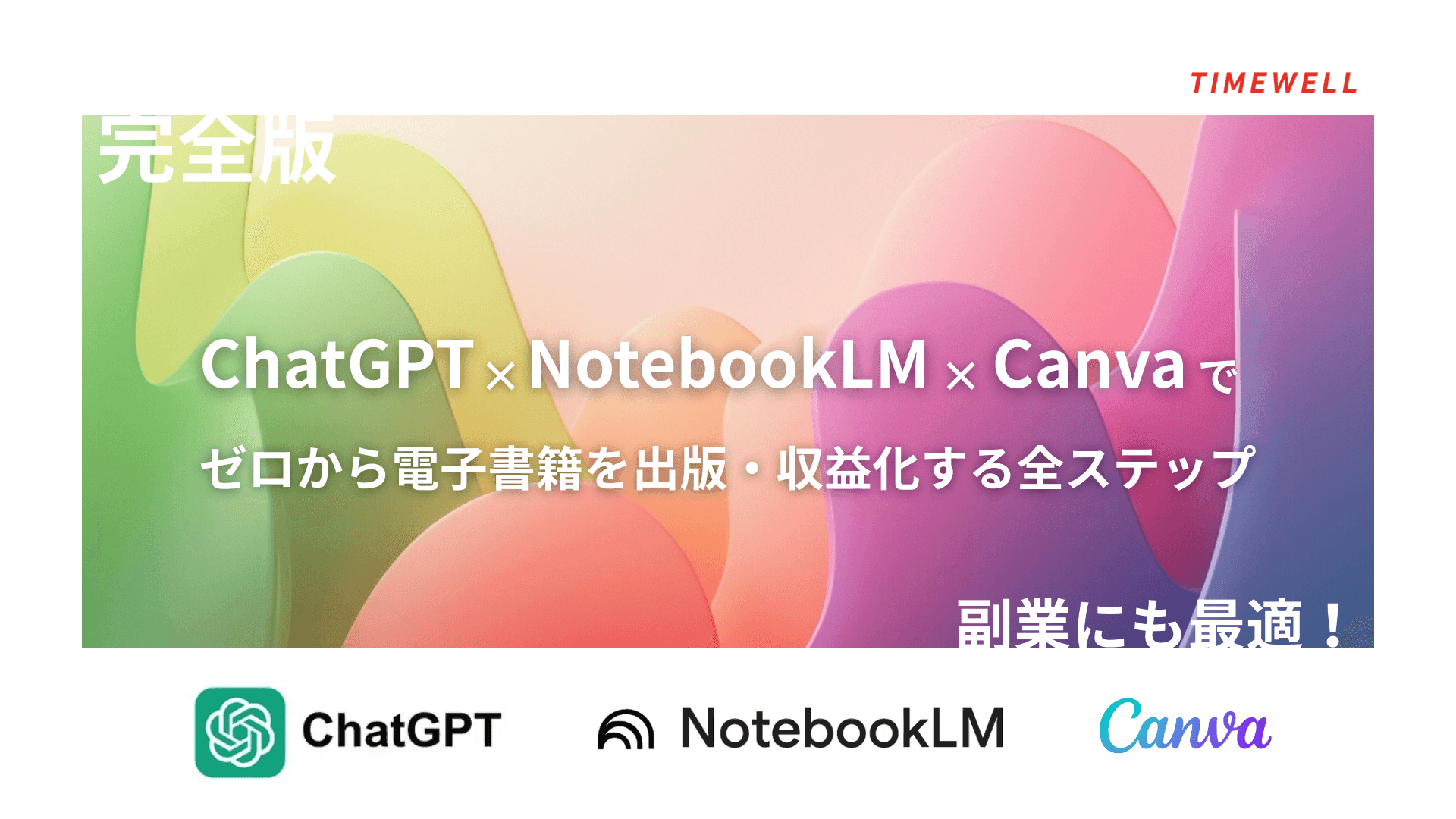
In today's world, eBook monetization is an attractive field that individuals can easily get into. We have entered an era where the latest AI tools, starting with ChatGPT, dramatically streamline every step of the process—from planning and researching a book, to writing it, designing it, and publishing it. For example, two AI tools—ChatGPT and NotebookLM—can produce results in just minutes for tasks like researching the Amazon Kindle market or conducting deep research and organizing information. Furthermore, with Canva you can easily create the design for publication, and by going through these processes, anyone can now complete a high-quality eBook in a short time.
This article introduces the complete picture of the eBook monetization workflow in detail, in a way that is easy for beginners to understand as well. It walks through the entire flow step by step, from actually starting with market research, through AI-powered deep research and structured output, to design with Canva and Kindle publishing. Each stage incorporates specific methods for achieving both efficiency and quality, and the explanation—including actual demonstration cases—will be highly useful for those who are about to take on the challenge of eBook publishing for the first time.
I hope that readers will, through practicing this workflow, experience the moment when their own ideas turn into revenue, and feel the full potential of new publishing possibilities leveraging AI tools. Since the content described in this introduction serves as the gateway to all the processes needed for eBook publishing, please read it all the way through and open the door to new business opportunities.
- Finding It with ChatGPT: How to Choose a Sellable eBook Theme and Conduct Market Research
- Auto-Generating Book Structure with NotebookLM: From Information Organization to Writing
- Creating Professional-Grade Covers with Canva: The Design and Submission Process Through to Kindle Publication
- Summary: In the AI Era, "3 Tools Is All You Need" Is the New Standard for eBook Monetization
Looking for AI training and consulting?
Learn about WARP training programs and consulting services in our materials.
Finding It with ChatGPT: How to Choose a Sellable eBook Theme and Conduct Market Research
One of the Most Important Points When Publishing an eBook Is Market Research
One of the most important points when publishing an eBook is market research—choosing which theme to pursue. The workflow introduced here starts by using ChatGPT with a dedicated prompt to understand the current state and demand of the Amazon Kindle market. Through this prompt, you identify high-demand fields and promising niche genres, and determine which markets are accessible to independent publishers.
Specifically, ChatGPT's "Deep Research" feature is used, conducting detailed market analysis by chat regarding eBook genres. Here, points such as how market trends in the "practical how-to" category—and demand related to side jobs, working from home, and remote work knowledge—are generated are reported in detail. ChatGPT lists high-demand genres as output, providing multi-faceted information including difficulty of entry, preparation costs to complete a book, and pros and cons. This makes the optimal theme for targeting monetization clear, and lays the groundwork for further information gathering.
Also, ChatGPT's output not only produces results quickly through the fast processing of Model 5, but you can also switch to a model with a different thinking process—such as "Thinking (think deeply)" mode—as needed. For example, by running the same prompt with a different model and comparing the output differences, you can verify which perspective is most suitable for your own publishing plan. This method is highly effective for winning in tough competition even as an independent publisher. In practice, a theme in the health and wellness field—specifically "Self-Care for Back Pain Prevention for Desk Workers"—was recommended and taken up as a concrete example for book planning.
In the market research process, the following points are particularly important:
To Generate Revenue from an eBook
- To generate revenue from an eBook, you need to choose a theme with high demand that can still be sufficiently differentiated even by an independent publisher.
- Use ChatGPT's dedicated prompt to extract specific market data and information on accessible fields.
- Run the same prompt with different models and compare the output differences to obtain more reliable information.
Furthermore, since the prompt presents specific subgenres and their pros and cons, concrete theme candidates are suggested—such as "Time Management Techniques Anyone Can Practice in Their First Year of Work" or "Introduction to Web Skills for Earning 30,000 Yen a Month on the Weekend"—enabling flexible theme setting in line with the reader's own expertise and interests. The fact that just entering a prompt yields detailed information—including competitive assessment, market outlook, and what aspects the target readers are interested in—is a great appeal, as it allows you to obtain high-quality information far more efficiently than conventional research methods.
Note That This Research Result
Note that this research result is recommended to be saved carefully, as it will also be used in the writing phase described later.
Users are required to use their own expertise and the latest information to select from and reflect the content of the AI's output in their final writing. By going through this process, it becomes possible to produce content of high quality with high originality while utilizing AI tools.
Furthermore, in market research, it not only greatly influences the selection of the eBook theme, but also the direction of the overall publishing strategy, making the method introduced here an important step for many people seeking side income or new revenue sources. By accurately grasping market trends and selecting in-demand themes, you become able to provide truly valuable content to purchasers, which directly connects to eBook monetization as a result. This enables individuals to plan solid publishing projects and achieve large results with minimal effort.
Auto-Generating Book Structure with NotebookLM: From Information Organization to Writing
Based on the Information Collected in Market Research, What Comes Next
Based on the information collected in market research, what comes next is organizing and structuring that data. This is where NotebookLM comes in. Like ChatGPT, this tool leverages AI technology to organize vast amounts of information in an easy-to-understand way and plays the role of generating the output needed for the eBook's structure. First, save the information obtained through market research in PDF format and upload that data to NotebookLM. After uploading, NotebookLM automatically extracts key points from that information and also uses Deep Research functionality to search for reliable sources online, additionally collecting data. Through this, existing information and newly obtained information combine to form a more accurate and comprehensive knowledge base.
As a specific procedure, first enter a prompt like "You are an eBook editor and writer. Based on the research sources you've read, create an eBook structure usable for Amazon" into NotebookLM. Then NotebookLM automatically generates a title, headings for each chapter, and a summary or outline of content for each chapter, completing an initial draft. Based on this structural proposal, the next step is to flesh out the content of each chapter so that readers' understanding deepens.
In this process, users themselves confirm the output content and make fine adjustments such as removing unnecessary information or, conversely, adding supplementary information. NotebookLM also has the function of organizing information in detail and explicitly showing source numbers and references so that users can analyze in depth based on that information. This allows the structure and content to be established quickly while maintaining the book's credibility. Also, by adding your own adjustments to the text and information gained from your own experience to the AI-proposed output, original and enriched content is ultimately completed.
This allows you to consider multiple ideas before publication and narrow down to the most appealing content. It should also be appreciated that users can flexibly edit—not simply using the AI-generated text as-is, but supplementing it with their own words, rewriting it in plain language understandable even to middle school students, and so on.
An Important Point Is That NotebookLM
An important point is that NotebookLM is largely free to use, so even first-time users can try it easily. Also, by linking with ChatGPT, already-obtained information and newly collected information can be well combined to complete the eBook's overall structure as a coherent story. For example, the "health and wellness" information already obtained through market research is automatically organized by NotebookLM, and based on that, headings and detailed summaries for each chapter are created, allowing users to focus on the writing work itself. As a result, information is organized and structured efficiently, and the expansion of the final text is greatly supported.
Furthermore, in NotebookLM, it is possible to extract detailed explanations and reference information for each chapter, and it automatically adds paragraph breaks and source links to the text so that users can re-edit easily later. This point becomes a factor that is evaluated as a reliable information source for readers when selling as an eBook. For example, in a back pain prevention guide for desk workers, each chapter begins with headings like "Why Back Pain Occurs," "What Is Correct Posture," and "Simple Self-Care Stretches"—followed by detailed body text, so readers can absorb knowledge step by step. NotebookLM effectively complements the sense of unity in structure that tended to be scattered in previous eBook publishing processes.
Editors make corrections based on NotebookLM's output, adding their own experience and specialized terminology. For example, experienced authors can add their own commentary and specific examples to the subheadings and chapter overviews created by NotebookLM, completing content with more substance. Through this work, efficient writing processes utilizing AI tools and human creativity and ingenuity are beautifully fused, completing an eBook that is easy for readers to understand and highly reliable.
Creating Professional-Grade Covers with Canva: The Design and Submission Process Through to Kindle Publication
After the Book Content Is Finalized, the Next Stage Is Creating Design That Catches Readers' Eyes
After the book content is finalized, the next stage is creating design that catches readers' eyes. Canva, a graphic design tool, is a powerful tool that lets you easily create eBook covers and body layouts that look professionally made. Canva has numerous eBook templates for diverse genres including health, lifestyle, and business, so you can select a design optimal for your book's theme.
For example, in this project, based on the theme of back pain prevention for desk workers, a simple and easy-to-understand eBook cover was selected from Canva's templates. The cover is a very important element that determines the book's first impression. Using Canva, you can freely combine the cover's layout, fonts, colors, illustrations, and photos to achieve a professional finish. The free version is sufficient for sufficiently attractive design, but for access to more templates, font assets, icons, and so on, you can use the paid plan (e.g., 1,180 yen/month). Canva also offers a 30-day free trial, so even users trying it for the first time can easily give it a go.
The specific design creation flow starts with logging into Canva, clicking "Create" in the upper left, and searching for "eBook cover." Various templates related to health and lifestyle appear, and you can choose one that suits your preferences. In cover creation, the choice of layout and visuals that match the book's theme influences the reader's first impression. In design creation, choose fonts that are easy to read, and adjust text size and positioning to aim for a layout that anyone can immediately understand.
As a note when creating in Canva, you also need to pay attention to the page composition. After the cover, consider the layout for the table of contents and each chapter, designing so that text, images, graphs, and so on are balanced well. Within Canva, there is also a multi-page document creation function similar to Google Docs, and by using this, you can create a well-organized layout for the eBook body all at once. For example, on the body's table of contents page, position the heading and brief summary of each chapter so readers can grasp the overall flow of the book. At the same time, in the body, paste the content organized and structured with AI tools, and finalize a high-quality manuscript by correcting with your own words as needed.
The Work at This Stage Hinges on the Harmony of Design and Text
The work at this stage hinges on the harmony of design and text. Canva's intuitive operation—where text positioning, decoration, and adding illustrations can be done easily with drag and drop—is a major advantage as even design beginners can use it with confidence. For example, by inserting decorative spot illustrations at the title of each chapter and adding color-coded title boxes at the beginning of each section, the result is a visually easy-to-understand eBook. Here, users proceed with the overall arrangement while being particular about the design itself and also devising ways to convey the appeal of their own written content to the maximum.
Once publication preparation is complete, the next step is publishing to Kindle. Download the created design data from Canva in PDF format, and convert it for KDP (Kindle Direct Publishing) using a tool called Kindle Create. Kindle Create is available for both Mac and Windows, and users can download and install it in their preferred environment. On the tool, press the "Create Menu" and proceed with settings according to the book category (text, manga, etc.), then enter the author name, title, and publisher information. Then upload the created PDF data and export it to create KDP data, which you upload to the KDP platform to complete the formal publishing process. After publishing, input the book's detailed settings, pricing, and description text suited to your sales strategy, and finally clicking the "Publish to Kindle" button delivers your eBook to readers around the world.
In this way, the process combining Canva and Kindle Create overhauls the previously complicated print publishing process and shows a new way to complete an eBook at high quality from home. The complete flow of using AI tools to research and write content, creating attractive design in Canva, and then proceeding to Kindle publication is a very instructive method for not only beginners but also experienced creators. In particular, the fact that through utilizing AI tools, the ingenuity of prompt input directly correlates to the quality of publications, and the time to publication can be dramatically shortened, should be evaluated as a great attraction in modern digital publishing.
Summary: In the AI Era, "3 Tools Is All You Need" Is the New Standard for eBook Monetization
In Today's Comprehensive Guide "Using NotebookLM and Canva"
In today's comprehensive guide "Using NotebookLM and Canva for eBook Monetization," we first explained how to use ChatGPT for market research to select high-demand themes that readers want and clarify specific market trends and accessible genres. Furthermore, we described in detail the method for converting vast data into readable and attractive manuscripts through efficient information collection, structuring, and the writing process using NotebookLM, and also explained in detail the steps of design creation using Canva and Kindle publication together with specific operation methods. All of these processes are introduced as a monetization workflow that can be easily practiced even by beginners and intermediate users, by effectively incorporating AI tools.
- Use ChatGPT's dedicated prompt for market research to identify in-demand fields
- Use NotebookLM to organize and structure information and streamline the eBook structure and output
- Create professional design with Canva and proceed smoothly to publication using Kindle Create
By carefully practicing each of these methods one by one, this dispels the preconception that eBook publishing is difficult and invites you to new business opportunities that you can actually monetize easily. In an era where AI is advancing, all processes from text creation to design and publication have become surprisingly simple. Why not use this workflow to complete an eBook faster and at higher quality than ever before, and take your first step toward monetization? In the publishing industry going forward, AI tools will become a reliable right-hand partner, greatly supporting your own creative activities.
Reference: https://www.youtube.com/watch?v=_MJBY09KiME
Related Articles
- From Full-Time to Part-Time: Life After Two Maternity Leaves and How My View of Work Changed | TIMEWELL
- Before Paternity Leave (Part 2): Three Things You Absolutely Must Do to Take Leave During Busy Season
- Staying True to the Field: How the 5th-Generation Head of a Construction Firm Found His Own Way | Fujita Construction