Hello, this is Ryuta Hamamoto from TIMEWELL.
This one is for carmakers, trading companies and logistics teams that ship passenger cars from Japan to Europe, and for the EU importers who sell those cars. Export control officers may find it useful too: it is a clear case of an import rule at the destination that can stop a shipment even when every export formality at home is in order.
In short, from December 1, 2026 the EU caps the number of hybrid passenger cars that can be imported from each country. Imports continue as normal up to the cap. Once a country's cap is reached, cars from that country cannot enter the EU until the next period opens.
Why now? On November 24 the European Commission published Implementing Regulation (EU) 2026/2614 in the Official Journal1. It applies from December 1, so there is very little time left. Japan's quota for the first three months is 76,900 units.
Background reading. For the EU's export control framework, see our guide to the EU Dual-Use Regulation. This article is about the other side of the border: an EU trade measure on imports, called a safeguard.
Key points
- For 200 days from December 1, the EU applies country quotas to imports of new hybrid passenger cars with nine seats or fewer, whether or not they can be charged from the grid
- Japan's quota is 76,900 units for December 1 to February 28, 78,609 for March 1 to May 31, and 15,380 for June 1 to 18
- The quotas are set at 2025 import volumes plus a little over 15%. For Japan, that is about 21% above the recent import pace (our calculation)
- Origin follows the EU's non-preferential rules, not the brand. Cars built outside Japan use the quota of the country where they originate
A few terms used below:
| Term | Plain meaning |
|---|---|
| Safeguard | A temporary limit on imports when a sudden rise threatens serious injury to domestic industry. The WTO Agreement on Safeguards allows it |
| Provisional measure | A measure applied before the investigation ends, when action is urgent. This one lasts up to 200 days |
| Import quota | The maximum quantity that can be imported in a period. Imports above it are not allowed |
| Non-preferential origin | The ordinary rules for deciding where a product comes from, separate from the rules used to claim lower tariffs under trade agreements |
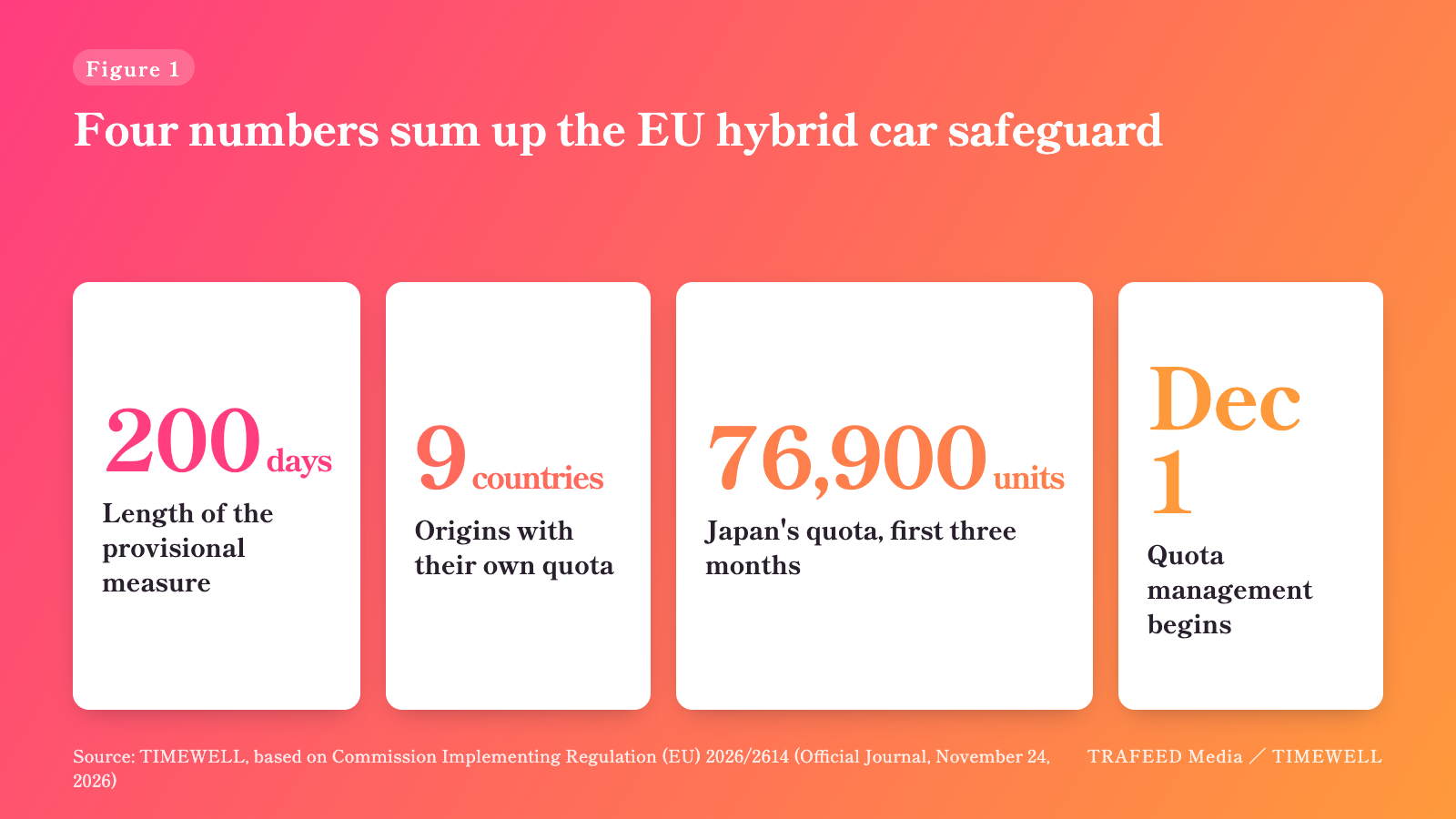 Figure 1. The measure at a glance: 200 days, nine countries with their own quotas, 76,900 units for Japan in the first three months, starting December 1. Source: TIMEWELL, based on Commission Implementing Regulation (EU) 2026/2614 (Official Journal, November 24, 2026)
What the regulation actually says
The legal basis is the EU's common rules for imports, Regulation (EU) 2015/478, Articles 5 and 71. Here is what the text of Regulation 2026/2614 sets out.
The product is new vehicles designed mainly to carry nine people or fewer, including the driver, that use both an internal combustion piston engine and at least one electric motor for propulsion. Whether the car can be plugged in to charge does not matter, so full hybrids (HEVs) and plug-in hybrids (PHEVs) are both covered. The Commission's press release adds that mild hybrids (MHEVs) are included2. In the EU's Combined Nomenclature, the product falls under parts of CN codes 8703 40 10, 8703 50 00, 8703 60 10 and 8703 70 00.
The period is 200 days. Article 1(1) opens the quotas "for a period of 200 calendar days from the entry into force of this Regulation," and Article 7 sets the date of entry into force as December 1, 2026. Once a quota is exhausted, imports of that origin are not allowed (Article 1(2)). Imports within the quota pay the duty that would normally apply, taking into account any preferential treatment under an agreement between the EU and the country of origin (Article 1(4)). For cars from Japan, the preferences under the EU-Japan Economic Partnership Agreement still apply.
Some origins are excluded: Iceland, Liechtenstein, Norway, Ukraine, Kenya, and the developing countries listed in Annex I, with the exceptions named there (Article 1(6)).
To make this concrete: if an EU importer declares a Japanese-built PHEV on December 10, one unit is drawn from Japan's first-period quota of 76,900, and the usual duty applies. If that quota has already run out, the car has to wait until the second period opens on March 1. The measure does not raise tariffs. It caps volumes, which is the main difference from anti-dumping or countervailing duties.
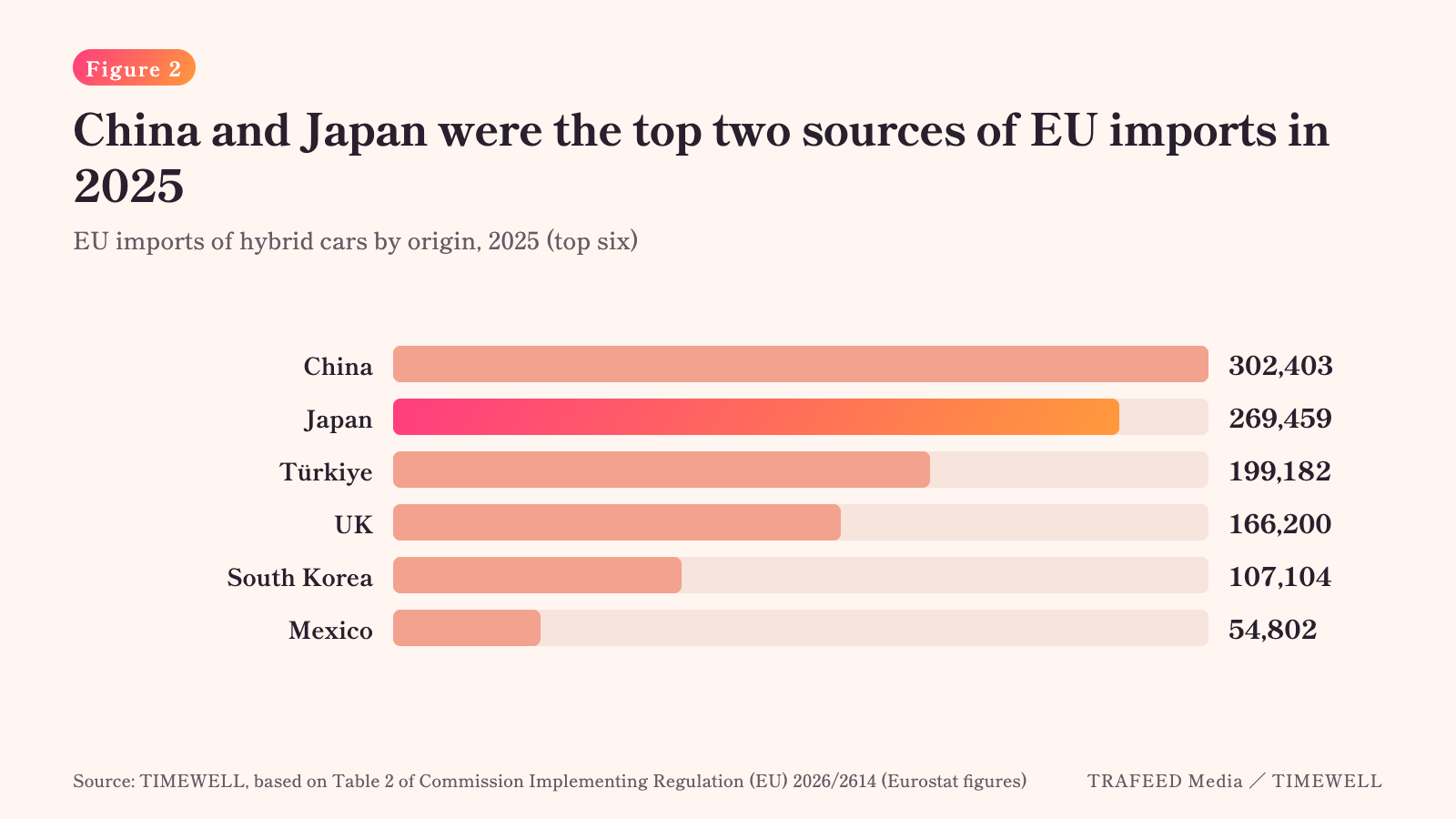 Figure 2. EU imports of hybrid cars by origin in 2025 (top six). Japan was second after China. Source: TIMEWELL, based on Table 2 of Commission Implementing Regulation (EU) 2026/2614 (Eurostat figures)
Why the EU chose quotas: the numbers in the investigation
The Commission opened the investigation on October 30, 2026 and adopted provisional measures less than a month later23. Its press release says the measures implement the understanding reached at the second EU-China Trade and Investment Consultations on October 9 to moderate China's hybrid exports to the EU, while applying to all hybrid imports regardless of origin2.
The tables in the regulation show very different trends by country. Imports from China rose from 46,001 units in 2023 to 302,403 in 2025, and to 486,582 in the most recent twelve months (the second half of 2025 and the first half of 2026). Imports from Japan were 268,611 in 2023, 305,240 in 2024, 269,459 in 2025 and 256,898 in the most recent period, broadly flat1. Comparing 2023 with the most recent 12 months, imports from Türkiye and Mexico rose, while those from the UK and South Korea fell.
Demand inside the EU is growing too. Measured by registrations, EU consumption of hybrids rose from 3.53 million in 2023 to 5.11 million in the most recent period, up 45%. Even so, EU producers' market share slipped from 73% to 72%, and imports' share rose from 27% to 28%1. The Commission attributes the surge to global overcapacity and to more trade restrictions in other large markets, and it found that the threat of serious injury to EU industry is imminent2.
Put simply, the EU market is growing, but imports, above all from China, are taking much of the growth. Imports from Japan have not grown, so Japan's quota ends up relatively roomy within this scheme, as the next section shows.
On November 24, a spokesperson for China's Ministry of Commerce noted that the EU had moved to provisional measures less than a month after opening the investigation on October 30, and said China reserves all its rights, including WTO dispute settlement and trade compensation4. This article does not judge between the two positions. What matters for companies is the quota numbers and the operating rules.
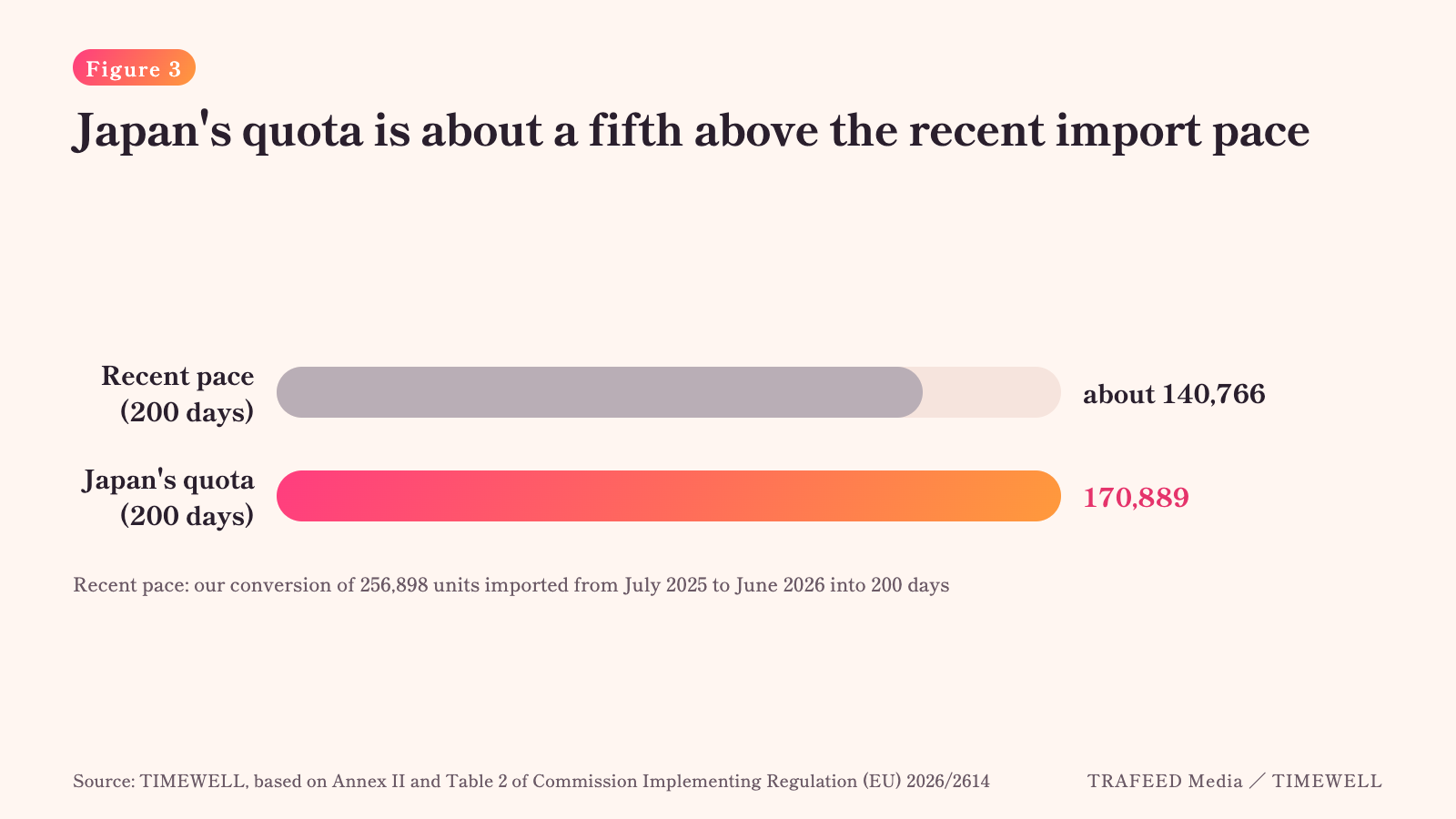 Figure 3. Japan's 200-day quota compared with the recent import pace. The recent pace is our conversion of imports from July 2025 to June 2026 into a 200-day figure. Source: TIMEWELL, based on Annex II and Table 2 of Commission Implementing Regulation (EU) 2026/2614
Replace siloed classification work with AI.
METI's FY2024 data shows 52% of foreign exchange law violations stem from classification errors. Download the TRAFEED product catalog covering features and rollout.
How big Japan's quota is, and how it is counted
Annex II sets Japan's quota as follows1.
| Period | Japan | China |
|---|---|---|
| Dec 1, 2026 to Feb 28, 2027 | 76,900 | 86,301 |
| Mar 1 to May 31, 2027 | 78,609 | 88,219 |
| Jun 1 to 18, 2027 | 15,380 | 17,260 |
| Total (200 days) | 170,889 | 191,780 |
According to the Commission, each country quota equals that country's 2025 import volume plus a little over 15%. Countries with more than 2% of EU imports in 2025 received their own quota, and all other origins share a residual quota2. Japan's numbers fit: 269,459 units in 2025 scaled to 200 days is about 147,649, and the 170,889-unit quota is about 1.16 times that.
Imports in the most recent twelve months (July 2025 to June 2026) were 256,898 units. Scaled to 200 days, that is about 140,766, so Japan's quota is roughly 21% above the recent pace (our calculation). The same arithmetic puts China's quota about 28% below its recent pace. If shipments from Japan continue at the recent rate, the numbers suggest Japan's quota as a whole is unlikely to run short.
That said, there are reasons for caution. The quotas are run in three periods, and allocation for each period stops on the Commission's 20th working day after the period ends (Article 2(3)). Unused volumes carry over to the next period (Article 2(4)). The quotas are managed under the EU's tariff quota system in Articles 49 to 54 of Implementing Regulation (EU) 2015/2447, and when requests exceed the remaining balance, allocation is pro rata (Article 2(1) and (7)). Japan's quota is shared by every importer bringing in cars of Japanese origin. It is not reserved for any one company.
Origin is the other point to watch. Article 4 says origin is determined under the EU's non-preferential origin rules. A Japanese carmaker's car built in Türkiye or the UK, and found to originate there, uses the Turkish or British quota. A car built in Japan uses Japan's quota whatever the brand. Cars originating in China can use their quota only with an export quota certificate issued by the China Chamber of Commerce for Import and Export of Machinery and Electronic Products (CCCME) (Article 5). There is no such certificate requirement for cars from Japan.
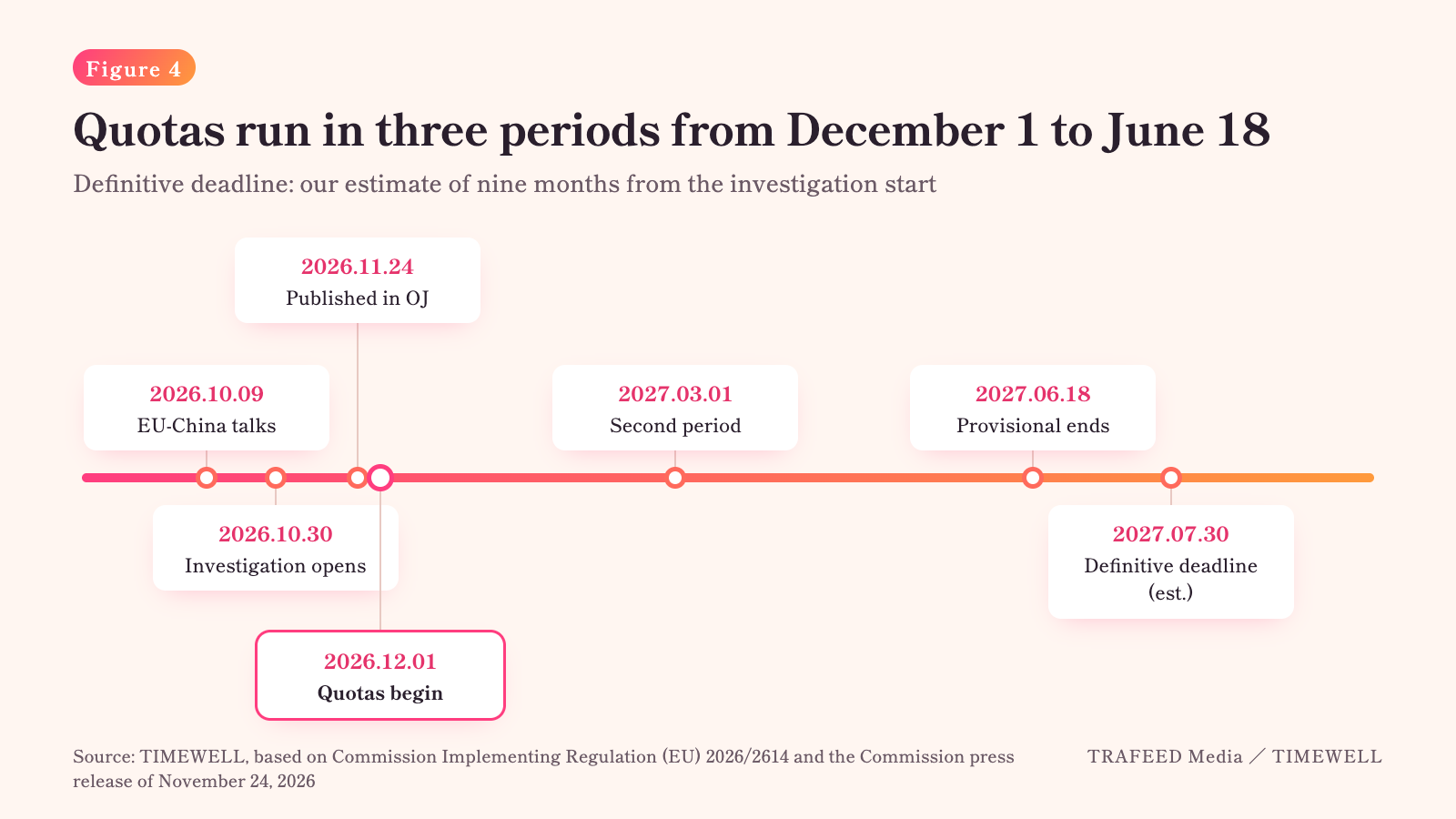 Figure 4. How the measure came about and the dates ahead. The highlighted point is December 1, when quota management begins. The deadline for definitive measures is our calculation of nine months from the start of the investigation. Source: TIMEWELL, based on Commission Implementing Regulation (EU) 2026/2614 and the Commission press release of November 24, 2026
What exporters in Japan and EU importers should check
Here is a checklist for the days before December 1. Each item maps to a rule in the regulation.
First, check whether your cars fall within the product scope. The regulation covers parts of CN 8703 40 10, 8703 50 00, 8703 60 10 and 8703 70 00, specified by TARIC subheadings. The test is whether the car is a new vehicle for nine people or fewer that uses both an engine and an electric motor for propulsion. Sharing the codes your EU importer will declare before shipment avoids surprises at customs.
Second, confirm origin. As described above, the quota you draw on depends on origin, not brand. If some of your cars ship from plants outside Japan, agree with your EU importer which country's quota each one will use.
Third, plan customs timing around the periods. The quotas reset on December 1, March 1 and June 1. A vessel arriving in late February may be better cleared after March 1 if little of the first-period quota is left. The final period runs only eighteen days, June 1 to 18, with a quota of 15,380 units for Japan, so June shipments deserve particular care.
Fourth, agree with importers how the quota will be used. Every importer of Japanese-origin cars draws on the same quota. If you sell to several importers, the timing and volume of each one's declarations can affect the others.
Fifth, prepare for definitive measures. The provisional measure ends after 200 days, but the Commission can impose definitive measures within nine months of starting the investigation, which by our count is the end of July 2027, with a possible extension of up to two months2. The size and length of any definitive quotas have not been decided.
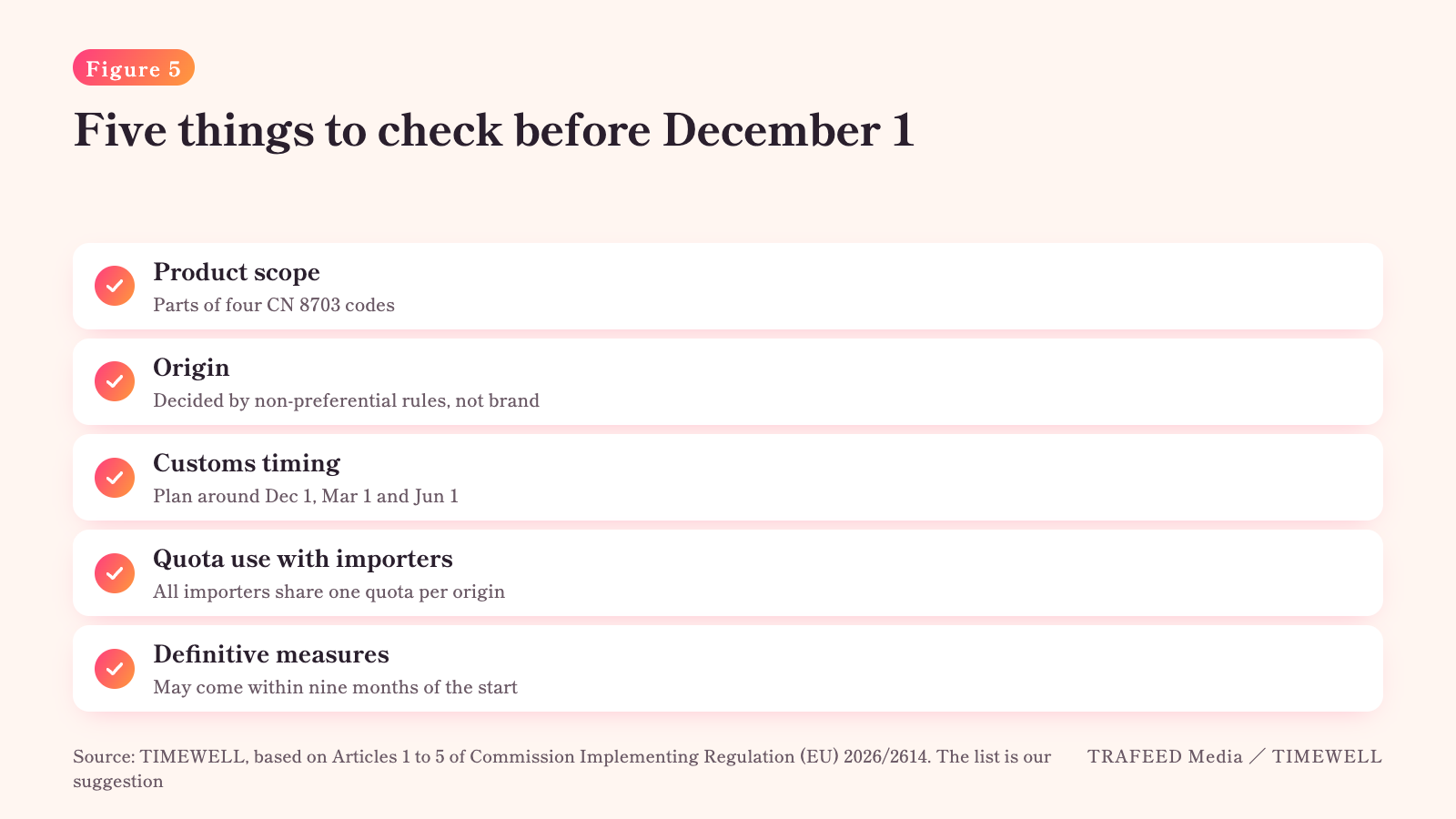 Figure 5. What exporters in Japan and EU importers should check. Working from the top gives you what you need for the next item. Source: TIMEWELL, based on Articles 1 to 5 of Commission Implementing Regulation (EU) 2026/2614. The list is our suggestion, not a requirement of the regulation
Summary
The EU's hybrid car safeguard does not raise tariffs. It caps the number of cars that can be imported from each origin. For 200 days from December 1, cars of Japanese origin face a combined quota of 170,889 units across three periods.
- The measure covers new hybrid passenger cars (HEVs and PHEVs) with nine seats or fewer, whether or not they can be plugged in
- Japan's quota is 76,900 units for December 1 to February 28, 78,609 for March 1 to May 31, and 15,380 for June 1 to 18
- Quotas equal 2025 imports plus a little over 15%; for Japan, that is about 21% above the recent pace (our calculation)
- Origin follows the non-preferential rules, so cars built outside Japan use the quota of their country of origin
- Definitive measures may follow within nine months of the investigation's start; their content is not yet known
Export licences and classification are not the only things that can hold up a shipment. Import rules at the destination can reshape shipping plans as well. We will add the date and details here once definitive measures are decided. TRAFEED Media also tracks regulatory changes country by country in its regulatory updates.
Related articles
- EU export rules in 2026: dual-use, CRA, CBAM and CE marking
- The EU's 21st Russia sanctions package and China's announcement the next day
- Tracking Japan, EU, UK and UN sanctions lists every week
- Trade basics and the legal framework behind them
References
Footnotes
-
Commission Implementing Regulation (EU) 2026/2614 of November 23, 2026 (Official Journal, November 24, 2026; in force December 1, 2026). https://eur-lex.europa.eu/legal-content/EN/TXT/?uri=OJ:L_202602614 (retrieved November 30, 2026; Articles 1 to 7, Annexes I and II, Tables 2 and 8 in the recitals) ↩ ↩2 ↩3 ↩4 ↩5
-
European Commission, "Commission imposes provisional import quotas on hybrid passenger vehicles" (IP/26/2564, November 24, 2026). https://ec.europa.eu/commission/presscorner/detail/en/ip_26_2564 (retrieved November 30, 2026) ↩ ↩2 ↩3 ↩4 ↩5 ↩6
-
Notice of initiation of a safeguard investigation concerning imports of certain new hybrid vehicles for the transport of persons (OJ C, C/2026/5780). https://eur-lex.europa.eu/legal-content/EN/TXT/PDF/?uri=OJ:C_202605780 (linked from the Commission press release; checked November 30, 2026) ↩
-
Ministry of Commerce of the People's Republic of China, spokesperson's answer on the EU's provisional safeguard measures on hybrid vehicles (November 24, 2026), in Chinese. https://www.mofcom.gov.cn/xwfb/xwfyrth/art/2026/art_67a40650300a4ef396543f5964c7748b.html (retrieved November 30, 2026) ↩