Hello, this is Ryuta Hamamoto from TIMEWELL.
Picture an e-learning completion rate of 98%, and a report that can say "training delivered to all employees." Even so, you still hear about someone who nearly mailed a free sample to an overseas customer, or a team passing design data to an overseas site through a shared folder. Finishing a course and being able to stop a problem at your own desk are two different things.
This piece is for export control officers at large Japanese companies who own the annual training and do not want it to be a formality. I checked the legal texts against the current versions on e-Gov, Japan's official law database, and METI's documents in the original (all on 20 November 2026). "Company C" in the examples is a fictional machinery maker.
The short version
- Training rests on two provisions: a duty for every exporter to keep staff informed and give guidance (Ministerial Ordinance on Export Compliance Standards, Article 1, item 1 (ro)), and a best-effort duty to train for companies handling list-controlled items (item 2 (to)). If you have filed an internal compliance program with METI, the best-effort part is expected in full.
- Keep general e-learning for everyone, and add 30-minute practical sessions for sales, engineering, logistics and management, built backwards from the violation patterns METI classifies.
- Read the quiz for patterns in wrong answers, not scores, and feed them into procedure fixes. Record which version of the materials and of the law you taught.
Obligation or best effort? Where training sits in the ordinance
Article 55-10(4) of Japan's Foreign Exchange and Foreign Trade Act (FEFTA) requires anyone who exports or provides technology as a business to follow the export compliance standards1. The ordinance that sets those standards touches on education in three places2.
| Provision | Who | What | Type |
|---|---|---|---|
| Art. 1, item 1 (ro) | Everyone exporting as a business | Keep staff informed of the latest law and give the guidance needed to comply | Obligation |
| Art. 1, item 2 (to) | Businesses handling list-controlled items | Train the overall officer and staff in the knowledge and skills they need | Best effort |
| Art. 1, item 2 (chi) | Same, where subsidiaries take part | Guidance, training and checks for those subsidiaries | Best effort |
Don't read "best effort" as optional. METI's Security Export Control Guidance [Introductory Edition], version 3.0 (the Introductory Guidance), says companies that have filed an internal compliance program (CP) must reliably carry out the best-effort items: audits, education (training), guidance to subsidiaries and document control3.
Watch the item letters, too. Training (to) has sat in the same place since the ordinance took effect in 2010. But METI Ordinance No. 79 of 2021, in force from 1 May 2022, inserted a new (chi) on subsidiaries, which pushed document retention from (chi) to (ri) and breach reporting from (ri) to (nu)4. If a slide made before 2022 says "item 2 (chi) = document retention," it is out of date. Staff copy these references into internal documents, so put an annual check of the slides against the current e-Gov text into your plan.
The Introductory Guidance also sets the scope: everyone, including directors, senior staff, managers, practitioners, transferees and new hires, at least once a year. It splits content into general education and practical education on your own procedures, and mentions training by level. A footnote says "staff engaged in the work" covers sales, engineering (which does classification), shipping and export control3. In my view, company-wide e-learning as the general part, plus the 30-minute role sessions below as the practical part, is the combination that runs most smoothly at a large company.
Thirty minutes per role, built back from where violations happen
I design role sessions around where a miss turns into a violation, not around what to teach. The raw material is the annual analysis of violation cases published by METI's Security Export Inspection Office. The FY2024 edition (cases decided between April 2024 and March 2025) breaks down causes like this5.
| Category | Breakdown |
|---|---|
| Classification 52% | No classification done or assumed uncontrolled 32%, classification or legal interpretation error 15%, relying on another firm's wrong classification 5% |
| Management system 36% | Rules and system not in place 19%, lack of FEFTA awareness or knowledge 9%, system flawed or hollow 8% |
| Transaction review 10% | Misapplying a license exception 9%, misapplying a license 1% |
| Shipping 0%, intentional 2% | Errors at shipment or declaration 0% |
For a large company, the comparison tables matter more. At firms with over 300 employees, classification was 52% and management system 35%. Among firms that had filed a CP, classification rose to 61% and management system fell to 26%, and 61% of their cases were found in-house. The better the system, the more the remaining gap sits with classification, which is engineering's desk.
The numbers also move from year to year. In FY2023, classification or interpretation errors were 30% and reliance on another firm's classification 18%6. Case counts are not published, so I would not call this a trend, but it is a good reason to rebuild your sessions every time a new analysis comes out.
Every session uses the same shape: five minutes on the violation patterns on one slide, fifteen minutes reading two cases and discussing where you would have stopped them, five minutes on internal procedures and who to call, and five minutes on the quiz.
| Role | Main patterns | METI cases (summarized) | What to do at your desk | Provisions |
|---|---|---|---|---|
| Sales | Lack of awareness, misapplied exceptions, end-use and end-user checks skipped | A controlled sample went overseas because no one saw it as an export. A contract over the small-value exception limit was split into shipments to use the exception | Treat samples, returns and repaired items as exports and refer them. Judge exceptions on the whole contract value | FEFTA Art. 48(1), Export Trade Control Order Art. 4(1)(v) |
| Engineering | No classification, classification errors, reliance on others | A replacement for a discontinued model was not classified because performance was "the same." Goods needing checks under rows 2 and 6 were checked under row 2 only. An overseas subsidiary had open access to controlled technology in the cloud | Reclassify when the model number changes. Check every row that could apply. Verify the maker's classification yourself. Review access rights by site | Ordinance Art. 1, item 2 (ha), FEFTA Art. 25(1) |
| Logistics | Shipment and declaration errors | Goods covered by a bulk license were declared to customs as uncontrolled | Stop shipments without approval. Match the classification record to the goods. Tell the customs broker in advance about licenses and exceptions | Ordinance Art. 1, item 2 (ho), Customs Act Art. 70(1) |
| Management | Rules not in place, hollow system | With a deadline close, a staff member exported goods as uncontrolled without a manager's check | Leave no route to ship without approval. On any sign of a breach, order a report and a fix | Ordinance Art. 1, item 2 (ro), (nu) |
The cases come from the FY2024 edition and the FY2023 case on skipped end-use and end-user checks56. Shipping errors were 0% in FY2024, but logistics stays in, because a customs declaration error appears as a Customs Act violation, and METI notes that the exporter stays responsible even when a broker files.
The overall officer joins the management session in person. The training duty covers "the overall officer and staff," and the overall officer must be chosen from among the people who represent the company (item 2 (i) and (to))2. Don't let the executive session turn into a briefing. Have them take the quiz. Honestly, that small step tells the whole company whether the training is serious.
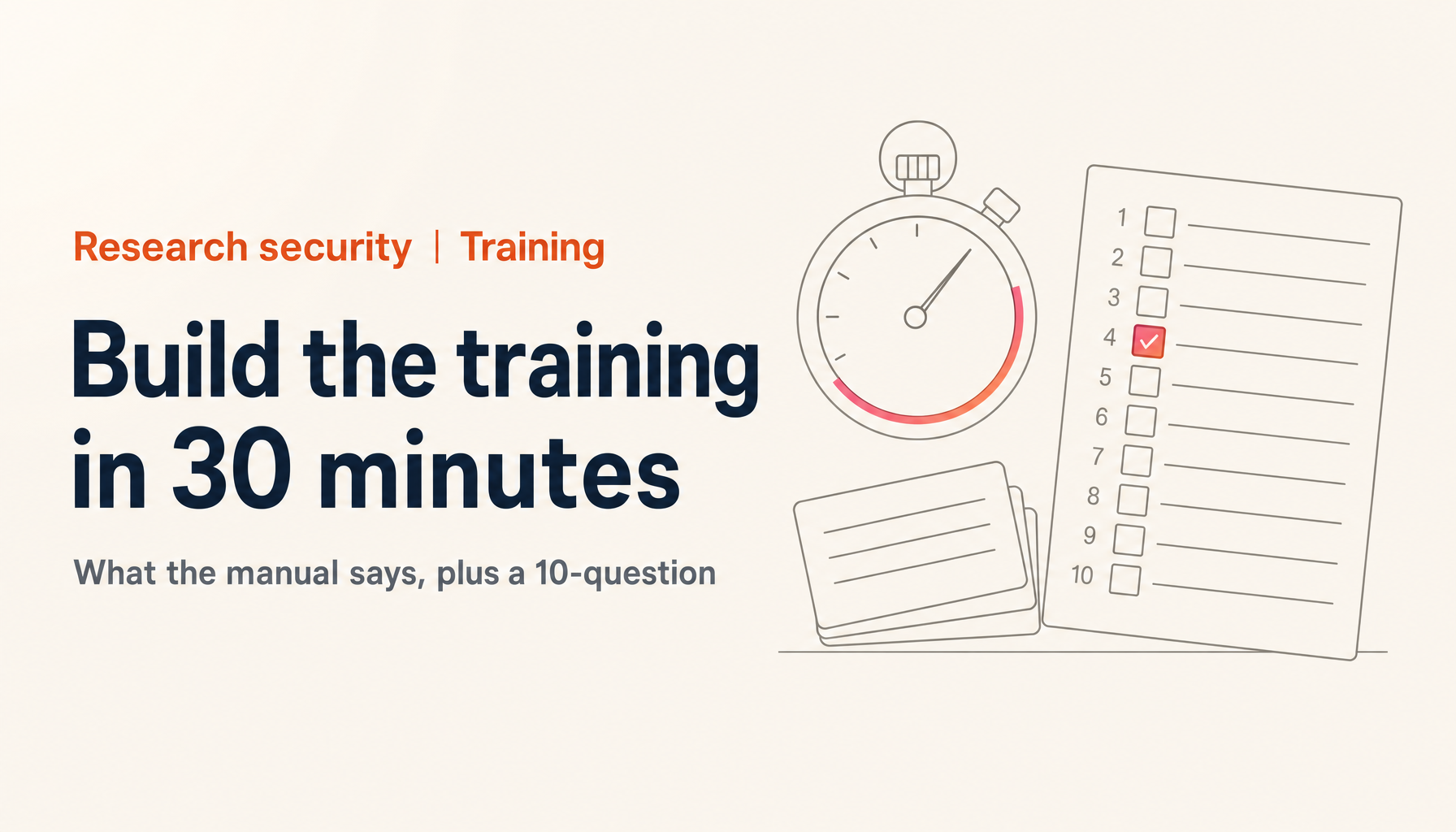
A 10-question quiz (fictional scenarios, with answers and grounds)
Two questions are for everyone, and sales, engineering, logistics and management get two each. In the role sessions, people answer the two common questions plus their own two. All scenarios are fictional and set at Company C. Answer true or false.
| No. | For | Scenario (fictional) | Answer | Grounds |
|---|---|---|---|---|
| 1 | All | You send a list-controlled part free of charge to an overseas prospect as an evaluation sample. Because it's free, no license check is needed | False | FEFTA Art. 48(1)1. A sample is an export whether paid or free |
| 2 | All | A product classified as uncontrolled three years ago can keep shipping without checking later amendments | False | Ordinance Art. 1, item 1 (ro) and item 2 (ha). METI cites a product that became controlled after an amendment and kept shipping without a license |
| 3 | Sales | The item is not list-controlled, so end-use and end-user checks can be skipped | False | Export Trade Control Order, Appended Table 1 row 16, Art. 4(1)(iii) and (iv) (catch-all controls)7. An uncontrolled item can still need a license because of its end use or end user |
| 4 | Sales | The contract exceeds the small-value exception limit, but split into shipments each one is under it, so the exception applies | False | Export Trade Control Order Art. 4(1)(v). METI says the whole contract value counts, and splitting without good reason may be treated as abuse |
| 5 | Engineering | The successor model has a new model number but the same performance, so the old classification record can be reused | False | Ordinance Art. 1, item 2 (ha). Specs may have changed, so classify again |
| 6 | Engineering | Letting engineers at an overseas subsidiary freely view design data containing controlled technology in the cloud can count as providing technology | True | FEFTA Art. 25(1). Restrict access or apply for a license |
| 7 | Logistics | Goods covered by a bulk license can still be declared to customs as uncontrolled | False | Customs Act Art. 70(1)8. You must show the license at declaration |
| 8 | Logistics | Sales asks you to ship now with the approval box empty and get approval later. You can ship | False | Ordinance Art. 1, item 2 (ro) and (ho). Shipping without sign-off is a cited cause of violations |
| 9 | Management | A company that has not filed a CP with METI is not bound by the compliance standards | False | FEFTA Art. 55-10(4). Filing is voluntary, but the standards apply to every business that exports |
| 10 | Management | After shipment, you learn goods may have needed a license. You hold off reporting to METI until the internal investigation ends | False | Ordinance Art. 1, item 2 (nu). Report promptly to the Minister and take measures to prevent recurrence |
When you mark the quiz, look at where wrong answers cluster rather than at scores. If half the sales team misses question 3, the cause may be an order process with no field for end use and end user, not individual understanding. Link each frequently missed question to the procedure that should catch it, and feed that into the next procedure update or audit. The quiz works best as a procedure check, not as the end of the session.
For background, see the catch-all controls explainer for question 3 and the small-value and free-of-charge exceptions explainer for question 4.
The scripts and quiz from this article are in our internal export control training kit (Word, in Japanese), ready to use. One Word file holds the 30-minute scripts for each role, the 10-question quiz with answers and grounds, and a training record form that also keeps the version of the materials and the law.
Replace siloed classification work with AI.
METI's FY2024 data shows 52% of foreign exchange law violations stem from classification errors. Download the TRAFEED product catalog covering features and rollout.
Training records: who, when, what, and which version
The Introductory Guidance asks you to keep education records and gives the date and time, method, instructor and attendees as example items3. At a large company, I would add four more. In an audit or investigation, the question is less "did you train?" and more "what had this person been taught when this transaction happened?"
| Item | Example (Company C, fictional) | Source |
|---|---|---|
| Date and time | 10 June 2027, 14:00 to 14:30 | Introductory Guidance example |
| Method | Head office meeting room and web, at the same time | Introductory Guidance example |
| Instructor | Section manager, Export Control Department (name) | Introductory Guidance example |
| Attendees | 32 people from Sales Dept. 2 (list with names and roles attached) | Introductory Guidance example |
| Version of materials | Sales edition, v4 (revised April 2027) | My suggestion |
| Version of the law assumed | Compliance standards ordinance as in force from 9 October 2025 | My suggestion, so item-letter shifts can be traced later |
| Quiz results | Average 8.6, 41% missed question 3 | My suggestion, to feed procedure fixes |
| Absentees and make-ups | 3 people, make-up session on the web on 24 June | My suggestion, to show full coverage |
I found no provision in the ordinance or FEFTA that sets a retention period for training records. The ordinance only asks businesses to "endeavor to" keep documents on list-controlled work for an appropriate period (item 2 (ri))2. For export documents, the Introductory Guidance suggests at least seven years for items related to rows 1 to 4 and at least five years for rows 5 to 163. I think matching your transaction records is the practical choice, because when you look into a transaction you can pull the training record from the same shelf.
Use published cases by cause, not by company name
Cases make people sit up. But I advise against putting a real company's name on a slide as the example of what not to do.
METI's violation analysis itself gives only the cause, a short summary and commentary, with no company names5. There are three reasons to follow that format. First, most outcomes are minor. In FY2024, 69% ended with a written report, 26% with an explanatory statement plus an oral caution, and 5% with an explanatory statement plus a strict written caution, with no administrative sanctions or warnings. Reports and explanatory statements are, as a rule, not published3. Second, the parties in published cases may be your customers or peers who are working on prevention. Third, names make people think "we're not like them," and the name sticks instead of the pattern.
Build each case on four fields.
| Field | What to write | Example (generalized from a METI case) |
|---|---|---|
| Cause | METI's category | No classification done or assumed uncontrolled |
| What happened | Two or three sentences, with no company, product or country names | A replacement for a discontinued model shipped without classification because performance was "the same" |
| Where it could have been stopped | The desk and the action | Send model number changes back to engineering at the pre-shipment check |
| In our company | Which procedure or form catches it. If none, leave it blank and log it as a gap | A field matching the model number on the shipping request to the classification record (item 2 (ho)) |
Cases you learn about from the news go into the same four fields. News of indictments or sanctions can come before the facts are settled. Use only confirmed facts and the pattern, and leave out words that judge people or companies. Being listed or sanctioned is a regulatory designation or an administrative decision. It is not a verdict on the company as a whole.
Company C's annual plan (fictional)
Here is how it fits into one year at Company C, a fictional machinery maker with about 3,000 employees, a filed CP and four overseas sales and service subsidiaries. The fiscal year runs from April to March.
| When | What | Owner | Record |
|---|---|---|---|
| April | Revise the four role materials using last year's quiz results and METI's latest analysis. Check item references against e-Gov | Export Control Dept. | Revision history of materials |
| May | Management session (directors, including the overall officer). Approve the annual plan | Head of Export Control, overall officer | Attendance, approval |
| June | Sales sessions (several, by department) | Export Control Dept., sales heads | Attendance, quiz results |
| July | Engineering sessions (design, quality assurance, procurement) | Export Control Dept., engineering heads | Attendance, quiz results |
| August | Logistics session. Training for the four overseas subsidiaries (item 2 (chi)) | Export Control Dept., logistics head, subsidiaries | Attendance, records per subsidiary |
| September | Company-wide e-learning. Make-up sessions | Export Control Dept., HR | Completion rate, make-ups |
| October | Internal audit, including training records | Internal Audit | Audit report |
| November | Fix procedures based on missed questions and audit findings. A 15-minute update on amendments | Export Control Dept. | Procedure revisions, attendance |
| January | Training for transferees and mid-year hires | Export Control Dept., HR | Attendance |
| March | Report completion, quiz results and audit findings to the overall officer | Head of Export Control | Annual report |
The Introductory Guidance says audits should happen at least once per business year, with no gap from the previous audit period, and should include education3. October sits after the sessions so the audit can check this year's records. A fixed November slot means a big amendment does not force you to rebuild the year.
When the plan gets complicated, go back to one question: which miss, at which desk, are you trying to stop? Completion rates are a result, not the goal.
What I could not confirm, and the limits of this piece
I checked the Introductory Guidance and both years of the violation analysis in the original PDFs. Case counts are not published, so the percentages may swing on small numbers. The METI Q&A on the small-value exception (Q5), which the analysis cites, moved on April 23, 2026 to the page "Before applying: exceptions." On November 21, 2026 I confirmed in the original that its Q2-4 says the whole contract value counts even when one contract is shipped in several lots, and that multiple contracts without a reasonable basis may be treated as abuse of the exception (the analysis's "Q5" appears to be the number used before the move). Q2-1 on the same page still cites Art. 4(1)(iv) of the Export Trade Control Order, which is the numbering before the amendment; in the current Order it is Art. 4(1)(v). Legal texts are the current e-Gov versions (FEFTA as in force from 12 August 2026, the ordinance from 9 October 2025). Article 4(1) of the Export Trade Control Order was renumbered on 9 October 2025, so don't reuse item numbers from older materials. The 30-minute length, the quiz and the version records are my suggestions, not METI's. For individual transactions, check with your own export control officer and outside experts.
What to read next
For the legal basis, start with the export compliance standards explainer and building an export control system in ten steps. To fold training results into a wider score, see the 20-item self-assessment you can report to the board. For violation patterns, read the FY2024 METI violation analysis. For audits, see the audit preparation checklist, and for subsidiaries, group and overseas site governance.
If you want training records, and the grounds for classification and counterparty checks, to be kept as part of everyday work, TRAFEED is happy to talk it through. You can reach us here.
Footnotes
-
Foreign Exchange and Foreign Trade Act, Articles 25(1), 48(1) and 55-10(4) (in Japanese). e-Gov Laws (Digital Agency), current version in force from 12 August 2026. Checked 20 November 2026 ↩ ↩2
-
Ministerial Ordinance on Export Compliance Standards (METI Ordinance No. 60 of 2009), Article 1, item 1 (i) and (ro), and item 2 (i) to (nu) (in Japanese). Current version as amended by METI Ordinance No. 41 of 2025, in force from 9 October 2025. e-Gov Laws (Digital Agency). Checked 20 November 2026 ↩ ↩2 ↩3
-
METI, "Security Export Control Guidance [Introductory Edition]," version 3.0 (March 2026) (in Japanese); we checked the original. Chapter 2, VI (export compliance standards, p. 29); Chapter 2, VII (penalties; explanatory statements and reports are as a rule not published); Chapter 4, I-2 (filing of internal compliance programs, p. 50); I-3 (informing staff of the latest law, and footnote 44, p. 51); Chapter 4, II-1 (education and training, p. 53); II-2 (audits, p. 54); II-3 (document control, p. 55). Checked 20 November 2026. https://www.meti.go.jp/policy/anpo/guidance/guidance.pdf ↩ ↩2 ↩3 ↩4 ↩5 ↩6
-
We retrieved the amendment history and the text at each point through the e-Gov Laws API v2 and compared them (20 November 2026). In the original version in force from 1 April 2010, Article 1, item 2 ran from (i) to (ri), with (to) training, (chi) document retention and (ri) breach reporting. METI Ordinance No. 79 of 2021 (promulgated 18 November 2021, in force from 1 May 2022) added (chi) on guidance to subsidiaries, moving document retention to (ri) and reporting to (nu). METI Ordinance No. 45 of 2022 (promulgated 28 April 2022, in force from 1 May 2022) corrected a cross-reference in (ho) from (chi) to (ri). https://laws.e-gov.go.jp/api/2/law_revisions/421M60000400060 ↩
-
METI Trade and Economic Security Bureau, Security Export Inspection Office, "Results of the Analysis of FEFTA Violation Cases (Security Trade) (FY2024)" (in Japanese) (December 2025; cases in which measures were decided between 1 April 2024 and 31 March 2025); we checked the original. Measures p. 1, firm size p. 2, causes and comparisons pp. 3 to 6, how cases came to light pp. 7 to 8, cases pp. 11 to 14. Checked 20 November 2026. https://www.meti.go.jp/policy/anpo/gaitameho_document/ihanjireigaitamehou6.pdf ↩ ↩2 ↩3
-
Same office, "Results of the Analysis of FEFTA Violation Cases (Security Trade) (FY2023)" (in Japanese) (cases decided between 1 April 2023 and 31 March 2024); we checked the original. Causes p. 3, cases (including skipped end-use and end-user checks) pp. 11 to 14. The document states that case counts are not published. Checked 20 November 2026. https://www.meti.go.jp/policy/anpo/gaitameho_document/ihanjireigaitamehou5.pdf ↩ ↩2
-
Export Trade Control Order, Article 4(1)(iii) to (v), Appended Table 1 row 16 (in Japanese). e-Gov Laws (Digital Agency), current version. Checked 20 November 2026 ↩
-
Customs Act, Article 70(1) (certification or confirmation) (in Japanese). e-Gov Laws (Digital Agency), current version. Checked 20 November 2026 ↩