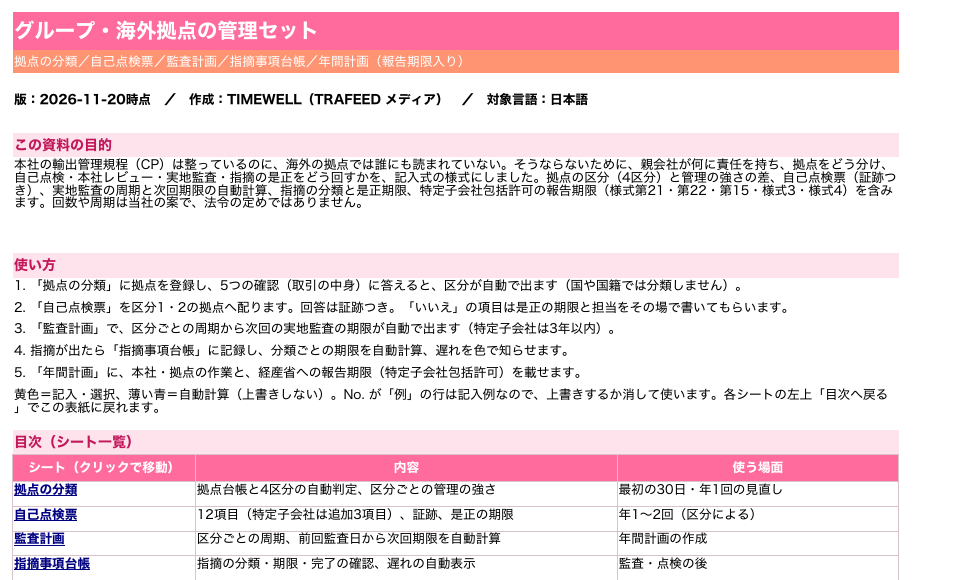
Group and Overseas-Subsidiary Governance Set (editable Excel)
Site classification, an evidence-based self-inspection form, an audit plan with automatic due dates, a findings ledger, an annual calendar and an EAR check sheet for overseas sites (Section 734.4(a), de minimis and FDPR, with automatic escalation to headquarters) (Japanese only).
Get the fileYou can download it after a short form (Japanese).
Hello, this is Ryuta Hamamoto from TIMEWELL.
Picture the export control manager at a manufacturer with three plants in Japan and twelve sales and manufacturing companies overseas. Head office's internal export control regulations (a compliance program, or CP) are in good shape. The procedures for classification (determining whether an item or technology falls under the control lists, 該非判定) and for checking counterparties are written down.
Then audit preparation begins, and it turns out that the "export control officer" field for one overseas sales company still shows someone who left three years ago. There are no training records and no local-language version of the rules. Nobody at the site had been reading head office's rules.
This article is a blueprint for not ending up there: what the parent is responsible for, how to sort sites, how to get the rules to them, and how to run audits. It goes as far as a full year's plan, with tables and templates.
The conclusion first
- Draw the parent's responsibility along two lines: the legal line (the compliance standards in the ordinance) and the license-condition line (the Specified Subsidiary Bulk License).
- Sort sites into four tiers, not by country or nationality but by whether they receive goods or technology from Japan and whether they re-export, and vary the strength of control by tier.
- Put self-inspection, head-office review, on-site audits and corrective action into a quarterly annual plan, and track them in a register.
Drawing the parent's responsibility along two lines
Start by being clear about what the parent is responsible for. Leave this vague and both the rules and the audits will miss the mark.
The first line: the Export Compliance Standards
Article 55-10 of the Foreign Exchange and Foreign Trade Act (FEFTA, 外為法) requires anyone who exports or provides technology as a business to follow standards set by a ministerial ordinance of the Ministry of Economy, Trade and Industry (METI)1. That ordinance is the Ministerial Ordinance on Export Compliance Standards (METI Ordinance No. 60 of 2009). For those handling list-controlled goods or technology, Article 1, item 2 adds ten standards2.
Five of them bear on group governance. (The ordinance labels its sub-items with Japanese kana, イ, ロ, ハ and so on. I write them as (i), (ro), (ha).)
| Provision | What it requires | Nature | What it means for group governance |
|---|---|---|---|
| Art. 1, item 2 (i) | Appoint, from among those who represent the company, an officer who oversees export work as a whole (the overall officer) | Obligation | Decide the group's ultimate responsible officer by title and name |
| Same item, (ro) | Define the authority and responsibilities of the departments that carry out export work, and the relationships between them | Obligation | Put in writing where authority lies among head office, regional headquarters and sites |
| Same item, (he) | Endeavor to set up an audit system and procedures for periodic audits, and to carry them out | Best-effort obligation | The basis for the annual plan of head-office and internal audits |
| Same item, (chi) | Where a subsidiary is involved in the work, endeavor to set up a system and procedures for guidance, training, and checking its operating structure and activities, and to carry them out periodically | Best-effort obligation | The basis for site self-inspections and head-office guidance |
| Same item, (nu) | When there is a violation or a risk of one, report promptly to the Minister of Economy, Trade and Industry and take steps to prevent recurrence | Obligation | Requires a line for first reports from sites to head office |
Three points to note here. First, (chi) and (he) say "endeavor to." They are not obligations backed by penalties. But the design assumes you have them in place as part of your system. Whether internal audits are carried out is among the things METI looks at in its on-site inspections (the inspection criteria are summarized in our article on preparing for an on-site inspection).
Second, who the standards reach. The subject of the provision is anyone who exports or provides technology as a business under Japan's FEFTA. Domestic subsidiaries are separate legal entities, and each may itself be an exporter. Our reading is that even if the parent appoints officers for the whole group, the domestic subsidiaries' obligations are not absorbed into the parent's. Whether the obligations reach a given domestic subsidiary is checked company by company.
Third, what counts as a "subsidiary" under (chi), and how often guidance is given. METI's "Security Export Control Guidance [Introductory Edition]", version 3.0 (the Introductory Guidance), explains that a subsidiary under the ordinance is a subsidiary as defined in Article 2, item 3 of the Companies Act. A subsidiary that does no work at all related to the exporter's export control is outside the scope. A subsidiary that, for example, carries out preliminary end-use screening is inside it3. Our reading is that affiliates in which the parent holds a low share of the votes are not covered by the ordinance. You can, however, extend your rules to the whole group.
On the frequency of guidance, the Introductory Guidance says "periodically (for example, once a year)," and asks companies to vary the content according to the volume and nature of the transactions the subsidiary is given, the destinations and so on3. The four tiers in this article (see below) turn that idea into a working arrangement for sites.
Exports that an overseas subsidiary makes locally are themselves subject to local law. On top of that, goods and technology leaving Japan, and the re-export or resale of goods shipped from Japan, are tied to the parent's control through Japanese license conditions and pledges. That "tied" part is what group governance covers.
The second line: license conditions
Groups that use the Specified Subsidiary Bulk License (特定子会社包括許可) have a stronger line still. METI's Bulk License Handling Guidelines set three requirements for the parent as the applicant4.
- Guide the subsidiary's internal controls so that it reliably carries out the pledge the specified subsidiary has given.
- Have the subsidiary submit a report once a year, and provide guidance and supervision.
- Audit the specified subsidiary at least once before applying and at least once before renewal (audits by a third party appointed by the applicant count).
The license is valid for no more than three years. METI's Q&A envisages an on-site audit "as a rule, at least once every three years" (Q5-7). The Q&A gives no reason; we read it as aligned with this validity period and with the requirement to audit before applying and before renewal5. The design is a trade: lighter procedures for movements within the group, in exchange for the parent taking on guidance, annual reports and on-site audits. The next chapter goes into this in detail.
A quick word on penalties too. Under Article 69-7(1) of FEFTA, exporting or carrying out a services transaction without a license is punishable by imprisonment of up to seven years, a fine of up to ¥20 million, or both (where five times the value of the goods or technology involved exceeds ¥20 million, the fine can be up to five times that value). Under Article 72, a company can be fined up to ¥700 million (or up to five times the value, where that exceeds ¥700 million). For the category relating to nuclear weapons and the like, Article 69-7(2) provides for imprisonment of up to ten years, a fine of up to ¥30 million, or both, and up to ¥1 billion for companies (again with the five-times-the-value ceiling)6. The full picture is in our explainer on penalties.
Putting the roles in a table
Lines of responsibility only become usable once they are spelled out role by role. The table below is an example division of roles that we propose. It is not an arrangement set by law.
| Role | Responsible for | Not responsible for |
|---|---|---|
| Parent's overall officer | Approving group policy and the annual plan; final decisions on serious findings and possible violations | Individual day-to-day decisions on classification or transaction screening |
| Head office export control department | Maintaining rules and procedures; tiering sites; designing and compiling self-inspection forms; carrying out head-office audits | Final decisions on a site's local law |
| Regional headquarters (if any) | Coordinating sites in the region; first-pass checks of local law; supporting training | Approving exceptions to head-office rules |
| Site officer | Running the site's operations; answering self-inspections; maintaining registers; first reports | Final approval of re-exports to third countries of goods or technology from Japan |
| Internal audit department | Independent audits of head office and sites; confirming corrective action | Writing the rules (it does not audit what it wrote) |
| Legal, HR and accounting | Changes in shareholding, transfers of officers, the contact point for responding to violations, keeping records | Deciding whether an export can go ahead |
Next, list in the rules the matters a site must not decide on its own. These four are the basics.
- Re-exporting or reselling to a third country list-controlled goods or technology received from Japan.
- Disclosing technical information received from Japan outside the group.
- Going ahead with a transaction where the counterparty is on a list or the screening result is in doubt.
- Dealing with a possible violation within the site before reporting it to head office.
On the second point, METI's analysis of violation cases (FY2024) includes a similar case. Controlled technology was stored on a cloud service where an overseas subsidiary could freely access it, but the company did not realize this amounted to providing technology. METI's commentary says that, even with your own subsidiary, a state in which non-residents can freely access controlled technology is considered provision of technology, so you need either to restrict access or to apply for a license to provide technology. It also notes that supplying materials to an overseas subsidiary can count as an export7.
These four go to head office before a site has to wrestle with them. This is not about distrusting sites. It is a line drawn to keep the quality of decisions consistent.
Sorting the sites, then getting the rules and self-inspection forms to them
The site side of the design comes in two steps. First, sort sites into four tiers by what their transactions involve, and set how strong the self-inspection, head-office review, on-site audits and training are for each tier. Then roll head office's rules out to the sites in three layers and measure how they are run with self-inspection forms that require evidence. The sample self-inspection items assume Tier 1 and Tier 2 sites, so read the two parts together.
Sorting sites into four tiers by the type of transaction
Apply the same level of control to every site and neither head office nor the sites can keep up. Leave every site to "local discretion" and the audit finds holes. So sort the sites and vary how strongly each is controlled.
The principle: classify by what the transactions involve
The tier is not decided by country, nationality or where the investors come from. It is decided by what goods and technology move through the site, and how. Treating every site in a particular country as high risk does not match what the transactions actually are, and it amounts to sorting people and companies by attributes. It is not the approach we recommend.
For each site, check five things.
- Does it continuously receive list-controlled goods or technology from Japan?
- Does it re-export, resell or provide what it receives to third countries or other parties?
- Does it do development or design work that handles technical data (drawings, source code, specifications and so on)?
- How many transactions a year need checks on counterparties or destinations?
- Is it covered, or planned to be covered, by a Specified Subsidiary Bulk License?
Tiers and the strength of control
Here is what we propose. The frequencies and cycles are not set by law; read them as an example of how to vary the strength of control.
| Tier | Sites in this tier | Self-inspection | Head-office review | On-site audit cycle | Training |
|---|---|---|---|---|---|
| Tier 1 (recipient and relay) | Sites that continuously receive list-controlled items or technology from Japan and also move them on to third countries. Most specified subsidiaries fall here | Twice a year | All items checked against evidence | Once every two years (for specified subsidiaries, never more than three years apart) | Twice a year; officers attend at head office |
| Tier 2 (recipient) | Sites that continuously receive from Japan but rarely re-export or resell | Once a year | All items | Once every three years | Once a year |
| Tier 3 (local only) | Sites that mainly buy and sell locally, receiving list-controlled items from Japan only as an exception | Once a year (fewer items) | Spot checks | On site once every five years, or in any year when risk rises | Once a year (online) |
| Tier 4 (not involved) | Sites that receive neither controlled items nor technology from Japan and are not involved in the group's export work | Annual confirmation form | Answers checked only | Only when needed | On joining and once a year |
Move a site up one tier in these cases.
- Development or design work handling technical data has been added at the site.
- Counterparty checks raised doubts about more than one transaction in the previous year.
- The shareholding or management structure has changed.
- The previous audit made a serious finding.
Review tiers once a year, and when something happens
Review every site's tier in the first quarter of the annual plan. Separately, review it straight away when there is a change in shareholding, a new item starts being handled, or the officer changes. The main reason for separating Tier 1 from Tier 4 is to concentrate head office's audit effort on the higher-risk sites.
Transactions involving local or third-country law, such as US rules, are checked on a separate axis from these tiers. For example, US-origin items, and transactions that US rules reach, need an EAR check separate from Japan's compliance standards. How controls carry through to counterparties is covered in our explainer on the BIS 50% rule and our article on the EAR; how the EAR reaches exports from Japan is covered in telling when extraterritorial rules apply and our FDPR and de minimis explainer. How an overseas site should check products containing US-origin parts or technology before sending them to third countries (the de minimis calculation, the FDPR, and the combination of shipping country and head-office country) is set out site by site in Reexports From Overseas Subsidiaries Under the EAR. The self-assessment form below includes a line for this check.
Rolling the rules out to sites, and measuring them with self-inspection forms
Rules mean nothing if sites do not follow them. Decide how to roll them out and what tools to use to measure how they are working.
Three layers
Group rules are workable when split into three layers rather than kept as one document.
- Layer 1 is the group's basic export control policy and the minimum standards common to every site. It corresponds to head office's CP. How to write a CP is covered in our article on CPs and our article on building a system.
- Layer 2 is site-specific procedures, reflecting the local language, local operations and local law.
- Layer 3 is a gap table against local law, listing for each site where head office's standards and local law differ.
Translating Layer 1 into the local language does not make it Layer 2. A procedure manual shows where in the site's workflow (orders, shipments, exchanges of technical documents) each step in the rules comes in.
Rollout timeline
| When | Head office | Sites |
|---|---|---|
| First 30 days | Build a list of all sites (legal entity, officer, shareholding, types of transaction). Draft the tiers | Report their officer to head office. Say whether they keep a register of goods and technology received from Japan |
| Days 31 to 90 | Confirm the tiers. Send Layer 1 to sites. Send out the first self-inspection form | Draft Layer 2 procedures. Answer the first self-inspection, with evidence attached |
| Day 90 to one year | Carry out head-office reviews and the first on-site audits at Tier 1 sites and specified subsidiaries | Report corrective action on findings within the deadline. Deliver training and keep the rosters |
Mapping the overlap with local law
I won't go into the substance of local law here. This is just a framework for organizing it.
| Axis to check | Japanese law | Local law | Third-country law (e.g. the US EAR) |
|---|---|---|---|
| Goods and technology leaving Japan | FEFTA, license conditions, pledges | Import-side procedures | Usually not applicable when shipping from Japan. Check if US-origin items or technology are included |
| Re-export from the site | Bulk license conditions (prior consent to re-export, etc.) | Local export control law | Check when re-exporting US-origin items |
| Disclosing technology to local engineers | FEFTA services transactions; the thinking behind deemed exports | Local law | Check if US-origin technology is included |
How deemed exports work under Japan's FEFTA is summarized in our article on deemed exports and our article on drawings and technology provision.
Template 1: notice appointing a site officer and setting out their authority
The template below is written so you can use it as it is. It is based on the Japanese system; have your legal department, and a specialist where needed, review it before use.
Template (appointment of a site officer; based on the Japanese system, to be reviewed by your legal team)
Subject: [Export control] Appointment of site export control officer
To: [Name], [Company name] ([site name])
Under our group's export control regulations, you are appointed export control officer for your site. Your term runs from [date] to [date].
Your responsibilities are: (1) operating the site's export control procedures; (2) maintaining the register of goods and technology received from Japan; (3) answering the self-inspection form and attaching evidence; (4) making a first report to head office when you learn of a violation or a possible violation.
Do not decide the following at the site on your own. Contact head office's export control department in advance: re-export and resale to third countries of goods or technology received from Japan; disclosure outside the group of technical information received from Japan; transactions where counterparty checks have raised doubts.
If the officer is to change, notify head office in advance. Also register in advance who will act for you until a successor is appointed.
Sample items for the self-inspection form
Do not make the self-inspection form a list of "Are you doing this?" questions. Make it a form that is answered with evidence attached, such as copies of registers and rosters. The table below is an example for Tier 1 and Tier 2 sites.
| Area | What to check | Evidence to attach |
|---|---|---|
| Structure | Are the site's export control officer and stand-in current employees? Is there a record of their appointment? | Appointment notice, organization chart |
| Training | Was training delivered in the previous fiscal year? What share of the officer and staff took it? | Training materials, attendee roster |
| Receipt records | Are list-controlled goods and technology received from Japan recorded in a register with item name, quantity, date received and end use? | Copy of the register (recent extract) |
| End-use checks | Is the end use of goods received checked, confirming they will not be used to make weapons of mass destruction and the like? | End-use check records |
| Counterparty checks | Are the parties to resales and re-exports screened against control lists? Are the results and decisions recorded? | Screening records, decision notes |
| Re-exports and resales | Are movements to third countries of goods or technology originating in Japan confirmed with head office in advance? | Records of confirmation with head office |
| Items reached by U.S. rules (EAR) | Do the site's items include U.S.-origin items, items incorporating more than a certain share of U.S.-origin content (de minimis), or foreign-made items produced from U.S. technology (foreign direct product rules)? If so, is the need for an EAR license checked before re-export (a check separate from Japan's compliance standards)? | Records of the EAR determination for each item |
| Inventory control | Are unused goods kept from building up as excess inventory? Are goods received from different exporters managed separately? | Inventory register |
| Disclosure of technology | Who can view technical information received from Japan? Is technical information in the cloud freely accessible to overseas subsidiaries? Are meeting minutes kept? | List of access rights, minutes |
| Changes in shareholding and structure | Have there been changes since last year in shareholding, shareholders with special rights, or the appointment and removal of directors? | Answer on whether anything changed; copy of the company registration |
| Possible violations | Were there any violations or possible violations in the past year? Were they reported? | List of cases |
| Previous findings | Were previous findings corrected by the deadline? | Corrective action completion report |
| Record retention | Are documents relating to export work kept for the period set in the rules, and can they be located? Is the period in line with the guide in the Introductory Guidance: at least seven years for rows 1 to 4 and at least five years for rows 5 to 16 (rows, or 項, of Appended Table 1 of the Export Trade Control Order)? | Retention register |
Answers are "Yes" or "No," plus "Not applicable." For any "No," have the site write down the correction deadline and the person responsible right there. Unless you make it a rule not to blame anyone for writing "No," the forms will come back with nothing but "Yes."
Replace siloed classification work with AI.
METI's FY2024 data shows 52% of foreign exchange law violations stem from classification errors. Download the TRAFEED product catalog covering features and rollout.
Connecting to the Specified Subsidiary Bulk License and its annual report
The Specified Subsidiary Bulk License turns group governance into a license condition. We checked the license requirements and conditions directly in the text of the Bulk License Handling Guidelines4. METI's Q&A we checked against the original on METI's pages on 21 November 202658. Our explainers are 14 questions on the Specified Subsidiary Bulk License and 14 questions after obtaining a license (both in Japanese).
First, the requirements for applicants and subsidiaries in the Guidelines
These are the entry conditions for the Specified Subsidiary Bulk License that we were able to confirm in the Guidelines4.
| Item | Content |
|---|---|
| Specified subsidiary | A company of which a majority of shares is held by a resident (the Japanese side), or a company specifically recognized as substantially equivalent in terms of shareholding or the like, and that is the importer or user of goods, or the counterparty to or user of a technology transaction |
| Applicant | A person holding a majority of the shares in the specified subsidiary, or one recognized as substantially equivalent. In addition, the applicant must have been issued the CP acknowledgement slip and the checklist acknowledgement slip, must have undergone a compliance inspection, and must have a track record of exports carried out after internal screening under its accepted internal regulations |
| Subsidiary's obligations | Submit a pledge to manage the goods and technology properly, set up an internal control system, submit an annual report on implementation to the parent, and accept guidance and audits |
| Parent's obligations | Guide the subsidiary's internal controls, have it submit an annual report, and provide guidance and supervision. Audit the subsidiary at least once before applying and at least once before renewal |
| Documents showing the audit record | When applying, state for audits within the 18 months before the application date: when, where, the title and name of the auditor, and the title and name of the person who dealt with the audit. When renewing, show the audits carried out during the license's validity |
| Validity | Not more than three years from the date the license takes effect |
We read the requirement to state "where" in the audit record as indicating that audits are expected to take place on site. We have not been able to confirm from the Guidelines whether remote audits are accepted.
Keep the two "once a year" items apart
METI's Q&A contains two different things that happen once a year.
| Annual item | From whom to whom | What the Q&A says |
|---|---|---|
| Subsidiary's report | From the specified subsidiary to the parent | Instruct the subsidiary to manage goods and technology thoroughly and to report on implementation once a year (Q5-6). The form may be one set in internal or group rules (Q5-7) |
| License performance report | From the applicant (the parent) to METI | Re-exports between specified subsidiaries covered by the license do not need prior consent, but an annual performance report is required (Q5-3) |
The first happens inside the group. The second is a report to METI. The quality of the first determines the quality of the second. If the subsidiary's report is late, the parent's performance report will be late too.
The license conditions (Appended Table) in the Guidelines confirmed the deadlines for reports to METI. Note that they are not only annual4.
| Report | Deadline | Form and content |
|---|---|---|
| Exports and transactions for the year (calendar year) | End of January of the following year | Form 21. Includes stock sales |
| Annual record of resales, re-exports and re-provision from a specified subsidiary to other specified subsidiaries or end users | Likewise, end of January of the following year | Form 22 |
| Status of storage, resale, re-export and the like of goods held by the specified subsidiary that is the importer or counterparty | Every six months | Form 15 |
| Exporter Profile and Self-Management Checklist | 1 to 31 July every year | Form 3 under the CP notification procedures (輸出管理内部規程の届出等について). One submission even if you hold more than one bulk license |
| Changes to the parts of the internal export control regulations that concern compliance with FEFTA and related laws | Within one month of the change | Form 4 under the same procedures |
| Retention of export materials | From the time of export or provision, at least seven years for rows 2 to 4 and at least five years for rows 5 to 14 | Under the internal export control regulations |
On top of the two annual items there are the six-monthly status report, the July checklist and reports of changes to the internal regulations. These all go into the annual plan below.
Turning the five points into inspection items
Q5-6 lists five matters on which the parent might guide the subsidiary and audit whether they are being carried out properly. The table below maps those five to the self-inspection form in the previous chapter.
| Q5-6 item | Item on the self-inspection form | Evidence head office looks at in its review |
|---|---|---|
| Making the purpose of export control understood (appointing an officer, training local staff) | Structure; Training | Appointment notice, training roster, completion rate |
| Thorough checks of purpose and use | End-use checks; Receipt records | End-use check records, reports on use |
| Reliable implementation of management methods (recording goods separately by exporter, preventing excess inventory) | Receipt records; Inventory control | Register, inventory register |
| An internal export control audit once a year (reporting use, inventory and staff awareness activities to the parent) | All items; whether an internal audit was carried out | The site's internal audit report |
| Making the necessary improvements based on internal audits and the like | Previous findings; Possible violations | Corrective action completion report |
For specified subsidiaries, add these three items to the common form.
| Additional item | What to check | Reason (what the Q&A says) |
|---|---|---|
| Changes in ownership and control | Has the share of Japanese capital changed? Has there been any change in whether shareholders hold special voting rights or a golden share? | A change may mean the requirements are no longer met, and significant changes should be reported promptly (Q5-2). A shareholding that no longer reaches a majority is given as an example of grounds for revocation (Q8-3) |
| Scope of technology provided | Have detailed drawings from which the product could be made been provided on the grounds that they are "needed at the planning stage"? | Detailed drawings that make manufacture possible go beyond the scope of the bulk license and need an individual license (Q5-5) |
| Technical information given orally in meetings | Are minutes kept? | Minutes are enough to meet the document retention requirement, and such information is outside the scope of the performance report (Q8-1) |
Getting news of shareholding changes to export control staff
What matters in Q5-2 is that the parent learns of a shareholding change before it happens. If Japanese capital is to fall from 51% to 45%, export control staff need to know before the local capital comes in. Write into the rules a line through which legal, accounting and corporate planning tell the export control department about planned shareholding changes.
Setting a cycle for on-site audits
Q5-7 envisages an on-site audit, as a rule, at least once every three years, and says it can be done as part of another audit or entrusted to a third party. On the Guidelines' side, audits before applying and before renewal are required, and the license is valid for no more than three years. Meeting both means getting at least one on-site audit into each validity period. So for specified subsidiaries, build the annual plan so that an on-site audit always happens once in every three years. For Tier 1 sites, as in the table in the previous chapter, make it once every two years to leave some margin.
Be ready for requests from METI as well. Q5-9 says that where there are doubts about the applicant's reports, or there are reports that goods exported from Japan are not being properly managed, METI may ask for a report based on an audit. Keep your audit reports, as a matter of routine, in a form you could show METI.
Template 2: guidance notice to a specified subsidiary
Template (guidance notice to a specified subsidiary; based on the Japanese system, to be reviewed by your legal team)
Subject: [Export control] Matters to implement under the Specified Subsidiary Bulk License
To: [Name], [Company name] ([site name])
Under the Specified Subsidiary Bulk License, we ask your company to carry out the following with respect to goods exported and technology provided to you.
(1) Appoint an officer and provide training to local staff. (2) Check the purpose and use of the goods and technology, and confirm that they will not be used to manufacture weapons of mass destruction and the like. (3) Record receipts of goods separately for each exporter, and manage unused goods so that they do not build up as excess inventory. (4) Carry out an internal export control audit once a year, and report on use, inventory and staff awareness activities to head office by [date]. (5) Make the necessary improvements based on internal audits and the like.
If changes are expected in shareholding, in shareholders with special rights, or in the appointment or removal of directors, please contact head office before any decision is made.
Putting head-office audits and internal audits into a quarterly annual plan
Once self-inspections are under way, turn head office's side of the work into a one-year plan.
Three layers of checking
The first layer is the site's self-inspection: the site checks itself. The second is the review by head office's export control department: head office checks the answers and the evidence. The third is an independent internal audit: the internal audit department or a third party checks on site.
Article 1, item 2 (he) of the ordinance asks companies to endeavor to set up an audit system and procedures for periodic audits, and to carry them out. METI's Introductory Guidance (version 3.0) says audits should cover every department involved in export control, be held at least once per business year, and be followed promptly by an audit report from the auditor to the chief officer (最高責任者)3. These three layers are one way of putting that into practice.
METI's analysis of violation cases (FY2024) also has figures that show what audits are worth. Overall, 59% of violations came to light through post-clearance audits by customs and 30% were found by the company itself. Among companies that had filed a CP, however, the share found by the company itself rises to 61%. METI presents this as showing the importance of the audit function7.
Sample annual plan
This is our proposal, using a company whose fiscal year starts in April as the example. If your fiscal year is different, shift the months accordingly.
| Quarter | Head office | Sites and specified subsidiaries |
|---|---|---|
| Q1 (April–June) | Confirm completion of corrective action on last year's findings. Review all sites' tiers. Get the overall officer's approval of the annual audit plan. Send out self-inspection forms (May) and collect them (end of June) | Answer the self-inspection and submit evidence. Specified subsidiaries submit their annual report |
| Q2 (July–September) | CP holders submit the Self-Management Checklist (1–31 July). Compile and review self-inspections. On-site audits of Tier 1 sites | Answer follow-up questions from the review. Host on-site audits |
| Q3 (October–December) | On-site audits of Tier 2 sites and of specified subsidiaries due that year in their three-year cycle. Check amendments to laws and circulars and reflect them in the rules. Take stock of findings still being corrected. In December, ask specified subsidiaries to compile their calendar-year figures | Carry out and report corrective action. Compile calendar-year figures |
| Q4 (January–March) | By the end of January, submit the Specified Subsidiary Bulk License performance report (Forms 21 and 22) to METI. Report audit results to the overall officer and to management. Revise the CP and procedures. Draft next year's plan. Check for changes in shareholding or structure | Reflect revisions to procedures. Deliver training and submit rosters |
For holders of a bulk license, the submission period for the Self-Management Checklist (1–31 July) is also written into the license conditions in the Guidelines4. The performance report under the Specified Subsidiary Bulk License is due by the end of January of the year after the year reported on (calendar-year figures; Forms 21 and 22). For a company whose year starts in April, that deadline falls at the end of the first month of Q4 (January to March). To compile the figures, set a date in your rules, early enough for the end-of-January submission, by which specified subsidiaries must send head office their export and resale figures for the previous calendar year. The "annual report" from specified subsidiaries placed in Q1 of the table is a different thing: the once-a-year report on implementation (Q5-6). Check the deadlines for the six-monthly status report (Form 15) on your license certificate, and put it into the annual plan twice.
How one on-site audit runs
An audit of a single site goes in this order.
- Beforehand, obtain the self-inspection form, copies of the registers, training rosters and the organization chart.
- Pick sample transactions to audit from the registers. For Tier 1 sites, sample from the last year of the register of goods and technology received from Japan.
- On site, check the sampled transactions against the paperwork: receipt, end-use check, counterparty check, and whether there was any re-export or resale.
- Interview the officer and staff to confirm that the procedures are actually used on the ground.
- At the closing meeting, give the findings so far.
- Issue the audit report within about two weeks, with each finding given a category and a correction deadline.
A week to prepare, two or three days on site and two weeks for the report is our rough guide. It varies with the size of the site.
Whether a remote audit counts as an "on-site audit" in METI's sense is not addressed in the materials we were able to check. To be safe, make the audits that satisfy the specified subsidiaries' cycle ones where someone actually goes to the site.
Categorizing findings and tracking corrective action
Sort audit findings by severity, with different deadlines and reporting lines for each. Again, this is our proposal, not a legal requirement.
| Category | Examples | Correction deadline | Report to |
|---|---|---|---|
| Serious | Suspected export or similar transaction without a required license. A transaction with a party on a control list. Exports continuing with no officer in place | Stop immediately. Establish the facts within a few days | The overall officer, immediately. Decide with legal whether a report is required by law |
| Moderate | Insufficient register entries. Training not delivered. No record of end-use checks | Within 60 to 90 days | Export control department; included in the quarterly report |
| Minor | Formatting errors. Omissions in rosters | By the next self-inspection | Export control department |
| Observation | Not a problem now, but could raise risk | No deadline; considered at the next tier review | Export control department |
The inspection finding "inadequate management of subsidiaries and group companies" refers to cases where a company's CP provides for guidance to subsidiaries but no concrete guidance or management actually happens (Finding 9 in our article on on-site inspections). The setup in this article is designed to close that gap. With site self-inspection forms, head-office reviews, audit reports and records of corrective action all in place, you can show on paper that guidance is being given.
Track corrective action in a register with the following fields.
| Register field | Content |
|---|---|
| Finding number | Fiscal year and serial number |
| Site and tier | Site name; tier at the time of the audit |
| Category | Serious, moderate, minor, observation |
| Details and basis | What was found; the rule provision or register entry it rests on |
| Cause | Procedural gaps, insufficient training, structural weaknesses and so on |
| Corrective action and owner | Who does what, by when |
| Deadline and completion date | If the deadline is missed, the overall officer is notified automatically |
| Confirmation of completion | The date head office checked the evidence and confirmed completion, and who confirmed it |
When you find a possible violation
When an audit or self-inspection turns up a violation or a possible violation, Article 1, item 2 (nu) of the ordinance requires a prompt report to the Minister of Economy, Trade and Industry and steps to prevent recurrence. Meeting that "promptly" requires the first report to reach head office from the site before the facts are settled.
The Introductory Guidance (version 3.0) sets out the sequence when there is a violation or a possible violation. First, report promptly to the specialist export control department and to the chief officer, such as the representative director. Then report to METI (the Security Export Inspection Office) without delay. After reporting, put together measures to prevent recurrence3. METI says that on receiving a report it carries out a follow-up review, the aims of which are "clarifying the facts" and "preventing recurrence."
To make that work, write the reporting line into the rules. When a site officer learns of a suspected problem, they contact head office's export control department before investigating the cause or coordinating internally. Head office shares it with the overall officer and legal and decides whether a report is needed. The decision on whether to report is never made at the site.
Template 3: first report from a site to head office
Template (first report from a site to head office; based on the Japanese system, to be reviewed by your legal team)
Subject: [Export control] First report (under investigation): [site name]
To: Export Control Department
I am reporting what we know at this point about the matter below. Fact-finding is still in progress.
- When it was noticed, and how.
- Name, quantity and date of the goods or technology involved, and the counterparty.
- Whether it was received from Japan or sourced locally by the site.
- Whether it has already been exported, re-exported or provided, and whether this has been stopped.
- What we do not yet know.
We will not try to identify the cause or contact the counterparty until head office instructs us.
This template is designed so that site staff can send it without waiting for all the facts. A late first report is the failure to avoid above all others.
Reporting to management
Once a year, the overall officer reports four things to management: the number of sites in each tier and the audits carried out that year; the number of findings and the corrective action completion rate; the status of annual reports received from specified subsidiaries; and next year's plan and the resources it needs. On-site inspections also look at reporting to management.
Common misconceptions and mistakes
The misconception that best-effort obligations can wait. (chi) and (he) of the ordinance are indeed best-effort obligations. But if you use the Specified Subsidiary Bulk License, guidance and reporting are preconditions of the license. If the license is revoked, you are back to individual licenses, and movements within the group become far more burdensome.
The operational mistakes fall into two groups: those that show up at the sites, and those that show up at head office.
At the sites, a familiar one is officers' names left out of date. Without a line for updating the register and appointment notices with every transfer, departure and reorganization, they go stale within six months. Simply translating head office's rules and sending them out leads to the same place. Rules that are not built into the local workflow do not get followed. Self-inspections that come back all "Yes" are a problem with how the form is built. If you do not require evidence, and you blame people for "No," the form becomes a formality.
At head office, the first mistake is inspecting only the specified subsidiaries. As Q5-8 shows, the guidance set out in the parent's CP extends to subsidiaries and affiliates other than the specified subsidiaries in the application. They are simply not assessed for the Specified Subsidiary Bulk License; the guidance applies to the whole group. Head office making the call on a site's local law is a mix-up of roles. The final check on local law is for local specialists and the regional headquarters, and head office uses the gap table to make sure nothing is missed. Then there are findings that are issued and left there. Unless you decide who confirms completion of corrective action and who is notified when a deadline is missed, findings stay open indefinitely.
The last one is dividing sites up by country. Tiers are decided by what the transactions involve. Treating everything in a given country, or everyone of a given nationality, as higher risk not only fails to match reality but amounts to sorting people by attributes.
What we could not confirm, and the limits of this article
The following points could not be confirmed, or were confirmed only within a limited scope.
We checked METI's Q&A (Q5-1 to Q5-14 and Q8-1 to Q8-4) against the original on METI's pages on 21 November 2026. The pages were last updated on 14 May 2026 ("[Before applying] Bulk licenses") and 23 April 2026 ("[After obtaining a license] Bulk licenses"). Before any individual decision, check the latest version of METI's pages. We checked the original texts of the Bulk License Handling Guidelines, the Ministerial Ordinance on Export Compliance Standards, METI's Introductory Guidance (version 3.0) and the analysis of violation cases (FY2024) directly. The requirements for the Specified Subsidiary Bulk License, the reporting deadlines (end of January of the following year, every six months, 1 to 31 July) and the audit requirements are based on the text of the Guidelines. The "five points for guidance" (Q5-6) do not appear in the text of the Guidelines; they are what the Q&A lists as "matters that might be considered."
Two points remain unconfirmed. We have not confirmed whether a parent can appoint officers for its domestic subsidiaries collectively. The text reflects our own reading and assumes you will check company by company. Nor have we confirmed whether a remote audit counts as an on-site audit. The Guidelines require the audit record at application to state "where," but say nothing about remote audits.
A word on the scope of this article, too. The tiers, cycles, frequencies and deadline figures are our proposals. They are not set by law, so adjust them to your own risks and structure. We do not cover the substance of local law. For each country's export control law and the details of the US EAR, see our other articles and consult local specialists. Have your legal department and specialists review the templates before use. We do not guarantee that they can be used as they are.
Laws and circulars are amended. We checked the statutory text on e-Gov Laws on 20 November 2026, but this is a field of continual amendment. The versions of the Guidelines and the Introductory Guidance are as stated in the sources.
What to read next
- Preparing for METI on-site inspections: a 30-item checklist: the background to Finding 9, and the seven areas inspectors examine
- 14 questions on the Specified Subsidiary Bulk License (in Japanese): the five points and the original wording on the annual report
- 14 questions after obtaining a license: specific bulk, subsidiaries, exhibitions and more (in Japanese): examples of revocation and operational questions
- Japan's Export Compliance Standards explained: the ten items in the ordinance and how they differ from a CP
- How to build an export control system: the steps for building head office's system
- End-user screening in practice: the foundation for sites' counterparty checks
- Reexports From Overseas Subsidiaries Under the EAR: checking de minimis and the FDPR site by site
- Export control violation penalties: criminal penalties and administrative sanctions
If you want to bring the whole group's registers and screening records together in one place, talk to us about TRAFEED.
Sources
Footnotes
-
Foreign Exchange and Foreign Trade Act, Articles 55-10 to 55-12 (in Japanese). e-Gov Laws (Digital Agency) https://laws.e-gov.go.jp/law/324AC0000000228 (checked 20 November 2026) ↩
-
Ministerial Ordinance on Export Compliance Standards (METI Ordinance No. 60 of 2009) (in Japanese). The current version as amended, in force from 9 October 2025. e-Gov Laws https://laws.e-gov.go.jp/law/421M60000400060 (checked 20 November 2026) ↩
-
METI, "Security Export Control Guidance [Introductory Edition]" (in Japanese), version 3.0 (March 2026); we checked the text directly. Chapter 2, VI, "Export Compliance Standards" (p. 29); Chapter 4, I.4, "Guidance etc. to subsidiaries involved in export work," with notes 46 and 47 (p. 51); I.5, "Reporting violations and measures to prevent recurrence" (p. 52); II.1, "Education" (p. 53); II.2, "Audits" (p. 54); II.3, "Document management" (p. 55). Checked 20 November 2026. https://www.meti.go.jp/policy/anpo/guidance/guidance.pdf ↩ ↩2 ↩3 ↩4
-
METI, "Bulk License Handling Guidelines" (in Japanese) (last amended by a notice promulgated on 14 November 2025, in force from 14 February 2026); we checked the text directly. Part V, "Specified Subsidiary Bulk License," 2 to 4, 6 (audit record) and 9 to 13; "Reporting of performance, etc.," 2(5); Appended Table 8 (conditions of the Specified Subsidiary Bulk Export and Services Transaction License), conditions (2) and (4) to (8). Checked 20 November 2026. https://www.meti.go.jp/policy/anpo/law_document/tutatu/tutatu24fy/houkatu_toriatukaiyouryou.pdf ↩ ↩2 ↩3 ↩4 ↩5
-
METI, "[Before applying] Bulk licenses," section 5, "Specified Subsidiary Bulk License" (Q5-1 to Q5-14) (in Japanese). Last updated 14 May 2026. Original checked 21 November 2026. https://www.meti.go.jp/policy/anpo/qanda28.html ↩ ↩2
-
Foreign Exchange and Foreign Trade Act, Articles 69-7 and 72 (in Japanese). e-Gov Laws https://laws.e-gov.go.jp/law/324AC0000000228 (checked 20 November 2026) ↩
-
METI Trade and Economic Security Bureau, Security Export Inspection Office, "Results of the Analysis of FEFTA Violation Cases (Security Trade) (FY2024)" (in Japanese) (December 2025; covers cases in which measures were decided between April 2024 and March 2025); we checked the original directly. Section ④ (how violations came to light) and section ⑦ (examples of violations). Checked 20 November 2026. https://www.meti.go.jp/policy/anpo/gaitameho_document/ihanjireigaitamehou6.pdf ↩ ↩2
-
METI, "[After obtaining a license] Bulk licenses," section 8, "Specified Subsidiary Bulk License" (Q8-1 to Q8-4) (in Japanese). Last updated 23 April 2026. Original checked 21 November 2026. https://www.meti.go.jp/policy/anpo/qanda40.html ↩