Twenty-Item Export-Control Self-Assessment and Executive One-Pager (editable Excel)
Twenty items mapped to the METI compliance-standard ordinance, scored on a four-level scale, with automatic totals, an executive one-pager and a 90-day plan (Japanese only).
Get the fileYou can download it after a short form (Japanese).
Hello, this is Ryuta Hamamoto from TIMEWELL.
Picture the head of export control at a manufacturer looking over the agenda for next month's board meeting. One line reads "Status report on the export control program." The slot is ten minutes. Last year the report covered the revised internal rules, the training delivered and the absence of any violations, and that was it. This year, one of the directors has sent a question in advance: "A company in our industry has just faced administrative action. Where are the gaps in our program?"
The rules exist, training happens and no violations have been reported. Even so, few officers can answer "where are the gaps?" on the spot. The only way to find them is to score your own program once, against a single yardstick. Without one, "no issues" is not the result of a check. It is just another way of saying nothing has been checked.
I wrote this article to provide that yardstick. It starts with a 20-item assessment table tied to the provisions of the Ministerial Ordinance on Export Compliance Standards, issued by Japan's Ministry of Economy, Trade and Industry (METI), and how to score it. From there it moves to the layers of checks that published violation cases point to, the penalties, the outline of a one-page board paper and a 90-day plan for after the assessment. It sticks to one task: an officer assessing the company's own program and reporting to the board. Individual regulatory questions, governance of overseas subsidiaries and responses to changes in U.S. rules are left to other articles.
The conclusion first
- Split the ordinance's requirements into 20 items and rate each on a four-level scale, and within a day you can see where the program falls short.
- If any of the 10 mandatory items is rated Missing, that item is the top priority for correction, however high the total.
- Report three things to the board on one page: the score, the three weakest items and a 90-day plan.
Four decisions to make before you start, and the standing of each source
There are four things to settle before scoring begins. Leave them vague and each department will score against its own yardstick, and the board will get numbers it cannot compare.
The first is the unit of assessment. Decide whether to score the company once as a whole, or each business unit or site separately. An export control program can have excellent rules at head office and still not be working at a particular plant or sales office. For the first round, score two places, the head-office function that oversees export control and the site with the most exports. The differences will be easier to see.
The second is which standards in the ordinance apply to you. Article 1, item 1 of the ordinance applies to everyone who exports or provides technology as a business. The ten standards in item 2 are added on top for those who handle list-controlled items (specified critical goods, etc.). Article 4 further provides that (i) to (ri) of item 2 do not apply to a person whose business consists only of transactions designated by the Minister of Economy, Trade and Industry under Article 17(8) of the Foreign Exchange Order, or of exports falling within the cases listed in Article 4(1) of the Export Trade Control Order1. Few export control departments at large companies can account for their whole business through this exception. Even so, write down once, before the assessment, which parts of your business fall within item 2.
The third is who does the scoring. Officers who score their own program tend to score it generously. It isn't bad faith. They know the system they built better than anyone, so they read it as "this should be working." Have at least two people score, the officer and someone outside export control (internal audit or legal), and settle any item where they disagree by looking at the evidence.
The fourth is how to gather evidence. Judge each item not only by whether a document exists, but by whether there is a record of it actually working. Pull the three most recent examples of each: classification records (records of determining whether an item or technology falls under the control lists, 該非判定), transaction screening records, training attendance lists and audit reports. An item for which you cannot pull three cannot be rated Evidenced.
The standing of each source, and what we were able to check
The basis for the assessment table mixes sources of different kinds. Be ready to explain to the board which are legal obligations and which are recommendations.
| Source | Nature | What we checked | How this article uses it |
|---|---|---|---|
| Ministerial Ordinance on Export Compliance Standards (METI Ordinance No. 60 of 2009) | Legal standards under Article 55-10 of the Foreign Exchange and Foreign Trade Act (FEFTA, 外為法). Compliance is mandatory | Text checked on e-Gov Laws. Current version, reflecting the amendment in force from 9 October 20251 | Cited in the basis column of the table by article, item and sub-item |
| Foreign Exchange and Foreign Trade Act | Basis for penalties, administrative sanctions and on-site inspections | Articles 55-10 to 55-12, 53, 68, 69-7, 69-8, 71 and 72 checked on e-Gov2 | Used for the summary of penalties |
| Security Export Control Guidance [Introductory Edition] | METI's explanation of everything from building a program to procedures. Includes a list of the Export Compliance Standards (Chapter 2, VI, p. 29), audits (p. 54) and document management (p. 55) | Text of version 3.0 (March 2026) checked. Its split between mandatory and best-effort standards matches the ordinance3 | To confirm the basis column, and as the basis for what earns Evidenced on items 15 and 17 |
| Results of the Analysis of FEFTA Violation Cases (FY2024) | A summary by METI's Security Export Inspection Office of cases in which measures were decided between April 2024 and March 2025 (published December 2025) | Text checked. The shares by measure taken, cause and how violations came to light, and the explanations of the violation examples, are quoted as in the original4 | Used in the section on the layers of checks seen in published cases |
| Security Export Control Self-Assessment Checklist for Universities | A voluntary self-assessment form METI produced for universities (31 March 2020; 16 items in the summary version, 52 in the detailed version) | Text checked. Ratings use three levels: "sufficient," "partly insufficient" and "insufficient"5 | A reference for the approach to scoring. Not a standard for companies |
| Economic Security Management Guidelines (1st Edition) | Recommendations for management published by METI's Trade and Economic Security Bureau on 23 January 2026. Not mandatory | Original (1st Edition) checked on 21 November 20266 | A reference for how to report to management. Compliance obligations under FEFTA are said to fall outside its direct scope |
That last point is where board briefings tend to go wrong. The Economic Security Management Guidelines say that they do not directly address compliance obligations under domestic law, such as security export control under FEFTA, and focus instead on economic security risks that cannot be handled by complying with domestic law alone (section 2(4) of the basic policy). A note on the same page adds that complying with laws such as security export control is a matter of course for any company doing business in Japan (note 5)6. In other words, filling in the guidelines' 44-item checklist does not mean your export control program meets the requirements. The program has to be assessed on the foundation of the ordinance. How to read the guidelines is covered in METI's Economic Security Management Guidelines (1st Edition).
The 20-item self-assessment table and how to score it
The table breaks the ordinance's 12 standards (Article 1, item 1 (i) and (ro), and item 2 (i) to (nu)) into units that are easy to check in practice. Six items are practical checks rather than obligations or best-effort obligations. Of these, items 6, 16 and 20 have no direct basis in the ordinance; they are included because audits and inspections always ask about them. Item 7 relates to Article 1, item 1 (ro) (keeping staff informed of the latest law), and items 10 and 19 rest on provisions of FEFTA. The basis column shows where each item comes from, and says so where there is no direct provision.
Ratings use four levels. Evidenced means you can show evidence of both documents and actual operation across the full scope. In place means the item is done but the evidence is weak, or there are documents only or a track record only. Partial means it is done only in some departments or sites, or exists only in someone's head. Missing means it does not exist, or nobody knows.
In each table, the column "What earns Evidenced" shows the evidence you should be able to produce on the spot to rate that item Evidenced. If you cannot produce it, do not rate it Evidenced.
Organization and officers (items 1 to 4)
| No. | What to check | Basis | What earns Evidenced (evidence you can show) | Next step if it falls short |
|---|---|---|---|---|
| 1 | An overall officer has been appointed from among those who represent the company | Ordinance Art. 1, item 2 (i) (obligation) | A board resolution, letter of appointment or similar document exists, and it matches the current representative's name | Appoint by board resolution or letter of appointment, and update the organization chart and the internal export control regulations (a compliance program, or CP) on the same day |
| 2 | A classification officer has been appointed, with a deputy named for absences | Ordinance Art. 1, item 1 (i) (obligation). Under Article 2 the same person may also serve as overall officer. The deputy is a practical check | Appointment documents and the deputy's name | Appoint in writing even if the roles are combined. Name one deputy and reflect this in the leave calendar |
| 3 | The authority and responsibilities of the departments that handle exports, and the relationships between them, are defined | Ordinance Art. 1, item 2 (ro) (obligation) | A division of duties, and an approval flow chart from sales through classification to shipment | Draw an approval line so that a salesperson cannot decide "not controlled" alone |
| 4 | Where subsidiaries are involved in export work, there are procedures for guiding and training them and checking their operating structure and activities, and these are carried out | Ordinance Art. 1, item 2 (chi) (best-effort obligation) | A yearly record of guidance and checks for each subsidiary | List the subsidiaries in scope and set how often to check them. Details are left to a separate article |
Classification (items 5 to 7)
| No. | What to check | Basis | What earns Evidenced (evidence you can show) | Next step if it falls short |
|---|---|---|---|---|
| 5 | Procedures for classification confirmation (該非確認) are set out in writing | Ordinance Art. 1, item 2 (ha) (obligation) | A procedure document, a classification record form, and separation of the person who classifies from the person who approves | Write a one-page procedure, and make the classifier and the approver different people |
| 6 | The basis for each decision (which entry and which requirement the item does not meet) is kept in a form that can be reproduced later | No direct provision in the ordinance. A practical check drawn from Art. 1, item 2 (ri) (keeping documents, a best-effort obligation) and the purpose of classification confirmation | Someone other than the author reads the three most recent classification records and reaches the same conclusion | Add mandatory fields to the classification record: the version consulted, the entry number, the values and the date of the decision |
| 7 | There is a procedure for reviewing existing classifications when the law or METI's Matrix Table (its combined goods and technology matrix) is amended | Related to Art. 1, item 1 (ro) (informing staff of the latest laws). METI's FY2024 analysis includes a case of failing to respond to an amendment7 | The date of the latest amendment, a list of items to reclassify and a record of the results | Assign someone to identify, for each promulgation date, the items that need reclassifying |
Transaction screening (items 8 to 11)
| No. | What to check | Basis | What earns Evidenced (evidence you can show) | Next step if it falls short |
|---|---|---|---|---|
| 8 | Procedures for confirming end use are set and carried out for each transaction | Ordinance Art. 1, item 2 (ni) (obligation) | End-use confirmation records for the three most recent transactions | Add an end-use field to the transaction screening sheet, and do not allow shipment while it is blank |
| 9 | End users (users of technology, and importers and end users of goods) are confirmed, screened against the End User List and other lists, and the results recorded | Ordinance Art. 1, item 2 (ni) (obligation). The ordinance does not say which lists to screen against, so this part is a practical check | The date of screening, the version of the list used and the result are on record | Set a format for screening records, and rescreen past counterparties when a list is revised |
| 10 | Provision of technology (including to overseas sites, foreign counterparties and non-residents, and via shared cloud storage) goes through the same review as goods | FEFTA Art. 25 (provision of technology). The ordinance's standards apply to "exports, etc.," which include provision of technology | A register of technology provision and records of access-right reviews | List the shared locations that hold controlled technology, and check who can view them |
| 11 | Classification records and end-use explanations obtained from trading companies, manufacturers and others are not taken at face value; there are procedures to make them more reliable | Ordinance Art. 1, item 2 (ha) (procedures for classification; checking other companies' classification records sits within these procedures) and the second sentence of (ni) (procedures to make end-use and end-user information obtained from someone other than the end user more reliable) (obligation) | A record showing the company checked the classification records it received | Assign someone to check other companies' classification records against the specifications when they arrive |
Shipment control (item 12)
| No. | What to check | Basis | What earns Evidenced (evidence you can show) | Next step if it falls short |
|---|---|---|---|---|
| 12 | At shipment, the goods described in the documents are confirmed to be the goods actually being shipped, and checked against the terms of the license or approval | Ordinance Art. 1, item 2 (ho) (obligation). Checking license terms is a practical check | The shipment check record shows the model number, quantity, license number and expiry date | Create a pre-shipment check form and have warehouse staff sign it |
Training (items 13 and 14)
| No. | What to check | Basis | What earns Evidenced (evidence you can show) | Next step if it falls short |
|---|---|---|---|---|
| 13 | People engaged in export work are informed of the latest laws and given the guidance they need | Ordinance Art. 1, item 1 (ro) (obligation) | A yearly record of delivery and a list of the people covered | Put sales, procurement, engineering and logistics staff on the list of people covered |
| 14 | The overall officer and staff receive training to acquire the knowledge and skills needed to do the work properly | Ordinance Art. 1, item 2 (to) (best-effort obligation) | A training plan, materials, a comprehension check, and a record that the overall officer personally attended | Run 30-minute, case-based training by role (sales, engineering, logistics) at least once a year, with a short update when the rules change (see designing in-house training) |
Audit and improvement (items 15 and 16)
| No. | What to check | Basis | What earns Evidenced (evidence you can show) | Next step if it falls short |
|---|---|---|---|---|
| 15 | An audit system and procedures for periodic audits of the proper conduct of export work are set and carried out | Ordinance Art. 1, item 2 (he) (best-effort obligation) | Audit rules and the latest audit report. The auditor is independent of the department audited. The Guidance's benchmark is at least once per business year3 | Start a yearly audit based on samples. Sample three kinds of record: classification records, transaction screening and shipments. Appendix 4 to the Guidance, "Audit Checklist [Summary Version]," can serve as a template |
| 16 | Findings from audits and self-inspections are corrected, and the results reported to management regularly | No direct provision in the ordinance. For reporting to management, the governance area of the Economic Security Management Guidelines is a useful reference6 | A corrective action plan, completion records and board minutes | Set a deadline and an owner for each finding, and report completion to the board twice a year |
Record keeping, response to violations and keeping up with rule changes (items 17 to 20)
| No. | What to check | Basis | What earns Evidenced (evidence you can show) | Next step if it falls short |
|---|---|---|---|---|
| 17 | Documents and electronic records relating to export work are kept for an appropriate period | Ordinance Art. 1, item 2 (ri) (best-effort obligation). The ordinance sets no period; the Guidance gives benchmarks3 | A retention schedule exists and records can be found by search. You can explain how you set the periods against the Guidance's benchmarks (counted from the date of export or provision of technology: at least 7 years for items related to rows 1 to 4 of Appended Table 1 of the Export Trade Control Order and of the Appended Table of the Foreign Exchange Order, and at least 5 years for rows 5 to 16) | Set a retention period for each type of document, and keep electronic data in one place. Records confirming whether employees fall within the specific categories, such as pledges taken at hiring, should preferably be kept for as long as controlled technology is expected to be provided to them (the Guidance) |
| 18 | There is a procedure for promptly reporting to the Minister of Economy, Trade and Industry and taking measures to prevent recurrence when the law has been, or may have been, violated | Ordinance Art. 1, item 2 (nu) (obligation) | A procedure covering the internal reporting desk, escalation to the officer and the report itself | Put the flow from internal report to the report to METI on one page, so that it works even when the officer is away |
| 19 | There is a contact point for on-site inspections and inquiries, and a list of documents that can be produced at once | FEFTA Art. 68 (on-site inspections). Refusing an inspection and similar acts fall under Art. 71, items 12 and 13 | Prepared questions and answers, a list of documents to submit, and at least one mock inspection held | Draw up the list of documents to submit, and name a contact person and a deputy |
| 20 | Someone is assigned, at a set frequency, to track amendments and new rules (Japan's and, as far as needed, extraterritorial rules such as those of the U.S.), assess the impact and communicate it internally | A practical check built on Art. 1, item 1 (ro) (informing staff of the latest laws) | An owner, a frequency and records of impact assessments | Fix a weekly or monthly review day, and record each impact assessment on one page |
How to score, and how to read the result
Evidenced is worth 3 points, In place 2, Partial 1 and Missing 0. Twenty items give a maximum of 60 points. To convert to a score out of 100, divide the total by 60 and multiply by 100.
The four levels and the points are our own benchmark. METI's self-assessment checklist for universities uses three levels, "sufficient," "partly insufficient" and "insufficient," and gives no points5. If you want to line up with METI's three levels, read Evidenced as "sufficient," In place and Partial as "partly insufficient," and Missing as "insufficient." This mapping is also our own.
| Total | How to read it | What to tell the board |
|---|---|---|
| 51 or more | The program is in place. The challenge is keeping evidence current and keeping up with new rules | Confirmation that the current state holds, plus one priority for the coming year |
| 40 to 50 | The framework is there, but some items have weak evidence of operation | The three weakest items and a plan to correct them within six months |
| 28 to 39 | The program leans heavily on individual staff's own practice | Make clear that correction needs people and budget, and put the 90-day plan up for approval |
| 27 or less | The program needs rebuilding | Report it as a management priority, with deadlines |
There is something to look at before the total: the items the ordinance frames as obligations. Ten items fall into this group: 1, 2, 3, 5, 8, 9, 11, 12, 13 and 18 (the best-effort items are 4, 14, 15 and 17). If even one of these ten is rated Missing, it comes first, however high the total. The total adds up the scores of every item, so a gap in an obligation can hide behind high scores elsewhere.
One more thing: read the score as a change from last time. A first score depends on how strict the assessors are, so comparing it with other companies tells you little. What matters is the change when the same assessors rescore on the same basis six months or a year later.
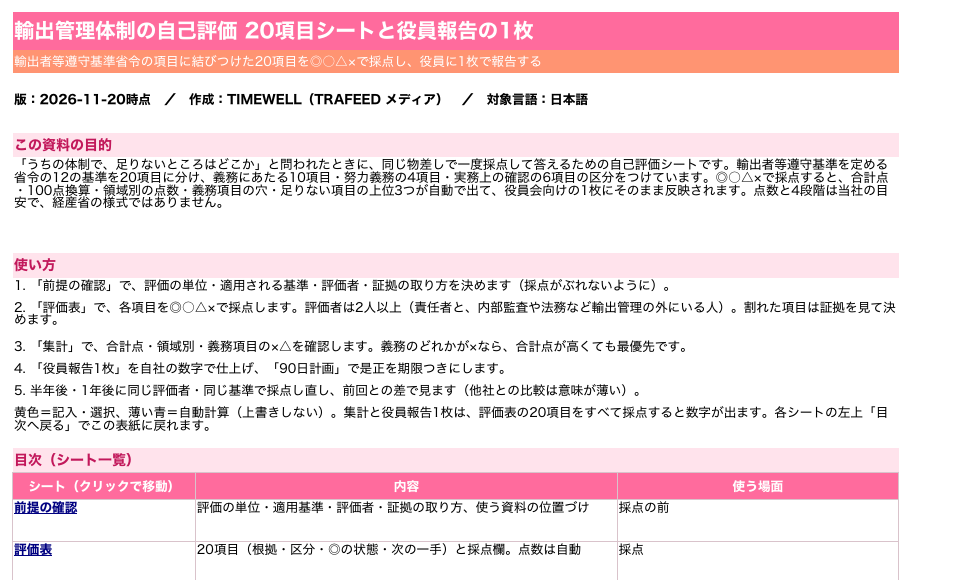
If you would rather run the scoring in a spreadsheet, our twenty-item self-assessment and executive one-pager (Excel, in Japanese) uses the same twenty items, each tagged as an obligation, a best-effort obligation or a practical check. Enter the four-level ratings and it works out the total, the scores by area and the priorities, and builds the one-page board report and a 90-day plan.
Replace siloed classification work with AI.
METI's FY2024 data shows 52% of foreign exchange law violations stem from classification errors. Download the TRAFEED product catalog covering features and rollout.
What published violation cases and penalties say about the layers of checks
Reading your score against what actually happens in practice gives the board report more weight. This section links the layers of checks that published cases point to with the items in the table.
First, a note on how to read this section. It uses only facts that can be confirmed publicly, such as METI announcements and Diet records. There is no intention to condemn any case as an example of wrongdoing. The interpretation and application of rules can shift on the regulator's side too, and businesses engaged in legitimate trade can face serious consequences from a procedural gap. What we draw out here is not a judgment on any business. It is a lesson about the system: which layer of checks, had it worked, might have stopped the problem. Where a published source does not analyze causes, mapping a case to items is our reading, not fact.
The overall picture in METI's FY2024 analysis
METI publishes an analysis of FEFTA violation cases every year. The FY2024 edition (cases in which measures were decided between 1 April 2024 and 31 March 2025, published December 2025) gives the following figures4. The figures are as in the original, which does not give case counts.
| Point | FY2024 share (original) |
|---|---|
| Measures taken | Report 69%, written account plus oral caution 26%, written account plus strict written caution 5%, administrative sanctions 0%, warnings 0% |
| Causes of violations | Classification 52% (no classification done or assumed not controlled 32%, wrong classification or misreading of the law 15%, relying on another party's wrong classification 5%), management system 36% (rules or system not in place 19%, lack of awareness or knowledge of FEFTA 9%, export control system deficient or hollowed out 8%), transaction screening 10% (misapplying an exception that removes the need for a license 9%, misapplying a license 1%), intentional 2%, shipment control 0% |
| How violations came to light | Customs post-clearance audits 59%, found by the company itself 30%, pointed out by another company 7%, METI 4% |
| Company size | Companies that had not notified METI of a CP (internal export control regulations) 71%, capital of ¥300 million or less 61%, 300 employees or fewer 64% |
The original sums up these figures as follows: "no measures were taken against intentional, malicious violations," "violations are, in part, the result of a chain of various individual factors," and "the share of violations tends to be larger among relatively small companies that have not notified a CP." Among companies that have notified a CP, 61% of violations came to light through the company's own discovery, against 17% for companies without one (where customs accounted for 74%). The original says the high rate of self-discovery among CP companies "shows the importance of the audit function." Causes differ too: classification 61% and management system 26% for CP companies, against classification 49% and management system 39% for the rest, a clear gap in the share put down to the management system.
The previous edition, FY2023 (published December 2024), showed classification 70%, management system 21%, reports 79%, and violations coming to light through customs 43% and the company's own discovery 27%4. The shares move from year to year, but in both years classification and the management system account for most causes.
Mapped onto the table, gaps in classification (items 5, 6 and 7) and in the program itself (items 1, 3 and 15) together correspond to 88% of causes (classification 52% plus management system 36%). You can also read it this way: when the parts of the program that let a company find its own problems (items 15, 16 and 18) work, the company can act before someone outside points the problem out. This mapping is our reading.
Published cases and the layers of checks they point to
| Published fact | Source | Layer of checks it points to (items) | Notes |
|---|---|---|---|
| In the 1980s, a machine tool capable of simultaneous 9-axis control was described as 2-axis, obtained a certificate of non-applicability, and was exported to the Soviet Union. A criminal complaint was filed in 1987 (because the statute of limitations had run on the machines themselves, it covered the unlicensed export of software shipped later) and judgment was handed down in March 1988 (under the law as it stood before amendment) | Diet records (14 July 1987 and 3 September 1987)8 | Checking the application against the actual machine's specifications (items 5, 6 and 12). Even with an outside certificate, the exporter checks the specifications itself | Nearly 40 years ago, and the system has changed greatly since. Only the facts of what happened are used |
| A warning issued on 30 June 2023. Between 2014 and 2022, controlled machine tools and other items were exported to China, Vietnam and elsewhere without a license | METI press release9 | The layers that stop a long-running transaction through reclassification or audits (items 7 and 15) | The published material gives only the facts of what happened. We have not confirmed any analysis of causes |
| Administrative sanctions on 9 May 2025. Between August 2022 and June 2023, on 18 occasions, a trading company and its representative exported a total of 523 motorcycles, personal watercraft and other items without approval, falsely declaring South Korea as the destination when the final destination was Russia. A one-year export ban and a ban on serving as an officer | METI news release10 | Checking destinations and end users rather than relying on documents alone (items 8, 9 and 12) | Administrative sanctions are a regulatory enforcement case, not a judgment on the merits of the business. The period has expired |
| A warning issued on 16 December 2025. Between 2022 and 2024, a dealer exported motorcycles, whose export to Russia is restricted, without approval | METI press release11 | Keeping up with how far controls now reach (items 7 and 20) | Even consumer goods can be subject to approval. An item not being on a control list does not mean no approval is needed |
| A typical case METI publishes anonymously. With a deadline close, a staff member judged an item not controlled without checking with a superior and exported it | FY2024 analysis, violation example (1), management system not in place (p. 11 of the original)4 | An approval line that stops one person deciding alone (items 3 and 5) | Anonymous; the company cannot be identified |
| Same. Controlled technology was stored in the cloud, where an overseas subsidiary could access it freely | Same (p. 11, lack of awareness of FEFTA) | Putting technology provision through the same review as goods (items 4 and 10) | The original explains that a state in which non-residents can freely access controlled technology, even at the company's own subsidiary, is considered to be provision of technology, so access must be restricted or a license to provide technology applied for |
| Same. The company exported on the strength of a manufacturer's classification record, and it later turned out, through the manufacturer's error, that the item was controlled | Same (p. 12, relying on another party's wrong classification) | Checking others' classifications in-house (item 11) | The original explains that because classification is the exporter's responsibility, the exporter should endeavor to recheck classification records obtained from others |
| Same. A substitute with a different model number was assumed to perform the same as the previous non-controlled item and was exported without classification | Same (p. 12, no classification done or assumed not controlled) | Classifying every export (items 5 and 7). This type is the most common cause of violations, at 32% | The original explains that even compatible items may have different specifications, so classifying again is recommended |
| Same. Goods that needed classifying under both row 2 and row 6 were classified under row 2 only and judged not controlled | Same (p. 12, wrong classification) | Not missing a second entry (items 5 and 6) | The original explains that a controlled item does not necessarily fall under just one entry |
| Same. The company did not realize that providing samples counts as exporting, and followed no procedures | Same (p. 11, lack of awareness of FEFTA) | Informing staff of the law (item 13) | The original explains that providing samples counts as exporting, whether paid or free |
| Same. A single contract exceeded the ceiling for the small-value exception, but the goods were exported without a license in several shipments, on the grounds that each declared value was within the ceiling | Same (p. 13, misapplied exception) | Judging use of an exception against the full contract value (items 5 and 8) | The original explains that the exception is judged on the full contract value, and that splitting a contract without good reason to use it may be treated as abuse |
Three things stand out in this table. First, none of these cases necessarily began with any special bad intent. They happened in everyday work, through deadlines, changed model numbers, trust in suppliers and the convenience of the cloud. Second, the layer that could have stopped each case differs. Some would stop at classification, some at transaction screening and some at audit. The items that score low in your table are the layers where nothing would stop a problem. Third, in METI's breakdown, 69% of measures ended with a report. According to the Guidance, criminal penalties, administrative sanctions and warnings are published as a rule, while the submission of a written account or a report is, as a rule, not published3. Unpublished responses are the majority, so a small number of published cases does not mean violations are rare.
A case not to use as a violation example: Ohkawara Kakohki
One case has to be mentioned whenever examples are listed. In 2020, officers of Ohkawara Kakohki, a maker of spray dryers, were arrested and indicted on suspicion of unlicensed exports. In July 2021 the Tokyo District Public Prosecutors Office withdrew the indictment. On 28 May 2025 the Tokyo High Court ruled that the investigation was unlawful, and the judgment is final12.
This is not a violation case. It is a case in which a maker of legitimate civilian machinery was drawn into criminal proceedings over the interpretation of regulatory wording, and obtained redress only after many years. Read against the assessment table, it carries two lessons. If interpretation can waver even on the authorities' side, a company needs a record of which provision it read, how it read it, whom it consulted and how it decided (item 6). And it needs to be able to answer inquiries from the authorities with both a contact point and documents (item 19). The background is in the Ohkawara Kakohki case.
A U.S. yardstick: BIS's penalty guidelines
If your company handles U.S.-origin parts or technology, or transactions that U.S. rules reach, the enforcement approach of the U.S. Commerce Department's Bureau of Industry and Security (BIS) is also a useful yardstick for self-assessment. BIS publishes how it sets administrative penalties in Supplement No. 1 to Part 766 of the Export Administration Regulations (EAR)13. Four points bear on a self-assessment:
| What the guidelines say | Content (summary of the original) | Items to look at in the scorecard |
|---|---|---|
| Minor cases (opening of Section III) | Many apparent violations are isolated, the result of a good-faith misinterpretation, or simple negligence; absent aggravating factors they are often closed with a no-action letter or a warning letter | Finding and fixing errors (items 15 and 16) |
| Voluntary self-disclosure (Section IV.B.2) | In a non-egregious case, the base penalty is up to one-half of the transaction value with a voluntary self-disclosure, and up to the transaction value without one. In an egregious case, up to one-half of the statutory maximum with a disclosure, and up to the statutory maximum without | Reporting procedures when a violation occurs (item 18) |
| Compliance program (Factor F in Section III) | Whether a risk-based compliance program existed at the time, and its nature and adequacy; how far it follows BIS's Export Compliance Guidelines; whether it uncovered the problem and prevented further violations | The whole framework (items 1 to 20) |
| Remedial response and cooperation (Factors G and H) | Whether the conduct was stopped immediately, the cause identified and recurrence prevented, and information provided to the authorities in a timely and comprehensive way | Correction and prevention (items 16, 18 and 19) |
This is a different system from Japan's FEFTA and is not the standard Japanese authorities use. Still, the logic that "was there a program," "did you find and report it yourself," and "did you fix it" affect the outcome points the same way as the Japanese guidance, which says voluntary reports may be taken into account in deciding sanctions (next section). BIS also publishes individual enforcement cases (settlement agreements and orders). These are records of regulatory procedure, not material for judging the companies involved. Read them not for the names but for which layer of checks was in question, and map that to the items in the scorecard.
Penalties: how much to explain to the board
The board does not need every penalty. It is enough to cover which acts, who is liable and what the ceilings are. FEFTA's article numbers moved with an amendment in 2026. In the current version on e-Gov, Article 69-6 is a provision on transitional measures, and the penalties for unlicensed exports and the like are in Article 69-7. If older internal materials cite "Article 69-6," they refer to the provision before the amendment2.
| Article | Act | Individual offender | Company (Article 72) |
|---|---|---|---|
| Article 69-7(1) | Carrying out controlled transactions or exporting controlled goods without a license (including licenses under list controls and under catch-all controls for destinations outside Appended Table 3 (Group A)) | Imprisonment of up to 7 years, a fine of up to ¥20 million, or both | A fine of up to ¥700 million |
| Article 69-7(2) | Carrying out transactions or exports without a license for goods or technology related to nuclear weapons, military chemical or biological agents, or rockets, unmanned aerial vehicles and the like capable of delivering them | Imprisonment of up to 10 years, a fine of up to ¥30 million, or both | A fine of up to ¥1 billion |
| Article 69-8(1) | Acting without a catch-all license for destinations in Appended Table 3 (Article 48(2) of the Act), a license for provision of technology under Article 25(2) or (3), export approval (Article 48(3); exports to Russia, etc.) or import approval (Article 52) | Imprisonment of up to 5 years, a fine of up to ¥10 million, or both | A fine of up to ¥500 million |
| Article 71, items 11 to 13 | Violating an order relating to the compliance standards (item 11), refusing an on-site inspection (item 12), failing to answer questions or answering falsely (item 13) | Imprisonment of up to 6 months or a fine of up to ¥500,000 | The fine under the relevant article (up to ¥500,000) |
In every row, where five times the value of the goods or technology involved exceeds the ceiling, the fine can be up to five times that value (Articles 69-7, 69-8 and 72). Article 69-7(3) also punishes attempts in relation to the export of goods. The company's liability to a fine rests on the dual liability provision in Article 72. When an employee commits a violation in connection with the company's business, the company is fined as well as the individual being punished.
Separately from criminal penalties, Article 53 provides for administrative sanctions. For a person who has exported without a license, the Minister of Economy, Trade and Industry can ban exports, transactions to provide technology and the like for a period of up to three years (paragraph 1). For other violations relating to the export or import of goods, the Minister can ban exports and imports for up to one year (paragraph 2; up to three years for violations of certain response measures). Where the violator is an individual, that person can also be banned from becoming an officer in charge of that business at a company (paragraph 3)2.
The Guidance ranks responses to violations, from most to least serious, as criminal penalties, administrative sanctions, warnings (published as a rule) and the submission of a written account or a report (not published as a rule). It also says that voluntarily reporting a violation to METI may be taken into account when deciding the measures3. That is one more reason to have the reporting procedure in item 18 in place.
The point to get across to the board is not the size of the fines but the impact of an export ban. Overseas sales and parts supply grinding to a halt is a management problem of a different order from any fine. Failing to meet the compliance standards carries no direct criminal penalty in itself. METI proceeds through guidance and advice, then a recommendation, then an order, and penalties apply only once an order is violated (Articles 55-11, 55-12 and 71, item 11)2. But a company whose compliance standards are not working keeps carrying the risk of the violations that do bring heavy penalties. The full picture is in Japan FEFTA penalties for export violations and export control violation penalties and risks.
The one-page board paper: outline and template
Once scoring is done, prepare the paper for the board. Keeping it to one page is not just because the board has ten minutes. Content that will not fit on one page has not been prioritized.
Build the outline from these seven fields.
| Field | What to write | Note |
|---|---|---|
| 1 Conclusion | The assessment in one sentence, such as "the framework is in place, but there are three weaknesses in the evidence of operation" | Do not write just "no issues" |
| 2 Score | The total, the score by area and the change since last time | For the first round, label it the "baseline" |
| 3 The three weakest items | Item number, what is missing, and what could happen if it is left alone | Put mandatory items rated Missing first |
| 4 Comparison with published cases | One line each on the recent published cases closest to your transactions, and how that layer stands at your company | Do not write in a way that criticizes any company |
| 5 Decisions needed | People, budget, deadlines and the matters you want approved | No more than three matters for approval |
| 6 90-day plan | Three milestones and the evidence of completion | Shrink the table in the next section to one line |
| 7 Next report | The date and the indicators to be reported | Include the date for rescoring |
Template: the one-page board paper
The template below is written so that you can paste it in as it is. Have it reviewed by your legal team and, where needed, outside specialists, and adapt it to your company's facts. Replace the bracketed placeholders with your own figures and names.
Template (one-page board paper; based on the Japanese system, to be reviewed by your legal team)
Export control self-assessment results and corrective action plan ([Month Year], [Export Control Department])
1 Conclusion On [date] we carried out a 20-item self-assessment based on the provisions of the Ministerial Ordinance on Export Compliance Standards. The total score is [X] out of 60 (previously [X]). Of the 10 mandatory items, [X] were rated Missing and [X] Partial.
2 The three weakest items Item [X] ([title]): Currently [status]. If left as is, there is a risk of [consequence]. Item [X] ([title]): Currently [status]. Item [X] ([title]): Currently [status].
3 Comparison with published cases Recent published cases have tested the layer of checks on destinations and the layer of reclassification. At our company, the former is rated [rating] and the latter [rating].
4 Decisions we are asking for (1) Approval to update the appointment document for the overall officer. (2) Approval to commit [X] people and ¥[X] to putting [area] in place. (3) We will report the results of rescoring at the next board meeting.
5 90-day plan We will complete [task] within 30 days, [task] within 60 days and [task] within 90 days, and keep evidence of each.
Have three sentences ready for the oral briefing as well: "We have scored ourselves against the items in the compliance standards." "There are three gaps, and all of them can be corrected within 90 days." "At the next board meeting we will report how the score has changed." What worries directors most is not the gaps themselves but gaps nobody has identified. Identify them, set deadlines and report back. With those three things in place, the report holds up even if the score is low.
A 90-day plan for after the assessment
If you stop at scoring, next year's score will be the same. Turn it into a 90-day plan. Set priorities in this order: first, mandatory items rated Missing; next, mandatory items rated Partial; then best-effort items rated Missing; and last, the evidence needed to lift In place to Evidenced.
How the 90 days run (example)
| Period | What | Owner | Evidence of completion |
|---|---|---|---|
| Days 0 to 30 | Finalize the scores and start correcting mandatory items rated Missing. Update the appointment documents for the overall officer and the classification officer. Report to the board | Overall officer, classification officer | Appointment documents, board minutes |
| Days 31 to 60 | Revise the classification procedure and the classification record form, add end-use and end-user fields to the transaction screening sheet, introduce the pre-shipment check form | Classification officer, sales, logistics | Revised forms, record of the date use began |
| Days 61 to 90 | Deliver training, hold a mock inspection, run audits based on samples, rescore | Overall officer, internal audit, legal | Training attendance list, record of the mock inspection, the new score |
Example division of roles
| Role | Main responsibilities | Items |
|---|---|---|
| Overall officer (appointed from among those who represent the company) | Final responsibility for the program, reporting to the board, deciding whether to report a violation to METI | 1, 3, 16, 18 |
| Classification officer | Classification procedures, approving classification results, reclassification when the law changes | 2, 5, 6, 7 |
| Sales and procurement | Confirming end use and end users, filling in the transaction screening sheet | 8, 9, 11 |
| Logistics and shipping | Pre-shipment identity check and checking license terms | 12 |
| Engineering | Checking specifications, maintaining the technology provision register | 10 |
| HR and training | Lists of staff covered, delivering and recording training | 13, 14 |
| Internal audit and legal | Independent audits, contact point for inspections, setting retention periods | 15, 17, 19 |
| Export control (information) | Tracking rule changes and communicating impact assessments | 7, 20 |
A common problem is that only the export control department moves while sales and logistics stay put. Items 8, 9, 11 and 12 are work done by sales and logistics themselves. However many procedures export control writes, if the transaction screening sheet becomes something sales will "get to later," no record will be left. The realistic approach is to bring the heads of sales and logistics into the plan in the first 30 days, and have each department hold its own evidence of completion.
One more point. What belongs in the plan is less about adding new systems than about connecting the documents and track record you already have. Classification records with a thin basis, training with no attendance list, audits with no record of corrective action: states like these can get close to Evidenced by adding one field to a form, without building anything new. How to build the program is covered in 10 steps to build an export control framework, and preparing for on-site inspections in the on-site inspection checklist. How to read the ordinance behind the table is set out in Japan's Export Compliance Standards explained. The table is not the same as the annual Exporter Profile and Self-Management Checklist for companies that have notified METI of a CP, but its results can serve as groundwork for filling that in. For choosing a CP, the CISTEC model CP explained is a useful reference.
Common misconceptions and pitfalls
Here are six misconceptions and mistakes that often come up in self-assessments.
The first is that having rules earns Evidenced. Rules are only the entry point for an item. Evidenced needs evidence of both documents and operation. When the score does not rise after rules have been put in place, the usual reason is that records of operation are missing.
The second is making a high score the goal. Scoring is not there to reassure the board. It is there to find the gaps. A low score is not, in itself, a failed report. Reporting "no issues" without knowing the gaps does far more damage to the board's trust when something goes wrong.
The third is deciding that the rules do not apply to your company. The two standards in Article 1, item 1 of the ordinance (appointing a classification officer, and informing and guiding staff on the law) apply, regardless of size, to anyone who exports or provides technology as a business (for an individual exporter, Article 3 disapplies item 1 (i) and reads (ro) as collecting the necessary information)1. Item 2 is an extra layer for those who handle list-controlled items. Do not skip the assessment just because the items you handle are not on a control list. You only know whether they are on a list once you have classified them.
The fourth is trusting other companies' classification records. A manufacturer's classification record is only material for the exporter's own decision. Responsibility for the classification lies with the exporter. Article 1, item 2 (ha) of the ordinance requires procedures for classification confirmation, and checking other companies' classification records belongs within those procedures. Where information on end use or end users comes from someone other than the end user, the second sentence of (ni) requires procedures to make that information more reliable.
The fifth is assuming that following the Economic Security Management Guidelines takes care of export control as well. As noted earlier, the guidelines do not directly address compliance obligations under FEFTA. Both need attention, but assessing them together drains both scores of meaning.
The sixth is scoring only once. A program erodes with every personnel change, reorganization, change in counterparties and amendment of the law. Build an annual rescoring into the audit plan.
Issues touching HR and employment need particular care. We do not recommend any practice that treats foreign employees or researchers as a risk. What the system looks at is not nationality, but the act of providing technology and the relationship with the person receiving it. The technology provision register (item 10) records acts of provision. It is not a tool for sorting people. When designing the process, have legal and HR review it so that it does not become discrimination. The approach to deemed exports is covered in deemed exports and the specific categories.
What we have not confirmed, and the limits of this article
Before you use this article, here is what we have not been able to confirm.
First, we checked the text of the Security Export Control Guidance [Introductory Edition] (version 3.0, March 2026) in the original. We also checked the text of the Economic Security Management Guidelines (1st Edition) in the original on 21 November 2026. The basis for the assessment table centers on the provisions of the ordinance and FEFTA checked on e-Gov, backed up by the Guidance. The Guidance presents the split between obligations and best-effort obligations in the Export Compliance Standards in the same way as the ordinance, and that split matches the table.
Second, we checked METI's FY2024 and FY2023 analyses in the original. However, the originals do not give case counts, and the shares are proportions of the cases in which measures were decided. If you put them in a board paper, add the fiscal year and the fact that they are "cases in which measures were decided." The breakdown of causes differs in places between the two years, so keep year-on-year comparisons broad.
In addition, in the table "Published cases and the layers of checks they point to," we checked the 1980s case against the original Diet records (via the API of the Diet record search system) on 21 November 2026. We checked the 30 June 2023 warning, the 9 May 2025 administrative sanctions and the 16 December 2025 warning against METI's original press releases on 21 November 2026.
Third, the items with no direct basis in the ordinance (6, 16 and 20) and the "practical checks" within some items are our own framing. Use the basis column to tell whether a legal obligation exists.
Fourth, the items in the table, the score bands (51 or more and so on) and the four levels from Evidenced to Missing are our own benchmarks for running a self-assessment, not standards set by METI. METI's checklist for universities uses three levels and no points. Feel free to add items or adapt them to the nature and size of your business.
Fifth, the penalties and administrative sanctions are as checked in the current version on e-Gov Laws (reflecting the amendment in force from 12 August 2026). Laws get amended. For decisions on individual cases, or what to do when you become aware of a possible violation, consult your internal officers and specialists such as lawyers. The templates in this article are drafts that assume legal review, and are not offered for submission as they stand.
If you want to start checking your program with a tool, the free export control program check is a good place to begin. If you want to keep the basis for each classification decision and run screening against control lists in one flow, talk to us about TRAFEED, our export control AI agent.
What to read next
- Japan's Export Compliance Standards explained: how to read the ordinance behind the table
- 10 steps to build an export control framework: the steps for filling the gaps
- The on-site inspection checklist: item 19 and preparing for inspections
- Export control violation penalties and risks: administrative sanctions and the impact on the business
- Japan FEFTA penalties for export violations: ceilings by article, and a list of published measures
- FEFTA violations in FY2024: METI's figures: reading the statistics on classification-related and system-related causes
- Japan export control violation cases: the background to the cases
- Export control for overseas subsidiaries: item 4 in detail
- U.S. export rule change playbook: item 20 in detail
References
Footnotes
-
Ministerial Ordinance on Export Compliance Standards (METI Ordinance No. 60 of 2009), Articles 1 to 4 (in Japanese). e-Gov Laws (Digital Agency). Current version, reflecting the amendment in force from 9 October 2025. Accessed 20 November 2026 ↩ ↩2 ↩3
-
Foreign Exchange and Foreign Trade Act, Articles 53, 55-10 to 55-12, 68, 69-6 to 69-8, 71 and 72 (in Japanese). e-Gov Laws (Digital Agency). Current version, reflecting the amendment in force from 12 August 2026. Accessed 20 November 2026 ↩ ↩2 ↩3 ↩4
-
METI, "Security Export Control Guidance [Introductory Edition]," version 3.0 (March 2026) (in Japanese). 59 pages. Compliance standards in Chapter 2, VI (p. 29); penalties and related measures in Chapter 2, VII (p. 31); audits in Chapter 4, II (p. 54); document management in the same section (p. 55). Text checked 20 November 2026. https://www.meti.go.jp/policy/anpo/guidance/guidance.pdf ↩ ↩2 ↩3 ↩4 ↩5
-
Results of the Analysis of FEFTA Violation Cases (Security Trade) (FY2024) (in Japanese). METI Trade and Economic Security Bureau, Security Export Inspection Office (published December 2025, 15 pages). Measures taken on p. 1, breakdown by size on p. 2, causes on pp. 3–6, how violations came to light on pp. 7–8, violation examples on pp. 11–14. Original checked 20 November 2026. The FY2023 edition (published December 2024), Results of the Analysis of FEFTA Violation Cases (FY2023) (in Japanese), was likewise checked in the original. ↩ ↩2 ↩3 ↩4
-
Security Export Control Self-Assessment Checklist for Universities (summary and detailed versions) (in Japanese). METI Trade and Economic Cooperation Bureau, Security Export Control Policy Division (31 March 2020). 16 items in the summary version and 52 in the detailed version. Ratings use three levels, "sufficient," "partly insufficient" and "insufficient." It is described as a voluntary self-assessment that does not require periodic or mandatory submission to METI. Text checked 20 November 2026 ↩ ↩2
-
Economic Security Management Guidelines (1st Edition) (published 23 January 2026) (in Japanese). METI Trade and Economic Security Bureau. Section 2(4), "Content and scope of these guidelines" (p. 5), note 5, and the appended checklist (pp. 18-21). Original checked 21 November 2026 ↩ ↩2 ↩3
-
Results of the Analysis of FEFTA Violation Cases (FY2024) (in Japanese), violation example (3), classification, "failure to respond to an amendment of the law" (p. 12 of the original). A product previously judged not controlled became controlled through an amendment, but the company did not notice the amendment and repeated unlicensed exports. The explanation says to "check classifications when the law is amended." ↩
-
Diet records (in Japanese): "109th Diet, House of Representatives, Budget Committee, No. 3" (14 July 1987; the questioning sets out that the machines were falsely described as simultaneous 2-axis to obtain a certificate of non-applicability, when they were in fact simultaneous 9-axis), "109th Diet, House of Councillors, Commerce and Industry Committee, No. 4" (3 September 1987; a government official explained that, because the statute of limitations had run on the machines, the complaint covered the unlicensed export of software), and "112th Diet, House of Councillors, Commerce and Industry Committee, No. 4" (28 March 1988; references to the judgment and to the case falling under the old law). Originals checked through the API of the Diet record search system (https://kokkai.ndl.go.jp/) on 21 November 2026. ↩
-
METI, "Warning issued to a company that violated the Foreign Exchange and Foreign Trade Act" (30 June 2023) (in Japanese). Original checked 21 November 2026 ↩
-
METI news release (9 May 2025): administrative measures, including an export ban, for a FEFTA violation, under Article 53(2) and (3) (in Japanese). Original checked 21 November 2026 ↩
-
METI, "Warning issued to a company that violated the Foreign Exchange and Foreign Trade Act" (16 December 2025) (in Japanese). Original checked 21 November 2026. We also checked the PDF of the same press release (https://www.meti.go.jp/policy/external_economy/trade_control/01_seido/02_jigo/download/20251216_keikoku.pdf) on 21 November 2026. ↩
-
CISTEC, "Commentary on the legal interpretation in the Tokyo High Court judgment (final) in the state compensation suit over the Ohkawara Kakohki case" (8 August 2025) (in Japanese). https://www.cistec.or.jp/service/houtaikei_saikochiku_data/20250808.pdf (we checked in the original on 21 November 2026 that the judgment was handed down on 28 May 2025 and became final when no appeal was filed by the 11 June deadline). The dates of the arrests (11 March 2020) and of the withdrawal of the indictment (30 July 2021) were checked on 21 November 2026 in the Diet record: House of Representatives Committee on Judicial Affairs, No. 5, 217th Diet (26 March 2025, statement by a witness), and House of Councillors Committee on Judicial Affairs, No. 2, 213th Diet (questioning on 22 March 2024). ↩
-
eCFR, 15 CFR Part 766, Supplement No. 1, "Guidance on Charging and Penalty Determinations in Settlement of Administrative Enforcement Cases" (Section III, Factors F, G and H; Section IV.B.2). Version as of 19 November 2026 (last amended at 89 FR 75485, 16 September 2024). Checked 21 November 2026. https://www.ecfr.gov/current/title-15/subtitle-B/chapter-VII/subchapter-C/part-766 ↩