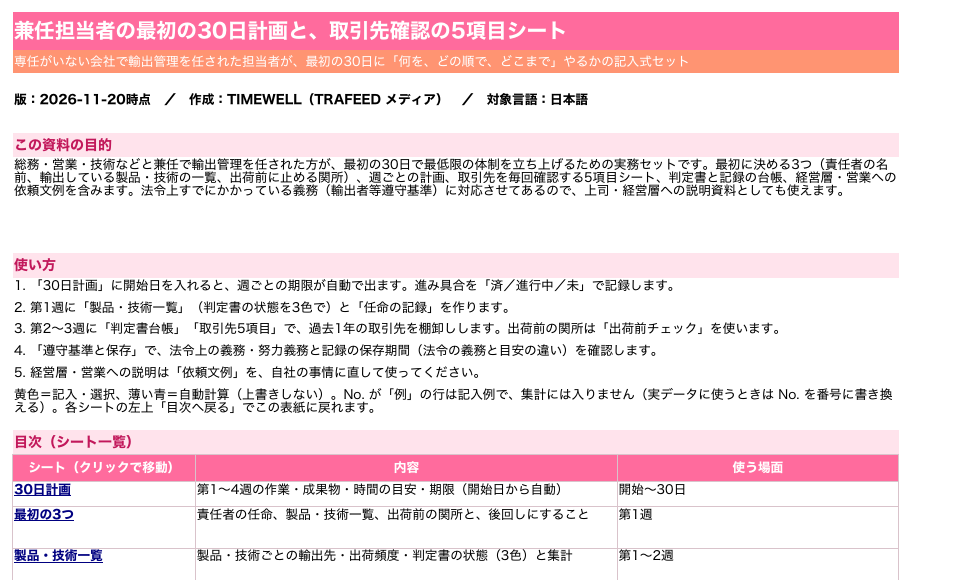
First 30-Day Plan and Five-Item Counterparty Sheet for Part-Time Officers (editable Excel)
A 30-day plan with automatic weekly deadlines, product and classification ledgers, a non-applicability certificate log, a five-item counterparty check, sample end-use and end-user statements in Japanese and English, and a pre-shipment checklist (Japanese only).
Get the fileYou can download it after a short form (Japanese).
(November 22, 2026) We had stated flatly that a division head or a director without powers of representation cannot be the overall officer. Following Q13 of METI's Q&A on internal compliance programs, a director without powers of representation generally does not qualify, but in a company with committees and similar cases the chief officer could exceptionally be chosen from among representative executive officers, directors or executive officers. The distributed Excel workbook has been corrected in the same way.
Hello, this is Ryuta Hamamoto from TIMEWELL.
Picture this. You are the general affairs manager at a parts maker with about 300 employees, and one day your boss stops by. "Could you take on export control? Right now sales just do whatever they're told." There is no one dedicated to it. The handover from your predecessor is a single file. You have heard the term export control, but you have no idea what it involves or how far you are supposed to go.
This article is for people in that position. Rather than general principles, it sticks to what to do in the first 30 days, in what order, and how far to take it. The overall system and how large companies write internal regulations are left to other articles. I checked the statutory text against the current versions on e-Gov (accessed 20 November 2026).
The conclusion first
- At the start you only need to decide three things: the name of the responsible officer, a list of the products and technology you export, and a checkpoint that stops shipments before they leave.
- Keep counterparty checks to five points, every time, and even someone doing this alongside another job can keep them running. Use templates for classification records and screening records, and keep them.
- Under export control law, keeping documents is a best-effort obligation; under the Customs Act, it is a five-year legal requirement. The penalties are in Articles 69-7 and 72 of the Foreign Exchange and Foreign Trade Act (FEFTA, 外為法).
Decide just three things first, and decide what can wait
The classic early mistake for someone handling export control alongside another job is to start everything at once and finish none of it. Writing internal regulations, comparing systems, planning company-wide training, reading up on bulk licenses (包括許可). All of it matters. None of it belongs in the first 30 days.
I picked the first three tasks on two criteria. One is meeting obligations the law already imposes. The other is closing off the places where accidents happen. Those two criteria give you the following three.
1. Decide who is responsible, and put the name in writing
Article 1, item 1 of the Ministerial Ordinance on Export Compliance Standards (METI Ordinance No. 60 of 2009) requires everyone who exports goods or provides technology as a business to appoint an officer responsible for classification confirmation1. The ordinance's term, 該非確認 (classification confirmation), means checking whether the goods you export or the technology you provide fall under the control lists. It is the same work practitioners call classification (determining whether an item or technology falls under the control lists, 該非判定), and you can treat the two as one. In this article I use "classification" for both and call this person the classification officer.
Article 55-10(4) of FEFTA says exporters "must comply" with these standards2. So the obligation already applies to companies that have no internal regulations. It is also the obligation you can meet fastest: decide who it will be, put the name in a letter of appointment or an internal notice, and you are done. That is why it comes first.
Without a named officer, nobody can say who stamps approval on a classification record, or who stops a deal when a question comes up about a counterparty. Most accidents come not from bad intent but from nobody being in charge.
2. List the products and technology you export
Make a list of what your company sends abroad: product name, model, destination country, a rough number of shipments a year, and the classification status. Three colors are enough for the status: "classification record on file," "record on file but old or needs checking," and "no record."
This list is the starting point for everything after it. Which products to sort out classification records for first, which counterparties to check first, whom to brief. Without the list, you cannot set priorities. Do not forget technology. Sending drawings, specifications or software to overseas customers or group companies is covered by FEFTA just as exporting goods is2.
3. Set up one checkpoint that stops shipments before they leave
The third is a pre-shipment check. Just before shipment, put in a checkpoint that confirms three things. Has this product been classified? Has this counterparty been through the five checks? Are the goods about to ship the same goods that were classified?
The third point is the procedure in Article 1, item 2 (ho) of the compliance standards: at shipment, confirm that the goods described in the documents are the same as the goods actually exported1. (The ordinance labels its sub-items with Japanese kana, イ, ロ, ハ, ニ, ホ and so on. I write them as (i), (ro), (ha), (ni), (ho).) On the shop floor it is not unusual for a model change or a design improvement to leave the classified goods and the shipped goods out of step. The checkpoint can start with a single approval stamp. If the shipping staff can hold any order whose approval box has no stamp, you have a system.
What can wait
Do not start on the following in the first 30 days. Here is why.
| What to put off | Why it can wait | When to start |
|---|---|---|
| Writing internal export control regulations (a compliance program, or CP) and filing them with METI | Filing a CP is voluntary, and the compliance standards apply with or without one. Writing it down once your routine has taken shape keeps the document in line with reality | From the third month |
| Obtaining bulk licenses | Consider them once individual license cases actually come up | When a license case comes up |
| Introducing systems or tools | Bring one in before you have a manual routine and nobody will know how to use it | After running the routine for one or two months |
| Planning company-wide training | At first, the departments involved in exports are enough | Second month |
| Audits | A best-effort obligation under the compliance standards (METI's Introductory Guidance indicates at least once per business year). Wait until you have a track record | After six months |
How a CP differs from the compliance standards is covered in our explainer on the Export Compliance Standards. The standards always apply, even to companies that have not filed a CP.
Filing a CP with METI does change things, though. METI's "Security Export Control Guidance [Introductory Edition]", version 3.0 (the Introductory Guidance), says that companies that have filed must reliably carry out audits, education (training), guidance to subsidiaries and document management, which the compliance standards treat as best-effort obligations3. File only once you can see a way to keep all of these running.
When you write the CP from month three, start from our ten-article outline of an internal export compliance program (Word, in Japanese). Each of the ten articles comes with draft wording, a field to fill in and a worked example for a fictional Company A, plus the matching item of the compliance standards ordinance and the page of METI's introductory guidance. It is our draft, not a METI form, so have your legal team review it.
The legal minimum, in plain words
It is worth going over why the officer has to be appointed in a little more detail. When you explain this to your boss or to senior management, being able to cite article numbers speeds things up.
Two obligations that apply to everyone
Article 1, item 1 of the ordinance imposes two things on everyone who exports or provides technology as a business. Sub-item (i) is appointing a classification officer. Sub-item (ro) is keeping the people engaged in export work informed of the latest FEFTA and the orders under it, and giving them whatever other guidance they need to comply with the relevant laws1.
The "guidance" in (ro) does not mean an elaborate training program. Tell the people concerned when a law changes. Explain the basics to anyone newly assigned. I think it is fine to start at that level. But record what you do; the section on records below covers this. The Introductory Guidance (version 3.0) sets education for people involved in export control at "at least once a year," and gives the date and time, method, instructor's name and participants' names as examples of what to record3.
Handle list-controlled items, and ten standards are added
Businesses that export or provide "specified critical goods, etc." (特定重要貨物等) as a business must also meet the standards in Article 1, item 2. Specified critical goods, etc. here means the goods in rows 1 to 15 (項) of Appended Table 1 of the Export Trade Control Order and the technology in rows 1 to 15 of the Appended Table of the Foreign Exchange Order4. In other words, items under list controls. Row 16, the catch-all row, is not included.
At this stage you may not yet know whether your products are on these lists. If so, it is safer to build your setup as if they are. Item 2 splits into obligations and best-effort obligations.
| Provision | What it requires | Type |
|---|---|---|
| Item 1 (i) | Appoint a classification officer | Obligation (all exporters) |
| Item 1 (ro) | Inform staff engaged in export work of the law and give them guidance | Obligation (all exporters) |
| Item 2 (i) | Appoint an overall officer from among those who represent the company | Obligation |
| Item 2 (ro) | Define the authority and responsibilities of the departments that carry out export work, and the relationships between them | Obligation |
| Item 2 (ha) | Set classification procedures | Obligation |
| Item 2 (ni) | Set and carry out procedures for checking end use and end users | Obligation |
| Item 2 (ho) | At shipment, confirm that the goods in the documents and the goods being exported are the same | Obligation |
| Item 2 (he) | Set up an audit system and procedures, and audit periodically | Best-effort obligation ("endeavor to") |
| Item 2 (to) | Train the overall officer and the staff engaged in export work | Best-effort obligation |
| Item 2 (chi) | Set up a system for guiding and checking subsidiaries | Best-effort obligation |
| Item 2 (ri) | Keep documents relating to export work for an appropriate period | Best-effort obligation |
| Item 2 (nu) | When there is a violation or a risk of one, report promptly to the Minister of Economy, Trade and Industry and take steps to prevent recurrence | Obligation |
In the wording of the ordinance, (i) to (ho) and (nu) say "appoint," "set" or "carry out," while (he) to (ri) say "endeavor to." That difference is the basis for how document retention is treated later in this article. METI's Introductory Guidance (version 3.0) likewise describes four of the ten standards for exporters handling list-controlled goods and technology (audits, training, guidance to subsidiaries and document retention) as things to "endeavor to" do3.
The first three tasks were chosen from the obligations in this table that can be met quickly. Here is how they line up.
| The first three | Provisions of the ordinance | Where they sit in the Introductory Guidance |
|---|---|---|
| Decide who is responsible and put the name in writing | Item 1 (i) (classification officer); item 2 (i) (overall officer) | Standard ① for all exporters; standard ① for those handling list-controlled items |
| List the products and technology you export | The groundwork for item 2 (ha) (classification procedures); also used for item 1 (ro) (informing and guiding staff) | Classification STEP 1, "identify the subject" |
| Set up a checkpoint that stops shipments | Item 2 (ho) (confirming the goods match at shipment); the entry point to item 2 (ni) (checking end use and end users) | Shipment control STEP 2; transaction screening STEP 1 |
The remaining obligations (defining departments' authority and responsibilities under item 2 (ro), and documenting the procedures under (ha) and (ni)) are met within the first 30 days, over weeks 2 and 3, in the form of the register and the five-point sheet.
Article 2 provides that exporters of specified critical goods, etc. may appoint the same person as classification officer and overall officer. In other words, one person may hold both roles. Article 4 provides that item 2 (i) to (ri) does not apply to those whose only business is transactions designated by the Minister of Economy, Trade and Industry under Article 17(8) of the Foreign Exchange Order, or exports in the cases listed in Article 4(1) of the Export Trade Control Order1. Decide whether your company is in this group only after checking what you actually export.
Where the penalties are
Failing to meet the compliance standards leads to consequences in stages. The Minister of Economy, Trade and Industry may give guidance and advice where necessary (FEFTA Article 55-11), and on finding that the standards are still being breached, may issue a recommendation (Article 55-12(1)). If the recommendation is not followed, the Minister may order measures to be taken (Article 55-12(2)). Breaching that order is punishable under Article 71, item 11 by imprisonment of up to six months or a fine of up to ¥500,0005.
The heavier penalties apply when a transaction that requires a license is carried out without one. Article 69-7(1) of FEFTA provides for imprisonment of up to seven years, a fine of up to ¥20 million, or both. Where five times the value of the goods or technology involved exceeds ¥20 million, the fine can be up to five times that value. Paragraph (2) covers technology, goods and the like that are particularly likely to be used to develop nuclear weapons and the like: imprisonment of up to ten years, a fine of up to ¥30 million, or both, and again up to five times the value where that exceeds ¥30 million6.
For companies, Article 72 provides that when an employee commits a violation in the course of the business, the company is fined as well as the individual being punished. The maximum is ¥700 million for a violation of Article 69-7(1) (or five times the value where that exceeds ¥700 million), and ¥1 billion for a violation of paragraph (2) (likewise five times the value)6.
A word of caution when you use these figures with senior management. Seven years, ¥20 million and ¥700 million are the baseline. Ten years, ¥30 million and ¥1 billion apply only under paragraph (2), that is, to items found particularly likely to be used to develop nuclear weapons and the like. "Ten years and ¥1 billion across the board" is inaccurate. Besides criminal penalties, the Minister may also ban anyone who exported without a license from exporting for a period of up to three years (Article 53(1))5. For the business, having exports stopped altogether may hurt more than any fine.
Splitting the roles so a dual-role setup works, and explaining it internally
If one person with another job does everything, it will not last. Divide the roles from the start and decide what to ask other departments to do.
Division of roles
The last column shows how each role relates to you, the person who has taken on export control.
| Role | Typically held by | What the job involves | How it relates to you |
|---|---|---|---|
| Overall officer | A person who represents the company (in an ordinary company, the representative director; compliance standards Item 2 (i)) | Responsible for export work as a whole. Final authority to stop shipments. Approves the annual review | The person you report to |
| Transaction review officer | A director or similar officer who can decide independently of sales (METI introductory guidance, p. 49). For a small company, the guidance also suggests the representative director doubling as the overall officer | Makes the final call on whether to go ahead when counterparty checks raise a concern | The person you bring the evidence to (the five-point sheet and follow-up answers) |
| Classification officer | You, or a section manager in engineering | Approves classification records. Organizes cases where counterparty checks raise a concern (the final call is the transaction review officer's) | Often you |
| Deputy | A colleague of yours, or someone in engineering | Approves in the officer's absence. Actually stands in a few times a year to stay in practice | Cover for holidays and departures |
| Drafting classifications | Engineering and design | Organizes the specifications of in-house products and compares them with the control thresholds | You send requests and receive the results |
| Gathering counterparty information | Sales | Asks for the counterparty's name, address, end use and end user at the quotation stage | Sales fill in items 1, 3, 4 and 5 of the five-point sheet (you do item 2, the list screening) |
| Pre-shipment check | Logistics or shipping | Holds orders with no approval in the check box. Checks that the shipped goods match the classification record | Runs the checkpoint |
| Records and registers | You (general affairs) | Keeps classification records, check sheets and training records, and updates the register | Your routine work |
The overall officer is chosen from among those who represent the company. Item 2 (i) of the compliance standards says the overall officer is appointed "from among those who represent" the company1, and METI's introductory guidance explains that in an ordinary company the representative director must be designated as the chief officer (Chapter 4, I (3), p. 49)3. A division head does not qualify. A director without powers of representation generally does not either, but METI's Q&A on internal compliance programs (Q13) says that where it is difficult to choose from among the representative directors, as in a company with committees, the chief officer could exceptionally be chosen from among representative executive officers, directors or executive officers, provided the reasons and their appropriateness are carefully considered and made clear through a board resolution or similar procedure. A note in the same Q&A says the chief officer in a compliance program corresponds to the overall officer under the compliance standards7. The rule also makes practical sense. Leave all the responsibility with a section manager who also has another job, and the authority falls short of what it takes to stop a shipment. One section manager will struggle to stop a deal that sales are pushing. Put the authority to stop shipments with the company's representative, and have the section manager prepare what that person needs to decide.
Decide in advance who makes the final call when a counterparty check raises a concern. The compliance standards ordinance itself does not use the term "transaction review officer."1 METI's introductory guidance, however, lists the transaction review officer among the officers in its chapter on building an export control system (Chapter 4). It recommends a position that can judge independently of the exporting department (sales and the like), and says the officer is expected to be chosen from among directors or similar, because the organization makes the final decision on the deal. For small companies that find it hard to appoint each officer, it adds that the representative director may serve as both chief officer and transaction review officer (Chapter 4, I (3), p. 49).3 The minister's notice on drafting and reviewing internal compliance rules also calls for a director or above to be the final decision-maker in transaction reviews of controlled items.8 Keep yourself or the engineering section manager in the role of organizing the concern and passing it up, and leave the final decision to a director. That way you will not have to rearrange roles when you file your internal rules.
How to explain it to senior management and to sales
A division of roles does nothing unless the people you are asking understand it. Tell senior management, briefly, that this is a legal obligation, how large the risk is, and what time and authority you need. Tell sales how their work will change. The templates below are written so you can use them as they are. They are based on the Japanese system. Adapt them to your company, and have your legal team or a specialist check them before use.
Template (request to senior management; based on the Japanese system, to be reviewed by your legal team)
I am asking for your approval to set up our export control system. Under Article 55-10 of the Foreign Exchange and Foreign Trade Act, a company like ours that exports as a business is subject to the Export Compliance Standards. At a minimum, we must appoint a classification officer and give guidance to the people involved. The criminal penalties for exporting without a license are imprisonment of up to seven years, a fine of up to ¥20 million, or both for individuals, and a fine of up to ¥700 million for the company (in either case, where five times the value of the goods exceeds the cap, the fine can be up to five times that value). Penalties are heavier where weapons of mass destruction and the like are involved.
I would therefore ask for three things. 1. That the representative director, or another person who represents the company, be named as overall officer. 2. That I be appointed classification officer, with [name] in Engineering as deputy. 3. That the officer be given written authority to stop any shipment whose pre-shipment check box has not been approved. For now, I expect the work to take about [X] hours a month.
Template (notice to sales; based on the Japanese system, to be reviewed by your legal team)
From next month, please fill in a counterparty check sheet before quoting for or accepting any overseas order. You will fill in four things (the counterparty's name, its country, what the product will be used for, and the company that will actually use it) and whether anything strikes you as unusual. It takes about five minutes. If you are offering a specification change or a new model, let me know before you quote. It cannot ship until the classification record has been checked. If this may affect a delivery date, please talk to me as early as you can.
Meet resistance from sales by showing the system first
What worries sales first is longer lead times. Showing them up front what you can promise calms things down. For example: a product whose classification record is in order, going to an existing customer, is approved the same day once the sheet is filled in. A product without a record, or a new counterparty, needs a few days. Put it that way and sales can see that only some orders will be held.
The plan for the first 30 days
Here is the plan, week by week. The hours are only a guide. I assumed the dual-role person can find 5 to 8 hours a week between regular duties. The real figure varies a lot with the number of products and counterparties, so adjust it to your size.
| Week | What to do | Deliverables | Time (guide) |
|---|---|---|---|
| Week 1 | Appoint officers, send the request to senior management, list products and technology | Appointment document; product and technology list (three colors) | 5–8 hours |
| Week 2 | Collect and check classification records; design the pre-shipment checkpoint | Classification register (first version); pre-shipment check form | 6–10 hours |
| Week 3 | Take stock of counterparties and run the five checks; brief sales | Counterparty list with check marks; notice to sales | 8–12 hours |
| Week 4 | Trial run; rules for keeping records; 90-day plan | Notes from the trial run; retention rules; plan for the next 90 days | 5–8 hours |
If you would rather track the plan in a spreadsheet, use our first 30-day plan and five-item counterparty sheet (Excel, in Japanese). Enter a start date and the 30-day plan fills in the weekly deadlines. It also has sheets for the product and technology list, the classification register, a log of certificates of non-applicability, the five counterparty checks, the pre-shipment check, and sample requests to senior management and sales.
Week 1. Decide the names and list what you have
On Monday, send the request to your boss and to senior management; the template in the previous section will do. Once it is approved, draw up the appointment document. It states the names of the officer and the deputy, the date of appointment and their roles.
In parallel, build the list of products and technology. Sales' shipment records, the quotation folders and accounting's sales data are your raw material. Leave unknown fields blank. Being able to see the blanks is itself progress. Color-code the classification status in the three colors.
By the end of week 1 you should have three things: the appointment document, the product and technology list, and a count of how many products have no classification record. That count sets the workload from week 2 onward.
Week 2. Collect classification records and build the checkpoint
Week 2 is for collecting classification records. For purchased items, ask the manufacturer; how to word the request is covered in the next section. For products you design yourself, ask engineering to compare the specifications with the control thresholds.
As records come in, enter them in the register: product name, model, manufacturer, date of the record, result (the row numbers found applicable or not applicable), who checked it, and when it is next due for review. This register later becomes the core of your records.
Design the checkpoint this week too. One page is enough for the pre-shipment check form. The fields are: has the product been classified, is there a counterparty check sheet, does the model of the goods match the classification record, plus the checker's signature and date. Hand the form to the shipping staff and spend five minutes explaining how to use it.
Week 3. Take stock of counterparties and run the five checks
Pull the counterparties you exported to in the past year from your shipment records. Even at a company with many customers, the number you actually trade with will often be a few dozen. You do not need to check them all to the same depth.
Start with new counterparties and those you sell list-controlled items to. The method is the five-point sheet described below. For any counterparty that raises a concern, the officer decides on the spot whether to investigate further.
Brief sales this week as well. Use the template above to put together something you can say in ten minutes. Answering questions with real orders as examples helps people get it faster.
Week 4. Run a trial and fix the routine
In week 4, put real orders through the whole system once. Pick one to three recent or upcoming orders and run the five-point sheet, the register and the pre-shipment check exactly as you would for real. Note where things stalled, where people were unsure and where it took too long.
Finally, decide the retention rules: what to keep, where, and for how many years. The section on records covers this in detail. Then write the plan for the next 90 days, working back from the problems the first 30 days revealed. For example, month 2 for clearing the products that still lack a classification record, month 3 for making counterparty checks routine and for training. That completes the first 30 days.
Replace siloed classification work with AI.
METI's FY2024 data shows 52% of foreign exchange law violations stem from classification errors. Download the TRAFEED product catalog covering features and rollout.
Who does classification? Build it around the manufacturer's record
The first thing people get stuck on with classification is who does it. The short answer: responsibility lies with the exporter, which means your company. The classification work itself is done by people who know the product's specifications. Your job is to sign off on classifications and keep the records in order.
Separate products you design from products you buy
For products you design and make, engineering knows the specifications best. Someone in engineering compares them, row by row, against METI's Matrix Table and the control thresholds in the Goods Ordinance. You review the result and approve it.
When you export products you bought in, the starting point is to obtain the manufacturer's classification record. Receiving it is not the end, though. METI's guidance asks the exporter, once it has the manufacturer's record, to check that the name and model match the goods being exported, that the reasons for the classification are sound, and that the check was made against the latest regulations3. Even if the record is wrong, it is the exporter that is held responsible under FEFTA.
Check three things.
- Do the name and model on the record match the nameplate or specifications of the goods being shipped?
- Does the record give reasons? If it just says "not applicable," with no reason for each row, ask for more information.
- Is the record dated before the most recent amendments? e-Gov's amendment history shows that, so far in 2026, amendments to the Export Trade Control Order took effect on 19 January, 14 February, 5 June and 16 October (checked 22 November 2026)9. A record whose classification date is earlier than the effective date of the most recent amendment may not reflect that amendment.
These three checks are what "Note 5" in the Introductory Guidance asks for. The guidance says that if a manufacturer's record is wrong and a controlled item is classified as not controlled and exported, it is the exporter that is held responsible for the FEFTA violation, and it tells exporters always to recheck for themselves3.
Ask manufacturers in writing, with the items spelled out
When requests to manufacturers drag on, the cause is usually how the request was made. If it is unclear what you want, the reply is slow. The template below can be reused for each request. Before using it, adapt it to your company and have a specialist check it if needed.
Template (request to a manufacturer for a classification record; based on the Japanese system, to be reviewed by your legal team)
Thank you for your continued business. We plan to export your product "[product name] (model: [model])" to a customer overseas and need to classify it under the Foreign Exchange and Foreign Trade Act. Could you please provide the following?
- A classification record (showing whether the product falls under rows 1 to 15 of Appended Table 1 of the Export Trade Control Order and under the Appended Table of the Foreign Exchange Order, with the reasons for each row)
- The effective date of the regulations the classification was based on (whether the latest amendment to the Export Trade Control Order is reflected)
- A specification sheet or other document that identifies the model
We will use the materials you provide only for our export control purposes. We would be grateful for your reply by [date].
If the manufacturer is overseas, or does not issue classification records, get the specifications and either have your own engineering department classify the product or bring in outside help. The options are laid out in our article on outsourcing classification versus doing it in house.
Don't build the forms from scratch
There is no legally prescribed form for a classification record. It is enough to make one with the necessary fields, using METI's published forms or an industry association's forms as a reference. I cover this in detail in our explainer on certificates of non-applicability.
We distribute a free set of Word and Excel forms with a guide to filling them in. You can get it from the classification record and certificate of non-applicability template pack (the forms are in Japanese).
The classification process at a glance
METI's Introductory Guidance lays out classification in five steps: identify the subject, gather information, check it against the regulations, classify, and get internal approval3. I go through the steps in detail in our explainer on the five steps of classification. If export control is not your only job, you need to remember just two points. Classify by specifications and performance, not by product name. And even if something is not list-controlled, the catch-all check still has to be done.
Catch-all controls require a license for goods that are not on the lists, depending on their end use or end user. Revisions took effect on 9 October 2025. How they work is explained in our guide to catch-all controls. A classification record shows that the list-control check has been done. It is not permission to export. Make sure sales understand the difference too.
Counterparty checks: these five, every time
Counterparty checks are what dual-role staff struggle with most, because it is hard to know where to draw the line. So fix the minimum check you run every time at five points. The five points are not a form set out in law. They take the "checks on end use and end users" that the compliance standards require and put them into a shape you can run day to day.
Item 2 (ni) of the compliance standards requires you to set procedures for checking end use and end users, and to carry out checks according to those procedures1. The end user is whoever actually uses the goods. Even if your counterparty is a trading company, you check through to the user beyond it.
The Introductory Guidance (version 3.0) splits the check into end-use checks and end-user checks. End use is confirmed from contracts, emails from the counterparty and other documents you have obtained; if they say nothing, you ask the counterparty. Then you look at whether the use fits the counterparty's business and whether there is a risk of diversion to military or similar uses. For end users and the like, you confirm the outline using the End User List and the company information on the counterparty's website3. The five-point sheet below turns these two checks into something you can run on every order.
The five-point sheet
Fill in one copy of this table per order at the quotation stage, and have the officer review it. Sales fill in items 1, 3, 4 and 5; you, as the person handling export control, fill in item 2 (screening against control lists). Feel free to copy it.
| Item | What to check | Entry | How to check | Concern? |
|---|---|---|---|---|
| 1. The counterparty exists, and where | Full legal name, address, country. Confirm it exists through registry records or its official website | ( ) | Official website, registry information, past transaction history | Yes / No |
| 2. Screening against control lists | Whether the counterparty's name appears on the End User List or the US Consolidated Screening List (which includes the Entity List) | ( ) | METI's published list; the CSL on trade.gov | Yes / No |
| 3. End use | What the product will be used for. Is there any explanation pointing to military use or to developing weapons of mass destruction? | ( ) | Written confirmation from the counterparty; what the purchase order says | Yes / No |
| 4. End user | Which company or institution will actually use it? Are there plans to resell or re-export? | ( ) | Written confirmation from the counterparty; a pledge | Yes / No |
| 5. Anything unusual | Unusual payment terms, excessive urgency, vague explanations of the use, quantities out of line with the specifications, and so on | ( ) | The salesperson's impressions; comparison with past transactions | Yes / No |
At the bottom of the sheet, record the date, who filled it in, who reviewed it, and the decision: ship, check further, consider a license application, or stop. If all five are "No," the officer stamps it and the order goes ahead to shipment.
Key points, item by item
Items 1 and 2: whether the counterparty exists, and the list screening. The End User List, published by METI, lists entities located outside Japan for which concerns about involvement in developing weapons of mass destruction or conventional weapons have not been dispelled. It is not an embargo list. Nor does being absent from it mean an entity is safe; end-use and end-user checks are still needed10. METI's notice on the list (dated 29 September 2025, applying from 9 October 2025) says that where the end user is on the list, a license from the Minister of Economy, Trade and Industry is required unless it is clear from the end use and from the form and terms of the transaction that the goods will not be used to develop weapons of mass destruction, conventional weapons or the like10. How to handle a counterparty that is on the list is covered in our explainer on METI's Q&A on the End User List (in Japanese).
The US Entity List is not an obligation under Japanese law. But products that contain US-origin parts or technology may be separately subject to US regulations. The easy way to start is a single search across the lists in the Consolidated Screening List on trade.gov. Names are written in different ways (English and local-language names, abbreviations, name changes), so search under several versions of the name.
Items 3 and 4: you cannot know the end use and end user unless you ask. Sales ask the counterparty and keep the answers in writing. The questions are not hard: "What will the product be used for?" "Could you tell us the name of the company that will actually use it?" Reluctance to answer, or answers that change, are also material for item 5. If a concern remains, consider getting a pledge. How to write one is covered in our guide to end-user certificates and pledges. For deals that need no license, sample end-use and end-user statements for confirming both in writing (in Japanese and English; separate from Forms 2 and 3 used in license applications) are on the "end-use and end-user statement (sample)" sheet of the 30-day plan for part-time officers (Excel, in Japanese). They are our drafts and assume a review by your legal team.
Item 5: what counts as unusual cannot be pinned down with numbers. It takes experience. At first, it is fine to have a rule that anything that feels off goes to the officer. What matters is a climate in which sales do not hesitate to raise things. If a case someone raised turns out to be fine, do not blame them.
What to do when a concern comes up
Only when one of the five is "Yes" or "Unknown" do you dig deeper, in this order.
- Ask the counterparty more questions, and get written answers on the end use, the end user and any plans to re-export.
- Look into the counterparty's ownership and representatives using public information.
- Obtain a pledge.
- If a concern still remains, the transaction review officer (a director or similar) decides whether to apply for a license or pass on the deal.
Knowing when not to over-investigate is also a judgment dual-role staff need to make. Spend too long on orders with no concerns and the routine will not last. Match the depth to the size of the concern. The full picture of counterparty checks is in our article on end-user screening in practice.
What to do every time, and what to do only the first time
For a new counterparty, the first time, ask for an outline of the company (its business, its representatives and its main shareholders) in addition to the five points, and put it on file. For existing counterparties, I think it is fine to start each time with a quick check of whether items 3 and 4 (end use and end user) have changed. List screening, though, has to be redone regularly because the lists are updated. As a guide, rescreen all existing counterparties every six months. As examples of procedures that make end-use and end-user information more reliable when it comes from someone other than the end user, the Introductory Guidance lists periodic checks of public information (once a year, for example) and including in the terms of the deal the right to cancel the contract in the event of unauthorized resale or the like3. Every six months is our own suggestion, and a stricter setting than the guidance's "once a year, for example."
Records: what to keep, where, and for how many years
Records serve two purposes. One is being able to explain later how decisions were reached. The other is being able to hand over when the person in charge changes. For dual-role staff, the second matters most, because a transfer can wipe out everything.
What to keep
At a minimum, keep these six kinds of record.
| Record | Contents | Where to keep it (example) |
|---|---|---|
| Appointment document | Names of the officer and deputy, date of appointment, roles | General affairs' rules folder |
| Classification records and register | Manufacturers' records, your own records, the register | Folder per product (shared) |
| Counterparty check sheets | What was entered for the five points, the reviewer, the decision | Folder per order or per counterparty |
| Pre-shipment checks | Check boxes, signature, date | With the shipping documents |
| Training and briefing records | Date and time, method, instructor, participants, materials (matching the examples in the Introductory Guidance) | General affairs' training folder |
| License and consultation records | License applications; records of consultations with METI or specialists | Folder per case |
Keep everything together in one shared folder, with names that make sense to whoever takes over. Do not keep records on personal computers. Limit access to the officer, the deputy and others who need it.
How many years? What we confirmed in the provisions
Even our own articles have treated retention periods inconsistently. This time we rechecked the provisions, so here is what we found. As far as we have confirmed, it is as follows.
| Basis | Type | What it says |
|---|---|---|
| Compliance standards ordinance, Article 1, item 2 (ri) | Best-effort obligation | Endeavor to keep documents, drawings and electronic records relating to export work for an appropriate period. Applies to exporters of specified critical goods, etc. No number of years is given1 |
| Customs Act, Article 94(2) (applying paragraph (1) with the necessary changes); Order for Enforcement of the Customs Act, Article 83(8) | Obligation | Anyone who exports goods as a business keeps customs-related books and customs-related documents for five years from the day after the date of the export permit. Documents submitted to customs are excluded11 |
| METI guidance (Introductory Guidance, version 3.0), Chapter 4, II.3, "Document management" | Guide (best effort) | Endeavor to keep them, counted from the date the goods are exported or the technology is provided, for at least seven years for rows 1 to 4 (arms and weapons of mass destruction) and at least five years for rows 5 to 16 (conventional weapons and others)3 |
| License conditions in the Bulk License Handling Guidelines | License condition | When exporting under a bulk license, it is a condition of the license to keep materials for at least seven years for rows 2 to 4, and for at least five years for the five-year category (rows 5 to 16 under the Special General Bulk License; rows 5 to 14 under the General Bulk License, the Specified Subsidiary Bulk License and the like). The wording differs by license type, however: under the Specific Bulk License it is seven years for rows 1 to 4, under the Special Bulk License for Returned Goods at least seven years for all materials, and seven years for return shipments under the Special General Bulk License12 |
To sum up: export control documents as such, meaning classification records and counterparty check records, are a best-effort obligation under the compliance standards, and the provision gives no number of years. The guide figures are in METI's Introductory Guidance, counted from the date the goods are exported or the technology is provided. What must be kept is the whole series of documents from the inquiry through to shipment and loading, or the provision of the technology. The guidance divides them into three kinds3.
| Kind | Examples |
|---|---|
| Documents obtained from the counterparty | Contracts, purchase orders, documents requesting export, return merchandise authorizations (RMAs), minutes of meetings |
| Internal screening documents | Classification, and transaction screening documents including end-use and end-user checks (including documents confirming whether people fall under the specific categories) |
| Export customs documents | Invoices, export permits, export permit notices, bills of lading (B/L), air waybills (AWB) |
Besides paper originals, records can be kept as electronic files. The guidance says it is important to decide which department keeps them and where, so that nothing is lost during the retention period and everything can be pulled up quickly. Records confirming whether an employee falls under the specific categories, such as the pledge signed at hiring, should ideally be kept properly for as long as controlled technology is expected to be provided to that person, whether or not they fall under a category.
So where does that leave the legal status? The one thing you can clearly call a "five-year legal retention requirement" is the books and documents relating to export permits under the Customs Act. We searched the text of FEFTA, the Foreign Exchange Order, the Export Trade Control Order and the Export Trade Control Regulations for "retention" (保存) and found no provision imposing a retention period for export control documents. Article 18-5 of the Foreign Exchange Order does mention keeping records for "five years," but it concerns books relating to reports on capital transactions, not export documents13.
Saying "the law requires five years' retention" is correct for Customs Act documents and inaccurate for classification records. Do not blur the two when you explain this to senior management.
One practical suggestion. If in doubt, standardizing on the longer period is easier to manage. Set everything to seven years, the guide figure for rows 1 to 4 in the Introductory Guidance, and you meet the Customs Act's five-year requirement and the guidance's five-year figure while keeping things simple. This is not a legal requirement; it is the practice I recommend. Retention of books and records for tax purposes, and the requirements for keeping records as electronic data, fall under other laws that this article has not checked. Ask your accounting department.
Common misconceptions and mistakes
Finally, here are the misconceptions and mistakes dual-role staff most often fall into. First, a look at the patterns in actual violation cases published by METI.
From METI's analysis of violation cases (FY2024)
METI's Security Export Inspection Office analyzed the cases in which measures were decided between April 2024 and March 2025, and published the results in December 202514. Here are the parts relevant to this article, taken from the original.
| What to look at | Findings |
|---|---|
| Causes of violations | 52% related to classification: no classification done or an assumption that the item was not controlled 32%, classification errors or misreading of the law 15%, relying on another company's incorrect classification 5%. 36% related to the management system: no management rules or system in place 19%, lack of awareness or knowledge of FEFTA 9%, a flawed or hollowed-out system 8%. 10% related to transaction screening, such as misapplying exceptions. 2% were intentional |
| Size of the companies involved | 71% had not filed a CP. 64% had 300 or fewer employees (43% with 21 to 300, 21% with 20 or fewer). 61% had capital of ¥300 million or less |
| How violations came to light | 59% through post-clearance audits by customs, 30% found by the company itself. Among companies that had filed a CP, 61% were found by the company itself |
| Breakdown of measures | Submission of a report 69%; a written account of events plus an oral caution 26%; a written account plus a strict written caution 5%. Administrative sanctions and formal warnings 0% |
Read from the point of view of dual-role staff, the analysis says four things.
The most common cause is not classifying at all. One case cited is a substitute product with a different model number that was exported without classification because its performance was equivalent. The checkpoint that compares the goods with the classification record (the third of the first three tasks) stops this kind of failure.
Staff acting on their own also appear among the cases. With a delivery deadline looming, a staff member exported an item as not controlled without a supervisor's check. METI's commentary says the problem lies in a setup that allows exports without internal approval. Putting the final authority to stop shipments with the person who represents the company (the overall officer) answers this.
Lack of awareness shows up in situations other than "selling goods," such as providing samples, returning defective products, delivering after repair, supplying materials to an overseas subsidiary, or sharing technology in the cloud. METI's commentary notes that any of these can amount to exporting goods or providing technology (a services transaction).
And the large share of small companies does not mean they are to blame. We read it as meaning there is a lot of room to put systems in place. In the breakdown of measures, minor cases settled by submitting a report are the most common, but that response comes with a pledge to prevent recurrence. It does not mean "no problem."
Common misconceptions
"We haven't filed a CP, so we have no obligations." This is the most common misconception. Filing a CP is voluntary, but the compliance standards apply as a FEFTA obligation to everyone who exports as a business2.
"We have the manufacturer's classification record, so we're safe." Receiving the record does not complete the check. Confirming that the name and model match, that the reasons hold up, and which version of the regulations was used is the exporter's job.
"It's not list-controlled, so we can export it freely." Not controlled means the list-control check is done. Catch-all controls look at end use and end user. The five checks are needed for uncontrolled products too.
"The counterparty isn't on the list, so there's no problem." The End User List is neither an embargo list nor a comprehensive one. Not being on it is not the end of the check.
"I'll handle everything myself." If you hold on to everything, it all stops when you take a holiday or get transferred. Appoint a deputy and have them actually stand in a few times a year.
"Once the classification record is done, that's it." If the model changes, the design is improved or the law is amended, redo the classification. Put a review date in the register and check everything at least once a year.
"Treating sales as the enemy." The aim is not to stop things but to put in place the conditions for shipping safely. Show sales the route that keeps orders moving and you will get their cooperation.
"Getting the penalty figures wrong." As noted above, the figures differ between Article 69-7(1) and (2). When you put them in internal documents, cite the article numbers.
What we could not confirm, and the limits of this article
The following points could not be confirmed from primary sources, or may change.
We checked the original PDFs of METI's guidance (Introductory Guidance, version 3.0), the Bulk License Handling Guidelines, the notice on the End User List and the analysis of violation cases (FY2024). The guide figures for document retention, "seven years for rows 1 to 4 and five years for rows 5 to 16," were also confirmed in the original guidance. The counts were confirmed in the table in METI's Introductory Guidance, version 3.0 (amended 9 October 2025: 15 countries and regions, 835 entities in total); we could not obtain the list file itself. Of METI's Q&A documents, this article relies only on Q13 of the Q&A on notification of internal compliance programs (prepared May 2, 2025), which we checked against the original obtained on November 21, 20267. We did not use any other METI Q&A for this article.
The five-year retention in Article 83(8) of the Order for Enforcement of the Customs Act concerns books and documents relating to goods that have received an export permit. Specified exporters (特定輸出者, exporters approved under Japan's AEO program) are covered by a different provision (Article 59-12 of the same Order). Check which category your company falls into with your customs broker or with customs.
Laws are amended. When we checked for this article, FEFTA was in the version in force from 12 August 2026 and the compliance standards ordinance in the version in force from 9 October 2025. Proposed amendments to the lists are sometimes put out for public comment, so check the current state before classifying.
Decisions on individual cases, whether a license application is needed, and whether your company is an exporter of specified critical goods, etc. are for your internal officers and specialists to confirm. The templates in this article are written to be usable as they are, but please use them only after review by your legal team or specialists. This article does not recommend treating counterparties or people differently by nationality or origin. What you check are objective facts: end use, end user, what the transaction actually involves, and whether an entity appears on a list. Appearing on a list is a regulatory classification, not a judgment on whether the entity is good or bad.
What to read next
Once your first 30 days are done, these articles will help. For the full picture of building a system, see 10 steps to build an export control framework from scratch; for the legal obligations, our explainer on the Export Compliance Standards. Criminal penalties and administrative sanctions are covered in detail in export control violation penalties, and if you get stuck on terminology, try the top 20 FAQs on export control basics. Catch-all controls, the background to end-use and end-user checks, are explained in our guide to catch-all controls. If you want to read METI's Q&A, we have put together a starting point for our explainer series (in Japanese).
If you would like to talk through where to start in your own situation, get in touch through our consultation form.
Footnotes
-
Ministerial Ordinance on Export Compliance Standards (METI Ordinance No. 60 of 2009), Articles 1 to 4 (in Japanese). Version as amended by METI Ordinance No. 41 of 2025, in force from 9 October 2025. e-Gov Laws (Digital Agency). Checked 20 November 2026 ↩ ↩2 ↩3 ↩4 ↩5 ↩6 ↩7 ↩8
-
Foreign Exchange and Foreign Trade Act, Article 55-10 (Export Compliance Standards), Articles 25 and 48 (in Japanese). e-Gov Laws (Digital Agency), version in force from 12 August 2026. Checked 20 November 2026 ↩ ↩2 ↩3
-
METI, "Security Export Control Guidance [Introductory Edition]" (in Japanese), version 3.0 (March 2026); we checked the text directly. Chapter 2, VI, "Export Compliance Standards" (p. 29); Chapter 3, classification STEPs 1 to 5 and "Note 5" (pp. 33–37); transaction screening STEP 1 (pp. 39–40); Chapter 4, II, "Measures to maintain the system": education (p. 53), audits (p. 54), document management (p. 55), and the treatment of companies that have filed internal regulations. Checked 20 November 2026. https://www.meti.go.jp/policy/anpo/guidance/guidance.pdf. We also drew on our own explainer, What is classification? Five steps, and keeping classification records up to date. ↩ ↩2 ↩3 ↩4 ↩5 ↩6 ↩7 ↩8 ↩9 ↩10 ↩11 ↩12
-
Ministerial Ordinance Specifying Specified Critical Goods, etc. (METI Ordinance No. 61 of 2009) (in Japanese). e-Gov Laws (Digital Agency). Checked 20 November 2026 ↩
-
Foreign Exchange and Foreign Trade Act, Article 53(1), Articles 55-11 and 55-12, and Article 71, item 11 (in Japanese). e-Gov Laws (Digital Agency). Checked 20 November 2026 ↩ ↩2
-
Foreign Exchange and Foreign Trade Act, Articles 69-7 and 72 (in Japanese). e-Gov Laws (Digital Agency). Checked 20 November 2026. Note that Article 69-6 of the Act is a transitional provision, not a penalty provision. We confirmed the penalties in Article 69-7 (individuals: up to seven years and ¥20 million under paragraph (1), up to ten years and ¥30 million under paragraph (2)) and Article 72 (companies: up to ¥700 million and up to ¥1 billion). ↩ ↩2
-
METI, Q&A on "Notification of Internal Compliance Programs" (prepared May 2, 2025; in Japanese), Q13 and its note (the chief officer in a compliance program corresponds to the overall officer under Article 1, item 2 (i) of the compliance standards ordinance). https://www.meti.go.jp/policy/anpo/compliance_programs_pdf/20250502_CPtutatsuQA.pdf . Checked against the original obtained on November 21, 2026 ↩ ↩2
-
Minister of Economy, Trade and Industry, notice on drafting or reviewing internal rules for compliance with export laws in line with non-proliferation export control, (2)(iii) (a director or above is to be the final decision-maker in transaction reviews of controlled items), in Japanese. Checked against the original retrieved on November 20, 2026. https://www.meti.go.jp/policy/anpo/law_document/tutatu/t06naibukitei/t06naibukitei_daijin.pdf ↩
-
e-Gov Laws, amendment history of the "Export Trade Control Order" (in Japanese) (effective dates: 19 January, 14 February, 5 June and 16 October 2026, among others). Checked 20 November 2026; the 2026 effective dates were rechecked on 22 November 2026 in the e-Gov Law API amendment history (the 5 June amendment is Cabinet Order No. 194 of 2026). https://laws.e-gov.go.jp/law/324CO0000000378 ↩
-
METI Trade and Economic Security Bureau, "On the 'End User List'" (in Japanese) (ref. 20250922 Bōkyoku No. 1, 29 September 2025, applying from 9 October 2025); we checked the text directly. We were not able to obtain the list itself. The counts were confirmed in the table in METI's Introductory Guidance, version 3.0 (amended 9 October 2025: 15 countries and regions, 835 entities in total); we could not obtain the list file itself. We also drew on our own explainers, end-user screening in practice and what the End User List is (in Japanese). ↩ ↩2
-
Customs Act, Article 94 (keeping of books, etc.), paragraphs (1) and (2) (in Japanese); Order for Enforcement of the Customs Act, Article 83 (matters to be entered in books, etc.), paragraphs (2), (4) and (8) (in Japanese). e-Gov Laws (Digital Agency). Checked 20 November 2026 ↩
-
METI, "Bulk License Handling Guidelines" (in Japanese) (last amended by a notice promulgated on 14 November 2025, in force from 14 February 2026), license conditions (Appended Table): condition (9) for the Special General Bulk Export and Services Transaction License, and condition (6) for the Specified Subsidiary Bulk Export and Services Transaction License, together with the retention conditions for the General, Specific and Special Returned Goods bulk licenses. Checked 20 November 2026 (the differences between license types checked 21 November 2026). https://www.meti.go.jp/policy/anpo/law_document/tutatu/tutatu24fy/houkatu_toriatukaiyouryou.pdf ↩
-
Foreign Exchange Order, Article 18-5 (reports on capital transactions) (in Japanese). e-Gov Laws (Digital Agency). Checked 20 November 2026 ↩
-
METI Trade and Economic Security Bureau, Security Export Inspection Office, "Results of the Analysis of FEFTA Violation Cases (Security Trade) (FY2024)" (in Japanese) (December 2025; covers cases in which measures were decided between April 2024 and March 2025); we checked the original directly. Checked 20 November 2026. https://www.meti.go.jp/policy/anpo/gaitameho_document/ihanjireigaitamehou6.pdf ↩