Hello, this is Ryuta Hamamoto from TIMEWELL.
A while back, when I was supporting the launch of a new business, the person in charge reported to me full of confidence: "I interviewed twenty people, and almost every one of them told me, 'That's nice.'" Judged by the numbers alone, it was a resounding success. Yet six months later, the number of people who actually paid was zero. Not a single one. This was not a case of especially bad luck. You collect a pile of "that's nice," feel reassured, build the thing out, and miss. It is the single most common shape of failure in new business.
Why does this happen? The answer is that the "I want it" a customer says out loud and the job the customer truly wants done are entirely different things. The tool for finding that job is what I want to talk about today: JTBD (Jobs to Be Done). It is the idea we put at the center of the TIMEWELL book How to Build a Business in the Age of AI, Together with Your Customers, and for anyone who wants to start a new business with AI, getting this wrong means doing up the very first button crooked.
Let me lay out the three key points up front.
- Customers don't "buy" a product; they "hire" it to move a situation forward. The heart of JTBD is finding the job hidden beneath the surface request.
- A job is made of three layers—functional, emotional, and social. If you ask only about the functional layer and stop there, you miss the value that sells best.
- What you should verify is not the verbal Yes of "that's nice," but a behavioral Yes such as an upfront payment or an advance reservation.
If you want to get a feel first for how far you or your team could make AI a partner in understanding customers, start with the roughly five-minute AI Literacy Check.
Customers Don't "Buy" a Product, They "Hire" It: What JTBD Is
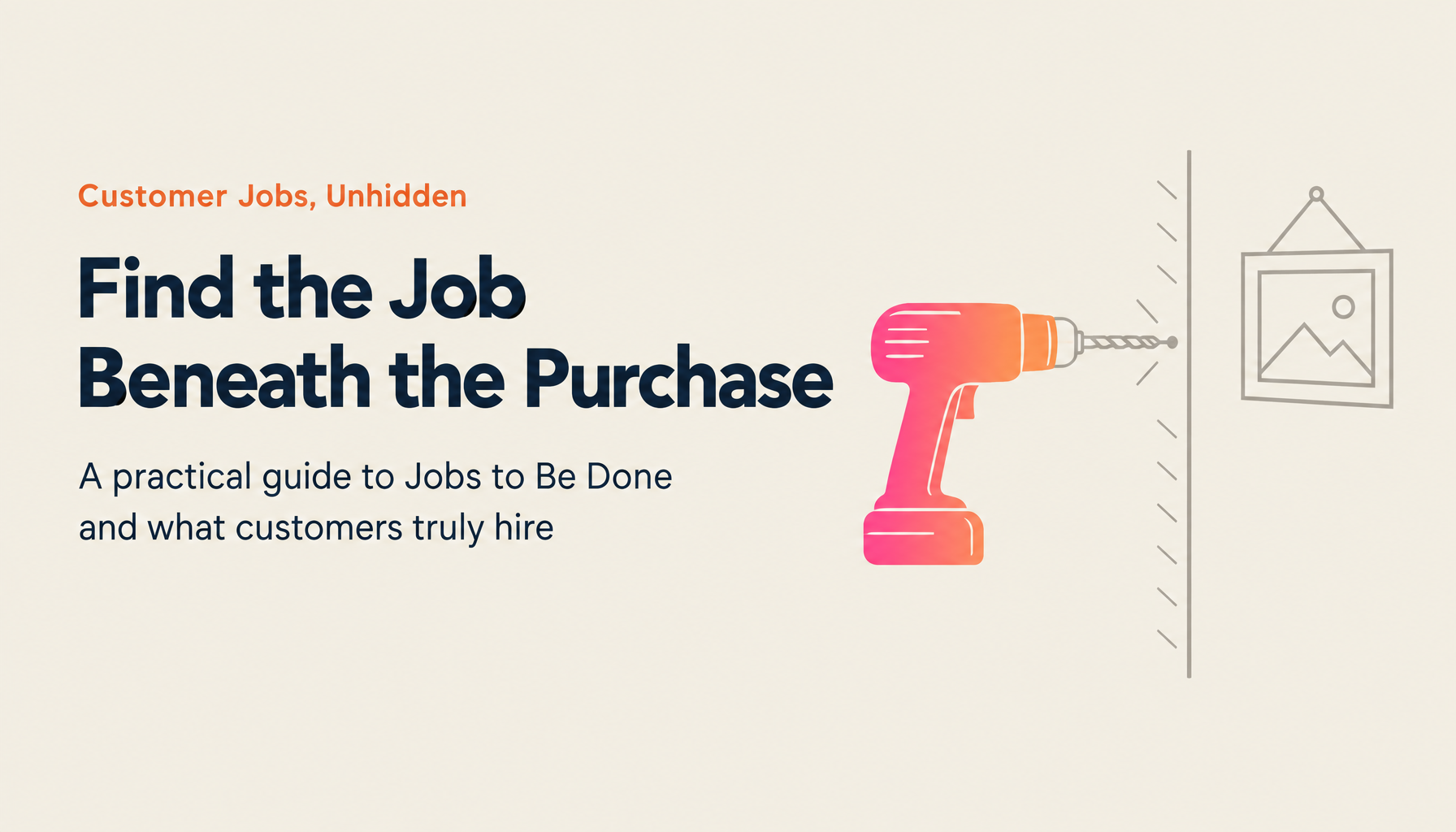
JTBD stands for Jobs to Be Done—literally, "jobs that need doing." Let me start with a famous analogy often quoted in marketing. Someone buys a drill at a hardware store. What does that person really want? Not a drill. What they want is a "hole" in the wall. That much is a familiar story, but JTBD digs one layer further. So why do they want the hole? Because they want to mount a shelf on the wall, display family photos, and sit down at the dinner table looking at them. In other words, the job that person handed to the drill was "to keep family memories somewhere always in view."
Once you take this view, you start to see that a product isn't something that gets "bought" but something that gets "hired." The customer is in a situation and wants to move it forward, so they hire something close at hand for the task. Today they hired a drill, but tomorrow they might hire adhesive hooks, or they might give up on displaying the photo altogether and set it as their phone's lock screen instead. Your competitors aren't necessarily other drills.
The famous milkshake study captures this feeling well. When a fast-food chain investigated why shakes sold in the morning hours, it turned out the buyers were people with long commutes by car. The job they were handing to the shake was "to be a companion that gets them through a boring, monotonous drive, a little at a time, with one hand." So the competition wasn't shakes from other chains—it was doughnuts that are gone too fast, or bananas that leave your hands sticky. There is no point in competing on taste. If the job being hired is "a companion for a boring commute," the battleground becomes how long it lasts until you finish it and how easily you can handle it one-handed.
The important thing here is that, in most cases, customers themselves can't put their own job into words. Ask the person who came to buy a drill "what do you really want to do?" and they usually stop at "well, I want to make a hole." So it falls to the maker to dive beneath the iceberg and dig up the real job. That digging is exactly what separates being able to use JTBD in practice from not.
Why "That's Nice" Is the Worst Thing You Can Hear
Whenever the topic turns to understanding customers, the interview failure from the opening always comes up. Everyone praised it, and no one bought. My view is that the moment a customer says "that's nice" in an interview, the information gained from that session is essentially zero. There are three reasons.
The first is that it costs nothing to say. Saying "that's nice" doesn't move the other person's wallet by a single yen, and it fills not one slot in their calendar. As long as it stays within the range of not hurting the person in front of them, people will hand out favorable words for free, endlessly. In Japanese business settings especially, there's a sense that flatly rejecting someone's idea to their face is far ruder. So the kinder the person, the more they praise you. The amount of praise is a measure of the other person's kindness, not a measure of demand.
The second is that it's a statement about the future. "I might use it" and "that would be handy to have" are nothing more than predictions about a self that hasn't arrived yet. People have a habit of painting their future selves as far more impressive than reality. It's the same as the day you bought a piece of exercise equipment, certain of a future in which you'd use it every day. In my experience, out of ten people who answer "I might use it," maybe one actually takes action. Nine out of ten well-meaning predictions miss.
The third is the scariest reason of all. Getting a "that's nice" stops the maker from learning. You mistake the praise for verified evidence and move on to the next stage, reassured. You've actually confirmed nothing, yet you feel as though you have. The person in charge from the opening was exactly this. Twenty interviews could have meant twenty lessons learned, but all twenty ended in satisfaction at "that's nice," and they moved on to development having learned nothing.
So what do you do? The answer is simple: stop collecting verbal Yeses and go get behavioral Yeses instead. Upfront payments, advance reservations, promises of a referral—with these, the other person's cost has actually moved. Because this principle applies across all of customer validation for a new business, the design of the interview itself is covered in detail in The Mom Test: Facing Your Customer Without Taking Praise at Face Value as well.
Looking for AI training and consulting?
Learn about WARP training programs and consulting services in our materials.
A Job Is Made of Three Layers: Functional, Emotional, and Social Roles
The key to escaping "it stopped at that's nice" is to break the job down and look at it. A job a customer wants done always has three layers: the functional role of what they want to achieve, the emotional role of how they want to feel, and the social role of how they want to be seen by others. Excellent businesses capture all three layers. Conversely, most businesses that don't work out talk only about the functional role and skip right past the emotional and social ones.
| Layer | The job the customer wants done | Milkshake example |
|---|---|---|
| Functional role | What they want to achieve | Satisfy hunger, consume it one-handed |
| Emotional role | How they want to feel | Relieve the boredom of driving, get a little enjoyment |
| Social role | How they want to be seen by others | Not look sloppy, not make a mess of the car |
Let me make this three-layer lens click with two real examples. One is the story of a babysitting business. The system was convenient, and functionally there was nothing to fault. Yet in interviews, everyone stopped at "handy." Digging deeper, the mothers' hearts were working with a sense of guilt—"leaving my child with a stranger?"—and an anxiety about appearances—"that household even farms their kids out to others." In other words, in the emotional and social layers, a strong brake was holding back the switch. So the business reframed it as an older sister with a licensed childcare qualification handling pickup and drop-off, adding reassurance, and limited the use case to just the two hours of going to a hair salon, lowering the guilt. The substance of the offering barely changed. Just by changing the layer it captured, the business started to turn.
The other is the story of a lacquerware craftsman in Kyoto. Carefully made vessels weren't selling well. The maker kept talking about function—"but the quality is the best there is." Yet when he listened to customers, the people who had bought the vessels were giving them as gifts for their mother's sixtieth birthday, or choosing them to commemorate a daughter's wedding. What they were truly hiring wasn't a "vessel," but "a medium that lets them give a shape to their love for family and hand it over." Once he noticed this job, the way he sold changed. Instead of the vessel itself, he began to talk about who it's for and with what feeling it's handed over. This isn't a special case because it's a traditional craft. Whether it's a business aimed at women or a straitlaced corporate product, the failure of talking only about function and overlooking the emotional and social roles happens with astonishing regularity.
The Three Questions That Dig Beneath the Iceberg, and the Job Story
So how do you dig beneath that iceberg? What I use is three questions. Ask them in order, and you naturally descend from the surface request to the real job.
The first is the situation question: What were you trying to do at that moment? The second is the motivation question: Once that was done, what did you want to do next? The third is the outcome question: What would have counted as it going well, in the end? Connect the answers to these three, and you get a single sentence: "When [situation], I want to [motivation], so that [outcome]." This is what we call a Job Story.
Get a feel for the translation with an everyday example. Suppose an accounting staffer says, "The month-end close in Excel is grueling." The surface job is "make Excel faster." Take that at face value, and you end up building a tool to speed up Excel. But dig with the three questions, and the situation was "at month-end, I spend three days reconciling numbers until late at night," the motivation was "I want to finish this work fast," and the outcome was "to win back those three days and eat dinner with my daughter." Connect them: "When the month-end close eats up three days every time, I want to shorten this time, so that I can win back the time to eat dinner with my daughter." The value that truly sells wasn't speeding up Excel, but winning back time with family. Even if you provide the same feature, which job you sell it toward completely changes how hard it lands.
Getting Your Hands Dirty with a Worked Example: A Fictional Toddler-Meal Subscription
From here, let me run JTBD through one full loop with a fictional business. The subject is "Kosodate-Gohan," a subscription for dual-income couples that delivers toddler dinners supervised by a registered dietitian, on weekdays at 6 p.m.
The first hypothesis was the usual entry point: "For busy dual-income mothers who can't cook dinner, deliver nutritionally balanced toddler meals for 20,000 yen a month." Ask ten mom friends, and all ten answered "nice, that's handy." The same scene as the opening failure. Sure enough, no one signed up.
So we re-dug beneath the iceberg with the three questions. The situation: "at 6 p.m. after coming home from daycare, exhausted, with zero energy to cook." The motivation: "I want to feed my child something proper." The outcome: "not to have to blame myself as a mother who cuts corners." As a Job Story: "When I get home from daycare at 6 p.m. with no energy to cook, I want to feed my child something proper, so that I don't blame myself as a mother who cuts corners." Now let's split the job into three layers.
| Layer | The job the customer wants done in Kosodate-Gohan |
|---|---|
| Functional role | Prepare a weekday dinner, secure nutritional balance |
| Emotional role | Erase the guilt of not being able to cook by hand, feel the relief of having made it through another day |
| Social role | Not be seen as a household that only serves ready meals, have food they can write about with pride in the daycare notebook |
What came into view was a structure in which, functionally, everyone wants it, but the moment they go to buy "convenience," a self-denial and a concern for appearances—cutting corners, outsourcing—kick in as a brake. This is the true identity of "it stopped at handy."
So, leaving the substance of the offering almost unchanged, we rebuilt only the appeal. We dropped "time-saving delivery" and switched to "a half-prepared kit where a registered dietitian thinks through the nutrition for you. Mom or Dad just plate it and add the final touch." By leaving the sense of having finished it with your own hands, we lowered the guilt, and by adding a path to post photos of the finished dish in the daycare notebook, we satisfied the social role too. The result: even with almost the same function, sign-ups started coming in. All we changed was the layer of the job we captured. In terms of the earlier Excel example, this is exactly the same structure as not building "Excel speed-up" but selling "shortening the three days of month-end so you can win back time to eat dinner with your daughter."
This iceberg-digging work speeds up dramatically when you use AI as a sparring partner. Here is a prompt that hands it the customer's remarks and your business and has it produce hypotheses for the real Job. Replace the bracketed parts with your own subject and paste it in as is.
You are an expert JTBD (Jobs to Be Done) coach who supports customer
understanding for new businesses. I'll give you my business and a remark
I actually heard from a customer.

- My business (one line): [e.g., a toddler-meal subscription for dual-income households]
- The customer's surface remark: [e.g., I'm struggling because I have no time to cook]
- The customer's attributes/situation: [age, occupation, family makeup, the scene where the remark came up]

Please output the following.
1. The "surface Job" of this remark, plus three hypotheses for the "real Job"
   likely hidden beneath it, each with its reasoning.
2. Each hypothesis as a single sentence in the Job Story form
   "When [situation], I want to [motivation], so that [outcome]."
3. One "wrong solution" you might build if you took this remark at face value.
4. Five questions to ask in the next interview to verify the real Job, of the
   "past, concrete, other-person-as-protagonist" type. Future hypotheticals
   (would you use it if there were ...) are forbidden; make them questions
   that draw out concrete past behavior.
Interviews and AI Validation: A Collection of Copy-and-Paste Prompts
Once you have your Job Story hypotheses, go meet actual customers and verify them. The iron rule here is to ask only about concrete episodes that genuinely happened within the last month, and to not utter a word about your own idea for the first thirty minutes. The instant you explain your idea, the other person enters idea-evaluation mode and the switch that returns "that's nice" flips on. So at first, ask only about the person's life and their past behavior. You start from questions like "When was the last time you did that task?" and "What triggered you to start on that day?"
When crafting questions, keep five rewrite directions in mind: ask about behavior, not opinion; ask about the past, not the future; ask about specifics, not abstractions; make the other person the protagonist rather than talking about yourself; and go for a behavioral Yes rather than a verbal Yes. These five essentially determine the quality of your questions. Having AI proofread your own question list against these principles raises the precision.
You are a reviewer of customer interview design. You are well-versed in JTBD
and in the principles of interviewing without taking praise at face value.
Please proofread my question list one question at a time.

- My question list:
"""
[Paste your questions here. e.g., Do you think it would be handy if AI
automatically categorized your receipts?]
"""

For each question, output the following as a table.
| Original question | Verdict (OK/NG) | Type of NG (opinion / future hypothetical / abstract / self-talk / leading verbal Yes) | Rewritten question |
Additionally, for each row, state which of the five rewrite directions
(opinion -> behavior / future -> past / abstract -> concrete / self -> other /
verbal Yes -> behavioral Yes) you used to fix it.
Across the whole list, flag any "question that hints at my own idea."
Finally, from the rewritten questions, produce a 60-minute guide draft
arranging 8-10 questions in the order
"situation -> function -> emotion -> social -> alternatives -> early signs."
Once you've recorded an interview, load in the transcript and structure it. The forbidden move here is summarizing remarks in your own words. Summarizing erases the person's raw nuance and the living voice you could later use in a pitch. Pulling out quotes word for word is something AI is good at, so let it handle that.
You are an assistant for customer interview analysis. Read the transcript
below and structure it.

- Pseudonym / segment attributes: [ ]
- My prior hypotheses: H1:[ ] H2:[ ] H3:[ ]
- Full transcript:
"""
[Paste here]
"""

Output format:
(1) Five verbatim quotes, word for word, ordered by the strength of emotional
    movement. For each, one line on "why it matters." Summarizing or rephrasing
    is forbidden.
(2) Job Stories in the form "When [situation], I want to [motivation], so that
    [outcome]," one each for the functional, emotional, and social layers.
(3) This speaker's pain score (1-10), with three supporting remarks
    (three kinds: frequency, impact, emotion).
(4) For each of H1, H2, H3, judge "confirmed / disconfirmed / neutral / not
    mentioned," and quote the supporting remark.
(5) At least two remarks that contradict the prior hypotheses. If there are
    none, state "none applicable" explicitly; do not silently omit this.
(6) Three unresolved points to verify in the next interview.
If you fall into the state of good reactions but no one signs up, you can diagnose the cause by breaking the purchase decision into four forces. The four are: the current dissatisfaction (Push), the pull of a new solution (Pull), the inertia of the existing one (Habit), and the anxiety of switching (Anxiety). Adoption happens when "Push + Pull" outweighs "Habit + Anxiety." You pin down which of these four is the true identity of "it stopped at that's nice."
You are an expert who diagnoses purchasing and switching with the four forces
(Push / Pull / Habit / Anxiety). You break down the state of
"good reactions but no one buys."

- Business: [e.g., a site-photo AI daily-report app for small construction firms]
- Assumed customer and their current alternative: [e.g., the owner, currently uses chat and handwritten daily reports]
- Remarks heard in interviews so far (praise, concerns, excuses, etc.):
"""
[Paste here]
"""

Output:
1. Classify the remarks into the four—Push (current dissatisfaction),
   Pull (expectation of the new solution), Habit (inertia of the existing one),
   Anxiety (worry about adopting something new)—in a table.
2. Against "Push + Pull > Habit + Anxiety," diagnose which force is currently
   lacking or too strong.
3. Conclude whether the true identity of "it stopped at that's nice" is
   weak Push / weak Pull / strong Habit / strong Anxiety, and quote the
   supporting remarks.
4. Three most effective moves (e.g., if Anxiety is the culprit, onboarding or a
   money-back guarantee that erases the worry).
5. Propose the next behavioral Yes to go after (an upfront payment, an advance
   reservation, or a promise of a referral).
Reading this far, you might feel it leans too much on AI. The line is clear. What you can leave to AI is transcription and first-pass analysis. Pulling out quotes, shaping them into Job Stories, scoring the pain—this sort of thing is done in ten minutes. Work that used to take hours has become dramatically faster. On the other hand, the moment you hand off to AI what the real emotion behind a remark is, and what to go verify in the next interview, the business becomes someone else's problem. The very act of reaching for the customer's heart is the part you must not let AI stand in for. In our AI consulting service WARP, too, we build these prompts together with new-business teams while always drawing the line that says: from here on, humans take over.
Common Failures, and How to Get Out of Them
Finally, let me share the stumbles I've seen over and over in the field, paired with their remedies. When you feel your interviews aren't going well, it's usually one of these.
The most common is explaining your own idea first. The other person enters evaluation mode, and the kinder they are, the more they praise you. Seal the idea away for the first thirty minutes and ask only about the person's past behavior. Next most common is asking a future hypothetical like "would you use it if there were ...?" People paint their future selves as cooler than reality, so the answers are almost useless. Rewrite them into concrete past behavior: "When was the last time you did that task?" and "How much did you pay recently for a similar purpose?"
Digging only into the functional role and ignoring the emotional and social roles is another frequent failure. Traditional crafts, businesses aimed at women, straitlaced corporate products—all of them get tripped up here across the board. Always pass through the three-layer lens and put into words how they want to feel and how they want to be seen by others. Building a solution off the surface Job comes from the same root. Before you take "I hate Excel" at face value and build an Excel speed-up tool, dig with the three questions all the way down to "I want to eat dinner with my daughter." Skip this, and what comes out is something nobody wants.
At the analysis stage, watch out for the failure of summarizing remarks in your own words and the failure of handing off even the interpretation to AI. Preserve verbatim quotes word for word, and separate interpretation into a different column. Keep the interpretation and the next move in your own hands. And don't take an n=1 anecdote at face value. A story that moved one person's heart is compelling, but what becomes a business is only a pattern where the same job recurs across five or more people. Confirm the saturation point where no new pain comes up, and only then move on. Let me say it one more time: don't mistake the praise of "that's nice" for evidence and march on to development. What you go after is a behavioral Yes—an upfront payment or an advance reservation.
Summary
- Customers don't "buy" a product; they "hire" it to move a situation forward. JTBD is about finding the job they want done, hidden beneath the surface request.
- A job is made of three layers—functional, emotional, and social. Don't stop at asking about function; dig into how they want to feel and how they want to be seen, and the value that sells best comes into view.
- Dig beneath the iceberg with three questions—situation, motivation, outcome—and cast it into a Job Story: "When [situation], I want to [motivation], so that [outcome]."
- Verify not a verbal Yes but a behavioral Yes. Leave transcription and first-pass analysis to AI, and keep the interpretation of emotion and the next move in your own hands.
Understanding customers is decided not by knowledge of frameworks, but by whether the face of one particular person comes clearly into view. In what situation is the person you're going to meet today, what do they want to get done, and why would they hire your business? When you can say that in a single sentence, the business finally gets its feet on the ground. If you want to unearth your customers' jobs on your own subject, and to make AI a partner in building your business, reach out through a one-on-one WARP consultation. We'll work through your first Job Story together, hands on.
References
Related Articles
- The Complete Guide to New Business Frameworks: Nine Steps from Idea to Business Plan
- The Mom Test: Facing Your Customer Without Taking Praise at Face Value
- The Customer Problem Empathy Map: Visualizing What Customers Really Think
- How to Write a Value Proposition Canvas: Connecting Customer Problems to the Value You Offer