Hello, this is Ryuta Hamamoto from TIMEWELL.
"Even if you never ship a product overseas, the way you provide software or technology can bring it under export controls." "SaaS and cloud services have actually been classified as strategic items." Several Korean news outlets reported that a researcher from the agency that runs Korea's export control practice said this at a briefing in Seoul on November 2612. One outlet added that Korean companies are struggling with how to respond1.
It is easy to read this as "Korea has created a new regulation." Go back to the statute and the notice, though, and the picture looks rather different.
Who this is for: companies with subsidiaries, development centers, contractors or joint research partners in Korea; companies using SaaS or AI services from Korean providers; companies sending design data or software into Korea; and the export control and IT people at all of them. I write from Japan, so my examples use Japanese companies, but the questions are the same if you are based in the US, Europe or Taiwan.
In one sentence: Korea has long treated handing technology to another country, or to a foreign national, as an "export" even when it happens by email or on a screen, with nothing put on a ship. On November 26, the authorities explained once more that this rule can reach SaaS, cloud and AI services.
Why now: the US put its remote access rule into force on November 19, and governments everywhere are looking harder at AI used over the network. In Korea, proposals were also made to revise classification guidelines and laws to fit how services are delivered. This is the moment to map which of your transactions could be caught, before any rule changes.
First, five terms that come up throughout.
| Term | In plain words |
|---|---|
| Strategic items (전략물자) | Goods, software and technology that need a license to export from Korea. Close to "listed items" under Japan's FEFTA, or CCL-controlled items under the US EAR |
| Strategic item classification (전략물자 판정) | Checking whether a good, piece of software or technology is a strategic item. The counterpart of Japan's gaihi hantei, or of classifying against the CCL |
| Expert classification and self-classification | Expert classification is a ruling from a designated classification body. Self-classification is done in-house |
| Technology transfer (기술 이전) | Handing technology to another country or to a foreign national, including by email, verbally or through a computer |
| KOSTI (무역안보관리원) | The Korean Security Agency of Trade and Industry, which handles classification and related work. Until August 2024 it was the Korea Strategic Trade Institute (전략물자관리원) |
The short version
- Korea's statute and notice did not change this time. The Foreign Trade Act counts moving technology "from Korea to another country" or "from a Korean to a foreign national" as an export, and the Enforcement Decree covers transfers over networks such as email, oral transfers, and transfers through computers34.
- There is no stand-alone control item for SaaS. The researcher reportedly said SaaS is classified against existing criteria such as encryption, and that some SaaS has in fact been classified as a strategic item12.
- For technology, in principle only an expert classification from a designated body counts. A wrong self-classification can be punished as an unlicensed export, which is why the researcher recommended expert classification25.
- Japan set out how to classify SaaS in a 2013 Q&A. The US treats SaaS as no export of the software, but controls compute rental as a condition on chip exports. Same "use it from abroad," three different lines6789.
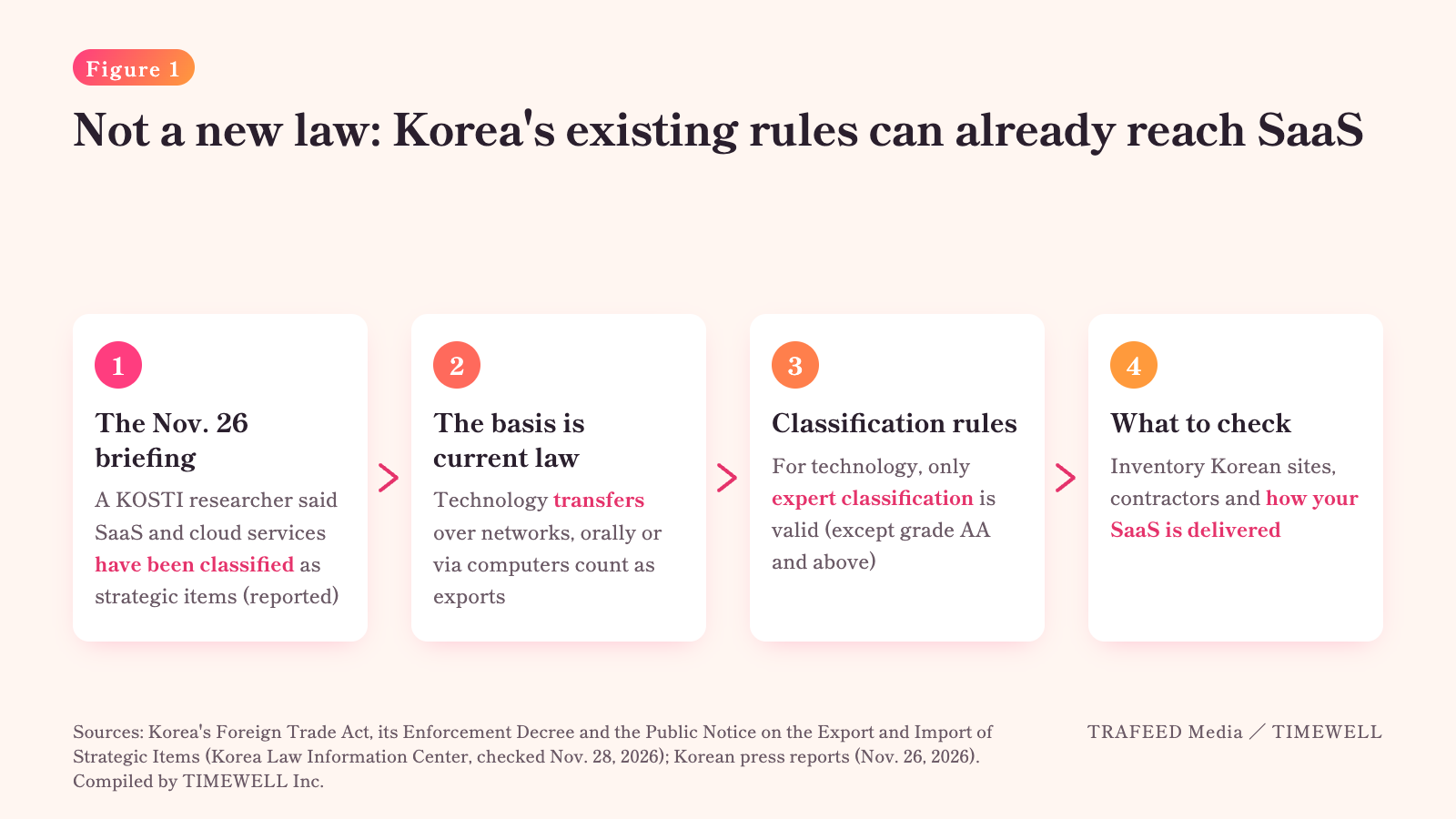 Figure 1. From the news to day-to-day practice. Read left to right: what was reported, the law behind it, the classification rules, and what companies should do. Sources: Korea's Foreign Trade Act, its Enforcement Decree and the Public Notice on the Export and Import of Strategic Items (Korea Law Information Center, checked Nov. 28, 2026); Korean press reports (Nov. 26, 2026)
What was said at the November 26 briefing
The bottom line: this was not a change in the law. It was a researcher from the agency side explaining how existing rules apply, and a university researcher proposing changes to the system.
The event was called the "AI and SW Strategic Items Export Control System Briefing" and took place at a hotel in Gangnam, Seoul. It was organized by KOSA, the Korea Artificial Intelligence and Software Industry Association (한국인공지능·소프트웨어산업협회); some reports said it was co-hosted with the National IT Industry Promotion Agency (NIPA, 정보통신산업진흥원)110. The speakers were Kim Young-woo (김영우), a senior researcher at KOSTI, and Professor Lee Tae-jin (이태진) of Sungkyunkwan University.
Three points from Kim's talk drew attention. First, depending on how software or technology is provided, it can fall under export controls even if no product is shipped abroad. Second, there are cases where KOSTI has classified SaaS and cloud services as strategic items. Third, Korea does not treat SaaS as a separate control item; it judges SaaS against existing criteria such as encryption functions12. He also said that simply using encryption does not make a service controlled, and that there are many exceptions, such as user authentication, tamper prevention and mass-market products111.
Lee pointed out that today's export control framework grew up around installed software. He interviewed five companies in enterprise software, AI chips, generative AI and network security, and reportedly found that almost none had been through a strategic item classification for AI functions or services10. He argued that the question should be less "who are we selling to" and more "who does the service reach, and what is it used for." His proposal was staged: in the short term, fill gaps in classification guidelines and explanatory materials; in the medium to long term, use the notice to spell out function-level classification and criteria for reclassification, and consider in the law how obligations should be shared between service providers and cloud or intermediary operators111.
Picture a Korean software company that hosts an AI document analysis service in a Seoul data center and lets customers in Japan and Southeast Asia use it through a web screen and an API. Not a single line of code is sent abroad. Even so, if an encryption function built into the service falls under the control list, and the design lets technology reach the user, the service can be subject to classification. That is the kind of situation the briefing was asking companies to prepare for.
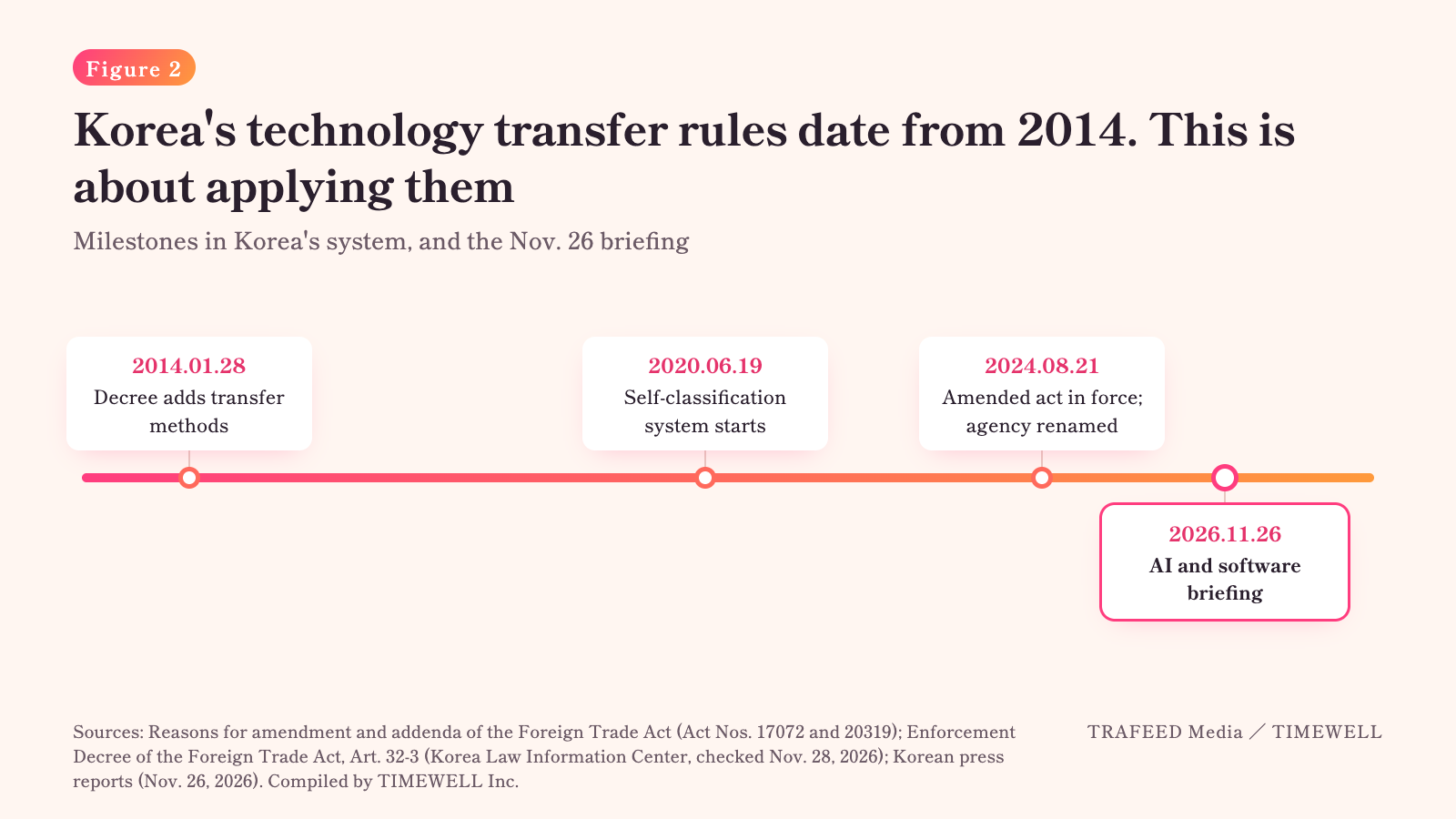 Figure 2. Milestones in Korea's system and the November 26 briefing. The 2014 amendment to the Enforcement Decree on the far left shows that rules on how technology is transferred were already in place. Sources: reasons for amendment and addenda of the Foreign Trade Act; Enforcement Decree of the Foreign Trade Act, Art. 32-3; Korean press reports (Nov. 26, 2026)
Controls on the goods side have also been tightening. On September 1, Korea amended its Public Notice on the Export and Import of Strategic Items to reflect more than 80 changes agreed in the international export control regimes. AI integrated circuits (3A501.a.16) are now caught on a single test, total processing performance (TPP) of 6,000 or more, with the input/output speed condition removed12. Korea's software industry association reportedly published a guide in February 2024 with KOSTI's predecessor that covered overseas examples for new forms of software such as SaaS13, so this topic did not come out of nowhere.
So the accurate way to read the news is not "a new regulation was announced," but "the agency and industry checked together whether the existing net has kept up with how software is now sold."
Replace siloed classification work with AI.
METI's FY2024 data shows 52% of foreign exchange law violations stem from classification errors. Download the TRAFEED product catalog covering features and rollout.
What counts as an export under Korean law
In Korea, an "export" is not just a parcel crossing the border. Software becomes an export through how it is sent; technology becomes an export through who receives it and how.
Start with the Foreign Trade Act. It defines the subjects of trade as goods, services specified by presidential decree, and electronic intangibles specified by presidential decree3. The Enforcement Decree says that a resident handing intangibles to a non-resident, including by transmission over an information and communication network, is an export, and lists software first among those intangibles4. If you let an overseas customer download your software, that is an export.
Technology is drawn even more widely. An amendment to the Foreign Trade Act in July 2013 (in force January 2014) added "intangible transfers" of technology, such as by email or social media, to what requires a license3. In the current text, Article 19-2 counts two kinds of transfer as exports of strategic technology. One is a "transfer from Korea to another country." The other is a "transfer from a Korean (including a corporation established under Korean law) to a foreign national (including a corporation established under foreign law), whether in Korea or abroad"3. Article 32-3 of the Enforcement Decree then lists three methods of transfer: transfer over information and communication networks such as phone, fax and email; transfer orally or by conduct, such as instruction, education, training and demonstration; and transfer through recording media such as paper, film, disks and semiconductor memory, or through information processing devices such as computers4. That article was added in January 2014. Both the Act and the Decree fall under the Ministry of Trade, Industry and Resources, which was reorganized from the Ministry of Trade, Industry and Energy on October 1, 20253.
The other key piece is how the destination is set. The Public Notice on the Export and Import of Strategic Items says that, for exports of software and technology, the final destination country is the country of nationality of the person who actually uses it, or of the person who receives it for resale5. The destination is decided by who the user is, not by where the server sits. In my view, this is the single most important point when you think about "access from abroad."
Say a development center in Seoul keeps design documentation that falls under the control list on an internal server, and both engineers at the parent company in Japan and foreign nationals working at the Seoul center can open it. On the face of the statute, the first case can be a transfer from Korea to another country, and the second a transfer within Korea from a Korean corporation to foreign nationals, and both can need a license. Because the statute is written in terms of nationality, I read it as counting foreign employees working inside Korea as foreign nationals too.
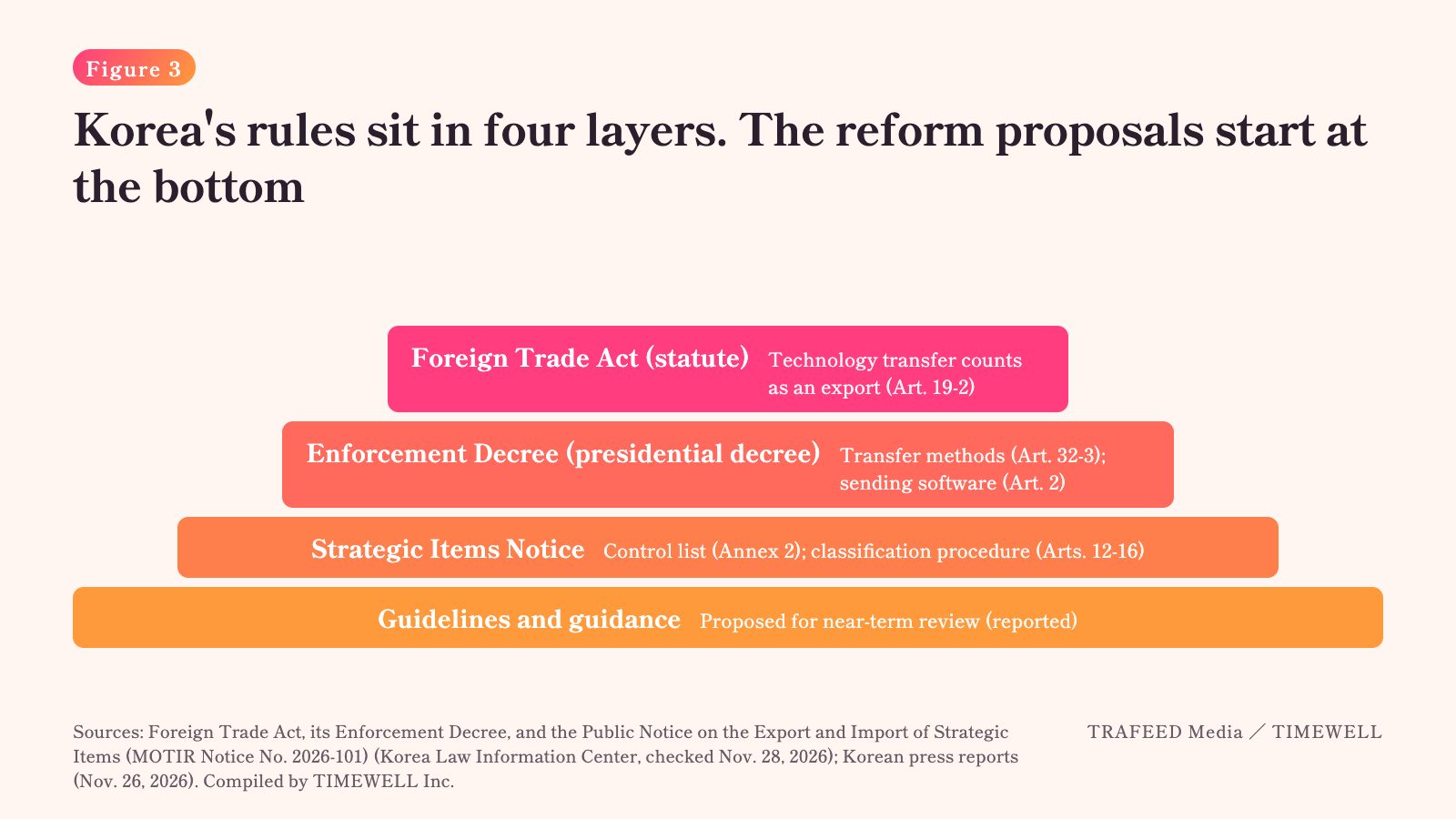 Figure 3. The layers of Korea's rules. The higher the layer, the more it sets out principles; the lower, the more it sets out procedure. The reform proposals start with the guidelines at the very bottom. Sources: Foreign Trade Act, its Enforcement Decree, and the Public Notice on the Export and Import of Strategic Items (Korea Law Information Center, checked Nov. 28, 2026); Korean press reports (Nov. 26, 2026)
There are exceptions. The Decree and the Notice exclude from licensing technology that is publicly available (including programs whose source code is published), technology from basic scientific research, the minimum technology needed to file a patent application, and the minimum technology needed to install, operate or maintain licensed goods45. Separately, exports of "national core technology" developed with government research funding need approval under Article 11 of the Act on Prevention of Divulgence and Protection of Industrial Technology, and once approved they are deemed licensed under the Foreign Trade Act14. For an overview of the whole Korean system, see South Korea's strategic goods export controls explained.
In short, in Korea you cannot say "the server is in Korea, so it is not an export." What matters is who can see what, and with which nationality.
What gets classified in SaaS, APIs and AI models
It is not as simple as "SaaS is controlled." The order is: split by delivery model, work out what actually lands with the user, and check that against the control list.
The Notice divides what can be classified into three: goods, electronic intangibles such as software, and technology5. The control list (Annex 2) follows the structure of the international regimes, with software coded D and technology coded E. Kim also said software and technology are separate fields and are classified separately11. Software with encryption functions is checked against the information security category of the list and the cryptography note that carves out mass-market products and similar items5.
Lee reportedly broke AI services down into installed software, on-device models, web and app SaaS, APIs, dedicated customer environments, deployment into the customer's own environment (BYOC), distribution of model weights, fine-tuning services, integration with external tools, and AI agents11. Figure 4 is our own regrouping of that list. It is not the result of any official classification.
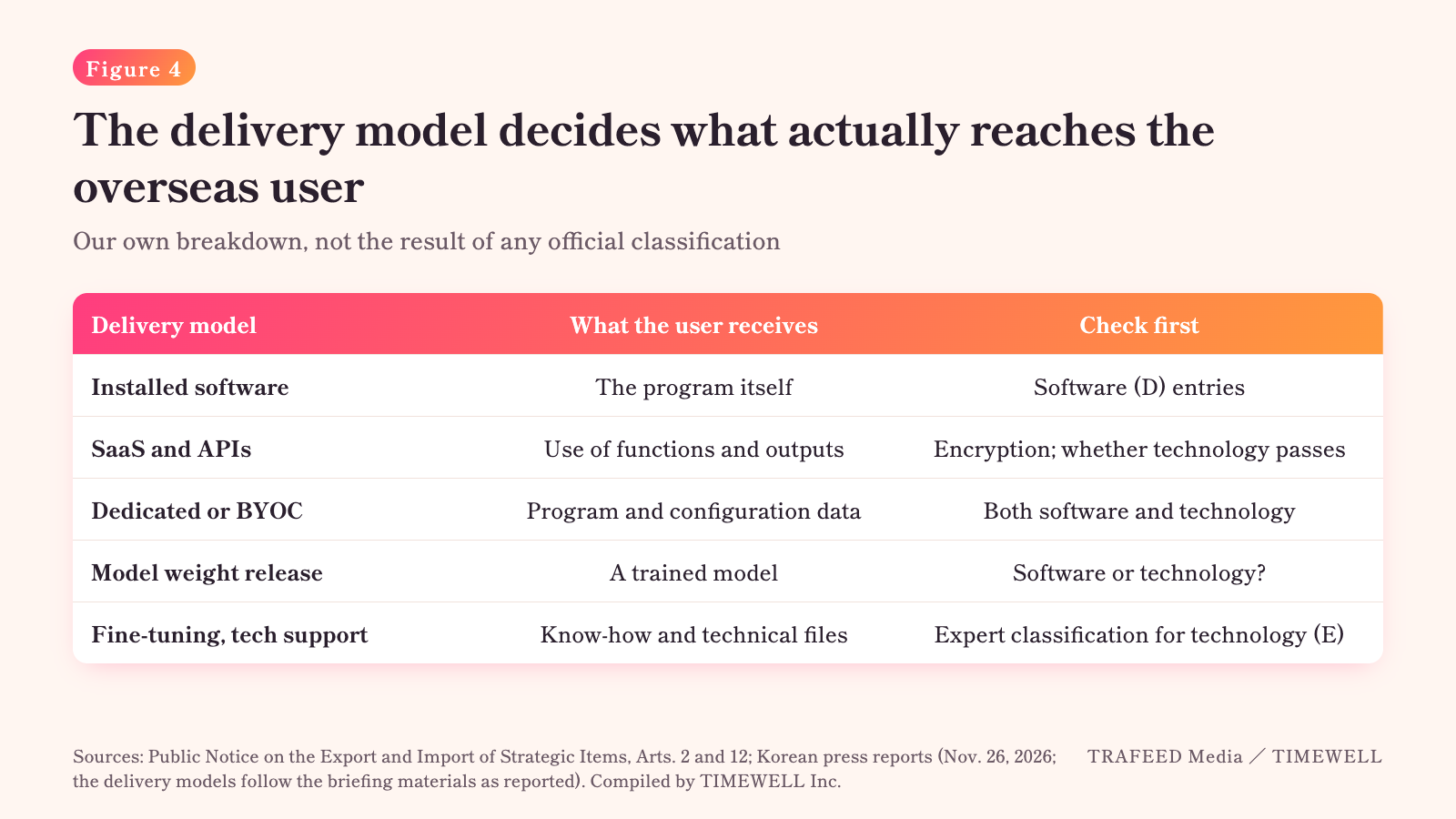 Figure 4. Delivery models and what reaches the overseas user. Toward the top, the program itself is handed over; toward the bottom, the technology itself is. Sources: Public Notice on the Export and Import of Strategic Items, Arts. 2 and 12; Korean press reports (Nov. 26, 2026), as organized by TIMEWELL
Here is an example. A Japanese company's Korean subsidiary offers a file-sharing SaaS with encryption to customers in Southeast Asia. If customers only use the functions on screen, what reaches them is the use of those functions and the results. If, as part of onboarding, the subsidiary hands over documentation on how the encryption is implemented, or deploys the program into the customer's environment, what reaches them changes. Kim said that adding new encryption functions after a classification, or adding functions beyond the scope of the original classification, requires reclassification, while performance improvements and bug fixes do not12.
Classification proceeds in the five steps in Figure 5.
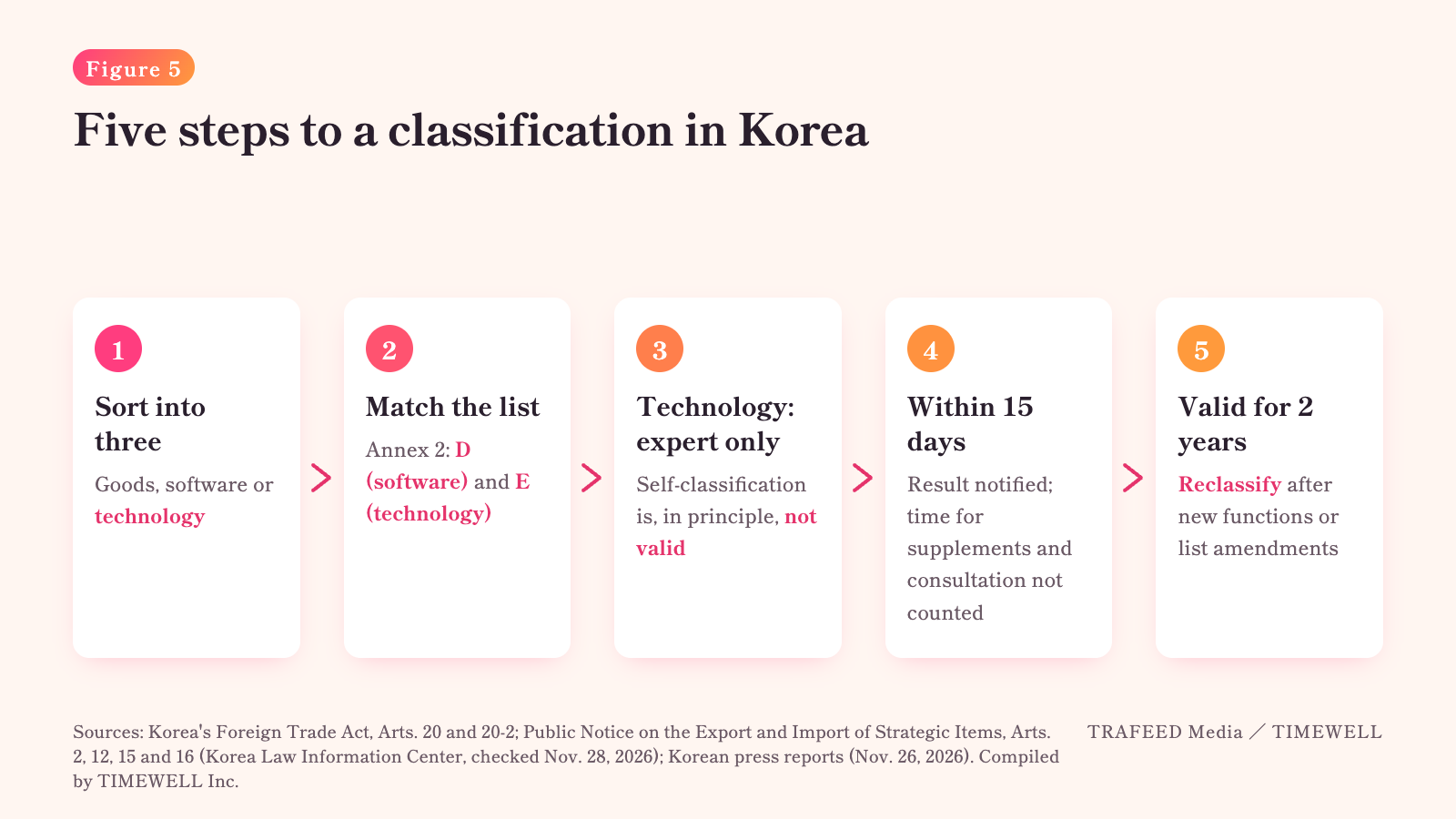 Figure 5. How a classification goes through in Korea. Note the third step: technology alone cannot be settled with your own classification. Sources: Foreign Trade Act, Arts. 20 and 20-2; Public Notice on the Export and Import of Strategic Items, Arts. 2, 12, 15 and 16
The Foreign Trade Act provides for expert classification by a designated body (Article 20) and self-classification by companies that have completed training (Article 20-2)3. For technology, though, self-classification is not available except to companies recognized with a voluntary compliance grade of AA or higher, and the Notice also says only expert classification is treated as valid for technology35. As a rule, expert classification results are issued within 15 days of receipt, not counting time spent on expert consultation or on supplementing documents. A ruling is valid for two years from its date and lapses as soon as the control list criteria change in substance5. According to press reports, expert classification is free and takes about 15 business days, and the researcher recommended applying at least a month before export2. On cost, the Notice is drafted so that the classification body can set fees, so check case by case5.
The penalties are heavy. Exporting strategic items without a license carries up to five years in prison or a fine of up to three times the value of the goods. If the purpose is proliferation, it is up to seven years or five times the value3. The researcher's warning that a wrong in-house classification can be punished as an unlicensed export points to these provisions2. KOSTI's own guidance on self-classification also cautions that products carrying cryptographic software can produce incorrect results15.
So even a SaaS product that "just lets people use functions" can come out differently depending on its encryption functions and whether technical documents or support reach customers in operation. Rather than reclassifying with every release, it is easier to run in practice if you reclassify whenever the encryption functions or the delivery model change.
How Korea's line compares with the EAR and Japan
All three countries start from the same place: technology is controlled like goods. Where they part ways is SaaS and compute.
If you work under the EAR, start with the US. The EAR treats a shipment or transmission out of the country as an export, and treats releasing technology or source code to a foreign person inside the US as a "deemed export" to that person's most recent country of citizenship or permanent residency16. On SaaS, BIS answered in an advisory opinion of January 13, 2009 that a service providing computing capacity is not itself subject to the EAR, because neither software nor technology is sent to the user7. In an advisory opinion of November 13, 2014, it said that letting users run software in the cloud does not export the software, although technology can still be exported8.
On top of that, the rule the US put into force on November 19, 2026 requires a license to export advanced chips when you know they will go to a data center that supplies more than 12 million TPP of compute in total to companies headquartered in Country Group D:5 (which includes China) or Macau, including companies whose ultimate parent is headquartered there9. The preamble calls this a "logical extension" of existing controls. The US did not define remote access itself as an export; it built the issue into the conditions for exporting chips. A House bill that would put remote access under export controls by statute (H.R. 2683) passed the House in January and has sat in a Senate committee since17. For more, see the US remote access rule and neoclouds and the RASA bill compared with Japan's FEFTA.
Here is the same comparison from the point of view of someone who knows the EAR.
| Question | Under the EAR | Under Korea's rules |
|---|---|---|
| Does letting overseas users run your software on your servers export the software? | No, per the 2009 and 2014 advisory opinions (technology can still be exported)78 | No separate SaaS category. Functions such as encryption are classified against the existing list, and some SaaS has been classified as a strategic item (reported)12 |
| Whose country counts as the destination? | Release to a foreign person in the US is deemed an export to that person's country16 | For software and technology, the country of nationality of the actual user5 |
| Is renting out compute controlled? | Indirectly, through the license requirement on advanced chips in §744.249 | No specific provision found |
| Who classifies? | The exporter, or BIS on request | For technology, a designated body by expert classification, in principle within 15 days and valid for two years5 |
The practical upshot for a US company with a Korean entity: an arrangement that BIS has said does not export the software can still need a look under Korean law if the Korean entity runs it, because Korea asks what functions and technology reach the user and checks the user's nationality.
Japan has its own design. Article 25 of the Foreign Exchange and Foreign Trade Act (FEFTA) requires a license from the Minister of Economy, Trade and Industry for transactions that provide controlled technology in specified countries, or to non-residents of specified countries. It can also impose license requirements on exports of recording media and on transmission by telecommunications18. Where Korea draws the line by nationality, Japan draws it by residency, and it has made clear that providing technology to people under strong foreign influence is also controlled. The basics are in deemed exports and the "specified categories" in five minutes.
Japan also set out its thinking on SaaS early. METI's technology Q&A has eight questions on cloud computing dated June 26, 2013. The answer is to classify the application functions available to the service's users the same way as if they were sold on a CD-ROM, and that the OS, middleware and communications encryption running in the background and not directly related to the service need not be classified. Storage used only to keep data is not a service transaction even if the server is abroad6. How Japan's service transaction rules work is covered in a beginner's guide to service transactions.
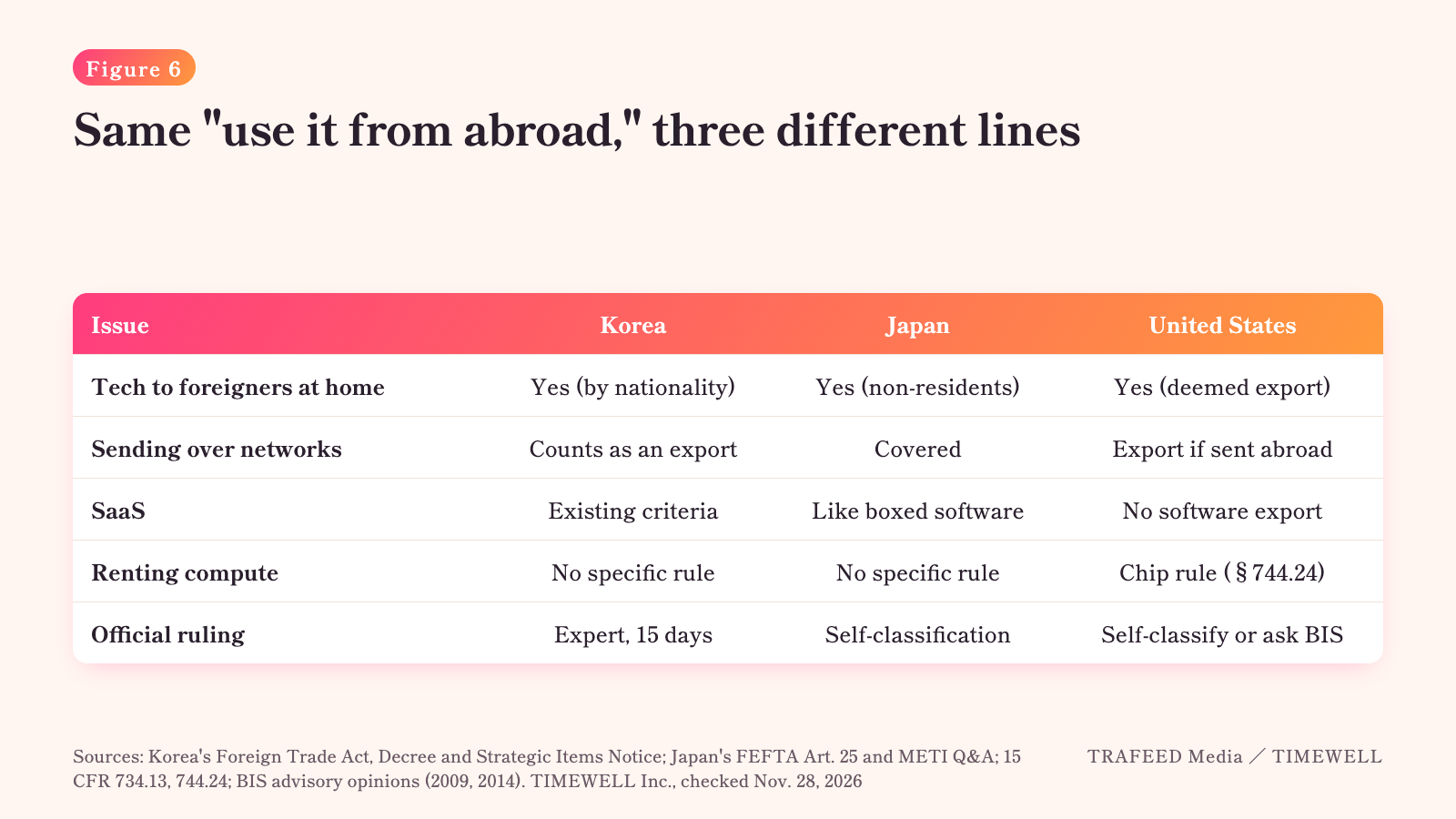 Figure 6. Three countries compared. The top two rows are nearly the same in all three; the differences show up in the bottom three. Sources: Korea's Foreign Trade Act, its Enforcement Decree and the Public Notice on the Export and Import of Strategic Items; Japan's FEFTA Art. 25 and METI's technology Q&A; 15 CFR 734.13 and 744.24; BIS advisory opinions (2009, 2014)
Personally, I see Korea's move as heading toward the Japanese model, which classifies the functions provided, rather than the US model, which draws the line by volume of compute. The professor's proposals center on function-level classification and clearer exception criteria (this is my own view). Whichever way it settles, each government is drawing its line according to its own view of security. The job on the practitioner's side is not to decide whose line is right, but to check where your own service touches each of the three.
What companies with Korean operations should check
Here is how this looks from Japan, as one example. The impact on Japanese companies splits three ways depending on how they deal with Korea, and the counterpart you check with changes accordingly. Companies elsewhere can apply the same split.
The first group has subsidiaries, development centers, contractors or joint research partners in Korea. Korean law governs what the Korean side does. If employees at the Japanese parent or in third countries view technology held by the Korean entity on Korean servers, that can be a transfer from Korea to another country, or a transfer from a Korean corporation to foreign nationals. Start by listing the technical files on servers at Korean sites and the nationalities of the people who can open them, and confirm whether the Korean side has obtained expert classification. The September 1 amendment to the Notice also wrote in an exporter's duty: if, after export, the counterparty asks for consent to resell, re-export or re-provide abroad, the exporter must consult the licensing authority19. It is worth checking whether contracts with Korean contractors and research partners address onward provision to third parties.
The second group uses SaaS or AI services from Korean companies. My reading is that the license obligation under Korean law sits with the provider. Even so, expect more requests from providers to confirm users' nationality and end use, so they can classify or apply for licenses. In the other direction, if you entrust your own controlled technology to a Korean SaaS, that is a question under Japan's FEFTA. Check first whether the service is purely for storage, and whether the contract lets the provider view the contents6.
The third group sends technology or software from Japan to Korea. That includes letting Korean customers use Japanese SaaS. The first step is to classify it as a service transaction under FEFTA. And if a Korean data center runs advanced US chips, check the EAR separately, because the US rule is not limited by country9.
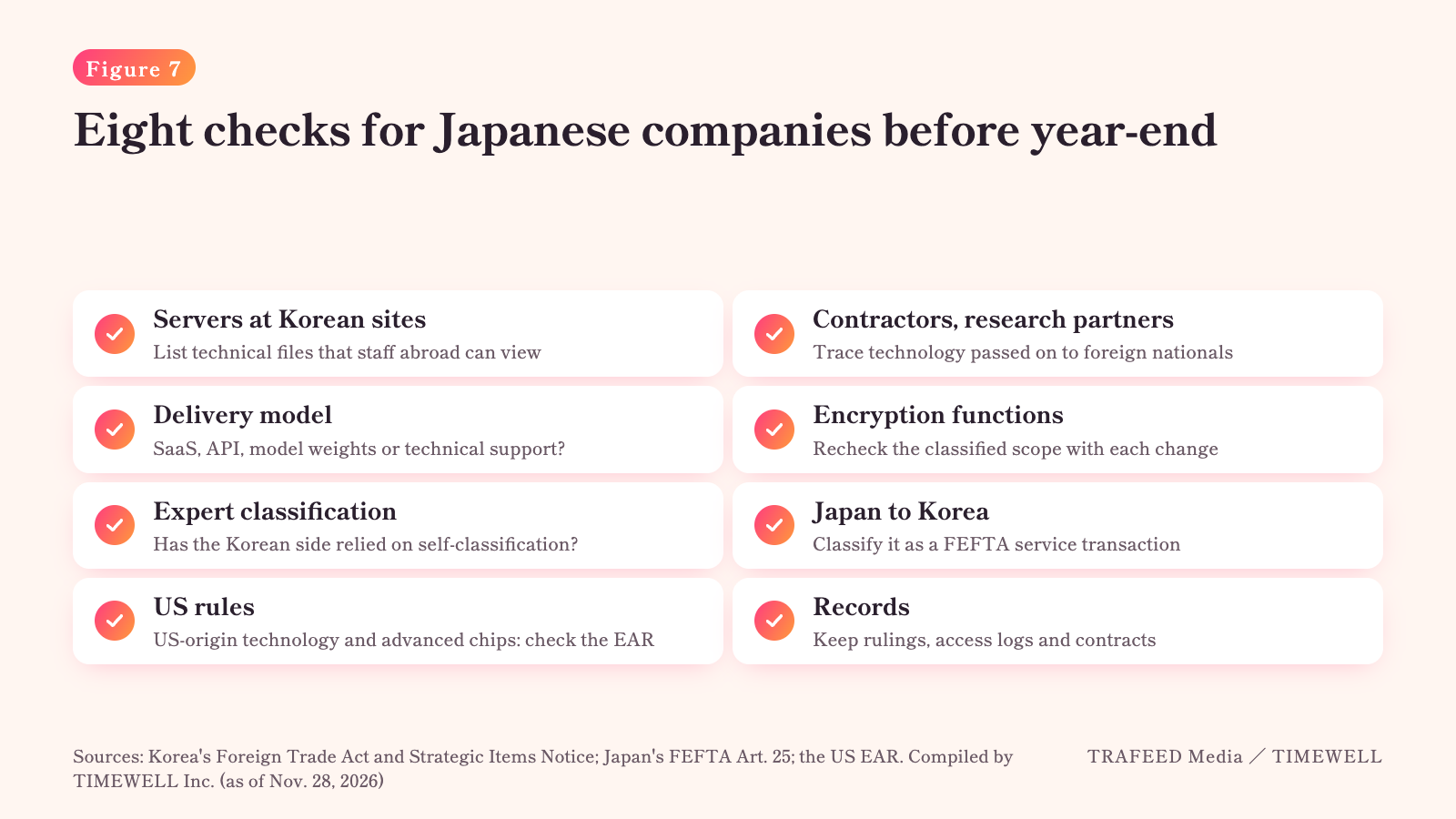 Figure 7. Checks for Japanese companies. The left column is mostly about acts on the Korean side; the right column mostly about Japanese and US rules. Sources: Korea's Foreign Trade Act and Strategic Items Notice; Japan's FEFTA Art. 25; the US EAR. Prepared by TIMEWELL (as of Nov. 28, 2026)
To compare the governing laws, authorities and control list structures of six Asian countries including Korea on one page, the Asia 6-country export control overview (a country comparison table plus a common self-check) is a good place to start. If you are deciding who in the group checks what, including at Korean sites, the group and overseas site governance set (Excel, in Japanese) covers site classification, a self-assessment sheet and a fill-in audit plan.
The work differs by role. Staff should start with the inventory in the first two rows of Figure 7. The export control manager should review whether the rules agreed with Korean sites cover access rights to technology and the classification procedure. Senior management, if there are plans to grow AI or SaaS business in Korea, should budget time and money to build classification into the development and contract stages. Lee also advised considering export controls from the development and contract stages, not after the product is built1.
Summary: take stock before the rules change
What Korea did this time was explain how existing rules apply, not change the law. Still, put together the nationality-based view of technology transfer, the principle that technology needs expert classification, and the proposals running from guidelines all the way up to legislation, and the direction is clear: the classification burden on AI and SaaS providers is going up.
Some things I could not confirm. No specific case of SaaS or cloud being classified as a strategic item has been made public. That expert classification is free is from press reports only. As of November 28, there is no timeline for the revised guidelines. On the US side, comments on the rule are due by January 19, 2027. Operators already supplying large-scale compute to companies headquartered in Country Group D:5 or Macau need a license within 90 days of the effective date, which by our count is February 17, 20279. I will follow these, together with the Korean guidelines, in the TRAFEED Media weekly.
Honestly, tracking three countries' lines at the same time is hard going by hand. If you want to lay Korea's, Japan's and the US rules side by side and see where your own services and transactions could be caught, you are welcome to use a TRAFEED consultation. The final classification decision rests with your company's export control officer.
Footnotes
-
ZDNet Korea (reporter 김동원), “"해외서 AI 접속만 해도 수출통제?"…국내 기업 대응 고심” (Nov. 26, 2026). https://zdnet.co.kr/view/?no=20261126141858 (retrieved Nov. 28, 2026; press report) ↩ ↩2 ↩3 ↩4 ↩5 ↩6 ↩7 ↩8 ↩9 ↩10
-
Digital Daily (디지털데일리, reporter 오병훈), “게이밍GPU·AI·SW 잘못 수출했다간 '벌금폭탄'…"자가판정보다 전문판정 받아야"” (Nov. 26, 2026). https://www.ddaily.co.kr/page/view/2026112611470591019 (retrieved Nov. 28, 2026; press report) ↩ ↩2 ↩3 ↩4 ↩5 ↩6 ↩7 ↩8
-
Republic of Korea, Foreign Trade Act (대외무역법) (Act No. 21568, partially amended Apr. 21, 2026, in force Oct. 22, 2026), Arts. 2, 19, 19-2, 20, 20-2, 25 and 53, addenda (Act Nos. 20319 and 21065), and reasons for amendment (Act Nos. 11958, 17072, 20319 and 21568). Korea Law Information Center https://www.law.go.kr/%EB%B2%95%EB%A0%B9/%EB%8C%80%EC%99%B8%EB%AC%B4%EC%97%AD%EB%B2%95 (retrieved Nov. 28, 2026) ↩ ↩2 ↩3 ↩4 ↩5 ↩6 ↩7 ↩8
-
Republic of Korea, Enforcement Decree of the Foreign Trade Act (대외무역법 시행령) (Presidential Decree No. 36776, partially amended Oct. 20, 2026, in force Oct. 22, 2026), Arts. 2, 4, 32-2 and 32-3. Korea Law Information Center https://www.law.go.kr/%EB%B2%95%EB%A0%B9/%EB%8C%80%EC%99%B8%EB%AC%B4%EC%97%AD%EB%B2%95%EC%8B%9C%ED%96%89%EB%A0%B9 (retrieved Nov. 28, 2026) ↩ ↩2 ↩3 ↩4
-
Republic of Korea, Ministry of Trade, Industry and Resources, Public Notice on the Export and Import of Strategic Items (전략물자수출입고시) (Notice No. 2026-101, partially amended Aug. 31, 2026, in force Sept. 1, 2026), Arts. 2, 4, 7 and 12 to 16, and Annex 2. Korea Law Information Center https://www.law.go.kr/%ED%96%89%EC%A0%95%EA%B7%9C%EC%B9%99/%EC%A0%84%EB%9E%B5%EB%AC%BC%EC%9E%90%EC%88%98%EC%B6%9C%EC%9E%85%EA%B3%A0%EC%8B%9C (retrieved Nov. 28, 2026; on the same day we also confirmed that neither the text nor Annex 2 uses the words "cloud" or "SaaS") ↩ ↩2 ↩3 ↩4 ↩5 ↩6 ↩7 ↩8 ↩9 ↩10
-
Japan, Ministry of Economy, Trade and Industry, technology Q&A, "3. Cloud computing services (Service Transactions Circular, Attachment 1-2)," Q3-1 to Q3-8 (last updated Apr. 23, 2026). https://www.meti.go.jp/policy/anpo/qanda25.html (retrieved Nov. 28, 2026) ↩ ↩2 ↩3
-
U.S. Department of Commerce, Bureau of Industry and Security, Advisory Opinion on grid and cloud computing services (Jan. 13, 2009). https://www.bis.gov/media/1343 (retrieved Nov. 28, 2026) ↩ ↩2 ↩3
-
U.S. Department of Commerce, Bureau of Industry and Security, Advisory Opinion on Cloud-based Storefronts (Nov. 13, 2014). https://www.bis.gov/media/1370 (retrieved Nov. 28, 2026) ↩ ↩2 ↩3
-
Federal Register, 91 FR 74970, "Addressing Remote Access to Advanced Semiconductors" (published and effective Nov. 19, 2026; FR Doc. 2026-23529; comments due Jan. 19, 2027), §744.24 and preamble. https://www.federalregister.gov/documents/2026/11/19/2026-23529/addressing-remote-access-to-advanced-semiconductors (retrieved Nov. 28, 2026) ↩ ↩2 ↩3 ↩4 ↩5
-
M Economy News (M이코노미뉴스, reporter 임수민), "AI·SW 수출통제제도 정비 필요...“클라우드·AI 서비스 특성 반영해야”" (Nov. 26, 2026). https://www.m-economynews.com/news/article.html?no=73620 (retrieved Nov. 28, 2026; press report) ↩ ↩2
-
IT Daily (아이티데일리, reporter 양승갑), "AI·클라우드로 달라진 SW 수출…전략물자 통제 기준 따져야" (Nov. 26, 2026). https://www.itdaily.kr/news/articleView.html?idxno=243243 (retrieved Nov. 28, 2026; press report) ↩ ↩2 ↩3 ↩4
-
Republic of Korea, Ministry of Trade, Industry and Resources, press release "「전략물자 수출입고시」 개정안 시행" (distributed Aug. 31, 2026, for release Sept. 1). https://www.motir.go.kr/attach/down/095a2dda9c864e1d90d751f7668a1117/c73ab37394595bb4c3c19d501db80206 (retrieved Nov. 28, 2026) ↩
-
tech42, "KOSA, SW 전략물자 수출통제 국내제도 설명 및 기업 대응 안내서 발간" (Feb. 19, 2024). https://www.tech42.co.kr/?p=80841 (retrieved Nov. 28, 2026; press report) ↩
-
Republic of Korea, Act on Prevention of Divulgence and Protection of Industrial Technology (산업기술의 유출방지 및 보호에 관한 법률) (Act No. 21154, in force June 3, 2026), Art. 11. Korea Law Information Center https://www.law.go.kr/%EB%B2%95%EB%A0%B9/%EC%82%B0%EC%97%85%EA%B8%B0%EC%88%A0%EC%9D%98%EC%9C%A0%EC%B6%9C%EB%B0%A9%EC%A7%80%EB%B0%8F%EB%B3%B4%ED%98%B8%EC%97%90%EA%B4%80%ED%95%9C%EB%B2%95%EB%A5%A0 (retrieved Nov. 28, 2026) ↩
-
KOSTI, YESTRADE, "온라인 자가판정 시작" and "전체 판정 민원신청 안내." https://www.yestrade.go.kr/judgements/self/intro (retrieved Nov. 28, 2026) ↩
-
15 CFR 734.13 (Export), 734.15 (Release), 734.18 (Activities that are not exports, reexports, or transfers). eCFR https://www.ecfr.gov/current/title-15/subtitle-B/chapter-VII/subchapter-C/part-734 (version as of Nov. 25, 2026, retrieved Nov. 28, 2026) ↩ ↩2
-
H.R. 2683, "Remote Access Security Act," engrossed in the House. https://www.govinfo.gov/content/pkg/BILLS-119hr2683eh/html/BILLS-119hr2683eh.htm . Latest action (Jan. 13, 2026: received in the Senate and referred to the Committee on Banking, Housing, and Urban Affairs) confirmed on Congress's bill information (Nov. 28, 2026) ↩
-
Japan, Foreign Exchange and Foreign Trade Act, Art. 25 (version in force from Aug. 12, 2026). e-Gov Laws https://laws.e-gov.go.jp/law/324AC0000000228 (retrieved Nov. 28, 2026) ↩
-
Republic of Korea, Ministry of Trade, Industry and Resources, partial amendment of the Public Notice on the Export and Import of Strategic Items (Notice No. 2026-101, Aug. 31, 2026), amended text, Art. 18-3 (exporter's duties). https://www.motir.go.kr/kor/article/ATCL0c554f816/65082/view (retrieved Nov. 28, 2026) ↩