This is Hamamoto from TIMEWELL.
When I wrote this article six months ago, Perplexity was "an AI search engine that answers with citations." By July 2026 it has shipped Comet, a browser where the AI operates the web on your behalf, and it has been sued by Japanese newspapers for copyright infringement. It is rare for a product to change this much internally while keeping the same name.
So I rebuilt this article too — from a catalog that simply lists features into a practical guide that helps you decide for yourself whether to adopt it. If you first want to understand what stage your own company's AI adoption is at, I would run the AI Literacy Check for about ten minutes before reading on. The rest of this piece will land more as your own concern that way.
In 2026, Perplexity stopped being "a search company"
Let's start with what can actually be confirmed. What Perplexity picked up over these six months is Comet, a browser where the AI operates the web itself, and a developer API that keeps expanding. The official changelog shows no let-up: models swapped in and out, new search modes, new tools aimed at business use1. A company that was a single search box has been rebuilt into one that owns both a browser and an API platform — that is the substance of these six months.
Valuations, funding totals, and GPU procurement contracts, on the other hand, swing widely in press reports. Where I cannot confirm a figure in an official announcement from the company or its investors, with an as-of date, I leave it out of this article.
Even so, the intent — to seize the very entry point of search — is unmistakable. Shipping your own browser is a play for the ground beyond the search results page.
Where to put the revenue model is shared homework for every company shipping AI search. A product that competes on the trustworthiness of its answers is walking a tightrope when it lines ads up around those answers. It is worth a moment's thought on the buying side too. Summarizing the six months of change on a single sheet looks like this.
| Item | Initial version (January 2026) | Now (July 2026) |
|---|---|---|
| Company positioning | AI search with citations | Browser + enterprise API platform |
| Browser | Not mentioned | Comet (an agentic AI browser) |
| Selectable models | GPT-5.2 / Claude 4.5 Sonnet generation | Fully replaced: GPT-5.6 family, Claude Sonnet 5, and others |
| API billing | Mostly token unit prices | Token unit prices plus a request search fee |
| Legal issues in Japan | Not covered | Joint suit by Nikkei and Asahi, August 2025 |
Comet, a browser the AI operates itself
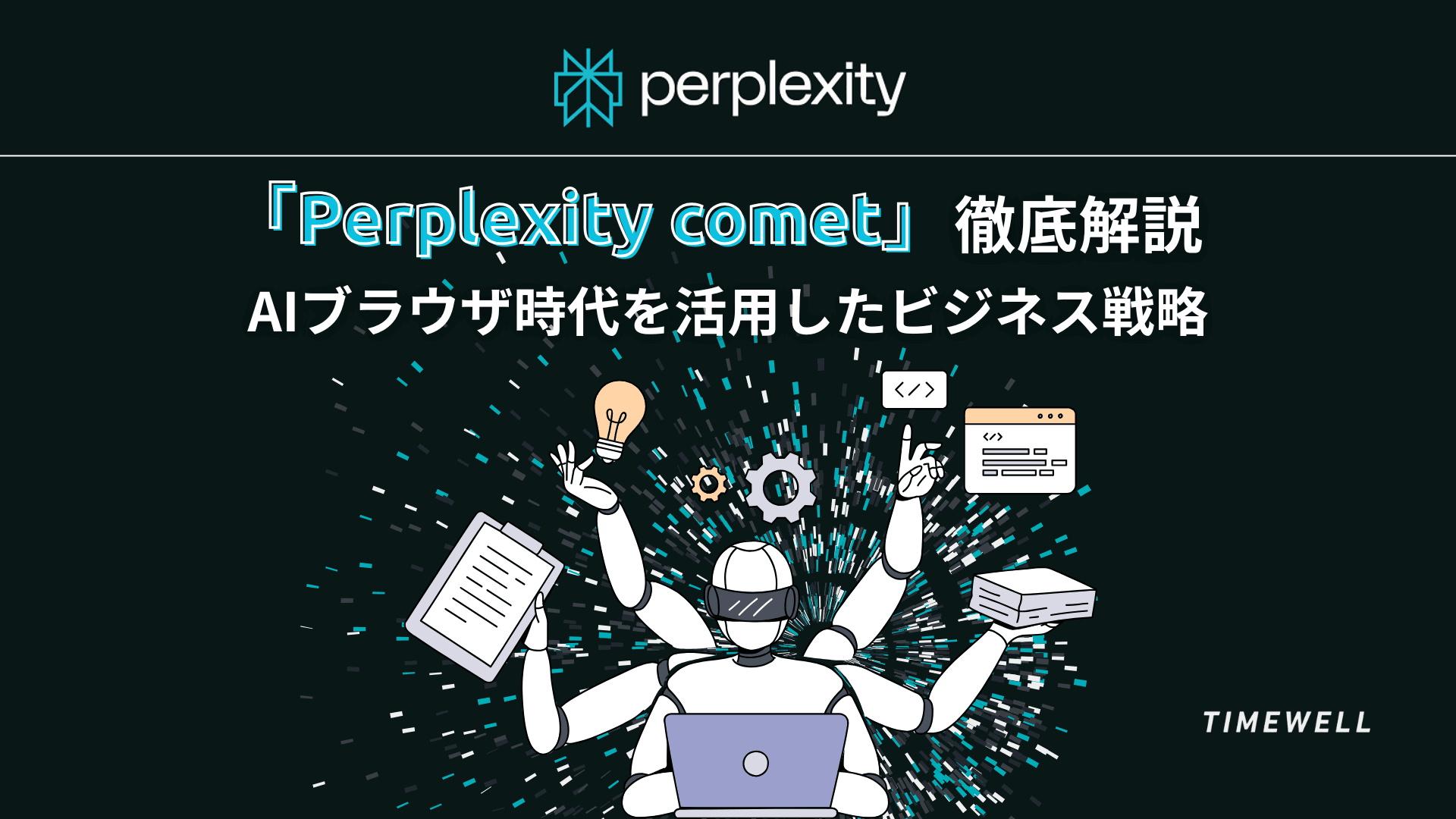
The one thing most missing from the article six months ago was Comet. There is a companion piece, the detailed report on Perplexity Comet, but I'll cover the essentials here too.
Comet is the AI browser Perplexity released. I could not confirm the rollout dates for each operating system in the company's own announcements, so I am not putting dates on them here. What matters for this article is not the dates but how the AI assistant on top of the browser behaves.
This assistant acts on your instructions inside the browser and can reach the services you have connected to it, such as Gmail and your calendar2. This is what people mean by agentic browsing. Beyond "give me the gist of this page in three lines," it can handle a chain of actions like "read this article and email a summary with key points to my manager" — the AI doing what a human would otherwise click through. The nature of the entry point itself is shifting, from the experience of typing a question into a search box to the experience of delegating work to an AI.
That said, let me be honest about the flip side of that convenience. In October 2025, security researchers published an information-leak technique in Comet called "CometJacking": a crafted URL can carry hidden instructions that steer the assistant into exfiltrating a user's data to an external server. The research team records that it submitted its findings through responsible disclosure on August 27, 2025, and that Perplexity closed the report as "Not Applicable," saying it could not identify any security impact2. When an AI operates autonomously inside a browser, the blast radius when that AI is tricked also grows. Before putting it on work devices, you will want to draw a clear line internally on how much authority to grant it.
Looking for AI training and consulting?
Learn about WARP training programs and consulting services in our materials.
Sonar and Deep Research: the latest numbers on pricing and capability
Now to the engines. Perplexity's search-specialized models are the "Sonar" family. The initial version stated flatly that they were "based on Llama 3.3 70B," but that was the information as of the Sonar announcement in January 2025; Perplexity does not officially disclose the fine details of the current base models. Here I'll leave it at "a family of models that started by tuning Meta's open models." I think writing accurately within what can be confirmed — rather than asserting and getting it wrong — is the more consistent stance for a company that also sells this kind of product.
The frequently cited figure "Sonar Pro scores an F-score of 0.858 on SimpleQA" also comes from the January 2025 announcement. The comparison targets at the time were 2024-generation models. As a factuality benchmark it was an excellent result, but trotting it out as "the latest industry-best score" in July 2026 is honestly misleading. The benchmark landscape has been rewritten many times over the past year and a half. If you use a number, pair it with its announcement date — that is the honest way to handle it.
The lineup of AI models you can select in Perplexity has also been completely replaced since the initial version. As of the official changelog in July 2026, the following models are available1.
| Provider | Model IDs listed in the changelog (as of July 2026) |
|---|---|
| OpenAI | openai/gpt-5.6-sol, openai/gpt-5.6-terra, openai/gpt-5.6-luna |
| Anthropic | anthropic/claude-opus-5 |
google/gemini-3.6-flash, google/gemini-3.5-flash-lite |
|
| xAI | xai/grok-4.5 |
| Moonshot | perplexity/kimi-k3 |
Not one of the "GPT-5.2, Claude 4.5 Sonnet, Gemini 3 Pro" lineup I wrote six months ago remains. Cleanup of older models has proceeded too: the non-Pro sonar-reasoning was removed from the API on 15 December 2025, and the early R1-1776 on 1 August 20251. Note that the table above lists only what could be confirmed in the changelog; the same page points to the model reference for the complete list, so check the official reference for everything actually available1. This speed of turnover is exactly why you cannot talk about AI tools on fixed assumptions. If you want to dig into the differences between individual models, reading the explainer on the GPT family and the explainer on Gemini alongside this will give you a more three-dimensional view.
The developer API pricing can be confirmed directly in the official documentation. The unit prices per million tokens are as follows3.
| Model | Input | Output |
|---|---|---|
| Sonar | $1 | $1 |
| Sonar Pro | $3 | $15 |
| Sonar Reasoning Pro | $2 | $8 |
| Sonar Deep Research | $2 | $8 |
On top of these token charges, Sonar, Sonar Pro, and Sonar Reasoning Pro incur a separate request search fee. It comes in three tiers — Low, Medium, and High — according to the amount of context, at $5–12 per 1,000 requests for Sonar and $6–14 per 1,000 requests for Sonar Pro and Sonar Reasoning Pro3. Miss this and the cost you estimated from token unit prices alone will diverge from reality.
Deep Research is one level more complex: the $2 input / $8 output token charges, plus $2 for citation tokens and $3 for reasoning tokens (both per million tokens), plus $5 per 1,000 queries for search3. The "roughly $0.41 per typical query" I wrote in the initial version does not hold under the current fee structure.
To get a feel for the actual amounts, let me run a model case (the token consumption below is a hypothetical assumption). Say a single Deep Research run consumes 50,000 input tokens, 200,000 reasoning tokens, 10,000 output tokens, 30,000 citation tokens, and 30 searches. That works out to $0.10 for input, $0.60 for reasoning, $0.08 for output, $0.06 for citations, and $0.15 for search — roughly $0.99 in total. If crossing hundreds of sources to produce one structured report costs about a dollar, it feels plenty cheap as a substitute for research that would take a person several hours by hand. Even so, consumption swings widely with the weight of the investigation, so be sure to measure with your own real queries before you set a budget.
Optimizing to "get cited" by Perplexity (GEO/AEO)
This is the topic with the fastest-growing search demand in 2026, yet the article six months ago did not say a word about it. Traditional SEO was a battle to "get your page to the top of the search results." GEO (Generative Engine Optimization) and AEO (Answer Engine Optimization) aim to "get your company cited in the AI's answer text itself." Because Perplexity is designed to always display its citations, how you play on this field affects revenue too.
In practice I prioritize four things. First, state the conclusion first. Since the AI tends to extract and cite a clear opening sentence, answering the question at the top of the page works. Second, embed numbers, dates, and sources in the body. Instead of "many companies have adopted it," write "as of 2026, more than 20 organizations have adopted it," and the AI can cite it verbatim. Third, get your crawler access settings right — though this calls for care. In August 2025, Cloudflare reported that Perplexity was using stealth, undeclared crawlers that evade website no-crawl directives4. Because your permission settings and the actual crawling behavior may diverge, you should look at your own access logs to see how you are actually being read. Fourth, add structure — FAQs, definitions, and clear headings. The more you shape content so the AI can extract it as an answer, the higher your odds of being cited.
In short, GEO is less an extension of SEO than "making material that is easy for AI to summarize." As the answer surfaces of ChatGPT Search, Google's AI Mode, Gemini, Grok, and others expand, the weight of this way of thinking only grows. I've summarized how Google's answer-style search changed in the explainer on Google AI Mode, and reading it side by side reveals the common threads for "landing in the answer." If you want to think through — from the design stage — how to rebuild your own site to get cited in answers, WARP's AI adoption consulting is a concrete place to get support.
Points to nail down before using it in Japanese BtoB
Finally, let me summarize the practical points for Japanese companies using this at work.
Copyright is unavoidable. On August 26, 2025, Nikkei Inc. and The Asahi Shimbun Company jointly filed suit against Perplexity in the Tokyo District Court. Per their announcement, they allege that their articles were copied and stored despite robots.txt directives prohibiting such use, that this extended to articles behind Nikkei's paywall, and that Perplexity displayed content diverging from the actual articles while citing the two companies as the source. Invoking the reproduction, adaptation, and public transmission rights under the Copyright Act as well as the Unfair Competition Prevention Act, they are seeking an injunction plus 2.2 billion yen each as a partial damages claim5. This is an ongoing matter, so I won't pass judgment on right or wrong here. But given that litigation is under way, it is safest to avoid the practice of pasting Perplexity's answers directly into your materials, and to draw a line in an internal policy on how far cited content may be reused. Always open the cited sources attached to an answer and verify against the primary information. This is a principle I harp on just as insistently with our own products.
For corporate adoption, the design of the Enterprise edition is also a decision factor. It provides the elements the information-governance team checks first: a non-training option that keeps your input data out of training, SSO, an admin console, and usage analytics. To avoid leaving "the field just uses the free version on its own" unaddressed, this is where you'll want the company to decide on a contract form.
Its usefulness for research work has also grown considerably this past year. Added features include a filter that narrows to SEC filings (July 2025), an academic search mode geared toward scholarly literature (mid-2025), and a finance_search tool that handles stock prices, financials, earnings, and analyst forecasts (May 2026)1. These are all features that speed up the first pass of market research and regulatory research. Our export-control AI agent TRAFEED is likewise designed on the premise of pinning down each country's regulations and counterparties against primary sources, so I feel it pairs well with the evolution of these research tools. That said, a general-purpose search tool and a dedicated agent responsible for compliance determinations play different roles. The principle that the final determination is made by your own export-control officer does not change.
If you want to organize the very idea of putting corporate knowledge to work with AI, the explainer on RAG and enterprise AI and the outlook for the AGI era are worth referencing. Before choosing a tool, deciding where to draw the line on "how much of your own information to let the AI read" is, though it looks like a detour, the fastest route.
Summary
It is dangerous to keep using a service that has moved this much in six months on a fixed understanding of it. Here are the key points to have in hand as of July 2026.
- Perplexity has expanded from a search app into the Comet AI browser and an enterprise API platform (valuation and funding figures are left out here because there is no official, dated confirmation).
- An agentic browser like Comet carries risks unique to autonomous operation, such as CometJacking, so design its permissions carefully.
- The selectable AI models have been completely replaced, now lining up the latest generation such as the GPT-5.6 family, Claude, Gemini, and Grok.
- The API charges a request search fee on top of token unit prices, and for Deep Research you should measure the actual amount with real queries before setting a budget.
- Going forward, the design of GEO — "getting cited in the AI's answer" — matters more than "ranking at the top."
- In Japan, the joint suit by Nikkei and Asahi is ongoing, so make the reuse scope of citations and verification against primary sources an internal rule.
As the entry point shifts from "searching" to "delegating to AI," I believe what separates winners from losers is less the choice of tool itself than the design of how you connect your own information to the AI. Companies that act here and companies where everyone just uses the free version on their own will see a wide gap open up a year from now. If you want to concretely map out an AI adoption path that fits your company, feel free to bring your questions from a consultation with WARP. Starting from a simple assessment of where you stand is perfectly fine.
Related Articles
- Perplexity Comet Complete Guide: The Real Capabilities of the AI Browser
- Google AI Mode and the Frontier of "Answer-Style Search"
- The Latest ChatGPT Features and How to Read the GPT Family
- The Real Capabilities and Best Uses of Google Gemini
- Designing to Put Your Own Data to Work with RAG and Enterprise AI
- Preparing Your Business for the AGI Era
References
Footnotes
-
Perplexity API official changelog (announcement dates for selectable models, new features, and deprecated models) https://docs.perplexity.ai/changelog/changelog ↩ ↩2 ↩3 ↩4 ↩5
-
LayerX Security, "Is Perplexity Comet Safe? LayerX Finds a Prompt Injection Attack Vector (CometJacking)" (October 4, 2025; documents that Comet's assistant acts on instructions and can reach connected services, and includes the responsible-disclosure timeline) https://layerxsecurity.com/blog/cometjacking-how-one-click-can-turn-perplexitys-comet-ai-browser-against-you/ ↩ ↩2
-
Perplexity API official pricing documentation (Sonar-family token unit prices, request search fees, and Deep Research add-on charges) https://docs.perplexity.ai/getting-started/pricing ↩ ↩2 ↩3
-
Cloudflare, "Perplexity is using stealth, undeclared crawlers to evade website no-crawl directives" (Cloudflare's own investigation, published 4 August 2025) https://blog.cloudflare.com/perplexity-is-using-stealth-undeclared-crawlers-to-evade-website-no-crawl-directives/ ↩
-
Nikkei Inc. and The Asahi Shimbun Company, "Joint Lawsuit Filed Against Generative AI Company for Copyright Infringement" (August 26, 2025; official release on the joint filing with the Tokyo District Court, including the claims and legal grounds) https://www.nikkei.co.jp/nikkeiinfo/en/news/release_en_20250826_01.pdf ↩