Hello, this is Ryuta Hamamoto from TIMEWELL.
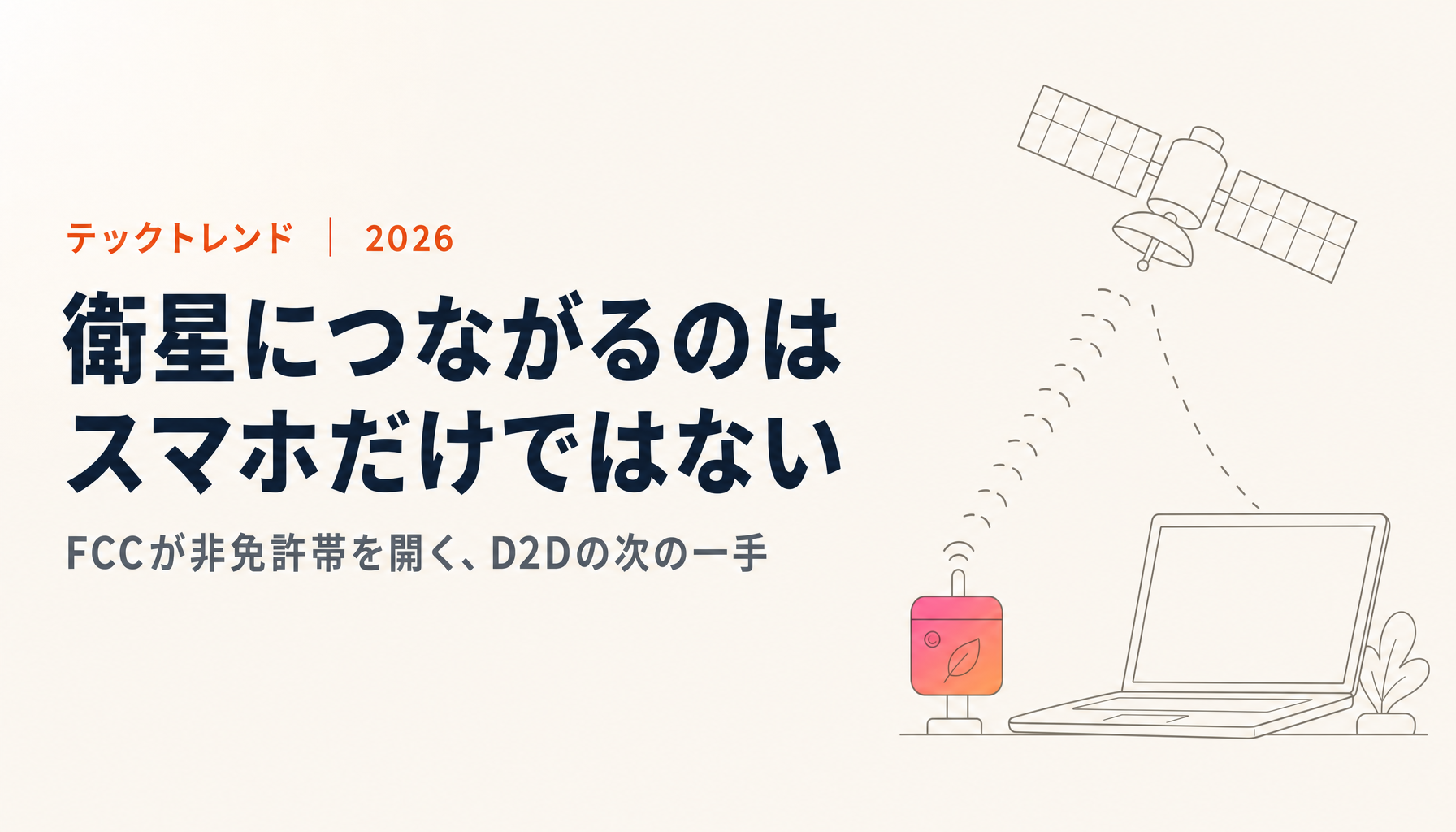
Two days ago the FCC made a decision that looks small and reaches a long way. It opened a proceeding on letting devices transmit to satellites from the same spectrum your Wi-Fi router and your Bluetooth earbuds already use1. No license required in those bands. Which means a regulator has started asking, formally, what happens when any device anyone can buy talks to space without a cell tower in the middle.
For the last few years the direct-to-device conversation has been almost entirely about phones staying connected in dead zones. That is a real achievement and I have enjoyed reading about it. But the proposal on the table is looking past that. Water level gauges. Electricity meters. Laptops. Eventually traffic signals. Machines that are not shaped like phones, routinely reaching a satellite. That is the version with the wider industrial footprint, and I think it deserves more attention than it is getting.
What the FCC adopted was a set of questions, not a decision
Let me get the record straight first. The document is FCC 26-51, titled "Unleashing Unlicensed Spectrum for Direct-to-Device," under ET Docket No. 26-169. Adopted August 6, 2026, released August 71. It is an NPRM, a Notice of Proposed Rulemaking, which in practice means the comment period is starting. I want to be blunt about this because it gets misread constantly: no rule took effect and no spectrum was opened. Comments are due 60 days after Federal Register publication, replies at 90 days. The argument has not happened yet.
The proposal splits three ways. The main event is adding Earth-to-space allocations in three bands: 902-928 MHz, 2400-2483.5 MHz and 5725-5850 MHz2. Anyone who works with radios will recognize that list immediately. In order, that is 920MHz-band IoT, 2.4 GHz Wi-Fi and Bluetooth, and 5.7 GHz Wi-Fi. The spectrum our daily life is soaked in. The three add up to 234.5 MHz, and the FCC describes it in the text as "more than 200 megahertz."
Power would stay inside the existing Part 15 technical rules, generally up to 36 dBm, which is 4 watts EIRP2. The design instinct here is to change as little as possible. Second piece: the downlink direction, space-to-Earth. That one is not proposed, only put out for comment. A single satellite illuminates an enormous footprint, so the interference math is a different animal, and the FCC's language is noticeably careful. If you see an article claiming the downlink was cleared, it is wrong.
Third piece is about the inside of spacecraft. Crewed missions increasingly run laptops and Bluetooth gear, yet whether Part 15 equipment is permitted inside a spacecraft was never actually spelled out. The NPRM proposes to clarify that it is, and asks separately about extravehicular activity and spacecraft-to-spacecraft links2. Unglamorous, and directly operational for anyone building orbital stations or in-space manufacturing.
If you want to pressure-test how well your organization tracks shifts like this before they hit your roadmap, the AI literacy assessment is a quick way to see where your team actually stands.
Take AI-driven development all the way to production
WARP is a hands-on program for teams who want more than headlines. Former enterprise DX and data strategy leads work alongside you until it runs.
Why "no license" is the part that matters
So why does opening unlicensed spectrum matter more than opening licensed spectrum? For me this is the whole story.
Licensed spectrum is spectrum a government has handed to an operator on an exclusive basis. The 2 GHz mobile band is the classic case, and you need a license to touch it. So the only entrants are carriers with balance sheets, and any new idea starts with a regulatory filing. Unlicensed spectrum works the other way. Meet the technical rules and you can use it. Wi-Fi routers, wireless microphones, garage door remotes, medical imaging equipment, all of it sits on that arrangement. The FCC describes Part 15 in this very NPRM as a sandbox for permissionless entry and experimentation1.
The gap shows up as speed. Launching a service on licensed spectrum means building a framework, obtaining a license, then building devices. Years. On unlicensed spectrum you certify the equipment and ship. Wi-Fi did not spread across the planet purely on technical merit. It spread because nobody had to wait for permission.
Now add satellites. Today's direct-to-device services work by having a satellite borrow a carrier's licensed spectrum, so the benefit lands on phones under contract with that carrier. Open the unlicensed bands and the contract stops being the precondition. A sensor manufacturer could put a satellite-capable module in its own product and sell it. That is a genuinely different structure from what exists now.
There is a price, of course. The bargain in Part 15 is that you must not cause harmful interference to licensed services and you must accept any interference you receive. Freedom in exchange for no protection. Whether that bargain survives contact with something as wide-reaching as a satellite is an open question, and I read the FCC's request for comment on licensing frameworks as an admission that it is not comfortable either.
The satellite side is largely ready
Part of why the regulatory conversation started now is that the capacity problem on the satellite side has genuinely begun to loosen. The numbers tell it faster than I can.
On July 24, 2026, SpaceX launched Starship Flight 13 from Starbase, Texas, and put 20 operational Starlink V3 satellites into orbit. It was the first Starship flight to deliver working payloads3. And the V3 design figures are on another scale. Starlink's own specifications put it at 1 Tbps downlink and 160 Gbps uplink, roughly 10x and 22x the V2 satellite4.
The more interesting detail is not raw capacity but how the traffic is handled. V2's phased arrays supported 192 downlink and 144 uplink beams. V3 supports 2,048 each way. Throughput per modem chip goes up roughly 64x, which lets the satellite shift beam data density in real time between dense cities and empty countryside4. Six 400-gigabit space lasers link the satellites to each other, and backhaul to the ground runs across Ka, E, V and W bands for 1.2 Tbps. The solar arrays are produced as a continuous blanket, cut into 19-meter segments and stitched in fours, generating about twice the power of V2. Per Starship launch, that works out to roughly 20x the capacity a Falcon 9 delivers with V2 satellites.
One correction worth making. People keep saying "V4 is next." Starlink's official material contains no generation called V4. What it does name is Starlink Mobile Gen 2, intended to deliver terrestrial-grade LTE-level speeds to unmodified cellular devices, and Starmind, an AI satellite constellation4. V3 technology is described as feeding both. The line is branching by purpose rather than marching up version numbers, which is a more accurate way to picture it.
Keep in mind these are design figures. What a user actually experiences depends on deployment density, ground stations, the antenna in the device and how many people share the beam. The 1 Tbps number is not going to appear on your speed test. For where this leads once satellites start hosting compute, I went into it separately in SpaceX's orbital data center plan.
Japan is half-started
What about Japan? Calling it "behind" would get the facts wrong.
Japan has already built the framework. In December 2024, ministerial ordinances covering non-geostationary satellite systems for mobile telephony in the 2 GHz band took effect, and on December 23 KDDI received a license for what Japan calls a mobile-fixed converged communications radio station. The Kanto Bureau of Telecommunications published it on December 255. From rulemaking to license, that moved quickly, and I think that deserves credit.
Service is ahead too. On April 23, 2026, KDDI and Okinawa Cellular launched au Starlink Direct for IoT, described as Japan's first enterprise service enabling direct communication between IoT devices and Starlink satellites6. It covers areas of Japan outside au 5G/4G LTE coverage, including territorial waters, the contiguous zone and ferry routes. The device list is electricity, gas and water meters, weather sensors, water level gauges, and animal trap systems. The use cases are remote meter reading, monitoring collection boxes, detecting wildfires and river flooding, and wildlife damage control.
Reading that list, I was quietly impressed. None of it is flashy. All of it is a real problem in Japan's mountainous interior and remote islands, and all of it was expensive for the same reason: somebody had to physically go and look. That is exactly where satellite connectivity earns its keep.
But the layer is different. What Japan authorized is D2D on licensed IMT spectrum at 2 GHz. What the FCC is examining is D2D on unlicensed spectrum. The first extends the carrier's network. The second creates an option that routes around the carrier. Under Japan's Radio Act, the 2.4 GHz and 920 MHz bands are organized as low-power data communication systems and specified low-power radio stations, and transmitting from them to a satellite is simply not contemplated. Now that the argument has opened in the US, Japan should get the "unlicensed to orbit" question on the table early. Devices are built for a world market, and a country without a framework just ends up with fewer choices.
If you are trying to turn a shift like this into an actual board-level decision about your connectivity and infrastructure strategy, that is the kind of work we do through WARP, our AI consulting practice.
The FCC put national security in the record itself
Now the darker half. I want to handle this carefully.
Concern about one company holding a large share of communications infrastructure comes up constantly, in Japan and elsewhere. It is also a topic that slides into emotion quickly, so the fairest framing I can offer is this: what did the regulator itself put on the record as a question? FCC 26-51 has that section.
Paragraphs 57 through 60 are given over to national security7. After laying out the Secure Networks Act, the Secure Equipment Act and the Covered List of equipment and services determined to pose an unacceptable risk, the FCC lines up its own questions. Would permitting satellites that transmit or receive in Part 15 bands raise national security concerns? Would the existing Part 25 space station licensing framework be sufficient? Would allowing satellite uplinks or downlinks in bands this widely used create new openings for bad actors or state-sponsored espionage? Are there devices or classes of devices that should be barred from communicating with satellites? What about equipment that already holds an authorization?
Paragraph 60 goes further. The FCC states it has recognized that Covered List entities could offer non-common-carrier service without advance Commission review if they use equipment meeting Part 15 technical criteria, then asks whether extending the rules to satellite D2D would inadvertently widen that path, and whether such entities should be explicitly excluded7. Opening a framework increases freedom and simultaneously widens the route that bypasses review. The FCC is writing about both sides deliberately.
The important thing is that none of this condemns any company or country. It is a regulator naming design gaps before they become permanent. I would read it at that distance, and I would encourage you to as well. The takeaway for a Japanese company is unglamorous and sound: do not build on a single point of dependence. I covered the dual-use structure of satellites in satellites, the military and dual-use technology, and Japan's own low-earth-orbit infrastructure push in Japan's answer to Starlink and the J-LEO subsidy.
The money moving through this space is in the FCC's record as well. More than $40 billion has flowed into the American space economy for D2D over the last 18 months. SpaceX acquired 65 MHz of D2D spectrum from EchoStar for $19.6 billion in 2025. Amazon's acquisition of Globalstar and Rocket Lab's acquisition of Iridium total close to $20 billion. Private forecasts cited by the Commission project more than $100 billion across D2D and IoT by 20341. How one company's capital structure shapes all of this is something I dug into in SpaceX's IPO and vertical integration.
What to do once "out of coverage" stops being a thing
To recap. What the FCC adopted on August 6, 2026 is a proposal, not a decision. The bands in question are Wi-Fi, Bluetooth and 920MHz, 234.5 MHz in total. The uplink is proposed at up to 4 W EIRP; the downlink is still only out for comment. Meanwhile V3 has entered service with a 1 Tbps design figure, and in Japan, IoT-to-satellite links are already running commercially. Regulation and technology are walking the same direction at different speeds.
There is probably one thing worth doing this week. Write down which parts of your business stop the moment connectivity drops. Factory sensors. Logistics trackers. Store payments. Headcount checks during a disaster. With that list in hand, you can decide instantly what to migrate first when satellite D2D gets cheap. Without it, more options will not help you move. Preparing from the shape of your own weak points beats trying to keep pace with the technology.
Personally, the part I am looking forward to is the day connectivity at sea and in the mountains is better than in town. The places nobody could justify a tower are the places that gain the most from a signal overhead. Search and rescue, shipping, island medicine. That is a straightforwardly good outcome. The homework about concentrated dependence arrived in the same delivery, though, and both belong in view.
If you want help mapping your connectivity and IoT dependencies into something your leadership team can act on, get in touch and we will start with an inventory.
Footnotes
-
Federal Communications Commission, Unleashing Unlicensed Spectrum for Direct-to-Device, Notice of Proposed Rulemaking, FCC 26-51, ET Docket No. 26-169 (Adopted August 6, 2026; Released August 7, 2026). Comments are due 60 days after Federal Register publication, replies at 90 days. The characterization of Part 15 as a sandbox for permissionless entry and experimentation, and the market figures (more than $40 billion over 18 months, SpaceX's $19.6 billion acquisition of 65 MHz of D2D spectrum from EchoStar, the Amazon-Globalstar and Rocket Lab-Iridium transactions totaling nearly $20 billion, and the Novaspace projection of more than $100 billion across D2D and IoT by 2034) all come from paragraphs 1-4 of that document. https://docs.fcc.gov/public/attachments/FCC-26-51A1.pdf ↩ ↩2 ↩3 ↩4
-
Same document, together with the FCC Fact Sheet "Unleashing Unlicensed Spectrum for Direct-to-Device — Notice of Proposed Rulemaking, ET Docket No. 26-169" (circulated draft FCC-CIRC2607-01, released July 16, 2026). The three bands (902-928 MHz, 2400-2483.5 MHz, 5725-5850 MHz), the 36 dBm (4 W) EIRP uplink proposal, the comment-only status of space-to-Earth, the clarification on Part 15 equipment inside spacecraft, and the EVA and inter-spacecraft questions are from that Fact Sheet. Note that the draft described the spectrum as "more than 225 megahertz" while the adopted version says "more than 200 megahertz." This article uses the adopted wording and states the simple sum of the three bands, 234.5 MHz. https://docs.fcc.gov/public/attachments/DOC-423135A1.pdf ↩ ↩2 ↩3
-
Starship Flight 13 launched from Starbase, Texas at 5:51 p.m. CT on July 24, 2026 and deployed 20 operational Starlink V3 satellites, with the upper stage making a soft splashdown in the Indian Ocean. SpaceX's own mission page renders its content in JavaScript and could not be retrieved as a primary source, so this description rests on press reporting. https://www.space.com/space-exploration/launches-spacecraft/spacex-starship-flight-13-starlink-v3-satellites / https://spacenews.com/spacex-gears-up-for-starship-flight-13/ ↩
-
Starlink (SpaceX) official page, "Starlink Version 3 Satellites." The 1 Tbps downlink and 160 Gbps uplink (about 10x and 22x V2), 2,048 beams each way against V2's 192 downlink and 144 uplink, roughly 64x throughput per modem chip, six 400-gigabit space lasers, quad-band Ka/E/V/W backhaul at 1.2 Tbps, solar arrays generating about twice the power of V2, roughly 20x capacity per Starship launch versus Falcon 9, and the references to "Starlink Mobile Gen 2" and "Starmind" are all from that page. These are design figures. https://www.starlink.com/updates/starlink-version-3-satellites ↩ ↩2 ↩3
-
Ministry of Internal Affairs and Communications, Kanto Bureau of Telecommunications, press release of December 25, 2024, announcing that a license for a mobile-fixed converged communications radio station using the 2 GHz band was granted to KDDI Corporation on December 23, 2024. https://www.soumu.go.jp/soutsu/kanto/press/2024/1225r1.html / Background on the framework: MIC Telecommunications Bureau, "Framework development toward the introduction of satellite direct communications" (October 23, 2024, 35th Effective Use Evaluation Subcommittee, Document 35-3). https://www.soumu.go.jp/main_content/000998738.pdf ↩
-
KDDI News Room, "A domestic first: au Starlink Direct now connects IoT" (April 23, 2026). The launch date, the scope of the "first in Japan" claim, the coverage area (areas of Japan outside au 5G/4G LTE coverage, including territorial waters, the contiguous zone and ferry routes), the supported devices (electricity, gas and water meters, weather sensors, water level gauges, animal trap systems) and the use cases (remote meter reading, collection box monitoring, wildfire and river flooding detection, wildlife damage control) are from that release. Pricing is not disclosed. https://newsroom.kddi.com/news/detail/kddi_nr-990_4444.html ↩
-
FCC 26-51, paragraphs 57-60 (National Security Issues). The explanation of the Covered List framework under the Secure and Trusted Communications Networks Act of 2019 and the Secure Equipment Act, and the questions raised about permitting satellite communications in Part 15 bands (whether the existing Part 25 framework suffices, whether new openings would be created for bad actors or state-sponsored espionage, whether certain device classes should be barred, the risk from already-authorized equipment, and whether Covered List entities could offer non-common-carrier service without advance review), are from those paragraphs. All are questions the Commission posed for comment, not conclusions about any particular entity or country. https://docs.fcc.gov/public/attachments/FCC-26-51A1.pdf ↩ ↩2